
Figures of speech are words or phrases used in a non-literal or deliberately patterned way, as in "busy as a bee" or "the wind howled all night." Most figures of speech with examples fall into six families, and the comparison family, led by simile and metaphor, is the one learners meet first in school.
What Are Figures of Speech?
A figure of speech is one named technique that bends the plain meaning of words or arranges them in a striking pattern, such as a simile, a pun, or a run of repeated openings. Figurative language is the wider term for any non-literal use of words, while each figure of speech is a single device within it, and some figures, like alliteration, change sound rather than meaning.
During the storm, the old farmhouse groaned like a tired giant, and the lights winked out one by one.
Comparison Figures of Speech With Examples
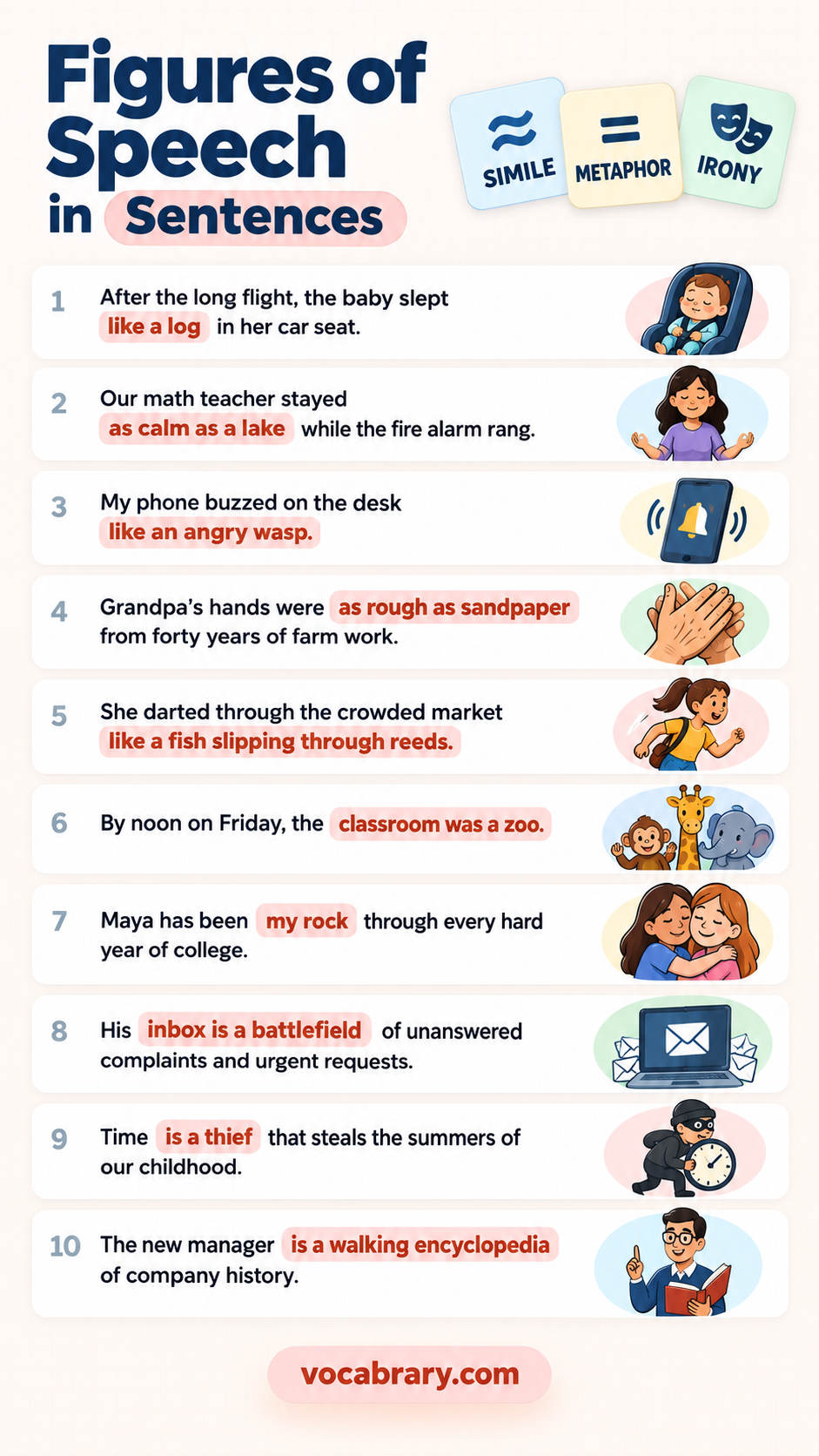
A baby sleeping like a log, a classroom that is a zoo, and a Trojan horse in an email are comparison figures of speech, each describing one thing through another thing, person, or story.
Simile Examples
A baby sleeping like a log, a teacher as calm as a lake, and a phone buzzing like an angry wasp are simile examples, since each compares two unlike nouns with like or as.
- After the long flight, the baby slept like a log in her car seat.
- Our math teacher stayed as calm as a lake while the fire alarm rang.
- My phone buzzed on the desk like an angry wasp.
- Grandpa’s hands were as rough as sandpaper from forty years of farm work.
- Were the cookies really as hard as bricks, or did you bake them too long?
- Nobody in the office moved, and the meeting room felt as quiet as a library at midnight.
- She darted through the crowded market like a fish slipping through reeds.
Metaphor Examples
Calling a classroom a zoo, a best friend a rock, and an old laptop a dinosaur turns each into a metaphor, which says one thing is another without like or as.
- By noon on Friday, the classroom was a zoo.
- Maya has been my rock through every hard year of college.
- His inbox is a battlefield of unanswered complaints and urgent requests.
- Time is a thief that steals the summers of our childhood.
- The new manager is a walking encyclopedia of company history.
- Don’t let one bad grade become a wall between you and science.
- Isn’t that old laptop a dinosaur by now?
Personification Examples
Wind howling at the windows, an alarm clock screaming at six, and an old car refusing to start give human actions to machines and weather, which is how personification works.
- The wind howled at the windows all night long.
- My alarm clock screamed at me at six this morning.
- On the coldest day of the year, the old car refused to start.
- Sunlight danced across the lake as the boat drifted toward shore.
- Why does the printer decide to quit every time a deadline arrives?
- Autumn leaves whispered secrets to the empty park benches.
- Opportunity knocked twice, but Leo never heard it.
Analogy Examples
Teachers explain a cell as a tiny factory, the heart as a pump, and learning a language as building a house, since analogy makes an unfamiliar process familiar by matching it with a known one.
- A cell works like a tiny factory, with the nucleus acting as the manager’s office.
- Just as a pump pushes water through pipes, the heart pushes blood through the veins.
- Learning a language is like building a house: skip the foundation, and the walls crack later.
- Our coach told us that a team is like a chain, only as strong as its weakest link.
- Writing code without testing it is like driving at night with the headlights off.
- Memory works like a library, where a book on the wrong shelf is nearly impossible to find.
- Isn’t saving money a bit like planting a tree, where the shade arrives years after the effort?
Extended Metaphor Examples
Life as an ocean voyage, a classroom as a garden, and Shakespeare’s world as a stage are extended metaphor examples, where one comparison continues across several linked images.
- Life is an ocean, and some years bring calm water while others bring storms that test every sail.
- Ms. Ortiz treats her classroom as a garden, watering shy students with praise until they bloom.
- My career has been a mountain climb, with steep trails early, thin air in the middle, and a wide view at the top.
- Grief was a heavy coat that Nora wore all winter and only took off when spring arrived.
- In As You Like It, Shakespeare’s Jaques calls all the world a stage, where every person has exits, entrances, and many parts to play.
- Our startup was a small boat rowing against the current, and every investor was a gust of wind at our backs.
- The debate was a chess match, with each candidate sacrificing pawns to protect the king.
Allusion Examples
The Trojan horse in an email, the Scrooge at the office party, and the Midas touch of a lucky investor are allusion examples, each pointing to a myth or novel readers already know.
- That harmless-looking email attachment was a Trojan horse that hid a virus.
- Don’t be a Scrooge; buy a ticket for the office party.
- Moving a piano up four flights of stairs was a Herculean task.
- Every stock Maya picks turns to profit, as if she has the Midas touch.
- My brother is no Einstein at math, yet he fixed the router in five minutes.
- Asking that driver to slow down is like asking Romeo to forget Juliet.
- Why does Jake keep crying wolf about being sick?
- Her ankle injury proved to be the Achilles’ heel of an otherwise perfect season.
Apostrophe Examples
Pleading with a jammed printer, greeting the moon from a balcony, and John Donne ordering Death not to be proud are apostrophe examples, where a speaker addresses someone absent or something that never answers.
- "Oh, printer, why do you hate me?" Leo groaned at the jammed machine.
- "Moon, old friend, you have watched over me since childhood," Nadia whispered from the balcony.
- "Sock, where did you go?" Sam asked the empty drawer.
- "Death, be not proud" opens one of John Donne’s Holy Sonnets.
- In Romeo and Juliet, Juliet addresses Romeo from her balcony without knowing he is hiding in the orchard, asking "wherefore art thou Romeo?"
- "Dear coffee, please work faster this morning," Omar muttered over his first cup.
- Standing at his father’s grave, Marcus said, "Dad, you would have loved today’s game."
Epithet Examples
English kings, Greek goddesses, and American presidents gave us Richard the Lionheart, grey-eyed Athena, and Honest Abe, epithet examples that attach a descriptive phrase to a name.
- King Richard I of England earned the name Richard the Lionheart for his courage in battle.
- Homer’s Odyssey greets each new morning with rosy-fingered Dawn.
- Americans still call Abraham Lincoln Honest Abe.
- A Soviet army newspaper nicknamed Margaret Thatcher the Iron Lady in 1976.
- After a sleepless night, Priya dragged herself to the exam.
- Everyone on the team calls our goalkeeper Big Hands Tom.
- In the Iliad and the Odyssey, the goddess who guides the Greek heroes is again and again called grey-eyed Athena.
Imagery Examples
Warm bread on a Sunday morning, snow crunching under boots, and a lemon’s sour sting are imagery examples, describing sight, sound, smell, taste, and touch in sensory words.
- The kitchen smelled of warm bread and melted butter on Sunday mornings.
- Every step on the path produced a crunch of fresh snow under our boots.
- Bright red poppies swayed against a gray, heavy sky.
- One bite of the lemon sent a sour sting across Mia’s tongue.
- Rough, salty wind scraped our cheeks as the ferry left the harbor.
- Did you hear the soft tick of rain on the tin roof last night?
- Inside the old barn, dust hung in golden shafts of light.
Metonymy Examples
Newspapers write that the White House announced a plan, Wall Street panicked, or Hollywood released a film, and each is metonymy, naming a thing by something closely connected to it.
- The White House announced a new climate plan on Tuesday.
- Hollywood has released three superhero films this summer.
- Ministers swear loyalty to the Crown before taking office.
- Wall Street panicked after the jobs report came out.
- Is the pen truly mightier than the sword?
- Please take your complaints to the front desk, not to the cleaning staff.
- Leo drank the whole bottle before lunch.
- Our school received a warm letter from City Hall after the park cleanup.
Synecdoche Examples
Asking for someone’s hand, counting heads before a field trip, and showing off new wheels are synecdoche examples, letting one part name the whole person or object.
- After five years together, Sam finally asked for her hand in marriage.
- The teacher counted heads before the bus left the museum.
- "Check out my new wheels," Jake said, pointing at his secondhand car.
- Every autumn, the orchard hires fifty extra hands for the harvest.
- "All hands on deck!" the captain shouted as the storm arrived.
- Were there really a thousand sails in the harbor that morning?
- Nobody in the village had a roof over their heads after the flood.
Contrast and Irony Figures of Speech
A deafening silence, a tiny giant of a puppy, and a fire station that burns to the ground are contrast and irony figures of speech, each setting two opposing meanings or outcomes against each other.
Antithesis Examples
Neil Armstrong’s small step and giant leap, Alexander Pope’s line on erring and forgiving, and the proverb about silver speech and golden silence are antithesis examples, placing opposed claims in balanced phrases.
- Neil Armstrong called his first step on the Moon in 1969 one small step for man, one giant leap for mankind.
- Speech is silver, but silence is golden.
- "To err is human; to forgive, divine," wrote Alexander Pope in An Essay on Criticism.
- Many are called, but few are chosen, says the Gospel of Matthew.
- Grandma always told us to hate the sin, not the sinner.
- We played not to win the crowd but to win the match.
- In The Prince, Machiavelli asks whether it is better to be loved than feared, or feared than loved.
- Our coach’s motto was sweat in practice, smile on game day.
Paradox Examples
"Less is more," Wordsworth’s child who is "father of the man," and a sign announcing that it is false are paradox examples, statements that sound self-contradictory yet reveal a truth.
- In architecture and in writing, less is more.
- "I know that I know nothing," Socrates is said to have admitted.
- William Wordsworth wrote that the child is father of the man in his short poem My Heart Leaps Up.
- The more you learn, the less you realize you know.
- If a sign reads this sentence is false, then the sign is true only when it is false.
- "You have to spend money to make money," the investor told her nervous partner.
- Why is it that the faster I hurry, the later I arrive?
Juxtaposition Examples
A glass mansion beside patched tents, a new stadium facing a closed library, and Charles Dickens pairing the best and worst of times are juxtaposition examples, placing unlike images side by side to sharpen both.
- A glass mansion rose beside a camp of patched tents at the edge of the city.
- Dickens opens A Tale of Two Cities by calling the age the best of times and the worst of times.
- On the same hospital floor, one family celebrated a newborn while another family grieved a loss.
- Tiny wildflowers pushed through the cracks of a burned-out car.
- Our town’s shiny new stadium overlooks a closed public library.
- At the gala, diamond necklaces glittered one street away from a soup kitchen queue.
- Isn’t it strange to see a toddler’s crayon drawing taped beside a stock market screen?
Oxymoron Examples
Jumbo shrimp, a deafening silence, and an open secret are oxymoron examples, joining two contradictory words into one phrase.
- A deafening silence followed the announcement of the test scores.
- We ordered jumbo shrimp and a plate of fries.
- Their new puppy is a tiny giant that barks at trucks.
- The kitchen on Thanksgiving morning was pure controlled chaos.
- My sister’s bittersweet farewell speech made the whole class laugh and cry.
- Is an open secret still a secret?
- Honestly, the leftover pizza is awfully good.
Hyperbole Examples
Students with backpacks that weigh a ton, parents who have said something a million times, and hallways a thousand miles long are hyperbole examples, exaggerating on purpose for emphasis or humor.
- My backpack weighs a ton today.
- We waited forever in line for the new phone.
- I’ve told you a million times to close the fridge door.
- Rosa ate enough pasta to feed an army.
- This hallway is a thousand miles long when you’re late for class.
- Nobody in the history of the world has ever been as tired as Leo on a Monday.
- Did Omar really cry a river over one lost football match?
- Ms. Lee’s handwriting is so small that ants need glasses to read it.
Understatement Examples
A hurricane called a bit breezy, a broken leg called just a scratch, and a four-hour traffic jam called a minor delay are understatement examples, making something sound smaller than it is.
- After the hurricane flattened the pier, Grandpa said it was a bit breezy.
- Jake broke his leg skiing and called it just a scratch.
- The surgeon finished a ten-hour operation and said it had been a bit of work.
- Priya scored 100 on the final and said she did all right.
- "It’s a little warm today," said the tourist in the 45-degree heat of Death Valley.
- Losing the wedding rings on the big day was slightly inconvenient.
- Our four-hour traffic jam, Dad told us, was a minor delay.
Litotes Examples
No small feat, not bad for a first try, and not exactly cheap are litotes examples, affirming an idea by denying its opposite.
- Finishing a marathon at seventy is no small feat.
- Your first cake is not bad for a first try.
- Leo is not the sharpest knife in the drawer, but he works hard.
- The hotel room was not exactly cheap.
- I wouldn’t say no to another slice of pie.
- Growing up on a farm, Dana is not unfamiliar with early mornings.
- That concert was not half bad, was it?
Situational Irony Examples
A fire station burning down, a marriage counselor filing for divorce, and O. Henry’s couple selling their treasures for useless gifts are situational irony examples, outcomes that reverse what everyone expected.
- The fire station burned to the ground while the crew was out on a call.
- A marriage counselor filed for divorce the week her book on happy couples came out.
- Thieves robbed the police station during the annual safety fair.
- Nobody expected the lifeguard to need rescuing at the staff pool party.
- Hundreds of flyers against littering blew across the parking lot.
- Why did the spelling bee champion misspell his own name on the certificate?
- In O. Henry’s The Gift of the Magi, Della sells her hair to buy a watch chain, while Jim sells his watch to buy her combs.
Verbal Irony Examples
Calling hail a perfect beach day, naming a ninety-kilo mastiff Tiny, and praising a delayed flight as speedy are verbal irony examples, where the words say the opposite of the meaning.
- Watching hail smash the tomato plants, Aunt June said, "What a perfect beach day."
- "Oh, it’s piping hot," Ben told the waiter about his cold soup.
- The Nguyens named their ninety-kilo mastiff Tiny.
- After a three-hour delay, the pilot announced, "Thank you for your patience on this speedy flight."
- "Nice parking," Sara told her brother, whose van straddled two driveways.
- "Brilliant idea," Mia said when her coworker microwaved fish in the office kitchen.
- Omar looked at his dead phone and said, "This battery lasts forever."
Sarcasm Examples
Coworkers, siblings, and schoolyard kids deliver the thank-you to a teammate who skipped every meeting, the slow clap for a dropped tray, and the "great job, Einstein," all sarcasm, verbal irony with a mocking edge.
- "Thanks for all your help," Dana told the teammate who skipped every project meeting.
- "Oh, you’re right on time," Priya said as her friend arrived an hour late.
- A waiter dropped a tray, and someone at the bar started a slow clap.
- "Wow, you’re a real genius," Leo muttered when his brother locked the keys in the car.
- "Sure, I’d love to work another weekend," Nina told her boss with a flat stare.
- Did you work yourself to exhaustion watching TV all day, Max?
- "Great job, Einstein," the older kids called after Jonah tripped over his own shoelaces.
Repetition and Parallel Figures of Speech
Churchill’s repeated "we shall fight," Lincoln’s "of the people, by the people," and "eat to live, not live to eat" are repetition figures of speech, repeating or mirroring words for rhythm.
Anaphora Examples
Speakers such as Winston Churchill and Martin Luther King Jr. built famous speeches on "we shall fight" and "I have a dream," anaphora examples that repeat the same opening words across clauses.
- In his June 1940 speech, Churchill repeated we shall fight before the seas, the beaches, the fields, the streets, and the hills.
- Martin Luther King Jr. opened line after line of his 1963 Washington speech with I have a dream.
- "Every drill counts, every sprint counts, and every minute on this field counts," the coach shouted.
- Thank you for the meals, thank you for the rides, and thank you for believing in me.
- We came to learn, we came to listen, and we came to change our town.
- Why did you leave, why didn’t you call, and why are you smiling now?
- Not today, not tomorrow, not ever will I fly with that airline again.
Epistrophe Examples
Abraham Lincoln’s "government of the people, by the people, for the people" and a family that eats together and cooks together are epistrophe examples, repeating the same words at the end of each clause.
- At Gettysburg in 1863, Abraham Lincoln spoke of government of the people, by the people, for the people.
- In First Corinthians, Paul recalls that as a boy he spoke as a child, understood as a child, and thought as a child.
- She wanted the truth, she deserved the truth, and she finally got the truth.
- There’s no rest for the team, no glory for the team, and no excuse for the team until we win.
- Mom says we eat together, we cook together, and we laugh together.
- Isn’t that what happens when you vote for change, march for change, and wait for change?
- Nobody asked for this storm, nobody planned for this storm, and nobody was ready for this storm.
Chiasmus Examples
"Eat to live, not live to eat," the witches’ "fair is foul, and foul is fair" in Macbeth, and Keats’s "beauty is truth, truth beauty" are chiasmus examples, repeating words in reverse order.
- "Eat to live, and do not live to eat," the old doctor advised.
- In Macbeth, the three witches chant that fair is foul, and foul is fair.
- Never let a fool kiss you or a kiss fool you.
- "When the going gets tough, the tough get going," the captain reminded her crew.
- Do you work to relax, or relax to work?
- My grandmother saved what she loved, and loved what she saved.
- "Beauty is truth, truth beauty" comes near the close of John Keats’s Ode on a Grecian Urn.
Asyndeton Examples
Julius Caesar’s "I came, I saw, I conquered," a coach yelling "run, pass, score," and a dawn rush for passports, tickets, and chargers are asyndeton examples, dropping the conjunctions for speed and force.
- Julius Caesar reported his quick victory at Zela in 47 BC with I came, I saw, I conquered.
- We packed passports, tickets, snacks, chargers before sunrise.
- "Run, pass, score," the coach shouted from the sideline.
- She was tired, hungry, soaked, furious by the time the bus arrived.
- In his 1961 inaugural address, John F. Kennedy promised to pay any price, bear any burden, meet any hardship.
- Why does every shampoo bottle say wash, rinse, repeat?
- "No excuses, no delays, no complaints," the manager told the new team.
Repetition Examples
Hamlet’s "words, words, words," a child begging "please, please, please," and rain that fell day after day after day are repetition examples, using the same word again and again for emphasis.
- Asked what he is reading, Hamlet replies, "Words, words, words."
- "Please, please, please let me stay up late," begged Lily.
- It was a long, long road to the championship.
- "Never, never, never give up," Coach Diaz told the team at halftime.
- The rain fell day after day after day.
- Did you check and check and check again before sending that email?
- Omar practiced the song over and over and over until his fingers ached.
Pleonasm Examples
Free gifts, a PIN number at an ATM machine, and something seen with your own eyes are pleonasm examples, adding words whose meaning the phrase already expresses.
- Our store is handing out free gifts to its first hundred customers.
- I saw the accident with my own eyes.
- Guests were asked to please RSVP by Friday.
- Let’s return back to the start of the story.
- That burning fire lit up the whole campsite.
- The end result of all that practice was a gold medal.
- Rosa forgot her PIN number at the ATM machine.
- In my personal opinion, the sequel was better than the original film.
Tautology Examples
"It is what it is," "boys will be boys," and "a deal is a deal" are tautology examples, saying the same thing twice so the statement proves nothing new.
- The coach shrugged and said, "It is what it is."
- "Boys will be boys," Grandma sighed as the twins tracked mud across the carpet.
- "Either it will rain tomorrow, or it won’t," the forecaster joked.
- Enough is enough; we’re leaving now.
- Yogi Berra famously joked that a replay of the past was déjà vu all over again.
- A win is a win, even if it’s an ugly one.
- Why argue? A deal is a deal.
Sound Figures of Speech
Peter Piper’s pickled peppers, a buzzing bee, and the hiss of a snake slithering across stones are sound figures of speech, which repeat or imitate sounds so a line stays in the listener’s memory.
Alliteration Examples
Tongue twisters like "Peter Piper picked a peck of pickled peppers," brand names like PayPal, and big brown bears at a campground are alliteration examples, repeating the first consonant sound of nearby words.
- Peter Piper picked a peck of pickled peppers.
- Big brown bears wandered through the campground at dusk.
- Freddy found five fat frogs by the fountain.
- Brands like Coca-Cola, PayPal, and Dunkin’ Donuts repeat their first sound.
- Wild winds whipped the wet washing off the clothesline.
- My daring dog dug deep in the garden.
- Did Tom take ten tickets to the concert?
- The mighty mountain made Marco nervous.
Assonance Examples
"Try to find the kite before night," "go slow over the road," and "loud crowds around the town" are assonance examples, repeating a vowel sound inside nearby words.
- Try to find the kite before night.
- The light of the fire lit up the night sky.
- Go slow over the road, Joe.
- Hear the deer near the pier.
- Please keep the sheep in the green field.
- Why did the fat cat nap on that mat?
- Loud crowds shouted out all around the town.
- Isabel feels the sea breeze as she sleeps.
Consonance Examples
Odds and ends, the pitter-patter of rain, and a black truck stuck in thick mud are consonance examples, repeating consonant sounds in the middle or at the end of words.
- Grandpa’s shed was full of odds and ends.
- The black truck got stuck in the thick mud.
- We heard the pitter-patter of rain on the roof.
- Mike likes his bike more than his old trike.
- Short and sweet, the speech ended in two minutes.
- Did the rest of the guests trust the chef?
- A dull bell fell from the tall tower.
Sibilance Examples
"She sells seashells by the seashore," a snake slithering silently, and soft silk swishing on a dance floor are sibilance examples, repeating hissing s, sh, and z sounds.
- She sells seashells by the seashore.
- A snake slithered silently across the sunny stones.
- Soft silk swished as the dancers spun.
- Waves sighed and hissed against the sand all summer.
- "Shh, stop whispering," the librarian said sternly.
- The sizzling sausages smelled delicious.
- Isn’t the hush of snow so soothing at sunset?
Onomatopoeia Examples
A buzzing bee, sizzling bacon, and the bang of a slammed door are onomatopoeia examples, words that imitate the sounds they name.
- A bee buzzed around the picnic blanket.
- Bacon sizzled in the pan while the kettle whistled.
- Bang! The door slammed shut in the wind.
- My stomach growled during the silent exam.
- The dog woofed and the cat hissed at the stranger.
- Rain drip-dripped from the gutter all night.
- Did you hear that thud upstairs?
- Tick-tock went the clock as the final minute passed.
Wordplay Figures of Speech
A baker short of dough, a lack of pies instead of a pack of lies, and racecar spelled backward are wordplay figures of speech, which play with the sound, spelling, or double meaning of words.
Pun Examples
A baker who never made enough dough, a bicycle that was two tired, and atoms that make up everything are pun examples, joking on two meanings of one word or on sound-alike words.
- The baker quit his job because he never made enough dough.
- My bicycle fell over because it was two tired.
- I used to hate facial hair, but then it grew on me.
- Why did the scarecrow win an award? He was outstanding in his field.
- When the clock got hungry, it went back four seconds.
- Our math teacher sighed that the textbook had too many problems.
- Time flies like an arrow; fruit flies like a banana.
- Don’t trust atoms, because they make up everything.
Spoonerism Examples
"A lack of pies" for "a pack of lies," "a well-boiled icicle" for "a well-oiled bicycle," and "shake a tower" for "take a shower" are spoonerism examples, swapping the first sounds of two words.
- "That’s a lack of pies," Leo blurted, meaning a pack of lies.
- The Reverend William Spooner is credited with calling a well-oiled bicycle a well-boiled icicle.
- Nervous before her speech, Ava said tease my ears instead of ease my tears.
- At the wedding, the nervous priest announced that it is kisstomary to cuss the bride.
- Instead of a crushing blow, the sports reporter said a blushing crow.
- My brother calls butterflies flutter-bys just to annoy me.
- Why did the coach tell us to shake a tower after practice?
Malapropism Examples
Mrs. Malaprop’s allegory on the banks of the Nile, a family escape goat, and very close veins for varicose veins are malapropism examples, swapping a word for a sound-alike with the wrong meaning.
- In Sheridan’s The Rivals, Mrs. Malaprop calls her niece as headstrong as an allegory on the banks of the Nile.
- "Please be more pacific about the delivery time," the customer told the courier.
- For all intensive purposes, the project is finished.
- Uncle Joe blamed the broken window on the family escape goat.
- The argument was a mute point by then.
- Tina told the doctor she had very close veins in both legs.
- "Don’t take your parents for granite," Grandpa warned.
Palindrome Examples
Racecar, "Was it a car or a cat I saw?" and "A man, a plan, a canal: Panama" are palindrome examples, reading the same letters in both directions.
- Hannah and Otto met at noon by the kayak rental.
- "Was it a car or a cat I saw?" Zoe asked as something darted past.
- On the whiteboard, Mr. Lee wrote Madam, in Eden, I’m Adam as a warm-up puzzle.
- "Step on no pets," the sign at the animal shelter joked.
- Did you know level, radar, and civic read the same backward?
- My little sister spells racecar backward every chance she gets.
- Every spelling club member memorizes a man, a plan, a canal: Panama.
Portmanteau Examples
Brunch, smog, and motel are portmanteau examples, each fusing parts of two words into one new word, as Lewis Carroll did with chortle.
- We met for brunch at eleven on Sunday.
- Thick smog covered the city all week.
- The family stopped at a roadside motel outside Tucson.
- Lewis Carroll invented chortle by blending chuckle and snort in Through the Looking-Glass.
- Priya listens to a podcast about old sitcoms on her commute.
- After the Brexit vote in 2016, the pound fell sharply.
- Who packed a spork for the camping trip?
Double Entendre Examples
Mercutio calling himself a grave man, a bakery that promises to rise early, and the headline Kids Make Nutritious Snacks are double entendre examples, phrases with two readings, one playful or dark.
- The corner bakery’s sign says its bread and its bakers both rise early every morning.
- In Romeo and Juliet, the wounded Mercutio jokes that tomorrow he will be a grave man.
- The headline Kids Make Nutritious Snacks reads as either a cooking story or a horror story.
- When the manager told the new hire to get fired up, Leo wondered whether it was praise or a warning.
- Our teacher called the class a bunch of bright sparks, and nobody knew if she meant clever or trouble.
- A travel ad promised that the airline would take you places, both on the map and in your career.
- Isn’t a salon called Curl Up and Dye a little dark for a hairdresser?
Zeugma Examples
Losing your keys and your temper, catching a train and a cold, and Pope’s Queen Anne taking counsel and tea are zeugma examples, where one verb governs two words in different senses.
- Leo lost his keys and his temper before breakfast.
- On the same rainy morning, Nina caught the early train and a bad cold.
- In The Rape of the Lock, Alexander Pope pictures Queen Anne at Hampton Court, where she takes counsel and tea by turns.
- Dickens sends Miss Bolo home in a flood of tears and a sedan chair in The Pickwick Papers.
- Mom opened the door and her heart to the lost puppy.
- She broke the school record and her ankle at the same race.
- Uncle Ray paid the bill and his respects before leaving the wake.
Diction Figures of Speech
"Passed away," "croaked," and "a round metal tool you eat soup with" are diction figures of speech, which choose softer, harsher, longer, or more casual words than the plain name.
Euphemism Examples
"Passed away" for died, "between jobs" for unemployed, and "collateral damage" for civilian deaths are euphemism examples, softening a harsh or awkward fact.
- Our old cat passed away last spring.
- Rahul has been between jobs since March.
- The company let go of forty workers in June.
- Grandpa moved into a retirement community near the lake.
- Excuse me, where is the restroom?
- Military reports described the civilian deaths as collateral damage.
- Isn’t economical with the truth just a polite way to say lying?
- Mia’s little brother is vertically challenged but fast on the court.
Dysphemism Examples
"Croak" for die, "the cattle car" for a crowded commuter train, and "a junk heap" for an old car are dysphemism examples, choosing a harsher word than the neutral one.
- Uncle Fred joked that he’ll croak before the roof gets fixed.
- Dad calls his morning commuter train the cattle car.
- My first car was a junk heap with no heater.
- Lunch at the cafeteria was mystery meat again.
- Why do you call your office the salt mine?
- Local critics called the new musical a train wreck.
- Jo refers to her math textbook as the torture manual.
Circumlocution Examples
Churchill’s "terminological inexactitude" for a lie, a cylindrical container of ground pepper, and a firing described as leaving the company’s future plans are circumlocution examples, talking around a word instead of saying it.
- Forgetting the word, Ana asked for the round metal tool you eat soup with.
- In 1906, Winston Churchill used the phrase terminological inexactitude instead of calling a claim a lie.
- Rather than say he was fired, Ben said he was no longer part of the company’s future plans.
- The mayor spoke for ten minutes about ongoing evaluation of multiple budget scenarios instead of saying no.
- "Would you mind passing me that cylindrical container of ground black pepper?" asked Theo.
- Grandpa never says he’s old; he says he has reached a certain stage in the journey of life.
- Instead of asking her crush out, Lia asked whether he ever went to places where people eat dinner together on Fridays.
Colloquialism Examples
"Gonna," "y’all," and "no worries, mate" are colloquialism examples, the casual words of everyday conversation in different English-speaking regions.
- I’m gonna grab some food after class.
- Are y’all coming to the barbecue on Saturday?
- We hung out at the mall all afternoon.
- That new video game is awesome.
- Wanna see a movie tonight?
- My brother crashed at our place after the party.
- The kids were chuffed to bits with their prizes, said the British coach.
- "No worries, mate," the Australian barista said when I spilled my coffee.
Cliché Examples
"Every cloud has a silver lining," "better late than never," and "only time will tell" are cliché examples, phrases repeated so many times that they no longer surprise anyone.
- "Every cloud has a silver lining," Mom said after my team lost the final.
- At the end of the day, the customer is always right.
- Only time will tell whether the new coach works out.
- The hero cut the wire in the nick of time.
- "Don’t judge a book by its cover," Grandpa reminded us.
- "Better late than never," Dan said as he walked in at noon.
- Why does every job ad ask for someone who will hit the ground running?
- Our farmhouse is as old as the hills.
Rhetorical Question Examples
"Who cares what the neighbors think?" "Is the sky blue?" and Shylock asking if Jews do not bleed when pricked are rhetorical question examples, questions asked for effect rather than for an answer.
- Who cares what the neighbors think?
- Is the sky blue? Of course I want pizza.
- In The Merchant of Venice, Shylock asks if you prick us, do we not bleed? to insist that Jews share every human feeling.
- What’s the rush? We have all day.
- How many times do I have to tell you to wipe your feet?
- Why would anyone skip dessert on their birthday?
- Didn’t I tell you it would rain?
Related
- Figurative Language Examples Sentences
- Imagery Example Sentences
- Analogy Examples Sentences
- Allusion Examples Sentences
FAQs
No official number of figures of speech exists, since rhetoric handbooks from ancient Greece and Rome onward have named well over a hundred of them. School courses in English teach twenty to forty, and the sentences in this collection demonstrate 46 of the most widely taught.
Figures of speech and figurative language are closely linked but not the same, because figurative language is the broad practice of using words beyond their literal sense. Each figure of speech is one named technique, and some figures, such as anaphora and alliteration, work through sound or word order rather than non-literal meaning.
The 12 main figures of speech taught in most schools are simile, metaphor, personification, hyperbole, alliteration, onomatopoeia, oxymoron, irony, pun, euphemism, metonymy, and apostrophe. No official body fixes that set, so some textbooks swap in antithesis, litotes, or synecdoche.
Five common figures of speech with examples are simile ("as calm as a lake"), metaphor ("the classroom was a zoo"), personification ("the wind howled"), hyperbole ("my backpack weighs a ton"), and onomatopoeia ("the bee buzzed"). Each one turns up in everyday speech as well as in poems and stories.
Yes, figures of speech are literary devices, but they make up only one branch of that larger group. Literary devices also name whole-story techniques such as foreshadowing, flashback, and point of view, while a figure of speech works inside a single phrase or sentence.
No, figures of speech and parts of speech are not the same, because parts of speech are grammar categories and figures of speech are stylistic techniques. Noun, verb, and adjective name the job a word does in a sentence, while simile or pun names the effect a phrase creates.
Tropes and schemes are the two classic branches of figures of speech: a trope changes the meaning of words, and a scheme changes their order or sound. Metaphor, irony, and metonymy are tropes, while anaphora, chiasmus, and alliteration are schemes.
A simile and a metaphor differ in how openly they compare, since a simile uses like or as and a metaphor states that one thing is another. "Her smile was like sunshine" is a simile, and "her smile was sunshine" is a metaphor.
Many teachers class an idiom as a figure of speech, although an idiom is really a fixed phrase whose meaning speakers learn as a whole. "Raining cats and dogs" is an idiom built on hyperbole, and "spill the beans" is an idiom built on metaphor.
A pun is a wordplay figure of speech that jokes on two meanings of one word or on two words that sound alike. "The baker quit because he never made enough dough" plays on dough as bread mix and as money.
You identify figures of speech by asking whether a phrase means exactly what its words say and whether its sounds or word order repeat in a pattern. A comparison with like or as signals a simile, a repeated opening signals anaphora, and a word that imitates a noise signals onomatopoeia.
Writers use figures of speech to make a description vivid, an argument memorable, or a joke funnier than a literal sentence would allow. Readers remember "I came, I saw, I conquered" far longer than a plain report that Caesar won a fast battle.
Antithesis, oxymoron, and paradox all use opposites, but they differ in scale. Antithesis balances two opposed claims in parallel clauses, an oxymoron joins two contradictory words such as "deafening silence," and a paradox makes a whole statement that sounds self-contradictory, such as "less is more."

Leave a Comment