
A transitive verb is a verb that requires a direct object to complete its meaning, as in she baked a cake. Whether a verb is transitive depends on the clause it appears in, because bake has an object in she baked a cake but none in she baked all morning. For a speaker, that flexibility means the same verb is checked each time by asking what or whom. Transitive verb example sentences apply that question to bake, give, and name in turn.
What Is a Transitive Verb?
A transitive verb is a verb whose meaning is incomplete until an object names the person or thing it affects or involves. It differs from an intransitive verb, which makes a complete statement without any object.
Subject + transitive verb + direct object
The mechanic repaired the engine before lunch.
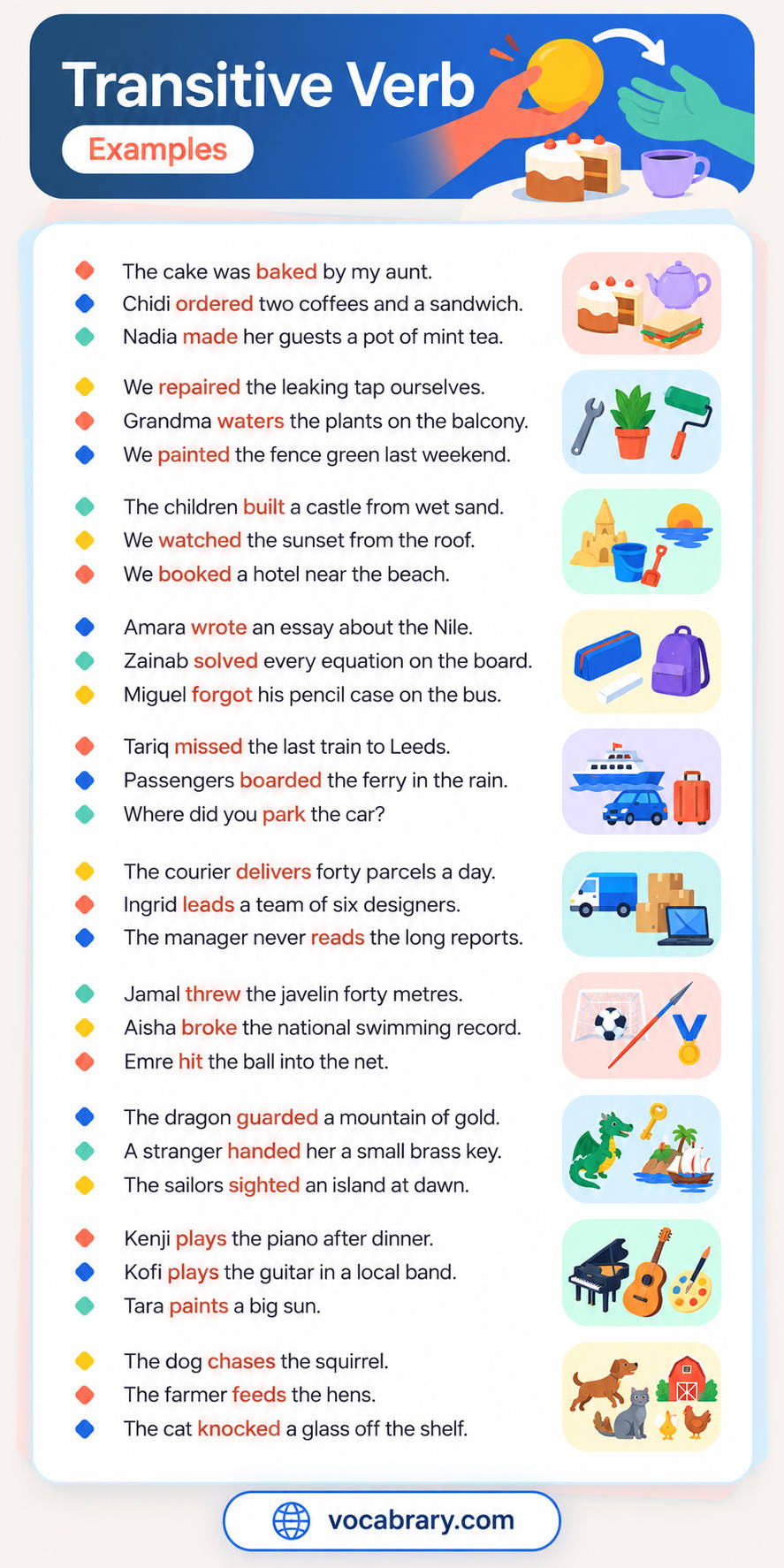
Common Transitive Verb Example Sentences
A baker who kneads dough, a student who writes an essay, and a driver who parks a van each act on something. The verb in every sentence takes a direct object that completes its meaning.
- The baker kneads the dough for ten minutes before sunrise.
- Amara wrote an essay about the Nile.
- Our neighbour parks his van outside the bakery every night.
- Diego kicked the ball over the fence.
- The committee approved the new budget on Tuesday.
- I bought a scarf at the market in Marrakech.
- Priya carries her camera everywhere, even on short walks.
- The storm destroyed three old barns.
- Kenji plays the piano after dinner.
- A young engineer designed the bridge.
- Fatima opened the window to let in the breeze.
- The librarian stamps each book before it leaves the desk.
- Hassan drives a taxi in Cairo.
- The children built a castle from wet sand.
- My grandmother grows tomatoes behind the house.
- Lena found her keys under the sofa.
- The council repaired the road after the flood.
- Tomas cooks dinner for his whole family on Sundays.
- A cold wind shook the windows all night.
- Ines admires her older sister for her patience.
- The pilot landed the plane in thick fog.
- They sell fresh bread at six o’clock.
- Our team won the final in extra time.
- Mei solved the puzzle in under a minute.
- Omar painted the garden gate on Saturday.
Sentence Patterns by Number of Objects
The three standard patterns of a transitive verb are one object, two objects, or an object followed by a complement that describes or renames it. A tailor sewing a jacket, a teacher giving a student a book, and a jury finding a man guilty show the three.
| Pattern | Structure | Example sentence |
|---|---|---|
| Monotransitive | Subject + verb + direct object | The tailor sewed a jacket. |
| Ditransitive | Subject + verb + indirect object + direct object | The teacher gave Sofia a book. |
| Complex-transitive | Subject + verb + direct object + object complement | The jury found the man guilty. |
Examples of Monotransitive Verbs With One Object
A monotransitive verb takes one direct object and no other object, as when a tailor sews a jacket or a pilot flies a plane. Sew and fly are typical verbs in this group.
- The tailor sewed a jacket for the wedding.
- A pilot from Lagos flies a small plane over the delta.
- Rosa lost her umbrella on the night bus.
- The farmer sells eggs at the roadside stall.
- Ravi cleaned the garage on Sunday morning.
- Her cousin teaches physics at a school in Nairobi.
- The detective questioned the witness for an hour.
- We watched the sunset from the roof.
- Aiko folded the laundry while the rice cooked.
- The goalkeeper caught the ball with one hand.
- Our neighbours planted an apple tree last spring.
- The mayor opened the new library in June.
- Samir fixed the bicycle chain with a small spanner.
- A sudden noise woke the baby.
- Chidi ordered two coffees and a sandwich.
- The museum displays ancient coins from Persia.
- Olga carried the heavy suitcase up three flights of stairs.
- The students finished their projects before the deadline.
- A thief took the painting from the gallery wall.
- Dalia brushes her teeth twice a day.
Ditransitive Verb Sentences With Two Objects
A ditransitive verb takes an indirect object, the receiver, followed by a direct object, the item that is given or told. Give, send, show, and tell are the standard cases, as in Hana gave her cousin a watch.
Sentences With Give and Send
A watch for a birthday, a postcard from Lisbon, and a map of the old town all go to a receiver. In each sentence with give, send, or show, the receiver comes first and the item second.
- Hana gave her cousin a watch for his birthday.
- Arjun sent his grandmother a postcard from Lisbon.
- The estate agent showed us the flat on the third floor.
- Mateo handed the waiter his empty glass.
- Our teacher gave every student a copy of the poem.
- Zara sent her landlord a message about the leaking tap.
- The guide showed the visitors a map of the old town.
- My uncle lends neighbours his ladder whenever they ask.
- Ingrid passed the driver the exact fare.
- The bank sent Mr Hughes a letter about his account.
- Leo showed his mother the drawing he made at school.
Tell and Teach in Sentences With Two Objects
A story about a lion, the rules of chess, and a job at a garage are shared in words or offered as an opportunity. Tell, teach, and offer put the person who benefits before the item.
- Grandpa told the children a story about a lion.
- Kwame taught his sister the rules of chess.
- The manager offered Tariq a job at the garage.
- Mina told her boss the truth about the delay.
- A retired chef teaches young cooks the secrets of pastry.
- The shop offers new customers a free sample.
- Ayesha promised her brother a ride on the new bicycle.
- The coach told the players the plan for the final.
- Sofia wrote her pen friend a long letter in French.
- The company owes its suppliers a large payment.
- The council offered residents a refund for the missed collection.
- My neighbour taught me the names of the birds in her garden.
Sentences With Buy and Make for Someone
A new coat, a pot of mint tea, and a Sunday dinner are bought or prepared for another person, and the paraphrase with a preposition uses for, not to. Buy, make, and cook all follow that pattern.
- Yusuf bought his daughter a new coat for winter.
- Nadia made her guests a pot of mint tea.
- My father cooks the whole family a big dinner every Sunday.
- Camila found her brother a cheap flat near the station.
- Thandi poured everyone a glass of orange juice.
- The baker saved Mrs Lopez a loaf of rye bread.
- Jonas built his niece a small wooden boat.
- Wei cooked his roommates a spicy noodle soup.
- Can you get me a glass of water, please?
- Samir fetched his grandfather a blanket from the cupboard.
- The tailor made the bride a silk dress.
Complex-Transitive Verb Sentences With an Object Complement
A complex-transitive verb takes a direct object and then a complement, an adjective or noun that describes or renames that object. Call, make, find, name, and paint are the standard cases, as in they called the puppy Biscuit.
Call and Name Sentences With a Noun Complement
A puppy called Biscuit, a baby named Leo, and a club member elected president each receive a name or title after the verb. The complement is a noun that renames the object.
- They called the new puppy Biscuit after a cartoon dog.
- Mei and Tom named their baby Leo.
- The club elected Dalia president last Friday.
- The council appointed Ravi head of the planning office.
- Critics named the film the best of the decade.
- My classmates call me Zee because of my initials.
- The company made Hana a manager after two years.
- Voters chose Ms Adeyemi mayor by a wide margin.
- The king crowned his son emperor in a grand ceremony.
- Everyone considers Ingrid the leader of the group.
Make and Find Sentences With an Adjective Complement
Neighbours who make Elena angry, software found confusing, and a door kept open each pair the object with an adjective that describes it. The adjective belongs to the object, not to the verb.
- The noisy neighbours made Elena angry.
- I find the new software confusing.
- Please keep the door open for the delivery.
- The long walk left the hikers exhausted.
- Jonas found the book boring after the first chapter.
- The frost turned the lawn white overnight.
- Her jokes keep everyone relaxed during long meetings.
- We painted the fence green last weekend.
- The loud music drove my grandfather crazy.
- Ana considered the offer fair and accepted it at once.
- The jury found the defendant innocent.
- Please leave the windows closed during the storm.
Test Sentences With What and Whom After the Verb
A verb is transitive when asking the question what or whom after it produces an answer in the sentence. Opened what, ate what, and met whom all give an answer, so open, eat, and meet are transitive there.
- Mina opened the box. Opened what? The box.
- Sana ate a mango after practice. Ate what? A mango.
- Whom did Leo meet at the station? He met his old teacher.
- Omar called his sister. Called whom? His sister.
- The students solved the problem. Solved what? The problem.
- What did Zara buy at the market? She bought a blue basket.
- The nurse helped an elderly patient. Helped whom? An elderly patient.
- Kenji heard a strange noise upstairs. Heard what? A strange noise.
- The gardener trimmed the hedge. Trimmed what? The hedge.
- Whom did the committee invite to the opening? It invited a famous chef.
- Bruno forgot his password. Forgot what? His password.
- The fox chased a rabbit. Chased what? A rabbit.
- Whom does Priya admire? She admires her aunt.
- Lucia lit two candles. Lit what? Two candles.
Verb and Object Order in Sentences
In a statement, a transitive verb stands between the subject and its object, so the pattern is subject, verb, object. A baker cutting bread and a teacher grading papers keep that order.
Direct Object Sentences With Adverbs After the Object
The direct object follows the verb, and an adverb or a phrase of manner or time is placed after the object in this group. A baker who cuts bread carefully and a student who reads the instructions slowly show this order.
- The baker cuts the bread carefully.
- Tariq closed the gate quietly so that he would not wake anyone.
- The teacher grades the papers on Friday evenings.
- A young woman pushed the stroller along the river path.
- The mechanic checked the brakes twice.
- My brother eats breakfast at seven o’clock.
- Wei read the instructions slowly before he started the machine.
- The officer stamped the passport without a word.
Object Pronoun Sentences With Him and Her
When the object is a pronoun, it takes the object form: me, you, him, her, it, us, or them. A mother who called him and a friend who thanked me both use the object forms.
- Mum called him an hour ago.
- I saw her at the bus stop yesterday.
- The coach praised us after the match.
- Nobody invited them to the party.
- Ayesha thanked me for the lift.
- The teacher asked you a difficult question.
- We found it under the stairs.
- The waiter recognised him from last week.
Phrasal Verb Sentences With Separable Particles
Many phrasal verbs are transitive, and a noun object of a separable phrasal verb comes before or after the particle, as in turn off the light and turn the light off. With such a verb, a pronoun object always comes between the verb and the particle.
- Amir turned off the light before leaving the room.
- Hana turned the radio off during dinner.
- She picked up the phone on the second ring.
- Sofia picked it up at once.
- The mechanic took out the old filter.
- Jamal put his jacket on and stepped outside.
- Please fill in the form with a black pen.
- The council set up a new recycling centre.
- Lucia threw it away after the match.
- They called off the picnic because of rain.
Negative Sentences With Transitive Verbs
A negative sentence keeps the object and adds not, never, or a negative subject such as no one. A vase that was not broken, a manager who never reads reports, and a phone nobody answered all keep their objects.
- She did not break the vase.
- They don’t sell shoes in that shop.
- No one saw the thief enter the building.
- He never eats meat or fish, even at celebrations.
- Nobody answered the phone at the front desk.
- I have not seen the new film yet.
- The chef will not change the recipe.
- Kofi doesn’t drink coffee after noon.
- The manager never reads the long reports.
- Nadia did not tell anyone the secret.
- We couldn’t find the entrance to the museum.
- The company has not paid its suppliers this month.
- My parents don’t own a car.
- Neither of them wanted the last slice of cake.
Question Sentences With Do and Did
A question with a transitive verb uses do, does, or did when no other helping verb is present, unless the question word is the subject. The object either stays after the verb or becomes the question word, as in what did you buy, did Karim finish the report, and who wrote this letter.
- What did you buy at the market?
- Did Karim finish the report before the meeting?
- Who wrote this long letter to the newspaper?
- Whom did the committee elect as its new chairperson?
- Which dress did she choose for the party?
- Where did you park the car?
- Have you seen my glasses anywhere in the kitchen?
- Does your sister teach French at the language school?
- Can you lend me a pen?
- Why did the manager cancel the meeting?
- Who broke the window in the kitchen last night?
- Will the council repair the bridge this year?
- Did Elena bring the tickets for the concert?
- How much did the ticket cost you?
Passive Sentences From Transitive Verbs
Most transitive verbs form a passive by turning the object of the active sentence into the subject of the passive one. A window broken by a stone and a cake baked by an aunt show the change.
Passive Sentences With One Object
In a passive sentence the former object comes first, a form of be follows, and the main verb is a past participle. The doer is named after by, or it is left out.
- The window was broken by a stone.
- The cake was baked by my aunt.
- The package will be delivered tomorrow morning.
- Thousands of tickets were sold within an hour.
- The old bridge is being repaired this month.
- The thief had been seen near the station.
- Several classrooms were painted over the summer.
- The winner will be announced on Friday.
Passive Sentences With Two Objects and Complements
A ditransitive verb such as give forms two passives, one with the receiver first and one with the item first. A complex-transitive verb keeps its complement, as in the room was painted blue.
- Sofia was given a medal for her bravery.
- A medal was given to Sofia by the mayor.
- The students were shown a short film about volcanoes.
- The room was painted blue last week.
- He was called a genius by his teachers.
- The youngest player was named captain by the coach.
- I was told the shop closes at nine.
- The prisoner was found guilty after a short trial.
Transitive Verbs in Reported Speech Sentences
Reported speech repeats what someone said, and the transitive verb keeps its object. After a past reporting verb, the tense moves one step back when the reported event is no longer current. Lost wallets, finished reports, and new laptops appear in the reported clause.
- Omar said that he had lost his wallet.
- She told me she had finished the report.
- The manager said the company would hire two new engineers.
- Lena explained that she needed a new laptop.
- Hassan announced that he had sold his old bicycle.
- The doctor told him to take the tablets after meals.
- My aunt promised that she would bring the cake.
- The teacher asked whether we had done our homework.
- Priya mentioned that she had met the mayor.
- The guide warned the tourists that the path was slippery.
Verbs Used With and Without an Object in Sentences
Read, write, eat, and run belong to both classes. Ruth, who reads a novel, and her brother, who reads quietly, use the same verb, but only the first sentence has a direct object.
Read and Write With and Without an Object
Read, write, eat, sing, and cook take an object when the thing read, written, eaten, sung, or cooked is named and take none when only the activity is stated. Ruth reading a novel and her brother reading in the corner show both patterns.
- Ruth reads a novel every week.
- Her brother reads quietly in the corner.
- Chidi writes letters to his grandmother.
- My daughter is learning to write.
- The children ate lunch under the tree.
- We ate early because the train left at seven.
- Tomas sings old folk songs at family parties.
- The choir sings every Thursday in the old church.
- Lucia cooked a lentil soup for the guests.
- Lucia cooks better than any of her friends.
Run and Open With and Without an Object
Run a company and run along the river share a verb but not a pattern, because the first has a direct object and the second has only a prepositional phrase. Drive, play, and open work the same way.
- Ms Okafor runs a company with forty staff.
- Dan runs along the river every morning.
- Bruno drives a delivery van for a bakery.
- Mariam drives to the coast every August.
- The twins play chess on Saturday afternoons.
- The twins play in the garden until dusk.
- Kofi plays the guitar in a local band.
- The shop opens a second branch next spring.
- The shop opens at nine on weekdays.
Household Chore Sentences With Sweep and Fold
A mother who sweeps the floor, a boy who boils water, and a father who folds the washing all do household work. Each verb in this group takes an object found around the house.
- Mum sweeps the kitchen floor every morning.
- My father folds the washing on Sunday evenings.
- Rahul boiled water for the tea.
- The cat knocked a glass off the shelf.
- Grandma waters the plants on the balcony.
- Jamal hung the picture above the fireplace.
- We repaired the leaking tap ourselves.
- Dalia cleans the windows before every holiday.
- My brother burned the toast again.
- The family painted the hallway cream.
School Sentences With Mark and Solve
A teacher who marks essays, a student who solves equations, and a librarian who lends books all use transitive verbs. The object in each sentence names something found in a classroom or a school library.
- Mr Haddad marks the essays over the weekend.
- Zainab solved every equation on the board.
- The librarian lends novels to the younger pupils.
- Our class planted sunflowers beside the football pitch.
- Miguel forgot his pencil case on the bus.
- The headteacher announced the winners at assembly.
- Students submit their projects through the school website.
- The art teacher hung the paintings in the corridor.
- Anna borrowed a dictionary from the library.
- Pupils wear blue jumpers in winter.
Sentences About Work With Sign and Deliver
A manager who signs contracts, a nurse who checks a chart, and a courier who delivers parcels perform tasks with objects. Each verb in this group takes an object found in a workplace.
- The manager signs the contracts on Monday mornings.
- A nurse checked the patient’s chart every hour.
- The courier delivers forty parcels a day.
- Ingrid leads a team of six designers.
- The accountant filed the tax returns before the deadline.
- Our supplier ships fresh fruit twice a week.
- Nikolai installed the new printer on the second floor.
- The receptionist greets every visitor with a smile.
- The engineer tested the bridge cables on Thursday.
- She sent the client an updated quote.
Travel Sentences With Book and Miss
A traveller who boards a train, a family that books a hotel, and a driver who crosses a border all take an action on a travel item. The objects in this group are tickets, bags, and routes.
- We booked a hotel near the beach.
- Tariq missed the last train to Leeds.
- The guard checked our tickets at the gate.
- Sofia packed a small bag for the weekend trip.
- The driver crossed the border at dawn.
- Passengers boarded the ferry in the rain.
- Jun photographed the temple from the hilltop.
- The airline lost my suitcase in Frankfurt.
- We took the night bus to Marrakech.
- The tourists visited three museums in one day.
Pass and Announce in News Report Sentences
A government that passes a law, a company that announces a profit, and floods that damage homes appear in daily reports. These verbs take objects such as laws, figures, and buildings.
- Parliament passed the new climate law on Wednesday.
- The company announced record profits for the year.
- Floods damaged hundreds of homes along the coast.
- Police arrested two men near the harbour.
- The central bank raised interest rates again.
- Scientists discovered a new species of frog.
- The mayor opened a new bridge over the river.
- Voters rejected the plan to close the library.
- Rescue teams found three missing hikers.
- The airline cancelled all flights to Oslo.
Draw and Stir in Story Sentences
A knight who draws a sword, a witch who stirs a potion, and a child who finds a map act on objects in fairy tales and adventure stories. Each verb in this group takes an object found in a story.
- The knight drew his sword at the castle gate.
- A witch stirred the potion until it turned silver.
- Elias found an old map behind the bookshelf.
- The dragon guarded a mountain of gold.
- Maya opened the letter with trembling fingers.
- The sailors sighted an island at dawn.
- A stranger handed her a small brass key.
- The wolf followed the girl through the forest.
- Prince Anton crossed the frozen river.
- The ghost moved the chair across the room.
Score and Break in Sports Sentences
A striker who scores a goal, a swimmer who breaks a record, and a coach who changes a plan act on objects in competitive play. The verbs in this group describe moves, results, and decisions.
- The striker scored a goal in the last minute.
- Aisha broke the national swimming record.
- The coach changed the plan at half time.
- Jamal threw the javelin forty metres.
- The goalkeeper saved a penalty in the final minute.
- Our team lost the match by two points.
- The cyclist climbed the steep hill without stopping.
- The referee blew the whistle twice.
- Emre hit the ball into the net.
- The club signed a promising young defender.
Sentences About Health With Treat and Take
A doctor who treats an infection, a patient who takes tablets, and a nurse who cleans a wound use transitive verbs in medical care. The objects in this group are treatments, symptoms, and body parts.
- The doctor treated the infection with antibiotics.
- Rita takes her tablets after breakfast.
- The nurse cleaned the wound carefully.
- Grandpa broke his wrist on the ice.
- The physiotherapist stretched my injured leg.
- She checks her blood pressure every morning.
- The pharmacist filled the prescription in ten minutes.
- Malik hurt his back while lifting a sofa.
- Regular exercise reduces the risk of heart disease.
- The surgeon removed the stitches on Friday.
Transitive Verb Example Sentences for Kids
Young learners meet transitive verbs through short actions such as kicking a ball, drinking milk, and drawing a cat. Each verb in this group is followed by an object that a child is able to name.
- I kick the ball.
- Sam drinks milk every morning.
- Lily draws a cat.
- The dog chases the squirrel.
- Mum cuts the cake.
- We eat apples at lunch.
- Ben wears a red hat.
- The baby holds a toy.
- Tara paints a big sun.
- Dad reads me a story.
- My sister likes pizza.
- The farmer feeds the hens.
Sentences for Students With Clause Objects and Complements
Exam-level sentences place a transitive verb in a longer clause with a noun phrase object, a clause object, or a complement. Writers who analyse data, estimate a cost, or consider a novel use these patterns.
- The author uses vivid imagery to describe the storm.
- Researchers analysed data from over two thousand participants.
- The government introduced a policy to reduce plastic waste.
- The essay presents a strong argument for renewable energy.
- Critics consider the novel a masterpiece of modern fiction.
- The experiment produced results that surprised the team.
- Economists estimate that the project will cost billions.
- The poet compares a river to the passage of time.
- Historians describe the treaty as a turning point in the war.
- The committee rejected the proposal after a lengthy debate.
- This chapter explains how tides form.
- The study found the new method effective.
Short Paragraphs With Transitive Verbs
Short paragraphs show transitive verbs in connected writing. A morning in a shop, a week on a building site, a trip to a market, a found wallet, and a winter of training each use six or more.
Nadia opened the shop at eight. She switched on the lights, counted the cash, and arranged the fresh bread in the window. A customer bought two loaves and thanked her. By noon she sold every roll on the shelf.
The builders dug a deep trench on Monday. They laid the pipes on Tuesday and filled the trench by Wednesday. The foreman inspected the work and signed the report. On Friday the crew cleaned the site and returned the tools.
Kofi visited the market with his grandmother. She chose ripe tomatoes, weighed a bag of rice, and paid the seller. Kofi carried the heavy basket home. After lunch they cooked a stew and shared it with the neighbours.
A young girl found a wallet on the pavement. She picked it up and carried it to the police station. The officer thanked her and called the owner. The owner rewarded her with a book.
The team followed a hard plan all winter. The coach changed the tactics, the captain led the warm-ups, and the players learned new routines. In May they won the cup and lifted the trophy.
Transitive and Intransitive Sentences Side by Side
A transitive verb and an intransitive verb differ in whether an object follows. The sentences she opened the door and the door opened use the same verb open in both patterns.
| Feature | Transitive verb | Intransitive verb |
|---|---|---|
| Direct object | The verb takes one. | The verb takes none. |
| Test of what or whom | The question gets an answer. | The question gets no answer. |
| Passive voice | The verb forms a passive. | The verb forms no direct passive. |
| Example with a verb | She opened the door. | The door opened. |
| Example with a different verb | Mina bought a ticket. | Mina arrived late. |
FAQs
Q1. How do you identify a transitive verb in a sentence?
You identify a transitive verb by asking the question what or whom after the verb. In Mina opened the box, the question opened what gets the answer the box, so open is transitive. In Mina arrived late, arrived what gets no answer, so arrive is intransitive there.
Q2. What is the difference between a transitive verb and an intransitive verb?
A transitive verb takes a direct object, while an intransitive verb makes a complete statement without one. In she wrote a letter, the noun letter completes wrote, and in she slept, no word completes slept. Further intransitive verb example sentences show the second pattern.
Q3. What is a ditransitive verb?
A ditransitive verb is a verb that takes two objects, an indirect object that names the receiver and a direct object that names the item. In Hana gave her cousin a watch, her cousin is the indirect object and a watch is the direct object. Give, send, show, tell, and teach are the best-known cases.
Q4. What is a complex-transitive verb?
A complex-transitive verb is a verb that takes a direct object followed by an object complement. In the jury found the man guilty, the man is the object and guilty is the complement that describes him. Call, make, find, name, and consider follow this pattern.
Q5. Can a verb be both transitive and intransitive?
Many English verbs are both transitive and intransitive, depending on whether an object follows them. Read is transitive in Ruth reads a novel and intransitive in Ruth reads quietly. Write, eat, sing, drive, play, and run work the same way.
Q6. Do transitive verbs have a passive voice?
Most transitive verbs have a passive voice, because the object of the active sentence becomes the subject of the passive one. The baker made the bread becomes the bread was made by the baker. A few transitive verbs, such as resemble and lack, are exceptions that form no passive.
Q7. Is enjoy a transitive verb?
Enjoy is a transitive verb, because it is followed by an object such as music, the trip, or herself. A sentence that ends after enjoy, such as She enjoys., is incomplete. The correct form is She enjoys music.
Q8. What are some examples of transitive verbs?
Common transitive verbs include buy, build, carry, find, make, open, read, send, and write. Each one is followed by a noun or pronoun that completes its meaning, as in Priya carries her camera. Many more appear in the first group of this page.
Q9. What is the difference between a direct object and an indirect object?
A direct object names the person or thing that receives the action, while an indirect object names the person who receives the direct object. In Arjun sent his grandmother a postcard, a postcard is direct and his grandmother is indirect. The indirect object is rewritten with to or for in another pattern, as in sent a postcard to his grandmother.
Q10. Is be a transitive verb?
The verb be is not a transitive verb, because it joins the subject to a complement and takes no direct object. In Fatima is a pharmacist, the noun pharmacist renames Fatima instead of receiving an action. Full lessons on this pattern are in linking verb example sentences.
Q11. Are phrasal verbs transitive?
Many phrasal verbs are transitive, and a noun object of a separable phrasal verb comes before or after the particle. Turn off the light and turn the light off are both correct, while a pronoun object must come between the two parts, as in turn it off. Some phrasal verbs, such as break down and come in, are intransitive.
Q12. How is a transitive verb different from an action verb?
A transitive verb is defined by its object, while an action verb is defined by its meaning, so the two classes overlap without being identical. The mechanic repaired the engine contains a verb that is both. Own and love are stative verbs that are also transitive, and they name states, as more stative verb example sentences show. For action meaning, see action verb example sentences.

Leave a Comment