
A regular verb is a verb that forms its past tense and past participle by adding -ed to the base form, as in she walked to the station. These regular verb example sentences pair everyday verbs such as play, talk, and cook with the -ed ending across different spelling patterns.
What Is a Regular Verb?
A regular verb adds -ed, -d, or -ied to its base form to make both the past tense and the past participle, so the two forms always match. An irregular verb breaks that rule: go becomes went and gone, and no -ed ending is involved.
Base form + -ed = past tense and past participle
Fatima cooked a three-course meal before the guests arrived.
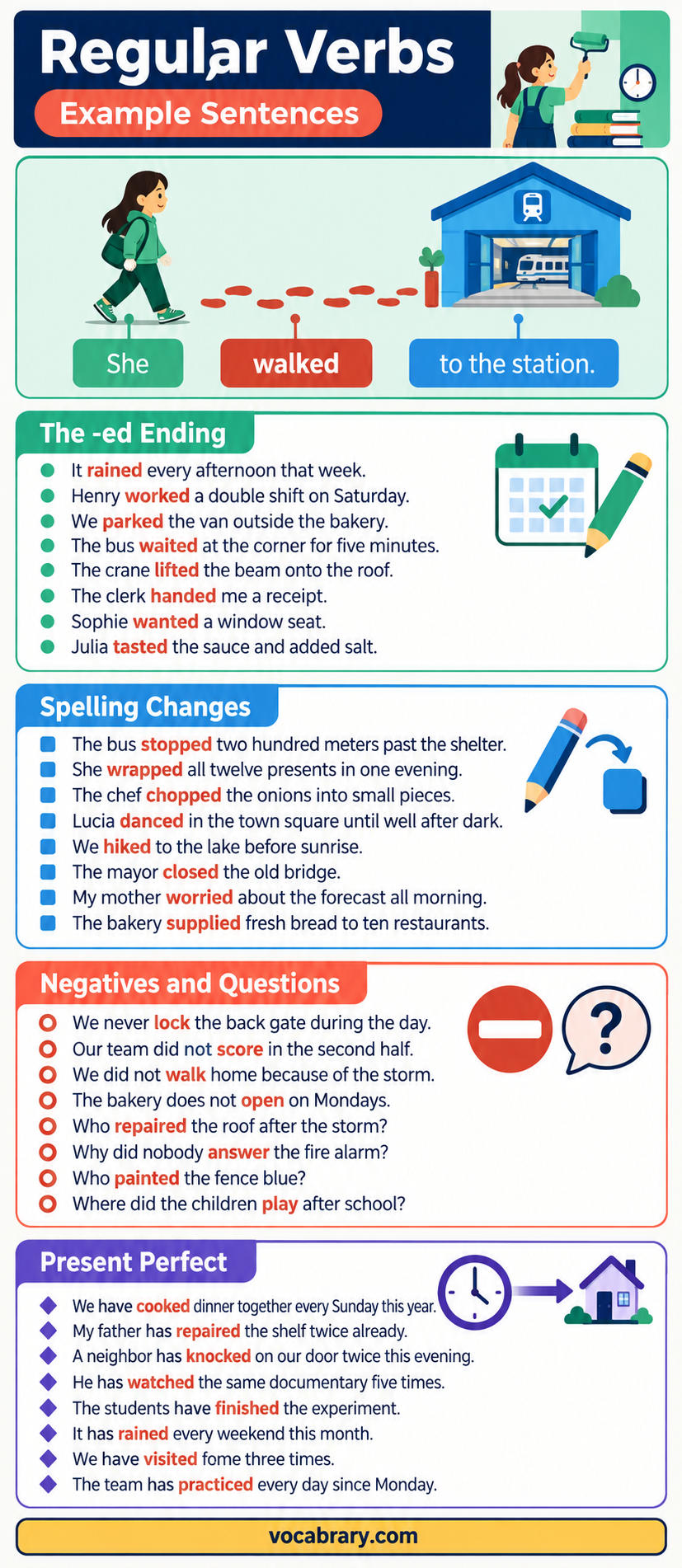
Common Regular Verb Example Sentences
Walking to a bus stop, painting a bedroom wall, and answering a phone before the third ring are the -ed verbs learners meet first in every grammar course.
- Priya walked to the bus stop and waited under the shelter.
- We painted the bedroom walls a pale grey last weekend.
- Nobody answered the phone before the third ring.
- Omar played chess with his grandfather every Friday evening.
- The delivery driver knocked twice and left the parcel on the doorstep.
- Suki talked to her neighbour about the broken fence for twenty minutes.
- A mechanic repaired the brakes in under an hour.
- My grandmother baked a walnut cake for my birthday every year until I turned sixteen.
- Rain soaked the washing on the line.
- Diego loaded five bags of groceries into the car for his mother.
- Nurses checked the ward every two hours during the night shift.
- Our teacher asked the same question three mornings in a row.
- Did Leyla finish her assignment before the midnight deadline?
- Tomatoes ripened on the windowsill in two days.
- Kwame fixed the leaking tap with a washer and a wrench.
- A stray cat followed the children home from the park.
- Marta poured the soup into four bowls and set them on the counter.
- Two volunteers collected litter along the canal path after the festival.
Regular Verb Forms: Base, Past, and Past Participle
Walked, played, and cooked each follow the same rule: add -ed to the base form, and the past tense and past participle come out identical.
| Base form | Past tense | Past participle |
|---|---|---|
| Walk | Walked | Walked |
| Play | Played | Played |
| Cook | Cooked | Cooked |
| Need | Needed | Needed |
| Start | Started | Started |
| Open | Opened | Opened |
| Jump | Jumped | Jumped |
| Rain | Rained | Rained |
| Watch | Watched | Watched |
| Turn | Turned | Turned |
Regular Verbs That Add -ed
The default -ed ending needs no spelling change on talked, jumped, or rained: two letters attach to the base form and the past tense is done.
- Priya talked on the phone for forty minutes after dinner.
- The cat jumped from the fence onto the shed roof in one leap.
- It rained every afternoon that week.
- Our neighbour knocked on the door at six in the morning.
- Hassan worked a double shift on Saturday.
- Somebody pulled the fire alarm during the lunch break.
- Birds nested under the bridge for three summers in a row.
- We parked the van outside the bakery.
- She poured milk into the jug and passed it across the counter.
- Emre kicked a stone down the lane all the way to the corner shop.
- Fireworks boomed over the harbour at midnight.
- Dad opened every window to let the smoke out of the kitchen.
- My sister washed the dog in the bathtub and left muddy paw prints on every towel in the house.
- Soldiers marched through the rain for six hours without stopping once.
Regular Verbs That Double the Final Consonant
Stopped, planned, and dropped gained an extra consonant before -ed because each base form ends with one vowel followed by one consonant in a stressed syllable.
- The bus stopped two hundred metres past the shelter.
- We planned the entire trip during a single lunch break.
- Marta dropped her keys on the escalator.
- Ahmed admitted his mistake before anyone else noticed it.
- The committee preferred the second proposal over the first.
- Our dog dragged a branch through the front door.
- Hana clapped at the end of every song.
- Lightning occurred twice in the same storm and knocked the power out for an hour.
- Two hikers slipped on wet rocks near the waterfall.
- She wrapped all twelve presents in one evening.
- Tomas jogged along the riverbank at dawn.
- Nobody skipped a single rehearsal before the concert.
Regular Verbs That Drop the Silent -e
Dance, move, and arrive already end in a silent -e that disappears the moment -d attaches, so the past tense gains only one letter.
- Lucia danced in the town square until well after dark.
- We moved into the flat on a rainy Tuesday in March.
- The ferry arrived twenty minutes behind schedule.
- Nobody noticed the crack in the wall until it reached the ceiling.
- She loved that old coat and wore it every winter.
- Our class practised the song five times before the assembly.
- Frost damaged the roses along the south fence.
- He hoped for a dry weekend, but clouds rolled in on Saturday morning and ruined his plans for the garden party.
- Two painters scraped the old wallpaper off every bedroom wall.
- Layla smiled at the shopkeeper and asked for a loaf of rye bread.
- My father retired from the factory after thirty-one years on the same floor.
- Children chased pigeons across the square for a full half hour.
Regular Verbs That Change -y to -ied
Studied, worried, and hurried swapped the final -y for -ied because a consonant comes right before that -y, and the same swap applies to every verb that ends the same way.
- Ravi studied for the biology exam until his eyes ached.
- My mother worried about the forecast all morning.
- We hurried down the platform and reached the train with seconds to spare.
- Emilia copied the diagram from the board into her notebook.
- The referee identified the foul from the far side of the pitch.
- I replied to the email within five minutes of reading it.
- She fried two eggs and a rasher of bacon for breakfast.
- Wind dried the sheets on the line before noon.
- Our neighbour tidied the front garden for the first time in months.
- Students applied for the scholarship before the February deadline.
- He denied every accusation during the hearing.
- Tomatoes multiplied in the greenhouse until we had three full baskets by the end of September.
Regular Verbs in Negative Sentences
Not finishing a report, never locking a gate, and never painting a spare room are denials of a deed, and the auxiliary takes the tense while the verb stays in its base form.
- Marta did not finish the report before the meeting started.
- We never lock the back gate during the day.
- Rosa never painted the spare room.
- Jonas does not watch the news in the evening.
- My landlord has not repaired the boiler since last February.
- She never complained about the noise from the building site next door.
- Our team did not score in the second half.
- He does not cook on weekdays.
- Rain did not stop the crowd from lining the streets for the parade.
- Nobody remembered the anniversary.
- My brother has not called since he moved to Lisbon.
- Ahmed will not accept the position until he has read every line of the contract and spoken with his lawyer.
Regular Verbs in Questions
Who repaired the roof, when did the class start, and why did nobody answer the alarm are questions built on a regular verb, and the auxiliary in front takes the tense.
- Who repaired the roof after the storm?
- When did the class start this morning?
- Why did the cat follow the postman down the street?
- Did Omar finish the painting before the exhibition opened?
- Has the council approved the new playground yet?
- How many boxes did the movers stack before the truck was full?
- Where did you park the van last night, because it was not in the driveway when I arrived this morning?
- Does your sister still work at the bakery near the station?
- Why did nobody answer the fire alarm?
- Will the school cancel the sports day if it rains?
- What time did the ferry dock yesterday evening?
- Have the builders completed the extension on the house next door?
Regular Verbs in Everyday Routines
Six o’clock kettles, folded laundry, and ironed shirts are the regular-verb deeds that open and close a day at home.
- My mother boils the kettle at six every morning.
- We fold the laundry while watching the evening news.
- Dad brushes his shoes before leaving the house.
- Aisha walks the dog around the park twice a day.
- Our children wash their hands before every meal.
- She irons three shirts on Sunday night for the week ahead.
- Grandma waters the tomatoes and the basil at sunrise.
- I cooked dinner for six people on Saturday and still had leftovers on Tuesday.
- Leyla vacuumed the living room before the guests arrived.
- Two builders repaired the garden wall in a single afternoon.
- We ordered groceries online and collected them on the way home from the dentist.
- Neighbours complained about the dog barking at three in the morning.
- He dusted every shelf in the front room.
- Kwame fixed the gate latch with a screwdriver and two new bolts.
- My aunt planted a row of sunflowers along the south fence and watered them every evening for the first two weeks.
Regular Verbs at School and at Work
Teachers marking homework, clerks filing invoices, and contractors demolishing an old building are the people who put regular verbs to work before the day ends.
- Mrs Okafor marked thirty exercise books during the lunch break.
- Ravi presented his research to the whole department.
- We filed the invoices before the auditor arrived on Monday morning.
- A teaching assistant printed worksheets for every pupil in year five.
- Managers discussed the budget for an hour and agreed on three cuts.
- Omar drafted a letter of complaint and emailed it to the supplier.
- Students labelled every diagram in the biology practical.
- Did the secretary book the conference room for Wednesday?
- Our principal welcomed the new families at the start of term.
- Contractors demolished the old building behind the gymnasium.
- Two interns designed the layout for the annual report, printed three drafts, and revised every paragraph before the director saw a word.
- She coordinated the conference and booked speakers from four universities.
- My colleague requested a transfer to the Leeds office and waited three months for a reply from the regional manager.
- He updated the spreadsheet every Friday afternoon.
Regular Verb Example Sentences for Kids
Kicking a ball, painting with fingers, and jumping in puddles are the deeds a six-year-old already knows, and the -ed ending turns each one into a finished story.
- Sami kicked the ball over the garden wall.
- We painted rockets on big sheets of paper at school today.
- Lucy jumped in every puddle on the way home and her socks ended up soaking wet.
- Dad cooked pancakes for breakfast.
- The puppy chewed a hole in my best trainer.
- Mum picked us up from swimming at four.
- I climbed the big tree in the back garden.
- Our class planted beans in plastic cups and watched them grow taller every day.
- She counted ten stars before her eyes closed.
- Tom pulled his sister on a sledge through the snow.
- Birds pecked at the bread on the garden wall.
- My friend opened all her presents before the party even started.
Regular Verb Example Sentences for Students
Submitting an essay at midnight, revising three chapters on a bus, and translating a poem for a fair are student deeds with a deadline attached.
- Nadia submitted her essay eleven minutes before the midnight deadline.
- We revised three chapters on the bus ride to the university.
- Amir presented his thesis to a room full of professors and answered every question for half an hour.
- Biology students dissected a flower under the microscope.
- Our professor cancelled the Friday lecture and sent the slides by email instead.
- She researched the history of the building for her architecture module.
- Two classmates recorded the debate on a phone.
- Did the tutor approve your proposal before the first draft was due?
- Erik translated the entire poem from Norwegian into English for the language fair.
- Exam invigilators collected every paper at four o’clock.
- He memorised forty dates for the history test and forgot half of them by Monday.
- My group prepared a ten-minute presentation on renewable energy sources.
Regular Verbs and Irregular Verbs in the Same Sentence
Walked beside drove, cooked beside ate, and started beside began pair a regular verb with an irregular one, so the contrast between -ed and a full spelling change becomes hard to miss. More irregular verb example sentences show the full set of verbs that break the -ed rule.
- She walked to the station while her brother drove.
- We cooked the rice, and Grandma ate three helpings.
- The orchestra started the overture before the conductor came on stage.
- Omar played his guitar, but his sister sang without any instrument.
- My father repaired the shelf that the cat had broken.
- Priya opened the window because the room smelt of paint.
- Farmers planted the wheat in October and saw the first shoots in December.
- A neighbour knocked on the door and told us the power was out on the whole street.
- She asked a question, and the professor spoke for ten minutes.
- We booked a flight to Lisbon and flew out the next morning.
- He watched the match while the rest of us went to the cinema.
- Lena studied the map, then chose a path that led through the forest.
Related
FAQs
An everyday example is "Paula walked to the bus stop and waited under the shelter." Another is "Nobody answered the phone before the third ring."
For young children, one example is "Dad cooked pancakes for breakfast." Another is "The ducks splashed in the pond."
A doubled-consonant example is "Marta dropped her keys on the escalator." Another is "Two hikers slipped on wet rocks near the waterfall."
With a dropped silent "-e", one example is "Lucia danced in the town square until well after dark." Another is "The ferry arrived twenty minutes behind schedule."
In the "-ied" group, one example is "My mother worried about the forecast all morning." Another is "We hurried down the platform and reached the train with seconds to spare."
A negative example is "Jonas does not watch the news in the evening." Another is "My landlord has not repaired the boiler since last February."
As a question, one example is "Who repaired the roof after the storm?" Another is "Does your sister still work at the bakery near the station?"
For daily routines, one example is "Alice walks the dog around the park twice a day." Another is "We fold the laundry while watching the evening news."
A work example is "Oliver drafted a letter of complaint and emailed it to the supplier." Another is "He updated the spreadsheet every Friday afternoon."
With "has" or "have", one example is "She has asked the same question three times today." Another is "They have lived in this house for twenty years."
Related:

Leave a Comment