
An irregular verb is a verb that does not form its past tense or past participle by adding -ed, as when go becomes went and gone. These irregular verb example sentences show the spelling shifts and vowel changes that set verbs such as sing, drive, and cut apart from regular verbs.
What Is an Irregular Verb?
An irregular verb produces its past tense and past participle through a vowel shift, a full spelling change, or no change at all, rather than by adding -ed the way a regular verb does. A regular verb follows one rule (walk / walked / walked), while an irregular verb follows its own (go / went / gone, cut / cut / cut).
Base form / past tense / past participle
Yara drove to the coast before sunrise.
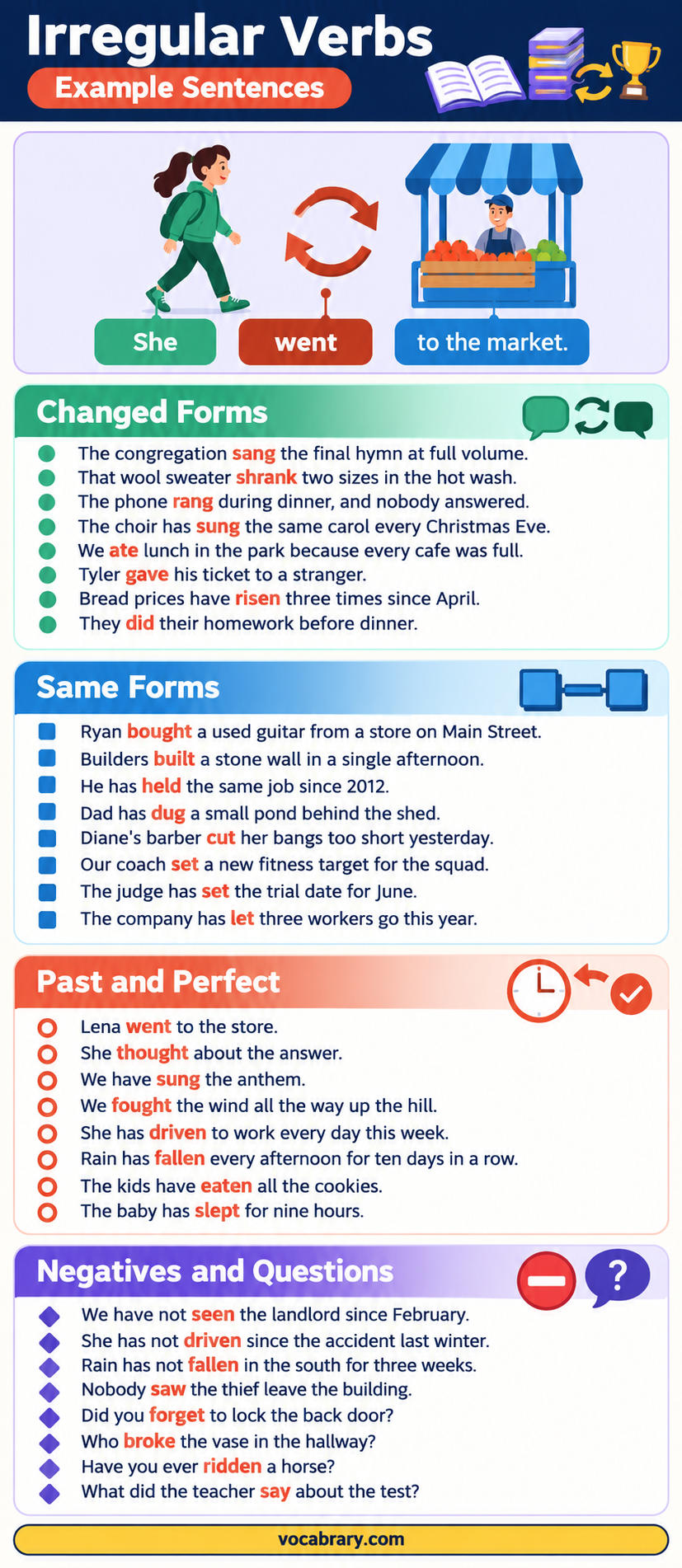
Common Irregular Verb Example Sentences
Going to a market before sunrise, breaking a kitchen window with a football, and singing hymns in a choir are among the first irregular verbs a learner meets. Each bolded form shows a spelling that no -ed rule predicts.
- Kwame went to the market before sunrise.
- A football broke the kitchen window during the Saturday match.
- Our choir sang two hymns before breakfast.
- Priya drove her brother to the airport at five in the morning.
- We ate dinner on the balcony because the dining room was too warm.
- Somebody took the last umbrella from the hallway stand.
- I saw a fox cross the road outside the school gate.
- Ravi wrote his resignation letter on a napkin at lunch.
- Nadia gave her old bicycle to the family next door.
- The temperature fell ten degrees in a single afternoon.
- Children ran through the sprinkler until their clothes were soaked.
- Marco chose the window seat on every flight he booked.
- Did you know the bakery on Church Street closes at noon?
- A gull stole a sandwich straight out of Emre’s hand.
- Sara wore her grandmother’s ring to the graduation ceremony.
- Nobody spoke during the last five minutes of the exam.
- Two deer froze at the edge of the meadow when the headlights swept past them.
- Layla has never flown in a helicopter.
- Our dog bit the postman’s trouser leg and tore the fabric from knee to ankle.
- Hassan swam forty lengths before the pool opened to the public.
Common Irregular Verbs and Their Three Forms
Go, break, sing, drive, teach, buy, cut, fly, take, and write each produce a different spelling in the past tense or past participle. The ten rows show the range of changes a learner memorizes.
| Base form | Past tense | Past participle |
|---|---|---|
| Go | Went | Gone |
| Break | Broke | Broken |
| Sing | Sang | Sung |
| Drive | Drove | Driven |
| Teach | Taught | Taught |
| Buy | Bought | Bought |
| Cut | Cut | Cut |
| Fly | Flew | Flown |
| Take | Took | Taken |
| Write | Wrote | Written |
Vowel-Change Irregular Verbs in Sentences
Sing turning to sang and then sung, swim becoming swam and swum, and drink shifting to drank and drunk all follow an i-a-u vowel pattern that a learner memorizes as one group.
- The congregation sang the final hymn at full volume.
- We swam across the lake and rested on the far rocks before heading back.
- Amara has drunk three glasses of water since the run ended.
- Someone rang the doorbell twice and left a parcel on the mat.
- The meeting began an hour late because the projector failed.
- A spring sprang loose inside the old clock and sent the hands spinning.
- Six miles from the harbour, the fishing boat sank after hitting a reef.
- Our neighbour’s bin stank for a week in the heat.
- That wool jumper shrank two sizes in the hot wash.
- She has sung in the cathedral choir since the age of ten.
- Nobody has swum in that pond since the algae turned it green.
- Church bells rang across the valley for a full hour on New Year’s Eve, and every family along the river road heard them.
- Construction on the new bridge has begun ahead of schedule.
- Rust water sank to the bottom of the glass within seconds.
Irregular Verbs With All Three Forms Different
Go becoming went and gone, eat turning into ate and eaten, and fly shifting to flew and flown give a learner three separate spellings to memorize for every tense.
- Lena went to the library and returned with six novels under her arm.
- We ate lunch in the park because every cafe was full.
- A pigeon flew through the open window during the test.
- The children took the wrong bus and ended up two towns away, so their father drove an hour to collect them.
- Nour wrote a letter to her cousin in Beirut.
- Did you see the meteor shower last night?
- Tariq gave his ticket to a stranger.
- Snow fell all night and buried the garden gate by dawn.
- The thief has stolen four bicycles from the same rack this month, and the police have still not identified a suspect.
- Hugo drew a floor plan on the back of an envelope.
- Wind tore the awning off the cafe.
- We have eaten at that restaurant twice, and both meals were poor.
- Marina chose the red coat.
- By December the river had frozen solid enough to walk across.
- Bread prices have risen three times since April.
Irregular Verbs With the Same Past Tense and Past Participle
Taught and bought never split into different past and participle forms, and sat, won, found, and kept behave the same way, so a learner memorizes only two forms instead of three.
- Grandpa sat on the bench and read the paper until noon.
- Portugal won the tournament after a goalless draw ended in penalties.
- We found a set of old coins under the kitchen floorboards.
- Mrs Adeyemi taught biology at the secondary school for thirty years.
- Ravi bought a used guitar from a shop on the high street.
- She felt the cold through her jacket, zipped her collar to her chin, and wished she had worn a thicker coat.
- I met an old classmate at the supermarket on Saturday.
- The janitor kept a spare torch in his desk drawer.
- Our train left the station four minutes ahead of time.
- Builders built a stone wall in a single afternoon.
- Dad spent the weekend fixing the shed roof.
- A courier sent the wrong parcel to our address.
- The witness told the court a different version of the event.
- Grandma sold her flat and moved to a cottage by the sea.
- They have heard the same excuse every Monday for a year.
Irregular Verbs With All Three Forms the Same
The same spelling across base, past, and participle marks cut, put, hit, shut, and let as the no-change verbs, so the surrounding words deliver all the tense signals a reader needs.
- Dina’s barber cut her fringe too short yesterday.
- Fatima put the groceries away while her daughter stacked the dinner plates on the counter.
- A cricket ball hit the pavilion window and cracked it in two places.
- The caretaker shut every window in the building before the storm arrived.
- We let the neighbours park in our driveway when their garage flooded.
- A return flight to Oslo cost four hundred euros in August.
- Somebody hurt their ankle on the broken step outside reception.
- She quit her desk job in March and started training as a paramedic the next Monday.
- During the night a pipe burst and flooded the hallway.
- Our coach set a new fitness target for the squad.
- Workers spread the gravel across the lane in under an hour.
- He split the firewood behind the shed.
Irregular Verbs in the Present Perfect
A deed that started in the past and still counts now takes has or have plus the irregular past participle, as in has driven, have written, and has spoken.
- She has driven to work every day this week.
- Tomas has written four chapters since January.
- The mayor has spoken to the press three times about the flooding.
- We have known each other since primary school.
- Rain has fallen every afternoon for ten days in a row.
- Amir has broken his glasses again.
- The price of flour has risen by twenty per cent this year.
- Our neighbours have grown tomatoes in their back garden for as long as anyone in the street remembers.
- Fatima has taken her driving test twice and passed on the second attempt.
- Nobody has forgotten the earthquake that struck the town in 2011.
- I have given my old laptop to my younger sister.
- A stray cat has bitten three delivery workers this month.
Irregular Verbs in Negative Sentences
Marta refusing to eat, a landlord who has not driven since an accident, and builders who have not begun the roof are all denials of a deed. The auxiliary takes the tense while the irregular verb stays in its base or participle form.
- Marta did not eat dinner because she had a stomachache.
- We have not seen the landlord since February.
- Jonas never woke before seven, even on exam mornings.
- Nobody spoke a word during the bus ride home.
- She has not driven since the accident last winter.
- I did not know the museum was closed on Tuesdays.
- The builders have not begun work on the roof.
- Our dog never bit a stranger until last Thursday.
- Tariq did not give a reason for leaving the meeting early.
- Rain has not fallen in the south for three weeks.
- The children did not understand the safety instructions.
- Layla has not forgotten the night the power went out during the school play.
Irregular Verbs in Questions
Did you forget, has she written, and where did Emre go turn the irregular verb into a question, and the auxiliary moves to the front while the main verb keeps its base or participle form.
- Did you forget to lock the back door?
- Has she written the thank-you cards yet?
- Where did Emre go after the concert?
- Have the children eaten their lunch?
- Who broke the vase in the hallway?
- When did you last see a shooting star?
- After three cold nights, had the river frozen solid?
- What brought you here at this hour?
- Have you ever ridden a horse?
- Why did the dog run into the neighbour’s garden?
- Has Omar spoken to his supervisor about the transfer?
- Which jacket did your brother choose for the interview?
Irregular Verbs in Daily Life
The kitchen, the bus stop, and the front door are where irregular verbs such as made, left, caught, and forgot show up in the first hour of the day. Every one of them has a past tense that no -ed rule predicts.
- Dad made scrambled eggs for the whole family.
- We left the house ten minutes late and missed the bus.
- Sonia forgot her phone and walked back in the rain to retrieve it.
- The dog ate the leftovers before anyone reached the breakfast counter.
- Our neighbour caught the same bus every morning for fifteen years.
- I woke to the smell of fresh bread from the bakery across the street.
- Grandma brought homemade soup when she heard I was unwell.
- Rain fell while we hung the washing on the line.
- Somebody drank the last of the orange juice and returned the empty carton to the fridge.
- Yara hung her coat on the wrong hook and walked out with somebody else’s jacket by mistake.
- The bus driver told us the next stop was closed for repairs.
- He swept the front path before the guests arrived.
- Children drew pictures on the steamed-up kitchen windows.
- She read the label twice and still picked up the wrong milk.
- Nobody knew the wi-fi password, so the whole evening turned into a conversation instead.
Irregular Verb Example Sentences for Kids
Riding a bike, drawing a monster, and losing a tooth are the irregular verbs a seven-year-old already knows, so the sentences need nothing longer than the verb and its setting.
- Tom rode his bike to the park.
- Lucy drew a monster on the classroom wall.
- Sam lost his front tooth at lunch.
- The kitten hid behind the sofa.
- We sang a song about the rain.
- Mum cut the cake into eight pieces.
- Dad threw the ball over the fence.
- Birds flew across the playground.
- She ate an ice cream in the sun.
- He found a ladybird in the grass.
- The frog swam across the pond.
- Nobody won the race because every runner stopped at the ice cream van and refused to move.
Irregular Verb Example Sentences for Students
Forgetting a textbook, writing exam answers in blue ink, and choosing the hardest assignment are student tasks where the irregular verb form has to be correct on the first attempt.
- Tanvir forgot his textbook and had to share with a partner.
- The lecturer gave a deadline extension after the library flooded.
- Students wrote their answers in blue ink as the exam instructions required.
- Nadia took notes on every lecture and reviewed them the same evening.
- A first-year student broke the lab’s most expensive beaker.
- We read the novel in two weeks and handed in our essays on time.
- Erik chose the hardest question on the assignment sheet and still finished before anyone else.
- The professor spoke for ninety minutes without a single pause.
- Has your tutor seen the draft of your dissertation?
- I understood the formula only after working through ten practice problems.
- Amira did her revision in the quiet zone of the university library.
- Nobody slept the night before the final exam.
- Two classmates lent me their notes when I was absent for a week.
- She got full marks on the vocabulary test.
Sentences Rewritten With the Correct Irregular Verb Form
Goed instead of went, eated instead of ate, and broked instead of broke are the mistakes learners make when they treat an irregular verb as regular. Each pair shows the wrong form beside the right one.
- Lena went to the shop ✅, wrong as goed to the shop ❌.
- We ate dinner early ✅, wrong as eated dinner early ❌.
- A ball broke the window ✅, wrong as broked the window ❌.
- Tariq ran five kilometres before breakfast ✅, wrong as runned five kilometres before breakfast ❌.
- She thought about the answer ✅, wrong as thinked about the answer ❌.
- Omar caught the last train ✅, wrong as catched the last train ❌.
- Priya bought new shoes ✅, wrong as buyed new shoes ❌.
- Mrs Lee taught the class ✅, wrong as teached the class ❌.
- We have sung the anthem ✅, wrong as have sang the anthem ❌.
- He has driven to work ✅, wrong as has drived to work ❌.
Related
FAQs
An everyday example is "Kevin went to the market before sunrise." Another is "We ate dinner on the balcony because the dining room was too warm."
For young children, one example is "Tom rode his bike to the park." Another is "The kitten hid behind the couch."
A present perfect example is "Thomas has written four chapters since January." Another is "Rain has fallen every afternoon for ten days in a row."
With a vowel change, one example is "The congregation sang the final hymn at full volume." Another is "Construction on the new bridge has begun ahead of schedule."
In the shared-form group, one example is "Grandpa sat on the bench and read the paper until noon." Another is "Builders built a stone wall in a single afternoon."
Without any change in form, one example is "During the night a pipe burst and flooded the hallway." Another is "He split the firewood behind the shed."
A negative example is "Nobody spoke a word during the bus ride home." Another is "We have not seen the landlord since February."
As a question, one example is "Who broke the vase in the hallway?" Another is "Have you ever ridden a horse?"
On an ordinary day, one example is "Dad made scrambled eggs for the whole family." Another is "We left the house ten minutes late and missed the bus."
For students, one example is "Nobody slept the night before the final exam." Another is "Two classmates lent me their notes when I was absent for a week."
Related:

Leave a Comment