
An irregular plural noun is a noun form that does not add -s or -es to become plural, as in child becoming children or mouse becoming mice. These irregular plural noun example sentences show every pattern, from vowel changes and Latin endings to words that stay the same in both singular and plural form.
What Is an Irregular Plural Noun?
An irregular plural noun forms its plural without the standard -s or -es ending. Foot becomes feet through a vowel swap, ox becomes oxen with an Old English suffix, cactus becomes cacti from its Latin origin, and sheep stays sheep with no change at all. A regular plural adds -s or -es, while an irregular plural rewrites part or all of the word.
Singular → Plural: vowel change, -en ending, Latin/Greek shift, or zero change
The dentist counted all thirty-two teeth before the cleaning began.
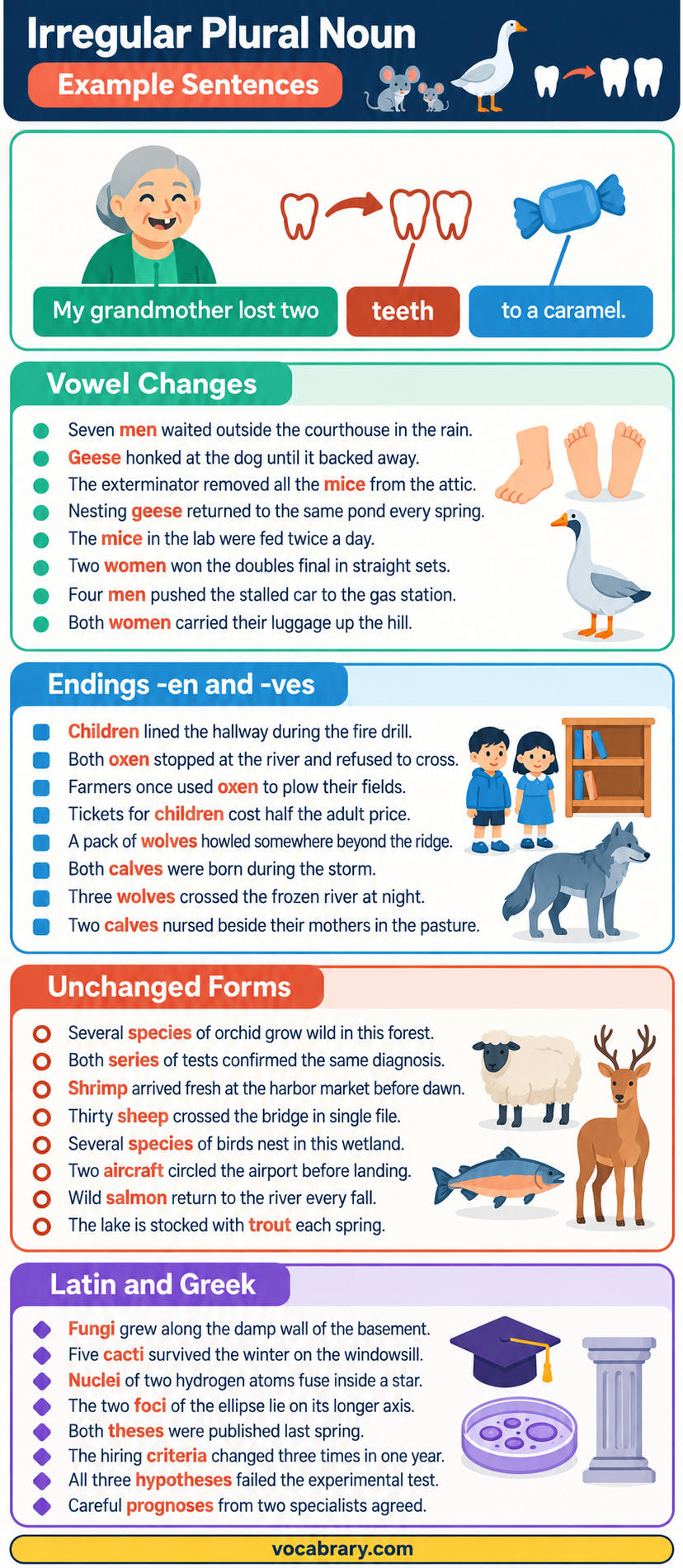
Common Irregular Plural Noun Examples in Sentences
Children on a playground, mice behind a wall and geese crossing a road are the irregular plurals most English speakers learn first. Each one names a familiar creature or person whose plural breaks the -s rule.
- Three children ran ahead of their parents on the trail.
- Two mice darted across the kitchen floor at midnight.
- A flock of geese landed on the frozen lake just as the sun dropped behind the tree line.
- Both feet ached after the hike.
- The dentist examined all of her teeth before starting the filling.
- Six men carried the piano up three flights of stairs while the movers waited at the van.
- Five women signed the petition before noon.
- Our cat chased two mice into the garage and refused to come back until we dragged her out.
- Geese blocked the bicycle path near the river.
- His feet barely fit inside last year’s shoes.
- Twelve children sat in a circle on the classroom rug and listened to the teacher read aloud.
- Those men repaired the stone wall in a single afternoon.
- Several women from the choir performed at the town hall on Saturday evening.
- My teeth hurt after eating the frozen dessert.
- A pair of oxen pulled the heavy cart through deep mud for over a mile before the farmer let them rest.
- Wild geese flew south earlier than expected.
- Four children shared one umbrella during the downpour.
- Lice in his hair required a prescription shampoo from the pharmacy on the corner.
- Men and women lined up separately at the entrance.
- Mice gnawed through the cardboard overnight.
- My feet slipped on the icy pavement outside the bakery, and I dropped every bag of groceries.
- The children begged for one more bedtime story.
Vowel-Change Irregular Plurals in Sentences
Man becoming men, foot becoming feet and goose becoming geese share a vowel shift that dates back to Old English, where the middle vowel moved forward in the mouth to signal more than one.
- Seven men waited outside the courthouse in the rain.
- Both of her feet dangled over the edge of the dock while the boat rocked underneath.
- Wild geese nested in the marsh behind the farm.
- A colony of mice lived under the garden shed for years before anyone noticed.
- All thirty-two teeth were healthy at the six-month checkup.
- Two women accepted the award on behalf of the whole department.
- Head lice spread through the nursery within a single week.
- The six men loaded the truck before sunrise and finished by the time the foreman arrived.
- My teeth chattered from the cold wind on the footbridge.
- Geese honked at the dog until it backed away.
- Three women opened the new branch on Monday morning.
- The exterminator removed all the mice from the attic.
- Her swollen feet needed rest after the marathon.
- Nesting geese returned to the same pond every spring.
- Twelve men from the village rebuilt the chapel roof over one long weekend.
- Both women received their diplomas at the same ceremony.
Irregular Plurals Ending in -en and -ren
Children and oxen add -en or -ren instead of -s, a pattern that survives from a stage of English where several more nouns followed the same ending.
- Children lined the hallway during the fire drill.
- A team of oxen dragged the plough across the frozen field before dawn.
- The children finished their lunch before the bell rang.
- Oxen still pull carts in parts of rural Southeast Asia.
- Young children learn new words faster than most adults expect.
- Twelve children competed in the school spelling bee.
- Both oxen stopped at the river and refused to cross.
- The children sang a folk song at the morning assembly.
- Older children helped the younger ones button their coats.
- A pair of oxen hauled timber down the hillside in the rain while the driver walked alongside.
Irregular Plurals From -f and -fe to -ves
Knives, wolves, loaves and shelves replace the -f or -fe ending with -ves, a spelling shift that matches the voiced buzz a speaker makes when saying the plural aloud.
- Knives and forks were missing from three place settings.
- A pack of wolves howled somewhere beyond the ridge.
- Two loaves of bread cooled on the kitchen counter.
- Shelves in the old bookshop sagged under rows of hardcovers that nobody had touched in years.
- Brown leaves covered the entire footpath.
- Both calves were born during the storm.
- Thieves broke into the warehouse through a back window.
- My scarves are tangled together at the bottom of the drawer.
- She cut the watermelon into two halves and gave one to her brother.
- Wolves circled the camp at dusk.
- Fresh loaves sold out before the bakery fully opened.
- His knives needed sharpening after the long dinner service.
- The farmer separated the calves from the herd at sunrise.
- Autumn leaves drifted onto the pond and turned the surface gold.
- Wives of the crew waited at the dock for the fishing boat.
- Garden elves made of painted clay lined the front path.
Unchanged Irregular Plurals in Sentences
Fifty sheep, three deer and a tank of fish keep the same spelling in singular and plural, and only the sentence around them signals the number.
- Fifty sheep grazed on the hillside after the rain stopped.
- Three deer crossed the highway in the early morning fog.
- Bright fish darted in and out of the coral along the reef.
- A small herd of bison blocked the dusty trail in Yellowstone.
- Two moose stood in the middle of the gravel road and refused to move for nearly ten minutes.
- Several species of orchid grow wild in this forest.
- Both series of tests confirmed the same diagnosis.
- Three military aircraft waited on the runway.
- Salmon swim upstream every autumn to spawn in the same gravel beds where they were born.
- Trout filled the cooler after a long morning on the lake.
- Shrimp arrived fresh at the harbour market before dawn.
- Deer ate every tulip in the garden overnight.
- A hundred sheep were loaded onto the transport truck one by one.
- The aquarium added two new species of jellyfish last month.
- Cod sold for twice the usual price during the winter shortage.
- Wild bison roamed the grassland in groups of thirty or more.
Latin and Greek Irregular Plurals in Sentences
Cacti, alumni, phenomena and analyses arrived from Latin and Greek, and each one kept the plural ending it had in its source language rather than adopting -s.
| Singular | Plural | Example sentence |
|---|---|---|
| Cactus | Cacti | Five cacti survived the winter on the windowsill. |
| Fungus | Fungi | Fungi spread across the fallen log after the rain. |
| Alumnus | Alumni | Alumni donated a new science wing to the school. |
| Nucleus | Nuclei | Nuclei of two hydrogen atoms fuse inside a star. |
| Stimulus | Stimuli | Researchers tested five visual stimuli on each volunteer. |
| Criterion | Criteria | The hiring criteria changed three times in one year. |
| Phenomenon | Phenomena | Northern lights rank among the rarest atmospheric phenomena. |
| Analysis | Analyses | Both analyses reached the same conclusion. |
| Thesis | Theses | Three doctoral theses were defended on a single afternoon. |
| Crisis | Crises | Two banking crises struck the country within a decade. |
| Appendix | Appendices | The report had four appendices of raw data. |
| Hypothesis | Hypotheses | All three hypotheses failed the experimental test. |
Latin Irregular Plurals in Sentences
Cacti on a terrace, fungi in a cellar and alumni at a reunion are Latin plurals that change -us to -i, -um to -a, or -a to -ae.
- Five cacti survived the drought on the apartment terrace.
- Fungi grew along the damp wall of the basement.
- Alumni gathered outside the campus gate and posed for the reunion photograph on the front steps of the old library.
- Two nuclei merged during the physics experiment.
- Multiple stimuli triggered the same reaction in every trial.
- Syllabi for the new term were posted online yesterday.
- Larvae hatched inside the glass jar within forty-eight hours.
- The museum displayed three vertebrae from a dinosaur skeleton.
- Both formulae produced the same answer for the equation.
- Hospital workers swabbed every surface for bacteria.
Greek Irregular Plurals in Sentences
Phenomena overhead, crises in the headlines and theses in the library are Greek plurals where -on becomes -a and -is becomes -es.
- Strange phenomena appeared in the night sky over the desert.
- Two financial crises reshaped the banking laws of three countries and forced a full decade of emergency budget cuts.
- Her analyses of the soil samples confirmed the contamination.
- Both theses were published last spring.
- A doctor ordered two separate diagnoses before starting treatment.
- All hypotheses were rejected after the second round of testing.
- Parentheses around the final numbers clarified the equation for the whole class.
- Film synopses were pinned to the noticeboard outside the cinema.
- The two criteria for the scholarship were a grade average and full attendance.
- Automata in the clocktower chimed twice on the hour.
Irregular Plural Noun Examples in Everyday Life
Bare feet on a kitchen floor, mice in an old attic and children at a crossing put irregular plurals into the routines a learner goes through every day.
- The children crossed at the school gate while a guard held traffic.
- Mice scratched inside the walls of the old cottage every night.
- His bare feet left prints on the freshly mopped tile.
- Geese waddled across the park lawn at sunrise.
- Knives in the kitchen drawer need replacing after ten years of use.
- Two deer appeared at the edge of the garden at dusk.
- She bought three loaves of sourdough at the Saturday farmers’ market.
- My teeth bled after I bit into the hard pretzel.
- Shelves in the pantry collapsed under too many canned goods.
- Brown leaves blocked the gutter for the second time this month.
- Fresh fish lay on ice at the harbour stall.
- Sheep wandered onto the village road during the harvest festival.
- A row of cacti lined the windowsill of the rented flat.
- Wolves were spotted near the hiking trail last weekend.
- Five children squeezed into the back seat for the morning school run.
- Both calves escaped the pen and wandered into the neighbour’s yard before anyone noticed they were gone.
Irregular Plural Noun Examples at School
Teeth on a biology diagram, mice in a lab experiment and children reading aloud from the same storybook fill school hours with irregular plurals from the first year.
- The teacher pointed to the teeth on the anatomy diagram.
- Lab mice ran through the maze.
- Children read aloud from the same picture book every Friday afternoon.
- Two men from the fire brigade spoke at the school assembly.
- Geese on the playing field delayed the morning PE session.
- Several analyses of the poem appeared on the exam paper.
- Women from the local council judged the annual science fair.
- The librarian shelved three new theses in the reference wing.
- Six feet of poster paper covered the hallway wall for the art display.
- Cacti in the classroom window grew taller than the blinds.
- Criteria for the essay prize were printed in the school newsletter every autumn.
- Phenomena such as rainbows and eclipses filled the first physics lesson of the term.
- Oxen appeared in the history textbook’s chapter on farming in medieval England.
- A diagram of human vertebrae hung beside the classroom door.
Irregular Plural Noun Examples at Work
Criteria in a job posting, analyses on a manager’s desk and memoranda from the head office bring Latin and Greek irregular plurals into professional English.
- New criteria for promotion were announced at the quarterly meeting.
- Analyses of the sales figures revealed a steady drop since March.
- Alumni from the training programme attended the networking dinner.
- Both hypotheses were rejected by the review board before lunch.
- The accountant sent three memoranda to the finance department.
- Crises in the supply chain delayed two product launches this quarter.
- Phenomena in the overseas market puzzled the entire research team.
- Six men from the warehouse loaded the delivery van in under an hour.
- Women in senior positions grew from twelve to twenty over the past five years.
- Mice nested in the storeroom.
- Two deer appeared on the company lawn during the all-staff lunch event.
- The engineer reviewed four appendices before signing off on the final proposal.
Irregular Plural Noun Examples for Kids
Mice in a cartoon, teeth under a pillow and geese at a farm pond are the irregular plurals young readers meet first in picture books and playground talk.
- Two mice hid behind the grandfather clock in the story.
- She placed both baby teeth under her pillow for the tooth fairy.
- Geese chased the dog.
- Three sheep escaped through a hole in the wooden fence.
- Children shared the sandpit without a single argument.
- My feet grew so fast that none of my old shoes fit anymore.
- Five fish swam in circles inside the glass bowl on the kitchen counter.
- A family of deer ate the carrots right out of the garden.
- Two men dressed as clowns at the birthday party.
- The wolves in the bedtime story blew the straw house down and chased the little pig all the way to the brick one.
- Toy knives and forks came in the plastic kitchen set.
- Oxen pulled the wagon in the farm picture book.
Sentences Rewritten With the Correct Irregular Plural
Foots, mouses, childs and sheeps are mistakes learners write before they memorize the correct irregular form.
- ❌ Three childs played in the yard. ✅ Three children played in the yard.
- ❌ My foots hurt after the walk. ✅ My feet hurt after the walk.
- ❌ We saw two mouses behind the shed. ✅ We saw two mice behind the shed.
- ❌ Several gooses blocked the path. ✅ Several geese blocked the path.
- ❌ The wolfs howled all night. ✅ The wolves howled all night.
- ❌ He lost two tooths in the accident. ✅ He lost two teeth in the accident.
- ❌ The farmer kept fifty sheeps on the hill. ✅ The farmer kept fifty sheep on the hill.
- ❌ Both knifes were dull. ✅ Both knives were dull.
- ❌ Several deers crossed the road. ✅ Several deer crossed the road.
- ❌ Two mans repaired the bridge. ✅ Two men repaired the bridge.
Irregular Plural Nouns in Short Paragraphs
A flock of geese, two deer at a pond and a cellar full of mice put several irregular plurals into one running story, the way real speech mixes them together.
The children rushed to the lake while the geese scattered across the grass. Two of them stubbed their feet on the rocks near the shore. Three fish leaped out of the water, and a pair of deer watched from the edge of the woods. By noon the women had set up a picnic, and the men hauled firewood from the trail. Mice had chewed through the blanket they left in the car. Nobody noticed until the children unrolled it on the damp ground.
Five grey wolves appeared on the ridge just after sunset. The sheep huddled closer together, and two oxen stamped their hooves by the gate. A farmhand counted the calves and found one missing. He grabbed two knives from the kitchen, stuffed fresh loaves of bread into his pack, and walked toward the dark tree line. Leaves crunched under his boots. His teeth chattered, but he kept walking until the wolves moved on.
The biology lab held six glass tanks of fish, a shelf of cacti, and a poster showing the vertebrae of a blue whale. Mice ran on wheels inside plastic boxes along the far wall. Fungi grew in petri dishes under the bench. The professor reminded the class that the criteria for the final grade included three written analyses and one lab presentation. Both hypotheses had to be tested by Friday, and all theses were due before the winter break.
Related
FAQs
An everyday example is "Three children ran ahead of their parents on the trail." Another is "Two mice darted across the kitchen floor at midnight."
In vowel changes, one example is "Seven men waited outside the courthouse in the rain." Another is "All thirty-two teeth were healthy at the six-month checkup."
With the "-en" ending, one example is "The children sang a folk song at the morning assembly." Another is "Both oxen stopped at the river and refused to cross."
One "-ves" example is "A pack of wolves howled somewhere beyond the ridge." Another is "Two loaves of bread cooled on the kitchen counter."
Among unchanged plurals, one example is "Fifty sheep grazed on the hillside after the rain stopped." Another is "Three deer crossed the highway in the early morning fog."
A Latin example is "Five cacti survived the drought on the apartment terrace." Another is "Fungi grew along the damp wall of the basement."
In Greek plurals, one example is "Strange phenomena appeared in the night sky over the desert." Another is "All hypotheses were rejected after the second round of testing."
A classroom example is "The teacher pointed to the teeth on the anatomy diagram." Another is "Lab mice ran through the maze."
In the workplace, one example is "New criteria for promotion were announced at the quarterly meeting." Another is "Analyses of the sales figures revealed a steady drop since March."
For kids, one example is "She placed both baby teeth under her pillow for the tooth fairy." Another is "Five fish swam in circles inside the glass bowl on the kitchen counter."
Related:

Leave a Comment