
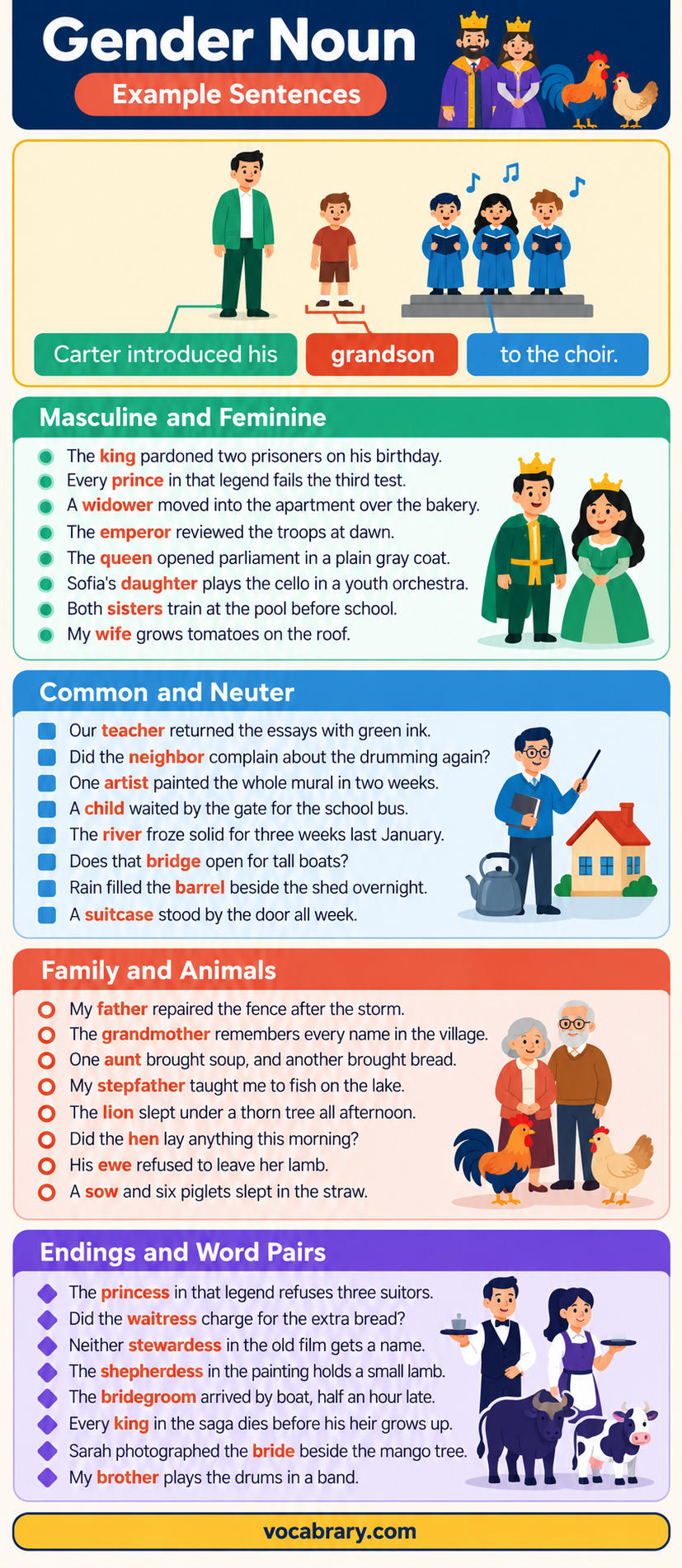
Gender nouns are the noun class that English grammar books group by gender, splitting every naming word into masculine, feminine, common, and neuter, as when king is masculine and queen is feminine. These gender noun example sentences mark the noun in bold, beginning with the four classes side by side.
What Is a Gender Noun?
A gender noun is a naming word whose class is masculine, feminine, common, or neuter, and that class decides whether he, she, it, or they replaces the noun later in the sentence. French and Spanish give every noun a gender, even a spoon or a window, while English marks gender only where the meaning names a male or a female.
The king rode ahead of the queen, and their children waved from the carriage.
Common Gender Noun Examples in Sentences
King, queen, teacher, and river fill the four classes at once, and these gender noun example sentences bold each noun as masculine, feminine, common, or neuter, with more noun sentences on englishan.com.
| Masculine | Feminine | Gender-neutral word |
|---|---|---|
| Actor | Actress | Actor |
| Waiter | Waitress | Server |
| Steward | Stewardess | Flight attendant |
| Fireman | Firewoman | Firefighter |
| Chairman | Chairwoman | Chairperson |
| Policeman | Policewoman | Police officer |
| Host | Hostess | Host |
| Salesman | Saleswoman | Salesperson |
| Headmaster | Headmistress | Head teacher |
| Businessman | Businesswoman | Business owner |
| Postman | Postwoman | Postal worker |
| Spokesman | Spokeswoman | Spokesperson |
- Every king in the story loses his crown by the final chapter.
- The queen opened the new hospital on Tuesday morning.
- Our teacher marked thirty essays before the bell rang.
- That river floods the lower fields each April.
- Marco asked whether the waiter had brought the wrong soup.
- No actress in the company had played the part before.
- A doctor from Nairobi answered the emergency call at midnight.
- Both tables in the corner were reserved for the choir.
- Her uncle repairs bicycles in a workshop near the market.
- Did the nurse write the dosage on the chart?
- One bull refused to move away from the gate.
- Priya left her book on the bench outside the library.
Masculine Gender Noun Examples in Sentences
King, uncle, waiter, and nephew belong to the masculine class, the gender nouns that name a male person or a male animal and take he or his later in the sentence.
- The king pardoned two prisoners on his birthday.
- Our uncle drove us to the airport at four in the morning.
- A waiter balanced four plates in one hand without spilling anything.
- Hamid’s nephew won the spelling contest last term.
- Did the landlord return the deposit after the inspection?
- No actor in the cast had worked on a film before.
- Every prince in that legend fails the third test.
- The bridegroom forgot his speech and thanked the cooks instead.
- Tomas asked his brother to feed the rabbits.
- That monk bakes bread for the whole valley.
- A widower moved into the flat over the bakery.
- Neither son remembered the name of the village.
- Mr. Okafor introduced his grandson to the choir.
Feminine Gender Noun Examples in Sentences
Queen, aunt, actress, and niece make up the feminine class, gender nouns that name a female person or a female animal and match she or her further along.
- The queen opened parliament in a plain grey coat.
- My aunt grows chillies on a narrow balcony in Karachi.
- An actress from Accra took the lead role in March.
- Did the niece send a reply to the invitation?
- Every empress in the novel rules from behind a painted screen.
- Sofia’s daughter plays the cello in a youth orchestra.
- No waitress at that cafe works past nine.
- The bride signed the papers with her grandmother’s pen.
- Nadia thanked the headmistress for a second chance.
- One hostess greeted forty guests without a single mistake.
- Grandmother sold her mare to a farmer in the next village.
- Both sisters train at the pool before school.
- Is the landlady raising the rent again this winter?
Common Gender Noun Examples for Teachers, Doctors, and Students
Teacher, doctor, student, friend, and cousin are common gender nouns, single words that name a person of any gender without changing form. They differ from the common nouns, which name any member of a class rather than a gender.
- Our teacher returned the essays with green ink.
- A doctor at the clinic diagnosed the fracture in four minutes.
- Every student in row three answered the last question correctly.
- My friend from Manila sent mangoes for the wedding.
- The cousin who fixed the roof refuses payment.
- Did the neighbour complain about the drumming again?
- No passenger on the late train had a printed ticket.
- Two cyclists waited at the crossing for the signal.
- Aisha trusts her dentist more than any specialist in the city.
- One artist painted the whole mural in a fortnight.
- The guest who arrived last brought the loudest stories.
- Neither parent signed the permission form.
- Is your cousin the pianist who played on Sunday?
Neuter Gender Noun Examples for Objects and Places
Table, book, river, and lamp fall into the neuter class, names for objects and places with no male or female sense, replaced by it rather than by he or she.
- That table wobbles whenever somebody sets a mug near its corner.
- Her book fell behind the radiator and stayed there for weeks.
- The river froze solid for three weeks last January.
- A lamp flickered in the corridor until the caretaker replaced it.
- Two buses left the depot before dawn.
- Nobody moved the ladder away from the window.
- Does that bridge open for tall boats?
- Our kitchen smells of cardamom every Sunday.
- One mountain in the photograph had no name on the map.
- The chair by the door lost a leg during the move.
- Rain filled the barrel beside the shed overnight.
- His watch stopped at ten past three.
- Neither window opens wider than a hand’s width.
Masculine and Feminine Gender Nouns in One Sentence
King beside queen, nephew beside niece, and waiter beside waitress are the paired gender nouns of traditional grammar, and each pair names the same role once for a male and once for a female.
- The king signed the order, and the queen read it aloud.
- Her nephew cooked while her niece washed every plate.
- A waiter took the order, and a waitress brought the bill.
- Our host poured the tea, and the hostess cut the cake.
- My uncle farms olives, and my aunt sells them at market.
- Both the bridegroom and the bride arrived late.
- One lion slept while the lioness guarded the cubs.
- Did the actor and the actress rehearse the duet together?
- That prince rides badly, though his princess wins every race.
- Neither the waiter nor the waitress remembered the allergy note.
- The grandfather taught chess, and the grandmother taught draughts.
Gender Noun Examples for Family Members
Father and mother, son and daughter, grandfather and grandmother are the family gender nouns a beginner meets first, since each word names a relative by gender.
- My father repaired the fence after the storm.
- Her mother teaches chemistry at a college in Lahore.
- Their son joined the navy last autumn.
- A daughter of the family opened the shop at six.
- The grandmother remembers every name in the village.
- Did your brother return the drill?
- No sister of mine would miss a wedding.
- Ravi phoned his grandfather before the match kicked off.
- Both nephews built a raft from old doors.
- One aunt brought soup, and another brought bread.
- That widow runs the dairy on her own.
- Neither parent speaks Portuguese at home.
- Is the stepmother in that tale ever kind?
Gender Noun Examples for Jobs and Professions
Waiter, actor, headmaster, and steward are the job words that older grammar books pair with waitress, actress, headmistress, and stewardess, and either word of a pair names a person doing that work.
- The waiter wrote the order on a paper pad.
- An actress rehearsed her lines on the night bus.
- Our headmaster cancelled assembly because of the flood.
- A steward checked every seatbelt twice.
- Did the waitress finish her shift early?
- No author on the panel had published a novel before.
- Every tailor in that street works until midnight.
- Ines thanked the usher who found her seat.
- One actor learned the whole part in two days.
- Mr. Duarte hired a cleaner for the upstairs offices.
- Neither steward noticed the broken latch.
Gender-Neutral Job Words in Current Use
Firefighter for fireman, flight attendant for air hostess, chairperson for chairman, and police officer for policeman are the words current usage prefers, and each one names the work without naming a gender.
- A firefighter climbed the ladder with a hose over one shoulder.
- The flight attendant demonstrated the exit routes before takeoff.
- Our chairperson closed the meeting at half past eight.
- Two police officers waited outside the courtroom.
- Every salesperson on the floor met the monthly target.
- Did the server bring the wrong dessert again?
- No spokesperson answered the reporters that evening.
- Yuki works as a camera operator for a wildlife channel.
- One head teacher wrote to every family in the district.
- The postal worker delivered parcels through the snow.
- Neither business owner agreed to the new lease.
Gender Noun Examples for Animals
Lion and lioness, bull and cow, cock and hen, stallion and mare are the animal gender nouns of farmyard and storybook, each naming the male or the female of one species.
- The lion slept under a thorn tree all afternoon.
- A lioness dragged the kill into the shade.
- Our bull broke through the fence again.
- That cow produces twenty litres a day.
- Did the hen lay anything this morning?
- No stallion on the farm accepts a new rider quickly.
- Every mare in the stable knows her own gate.
- Ali fed the drake and the duck at the pond edge.
- One ram butted the gate until it opened.
- His ewe refused to leave her lamb.
- Two tigresses share that enclosure at the zoo.
- Nobody warned the children about the gander.
- Is the peacock or the peahen the bird with the long tail?
Gender Nouns Formed With the -ess Ending
Actress, waitress, hostess, lioness, and princess take the -ess ending on a masculine word, the oldest method English grammar books teach for building a feminine noun.
- The princess in that legend refuses three suitors.
- An actress from Lagos won an award for a silent role.
- Our hostess remembered every guest’s name.
- A lioness hunts at dusk while the pride sleeps.
- Did the waitress charge for the extra bread?
- No heiress in the novel keeps her fortune past chapter ten.
- Every tigress in the reserve wears a tracking collar.
- Marta played a duchess in her first season at the theatre.
- One goddess in Greek myth turned a weaver into a spider.
- That empress ordered a canal dug across the plain.
- Neither stewardess in the old film gets a name.
Gender Nouns Formed From a Separate Word
Bridegroom and bride, widow and widower, nephew and niece, gentleman and lady use a wholly different word for each gender instead of an ending.
- The bridegroom arrived by boat, half an hour late.
- A widow from the next street taught me to make pasta.
- Our nephew flew in from Toronto on Friday.
- Every king in the saga dies before his heir grows up.
- Did the niece ever collect the parcel?
- No widower on that road eats alone on Sundays.
- Sana photographed the bride beside the mango tree.
- One queen in the pack of cards is missing.
- That boy shares a desk with his girl cousin.
- Two gentlemen offered their seats to the ladies.
- Neither bull nor cow would cross the stream.
Gender Noun Examples With Mr, Mrs, and Ms
Mr. Ahmed, Mrs. Okafor, Ms. Lindgren, and Dr. Patel show titles at work, where Mr. marks a male, Mrs. a married female, and Ms. a female of any marital status.
- Mr. Ahmed signed for the delivery at noon.
- Our neighbour Mrs. Okafor grows roses along the wall.
- Ms. Lindgren chairs the committee this year.
- Did Mr. Duarte pay the electricity bill?
- Every letter reached Mrs. Bianchi except the last one.
- The old enrolment form shows no Ms. or Mrs. beside her name.
- Dr. Patel prefers her title to any other.
- Two parcels waited at the desk for Mr. Nakamura.
- The gentleman at the counter asked for Ms. Rivera.
- Madam Chair opened the vote at ten.
- Neither Mr. nor Mrs. Alvarez attended the hearing.
Gender Nouns With Pronouns That Agree
He for the waiter, she for the actress, it for the lamp, and they for a student whose gender goes unnamed: each sentence pairs a gender noun with the pronoun that matches it.
- The waiter dropped his tray, and he apologised twice.
- Her aunt phoned from Seville, and she sounded tired.
- That lamp broke last winter, and nobody replaced it.
- Every student who finishes early hands in their paper at the front.
- A firefighter rang the bell, and they asked for the landlord.
- Did your brother bring his passport with him?
- No actress in the company minds who directs her scenes.
- One cow wandered off, and the farmer found her by the stream.
- Our doctor retires in June, and the whole clinic thanked her.
- The bridegroom lost his ring, and his sister found it.
- Neither teacher remembered where they had parked.
Gender Noun Examples at School and at Work
Headmistress, pupil, and classmate belong to the school corridor, while colleague, manager, and apprentice belong to the office, and both places mix marked gender nouns with words open to anyone.
Gender Noun Examples at School
Headmistress, pupil, schoolboy, schoolgirl, and librarian turn up in every school day, where a marked pair such as schoolboy and schoolgirl works beside an unmarked word such as pupil.
- Our headmistress announced a half day after the flood.
- Every pupil in the class wrote a letter to the mayor.
- A classmate of mine repaired the projector during lunch.
- Did the schoolboy at the gate return the football?
- The schoolgirl with the red bag won the science prize.
- No prefect stayed behind to lock the hall.
- Two students presented their project in Portuguese.
- Farah asked the librarian for a second copy.
- One coach trains both the boys’ team and the girls’ team.
- Nobody told the caretaker about the broken pipe.
- Is the new head teacher the one from Bristol?
Gender Noun Examples at Work
Colleague, manager, apprentice, receptionist, and cashier are the workplace gender nouns of modern English, and every one of them names a worker of any gender.
- My colleague from Seoul designed the whole interface.
- The manager approved three days of leave.
- An apprentice welded the gate under supervision.
- Did the receptionist forward the message?
- Every engineer on the site wore a blue helmet.
- No client complained about the delay.
- Our chairperson signed the minutes before lunch.
- Two waiters shared the late shift on Saturday.
- Kofi trained the new cashier in one afternoon.
- One supervisor noticed the error in the invoice.
- Neither partner wanted to move the office.
Gender Noun Examples From History and Fiction
Queen Victoria, Emperor Akbar, and Mr. Darcy from Jane Austen’s Pride and Prejudice put gender nouns beside a named ruler or a written character.
- Queen Victoria ruled the United Kingdom from 1837 until her death in 1901.
- Emperor Akbar governed much of northern India in the sixteenth century.
- Jane Austen gave Pride and Prejudice a proud gentleman named Fitzwilliam Darcy.
- Charles Dickens opened Great Expectations with an orphan called Pip.
- Tsar Nicholas II of Russia abdicated in March 1917.
- The goddess Athena gave her name to the city of Athens.
- Harper Lee named the lawyer in To Kill a Mockingbird Atticus Finch.
- Empress Wu Zetian ruled China in her own name around the year 700.
- Mary Shelley made a scientist called Victor Frankenstein the heart of her 1818 novel.
- King Henry VIII of England married six times.
- Frances Hodgson Burnett made a lonely girl named Mary the centre of The Secret Garden.
Short Gender Noun Sentences for Kids and Students
Boy, girl, cat, doll, and grandmother are the first gender nouns a young learner meets, in sentences short enough to copy onto one line of a notebook.
- The boy kicked the ball.
- A girl fed the ducks.
- My mother bakes bread.
- That cat sleeps on the mat.
- Her doll lost an arm.
- Grandmother knits every evening.
- Two boys raced to the gate.
- Did the girl find her shoe?
- No king wears a crown at breakfast in this story.
- One hen escaped.
- Our teacher smiled.
- Nobody woke the baby.
- Is that man your uncle?
- Every queen in the picture wears a green cloak and golden shoes.
Gender Noun Examples in a Paragraph
A wedding morning in Lisbon brings bridegroom, bride, aunt, waiter, and photographer into one running account, where every gender noun keeps the pronoun that suits it.
The bridegroom arrived before anyone else and paced outside the chapel. His aunt pinned a flower to his jacket, then sent his nephew to find the rings. The bride reached the gate ten minutes later with her sister beside her. A waiter from the hotel handed out cold water, and the photographer asked everyone to move into the shade. By noon the grandmother of the bride had greeted every guest by name.
Related
FAQs
An everyday example is "The queen opened the new hospital on Tuesday morning." Another is "Our teacher marked thirty essays before the bell rang."
One masculine example is "The king pardoned two prisoners on his birthday." Another is "Our uncle drove us to the airport at four in the morning."
A feminine example is "The bride signed the papers with her grandmother’s pen." Another is "Sofia’s daughter plays the cello in a youth orchestra."
For common gender, one example is "A doctor at the clinic diagnosed the fracture in four minutes." Another is "Every student in row three answered the last question correctly."
Among neuter nouns, one example is "The river froze solid for three weeks last January." Another is "Our kitchen smells of cardamom every Sunday."
In a family, one example is "My father repaired the fence after the storm." Another is "Ryan phoned his grandfather before the match kicked off."
An animal example is "A lioness dragged the kill into the shade." Another is "One ram butted the gate until it opened."
For jobs, one example is "The flight attendant demonstrated the exit routes before takeoff." Another is "Our chairperson closed the meeting at half past eight."
With "-ess", one example is "Our hostess remembered every guest’s name." Another is "A lioness hunts at dusk while the pride sleeps."
A historical example is "Queen Victoria ruled the United Kingdom from 1837 until her death in 1901." Another is "King Henry VIII of England married six times."
Related: