
A possessive noun is the noun form that shows ownership or a close relationship, written with an apostrophe, as in the teacher’s desk. Most possessive noun example sentences use a singular owner with an apostrophe plus s, as in Maria’s passport, before the plural forms where the apostrophe moves after the s.
What Is a Possessive Noun?
A possessive noun marks the owner rather than the thing owned, and the apostrophe does that marking: Ana becomes Ana’s, and dogs becomes dogs’. A possessive pronoun replaces the whole phrase instead, so that is Ana’s coat turns into that coat is hers, with no apostrophe at all.
Singular noun + ‘s, plural noun ending in s + ‘, irregular plural + ‘s
The children’s bus arrived before Mr Patel’s taxi.
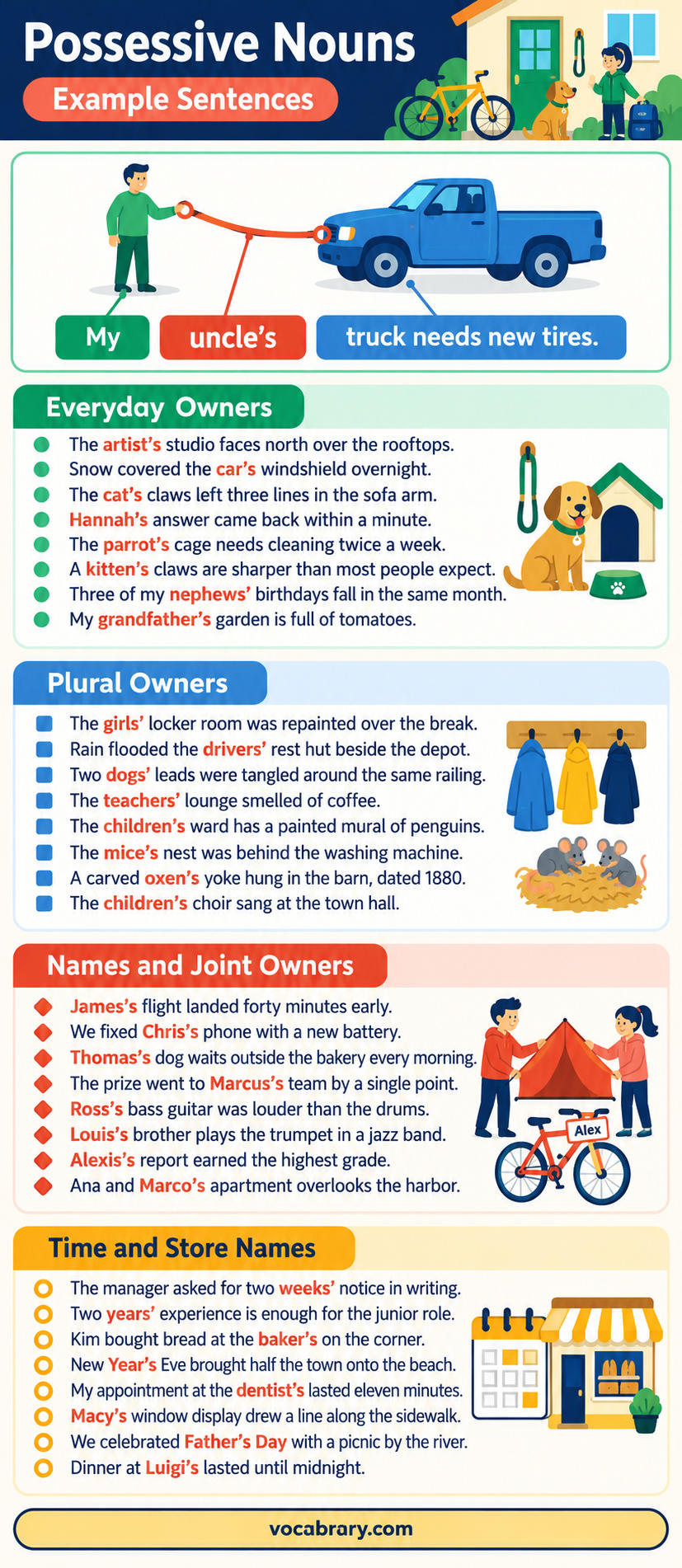
Common Possessive Noun Example Sentences
Maria’s passport, the dog’s lead, and the twins’ bedroom are the possessive nouns learners meet first, and each one names an owner right in front of whatever that owner has.
- Maria’s passport expired two weeks before the wedding.
- The dog’s lead hangs on a hook by the back door.
- My brother’s phone rang three times during the film.
- Nobody touched Ana’s birthday cake before midnight.
- Our grandmother’s recipe uses four eggs and no sugar.
- Ahmed’s bicycle lost a pedal halfway up the hill.
- A crack ran along the vase’s base.
- Everyone laughed at the baby’s first word, which turned out to be the name of the neighbour’s cat.
- The twins’ bedroom looks out over a small garden.
- I borrowed my neighbour’s ladder to reach the gutter.
- Did you find the driver’s licence in the glove compartment?
- Priya’s answer surprised the whole panel of judges at the regional science fair.
- Rain soaked the postman’s uniform before eight o’clock.
- Her father’s watch stopped on the morning of the wedding.
- The hotel’s wifi password was printed on a small plastic card.
- Daniel’s jacket was still hanging on the back of the chair.
- We repainted the shed’s roof last Sunday.
- Two of the students’ projects filled the whole corridor display.
- That restaurant’s kitchen closes at ten on weekdays.
- Sofia’s cousins arrived from Lisbon without warning.
Possessive Noun Forms by Noun Type
A singer’s microphone, the girls’ changing room, the children’s ward, and my sister-in-law’s flat show the spellings that give learners the most trouble, and the noun in front of the apostrophe decides every one.
| Noun type | Rule | Example sentence |
|---|---|---|
| Singular noun | Add an apostrophe and s | The artist’s studio faces north. |
| Singular noun ending in s | Add an apostrophe and s | James’s flight landed early. |
| Plural noun ending in s | Add an apostrophe after the s | The girls’ team won on penalties. |
| Irregular plural | Add an apostrophe and s | The children’s coats hung by the door. |
| Plural with no owner | Use no apostrophe at all | The bananas turned brown by Friday. |
| Compound noun | Add an apostrophe and s to the last word | My sister-in-law’s car broke down. |
| Joint ownership | Add an apostrophe and s to the second name | Ana and Marco’s flat has two balconies. |
| Separate ownership | Add an apostrophe and s to both names | Ana’s and Marco’s phones rang at once. |
| Time expression | Add an apostrophe by the same plural rule | Two weeks’ notice is enough. |
Singular Nouns With Apostrophe S
One owner takes an apostrophe and s, so the artist’s studio, Yusuf’s homework, and the landlord’s number all end the same way whatever letter finishes the noun.
- The artist’s studio faces north over the rooftops.
- Yusuf’s homework was still in his locker on Monday morning.
- A child’s ticket costs half the adult fare.
- My aunt’s garden produces more tomatoes than she eats.
- Our company’s logo changed for the third time this year.
- Grandpa’s hearing aid whistles whenever he hugs somebody.
- Snow covered the car’s windscreen overnight.
- Every nurse’s badge was checked at the entrance.
- Layla’s violin came from a small workshop in Cremona, where her grandfather once studied the craft.
- Our landlord’s number is written on the fridge door.
- The cat’s claws left three lines in the sofa arm.
- Diego’s verdict on the film was one word long.
- Frost cracked the pipe’s outer seal during the cold week.
- I read the doctor’s note twice before I understood the handwriting.
- That school’s front gate opens at seven.
- Hannah’s answer came back within a minute.
Plural Nouns Ending in S With the Apostrophe After the S
The girls’ changing room, the farmers’ stalls, and the workers’ helmets put the apostrophe after the s, because the owner was already plural before the possessive form was spelled.
- The girls’ changing room was repainted over the holidays.
- Farmers’ stalls fill the square every Saturday morning.
- Our neighbours’ fence blew down in the March storm.
- Rain flooded the drivers’ rest hut beside the depot.
- Students’ grades went up after the tutoring scheme began in September.
- A notice about the teachers’ meeting was pinned near the staff kitchen.
- The workers’ helmets were stacked by the site office.
- Parents’ evening runs from six until nine.
- My sisters’ flat has one bedroom between the two of them.
- Somebody moved the players’ water bottles off the bench.
- Babies’ clothes are on the second floor, next to the shoe department.
- Two dogs’ leads were tangled around the same railing.
- That ladies’ choir rehearses in the church hall on Thursdays.
- Countries’ borders change slowly, and old maps confuse travellers who trust a printed atlas from thirty years ago.
Irregular Plurals With Apostrophe S
Children’s, men’s, women’s, and people’s take an apostrophe and s like a singular noun, because the plural spelling itself never ends in s.
- The children’s ward has a painted mural of penguins.
- Men’s trousers are on the second floor.
- A women’s cycling team trains on the coast road each spring.
- People’s memories of that night differ from one street to the next.
- The mice’s nest was behind the washing machine.
- Geese’s feathers covered the path by the pond, and two toddlers gathered them into a paper bag.
- Our school sells children’s books at the summer fair.
- Women’s football packs the stadium on final day.
- A carved oxen’s yoke hung in the barn, dated 1880.
- Men’s voices carried across the empty car park after midnight.
- Nobody moved the children’s shoes from the hallway.
- People’s patience ran out during the fourth hour of the delay.
Names Ending in S
James’s flight, Charles’s allotment, and Chris’s phone keep the extra s after the apostrophe, the spelling most style manuals now prefer for one person.
- James’s flight landed forty minutes early.
- Charles’s allotment produces the best onions on the street.
- We fixed Chris’s phone with a new battery.
- Lucas’s parents drove down from Aberdeen for the ceremony.
- Thomas’s dog waits outside the bakery every morning.
- Nobody found Agnes’s glasses until the next Tuesday.
- Iris’s paintings hang in a small gallery near the harbour.
- The prize went to Marcus’s team by a single mark.
- Nicholas’s email arrived while the meeting was still running.
- Our teacher read Dickens’s original ending aloud to the class.
- The whole family parks on the Joneses’ driveway, because three cars never fit inside one narrow garage.
- Ross’s bass guitar was louder than the drums.
Compound and Hyphenated Nouns
My sister-in-law’s car, the editor-in-chief’s decision, and a six-year-old’s drawing add the apostrophe and s to the last word of the compound, never to the first.
- My sister-in-law’s car broke down outside the station.
- The editor-in-chief’s decision ended the argument in one line.
- A six-year-old’s drawing of the family dog won the village prize.
- Mother-in-law’s tongue is the nickname for that spiky houseplant.
- Reporters printed the attorney general’s statement at noon.
- We waited beside the runner-up’s bench for the photograph.
- Her brother-in-law’s jokes at the wedding lasted eleven minutes.
- The commander-in-chief’s plane landed at a military airfield.
- A passer-by’s quick phone call brought the ambulance within six minutes, and the injured driver survived.
- Yesterday the deputy head teacher’s office stayed locked all afternoon.
Joint Ownership and Separate Ownership
Ana and Marco’s flat has one set of keys, while Ana’s and Marco’s phones ring separately, so the second apostrophe turns up only when two owners have different objects.
- Ana and Marco’s flat overlooks the harbour.
- Ana’s and Marco’s phones rang at the same moment.
- We borrowed Lena and Sam’s tent for the weekend.
- Lena’s and Sam’s exam grades arrived in separate envelopes.
- Priya and Omar’s wedding photographs filled three albums.
- Priya’s and Omar’s families come from opposite ends of the country.
- The twins share Hugo and Mia’s old bunk bed.
- Hugo’s and Mia’s bicycles need new tyres before the summer trip.
- Kofi and Adwoa’s restaurant opened in March.
- Kofi’s and Adwoa’s signatures appear on both pages of the lease, dated the same afternoon.
- My parents keep Grandma and Grandpa’s letters in a wooden chest.
- Grandma’s and Grandpa’s birthdays fall in the same week.
Possessive Nouns With Time and Money
A day’s work, two weeks’ notice, and five pounds’ worth of chips treat time and money as owners, and the plural forms still take the apostrophe after the s.
- After a day’s work in the orchard, nobody wanted to cook.
- The manager asked for two weeks’ notice in writing.
- An hour’s delay at the gate turned into four hours on the runway.
- Three months’ salary went straight into the deposit for the flat.
- Yesterday’s newspaper was still on the doormat.
- We bought five pounds’ worth of chips for the whole crew and still had change from a twenty.
- Tomorrow’s meeting starts half an hour earlier than usual.
- A moment’s hesitation cost the runner her place in the final.
- Today’s date was wrong on every printed form.
- Two years’ experience is enough for the junior role.
- Ravi took a night’s rest before driving the last four hundred kilometres.
- Next week’s timetable is pinned by the staffroom kettle.
Possessive Nouns Before a Gerund
Ana’s singing, the team’s winning, and Tom’s leaving early put a possessive noun in front of an -ing form, so the owner is also the one doing the action.
- Ana’s singing woke the baby at five in the morning.
- Nobody minded Tom’s leaving early on Friday.
- The team’s winning surprised every reporter in the press room.
- Grandad’s snoring reaches the far end of the corridor.
- My mother’s cooking beats every restaurant in town.
- Sara’s complaining about the timetable changed nothing at all.
- The crowd’s booing forced the referee to stop the match for a full minute before the free kick.
- Dev’s arriving late annoyed the entire cast.
- Her father’s whistling gave away the surprise party before anyone opened the door.
- Layla’s insisting on a rematch amused the older players.
Possessive Nouns in Titles, Shops, and Place Names
St Paul’s Cathedral, McDonald’s, Mother’s Day, and the baker’s on the corner keep an apostrophe inside the name itself, long after the first owner was forgotten.
- St Paul’s Cathedral was the last stop on the walking tour.
- We ate at McDonald’s because everything else had closed.
- Mother’s Day falls on a different Sunday in each country.
- Kim bought bread at the baker’s on the corner.
- New Year’s Eve brought half the town onto the beach.
- My appointment at the dentist’s lasted eleven minutes.
- Macy’s window display drew a queue along the pavement.
- Our class visited King’s College on a wet Thursday in March, and the porter let us shelter inside.
- Valentine’s Day cards outsold birthday cards that week.
- The sign for Harrods has no apostrophe, unlike Sainsbury’s two streets away.
- St Patrick’s Day parades filled Fifth Avenue in New York.
- Meat for the stew came from the butcher’s beside the flower stall.
Possessive Nouns in Daily Settings
Kettles, lockers, and staff rotas supply most everyday possessives, from the flatmate’s kettle at home to the head teacher’s notice at school and the client’s invoice at work.
Possessive Nouns at Home
A flatmate’s kettle, Dad’s keys in the cutlery drawer, and Grandma’s armchair by the window are the household possessives that come up in ordinary conversation.
- My flatmate’s kettle broke on the coldest morning of the year.
- The baby’s bottle was warming on the counter.
- Dad’s keys turned up inside the cutlery drawer.
- We hid the puppy’s chew toy behind the sofa.
- Mum’s old sewing machine still works after forty years.
- A guest’s towel was folded at the end of the spare bed.
- Grandma’s armchair faces the window and the bird feeder.
- Somebody left the freezer’s door open all night.
- Ravi’s bedroom smells of paint after last weekend.
- The landlord’s plumber arrived three days late with the wrong part, so the leak continued all weekend.
- Nadia’s slippers were under the radiator where she always leaves them.
- Half the family’s photographs are still in unopened cartons from the move.
Possessive Nouns at School
A head teacher’s notice, Omar’s calculator, and two pupils’ essays read out in assembly show how possessive nouns name owners across a school day.
- The head teacher’s notice went up beside the main staircase.
- Omar’s calculator stopped working during the maths exam.
- Two pupils’ essays were read out in assembly.
- My classmate’s handwriting is smaller than mine.
- Mrs Ito’s attendance sheet was missing three names on Monday.
- Chalk dust covered the teacher’s sleeve by the end of the lesson.
- Students’ lockers are cleared out every July.
- A librarian’s stamp marks the inside cover of each book.
- Zainab’s science project used four litres of vinegar.
- The school’s football pitch floods after every heavy rain.
- Boys’ and girls’ changing rooms are on opposite sides of the gym.
- Nobody understood the examiner’s question about the second poem, so the whole row left it blank.
Possessive Nouns at Work
A client’s invoice, the firm’s accountant, and a colleague’s mistake that delays a shipment are the possessive nouns that fill emails in any office.
- The client’s invoice arrived before the work was finished.
- Sofia’s report reached the director before nine.
- A colleague’s mistake delayed the whole shipment by two days.
- Managers’ cars fill the row nearest the entrance.
- My supervisor’s patience ran out at the fourth meeting.
- Yesterday’s stock count was wrong by eleven crates.
- Our firm’s accountant found the error inside an hour.
- Hassan’s shift ends at six on Fridays.
- Somebody parked in the doctor’s bay again.
- Workers’ wages rose after the union meeting in October.
- The receptionist’s headset kept cutting out during long calls.
- Nina’s email about the audit reached forty people before she noticed the wrong attachment at the bottom.
Possessive Nouns for Families and Pets
A parrot’s cage, my cousin’s wedding, and Aunt Mei’s dumplings are the family and pet possessives that fill first compositions and photo captions.
- The parrot’s cage needs cleaning twice a week.
- My cousin’s wedding takes place in a small chapel near Cork.
- Bruno’s bowl is refilled before breakfast.
- Our rabbit’s hutch was moved into the shed for winter.
- Aunt Mei’s dumplings disappear within ten minutes at every family gathering.
- A kitten’s claws are sharper than most people expect.
- Grandpa’s stories about the fishing boat never end the same way twice, and nobody minds the changes.
- The hamster’s wheel squeaked until Dad oiled it.
- Uncle Sami’s car smells of pine and old coffee.
- Three of my nephews’ birthdays fall in the same month.
- Tilly’s fur turned grey around her nose this year.
- We photographed the twins’ first day at nursery.
Possessive Nouns for Sports Teams
The goalkeeper’s gloves, United’s manager, and the swimmers’ medals show possessive nouns naming teams, players, and officials in match reports.
- The goalkeeper’s gloves were soaked before half time.
- United’s manager named an unchanged side for Saturday.
- Our club’s stadium seats twelve thousand people.
- Volunteers pinned the runners’ numbers on before the warm-up.
- Serena’s serve ended the rally in under four seconds.
- A referee’s whistle stopped play in the final minute.
- Swimmers’ medals were handed out beside the pool.
- The coach’s notebook was full of diagrams from Tuesday’s session, none of which the players understood.
- Brazil’s forwards scored twice in the opening fifteen minutes.
- Rain delayed the players’ bus by two hours.
Possessive Nouns With Of Instead of an Apostrophe
The roof of the church, the name of the street, and the price of the ticket use of rather than an apostrophe, the form English prefers for objects and longer phrases.
- The roof of the church leaks.
- Nobody remembered the name of the street where the party was.
- By March the price of the ticket had doubled.
- We repainted the door of the garage last August.
- Everybody noticed the smell of the bread long before the bakery opened.
- Snow covered the top of the mountain until late June.
- Evening light changed the colour of the walls completely.
- Ana photographed the arrival of the train from the footbridge.
- A street scene from Lisbon filled the cover of the magazine.
- Marek learned the history of the building from an old caretaker who still had the keys.
- A power cut delayed the start of the concert by forty minutes.
- Half the pages of the report were printed upside down.
Sentences Corrected With the Right Apostrophe
Its written as it’s, childrens’ for children’s, and a plain plural given an apostrophe are the three slips that fill marked homework, and the owner decides where the apostrophe goes.
- The dog hurt its paw ✅, not the dog hurt it’s paw ❌, which spells it is.
- A children’s playground reopened in April ✅, never a childrens’ playground ❌.
- We bought three pizzas ✅, not three pizza’s ❌, because a plural with no owner takes no apostrophe.
- Signs for the women’s changing room ✅, never the womens’ changing room ❌.
- Both boys’ bikes were stolen ✅, not both boy’s bikes ❌ when two boys own them.
- My handwriting is worse than James’s ✅, and Jame’s ❌ is wrong in every style manual.
- She gave two weeks’ notice ✅, not two weeks notice ❌ with no apostrophe at all.
- Whose bag is under the seat ✅, never who’s bag is under the seat ❌.
- Next door, the Joneses’ dog barks all night ✅, not the Jones’s dog ❌ when the whole family is meant.
- Music from the 1990s ✅, never the 1990’s ❌, since a decade owns nothing.
- That is my sister-in-law’s address ✅, not my sister’s-in-law address ❌.
- Head office closed the company’s branches ✅, not the companys branches ❌ with no apostrophe.
Possessive Noun Example Sentences for Kids
A puppy’s tail, Mia’s lunchbox, and the teacher’s gold star are the possessive nouns children write first, each naming one owner and whatever that owner has.
- My puppy’s tail never stops wagging.
- Mia’s lunchbox has a picture of a rocket on the lid.
- The teacher’s gold star went at the top of the chart.
- Ben’s football rolled under the parked car.
- A frog’s back legs are strong enough for a jump across the whole pond.
- Grandma’s biscuits taste better than shop ones.
- Our cat’s favourite bed is the warm windowsill.
- Dad’s hat blew off in the wind.
- Two rabbits’ ears popped up over the grass.
- Ella’s kite got stuck in the tallest tree in the school playground.
- The baby’s rattle fell out of the pram.
- Sam’s bike has a bell shaped like a ladybird.
Possessive Noun Example Sentences for Students
An examiner’s comment, the university’s library hours, and last term’s grades are the possessive nouns that turn up in essays, timetables, and feedback.
- The examiner’s comment on my essay filled the whole margin.
- Priya’s revision timetable runs for eleven weeks.
- Our university’s library opens until midnight in exam season.
- Last term’s grades arrived by email on the first of July.
- Ahmed’s dissertation argues against the standard reading of the poem, and two examiners agreed with him.
- A tutor’s comment in red ink changed the whole conclusion.
- Students’ union elections take place in the second week.
- The professor’s lecture notes are shared the night before each class.
- Hana’s laptop died halfway through the online exam.
- Three candidates’ answers were marked again after the appeal.
- Tomorrow’s seminar needs two chapters of reading beforehand.
- My flatmate’s alarm wakes the whole corridor at six.
Short Possessive Noun Sentences for Young Learners
Tom’s cap, the bird’s nest, and Anna’s new shoes make four-word and five-word sentences that beginners copy straight into a notebook.
- Tom’s cap is red.
- The bird’s nest is empty.
- Anna’s shoes are new.
- My dog’s name is Pip.
- Leo’s book is on the bed.
- A bee’s wings are tiny.
- Sara’s door is open.
- That boy’s kite flew high.
- Mum’s car is blue.
Possessive Nouns in a Short Paragraph
Nadia’s alarm, the neighbours’ cat, and a locksmith’s van run through one Saturday morning, where each possessive noun names the next owner in the story.
- Nadia’s alarm failed on Saturday morning.
- Her brother’s shouting from the kitchen woke her instead.
- The neighbours’ cat had walked across the wet paint on the porch.
- Dad’s newspaper was already soaked by the sprinkler.
- Nobody found the car’s spare keys in the usual drawer.
- A locksmith’s van arrived at eleven and stayed for an hour.
- By noon the family’s plans for the beach had collapsed.
- Everyone agreed that the family’s ruined Saturday was the week’s best story.
Related
FAQs
An everyday example is "Maria’s passport expired two weeks before the wedding." Another is "The dog’s lead hangs on a hook by the back door."
With a plural owner, one example is "Farmers’ stalls fill the square every Saturday morning." Another is "The workers’ helmets were stacked by the site office."
An irregular plural example is "The children’s ward has a painted mural of penguins." Another is "A women’s cycling team trains on the coast road each spring."
For a name ending in s, one example is "James’s flight landed forty minutes early." Another is "We fixed Chris’s phone with a new battery."
A compound example is "My sister-in-law’s car broke down outside the station." Another is "The editor-in-chief’s decision ended the argument in one line."
For joint ownership, one example is "Ana and Marco’s apartment overlooks the harbor." Another is "We borrowed Lena and Sam’s tent for the weekend."
With time, one example is "The manager asked for two weeks’ notice in writing." Another is "A moment’s hesitation cost the runner her place in the final."
Before a gerund, one example is "Ana’s singing woke the baby at five in the morning." Another is "Nobody minded Tom’s leaving early on Friday."
A school example is "Oliver’s calculator stopped working during the math exam." Another is "Chalk dust covered the teacher’s sleeve by the end of the lesson."
For kids, one example is "My puppy’s tail never stops wagging." Another is "Mia’s lunchbox has a picture of a rocket on the lid."
Related:

Leave a Comment