
A verbal noun is a noun form derived from a verb that works as a full noun in the sentence, as in the arrival of the train. These verbal noun example sentences show -ing endings, -tion suffixes, and bare forms such as a run and a swim across home, school, and workplace scenes.
What Is a Verbal Noun?
A verbal noun is formed from a verb and works as a full noun, taking articles, adjectives, and plural endings the same way any other noun does. A gerund also comes from a verb and ends in -ing, yet a gerund retains verb-like grammar such as taking a direct object, while a verbal noun does not.
Verb stem + suffix (-ing, -tion, -ment, -al, -ance, -ure, or none)
The late arrival of the ferry left fifty passengers on the dock.
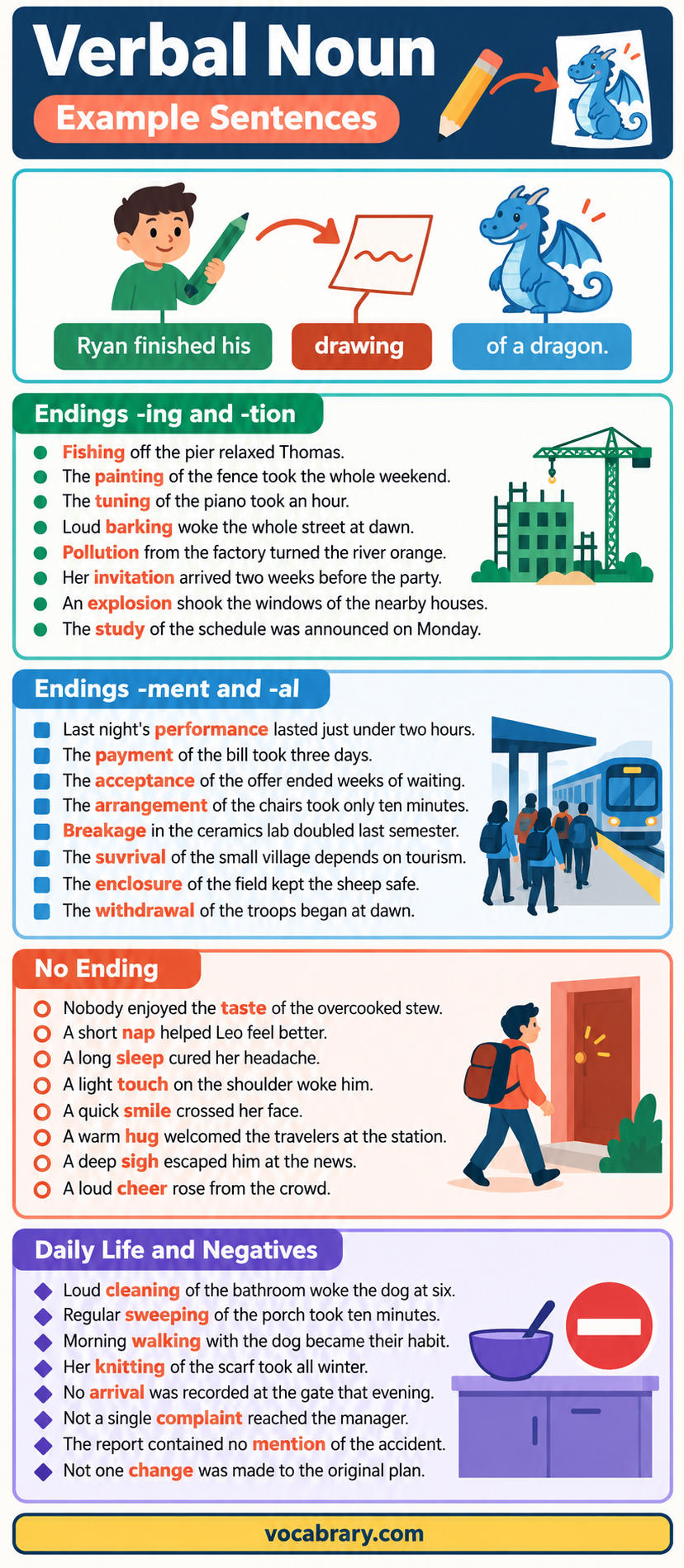
Common Verbal Noun Example Sentences
Arrival at the station, laughter in a quiet room, and the reading of a bedtime story are verbal nouns a learner meets in the first week of noun study. The verb root is still visible in the spelling of every one.
- An early arrival of the morning train woke everyone on the platform.
- Ravi’s reading improved after three months of daily practice at the local library.
- Laughter echoed through the empty corridor when the youngest cousin retold the joke from dinner.
- A sudden movement behind the curtain startled the cat and knocked a vase off the sill.
- Controlled blasting brought the destruction of the old bridge over four long days.
- Her decision surprised the entire hiring panel.
- Swimming before breakfast became Amara’s favorite routine during the long summer holidays.
- Dad’s cooking left the whole kitchen smelling of garlic.
- After the final note, the performance earned a standing ovation from every row.
- My breathing steadied after ten minutes of rest in the shade.
- Kofi’s departure from the team disappointed every player on the squad.
- A slow growth in membership brought the choir from twelve singers to forty in one season.
- Late payment of the invoice delayed the delivery by two weeks.
- Elena’s painting of the harbour won first prize at the county fair.
- Running in the park before work burned off the tension of a twelve-hour shift the day before.
- Nobody expected the failure of both engines during the climb.
- The approval came through on the last day before the deadline.
- His discovery of a Roman coin in the field made the local newspaper.
- Building near the coast requires a separate permit.
- Winter storage of thick coats and boots crowds the attic every April.
- The singing from the school choir drifted across the playground and reached the car park.
- Priya noticed an improvement in her spelling after two months of extra homework.
- Walking along the canal after dinner is the quickest route to the market square.
- Immediate closure of the factory put three hundred workers out of a job.
- A loud crash in the hallway sent the dog under the bed while the rest of us froze.
Verbal Noun Examples by Suffix
Destruction, movement, arrival, and storage all come from verbs, yet each one has a different suffix that marks it as a noun.
| Suffix | Base verb | Verbal noun | Example sentence |
|---|---|---|---|
| -ing | read | reading | Ravi’s reading of the map saved the whole group from taking the wrong trail. |
| -tion | destroy | destruction | The destruction of the old warehouse cleared a full city lot. |
| -sion | decide | decision | Her decision to accept the offer ended weeks of waiting. |
| -ment | move | movement | A sharp movement in the branches sent the birds into the air. |
| -ance | perform | performance | Last night’s performance lasted just under two hours. |
| -ence | exist | existence | The existence of the tunnel was a secret for decades. |
| -al | arrive | arrival | The arrival of the ambassador drew cameras to the airport gate. |
| -age | store | storage | Storage underneath the stairs freed up an entire room upstairs. |
| -ure | depart | departure | An early departure gave them six extra hours on the island. |
| (none) | run | a run | A morning run along the beach started every day of the trip. |
Verbal Nouns Ending in -ing
Swimming, writing, and snoring end in -ing yet take determiners and adjectives the way any other noun does.
- Swimming at the municipal pool starts at seven every morning.
- The writing on the envelope was too small for Grandma to read.
- Dancing after midnight kept the neighbours awake until the music stopped.
- Loud snoring from the tent next door ruined the whole camping trip.
- Cleaning of the stadium after the cup final took a full crew, two scrubbers, and fourteen hours from midnight until noon.
- Marta’s drawing of the cathedral hung on the classroom wall for a month.
- Old heating in this building breaks down every December.
- Fishing off the pier relaxed Tomas.
- My training for the half-marathon lasted sixteen gruelling weeks and ended with a personal best on race day.
- Parking near the hospital is impossible after nine in the morning.
- Did Farid’s singing impress the judges at the audition?
- Nobody predicted the flooding of the basement that ruined two shelves of old photographs.
Verbal Nouns Ending in -tion and -sion
Destruction of a reef, education at a village school, and permission to cross the border use -tion or -sion to turn a verb into a countable noun.
- Destruction of the reef alarmed marine biologists across the region.
- His education at the village school shaped every choice he made afterward.
- Leila waited three days for the permission to cross the border.
- A wrong decision during the trial changed the outcome for both sides.
- Pollution from the factory turned the river orange.
- The construction of the bridge lasted two full years.
- Kwame’s promotion came with a new desk and twice the responsibility.
- An explanation of the delay satisfied nobody in the waiting room.
- Quick repetition of the drill made the youngest students confident by Friday.
- Did anyone question the selection of the final candidate?
- Admission to the gallery is free on the first Sunday of every month.
- Nadia’s connection to the internet dropped twice during her video interview with the London hiring committee.
Verbal Nouns Ending in -ment, -ance, and -ence
Movement of troops, performance at a recital, and existence of a secret room add -ment, -ance, or -ence to verb roots that no longer end in -ing.
- Movement of troops toward the border alarmed the neighbouring country overnight.
- Yusuf’s achievement at the science fair earned him a university scholarship.
- Agreement between the two sides ended months of dispute.
- Rosa’s performance at the recital silenced the critics who doubted her talent.
- The existence of the secret room was only revealed during the renovation.
- Weeks of endurance training prepared the swimmer for the open-water race across the strait.
- Appearance of the first snowdrops told the gardener that spring was near.
- Ahmed’s attendance at every meeting showed his dedication to the project.
- The replacement of every window on the ground floor took the crew a full week.
- Nobody questioned her competence after she presented the quarterly numbers to the board without a single error.
- Governance of the district passed to an elected council in 2018.
- Did the maintenance crew finish before the morning shift arrived?
Verbal Nouns Ending in -al, -age, and -ure
Arrival of an ambulance, storage underneath the stairs, and departure at dawn use three less-frequent suffixes that still produce full nouns from verbs.
- Arrival of the ambulance took nineteen minutes in heavy traffic.
- The removal of asbestos from the roof closed the school for three weeks.
- Sanjay’s approval of the new menu was the last step before the restaurant opened.
- Breakage in the ceramics lab doubled last term.
- Storage underneath the stairs freed up a full room on the second floor.
- Heavy drainage from the hillside washed soil into the lower fields every spring.
- Their departure for the airport at four in the morning left the house silent, and the dog paced the hallway until noon.
- The failure of the backup generator left the hospital dark for forty minutes.
- Closure of the mine ended a tradition that went back four generations.
- Did the exposure of the film to sunlight ruin every photograph on the roll?
Zero-Suffix Verbal Nouns in Sentences
A run, a walk, a swim, and a laugh are nouns spelled exactly like their parent verbs, with nothing added or changed.
- An early-morning run woke Jonas up faster than any alarm.
- Leila went for a swim in the bay before the rest of the family had even poured their morning tea.
- A brisk walk through the park cleared Diego’s head after the argument.
- Their drive from Madrid to Lisbon took nine hours with one stop for fuel.
- One loud laugh from the back row broke the tension during the exam.
- Grandma’s fall on the icy path kept her in hospital for a week.
- Mei’s guess at the final answer turned out to be right.
- A quick look through the window told her the garden was flooded.
- Talk of a new motorway divided the village into two camps.
- Nobody enjoyed the taste of the overcooked stew.
- His first try at the high bar ended with a fall onto the crash mat.
- Did the catch of the season break the old record?
Verbal Noun Examples in Everyday Life
The cooking in the kitchen, weekend gardening in the yard, and morning reading by the lamp name the daily routines in every home.
- Morning breathing exercises relaxed Nina before her commute to the office.
- The cooking in our house never stops between five and seven in the evening.
- Weekend gardening gave Ravi a break from his desk and his screen.
- Reading before bed is the one habit Amara refuses to give up.
- Farid’s shopping for groceries ate up the entire Saturday morning.
- Loud cleaning of the bathroom woke the dog at six.
- Persistent knocking on the front door interrupted dinner for the second night in a row.
- Ironing of ten shirts took Hugo an hour and a half every Sunday.
- Her walking to the bus each morning saved the family a second car.
- Daily jogging at the community centre kept Grandpa fit into his nineties.
- Ahmed’s driving test was postponed because of a snowstorm.
- Nobody finished the washing before the power went out at ten.
- Baking of three dozen rolls for the neighbours filled the kitchen with warmth on a freezing Friday.
- Priya’s sewing of the torn curtain saved the family from buying a new one.
- Did the painting of the living room ceiling take more than one coat?
- Quick dusting of the shelves twice a week kept the allergies from getting worse.
- Nightly watering of the tomato plants was Elena’s only summer chore.
Verbal Noun Examples at School and at Work
Teaching of advanced mathematics, weekly revision before exams, and management of the department budget are verbal nouns that a student or an office worker encounters daily.
- Teaching of advanced mathematics brought Professor Oka to the university from Osaka.
- Weekly revision before exams improved every student’s grade by the end of the year.
- The spelling in his essay was perfect for the first time all term.
- Sanjay’s management of the budget kept the department under its spending limit.
- Employment at the new factory doubled the number of jobs in the town.
- Marta’s supervision of the interns lasted the entire summer placement.
- A sudden announcement from the principal cancelled the Friday assembly.
- Enrollment at the language school rose sharply after the town welcomed fifty new families from three different countries last autumn.
- His retirement from the company ended a thirty-year career in engineering.
- Did the assessment of her portfolio go well?
- Recruitment for the summer program began in March and closed in April.
- Late submission of the report cost the team its bonus.
- Nobody challenged Kwame’s presentation of the findings to the board.
- Rosa’s instruction of the new hires took three full days of workshops.
- Development of the software patch ran two weeks behind the original schedule.
Verbal Noun Examples in Negative Sentences
No arrival at the gate, zero approval from the committee, and failure to meet the deadline put verbal nouns into sentences that deny rather than affirm.
- No arrival was recorded at the gate that evening.
- The refusal of the loan left the family without options for the school fees.
- Ahmed’s non-payment of the rent led to an eviction notice on the door.
- Not a single improvement followed the three rounds of repairs.
- Failure to submit the form on time disqualified two of the strongest applicants and delayed the entire selection process by a fortnight.
- Zero approval from the committee reached the team for the entire month.
- Destruction of the evidence proved impossible once the investigators arrived.
- There was no acknowledgment of the error in the manager’s written response.
- Nobody witnessed Kofi’s quiet departure from the party.
- Did the rejection of the manuscript discourage the author?
Short Verbal Noun Sentences for Kids
A swim, a run, a loud splash, and a drawing of a dragon give children verbal nouns they already know from their own play.
- The afternoon swim starts at ten.
- Ravi finished his drawing of a dragon.
- Loud singing woke the baby during nap time.
- My reading homework has three new words this week.
- A quick run around the garden wore the puppy out.
- Dad’s cooking smelled wonderful tonight.
- A big splash surprised the ducks at the pond.
- Her painting of the sunset used every colour in the set and took the rest of the art lesson to dry.
- Nana’s baking made the kitchen warm for the whole afternoon while we sat and watched.
- Nobody liked the taste of the green soup at lunch.
- Clapping after the song made the performers smile and bow twice.
- Did the catching of the ball hurt your hand at practice?
Verbal Nouns and Gerunds in the Same Sentence
The slow reading of a poem, the careful building of a wall, and Michelangelo’s painting of the Chapel ceiling are verbal nouns placed next to a gerund form of the same word in one sentence.
- The slow reading of the poem moved the audience, while reading it aloud at rehearsal felt rushed.
- Building of the wall was careful and slow, but building it again without a plan wasted bricks.
- Michelangelo’s painting of the Sistine Chapel ceiling took four years, and painting each panel demanded steady hands.
- Her singing of the anthem impressed the crowd, but singing in the shower is something she does only when alone.
- Annual cleaning of the chimney prevents fires, yet cleaning a chimney yourself needs the right brushes.
- Competitive swimming in the relay tired every athlete, while swimming three extra laps afterward was the coach’s idea.
- Rapid typing of the report kept errors low, but typing without looking at the screen produced mistakes on every line.
- Quiet breathing during the meditation calmed the group, while breathing through a paper bag stopped the panic attack.
- Official testing of the water from three wells found no contamination, yet testing every house on the street after the autumn floods revealed a rise in iron that worried the whole neighbourhood.
- Overnight cooking of the feast filled the kitchen with steam, and cooking for sixty guests left the staff exhausted by noon.
Sentences Rewritten With the Correct Verbal Noun
Destroying, examining, and arriving become destruction, examination, and arrival in these corrections, where the -ing form gives way to the standard verbal noun suffix.
- ❌ The destroying of the old warehouse lasted a full week. ✅ The destruction of the old warehouse lasted a full week.
- ❌ His arriving late upset the entire schedule. ✅ His late arrival upset the entire schedule.
- ❌ The explaining of the new rules confused the youngest students. ✅ The explanation of the new rules confused the youngest students.
- ❌ Her refusing of the job offer offended the recruiter. ✅ Her refusal of the job offer offended the recruiter.
- ❌ The performing of the play went better than anyone predicted. ✅ The performance of the play went better than anyone predicted.
- ❌ His departing from the company was sudden. ✅ His departure from the company was sudden.
- ❌ The failing of the brakes caused the accident. ✅ The failure of the brakes caused the accident.
- ❌ Their examining of every witness took two days. ✅ Their examination of every witness took two days.
Related
FAQs
An everyday example is "An early arrival of the morning train woke everyone on the platform." Another is "Dad’s cooking left the whole kitchen smelling of garlic."
With an "-ing" ending, one example is "Swimming at the municipal pool starts at seven every morning." Another is "Marta’s drawing of the cathedral hung on the classroom wall for a month."
For "-tion", one example is "Destruction of the reef alarmed marine biologists across the region." Another is "The construction of the bridge lasted two full years."
With "-ment", one example is "Movement of troops toward the border alarmed the neighboring country overnight." Another is "Rosa’s performance at the recital silenced the critics who doubted her talent."
Without a suffix, one example is "A brisk walk through the park cleared Diego’s head after the argument." Another is "A quick look through the window told her the garden was flooded."
A daily example is "Weekend gardening gave Ryan a break from his desk and his screen." Another is "Nightly watering of the tomato plants was Elena’s only summer chore."
At work, one example is "Development of the software patch ran two weeks behind the original schedule." Another is "Late submission of the report cost the team its bonus."
A negative example is "No arrival was recorded at the gate that evening." Another is "There was no acknowledgment of the error in the manager’s written response."
With "-al", one example is "The removal of asbestos from the roof closed the school for three weeks." Another is "Their departure for the airport at four in the morning left the house silent, and the dog paced the hallway until noon."
For kids, one example is "The afternoon swim starts at ten." Another is "A big splash surprised the ducks at the pond."
Related:

Leave a Comment