
An infinitive is the word to followed by the base form of a verb, as in to travel, to learn, and to help. These 373 infinitive example sentences are written for subjects, objects, complements, modifiers, purpose, main verbs, negative, perfect, and passive forms, questions, and everyday contexts. You get model sentences for speaking, essays, and exam practice, together with related practice on bare infinitives, infinitive phrases, and gerunds.
Quick Answer: Infinitive Example Sentences
- Subject: To save money takes discipline.
- Object of a verb: Laila hopes to study medicine in Berlin.
- Subject complement: His dream is to open a bookshop.
- After a noun: We have a train to catch at six.
- Purpose: Amir called the hotel to book a room.
- After an adjective: The children were excited to see the snow.
- Negative form: Rosa promised not to be late.
- Passive form: The gate needs to be painted.
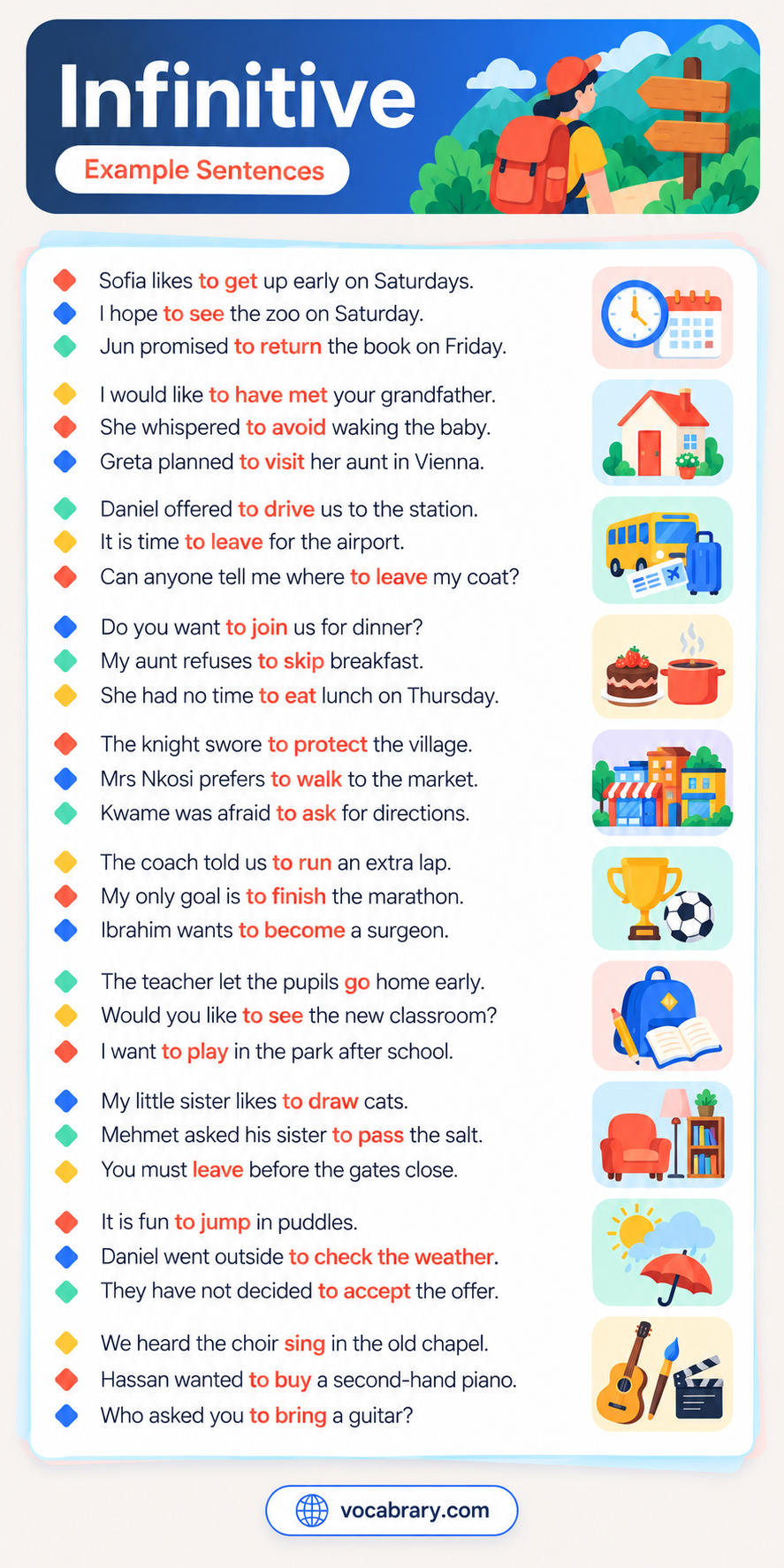
Infinitive Example Sentences for Everyday Use
An infinitive is a subject, an object, a complement, or a modifier in each sentence, as in “to travel”, “to buy”, and “to swim”.
- Anita wants to travel across South America next year.
- To learn a new instrument takes patience and regular practice.
- My neighbour offered to help with the heavy boxes.
- Everyone hoped to win the final match on Saturday.
- The children promised to tidy their rooms before dinner.
- Omar was the first student to arrive at the exam hall.
- We stopped at the bakery to buy fresh bread.
- It is rude to interrupt a speaker in the middle of a sentence.
- Lucia needs to rest after the long flight from Lima.
- The mechanic agreed to repair the bicycle for free.
- My grandfather loves to tell stories about his village.
- She had no time to eat lunch on Thursday.
- The museum plans to open a new gallery in spring.
- Yuki learned to swim at the age of four.
- I am happy to answer any question about the trip.
- They decided to sell the old farmhouse.
- Isabel is saving money to study marine biology.
- There is nothing to fear in this quiet little town.
- He was too tired to finish the crossword.
- To sing in front of a thousand people terrified the young tenor.
Noun Function Sentences with Infinitives
Subject, object, and complement are the three noun roles of the infinitive here, as in “to measure”, “to hire”, and “to read”.
Infinitive Example Sentences as Subjects
At the start of the sentence or after it, the infinitive is the subject, as in “to forgive”, “to walk”, and “to speak”.
- To forgive takes more courage than to stay angry.
- To travel alone teaches self-reliance quickly.
- To succeed in business requires luck as well as skill.
- To err is human, as Ravi reminded his nervous team.
- To walk in the forest at dawn was Marta’s greatest pleasure.
- To master the violin demands years of daily work.
- To lose a game gracefully shows real maturity.
- It is exhausting to argue with a stubborn friend.
- It takes courage to speak honestly about your mistakes.
- To rebuild the bridge before winter was the council’s main goal.
- It was a pleasure to meet your family last weekend.
- To read every night became Ayesha’s most important habit.
Infinitive Example Sentences as Objects of Verbs
Verbs such as want, decide, try, and expect take an infinitive as the object, as in “to leave”, “to arrive”, and “to join”.
- Hamid wants to leave the party before midnight.
- Priya decided to quit her job and open a cafe.
- The twins tried to climb the fence behind the school.
- Dmitri likes to cook dinner for his sisters.
- We expect to arrive in Cairo around noon.
- The cat refused to enter the carrier.
- Mrs Nkosi prefers to walk to the market.
- They began to build the shed in October.
- My cousin hopes to join the national orchestra.
- Sara forgot to bring her umbrella this morning.
- The company needs to hire two more engineers.
- Liam learned to ride a horse in the Argentine hills.
Infinitive Example Sentences as Subject Complements
After is or was, the infinitive completes a subject such as goal, dream, plan, or job, as in “to finish”, “to improve”, and “to see”.
- My only goal is to finish the marathon.
- Her dream was to teach children in a remote village.
- The plan is to leave before the guests arrive.
- Our main aim this term is to improve our spelling.
- His job is to inspect the bridges every spring.
- Her usual habit on Sundays is to listen to quiet music.
- What Hana wants most is to see her grandmother again.
- The purpose of the visit was to sign the contract.
- Her biggest ambition is to run a hospital in her home town.
- The aim of the experiment is to measure the speed of sound.
Modifier Sentences with Infinitives
Adding a description or a purpose, the infinitive follows a noun, a verb, or an adjective, as in “to tuck”, “to begin”, and “to afford”.
Infinitive Example Sentences After Nouns
Nouns and pronouns such as book, time, nothing, and anything are followed by an infinitive, as in “to read”, “to save”, and “to board”.
- Karim bought a book to read on the long train ride.
- Mina has three letters to post before the shop closes.
- There is nothing to eat in the fridge tonight.
- We need a place to stay in Prague for three nights.
- Priya has no reason to doubt her friend.
- She has a plan to save enough for a motorbike.
- It is time to leave for the airport.
- Do you have anything to declare at customs?
- The right to vote was won after decades of campaigning.
- Tomas has a lot of homework to finish before supper.
- The last passenger to board was a woman with a violin.
- Zainab found a quiet corner to read in the library.
- Nobody has the courage to tell the manager the truth.
- Her ability to solve puzzles amazed the whole class.
- The council announced a decision to close the old pool.
Infinitive Example Sentences for Purpose
The infinitive gives the reason for an action, as in “to buy”, “to lift”, and “to see”.
- Nina went to the market to buy fresh tomatoes.
- He ran all the way to catch the last bus.
- We left early in order to avoid the traffic.
- Rashid saves a little each month so as to afford a bicycle.
- The nurse stooped to lift the fallen child.
- Lena called the airline to change her ticket.
- Farmers rise before dawn to milk the cows.
- I am writing to apply for the position of librarian.
- She whispered to avoid waking the baby.
- They climbed the hill to see the sunrise.
- The students stayed late to finish the mural.
- Pablo uses a map to find his way through the old town.
- Chidi borrowed a ladder to fix the loose roof tiles.
- Svetlana practises scales every morning to strengthen her fingers.
Infinitive Example Sentences After Adjectives
Adjectives such as happy, afraid, ready, and eager are followed by an infinitive, as in “to help”, “to install”, and “to find”.
- Nadia was happy to help with the school fair.
- The instructions are easy to follow even for beginners.
- Kwame was afraid to ask for directions.
- We were delighted to hear about your promotion.
- The new software is simple to install on any laptop.
- Dara is ready to start her first shift at the clinic.
- The old bridge is dangerous to cross after heavy rain.
- I am sorry to trouble you so late at night.
- The students were eager to begin the experiment.
- That mountain path is hard to find in the dark.
- Mia was surprised to see her cousin at the station.
- The water here is safe to drink without boiling.
- Everyone was pleased to learn that the road had reopened.
- Her handwriting is difficult to read on a rainy day.
Infinitive Example Sentences with Too and Enough
With too and enough, an adjective or an adverb comes before the infinitive, as in “to walk”, “to drink”, and “to catch”.
- Samira was too tired to walk home after the concert.
- The box is light enough to carry with one hand.
- It was too dark to see the road signs.
- Raj is old enough to travel alone on the train.
- The tea was too bitter to drink without sugar.
- Is the lake warm enough to swim in today?
- She spoke too quietly to be heard at the back.
- We were lucky enough to find seats near the stage.
- The suitcase is too heavy for a child to lift.
- Tomas did not run fast enough to catch the bus.
- They arrived too late to join the opening ceremony.
- The room is big enough to hold forty guests.
- He was too proud to ask for any help.
- The shirt is not long enough to tuck in.
Main Verb Sentences with Infinitives
Main verbs followed by an infinitive, with or without an object, and question words before an infinitive appear here, as in “to take”, “to survive”, and “to buy”.
Infinitive Example Sentences After Want and Decide
Want, decide, plan, and hope are each followed by an infinitive, as in “to buy”, “to become”, and “to join”.
- Hassan wanted to buy a second-hand piano.
- The family decided to move closer to the sea.
- Greta planned to visit her aunt in Vienna.
- We hoped to see the comet from the roof.
- Ibrahim wants to become a surgeon.
- The committee decided to postpone the vote.
- Maria plans to write a novel during the summer.
- They hope to reach the summit before sunset.
- Do you want to join us for dinner?
- Our teacher has decided to give no homework this weekend.
- Kofi planned to surprise his sister with a cake.
- All the villagers hoped to hear good news from the council.
Infinitive Example Sentences After Promise and Refuse
An infinitive follows promise, refuse, manage, and afford, as in “to call”, “to land”, and “to return”.
- Claudia promised to call her mother every Sunday.
- The guard refused to open the gate without a pass.
- Despite the storm, we managed to reach the village.
- The students cannot afford to waste another week.
- The pilot promised to land before the fog arrived.
- He refused to leave the building until everyone was safe.
- Somehow Elif managed to finish the report overnight.
- Few families could afford to travel abroad that year.
- Jun promised to return the book on Friday.
- The mayor refused to comment on the rumour.
- Tendai managed to fix the engine with a paperclip.
- I cannot afford to buy a new laptop this month.
Infinitive Example Sentences After Agree and Offer
Agree, offer, learn, seem, and similar verbs take an infinitive, as in “to share”, “to play”, and “to run”.
- The neighbours agreed to share the cost of the fence.
- Daniel offered to drive us to the station.
- Anya learned to bake bread from her grandmother.
- The new student seems to know everyone already.
- The road appears to be blocked by a fallen tree.
- Both teams agreed to play the match on Sunday.
- Rafael offered to carry the heavy suitcase upstairs.
- Children learn to read faster when stories interest them.
- The old clock seems to run five minutes slow.
- The suspect pretended to sleep while the police searched the room.
- Camille threatened to resign if the budget was cut.
- Our guide happened to know the owner of the castle.
Infinitive Example Sentences After Tell and Ask
Tell, ask, want, and expect are followed by an object and an infinitive, as in “to run”, “to wash”, and “to write”.
- The coach told us to run an extra lap.
- Mehmet asked his sister to pass the salt.
- My boss wants me to finish the report by Friday.
- The villagers expect the rain to arrive by June.
- Mum told me to wash my hands before dinner.
- Aisha asked the waiter to bring a glass of water.
- I want you to meet my oldest friend.
- Everyone expected Vera to win the chess tournament.
- The teacher asked us to write our names clearly.
- She told her brother to stop teasing the dog.
- The director wants the actors to arrive an hour early.
- Nobody expected the old bridge to survive the flood.
Infinitive Example Sentences After Allow and Advise
Verbs such as allow, advise, warn, remind, and invite are followed by an object and an infinitive, as in “to enter”, “to attend”, and “to dismount”.
- The guard allowed the visitors to enter the garden.
- Our doctor advised us to drink more water.
- The lifeguard warned the swimmers not to go past the buoys.
- Tariq reminded his father to take his medicine.
- The school invited parents to attend the concert.
- The law does not allow drivers to use a phone at the wheel.
- The travel agent advised us to book early for the festival.
- Rosa warned her brother to be careful on the ice.
- The sign reminds cyclists to dismount on the bridge.
- Their hosts invited us to stay for supper.
- The captain ordered the crew to lower the sails.
- My teacher encouraged me to enter the national contest.
Infinitive Example Sentences After Question Words
Where, how, what, when, whom, which, and who come before the infinitive, as in “to go”, “to contact”, and “to park”.
- Nobody knew where to go after the bridge collapsed.
- Ines explained how to cook rice without a pot.
- Tell me what to bring to the picnic.
- We could not decide when to leave for the airport.
- Emeka asked whom to contact about the missing parcel.
- She could not choose which to buy from the tray of scarves.
- I have no idea what to say at his funeral.
- Ahmed showed the children how to plant a seed.
- The map shows where to park near the stadium.
- Nobody told us who to ask about the missing keys.
- Lena learned how to repair a flat tyre.
- Have you decided which road to take?
Form Sentences with Infinitives
Negative, perfect, continuous, passive, and split forms of the infinitive appear here, along with infinitives with longer phrases, as in “to complete before Friday”, “to quietly leave”, and “to be sleeping”.
Negative Infinitive Example Sentences
Not comes before to, as in “not to go”, “not to answer”, and “not to panic”.
- Aisha decided not to go to the party.
- The doctor told him not to eat anything after midnight.
- I promised not to tell anyone about the surprise.
- Please try not to make a noise.
- Kenji chose not to answer the question.
- She worked hard not to disappoint her parents.
- The sign asks visitors not to touch the paintings.
- We agreed not to argue about money at dinner.
- The coach told the players not to panic.
- It is important not to forget your passport.
- He pretended not to hear the insult.
- Their instructions were not to open the door for strangers.
Perfect Infinitive Example Sentences
To have plus a past participle forms the perfect infinitive, as in “to have forgotten”, “to have escaped”, and “to have visited”.
- She seems to have forgotten the appointment.
- I would like to have met your grandfather.
- The thief is believed to have escaped through a window.
- To have won that race was her proudest moment.
- They were glad to have finished before the storm.
- He claims to have visited forty countries.
- We were sorry to have missed your birthday.
- The explorer is said to have crossed the desert alone.
Continuous Infinitive Example Sentences
Continuous infinitives use to be or to have been plus an -ing form, as in “to be sleeping”, “to be passing”, and “to have been crying”.
- The baby seems to be sleeping at last.
- He pretended to be working when the manager walked in.
- I would love to be lying on a beach right now.
- The children appear to be playing in the garden.
- Ola happened to be passing the station when the train arrived.
- It is nice to be sitting by a fire on a cold night.
- She seems to be waiting for someone.
- The old man was said to be living in a tiny village.
- She seems to have been crying all morning.
- He claims to have been working on the book for ten years.
- The workers appear to have been digging here for weeks.
- I am sorry to have been keeping you waiting.
Passive Infinitive Example Sentences
A passive infinitive is to be plus a past participle, as in “to be finished”, “to be told”, and “to be carried”.
- The report needs to be finished by noon.
- She hopes to be chosen for the school choir.
- Mateo wants to be told the truth.
- There is a lot to be done before the guests arrive.
- The old paintings need to be restored before the exhibition.
- The injured player refused to be carried off the pitch.
- Children deserve to be listened to.
- The package is expected to be delivered on Tuesday.
Split Infinitive Example Sentences
Between to and the verb, there is a modifier, as in “to quickly expand”, “to finally win”, and “to gently wake”.
- The company plans to quickly expand into new markets.
- Marta tried to quietly leave without waking anyone.
- Our mission is to boldly explore the deep ocean.
- Gabriel wants to fully understand the contract before signing.
- The team hopes to finally win a trophy this year.
- I decided to carefully read every page of the manual.
- The government aims to gradually reduce the budget deficit.
- Nobody expected the shy boy to suddenly sing.
- Lena tried to gently wake her grandfather.
- She asked us to please keep the noise down.
- Farah wanted to completely repaint the old fence.
- The council promised to swiftly repair the broken lights.
Infinitive Example Sentences with Longer Phrases
Each infinitive has an object or a modifier, as in “to bake a chocolate cake”, “to see her grandchildren again”, and “to complete before Friday”.
- Alma wants to bake a chocolate cake for her mother.
- To finish the project before noon was our only goal.
- Daniel went outside to check the weather.
- The pupils began to sing a song about the sea.
- Her wish is to see her grandchildren again.
- Hugo bought a ticket to hear the orchestra play.
- To walk across the whole city took Mina four hours.
- We have a lot of work to complete before Friday.
- The company hopes to double its profits within two years.
- Beatriz was brave enough to speak in front of the whole school.
Question and Reported Sentences with Infinitives
After a negative main verb, in questions, and in reports, the sentences contain an infinitive, as in “to walk”, “to wait”, and “to sell”.
Infinitive Example Sentences in Negative Sentences
A negative word such as not, never, or nobody is used with the main verb.
- Kareem did not want to leave the beach so early.
- She never learned to drive a car.
- The students did not manage to finish the test in time.
- They have not decided to accept the offer.
- I don’t expect to win the lottery.
- He didn’t dare to open the cellar door.
- Naomi doesn’t plan to stay in Berlin after the course.
- Nobody wanted to speak first at the meeting.
- The shop did not offer to refund the broken cup.
- We haven’t forgotten to lock the front door.
Infinitive Example Sentences in Questions
Every sentence is a question that contains an infinitive, as in “to come”, “to see”, and “to find”.
- Do you want to come with us to the lake?
- Did she decide to sell her old camera?
- Who was the first woman to fly solo across the channel?
- Why did Omar choose to study physics?
- Would you like to see the new classroom?
- Is it hard to learn Japanese?
- Where do you plan to spend the holidays?
- Have the neighbours agreed to share the garden?
- What do you hope to find in the old trunk?
- Can anyone tell me where to leave my coat?
- Are you ready to order now?
- Who asked you to bring a guitar?
Infinitive Example Sentences in Reported and Passive Sentences
Reports of what people said, asked, or believed contain an infinitive, and so do sentences with passive verbs such as were asked and is said, as in “to wait”, “to move”, and “to study”.
- The officer told us to wait outside.
- She asked the children to be quiet.
- The bridge is said to be more than three hundred years old.
- He was believed to have left the country in March.
- Tom said that he planned to move to Oslo.
- The visitors were asked to remove their shoes.
- The teacher reminded the class to bring their dictionaries.
- The manager was thought to be retiring in June.
- Anna explained that she wanted to study music.
- Workers were told to wear helmets on the site.
- She was seen to enter the building at noon.
- The prisoners were allowed to walk in the yard for an hour.
Context Sentences with Infinitives
The settings are homes, classrooms, offices, journeys, newsrooms, stories, sports, and clinics.
Infinitive Example Sentences for Home Life
At home, the infinitives describe chores, repairs, and family routines, as in “to fix”, “to cook”, and “to switch”.
- Dad promised to fix the leaking tap by Saturday.
- I need to water the plants before we leave.
- My sister offered to cook dinner for the whole family.
- We bought a new sofa to replace the old one.
- Grandma likes to sit by the window and knit.
- Remember to switch off the oven before you leave.
- It is my turn to wash the dishes tonight.
- Tomas has decided to paint the kitchen yellow.
Infinitive Example Sentences for School Life
In the classroom, the infinitives describe lessons, exams, and school activities, as in “to open”, “to hand in”, and “to finish”.
- The teacher asked us to open our books at page ten.
- Hana studies every evening to prepare for the exam.
- Students are expected to hand in their essays on Monday.
- Mr Banerjee wants everyone to revise the formulas tonight.
- It is important to answer all the questions.
- Elena was the first pupil to finish the test.
- We stayed late to rehearse the school play.
- The headmistress encouraged the class to read more novels.
Infinitive Example Sentences for Work
At the office, the infinitives describe meetings, reports, and company tasks, as in “to attend”, “to meet”, and “to finish”.
- The manager asked Carla to attend the Monday meeting.
- I need to reply to forty emails before lunch.
- We hope to meet the client’s deadline this week.
- The firm plans to hire twenty new staff.
- Samuel was the first employee to receive the award.
- She works late to finish the quarterly report.
- Our task is to design a new logo.
- He called the supplier to confirm the delivery.
Infinitive Example Sentences for Travel
On the road, the infinitives describe trips, transport, and tourist plans, as in “to check”, “to pack”, and “to see”.
- We arrived early to check in without queuing.
- Beatriz plans to visit three countries in two weeks.
- Remember to pack a warm coat for the mountains.
- I want to catch the early train to Lyon.
- The guide told us to meet at the fountain.
- It was too foggy to see the coast from the ferry.
- Nobody has enough time to explore the whole city.
- They hired a car to reach the remote villages.
Infinitive Example Sentences for News Reports
In news reports, the infinitives describe officials, public plans, and local events, as in “to rebuild”, “to vote”, and “to add”.
- The government promised to rebuild the flooded schools.
- The minister is expected to resign on Monday.
- Citizens were urged to vote in the local election.
- Police asked residents to stay indoors during the storm.
- The council has voted to close the old library.
- The airline announced plans to add twenty new routes.
- Scientists are working to develop a cheaper vaccine.
- The mayor refused to answer the reporters’ questions.
Infinitive Example Sentences for Stories
Characters, quests, and strange events in stories are described by the infinitives, as in “to escape”, “to whisper”, and “to open”.
- The prince longed to escape from the palace.
- The old sailor wanted to find the island once more.
- She crept down the stairs to whisper a warning.
- The villagers feared to speak the witch’s name.
- The detective refused to believe the butler’s story.
- Nobody dared to open the locked door in the tower.
- The child woke up to discover a dragon in the garden.
- The knight swore to protect the village.
Infinitive Example Sentences for Sports
On the pitch, the infinitives describe players, coaches, and matches, as in “to score”, “to train”, and “to qualify”.
- The striker ran forward to score the winning goal.
- Our captain hopes to lead the team to victory.
- The swimmers get up at five to train before school.
- It is hard to win without good defence.
- The referee asked the players to shake hands.
- Sana was the youngest athlete to qualify for the final.
- We need to practise our passing before Saturday.
- The coach told the goalkeeper to stay calm.
Infinitive Example Sentences for Health
At the clinic, the infinitives describe doctors, patients, and healthy habits, as in “to rest”, “to wash”, and “to collect”.
- The doctor advised him to rest for two weeks.
- It is wise to drink water during a long walk.
- Nurses were asked to wash their hands before each visit.
- She tries to exercise for thirty minutes every day.
- Patients are encouraged to report any pain.
- He stopped at the pharmacy to collect his medicine.
- Try to sleep at the same time every night.
- My aunt refuses to skip breakfast.
Kids and Student Sentences with Infinitives
The range runs from short sentences for beginners to formal sentences for exam answers.
Infinitive Example Sentences for Kids
For kids, the infinitives are short and about play and daily routines, as in “to play”, “to tie”, and “to build”.
- I want to play in the park after school.
- My little sister likes to draw cats.
- We like to share our toys with new friends.
- Dad helps me to tie my shoes.
- I hope to see the zoo on Saturday.
- The puppy wants to chase the ball.
- Do you want to build a sandcastle with me?
- Mum asked me to wash the cups.
- Sam is learning to ride a bike.
- It is fun to jump in puddles.
Short Infinitive Sentences for Beginners
Beginners start with sentences of three or four words, as in “to eat”, “to rest”, and “to run”.
- I want to eat.
- She wants to sing.
- We like to play.
- He needs to rest.
- They hope to win.
- I love to swim.
- Dogs like to run.
- Try to jump.
- Birds learn to fly.
- I plan to read.
Infinitive Example Sentences for Exams
In exam answers, the wording is formal, as in “to measure”, “to reduce”, and “to reach”.
- The researchers designed a survey to measure how teenagers spend their free time.
- Governments are expected to protect the rights of every citizen.
- To understand the causes of the war, students must compare several sources.
- Critics argue that the policy is too weak to reduce emissions significantly.
- The author’s purpose seems to challenge the reader’s assumptions about progress.
- It is difficult to prove that a single event caused the economic collapse.
- The committee was unable to reach a decision before the deadline.
- Scientists continue to search for evidence of life on other planets.
- To have ignored the early warnings was a serious error of judgement.
- The essay aims to show that education reduces inequality over time.
FAQs
Some infinitive example sentences are "Anita wants to travel across South America next year," "It is rude to interrupt a speaker in the middle of a sentence," and "We stopped at the bakery to buy fresh bread." Each infinitive is the word to followed by a verb. The three sentences use the infinitive as an object, after an adjective, and for purpose.
You use an infinitive in a sentence as a subject, an object, a complement, or a modifier. "To forgive takes more courage than to stay angry" has an infinitive subject, and "Hamid wants to leave the party before midnight" has an infinitive object. "Nina went to the market to buy fresh tomatoes" has an infinitive of purpose.
Infinitive example sentences as subjects use an infinitive as the subject of the verb. "To travel alone teaches self-reliance quickly" and "To master the violin demands years of daily work" are two models. "It takes courage to speak honestly about your mistakes" is a third.
Infinitive example sentences after want and decide use an infinitive as the object of the verb. "Hassan wanted to buy a second-hand piano" and "The family decided to move closer to the sea" are two models. "Greta planned to visit her aunt in Vienna" is a third.
Infinitive example sentences for purpose use an infinitive to give the reason for an action. "He ran all the way to catch the last bus" and "Lena called the airline to change her ticket" are two models. "They climbed the hill to see the sunrise" is a third.
Infinitive example sentences with an object use a verb, an object, and an infinitive. "The coach told us to run an extra lap" and "Mehmet asked his sister to pass the salt" are two models. "My boss wants me to finish the report by Friday" is a third.
Infinitive example sentences after adjectives use an infinitive after words such as happy, afraid, and eager. "Nadia was happy to help with the school fair" and "Kwame was afraid to ask for directions" are two models. "The students were eager to begin the experiment" is a third.
Negative infinitive example sentences put the word not directly before to. "Aisha decided not to go to the party" and "I promised not to tell anyone about the surprise" are two models. "Kenji chose not to answer the question" is a third.
Perfect and passive infinitive example sentences use to have plus a past participle or to be plus a past participle. "She seems to have forgotten the appointment" is a perfect model, and "The report needs to be finished by noon" is a passive model. "She hopes to be chosen for the school choir" is a second passive model.
Infinitive example sentences for kids use short infinitives about play and daily routines. "I want to play in the park after school" and "My little sister likes to draw cats" are two models. "We like to share our toys with new friends" is a third.
Related:

Leave a Comment