
Pronoun-antecedent agreement is the rule that a pronoun must match the noun it replaces, called its antecedent, in number, person, and gender, as in Maria lost her keys. These pronoun antecedent agreement examples cover singular and plural antecedents, indefinite pronouns, collective nouns, compound antecedents, and unclear reference.
What Is Pronoun-Antecedent Agreement?
Pronoun-antecedent agreement means that a pronoun has the same number, person, and gender as the noun or pronoun it replaces. Subject-verb agreement is its closest relative, because it matches a verb to its subject, while this rule matches a pronoun to its antecedent.
Antecedent (number + person + gender) = pronoun of the same number, person, and gender
Priya forgot her umbrella on the train.
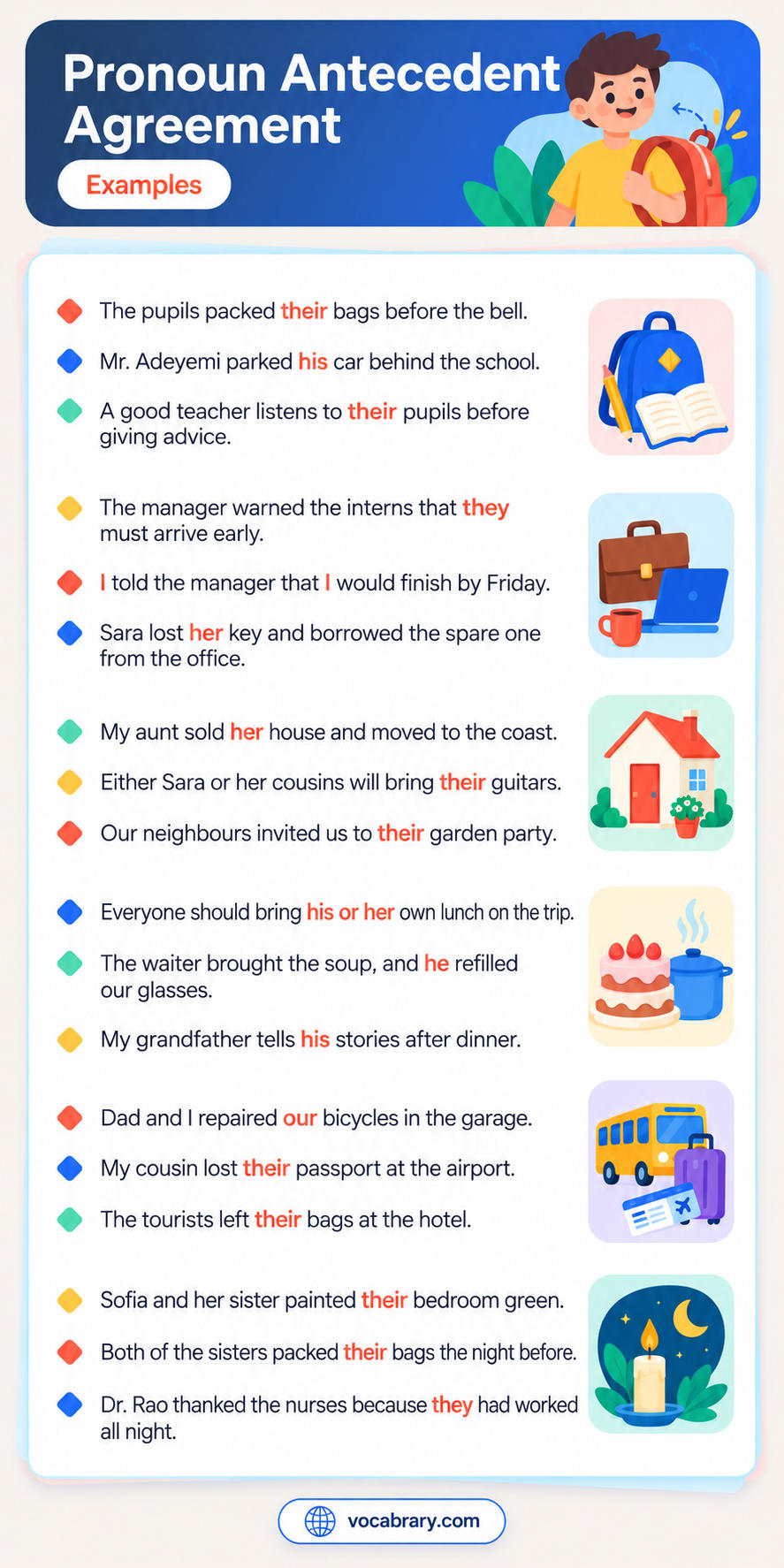
Common Pronoun Antecedent Agreement Examples
A pronoun has the same number and gender as its antecedent, so Maria goes with her, the boys with their, and the dog with its.
- Maria lost her keys on the train.
- The boys finished their homework before dinner.
- Mr. Adeyemi parked his car behind the school.
- The dog wagged its tail when the gate opened.
- Priya and Jun shared their notes with the whole class.
- The tree dropped its leaves early this year.
- Our neighbours invited us to their garden party.
- The girl said that she would arrive by noon.
- Kofi hurt himself while he was painting the fence.
- The twins forgot their umbrellas at the station.
- The museum opened its new wing on Saturday.
- Dr. Okafor wrote her report in one night.
- The students handed in their essays on Friday.
- Ahmed missed his bus, so he walked home.
- The kittens drank their milk and fell asleep.
- The river changed its course after the flood.
- Elena said that the red bicycle was hers.
- Both of the cooks washed their hands before the lunch rush.
- Mina and I cleaned our room on Sunday.
- The pilot checked her instruments twice before take-off.
Pronoun-Antecedent Agreement With Singular Antecedents
A singular antecedent such as the teacher or my uncle takes a singular pronoun, which is he, she, or it with the matching possessive form.
- The teacher forgot her glasses in the staff room.
- My uncle repaired his bicycle with a borrowed wrench.
- The lamp lost its shade during the move.
- Rosa, a singer, protects her voice with warm tea before each show.
- The baby waved her tiny hand at the camera.
- The company announced that it would close the old factory.
- My grandfather tells his stories after dinner.
- The ship left its harbour at dawn.
- The mechanic said that he needed another hour.
- The queen greeted her guests at the door.
- A lion defends its territory from rivals.
- The nurse smiled and said that she would return soon.
Pronoun-Antecedent Agreement With Plural Antecedents
A plural antecedent such as the farmers or my cousins takes a plural pronoun, which is they, them, or their.
- The farmers sold their wheat at the autumn market.
- My cousins said that they would visit in July.
- The clouds gathered, and they darkened the whole valley.
- The workers demanded better pay, and the manager promised them a meeting.
- Sofia and her sister painted their bedroom green.
- The roses lost their petals in the wind.
- The nurses checked their schedules before the night shift.
- The players thanked the crowd, and they waved from the bus.
- The tourists left their bags at the hotel.
- The books were old, but they still smelled of pine.
- The scientists published their results in March.
- These shoes hurt, so I will return them tomorrow.
Pronoun-Antecedent Agreement in Gender: He, She, and It
The pronoun matches the gender of a person or animal that has one, as in the actress with her and the king with his. The pronoun it refers to an object, such as the sofa.
- The actress thanked her director in the speech.
- The king signed his name at the bottom of the decree.
- The waiter brought the soup, and he refilled our glasses.
- The mare ran across the field with her foal.
- The rooster crowed, and he woke the whole farm.
- My aunt sold her house and moved to the coast.
- The sofa is old, but it is still comfortable.
- Captain Reyes steered her ship through the storm.
- The prince wore his grandfather’s ring.
- The hen guarded her chicks from the cold.
- The moon was bright, and it lit the empty road.
- The headmaster said that he would announce the winners at noon.
Pronoun-Antecedent Agreement in Person
A pronoun has the same person as its antecedent, so you goes with your, we with our, and one with one’s, with no shift in person inside one sentence.
- If you want to improve, you should read every day.
- We packed our bags and left for the airport.
- I did my homework before I watched the film.
- One should check one’s work before handing it in.
- You and Sam may leave your coats in the hall.
- We taught ourselves to swim in the lake.
- I told the manager that I would finish by Friday.
- When you travel abroad, keep your passport in a safe place.
- Chen and I painted our fence last weekend.
- You should drink your tea before it gets cold.
Pronoun-Antecedent Agreement With Singular They
Singular they refers to one person whose gender is unknown or not specified, or who uses they, as in the new tenant lost their key and Alex said they would arrive. More forms are in the personal pronoun example sentences.
- The new tenant said that they had lost their key.
- Alex said that they would arrive after lunch.
- Someone left their umbrella in the hall.
- A good teacher listens to their pupils before giving advice.
- The applicant must sign their name at the bottom of the form.
- Jordan is a poet, and they are reading at the library on Friday.
- The patient should bring their insurance card to the first appointment.
- The author signed their name inside every copy.
- Each customer will receive their receipt by email.
- My cousin lost their passport at the airport.
- The winner will be asked to give their speech first.
- Sam hung up the phone because they were already late.
Pronoun-Antecedent Agreement With Indefinite Pronoun Antecedents
Indefinite pronouns name people or amounts without being specific, and the pronoun that follows depends on whether the antecedent is singular, plural, or variable. For the full set, see indefinite pronoun example sentences.
Singular Indefinite Pronoun Antecedents
Everyone, each, and somebody are singular, so formal writing uses his or her and everyday writing uses singular they.
- Everyone should bring his or her own lunch on the trip.
- Everyone in the choir should bring their own folder.
- Each of the girls brought her own racket.
- Somebody has left their phone on the front desk.
- Nobody wanted to share his or her answer with the class.
- Each of the boys packed his own tent.
- Anyone who loses their ticket must pay again.
- Neither of the sisters has finished her meal.
Plural Indefinite Pronoun Antecedents
Both, few, many, and several are plural, so the pronoun that follows is they, them, or their.
- Both of the sisters packed their bags the night before.
- Few of the climbers reached the summit, and they were exhausted.
- Many of the villagers shared their food with strangers.
- Several of the students forgot their calculators.
- Others took their seats near the window.
- A few of the tourists lost their way in the old town.
- Many of my friends prefer to spend their holidays at home.
- Few of the guests had finished their dessert when the music stopped.
Variable Indefinite Pronoun Antecedents
Some, all, most, and none take a singular pronoun with a singular or uncountable noun and a plural pronoun with a plural noun, as in some of the cake and some of the cakes.
- Some of the cake lost its icing in the heat.
- Some of the cupcakes lost their icing on the hot tray.
- Most of the water had left its mark on the floor.
- Most of the boats returned to their moorings by dark.
- All of the money kept its value despite the delay.
- All of the passengers showed their tickets.
- Much of the forest lost its leaves in the storm.
- None of the flowers had opened their petals.
Pronoun-Antecedent Agreement With Collective Noun Antecedents
A collective noun such as committee or team takes it and its when the group acts together, and British English uses they and their when the members act separately. See collective noun example sentences for more groups.
- The committee announced its decision on Monday.
- The team celebrated its first win of the season.
- The jury took its place in the courtroom after lunch.
- The company raised its prices in January.
- The orchestra tuned its instruments before the concert.
- The class finished its project ahead of schedule.
- The herd crossed the river, and it moved slowly up the bank.
- The audience rose to its feet at the end of the play.
- The government presented its plan to parliament on Tuesday.
- The family are packing their suitcases in separate rooms.
- The staff have left their coats in different offices.
- The band were tuning their guitars when the lights went out.
- The crew argued among themselves about the route.
- The police said that they had found the stolen car.
Pronoun-Antecedent Agreement With Compound Antecedents Joined by And
Two antecedents joined by and, such as Tom and Priya, take a plural pronoun, but a pair that names one person, as in my friend and neighbour, takes a singular pronoun.
- Tom and Priya finished their project early.
- The captain and the coach shook hands, and they left together.
- Salt and pepper sit on the table, and they are both almost empty.
- My friend and neighbour, Hana, lent me her ladder.
- The author and illustrator of the book signed her name at the fair.
- Ravi and Leila bought themselves a new sofa.
- The cat and the dog share their bowl.
- The mayor and the governor held their meeting in the town hall.
- Dad and I repaired our bicycles in the garage.
- Rice and beans are cheap, and they feed a large family.
Pronoun-Antecedent Agreement With Compound Antecedents Joined by Or and Nor
When antecedents are joined by or or nor, the pronoun agrees with the antecedent nearest to it, as in either Sara or her cousins and neither the cousins nor Sara.
- Either Sara or her cousins will bring their guitars.
- Neither the cousins nor Sara remembered her ticket.
- Either the coach or the players will announce their decision.
- Neither the players nor Mr. Ibrahim has seen his copy of the schedule.
- Either Jamal or Ana will present her findings first.
- Neither the sisters nor Lena has finished her homework.
- Either the dog or the cats have left their toys in the hall.
- Either the cats or the dog has left its toys in the hall.
- Neither Hugo nor his brothers paid for their tickets.
- Neither the children nor their mother has packed her bag.
Pronoun-Antecedent Agreement and Reference to One Antecedent
A reference is unambiguous when exactly one noun in the context fits the pronoun, as when it refers only to the drawing and him refers only to Hugo.
- Mia showed the drawing to Hugo, and it impressed him.
- Lina met Omar at the station, and he carried her suitcase.
- The letter arrived with two parcels, and they were addressed to my sister.
- Ben told Aisha that she had won the prize.
- The waiter gave the customers the menu, and they ordered soup.
- When Zara called Peter, he was already asleep.
- The dog chased the girls, and they laughed all the way home.
- Dr. Rao thanked the nurses because they had worked all night.
- Tomas lent Eva his bike, and she returned it the next day.
- The manager warned the interns that they must arrive early.
- Hana dropped the cup, and it broke on the stone floor.
- Rita sent Joel a message, but he never replied.
Pronoun-Antecedent Agreement With Relative Pronouns
A relative pronoun refers back to its antecedent: who or whom for people and which or that for objects, and the verb in the relative clause agrees with that antecedent. Examples are the teacher who helped me and the book that won the prize, and that also refers to people. See relative pronoun example sentences for further cases.
- The teacher who helped me has moved to another school.
- The book that won the prize is on the top shelf.
- The boys who won the race received medals.
- A cat that sleeps all day rarely catches mice.
- My neighbour, who grows roses, gave me a bouquet.
- The bridge, which was built before the war, needs repairs.
- The woman whom we met at the station was a doctor.
- The runner whose shoe came off finished last.
- The ones who wait for the later bus will miss the show.
- The apples that fell from the tree were sour.
- Anyone who lost a ticket should see the desk.
- The coat which hangs by the door belongs to Yusuf.
Pronoun-Antecedent Agreement With Possessive Pronouns
Possessive words such as her, their, and its come before a noun, and the forms hers, theirs, and mine are used alone, so both kinds match their antecedents in number and person. More forms are at possessive pronoun example sentences.
- Sara lost her key and borrowed the spare one from the office.
- Ines says that the green scarf on the chair is hers.
- The students checked their answers, and the best paper was theirs.
- Omar and I painted our boat, and the boat is now ours.
- The cat licked its paw after the meal.
- You left your book on the bus, and this one is yours.
- Mika said that the seat beside hers was free.
- The Smiths sold their farm to a neighbour.
- The company updated its policy on remote work.
- Andre handed me his pen because mine had stopped working.
- We forgot our tickets, but the ones in the drawer are ours.
- Maya thinks the winning drawing is hers.
- The neighbours said the dog was theirs.
- I found my wallet under the sofa.
Pronoun-Antecedent Agreement With Reflexive Pronouns
A reflexive pronoun ends in -self or -selves and refers back to the subject, so it agrees with its antecedent in number and person, as in Daniel taught himself and the children dressed themselves. Further forms are in the reflexive pronoun example sentences.
- Daniel taught himself to play the guitar.
- The children dressed themselves for the first time.
- I cut myself while slicing the onions.
- We gave ourselves an hour to finish the puzzle.
- You should be proud of yourself after that speech.
- The cat washed itself in the sun.
- Lina looked at herself in the shop window.
- Both of the boys blamed themselves for the delay.
- Sam made himself a sandwich and sat on the porch.
- You and Tara should introduce yourselves to the new neighbours.
- The chef burned herself on the hot pan.
- Everyone in the team enjoyed themselves at the party.
Pronoun-Antecedent Agreement When the Antecedent Follows the Pronoun
A pronoun in an opening clause comes before its antecedent when the main clause names the antecedent later, as in when she arrived, Nadia and before he left, Mr. Silva, and the two still agree in number and gender.
- When she arrived at the airport, Nadia found the gate closed.
- Before he left, Mr. Silva locked every window.
- Because they were tired, the hikers stopped early.
- After it stopped raining, the match continued.
- When he heard the news, Jin called his mother.
- Although she was nervous, the young pilot landed smoothly.
- As they reached the summit, the climbers cheered.
- Since it was old, the bridge needed repairs.
Pronoun-Antecedent Agreement in Negative Sentences
A negative sentence has the same match between pronoun and antecedent, as in Maria did not lose her passport and the boys never forgot their promise.
- Maria did not lose her passport at the airport.
- The boys never forgot their promise to the old man.
- The company has not changed its logo since the merger.
- Nobody in the room raised their hand.
- The dog did not touch its food all morning.
- Neither of the girls admitted that she had broken the lamp.
- Karim isn’t sure that the jacket is his.
- The students didn’t realise that they had left the lights on.
Pronoun-Antecedent Agreement in Questions
In a question the pronoun still matches its antecedent, as in Did Anna bring her passport? and Have the boys finished their homework?
- Did Anna bring her passport to the interview?
- Have the boys finished their homework?
- Is the cat licking its paw again?
- Where did Mr. Lopez leave his keys?
- Why did the committee change its mind?
- Did anyone remember to bring their raincoat?
- Which of the sisters lost her ring?
- Will you and Tom bring your lunches?
Pronoun-Antecedent Agreement in Reported Speech and Passive Sentences
In reported speech the pronoun matches its antecedent in the reported clause, as in Hamid said that he was tired. In a passive sentence the antecedent is the grammatical subject, as in the letters were returned to their senders.
- Hamid said that he was tired.
- The girls told the coach that they would arrive early.
- Ms. Chen explained that her train had been cancelled.
- The manager announced that she would resign in June.
- The letters were returned to their senders.
- The package was sent back to its owner.
- The children were praised for their patience.
- The ship was repaired before it left the harbour.
- Joseph promised that he would call the next day.
- The pupils were told to leave their bags outside.
Pronoun-Antecedent Agreement in Everyday Contexts
Antecedents in home, school, work, travel, news, fiction, sports, and health settings take a singular or plural pronoun according to their number.
Pronoun-Antecedent Agreement at Home
At home, the baby and my parents take her and their, and an object like the kettle takes a reflexive such as itself.
- The baby dropped her toy again.
- My parents repainted their kitchen last weekend.
- The kettle switched itself off when the water boiled.
- Grandpa told us that he had built the shed.
Pronoun-Antecedent Agreement at School
In a classroom, the pupils take their, the principal takes her, and a school as an institution takes its.
- The pupils packed their bags before the bell.
- The principal congratulated her staff in the hall.
- Mr. Haddad asked the class to open their books.
- The school held its sports day in June.
Pronoun-Antecedent Agreement at Work
Office sentences pair the accountant with her, the clients with they, and a business with its.
- The accountant sent her report on Tuesday.
- The clients said that they would sign the contract.
- The firm moved its office to a bigger building.
- Rafael reminded the team that he would be away.
Pronoun-Antecedent Agreement While Travelling
In travel sentences, their and its refer to the tourists and the airline, and a named traveller uses her or his.
- The tourists checked their passports at the gate.
- The airline cancelled its evening flights.
- The train left the platform before it was full.
- Layla lost her suitcase in Madrid.
Pronoun-Antecedent Agreement in the News
In news writing, the pronouns her and its match the antecedents the mayor and the council.
- The mayor defended her decision at the press conference.
- The council postponed its vote until next week.
- The protesters shouted that they wanted a fair wage.
- The minister said that he would study the report.
Pronoun-Antecedent Agreement in Fiction
In stories, his and their match the antecedents the knight and the dragons in number and gender.
- The knight raised his sword at the cave.
- The dragons guarded their gold inside the cave.
- Elara whispered that she had seen the stranger before.
- The old house creaked as it settled in the wind.
Pronoun-Antecedent Agreement in Sports
The striker takes her and the team takes its in these match reports.
- The striker kicked her boots off after the match.
- The team changed its tactics at half time.
- The runners checked their times on the screen.
- The coach said that he was proud of the squad.
Pronoun-Antecedent Agreement in Health
Health sentences pair the patient with her and the doctors with their.
- The patient took her medicine twice a day.
- The doctors shared their findings with the family.
- The hospital extended its visiting hours.
- Ali said that he felt better after resting.
Pronoun Antecedent Agreement Examples for Kids
Short sentences about the boy and the girls give children a pattern: one person takes his or her, and several people take their.
- The boy is eating his apple.
- The girls are playing with their dolls.
- My dog wags its tail when I come home.
- Mum said that she will bake a cake.
- The kids put their shoes by the door.
- Tom hurt his knee at the playground.
- The bird built its nest in the tall tree.
- Anna and Lucy made their beds this morning.
- We washed our hands before lunch.
Short Pronoun-Antecedent Agreement Sentences for Young Learners
Three, four, and five word lines such as Tom has his hat and Dogs wag their tails give beginners one antecedent and one pronoun at a time.
- Tom has his hat.
- Anna has her bag.
- Dogs wag their tails.
- The cat licks its paw.
- I love my mum.
- We clean our room.
- Sam said he is tall.
- Mia says she is hungry.
- Birds build their nests.
- You lost your pen.
Pronoun Antecedent Agreement Examples for Students
Exam answers use longer antecedents such as neither the director nor her assistants and the committee, which students must match to the correct pronoun.
- Neither the director nor her assistants submitted their reports before the deadline.
- The committee reviewed the proposal and announced its verdict in writing.
- Each of the candidates must present his or her research to the panel.
- The researchers acknowledged that they had not controlled for age.
- Dr. Mensah recorded her methods in detail so that others could repeat the study.
- The students and the lecturer exchanged their notes after the seminar.
- The government defended its budget, although it had faced criticism for months.
- Anyone who submits late work will lose their bonus marks.
- The novel reveals its themes slowly, and they become visible only in the final chapter.
- Both the author and the editor signed their names to the agreement.
- The writer explained that her argument relied on three examples.
Pronoun-Antecedent Agreement in Short Passages
Two short passages about a trip to the airport and a football team use pronouns such as her and its that match their antecedents in running text.
Nadia packed her bag and checked that she had her passport. Her brothers waited in the car, and they argued about the route. The taxi arrived late, but it still reached the airport on time. Nadia hugged her mother and promised that she would call from Rome.
The team trained hard all week, and its captain praised the players for their effort. Everyone agreed that they had improved. The coach told the reporters that he was proud, and the fans sang their anthem all the way home.
Pronoun-Antecedent Agreement Mistakes and Corrections
Errors in pronoun antecedent agreement examples include a number mismatch, as in the students … his, a shift in person, as in you … one, and a pronoun with no antecedent.
❌ The students forgot his books at home.
✅ The students forgot their books at home.
The plural antecedent students needs the plural pronoun their.
❌ The dog wagged their tail when the gate opened.
✅ The dog wagged its tail when the gate opened.
The singular antecedent dog takes the singular pronoun its.
❌ Maria and Sara packed her bags.
✅ Maria and Sara packed their bags.
Two antecedents joined by and form a plural antecedent, so the pronoun must be plural.
❌ If you want to improve, one should read every day.
✅ If you want to improve, you should read every day.
The sentence shifts from second person to third person, so the pronoun must stay in the second person.
❌ Neither Sara nor the cousins remembered her tickets.
✅ Neither Sara nor the cousins remembered their tickets.
The nearest antecedent, cousins, is plural, so the pronoun is their.
❌ Lina told Maya that she had won the prize.
✅ Lina told Maya, "You have won the prize."
In the first sentence she fits either woman, and the corrected sentence names the winner with you.
❌ Mia likes to bake, but she has never eaten them.
✅ Mia likes to bake, but she has never eaten her own cakes.
The pronoun them has no plural antecedent, so the corrected sentence names the noun.
❌ The children dressed theirselves.
✅ The children dressed themselves.
The plural reflexive pronoun is themselves, and theirselves is not a standard form.
❌ I hurt me while cooking.
✅ I hurt myself while cooking.
The subject and the object are the same person, so the reflexive pronoun myself is required.
❌ Priya hurt himself while cooking.
✅ Priya hurt herself while cooking.
The antecedent Priya is female, so the reflexive pronoun is herself.
❌ The bridge is old, so they need repairs.
✅ The bridge is old, so it needs repairs.
The antecedent bridge is singular, so the pronoun is it and the verb is needs.
Pronoun-Antecedent Agreement Compared With Subject-Verb Agreement
Pronoun-antecedent agreement matches a pronoun to the noun it replaces, while subject-verb agreement matches a verb to its subject. The second rule has its own page at subject-verb agreement examples.
| Feature | Pronoun-antecedent agreement | Subject-verb agreement |
|---|---|---|
| Words matched | Pronoun and antecedent | Subject and verb |
| Features matched | Number, person, and gender | Number and person |
| Correct example | Maria lost her keys. | The boxes are heavy. |
| Common error | The girls lost her keys. | The boxes is heavy. |
| Test | Find the noun the pronoun replaces | Find the head noun of the subject |
Related
- Personal Pronoun Example Sentences
- Indefinite Pronoun Example Sentences
- Collective Noun Example Sentences
- Subject-Verb Agreement Examples
- Possessive Pronoun Example Sentences
- Reflexive Pronoun Example Sentences
- Relative Pronoun Example Sentences
- Singular and Plural Example Sentences
FAQs
Q1. What are some common pronoun antecedent agreement examples?
Common pronoun antecedent agreement examples pair a pronoun with an antecedent of the same number, person, and gender, as in Maria lost her keys and the boys finished their homework. A singular antecedent takes he, she, or it, and a plural antecedent takes they. Objects and animals without a stated gender take it and its.
Q2. How do you find the antecedent of a pronoun?
You find the antecedent by asking which earlier noun or pronoun the pronoun replaces. In Kofi hurt himself, the pronoun himself replaces Kofi, so Kofi is the antecedent. In a few sentences the antecedent follows the pronoun, as in when she arrived, Nadia found the gate closed.
Q3. Does a pronoun have to match its antecedent in number?
A pronoun must match its antecedent in number, so a singular antecedent takes a singular pronoun and a plural antecedent takes a plural pronoun. You write the dog wagged its tail and the dogs wagged their tails. A mismatch such as the students forgot his books is an error in standard written English.
Q4. Is singular they correct when the antecedent is one person?
Singular they is correct in standard writing when the antecedent is one person whose gender is unknown or not specified, or who uses they. You write the new tenant lost their key and Alex said they would arrive. Formal writing also uses his or her in the first case, though they is shorter.
Q5. Which pronoun follows everyone, someone, and nobody?
Indefinite pronouns such as everyone, someone, and nobody are singular, and the pronoun that follows is his or her or singular they. Everyday writing uses everyone should bring their own lunch. Formal writing uses everyone should bring his or her own lunch, or a plural rewrite such as all guests should bring their own lunch.
Q6. Should a collective noun be followed by it or they?
A collective noun is followed by it and its when the group moves or decides as one unit, as in the committee announced its decision. British English also uses they and their when the members act separately, as in the family are packing their suitcases. A writer uses the same choice throughout a sentence.
Q7. Which pronoun follows two antecedents joined by and?
Two antecedents joined by and take a plural pronoun, as in Tom and Priya finished their project. The exception is a pair that names one person, such as my friend and neighbour, which takes a singular pronoun. A pair introduced by each or every, as in every boy and girl, also takes a singular pronoun in formal writing.
Q8. Which pronoun follows antecedents joined by or and nor?
Antecedents joined by or or nor take a pronoun that agrees with the antecedent nearest to it. In neither the cousins nor Sara remembered her ticket, the singular Sara is nearest, so the pronoun is singular. Writers avoid awkward sentences by placing the plural antecedent last.
Q9. What is an ambiguous antecedent, and how do you fix it?
An ambiguous antecedent is a reference in which the reader is unable to decide which of two nouns a pronoun replaces. In Lina told Maya that she had won, the pronoun she fits both women. A writer fixes the sentence by repeating the noun or by quoting the speaker, as in Lina told Maya, "You have won."
Q10. Can a pronoun come before its antecedent?
A pronoun comes before its antecedent when it is in an opening subordinate clause, as in when she arrived, Nadia found the gate closed. The pronoun still matches the antecedent in number, person, and gender. A pronoun with no antecedent anywhere in the passage, as in in the manual it says, is an error.
Q11. Do possessive and reflexive pronouns follow the same agreement rule?
Possessive and reflexive pronouns follow the same agreement rule as personal pronouns, because each one repeats the number, person, and gender of its antecedent. You write Sara lost her key, the cat washed itself, and the children dressed themselves. The stand-alone possessives hers, theirs, and ours follow the same match.
Q12. What are the most common pronoun-antecedent agreement mistakes?
The most common pronoun-antecedent agreement mistakes are a number mismatch, a shift in person, an ambiguous antecedent, and a pronoun with no antecedent. A number mismatch is seen in the students forgot his books, and a shift in person is seen in if you want to improve, one should read. Naming the noun that each pronoun replaces identifies most of these errors.
Q13. How does pronoun-antecedent agreement differ from subject-verb agreement?
Pronoun-antecedent agreement matches a pronoun to the noun it replaces, while subject-verb agreement matches a verb to its subject. In the boxes are heavy, the verb are agrees with boxes, and in the boxes arrived, and they were heavy, the pronoun they agrees with boxes. Both rules depend on number and person, and the pronoun rule adds gender.

Leave a Comment