
Subject-verb agreement is the match in number between a verb and its subject: a singular subject takes a singular verb and a plural subject takes a plural verb, as in the dog barks. These subject verb agreement examples move from ordinary subjects to harder cases such as collective nouns and compound subjects.
What Is Subject-Verb Agreement?
Subject-verb agreement is the match in number between the head noun of a subject and the finite verb of its clause. Pronoun-antecedent agreement is its closest relative, because it matches a pronoun to an earlier noun, while this rule matches a verb to its own subject.
Singular subject + verb with -s (or is, was, has) | plural subject + base verb (or are, were, have)
The players in the red shirts train at dawn.
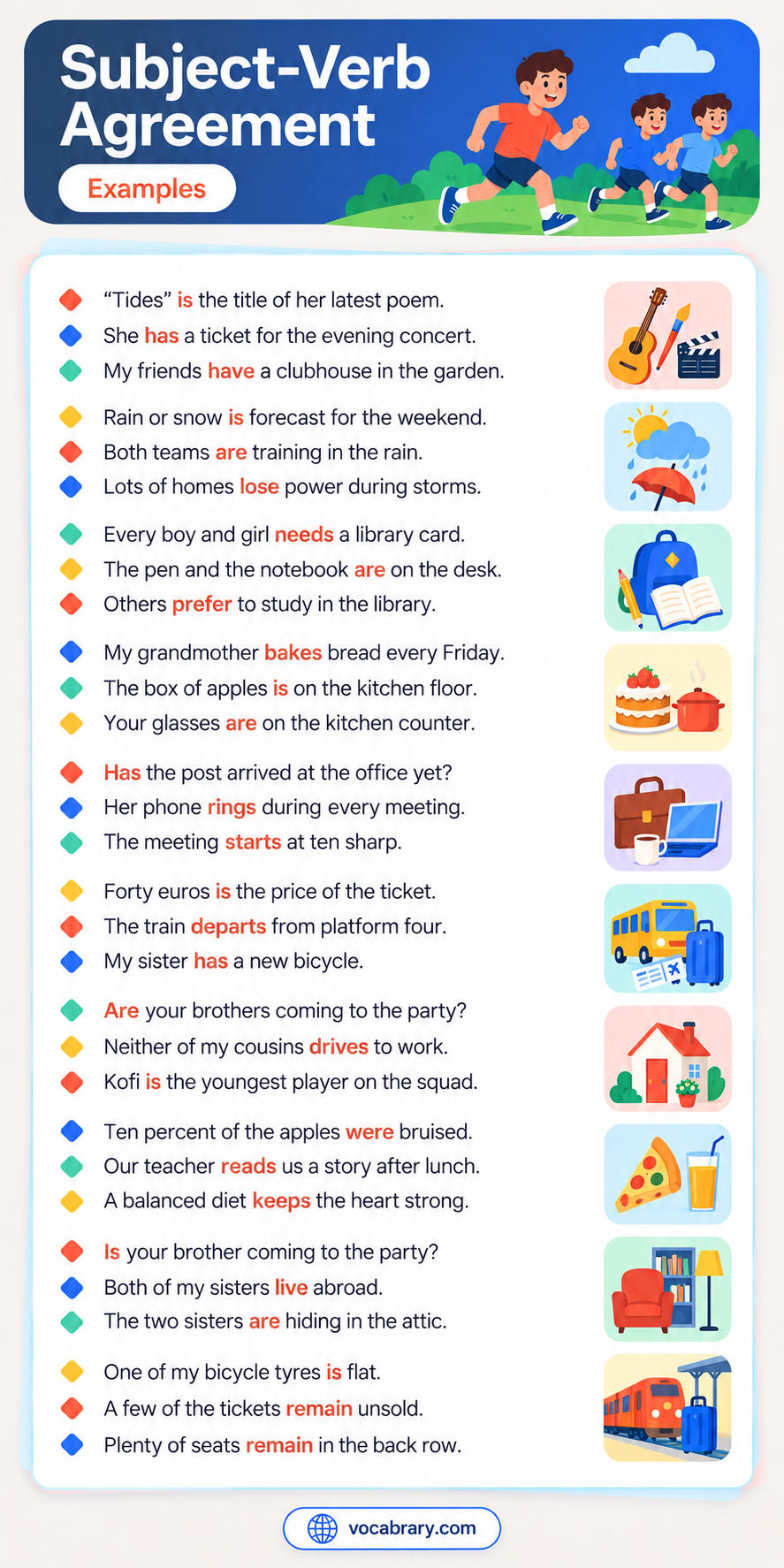
Common Subject Verb Agreement Examples
A singular subject such as the teacher takes a verb like explains, while a plural subject such as my brothers takes the base form play.
- The teacher explains each new rule on the whiteboard before the lesson ends.
- My brothers play football in the park every Saturday afternoon.
- Aisha reads two chapters of her novel before she goes to sleep.
- The children walk to school together along the river path.
- A single candle burns on the kitchen table.
- Our neighbours grow tomatoes and peppers behind their house.
- The bus leaves the station at a quarter past seven each morning.
- Hiro and his sister cook dinner together on Sundays.
- The mechanic repairs old bicycles in a small workshop near the market.
- These shoes cost more than I expected.
- The old library has wooden shelves in every room.
- Maria and Luis speak three languages at home.
- The cat sleeps on the warm radiator all afternoon.
- Both runners train on the beach before sunrise.
- My grandmother bakes bread every Friday.
- The students finish their experiments before noon.
- A tall tree shades the front garden.
- The flowers on the balcony need water twice a week.
Singular Subjects With Singular Verbs
A noun such as the pilot or a bottle of water is singular, so the present tense verb ends in -s and the verb be takes the form is or was.
- The pilot checks the weather report before every long flight.
- A bottle of water costs two dollars at the station kiosk.
- My cousin lives in a flat above a bakery in Lisbon.
- The river floods the lower fields each spring.
- She has a ticket for the evening concert.
- The museum was closed on Monday for repairs.
- Kofi is the youngest player on the squad.
- This laptop runs quietly even with ten programs open.
- A good dictionary gives the meaning and the pronunciation of each word.
- The plumber arrives at nine and leaves at noon.
- Her phone rings during every meeting.
- The street looks empty after the rain.
Plural Subjects With Plural Verbs
A noun such as the farmers or two engines is plural, so the present tense verb keeps its base form and the verb be takes the form are or were.
- The farmers sell fresh eggs at the Sunday market.
- Two engines power the ferry across the bay.
- Her parents are visiting from Seoul next month.
- The twins have different tastes in music.
- Those mountains look blue in the early light.
- The nurses work in shifts of twelve hours.
- Children learn languages faster than most adults.
- Several buses were late because of the road works.
- Their dogs bark whenever the postman comes.
- We are ready to leave when you are.
- The roads in the valley freeze by November.
- Chen’s grandparents phone every Sunday evening.
Subject-Verb Agreement With Compound Subjects Joined by And
Two subjects joined by and, such as Tom and Priya or the pen and the notebook, form a plural subject and take a plural verb. A pair that names one person or one dish, as in the founder and director, takes a singular verb.
- Tom and Priya share an office on the third floor.
- The pen and the notebook are on the desk.
- My mother and my aunt cook together at every festival.
- Bread and butter is all she wants for breakfast.
- The captain and the coach were talking after the match.
- Reading and writing are taught every morning.
- The doctor and her assistant arrive at eight.
- Both the mayor and the governor have approved the plan.
- Ravi, Elena, and Chen form the debate team.
- The founder and director of the school is retiring this year.
- The cost and the delay were the main complaints.
- A teacher and a pupil walk along the corridor.
Subject-Verb Agreement With Compound Subjects Joined by Or and Nor
When subjects are joined by or or nor, the verb agrees with the subject nearest to it, as in the manager or the clerks and neither the clerks nor the manager.
- Either the manager or the clerks are responsible for the mistake.
- Neither the clerks nor the manager was told about the change.
- Either the singer or the dancers perform the opening act.
- Tea or coffee is served at the end of the meeting.
- Neither my sister nor my parents know about the surprise.
- Neither my parents nor my sister knows about the surprise.
- Either Carlos or his brothers are collecting the parcels.
- Either his brothers or Carlos is collecting the parcels.
- A pencil or two pens are enough for the exam.
- Neither the lights nor the heater works in the cabin.
- Rain or snow is forecast for the weekend.
- Either you or I am going to speak first.
- Neither she nor they were ready for the interview.
- Mei or her cousins bring the drinks to every picnic.
Subject-Verb Agreement With Indefinite Pronouns
Indefinite pronouns refer to people or amounts that are not specified, and each one is singular, plural, or variable in number. For more cases, see indefinite pronoun example sentences.
Singular Indefinite Pronouns
Everyone, nobody, somebody, and each take singular verbs such as knows, was, and has, even when a plural noun follows.
- Everyone in the choir knows the song by heart.
- Nobody was waiting at the bus stop.
- Somebody has left a bag in the corridor.
- Anything is possible when the whole team works together.
- Each of the boxes contains a different gift.
- Someone needs to close the window.
- Everything in the shop is half price today.
- No one wants to be the first to speak.
Plural Indefinite Pronouns
Both, few, many, and several take plural verbs such as live, understand, and have.
- Both of my sisters live abroad.
- Few understand how the old machine works.
- Many of the visitors were surprised by the silence.
- Several have already signed the petition.
- Others prefer to study in the library.
- A few of the tickets remain unsold.
- Both of these answers are correct, so you may choose either one.
- Few of the climbers reach the summit in winter.
Indefinite Pronouns With Of Phrases
Some, all, most, and none take a singular verb when the noun after of is uncountable or singular and a plural verb when that noun is plural.
- Some of the soup is still warm.
- Some of the apples are bruised.
- All of the money was returned to the owners.
- All of the passengers were safe after the landing.
- Most of the cake has disappeared.
- Most of the guests have arrived.
- None of the milk is fresh.
- Most of the coastline is rocky, but most of the beaches are sandy.
Subject-Verb Agreement With Collective Noun Subjects
A collective noun such as team or committee takes a singular verb when the members form one unit. British English also uses a plural verb when the members act separately, as in the family are arriving. More groups are in the collective noun example sentences.
- The committee has approved the new budget.
- Our team wins most of its home games.
- The audience was silent as the curtain rose.
- A flock of geese crosses the lake at dawn.
- The jury delivers its verdict this afternoon.
- The class is studying volcanoes this term.
- The company plans to open three new branches next year.
- The orchestra rehearses in the hall on Thursdays.
- The family are arriving by different trains this evening.
- The staff have all brought their own lunches to the picnic.
- The crew were arguing about who should steer.
- The police are searching the park for the missing bicycle.
- The crowd in the queue was getting restless.
- The herd grazes on the hills above the village.
Subject-Verb Agreement With Words Between the Subject and the Verb
The verb agrees with the head noun of the subject, not with a noun inside an interrupting phrase, as in the box of apples and the teachers in the hall.
- The box of apples is on the kitchen floor.
- The teachers in the hall are waiting for the principal.
- The price of tomatoes has risen again this month.
- A stack of papers was pinned to the door.
- The colour of her eyes changes with the light.
- The students who sit near the window see the whole playground.
- The manager, together with her assistants, is planning the event.
- My uncle, as well as his two sons, works at the harbour.
- The roses in the vase, along with a candle, make the room smell sweet.
- One of my bicycle tyres is flat.
- The noise from the machines hurts my ears.
- The windows of the old church glow at sunset.
- The key to the cabinets is missing.
Subject-Verb Agreement in There Is and There Are Sentences
In sentences that open with there, here, or a place phrase, the real subject follows the verb, so the verb agrees with a bag in one sentence and with two bags in the next.
- There is a bag under the seat.
- There are two bags under the seat.
- There was a long queue outside the bakery.
- There were fourteen candles on the birthday cake.
- Here comes the bus we have waited for since noon.
- Here are the keys you were looking for.
- There has been a change in the timetable.
- There have been several complaints about the noise.
- There are two eggs and some milk in the fridge.
- Behind the barn stands an old tractor.
- Among the guests were two famous painters.
- There seems to be a problem with the printer.
- There exist many ways to solve this puzzle.
- Under the bridge flows a narrow, quiet stream.
Subject-Verb Agreement With Each, Every, Either, and Neither
Each and every take a singular verb even before a plural noun, and either and neither take a singular verb in formal writing, as in each of the actors and neither of my cousins.
- Each student has a locker in the corridor.
- Every window in the building was cleaned yesterday.
- Each of the actors plays two different roles.
- Every one of the runners is wearing a number.
- Either of the roads leads to the coast.
- Neither of my cousins drives to work.
- Neither answer on the worksheet is correct.
- Every boy and girl needs a library card.
- Each man and woman receives a certificate.
- Each day brings new problems for the builders.
- Either option is fine with me.
- Neither of the two hotels offers a free breakfast.
- Each of the paintings was sold within an hour.
Subject-Verb Agreement With Plural-Form Singular Nouns
Nouns such as news, mathematics, and measles end in -s but name one body of knowledge, one report, or one illness, so they take a singular verb.
- The news from the village is good.
- Mathematics is her favourite subject at school.
- Measles spreads quickly in crowded classrooms.
- Physics explains why the ball falls.
- Economics has become popular among first-year students.
- Politics was the main subject at dinner.
- Athletics is taught on Wednesday afternoons.
- Diabetes requires careful attention to diet.
- Gymnastics demands strength, balance, and years of patient practice.
- Linguistics studies the structure of language.
- Ethics is compulsory for all medical students.
- Genetics continues to change medicine in unexpected ways.
Subject-Verb Agreement With Plural-Only Nouns
Nouns such as scissors, trousers, and jeans have no singular form and take plural verbs, but a phrase that begins with a pair of takes a singular verb.
- My scissors are in the top drawer.
- These trousers need a new button.
- A pair of scissors is on the table.
- Your glasses are on the kitchen counter.
- The jeans were too long for him.
- A pair of jeans costs about forty dollars in this shop.
- Her sunglasses look brand new even after five summers.
- The clothes are drying on the line.
- Binoculars help hikers spot distant birds.
- These tongs grip the hot pan firmly.
- Those pliers are too small for the job.
Subject-Verb Agreement With Units of Measure, Money, and Time
A sum of money, a distance, or a period of time takes a singular verb when it names one amount, as in ten dollars and three hours.
- Ten dollars is too much for a bottle of juice.
- Three hours seems a long time to wait.
- Fifty kilometres is a short ride for a trained cyclist.
- Two weeks is enough time to finish the report.
- Five minutes was all they needed.
- Forty euros is the price of the ticket.
- Seven miles is farther than she can walk before dark.
- A million rupees is a large amount for a small shop.
- Twenty minutes is not enough time to cook the lentils.
- Six months feels like a long time to be away.
- Eight hours is the standard length of a shift in the factory.
- Three litres is more than the small jug holds.
Subject-Verb Agreement in Relative Clauses With Who, That, and Which
In a relative clause, the verb agrees with the noun that the relative pronoun stands for, as in students who work and a student who works.
- She is one of the students who work in the library after class.
- She is the only one of the students who works in the library.
- The children who live next door play in our garden.
- The man who lives next door plays the violin.
- I know a teacher who speaks five languages.
- These are the books that belong to the school.
- The book that belongs to Hana is on the shelf.
- He is one of those people who enjoy early mornings.
- The cars which were parked outside have been towed.
- The car which was parked outside has been towed.
- Any person who breaks the rules loses the right to enter.
- We need a leader who listens and employees who care.
Subject-Verb Agreement With Titles and Names of Works
The title of one work or the name of one company takes a singular verb even when it contains a plural noun, as in Seven Winters and Blue Doors Limited.
- Seven Winters is a novel about a family in Norway.
- The Silver Gardens was published by a small press.
- Blue Doors Limited employs about two hundred people.
- Letters from Ankara has been translated into six languages.
- “Tides” is the title of her latest poem.
- The Daily Harbour reports on local politics every morning.
- Three Brothers tells the story of a farm in Ghana.
- Harvest Brothers sells vegetables at the weekend market.
Subject-Verb Agreement With A Number Of and The Number Of
A number of takes a plural verb because it works like several, while the number of takes a singular verb because number is the subject. Other quantity phrases such as a lot of and plenty of take the number of the noun after of. For other quantity words, see quantifiers example sentences.
- A number of students have asked for extra time.
- The number of students has risen this year.
- A lot of people were waiting outside the gate.
- A lot of money was spent on the new library.
- The majority of the voters support the change.
- The majority of the work was done by volunteers.
- Plenty of seats remain in the back row.
- Plenty of time remains before the train.
- A couple of friends are staying with us.
- The total number of visitors was higher than last year.
- A large number of birds nest on the cliff.
- Lots of homes lose power during storms.
- A great deal of effort goes into each performance.
- The rest of the cake is in the fridge, but the rest of the cookies are in the tin.
Subject-Verb Agreement With Fractions and Percentages
A fraction or a percentage takes the verb that matches the noun after of, so half of the cake is singular and half of the cakes is plural.
- Half of the cake is gone.
- Half of the cakes are gone.
- Two thirds of the town was without power.
- Two thirds of the houses were without power.
- Forty percent of the land is forest.
- Forty percent of the students walk to school.
- A quarter of the budget goes to salaries.
- A quarter of the workers travel more than an hour to the office.
- Ten percent of the apples were bruised.
- Most of the road is closed for repairs.
- Part of the roof has fallen in.
- The rest of the players are staying for the photograph.
Subject-Verb Agreement in Negative Sentences
In a negative sentence the auxiliary agrees with the subject. The form does not goes with a singular subject and do not with a plural one, as in the shop does not open and the shops do not open. The forms was not and were not follow the same pattern.
- The shop does not open on public holidays.
- The shops do not open on public holidays.
- My sister doesn’t eat meat, but she loves cheese.
- My sisters don’t eat meat, but they love cheese.
- Nobody has answered the door since the bell rang.
- Neither of the printers works today.
- The students were not told about the change.
- The child was not frightened by the thunder.
- The new trains aren’t as quiet as the old ones.
- She isn’t ready to leave yet.
- Rain hasn’t fallen in the valley for six weeks.
- The keys haven’t turned up anywhere in the house.
Subject-Verb Agreement in Questions
In a question the auxiliary comes before the subject and still agrees with it, as in Does the bus stop here? and Do the buses stop here?
- Does the bus stop near the museum?
- Do the buses stop near the museum?
- Is your brother coming to the party?
- Are your brothers coming to the party?
- Has the post arrived at the office yet?
- Have the letters arrived at the office yet?
- Where is the nearest pharmacy in this town?
- Where are the spare batteries for the torch?
- What does the label on the bottle say?
- Which of the students has finished the test?
- Was anyone waiting at the gate?
- How many people were at the meeting?
Subject-Verb Agreement in Reported Speech and Passive Sentences
In a passive sentence the verb be agrees with the grammatical subject, as in the letters were sent. In reported speech the verb in the reported clause agrees with its own subject, as in she said the results were ready.
- The letters were sent on Friday.
- The letter was sent on Friday.
- The windows have been repaired by a local firm.
- The window has been repaired by a local firm.
- She said that the results were ready.
- He told us that the shop was closed.
- The coach announced that the players were tired.
- They reported that the road had been blocked by snow.
- Tickets for the concert are sold online.
- This cheese is made in the mountains.
- The reporter said that nobody was hurt in the accident.
- The workers said that the tools are kept in the shed.
Subject-Verb Agreement in Everyday Contexts
Subjects in home, school, work, travel, news, fiction, sports, and health settings take singular or plural verbs.
Subject-Verb Agreement at Home
Household subjects such as the kettle and my parents take the singular verb whistles and the plural verb water.
- The kettle whistles when the water boils.
- My parents water the garden every evening.
- Our washing machine is making a strange noise.
- The children are doing their homework at the kitchen table.
Subject-Verb Agreement at School
The principal and her classmates take announces and are preparing, one singular verb and one plural verb.
- The principal announces the winners on Friday.
- Her classmates are preparing a science fair project.
- Every pupil in the class brings a lunchbox.
- The exam results arrive in August.
Subject-Verb Agreement at Work
In an office, the subjects the accountant and our clients take reviews and want, and a neither … nor subject takes the verb that matches the nearer noun.
- The accountant reviews the invoices every month.
- Our clients want a faster delivery service.
- The meeting starts at ten sharp.
- Neither the director nor the managers were at the conference.
Subject-Verb Agreement While Travelling
The verbs departs and are waiting agree with the train and the passengers, and a phrase like a bag of souvenirs takes a singular verb.
- The train departs from platform four.
- The passengers are waiting in the departure hall.
- A bag of souvenirs was left on the bus.
- The flights to Nairobi leave every afternoon.
Subject-Verb Agreement in the News
In news sentences, the verbs has and were agree with the head nouns mayor and results, as in the mayor has announced and the results of the election were released.
- The mayor has announced a new recycling plan.
- Police are investigating the fire at the warehouse.
- The results of the election were released overnight.
- The economy of the region is growing slowly.
Subject-Verb Agreement in Fiction
Story sentences have subjects such as dragons and the old woman with verbs like guard and walks, and a compound action takes two agreeing verbs.
- The old woman walks through the empty house, and the floorboards groan under her feet.
- Dragons guard the mountain pass above the silent valley.
- Everyone in the village fears the stranger at the inn.
- The two sisters are hiding in the attic.
Subject-Verb Agreement in Sports
Sports sentences have subjects such as the goalkeeper and both teams, and neither of the finalists takes a singular verb.
- The goalkeeper saves the penalty in the final minute.
- Both teams are training in the rain.
- The score is tied at two goals each.
- Neither of the finalists has lost a match this season.
Subject-Verb Agreement in Health
Health sentences have subjects such as a balanced diet and the doctors, and a gerund subject like stretching for ten minutes takes a singular verb.
- A balanced diet keeps the heart strong.
- The doctors recommend a daily walk.
- Sleep is essential for growing children.
- Stretching for ten minutes reduces back pain.
Subject Verb Agreement Examples for Kids
Short subject verb agreement examples for kids pair the dog and the birds with verbs that either end in -s or stay in the base form.
- The dog runs after the red ball.
- The birds sing in the tree outside my window.
- My sister has a new bicycle.
- My friends have a clubhouse in the garden.
- The baby laughs when I make a funny face.
- The cows eat grass in the big green field.
- Our teacher reads us a story after lunch.
- The two kittens sleep in a basket by the fire.
- Mum and Dad are painting my bedroom blue.
Short Subject-Verb Agreement Sentences for Young Learners
Short lines such as The sun shines and The stars shine give beginners one subject and one verb to practise at a time.
- The sun shines.
- The stars shine.
- Birds fly south.
- A bird flies home.
- My cat purrs loudly.
- Dogs bark loudly.
- She sings well.
- They sing well.
- He has a hat.
- We have two hats.
- I am happy.
- You are kind.
Subject-Verb Agreement Examples for Students
Exam-level subject verb agreement examples use longer subjects such as the criteria for admission and a series of lectures, which students must match to the right verb.
- The results of the third experiment, together with the earlier data, suggest a pattern.
- Neither the lecturer nor the teaching assistants were able to explain the error.
- A series of lectures on climate policy is scheduled for March.
- The majority of the committee members support the proposal.
- The criteria for admission are published each autumn, and the deadline is strict.
- The findings of the survey show that attendance has fallen.
- One of the main reasons for the delay is the shortage of materials.
- Each of the proposals that were submitted has been reviewed twice.
- Phenomena such as lightning are explained in the first chapter.
- The analysis of the two samples reveals a significant difference.
- Statistics is a required course, but the statistics in the report are misleading.
- What the committee wants is more time.
Subject-Verb Agreement in Short Passages
In two short passages about a market morning and a class trip, verbs such as opens and needs agree with their subjects in running text.
The market opens at six. Fruit sellers arrange their baskets, and a crowd of shoppers moves between the stalls. Neither the baker nor the butchers have time to talk. A boy with two bags carries the shopping home, and everyone agrees that the morning is perfect.
Our class is going to the science museum on Friday. Each pupil needs a packed lunch, and the teachers are collecting permission forms. A group of parents is joining us, so the number of adults has doubled. Mrs Okafor, together with two assistants, leads the tour.
Subject-Verb Agreement Mistakes and Corrections
Frequent agreement mistakes in written work involve a plural noun inside a phrase, as in the stack of papers, and a singular pronoun such as everyone.
❌ The stack of papers are on my desk.
✅ The stack of papers is on my desk.
The verb agrees with the singular head noun stack, not with the plural noun papers inside the phrase.
❌ There is three chairs in the room.
✅ There are three chairs in the room.
The real subject chairs follows the verb and is plural, so the verb must be are.
❌ Mathematics are her favourite subject.
✅ Mathematics is her favourite subject.
The noun mathematics names one subject, so it takes a singular verb despite its -s ending.
❌ My friend and her sister is visiting us.
✅ My friend and her sister are visiting us.
Two subjects joined by and form a plural subject, so the verb must be plural.
❌ Everyone in the room were laughing.
✅ Everyone in the room was laughing.
The pronoun everyone is singular, so the past form is was.
❌ The number of applicants have increased.
✅ The number of applicants has increased.
In the number of, the word number is the subject, so the verb is singular.
❌ Neither the teacher nor the students was late.
✅ Neither the teacher nor the students were late.
The nearest subject, students, is plural, so the verb is were.
❌ A number of problems has been reported.
✅ A number of problems have been reported.
The phrase a number of means several, so the plural verb have is correct.
❌ He don’t like spicy food.
✅ He doesn’t like spicy food.
The pronoun he is singular, so the negative auxiliary is doesn’t.
❌ The children plays in the garden.
✅ The children play in the garden.
The plural noun children takes the base form of the verb.
Subject-Verb Agreement Compared With Pronoun-Antecedent Agreement
Subject verb agreement examples and pronoun-antecedent agreement examples both match two words in number. Subject-verb agreement matches a verb to its subject, while pronoun-antecedent agreement matches a pronoun to the noun it replaces. The second pattern has its own page at pronoun-antecedent agreement examples.
| Feature | Subject-verb agreement | Pronoun-antecedent agreement |
|---|---|---|
| Words matched | Subject and verb | Antecedent and pronoun |
| Form that marks number | Verb form, such as is and are | Pronoun form, such as it and they |
| Correct example | The boxes are heavy. | The boxes arrived, and they were heavy. |
| Common error | The boxes is heavy. | The girls lost her keys. |
| Test | Find the head noun of the subject | Find the noun the pronoun replaces |
Related
- Singular and Plural Example Sentences
- Collective Noun Example Sentences
- Indefinite Pronoun Example Sentences
- Pronoun-Antecedent Agreement Examples
- Quantifiers Example Sentences
- Helping Verb Example Sentences
- Uncountable Noun Example Sentences
FAQs
Q1. What are some common subject verb agreement examples?
Common examples of subject-verb agreement pair a singular subject with a verb ending in -s and a plural subject with the base form, as in the dog barks and the dogs bark. The verb be changes more, with is and was for singular subjects and are and were for plural ones. The verb have follows the same pattern, with has for he, she, and it.
Q2. How do you find the subject of a sentence before choosing the verb?
You find the subject by asking who or what performs the action of the verb or is described by it. Ignore an interrupting phrase that begins with a preposition such as in or with a phrase such as along with, because the head noun is outside that phrase. The exceptions are quantity phrases such as some of the soup, where the verb agrees with the noun after of. In the box of apples is heavy, the subject is box, so the verb is singular.
Q3. Which verb form follows two subjects joined by and?
Two subjects joined by and take a plural verb, as in Tom and Priya share an office. The exception is a pair that names one person or one dish, such as the founder and director or bread and butter, which takes a singular verb. Subjects introduced by each or every, as in every boy and girl, also take a singular verb.
Q4. Which verb form follows subjects joined by or and nor?
Subjects joined by or or nor take a verb that agrees with the subject nearest to it. In neither the clerks nor the manager was told, the singular manager is nearest, so the verb is singular. Placing the plural subject last gives a smoother sentence, because the sentence then has a plural verb.
Q5. Do indefinite pronouns such as everyone and nobody take singular or plural verbs?
Indefinite pronouns such as everyone, nobody, and somebody take singular verbs, so you write everyone knows and nobody was there. Both, few, many, and several take plural verbs. Some, all, and most take a singular verb with an uncountable noun and a plural verb with a plural noun, as in some of the soup is warm and some of the apples are bruised.
Q6. Does a collective noun take a singular or a plural verb?
A collective noun takes a singular verb when the group moves or decides as one unit, as in the committee has approved the budget. British English also uses a plural verb when the members act as individuals, as in the family are arriving by different trains. American English uses the singular verb in standard writing.
Q7. Why does the word news take a singular verb?
The word news takes a singular verb because it is an uncountable noun, in spite of its -s ending. Mathematics, physics, measles, and politics follow the same pattern, since each names one subject or one illness. Scissors and jeans differ, because those plural nouns take plural verbs unless a pair of comes first.
Q8. Is a number of singular or plural?
The phrase a number of is plural, so you write a number of students have asked for extra time. The phrase the number of is singular, so you write the number of students has risen. In the first phrase a number of works like several, and in the second phrase number is the head noun.
Q9. How do words between the subject and the verb affect agreement?
Words between the subject and the verb do not change the form of the verb, because the verb agrees with the head noun of the subject. In the teachers in the hall are waiting, the verb agrees with teachers, not with hall. Phrases such as together with and as well as add no plural meaning, so the manager, together with her assistants, is planning stays singular.
Q10. Which verb agrees in there is and there are sentences?
The verb in there is and there are sentences agrees with the noun after the verb, because that noun is the real subject. You write there is a bag and there are two bags. When two nouns joined by and follow, formal writing uses a plural verb, as in there are two eggs and some milk.
Q11. Do units of measure such as ten dollars take a singular verb?
Units of measure such as ten dollars, three hours, and fifty kilometres take a singular verb when they name one amount, as in ten dollars is too much for a bottle of juice. The same pattern applies to money, time, distance, and weight. A plural verb follows when the sentence counts the items one by one, as in ten dollars were scattered across the floor.
Q12. How does a relative pronoun such as who or that agree with its verb?
A relative pronoun such as who, that, or which takes the number of the noun it stands for. In she is one of the students who work in the library, the verb is plural because who stands for students. In she is the only one of the students who works in the library, the verb is singular because who stands for one.
Q13. What are the most common subject-verb agreement mistakes?
Frequent subject-verb agreement mistakes involve a plural noun inside a phrase, a singular indefinite pronoun, and a there is sentence with a plural subject. Writers also err with a number of and the number of, and with plural-form singulars such as mathematics and news. Reading only the subject and the verb aloud reveals most of these errors.

Leave a Comment