
Word order is the sequence of the subject, verb, object, and modifiers in a clause or sentence, as in the cat chased the mouse. These word order examples English learners study begin with the standard subject, verb, object pattern and move on to adverbs, questions, and emphasis.
What Is Word Order?
Word order is the arrangement of words in a clause, and English has a stricter order than many languages because few word endings mark which noun performs the action. Inversion is one change within word order, in which a verb or auxiliary comes before the subject.
Subject + Verb + Object + Place + Time = standard order
Maria always reads novels before bed.
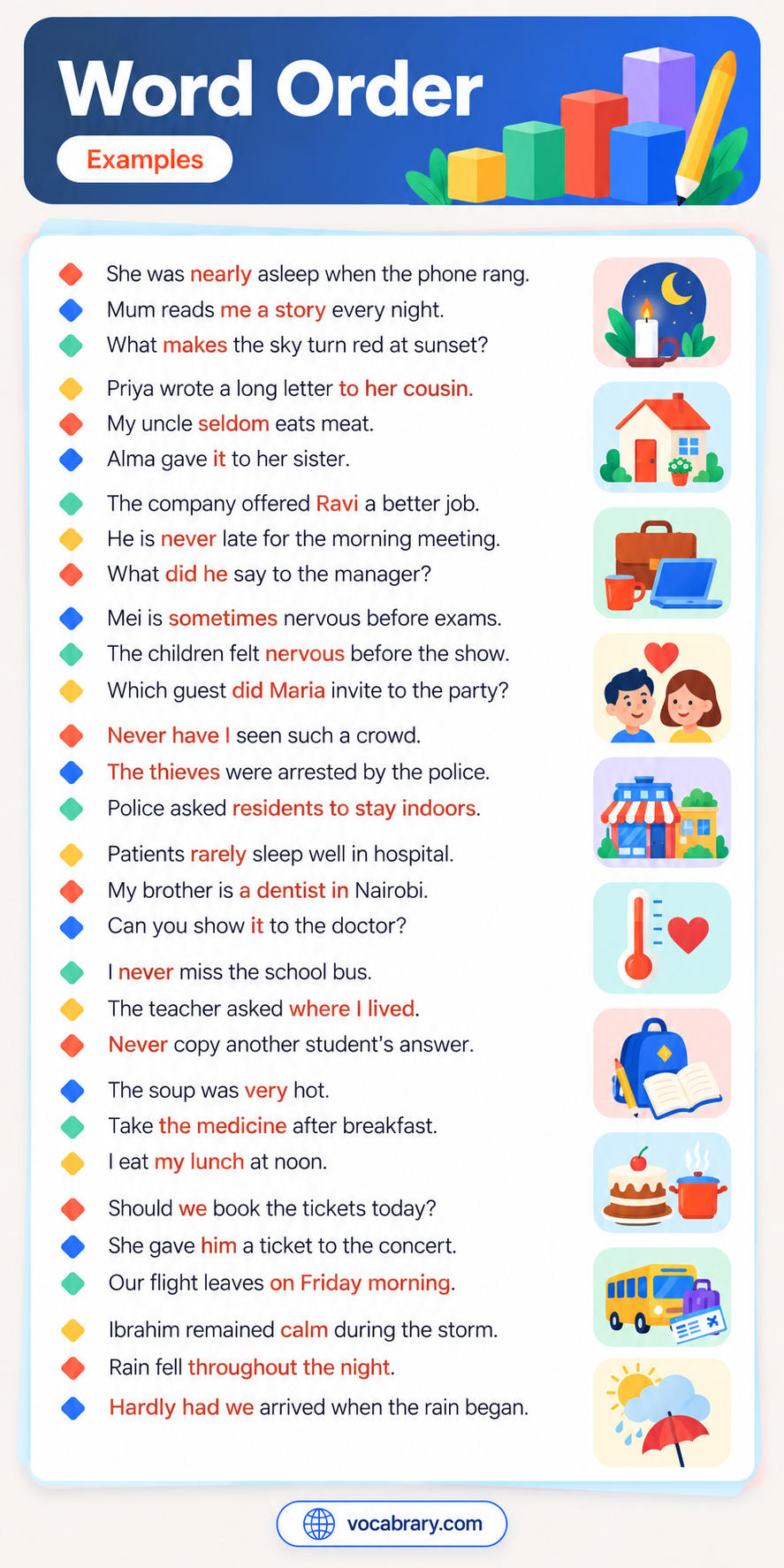
Common Word Order Examples
The chef baked a chocolate cake, Joon always drinks black tea, and rarely did we stay out are three kinds of order: standard, mid-position adverb, and inverted. These word order examples English learners need use all three.
- The chef baked a chocolate cake for the party.
- Joon always drinks black tea at breakfast.
- Did you lock the front door?
- She gave him a ticket to the concert.
- Ines called from the station an hour ago.
- It was a lovely old stone cottage.
- I wonder where the station is.
- Please put it down gently.
- Rarely did we stay out after midnight.
- Although he was ill, Tariq went to work.
- How do you spell your surname?
- He never arrives late.
- They speak English fluently.
- Rafael quickly finished his homework.
- The pilot told the passengers the good news.
- Hardly ever do we eat out.
- Two small brown Spanish dogs barked all night.
- The manager did not say a word.
- Under the bed lay a sleeping puppy.
- What Ana wants is a quiet weekend.
Subject Verb Object Word Order
Nadia baked a lemon tart, the soup tastes delicious, and the train arrived at noon are three standard patterns, in which the subject comes first, the verb second, and the rest after.
Subject Verb Object
A transitive verb, one that takes an object, is followed directly by that object in a neutral statement, as in baked a lemon tart.
- Nadia baked a lemon tart for her brother’s birthday.
- The farmer sells fresh eggs at the Saturday market.
- Our neighbour painted the garden fence last weekend.
- The students wrote three long essays before the holidays.
- A strong wind knocked down several old trees.
- Kenji repairs bicycles in a small shop near the station.
- The nurse carried the sleeping child to the ward.
- Ahmed drinks black coffee every morning.
- The committee approved the new budget on Thursday.
- Grandfather planted an apple tree behind the house.
- The mechanic fixed the broken engine in an hour.
- Lena sent an invitation to every classmate.
- The storm destroyed the old wooden bridge.
- Tomas found a silver coin under the sofa.
Subject Verb Complement
A linking verb such as be, seem, or taste is followed by a complement that describes or renames the subject. The soup tastes delicious and Elena became a pilot follow the order subject, verb, complement.
- The soup tastes delicious.
- Elena became a pilot after years of training.
- The old house seems empty.
- My brother is a dentist in Nairobi.
- The night grew cold very quickly.
- The music sounded beautiful across the water.
- Ibrahim remained calm during the storm.
- The milk smells sour.
- Her cousin is the youngest member of the choir.
- The children felt nervous before the show.
Subject Verb Adverbial
An intransitive verb needs no object, and a phrase of place or time is added after it, as in arrived at noon and slept in the cot.
- The train arrived at noon.
- The baby slept in the cot.
- Visitors gather near the fountain every evening.
- The students waited outside the hall.
- Our flight leaves on Friday morning.
- The dog ran across the frozen field.
- Rain fell throughout the night.
- My grandparents live in a village near Porto.
Adverb Placement in Word Order
Frequency adverbs, manner adverbs, and place and time phrases each have a usual position, and the position of an adverb such as only changes the meaning of the sentence.
Adverbs of Frequency Before the Main Verb
Always, never, and rarely go before a main verb, as in always drinks, after the verb be, as in is never late, and after the first auxiliary, as in have rarely visited. The adverbs sometimes, usually, and occasionally also open a sentence. The adverbs of frequency example sentences page covers this group in full.
- Samira always drinks green tea after lunch.
- He is never late for the morning meeting.
- We often walk along the river after supper.
- They have rarely visited the coast in winter.
- My uncle seldom eats meat.
- She will always remember her first concert.
- Sometimes the bus is late in the rain.
- The shop usually opens at eight.
- Pedro is hardly ever at home on weekends.
- Occasionally we cook dinner together.
- The children have never seen snow.
- You should always read the instructions first.
- I frequently forget my umbrella.
- Mei is sometimes nervous before exams.
Adverbs of Manner After the Verb
Quietly, carefully, and fluently come after the verb or after its object, as in closed the door quietly and speaks Portuguese fluently, and they are not placed between a verb and its direct object. A manner adverb is also placed before the main verb in some sentences, as in Rafael quickly finished his homework.
- Hana closed the door quietly.
- The pianist played the sonata beautifully.
- Rafael speaks Portuguese fluently.
- The guide explained the rules carefully.
- The children waited patiently in the queue.
- She answered the question politely.
- The old man walked slowly up the hill.
- The athletes trained hard all winter.
- He carried the vase gently across the room.
- The team played well in the final.
- The baby laughed happily at the puppy.
- She drives very carefully in the fog.
Adverbs of Place and Time
Here, outside, yesterday, and tomorrow name where or when, and they go at the end of the clause or, for time words, at the start. Place comes before time when both follow the verb.
- We met in the park yesterday.
- The concert starts tomorrow evening.
- Yesterday the whole street lost power.
- The meeting will take place in the main hall at ten.
- Dina left her keys upstairs.
- Last summer we travelled to Morocco.
- The children are playing outside.
- Our guests arrived at the station on Sunday.
- Tomorrow I will call the bank.
- He was born in a small town in 1990.
- Please wait here until your name is called.
- She will visit her aunt in Delhi next month.
Manner, Place, and Time in One Sentence
When a sentence has all three, the usual order after the verb is manner, then place, then time, as in worked hard in the garden all morning.
- Lucia worked hard in the garden all morning.
- The choir sang beautifully in the cathedral last Sunday.
- The children played happily in the yard until dark.
- He drove carefully through the village at night.
- They waited patiently outside the clinic for an hour.
- Anna studies quietly in the library every evening.
- The workers laboured cheerfully on the roof all week.
- She spoke confidently to the committee on Monday.
- The dancers moved gracefully across the stage that night.
- We walked slowly along the beach after sunset.
Degree Adverbs and the Word Only
Very, quite, and almost go before the word they modify, and only goes next to the word it limits, so Only Tom ate the cake and Tom ate only the cake have different meanings.
- The soup was very hot.
- It was quite a difficult exam.
- The bus almost missed the turn.
- Only Tom ate the cake.
- Tom ate only the cake.
- Tom ate the cake only after everyone had left.
- The lake is extremely deep near the bridge.
- She was nearly asleep when the phone rang.
- The coffee was fairly strong this morning.
- Even the youngest child understood the joke.
Adjective Word Order Before a Noun
A lovely old stone cottage and a tall young Brazilian footballer follow the usual order of adjectives: opinion, size, age, shape, colour, origin, material, and purpose. The order of adjectives examples page covers this order in full.
- She lives in a lovely old stone cottage.
- Rosa bought a small round wooden table.
- A tall young Brazilian footballer scored twice.
- The shop sells beautiful old Persian carpets.
- He wore a big red woollen scarf.
- We stayed in a comfortable modern glass hotel.
- Lucas owns a fast new black motorbike.
- Grandma gave me a delicious homemade apple pie.
- The museum displays a huge ancient Greek vase.
- An expensive little silver watch lay on the table.
- Beatriz carried a heavy brown leather bag.
- They adopted a sweet little grey kitten.
- The farmer drove an old green tractor.
- I need a large plastic storage box.
Direct and Indirect Object Word Order
The clerk gave her a receipt and The clerk gave a receipt to her are two orders for the same meaning. The indirect object, the receiver, comes first without to, or after the direct object with to or for.
Indirect Object Before Direct Object
Gave her a receipt and sent us a postcard have the receiver directly after the verb with no to.
- The clerk gave her a receipt.
- Dad bought me a new bicycle.
- Ines sent us a postcard from Lisbon.
- The teacher handed each student a dictionary.
- Grandma knitted the baby a warm hat.
- Please show me your passport.
- My aunt cooked the guests a huge meal.
- The company offered Ravi a better job.
- Can you lend me your pen for a moment?
- They taught the children a new song.
Direct Object Before To or For
Gave a receipt to her and cooked a huge meal for the guests have the receiver after the direct object with to or for. This order is used to stress the receiver or when the receiver is a long phrase.
- The clerk gave a receipt to her.
- The tailor made a suit for my uncle.
- Priya wrote a long letter to her cousin.
- The waiter brought the bill to the old couple by the window.
- Tomas baked a lemon cake for the neighbours.
- Please show your passport to the officer at the desk.
- My aunt cooked a huge meal for the guests.
- The agency found a small flat for the students.
- She passed the salt to her neighbour.
- The pilot lent his jacket to a stranger.
Pronoun Objects and Verbs That Need To
When the direct object is a pronoun, the receiver comes after it with to, as in gave it to her sister. Explain, describe, and suggest take the to form only.
- Alma gave it to her sister.
- He sent them to the manager yesterday.
- Please pass it to me.
- She explained the rules to the new students.
- The guide described the route to us.
- Miguel suggested a quiet cafe to his parents.
- He introduced his friend to the headmaster.
- Can you show it to the doctor?
- The mayor announced the plan to the villagers.
- I gave it to him after the lesson.
Question Word Order
In an English question the auxiliary verb comes before the subject, and a question word comes first in the clause. Subject questions are the exception, because the question word is itself the subject.
Yes or No Questions
Is she at home, do you like spicy food, and have they arrived put the verb be or an auxiliary before the subject. The auxiliary do is added when the statement has neither a form of be nor another auxiliary.
- Is she at home this evening?
- Do you like spicy food?
- Have they arrived at the hotel?
- Can Tariq swim across the lake?
- Does your sister play the violin?
- Was the film longer than the book?
- Will the shop open on Sunday?
- Did the children finish their homework?
- Are the neighbours coming to dinner?
- Should we book the tickets today?
Wh Questions With an Auxiliary
Where are you going, what did he say, and why was the match cancelled have the question word first, then the auxiliary, then the subject.
- Where are you going this weekend?
- What did he say to the manager?
- Why was the match cancelled?
- When will the parcel arrive?
- How long have you lived in Madrid?
- Which bus does your cousin take to school?
- Whose coat did you borrow?
- Which guest did Maria invite to the party?
- Where can we park near the stadium?
- What time does the library close?
- How often do you visit your grandparents?
- Why have the lights gone out?
Subject Questions Without Inversion
Who called you, what happened, and which team won use the question word as the subject, so no auxiliary comes before it and the verb follows directly.
- Who called you this morning?
- What happened at the market?
- Which team won the cup?
- Who lives in the blue house?
- What makes the sky turn red at sunset?
- Who has the key to the cellar?
- How many students passed the test?
- Which road leads to the lake?
Negative Word Order
The word not comes after the first auxiliary or after be. A verb in the present or past tense with no auxiliary takes the auxiliary do, as in does not speak and did not call. Other negative words such as never, nobody, and hardly ever make a sentence negative without not.
- He is not at home today.
- They have not seen the new gallery.
- She does not speak French.
- We did not call anyone about the delay.
- The shop will not open before nine.
- I could not find my glasses.
- Mina has never been to the mountains.
- The children should not play near the road.
- Nobody answered the door.
- He hardly ever complains about the weather.
- The bus did not stop at the village.
- It was not a difficult decision.
Embedded Question Word Order
An embedded question is placed inside a longer sentence and takes statement order, with the subject before the verb and no auxiliary do, as in tell me where the station is. The question word stays first, and if or whether introduces a yes or no question.
- Could you tell me where the station is?
- I wonder what she said to the teacher.
- Do you know when the film starts?
- She asked me how much the ticket cost.
- I don’t know why he left so early.
- Can you explain how this machine works?
- Nobody knows who broke the window.
- Please tell me what time the shop opens.
- He wondered whether the bridge was open.
- Do you know if the library is open on Sunday?
- The reporter asked where the survivors had been found.
- I have no idea what the answer is.
- Tell us which road leads to the lake.
- Where she went is still a mystery.
Subordinate Clause Word Order
An adverbial subordinate clause is placed at the start or the end of a sentence, as in when the bell rang, the students left and the students left when the bell rang. A comma follows the clause when it comes first.
- When the bell rang, the students left the room.
- The students left the room when the bell rang.
- Although it rained, the match continued.
- The market stayed open although the streets were wet.
- Because the road was flooded, we took the train.
- The shop closed early because the owner was ill.
- If you heat the butter gently, it melts without burning.
- You will taste the difference if you use fresh herbs.
- While the baby slept, Mum finished the washing.
- Dad read the paper while the coffee cooled.
- Unless the weather improves, the ferry will stay in port.
- The race will start on time unless a storm arrives.
Word Order for Emphasis
Fronting moves a word or phrase to the start of the sentence to stress it, and some fronted forms also invert the subject and verb. The inversion examples and cleft sentence examples pages cover the two main emphasis patterns in full.
Fronting an Object or Adverbial
Into the garden ran the children and that film I have seen twice start with the part of the sentence that the writer stresses.
- Into the garden ran the children.
- That film I have seen twice.
- At the top of the hill stood an old castle.
- Here comes the bus.
- Slowly and carefully she opened the envelope.
- Some of the stories I believed; others I doubted.
- On the table lay a sealed letter.
- Beside the river grew a row of poplars.
- Away ran the frightened rabbit.
- In the corner sat an old man with a violin.
Inversion After Negative Adverbs
Never have I seen, rarely does he complain, and only then did she understand have the auxiliary before the subject after a negative or limiting adverb at the start.
- Never have I seen such a crowd.
- Rarely does he complain about the food.
- Only then did she understand the problem.
- Not only did he forget the tickets, but he also lost the map.
- Hardly had we arrived when the rain began.
- Seldom do the villagers see snow in October.
- No sooner had the bell rung than the pupils ran outside.
- Little did they know about the surprise.
- Under no circumstances should you open the red door.
- Only after the meeting did Karim read the report.
Cleft Sentences With It and What
Sentences such as It was Maria who found the keys and What I need is a holiday divide one statement into two clauses to stress one part.
- It was Maria who found the keys.
- It was in Lisbon that they first met.
- What I need is a long holiday.
- It is the noise that bothers me most.
- What surprised everyone was his calm voice.
- It was last winter that the river froze completely.
- All she wanted was some peace and quiet.
- It was my brother who broke the lamp.
Separable Phrasal Verb Word Order
A phrasal verb is a verb plus a particle, and a separable one has its object between the two parts or after the particle, as in turn the light off. When the object is a pronoun it goes between them, so turn it off is correct and turn off it is not.
Noun Object Before or After the Particle
Turn off the light and turn the light off are both correct, because a noun object is placed either after the particle or between the two parts of a separable phrasal verb.
- Please turn the light off before you leave.
- Please turn off the light before you leave.
- Omar picked up the heavy box.
- Omar picked the heavy box up.
- Fill in the form with a black pen.
- Fill the form in with a black pen.
- She threw away the old magazines.
- She threw the old magazines away.
- Write the address down before you forget.
- The guard put on his heavy coat.
Pronoun Object Between the Parts
Turn it off, pick them up, and fill it in have a pronoun object between the verb and the particle, and this is the required position for a pronoun object with a separable phrasal verb.
- Turn it off before you leave.
- Zainab picked them up from the station.
- Please fill it in with a black pen.
- She threw them away last week.
- Write it down before you forget.
- The guard put it on and left.
- Can you switch them on?
- He took it off and hung it by the door.
Inseparable Phrasal Verbs
Look after, get over, and run into are inseparable, so the verb and particle stay together and the object comes after the particle, as in look after them.
- Nina looks after her grandmother every weekend.
- It took him a year to get over the loss.
- We ran into an old friend at the market.
- The nurse looks after them with great care.
- The lecturer went through the main points slowly.
- The detective came across a strange letter.
- She is getting along with her new neighbours.
- I can’t put up with this noise any longer.
Word Order in Reported Speech and Passive Sentences
A reported question takes statement order, as in the teacher asked where I lived. A passive sentence moves the object of the active sentence into the subject position, as in the cake was eaten by the children.
- The teacher asked where I lived.
- He said he was tired.
- She wanted to know what time the train left.
- The reporter asked how many people had come.
- The cake was eaten by the children.
- A letter has been sent to every family.
- The cat was chased by the dog.
- The bridge was built by local workers.
- The thieves were arrested by the police.
- The invitations were printed in gold ink.
- Mother wondered why the door was open.
- The results will be announced on Friday.
Standard and Inverted Word Order Compared
In Is she ready? the verb comes before the subject, while in She is ready it comes after. The inversion examples page covers the inverted order in full.
| Feature | Standard order | Inverted order |
|---|---|---|
| Order | Subject before the verb | Auxiliary or verb before the subject |
| Typical use | Statements and subject questions | Questions, negative adverbs, and some openings |
| Statement and question | She is ready. | Is she ready? |
| Emphasis | I have never seen such a view. | Never have I seen such a view. |
Standard Order or Inverted Order
The same words change their order to change the function of the sentence, as in You are coming tonight and Are you coming tonight?, or to make a plain statement emphatic.
- You are coming tonight.
- Are you coming tonight?
- They have finished the project.
- Have they finished the project?
- A castle stood at the top of the hill.
- At the top of the hill stood a castle.
- He had hardly left when the phone rang.
- Hardly had he left when the phone rang.
- She rarely complains about the weather.
- Rarely does she complain about the weather.
Word Order in Everyday Contexts
Sentences from home, school, work, travel, the news, fiction, sports, and health follow the same order patterns, and the adverb, object, and auxiliary come in their usual positions.
Word Order at Home
Household sentences such as Mum always bakes fresh bread, Dad left the keys upstairs and switch it off have an adverb, a place word, and a pronoun, each in its usual position.
- Mum always bakes fresh bread on Sundays.
- Dad left the keys upstairs.
- Please switch it off before bedtime.
- We rarely eat in the dining room.
- The cat sleeps on the warm radiator every afternoon.
- Grandma carefully folded the clean sheets.
- Where did you put the scissors?
- Nobody knows who ate the last biscuit.
Word Order at School
At school, The students always hand in their homework, The teacher gave each pupil a worksheet and What did the author mean use an adverb, an object, and an auxiliary, each in its usual position.
- The students always hand in their homework on Monday.
- The teacher gave each pupil a worksheet.
- What did the author mean by the last line?
- Hana answered the question correctly.
- Never copy another student’s answer.
- The headmistress asked why the bell had not rung.
- Please write your name at the top of the page.
- They revise at the library after lunch.
Word Order at Work
Office sentences such as The manager is rarely late and Carla sent the report to the client yesterday have an adverb and a to phrase. A sentence such as could you tell me when the meeting starts has an embedded question.
- The manager is rarely late for meetings.
- Carla sent the report to the client yesterday.
- Did the board approve the budget?
- I usually answer emails before lunch.
- Could you tell me when the meeting starts?
- The team finished the project quickly.
- We sent them the invoice on Friday.
- The supervisor never forgets a deadline.
Word Order While Travelling
In travel sentences such as The train leaves from platform four at noon, they have already booked and we arrived at the hotel late on Saturday, the place, time, and adverb have their usual positions.
- The train leaves from platform four at noon.
- Excuse me, where is the nearest bank?
- The tourists happily explored the old town.
- Could you tell me how I can get to the museum?
- We arrived at the hotel late on Saturday.
- They have already booked the ferry tickets.
- Pablo carried the suitcase upstairs.
- Have you ever been to Istanbul?
Word Order in the News
News sentences such as The council voted on Tuesday, The minister rarely answers and Only after the inquiry did the company admit contain a time phrase, an adverb, and a fronted adverbial.
- The council voted on Tuesday.
- The minister rarely answers reporters’ questions.
- A powerful storm hit the coast overnight.
- Police asked residents to stay indoors.
- Only after the inquiry did the company admit its mistake.
- Officials announced the results at noon.
- The government has already promised new funding.
- Nobody knows when the road will reopen.
Word Order in Fiction
Story sentences with a manner adverb, a manner phrase, and a fronted place phrase include The knight rode slowly, The door opened without a sound and Behind the curtain hid a trembling child.
- The knight rode slowly through the dark forest.
- The door opened without a sound.
- Behind the curtain hid a trembling child.
- Suddenly the lights went out.
- Never had she felt so alone.
- The old man whispered softly in the corner.
- Into the mist vanished the stranger.
- She quietly closed the book and smiled.
Word Order in Sports
Sporting sentences with a time phrase and two frequency adverbs include The striker scored in the last minute, Our coach always shouts and The team rarely loses at home.
- The striker scored in the last minute.
- Our coach always shouts from the sideline.
- The team rarely loses at home.
- Did the referee see the foul?
- The runner crossed the line first.
- Only in the final did they play well.
- She passed the ball to her captain.
- They trained hard on the pitch every morning.
Word Order About Health
In health sentences such as The nurse regularly checks the patients, The doctor gave him some advice and Patients rarely sleep well, two frequency adverbs and an indirect object come in their usual positions.
- The nurse regularly checks the patients.
- The doctor gave him some advice.
- Patients rarely sleep well in hospital.
- Take the medicine after breakfast.
- Do you know what the doctor said?
- He feels much better today.
- The therapist asked how often I exercised.
- She drinks water throughout the day.
Word Order Examples for Kids
The cat chased a ball, I eat my lunch at noon, and my dog runs fast are everyday sentences written for pupils learning that the subject comes first, then the verb, then the rest.
- The cat chased a ball.
- I eat my lunch at noon.
- My dog runs fast.
- Mum reads me a story every night.
- We always wash our hands.
- Do you like pizza?
- The bird sings in the tree.
- I never miss the school bus.
- Where is my red ball?
- She gave me a big hug.
Short Word Order Sentences for Young Learners
Three-word lines such as I always smile and She never runs follow one fixed pattern that beginners copy and read aloud.
- I always smile.
- She never runs.
- We often sing.
- Dogs can swim.
- Is it big?
- He likes tea.
- Birds fly high.
- Sit here, please.
- Where is Dad?
- They play outside.
Word Order Examples for Students
Exam answers about history, science, and law use longer sentences with fronted adverbials, embedded questions, and long object phrases, as in these word order examples English students write.
- Only after the data had been collected did the researchers draw their conclusions.
- The committee wanted to know why the experiment had failed twice.
- Rarely has a policy changed so many lives in so short a time.
- In the final chapter the author reveals the true cause of the war.
- The government must decide how much money it can afford to spend.
- She presented her findings clearly and confidently to the board on Tuesday.
- Not only did the treaty end the conflict, but it also created a lasting alliance.
- The students questioned whether the evidence was reliable.
- Beneath the ice of the northern lakes live several rare species of fish.
- It was the lack of funding that caused the project to collapse.
Word Order in a Short Paragraph
Seven connected sentences about Rosa, a gardener in Seville, use always, never, quietly, and only after in continuous writing, as in the word order examples English writers use.
Rosa always wakes before sunrise and quietly walks into her garden. She waters the roses carefully, and she never forgets the lemon tree. At the end of the path stands an old stone fountain. Only after the watering does she make her coffee.
Her neighbour asked how she kept the flowers so fresh. Rosa gave him a bag of seeds, and she explained the secret to him slowly. Because the soil was rich, the garden bloomed all summer.
Word Order Examples English Learners Get Wrong
I like very much it, I go always, and do you know where is the station are errors in which the right words stand in the wrong order.
❌ I like very much it.
✅ I like it very much.
An adverb of degree such as very much does not come between a verb and its direct object.
❌ I go always to school by bus.
✅ I always go to school by bus.
A frequency adverb such as always goes before the main verb in a neutral statement.
❌ She speaks very well English.
✅ She speaks English very well.
The object comes directly after the verb, and the adverb follows the object.
❌ He never is late.
✅ He is never late.
A frequency adverb goes after the verb be in a neutral statement.
❌ He gave to me the book.
✅ He gave me the book.
The verb give takes an indirect object without to before the direct object, or the to form after it, as in gave the book to me.
❌ Where you are going?
✅ Where are you going?
In a question about an object or an adverbial, the auxiliary comes before the subject.
❌ Do you know where is the station?
✅ Do you know where the station is?
An embedded question takes statement order, with the subject before the verb.
❌ She asked me where did I live.
✅ She asked me where I lived.
A reported question takes statement order, and the auxiliary do is dropped.
❌ Turn off it before you go.
✅ Turn it off before you go.
A pronoun object goes between the verb and the particle of a separable phrasal verb.
❌ She bought a wooden big table.
✅ She bought a big wooden table.
A size adjective comes before a material adjective in the usual order of adjectives.
Related
- Inversion Examples
- Cleft Sentence Examples
- Simple Sentence Examples
- Adverbs of Frequency Example Sentences
- Order of Adjectives Examples
- Complex Sentence Examples
- Compound Sentence Examples
FAQs
Q1. What is the standard word order in an English sentence?
The standard word order in an English sentence is subject, then verb, then object, as in The chef baked a cake. Place and time phrases follow the object, so a full sentence reads subject, verb, object, place, time. The word order examples English teachers give first follow this pattern, because the position of a noun indicates whether it performs or receives the action.
Q2. Why does English have a fixed word order?
English has a strict standard word order because its nouns have no separate subject and object endings. The position of a noun therefore determines whether it is the subject or the object, so the dog bit the man and the man bit the dog have different meanings. Pronouns keep a few case forms, as in he and him.
Q3. Where do adverbs of frequency go in a sentence?
Adverbs of frequency go before the main verb and after the verb be, as in she always drinks tea and he is never late. With an auxiliary they go after the first auxiliary, as in they have rarely visited. The adverbs sometimes, usually, and occasionally also open a sentence, but always and never are not placed first in a plain statement.
Q4. In what order do adverbs of manner, place, and time appear?
Adverbs of manner, place, and time come in that order after the verb, as in She worked hard in the garden all morning. Manner comes first, place second, and time last. A time word is able to move to the start of the sentence, as in Yesterday she worked hard in the garden.
Q5. What is the correct order of adjectives before a noun?
Several adjectives of different kinds before a noun follow the order opinion, size, age, shape, colour, origin, material, and purpose, as in a lovely old stone cottage. A different order such as a wooden big table is incorrect in standard English. The order of adjectives examples page covers the full sequence.
Q6. What is the word order in an English question?
In an English question, the auxiliary verb comes before the subject, as in Are you coming and Where did he go. The auxiliary do is added when the statement has no auxiliary, as in Do you like tea. Subject questions such as Who called you have statement order because the question word is the subject.
Q7. How does word order change in embedded questions?
An embedded question takes statement order, with the subject before the verb and no auxiliary do. The correct form is Do you know where the station is?, and Do you know where is the station? is incorrect. If or whether introduces an embedded yes or no question, as in I wonder whether he left.
Q8. Where does not go in a negative sentence?
The word not goes after the first auxiliary or after the verb be, as in She has not arrived and He is not here. A verb in the present or past tense with no auxiliary takes the helper do, as in She does not speak French. Nobody and nothing make a sentence negative without not, as in Nobody answered.
Q9. How do you place the indirect object in a sentence?
The indirect object comes directly after the verb without to, as in She gave him a ticket. It follows the direct object with to or for in the other order, as in She gave a ticket to him. Explain, describe, and suggest take only the second order, so she explained the rule to me is correct.
Q10. Where does the pronoun go in a separable phrasal verb?
A pronoun object goes between the verb and the particle of a separable phrasal verb, as in turn it off and pick them up. A noun object goes either between the two parts or after the particle, as in turn the light off and turn off the light. Inseparable phrasal verbs such as look after have no object between the two parts.
Q11. Can you change word order for emphasis?
Writers change word order for emphasis by fronting a phrase, inverting the subject and verb, or using a cleft sentence. Examples are Into the garden ran the children, Never have I seen such a crowd, and It was Maria who found the keys. The inversion examples and cleft sentence examples pages cover these patterns in full.
Q12. What is the word order in a sentence with a subordinate clause?
A subordinate clause is able to come before or after the main clause, and the facts stated are the same. When it comes first, a comma follows it, as in When the bell rang, the students left. When it comes second, a comma is not needed before a clause that gives a time, a reason, or a condition, as in The students left when the bell rang.
Q13. What is the difference between standard and inverted word order?
Standard word order places the subject before the verb, while inverted word order places the auxiliary or verb before the subject. The statement She is ready uses standard order, and the question Is she ready? uses inverted order. Inversion is also used after negative adverbs, as in Rarely does he complain. Both patterns are in the word order examples English learners study.

Leave a Comment