
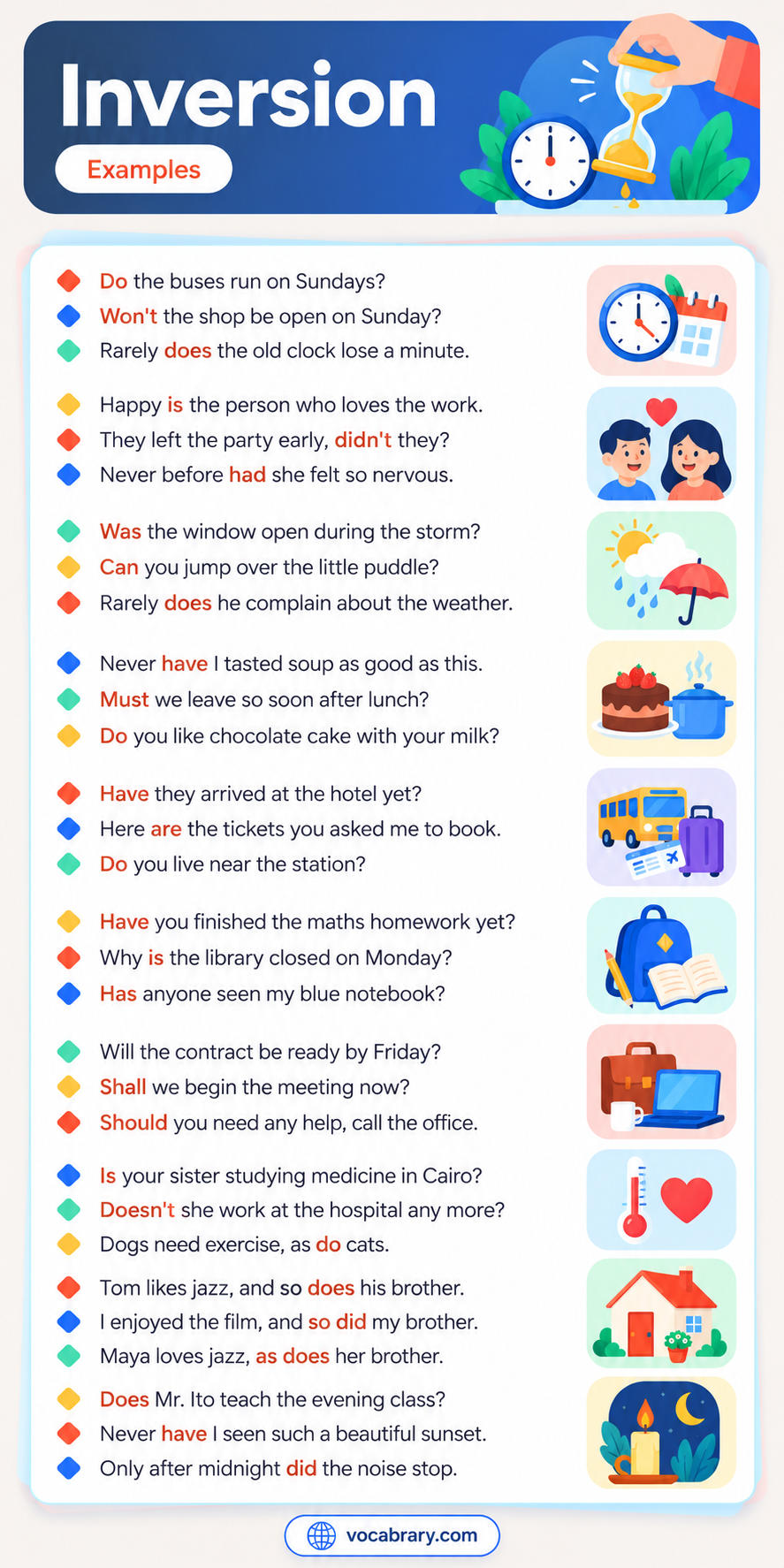
Inversion is a reversal of the usual positions of the subject and the verb, in which an auxiliary verb or a main verb comes before the subject. These 301 inversion examples sentences are written for questions, negative adverbs, only, not only, conditionals, so and such, here and there, and everyday contexts. You get model sentences for speaking, writing, and exam practice, together with related practice on word order, cleft sentences, and complex sentences.
Quick Answer: Inversion Examples Sentences
- Yes or no question: Does your cousin speak Spanish?
- Wh-question: Where have the visitors gone?
- After never: Never have I met such a generous host.
- After not only: Not only did the bakery close early, but it also lost power.
- After hardly: Hardly had the guests sat down when the soup arrived.
- After only: Only then did the crowd begin to cheer.
- Conditional with should: Should the guests arrive early, show them the garden.
- After so: So bright was the moon that we walked without torches.
Inversion Examples Sentences for Everyday Use
An auxiliary verb or a main verb comes before the subject, as in “hung”, “comes”, and “lay”.
- Is she a doctor at the city clinic?
- Never have I seen such a beautiful sunset.
- Rarely does he complain about the weather.
- Between the trees hung a faded banner.
- Had the tickets been cheaper, we would have booked two.
- Not only did she win the race, but she also broke the record.
- Here comes the postman with a parcel for you.
- So deep was the silence that everyone heard the clock.
- Hardly had the film started when the power went out.
- Do you live near the station?
- Only then did Leila understand the real problem.
- Little did they know about the surprise waiting at home.
- Should the lights go out, stay calm and use the stairs.
- I enjoyed the film, and so did my brother.
- Seldom do we see snow in this part of the country.
- Under the table lay a sleeping puppy.
- Nowhere was the missing key to be found.
- Were the weather warmer, we would swim in the sea.
- No sooner had the show ended than the crowd rushed out.
- Such was her talent that every school wanted her.
Question Sentences with Inversion
In questions, an auxiliary verb comes before the subject, as in “wasn’t”, “can’t”, and “aren’t”.
Inversion Examples Sentences in Yes or No Questions
An auxiliary verb begins each sentence, as in “Do the buses run on Sundays?”, “Can you swim across the lake?”, and “Will the concert start on time?”.
- Can you swim across the lake?
- Have they arrived at the hotel yet?
- Is your sister studying medicine in Cairo?
- Do the buses run on Sundays?
- Does Mr. Ito teach the evening class?
- Did the shop close early last night?
- Will the concert start on time?
- Shall we begin the meeting now?
- Must we leave so soon after lunch?
- Were the children asleep when you got home?
- Was the window open during the storm?
- Would you like another cup of tea?
- Could you tell me where the post office is?
- Has anyone seen my blue notebook?
Inversion Examples Sentences in Wh Questions
A question word is followed by an auxiliary verb, as in “How long has she lived in Nairobi?”, “When will the results be announced?”, and “Why is the library closed on Monday?”.
- Where did you park the car this morning?
- Why is the library closed on Monday?
- What have the children done with the scissors?
- How long has she lived in Nairobi?
- When will the results be announced?
- Which road should we take to the coast?
- Whose bag did the porter leave on the platform?
- Who are you waiting for outside the station?
- What time does the train from Pune arrive?
- How often do the volunteers meet in the hall?
- Whom did the committee choose as chairperson?
- Where were the keys when you last saw them?
- Which film did you watch on Saturday?
- How many tickets have they sold so far?
Inversion Examples Sentences in Question Tags
Question tags at the end put the auxiliary verb before the pronoun, as in “aren’t”, “doesn’t”, and “shouldn’t”.
- You are very tired, aren’t you?
- She can swim well, can’t she?
- They left the party early, didn’t they?
- The shop opens at nine, doesn’t it?
- Tom hasn’t called today, has he?
- You won’t tell anyone, will you?
- We should go now, shouldn’t we?
- It isn’t raining outside, is it?
- He lives nearby, doesn’t he?
- You have met Sara, haven’t you?
Inversion Examples Sentences in Negative Questions
Negative auxiliary verbs such as “didn’t”, “won’t”, and “aren’t” appear in the question.
- Didn’t you hear the alarm last night?
- Haven’t the neighbours returned from Spain?
- Isn’t your brother coming to the party?
- Won’t the shop be open on Sunday?
- Doesn’t she work at the hospital any more?
- Why wouldn’t he answer the phone?
- Aren’t the tickets already sold out?
- Wasn’t the road closed after the storm?
- Hasn’t the plumber arrived yet?
- Weren’t the students ready for the test?
Negative Adverbial Sentences with Inversion
Each sentence begins with a negative or restrictive word or phrase, and an auxiliary verb follows.
Inversion Examples Sentences After Never and Rarely
After never, rarely, or seldom at the start, an auxiliary verb comes before the subject, as in “Seldom did the pilot lose her calm”, “Never before had she felt so nervous”, and “Rarely is the river this low in spring”.
- Never have I tasted soup as good as this.
- Never before had she felt so nervous.
- Rarely does the old clock lose a minute.
- Seldom do the neighbours complain about the music.
- Never will I forget the kindness of the villagers.
- Rarely have the students worked so hard.
- Seldom has the village seen such heavy snow.
- Never again will he trust a stranger with his keys.
- Seldom did the pilot lose her calm.
- Rarely is the river this low in spring.
- Seldom was a speech received with such silence.
- Never has the team played better than today.
- Rarely has the town been as quiet as it was after the flood.
- Rarely do I eat dinner before eight o’clock.
- Never did he suspect that his friend was lying.
- Seldom does a week pass without a letter from my aunt.
Inversion Examples Sentences with Not Only
Not only begins the sentence and is followed by an auxiliary verb, as in “Not only is the flat small, but it is also very noisy”, “Not only had the road flooded, but the bridge had also collapsed”, and “Not only did the team arrive late, but it also forgot the uniforms”.
- Not only did Rafa win the semi-final, but he also set a national record.
- Not only is the flat small, but it is also very noisy.
- Not only have they lost their keys, but they have also missed the last bus.
- Dinner went badly, because not only was the soup cold, but it was also too salty.
- Not only does she sing beautifully, but she also writes her own songs.
- Not only will the museum open late, but it will also offer free entry.
- Marta is talented, and not only can she cook, but she can also repair the oven.
- Not only had the road flooded, but the bridge had also collapsed.
- Not only should you apologise, but you should also pay for the damage.
- On the school trip, not only did the children behave well, but they also thanked the driver.
- Not only did the team arrive late, but it also forgot the uniforms.
Inversion Examples Sentences After Hardly and No Sooner
Hardly, scarcely, and no sooner are followed by had and a past participle.
- Hardly had she sat down when the phone rang.
- Scarcely had the speaker finished when the audience began to clap.
- No sooner had we reached the car than the rain began.
- Hardly had the engineers left the site when the wall collapsed.
- No sooner had he opened the door than the dog ran out.
- Scarcely had the sun risen when the market opened.
- No sooner had the bell rung than the pupils rushed outside.
- Hardly had Karim signed the form when the clerk closed the window.
- Scarcely had they unpacked when the neighbours knocked at the door.
- No sooner had the lights gone out than the baby started crying.
- Hardly had the ferry left the dock when the storm broke.
- Hardly had the guests arrived when the music began.
- Hardly had the baby fallen asleep when the doorbell rang.
Inversion Examples Sentences After Little and No Phrases
Little, nowhere, and negative phrases such as at no time and under no circumstances begin the sentence, as in “In no way was the delay my fault”, “By no means is the work finished”, and “On no account must the gate be left open”.
- Little did they know that the storm was coming.
- Nowhere have I felt as welcome as in this village.
- At no time did the manager approve the plan.
- Under no circumstances should you open the door to a stranger.
- On no account must the gate be left open.
- In no way was the delay my fault.
- By no means is the work finished.
- Nowhere in the report does it mention the cost of repairs.
- Not a single word did he say during the meeting.
- No longer do the trains stop at this tiny station.
- Little does she realise how much the children admire her.
- In no case will the fee be refunded after the deadline.
- Not for one moment did Ayesha doubt her sister.
- Under no condition may visitors enter the laboratory.
Inversion Examples Sentences After Only
Only is followed by a time, a place, or a condition, as in “Only then did she realise her mistake”, “Only after midnight did the noise stop”, and “Only after dinner did the guests begin to dance”.
- Only then did she realise her mistake.
- Only after the storm did the birds return to the garden.
- Only when you finish your homework may you play outside.
- Only by working together can the villagers rebuild the school.
- Only in the evening does the market become quiet.
- Only once have I seen a fox in the city.
- Only later did we learn the truth about the letter.
- Only if the weather improves will the match go ahead.
- Only recently has the museum opened to the public.
- Only with great effort was the heavy door forced open.
- Only after midnight did the noise stop.
- Only in this room are visitors allowed to take photographs.
- Only after dinner did the guests begin to dance.
Conditional Sentences with Inversion
Each condition begins with had, should, or were, and no if is used.
Inversion Examples Sentences with Had for Past Conditions
A condition in the past begins with had.
- Had I known the price, I would have bought the cheaper one.
- Had they left earlier, they would have caught the train.
- Had the engineers checked the bridge, the accident would not have happened.
- Had she studied harder, she would have passed the exam.
- Had we realised the danger, we would have turned back.
- Had the weather been better, the festival would have gone ahead.
- Had he listened to the advice, he would have avoided the mistake.
Inversion Examples Sentences with Should for Future Events
With should, the clause describes a possible event in the future.
- Should you need any help, call the office.
- Should the train be late, wait for me at the café.
- Should it rain tomorrow, the picnic will move indoors.
- Should any questions arise, the manager will answer them.
- Should you change your mind, please email us before Friday.
- Should the printer jam again, switch it off and call the technician.
- Should the delivery arrive early, leave it with the neighbour.
Inversion Examples Sentences with Were for Unreal Conditions
An imagined condition begins with were.
- Were she here, she would explain everything herself.
- Were I you, I would accept the offer.
- Were the road open, we would drive to the coast today.
- Were the shop closer, we would visit it every day.
- Were he to apologise, she would forgive him.
- Were they richer, they would buy the old farmhouse.
- Were the exam easier, more pupils would pass it.
So and Such Sentences with Inversion
So and such begin the sentence, as in “Such was the noise that nobody heard the bell” and “So loud were the drums that the windows shook”.
- So tired was he that he fell asleep at the table.
- Such was the noise that nobody heard the bell.
- So loud were the drums that the windows shook.
- Such is the beauty of the valley that tourists return every summer.
- So great was her fear that she could not speak.
- Such were the delays that the conference started two hours late.
- So quickly did the water rise that the family escaped through a window.
- So generous was the old baker that he gave away half his bread.
- Such was his disappointment that he left the room without a word.
- So heavy was the rain that the match was abandoned.
Addition Sentences with Inversion
A second statement is added with so, neither, or nor followed by an auxiliary verb, as in “My laptop is old, and so is my phone”, “Tom likes jazz, and so does his brother”, and “I won’t go, and neither will my friends”.
- Tom likes jazz, and so does his brother.
- I have never been to Rome, and neither has my sister.
- “I am very hungry,” said Marco, and Lena answered, “So am I.”
- “I can’t swim,” said Omar, and Sana replied, “Neither can I.”
- She did not call, nor did she write a letter.
- The shop is open on Sunday, and so are the banks.
- He doesn’t eat meat, and neither do his parents.
- Ivan said they enjoyed the concert, and Leah replied, “So did we.”
- They have not paid the bill, nor have they replied to the reminder.
- Maria speaks Italian, and so does her husband.
- The office has not opened yet, nor has it answered the phone.
- I won’t go, and neither will my friends.
- The students were tired, and so was the teacher.
- My laptop is old, and so is my phone.
Here and There Sentences with Inversion
Here and there begin the sentence, followed by a verb such as “comes”, “goes”, and “flies”.
- Here comes the bus we have been waiting for.
- There goes my last chance of catching the early train.
- Here is the receipt for the repairs.
- Here are the tickets you asked me to book.
- There goes the final bell, and the pupils run for the gates.
- Here comes the bride, wearing a long white dress.
- There stands the lighthouse that guided the ships for centuries.
- Here lies a brave sailor who never returned home.
- There comes the first snow of the winter.
- Here are the results of the spelling test.
- There flies the heron again, low over the water.
- Here goes the winner, running alone down the final straight.
- There goes the last bus of the evening.
Place and Direction Sentences with Inversion
Fronted place and direction phrases are followed by the verb, as in “stood”, “sat”, and “walked”.
- On the hill stood an old stone castle.
- Down the road came a battered blue truck.
- Out of the box jumped a green frog.
- Behind the curtain hid two giggling children.
- In the corner of the room sat an elderly cat.
- Across the square marched the band, playing loudly.
- Beside the river grew tall reeds and yellow flowers.
- Up the stairs ran the excited puppy.
- In the middle of the lake lies a tiny island.
- Along the shore walked two fishermen carrying nets.
- Through the open window drifted the smell of fresh bread.
- Inside the cave lived a hermit who spoke to no one.
- Over the distant hills rolled the thunder.
- Next to the door stood a basket of ripe oranges.
As and Than Sentences with Inversion
As and than are followed by an auxiliary verb, as in “Dogs need exercise, as do cats”, “Maya loves jazz, as does her brother”, and “She cooks better than does her brother”.
- Maya loves jazz, as does her brother.
- He was late for the meeting, as were the other delegates.
- She runs faster than does her younger sister.
- The new phone costs more than did the old one.
- The coach was nervous, as were the players.
- Prices have risen this year, as have wages.
- Lena earns more than do most of her colleagues.
- Dogs need exercise, as do cats.
- Cats sleep for many hours, as do most dogs.
- She cooks better than does her brother.
Participle and Adjective Sentences with Inversion
Participle phrases and adjective phrases come first, followed by a form of be, as in “Happy is the person who loves the work”, “Of greater concern was the state of the roof”, and “Most important is the safety of the passengers”.
- Standing at the gate was a tall stranger in a grey coat.
- Hidden in the attic were three old letters tied with string.
- Gone are the days when letters took a month to arrive.
- Happy is the person who loves the work.
- Seated at the head of the table was the oldest member of the family.
- Written on the wall were the names of the lost sailors.
- Most important is the safety of the passengers.
- Pleased with the result were the coach and the players.
- Of greater concern was the state of the roof.
- Lost in the forest were two hikers who had ignored the map.
- Present at the ceremony were the mayor and the head of the school.
- Gone is the boy who used to run along this beach.
Reported and Passive Sentences with Inversion
Reported speech and passive verbs are used, as in “Never was a promise kept so faithfully”, “Only last spring was the old bridge repaired”, and “Seldom were the letters answered within a week”.
- She admitted that never had she felt so nervous.
- The pilot reported that rarely had he seen such turbulence.
- Mr. Ito said that only then did he understand the problem.
- The reporter wrote that nowhere was the damage greater than in the harbour.
- Not until noon was the road reopened after the avalanche.
- Never was a promise kept so faithfully.
- Only last spring was the old bridge repaired.
- Not once was the rule broken during the tournament.
- Seldom were the letters answered within a week.
- Under no circumstances are the documents to be removed from the archive.
Context Sentences with Inversion
Homes, classrooms, offices, journeys, newsrooms, stories, sports, and clinics are the settings.
Inversion Examples Sentences for Home Life
At home, the sentences describe dinner, bread, children, and old photographs.
- Is dinner ready, or should I set the table?
- Never have I smelled bread as good as Grandma’s.
- Only after the children slept did the house become quiet.
- Under the stairs lies a box of old photographs.
Inversion Examples Sentences for School Life
In the classroom, the sentences describe homework, a test, a bell, and a board.
- Have you finished the maths homework yet?
- Not only did Zara pass the test, but she also topped the class.
- Hardly had the bell rung when the corridor filled with pupils.
- On the board were written the names of the winners.
Inversion Examples Sentences for Work
At the office, the sentences describe a contract, clients, a system, and a meeting.
- Will the contract be ready by Friday?
- Rarely do our clients ask for a refund.
- Should the system fail, call the support team at once.
- No sooner had the meeting ended than the phones began to ring.
Inversion Examples Sentences for Travel
On a journey, the sentences describe a train, a view, a plane, and commuters.
- Does this train stop at Lyon?
- Nowhere have I seen a view as wide as this.
- Only when the plane landed did Nina turn on her phone.
- Down the platform rushed a group of tired commuters.
Inversion Examples Sentences for News Reports
News reports describe a winner, a city, voters, and a minister.
- Not until midnight was the winner announced.
- Seldom has the city seen such a large crowd.
- Little did the voters expect the final result.
- Under no circumstances will the minister resign, said an aide.
Inversion Examples Sentences for Stories
In stories, the sentences describe a forest, a king, a dragon, and a bird.
- Into the dark forest walked the lonely traveller.
- Never had the old king felt such fear.
- Such was the dragon’s rage that the mountain shook.
- Were I a bird, I would fly home tonight.
Inversion Examples Sentences for Sports
On the pitch, the sentences describe a striker, a goalkeeper, fans, and visitors.
- Did the striker score in the second half?
- Not only did the goalkeeper save the penalty, but she also caught the rebound.
- Rarely do the home fans leave before the final whistle.
- Only in the last minute did the visitors take the lead.
Inversion Examples Sentences for Health
At the clinic, the sentences describe pain, a patient, a child, and a cough.
- Should the pain return, see a doctor immediately.
- Hardly had the patient woken when the nurse took his pulse.
- Only by sleeping well can a child concentrate at school.
- Is your cough getting worse at night?
Kids and Student Sentences with Inversion
Levels range from short beginner sentences to formal exam answers.
Inversion Examples Sentences for Kids
For kids, the sentences use pets, food, and play, with verbs such as “comes” and “goes”.
- Is your dog friendly to other children?
- Can you jump over the little puddle?
- Here comes the ice cream truck down our street!
- Do you like chocolate cake with your milk?
- There goes my balloon up into the sky!
- Are the ducks swimming on the pond?
- Never have I seen such a big rainbow.
- My brother likes pizza, and so do I.
- Have you finished your drawing of the elephant?
Short Inversion Examples for Beginners
Beginners read sentences of three words, as in “comes” and “goes”.
- Can you run?
- Is it big?
- Do you swim?
- Are they happy?
- Has he left?
- Will you come?
- Here comes Dad!
- There goes Sam!
- So do I.
- Was it fun?
Inversion Examples Sentences for Exams
For exam answers, the wording is formal, as in “Rarely do economists agree on the causes of inflation” and “Hardly had the lecture begun when the projector failed”.
- Not only did the experiment fail, but it also damaged the equipment.
- Seldom has the committee faced a decision of such weight.
- Had the researchers measured the soil earlier, they would have changed the method.
- Only through sustained effort can a student master a second language.
- Nowhere in the novel does the narrator reveal her own name.
- So persuasive was the speaker that the audience voted for the motion.
- Should the results prove inconclusive, the study will be repeated next year.
- Under no circumstances may candidates leave the examination hall early.
- Rarely do economists agree on the causes of inflation.
- Little did the early settlers realise how harsh the winters would be.
- Hardly had the lecture begun when the projector failed.
FAQs
Some inversion examples sentences are "Never have I seen such a beautiful sunset," "Between the trees hung a faded banner," and "Is she a doctor at the city clinic?" Each sentence puts a verb before the subject. The three sentences use a negative adverb, a place phrase, and a question.
You use inversion in a sentence by putting an auxiliary verb or a main verb before the subject. "Can you swim across the lake?" puts the auxiliary verb before the subject, and "Rarely does he complain about the weather" puts does before he. "Between the trees hung a faded banner" puts the main verb before the subject.
Inversion examples in questions put an auxiliary verb before the subject. "Have they arrived at the hotel yet?" and "Why is the library closed on Monday?" are two models. "Didn’t you hear the alarm last night?" is a third.
Inversion examples after never and rarely put an auxiliary verb between the negative adverb and the subject. "Never have I tasted soup as good as this" and "Rarely does the old clock lose a minute" are two models. "Seldom has the village seen such heavy snow" is a third.
Inversion examples with not only begin with not only and an auxiliary verb, then continue with but also. "Not only did Rafa win the semi-final, but he also set a national record" and "Not only does she sing beautifully, but she also writes her own songs" are two models. "Not only will the museum open late, but it will also offer free entry" is a third.
Inversion examples with hardly and no sooner begin with the adverb and had. "Hardly had she sat down when the phone rang" and "No sooner had we reached the car than the rain began" are two models. "Scarcely had the sun risen when the market opened" is a third.
Inversion examples after only begin with only and a time, a place, or a condition, followed by an auxiliary verb. "Only then did she realise her mistake" and "Only after the storm did the birds return to the garden" are two models. "Only by working together can the villagers rebuild the school" is a third.
Conditional inversion examples begin with had, should, or were instead of if. "Had I known the price, I would have bought the cheaper one" describes a past condition, and "Should you need any help, call the office" describes a possible future event. "Were I you, I would accept the offer" describes an unreal present condition.
Inversion examples after so and such begin with so or such followed by the verb. "So tired was he that he fell asleep at the table" and "Such was the noise that nobody heard the bell" are two models. "Tom likes jazz, and so does his brother" is a third example with so.
Inversion examples with here, there, and place phrases begin with the adverb or the phrase before the verb. "Here comes the bus we have been waiting for" and "On the hill stood an old stone castle" are two models. "Down the road came a battered blue truck" is a third.
Related:

Leave a Comment