
An infinitive phrase is the word to followed by a verb and its objects or modifiers, as in to learn the guitar and to see the northern lights. These 299 infinitive phrase examples are written for subjects, objects, complements, adjective and adverb uses, negative, perfect, and passive forms, questions, and everyday contexts from home to sports. You get model sentences for speaking, writing, and exam practice, together with related practice on infinitives, gerund phrases, and participial phrases.
Quick Answer: Infinitive Phrase Examples
- Subject: To cross the river in winter takes courage.
- Direct object: Nadia hopes to visit her uncle in Cairo.
- Subject complement: Her ambition is to write a novel.
- After a noun: Tariq has a report to finish tonight.
- Purpose: We left early to catch the first train.
- After an adjective: The pupils were glad to see the sea.
- Negative form: Ines decided not to sell the house.
- Passive form: The tickets need to be booked today.
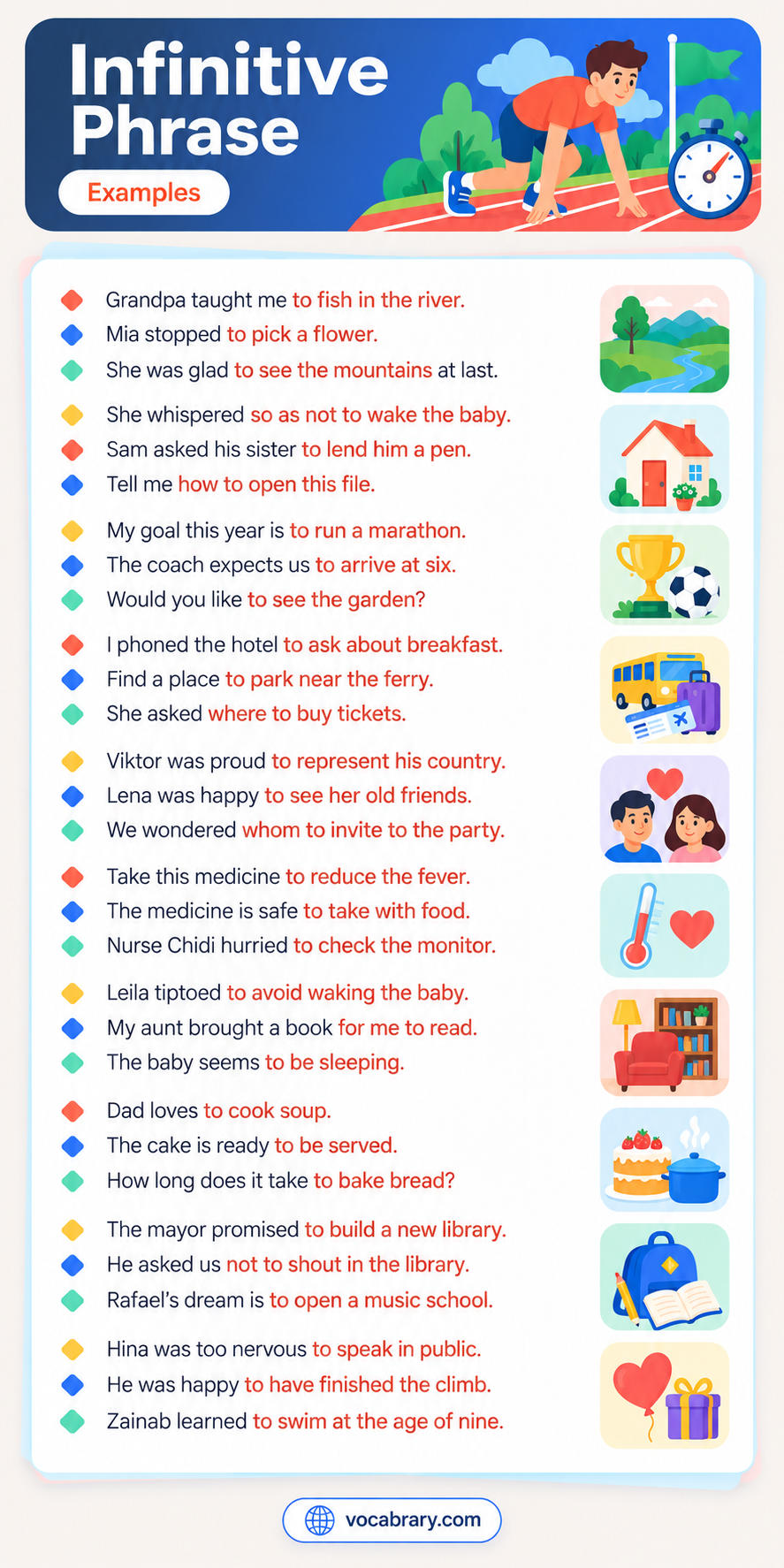
Infinitive Phrase Examples for Everyday Use
An infinitive phrase is a subject, an object, a complement, or a modifier in each sentence, as in “to learn the guitar”, “to rest our feet”, and “to build a new library”.
- Mina took a train to visit her cousin in Porto.
- To finish the report by Friday, Jonas worked through the weekend.
- Sofia wants to learn the guitar.
- My ambition is to travel the world.
- We stopped at a café to rest our feet.
- Chidi has a lot of homework to finish before Monday.
- To win the championship was the team’s only goal.
- The farmer got up early to feed the cattle.
- Lena was happy to see her old friends.
- The mayor promised to build a new library.
- Nobody expected the shop to open so early.
- I came here to say thank you.
- It is difficult to explain this rule.
- They plan to move to Canada next spring.
Noun Function Sentences with Infinitive Phrases
Three noun roles appear in this group: subject, object, and complement, as in “to walk daily”, “to inspect the new library”, and “to lock the back door”.
Infinitive Phrase Examples for Subjects
The infinitive phrase is the subject of the verb, as in “to make mistakes”, “to forgive an old friend”, and “to see the northern lights”.
- To make mistakes is part of being human.
- To learn a new language takes patience and daily practice.
- To win the first match gave the young team confidence.
- For the youngest scout, to walk alone through the forest at night was frightening.
- To forgive an old friend takes courage.
- To save money every month requires a plan, experts agree.
- To speak in front of two hundred people made Karim’s hands shake.
- To see the northern lights was Ingrid’s lifelong wish.
- To repair the old bridge will cost the town a great deal, engineers warn.
- In my family, to be honest with yourself is the hardest lesson.
Infinitive Phrase Examples for Direct Objects
After want, decide, offer, and promise, the infinitive phrase is the object, as in “to study architecture in Vienna”, “to lock the back door”, and “to catch the last ferry”.
- Selim wants to study architecture in Vienna.
- The twins decided to build a treehouse.
- Our neighbour offered to carry the shopping.
- Freya hopes to see her cousins in Norway next winter.
- They agreed to share the cost of the repairs.
- I forgot to lock the back door.
- Mrs Adeyemi plans to open a bakery in October.
- The boy refused to wear his helmet.
- Can you afford to buy a new laptop this year?
- Zainab learned to swim at the age of nine.
- We managed to catch the last ferry.
- He pretended to be asleep when his mother came in.
- She promised to return the book on Monday.
- Pablo expects to graduate in June.
- I would love to hear your story.
Infinitive Phrase Examples for Subject Complements
A subject such as goal, plan, job, or dream is completed by the infinitive phrase after is or was, as in “to run a marathon”, “to keep the patients comfortable”, and “to inspect the new library”.
- My goal this year is to run a marathon.
- Her plan was to leave before sunrise.
- The best advice is to listen more than you speak.
- Our job is to keep the patients comfortable.
- Rafael’s dream is to open a music school.
- The idea was to surprise Mum with a cake.
- The purpose of the visit is to inspect the new library.
- His habit was to read for an hour after dinner.
- Their mission is to plant ten thousand trees.
- All she wanted was to be left alone.
Infinitive Phrase Examples After Verbs with Objects
Tell, ask, invite, and allow are followed by an object and then an infinitive phrase, as in “to fasten their seat belts”, “to join our picnic”, and “to arrive at six”.
- The pilot told the passengers to fasten their seat belts.
- Grandpa taught me to fish in the river.
- The sergeant ordered the soldiers to advance at dawn.
- Sam asked his sister to lend him a pen.
- We invited the neighbours to join our picnic.
- The sign warns visitors to keep off the grass.
- My parents allowed me to stay out until ten.
- She encouraged her students to ask more questions.
- The coach expects us to arrive at six.
- I reminded him to bring the tickets.
- The storm forced the sailors to turn back.
- Dr Silva advised her patients to walk daily.
Modifier Sentences with Infinitive Phrases
Adding a purpose, a result, or a description, the infinitive phrase follows a noun, a verb, or an adjective, as in “for the ambulance to pass”, “to represent his country”, and “to be near her grandchildren”.
Infinitive Phrase Examples After Nouns
Nouns and pronouns such as chance, time, book, and nothing are followed by an infinitive phrase, as in “to win a scholarship”, “to worry about”, and “to rent to students”.
- She has a chance to win a scholarship.
- This is the best way to learn vocabulary.
- Mei has no time to waste on gossip.
- I need a book to read on the train.
- There is nothing to worry about.
- Omar was the first person to arrive at the meeting.
- The villagers need a place to store grain.
- Her right to vote in elections was protected by law.
- He showed the ability to lead under pressure.
- We have a spare room to rent to students this term.
- The teacher made an attempt to calm the class.
- Noah has the courage to speak the truth.
- The company announced a plan to hire fifty graduates.
- I have two letters to post before noon.
Infinitive Phrase Examples for Purpose
Giving the reason for an action, the infinitive phrase answers the question why, as in “to buy fresh fish”, “to check his balance”, and “to be near her grandchildren”.
- Lina went to the market to buy fresh fish.
- We saved money to build a small house.
- The pupils stood up to greet the visitor.
- She wore gloves to protect her hands.
- Diego called the bank to check his balance.
- To reach the island before dark, the fishermen left at noon.
- They set two alarms in order to wake before dawn.
- I phoned the hotel to ask about breakfast.
- The farmer built a fence to keep out the deer.
- She moved to Leeds to be near her grandchildren.
- Add salt to bring out the flavour.
- The nurses wore masks so as to prevent infection.
- Fatima took a taxi to arrive on time.
- Zoltan opened the window to let in some air.
Infinitive Phrase Examples for Result
What happened next is stated by the infinitive phrase, as in “to become a respected surgeon”, “to discover thick fog”, and “to tell the tale”.
- Tom woke up only to find the shop already closed.
- She grew up to become a respected surgeon.
- The old sailor lived to see his grandchildren graduate.
- The tourists reached the summit only to discover thick fog.
- He opened the box only to find it empty.
- Eva returned home only to see her house surrounded by reporters.
- The explorers survived to tell the tale.
- The young inventor rose from poverty to lead a global company.
- I arrived at the station only to learn that the train had gone.
- The diver surfaced only to see the boat sailing away.
Infinitive Phrase Examples After Adjectives
Adjectives such as happy, eager, ready, and proud are followed by an infinitive phrase, as in “to learn the new dance”, “to prepare in ten minutes”, and “to follow in the dark”.
- I am happy to help you with the move.
- The students were eager to learn the new dance.
- Ahmed is ready to leave at any moment.
- Lucia was surprised to see her old teacher.
- This soup is easy to prepare in ten minutes.
- We are sorry to hear about your loss.
- She was afraid to ask for directions.
- It is likely to rain this evening.
- The path is difficult to follow in the dark.
- Viktor was proud to represent his country.
- The children were thrilled to meet the astronaut.
- The medicine is safe to take with food.
Infinitive Phrase Examples with Too and Enough
With too and enough, an adjective comes before the infinitive phrase, as in “to drink at once”, “to study in”, and “to cross on foot”.
- The tea is too hot to drink at once.
- Hina was too nervous to speak in public.
- This coat is warm enough to wear in winter.
- The room is too noisy to study in.
- He was strong enough to lift the piano alone.
- It is too late to call your grandmother.
- The lake is shallow enough to cross on foot.
- She is old enough to travel alone.
- The puzzle was too difficult to finish in one evening.
- I am too tired to continue the climb.
Infinitive Phrase Examples with For and a Subject
For and a noun or pronoun come before the infinitive, so the infinitive has its own subject, as in “for everyone to sit down”, “for me to carry”, and “for twenty people to dance”.
- It is time for the children to go to bed.
- For him to win the race would be a miracle.
- The teacher waited for everyone to sit down.
- There is nothing for us to do today.
- The bag was too heavy for me to carry.
- Dad opened the door for the dog to run out.
- It was easy for Maria to learn Spanish.
- My aunt brought a book for me to read.
- The room is big enough for twenty people to dance.
- It is important for patients to follow the doctor’s advice.
- Her wish is for her daughter to become a pilot.
- We stepped aside for the ambulance to pass.
Form Sentences with Infinitive Phrases
Five forms of the infinitive appear here: negative, perfect, passive, continuous, and split, as in “to successfully complete the course”, “to be reading the report”, and “to have forgotten his keys”.
Negative Infinitive Phrase Examples
Not comes before to, as in “not to be late”, “not to feed the ducks”, and “not to open the parcel”.
- The teacher told us not to be late.
- Hiroshi decided not to apply for the job.
- It is better not to wait for perfect weather.
- She whispered so as not to wake the baby.
- I promised not to tell anyone the secret.
- The sign asks visitors not to feed the ducks.
- We chose not to argue in front of the guests.
- Try not to touch your face during the test.
- Their instructions were not to open the parcel.
- The goalkeeper managed not to concede a single goal.
- Remember not to share your password.
- He was careful not to spill the paint.
Perfect Infinitive Phrase Examples
To have plus a past participle forms the perfect infinitive, as in “to have met the president”, “to have forgotten his keys”, and “to have left the country”.
- Selma claims to have met the president once.
- It was foolish to have left the window open.
- The vase is said to have belonged to a queen.
- I would like to have seen the old harbour before it changed.
- Mr Yamada seems to have forgotten his keys.
- He was happy to have finished the climb.
- The defendant appears to have lied to the court.
- They were thought to have left the country years ago.
- She hoped to have repaired the engine by noon.
- To have lost the final was painful for the whole squad.
Passive Infinitive Phrase Examples
A passive infinitive is to be plus a past participle, as in “to be signed by Friday”, “to be told the truth”, and “to be promoted this spring”.
- Joanna hoped to be invited to the wedding.
- The report needs to be signed by Friday.
- The cake is ready to be served.
- He wants to be told the truth.
- The old bridge is expected to be repaired next month.
- Children deserve to be treated with respect.
- Nobody likes to be ignored by a close friend.
- The parcels are waiting to be collected at the desk.
- Karen expects to be promoted this spring.
- The windows need to be cleaned every spring.
Continuous Infinitive Phrase Examples
Continuous infinitives use to be or to have been plus an -ing form, as in “to be sleeping”, “to be enjoying the lesson”, and “to be learning something new”.
- The baby seems to be sleeping.
- Karim pretended to be reading the report.
- She happened to be passing the shop at that moment.
- The students appear to be enjoying the lesson.
- Dad claims to have been working since dawn.
- I would love to be lying on a beach right now.
- The neighbours seem to have been waiting outside for an hour.
- It is nice to be learning something new.
Split Infinitive Phrase Examples
Between to and the verb, there is a modifier, as in “to really understand the poem”, “to fully test the software”, and “to successfully complete the course”.
- Maya wants to really understand the poem before the exam.
- The team plans to quickly finish the repairs before dark.
- Our goal is to gently guide the new students.
- We aim to fully test the software before launch.
- He decided to never speak of the incident again.
- The manager asked us to carefully check every invoice.
- I would like to personally thank everyone who helped.
- She hopes to successfully complete the course in June.
- The company expects to more than double its profits.
- Try to calmly explain the situation to the customer.
Question and Reported Sentences with Infinitive Phrases
Questions, reported speech, and question words all contain infinitive phrases, as in “how to reset the router”, “to drive us home”, and “to stay late”.
Infinitive Phrase Examples in Questions
Each sentence is a question with an infinitive phrase inside it, as in “to join us”, “to eat in the house”, and “to see the garden”.
- Do you want to join us?
- Why did he decide to leave so early?
- Who told you to wait outside?
- Is there anything to eat in the house?
- Have they tried to call you?
- Where is the best place to park the van?
- Would you like to see the garden?
- Is it difficult to learn Arabic?
- How long does it take to bake bread?
- Did the manager ask Rosa to stay late?
Infinitive Phrase Examples in Reported Speech
Reporting what someone ordered, asked, advised, promised, or offered, each sentence uses an infinitive phrase, as in “to close the door”, “to leave the building”, and “not to touch the stove”.
- She told me to close the door.
- He asked us not to shout in the library.
- The doctor advised him to avoid heavy lifting.
- The police ordered them to leave the building.
- The captain ordered the crew to lower the sails.
- The teacher reminded us to submit the forms.
- He promised to call back within an hour.
- She warned the children not to touch the stove.
- The guide asked the group to stay together.
- My uncle offered to drive us home.
Infinitive Phrase Examples After Question Words
What, where, how, which, whom, when, and whether come before the infinitive, as in “what to do”, “which road to take”, and “how to tie the knot”.
- I don’t know what to do.
- She asked where to buy tickets.
- Tell me how to open this file.
- He couldn’t decide which road to take.
- We wondered whom to invite to the party.
- Nobody in the room knew when to start.
- Show me how to tie the knot.
- Ask the guard where to park.
- I’m not sure whether to accept the offer.
- The manual explains how to reset the router.
Context Sentences with Infinitive Phrases
Eight settings appear here: homes, classrooms, offices, journeys, newsrooms, stories, sports, and clinics.
Infinitive Phrase Examples for Home Life
At home, the phrases describe chores and family routines, as in “to bake bread”, “to stay up late”, and “to replace the old curtains”.
- Grandma got up early to bake bread for breakfast.
- Dad promised to fix the leaking tap before dinner.
- The children begged to stay up late on New Year’s Eve.
- There is nothing to cook tonight.
- Mum asked me to water the plants while she was away.
- We need to replace the old curtains soon.
- Leila tiptoed to avoid waking the baby.
- It is time to switch off the lights.
Infinitive Phrase Examples for School Life
In the classroom, the phrases describe lessons and school routines, as in “to bring their library cards”, “to answer the first question”, and “to line up quietly”.
- Pupils must remember to bring their library cards.
- The teacher gave us an hour to finish the essay.
- Nobody wanted to answer the first question.
- Marcos stayed late to practise the song with the choir.
- It is hard to concentrate during a heatwave.
- The headmaster expects every class to line up quietly.
- She raised her hand to ask about the homework.
- The exam is too long to finish in forty minutes.
Infinitive Phrase Examples for Work
At the office, the phrases describe jobs, duties, and company plans, as in “to build the new app”, “to approve the budget”, and “to catch the evening train”.
- The company hired ten engineers to build the new app.
- Ms Okoye tried to negotiate a longer deadline.
- It is the manager’s job to approve the budget.
- Employees are required to sign in at reception.
- We plan to launch the product in spring.
- She left early to catch the evening train.
- Our aim is to reduce delivery times by half.
- The clerk forgot to attach the invoice.
Infinitive Phrase Examples for Travel
On the road, the phrases describe journeys and tourist visits, as in “to visit Japan”, “to check your passport”, and “to touch the paintings”.
- We arrived early to avoid the queue at the border.
- The family saved for years to visit Japan.
- Remember to check your passport before leaving home.
- She was glad to see the mountains at last.
- Passengers hurried to board the bus before the doors closed.
- Tourists are not allowed to touch the paintings.
- Find a place to park near the ferry.
- Zoe packed light to move quickly through the airports.
Infinitive Phrase Examples for News Reports
News reports describe officials, councils, companies, and protesters with infinitive phrases, as in “to comment on the rumour”, “to stay indoors”, and “to demand lower bus fares”.
- The minister refused to comment on the rumour.
- Rescue crews managed to reach the village by boat.
- The council voted to close the old swimming pool.
- Police urged residents to stay indoors during the storm.
- The company is expected to announce new jobs next week.
- Protesters gathered to demand lower bus fares.
- Officials are reported to have signed the agreement.
- The president promised to rebuild the bridge.
Infinitive Phrase Examples for Stories
In stories, infinitive phrases describe characters, journeys, and magic, as in “to find the missing prince”, “to rule his father’s kingdom”, and “to cast another spell”.
- The knight vowed to find the missing prince.
- Elena crept down the stairs to listen at the door.
- The hero returned from the war to rule his father’s kingdom.
- No one dared to open the iron gate.
- Alice woke only to find the garden gone.
- The witch grew too weak to cast another spell.
- He rode all night to reach the castle before dawn.
- The children seemed to hear music in the walls.
Infinitive Phrase Examples for Sports
On the pitch, the phrases describe coaches, players, and matches, as in “to defend deeper”, “to save the penalty”, and “to restart the match”.
- The coach told the team to defend deeper.
- Amara trained for months to qualify for the final.
- The goalkeeper dived to save the penalty.
- It is hard to beat a team that never gives up.
- Our captain hopes to lift the trophy in June.
- The referee signalled to restart the match.
- The players promised not to argue with the referee.
- She is the youngest athlete to win the title.
Infinitive Phrase Examples for Health
At the clinic, the phrases describe doctors, patients, and healthy habits, as in “to rest for a week”, “to arrive ten minutes early”, and “to reduce the fever”.
- The doctor advised him to rest for a week.
- It is wise to drink water before a long run.
- Patients are asked to arrive ten minutes early.
- Nurse Chidi hurried to check the monitor.
- She tries to sleep eight hours every night.
- Take this medicine to reduce the fever.
- He was lucky to recover so quickly.
- Children need to play outside every day.
Kids and Student Sentences with Infinitive Phrases
The range runs from short sentences about play to formal sentences for exam answers.
Infinitive Phrase Examples for Kids
Short phrases about familiar actions suit kids, as in “to play outside”, “to cry loudly”, and “to eat lunch”.
- I want to play outside.
- She likes to sing songs.
- We went to swim in the lake.
- Mum came to help us.
- He began to cry loudly.
- Dad loves to cook soup.
- Let’s try to jump high.
- I need to sleep early.
- It is time to eat lunch.
- The bird flew to find food.
- Ben ran to catch the bus.
- Mia stopped to pick a flower.
Infinitive Phrase Examples for Exams
For exam answers, the wording is formal, as in “to confirm the hypothesis”, “to succeed without public support”, and “to maintain a balanced budget”.
- The committee’s aim is to reduce emissions by thirty percent within a decade.
- Candidates are required to submit a written proposal before the interview.
- The study was designed to measure the effect of sleep on memory.
- Governments have a duty to protect the rights of minorities.
- It would be unwise for the council to ignore the warnings of engineers.
- The author appears to have written the novel in secret.
- Researchers need more data to confirm the hypothesis.
- Citizens deserve to be informed about the changes.
- The reforms are unlikely to succeed without public support.
- To maintain a balanced budget requires discipline from every department.
FAQs
Some infinitive phrase examples are "Sofia wants to learn the guitar," "The farmer got up early to feed the cattle," and "It is difficult to explain this rule." Each infinitive phrase begins with to and a verb. The three sentences use the phrase as an object, as a purpose, and after an adjective.
You use an infinitive phrase in a sentence as a subject, an object, a complement, or a modifier. "To make mistakes is part of being human" has a subject phrase, and "Selim wants to study architecture in Vienna" has an object phrase. "Lina went to the market to buy fresh fish" has a phrase of purpose.
Infinitive phrase examples as subjects use a phrase that begins with to as the subject of the verb. "To learn a new language takes patience and daily practice" and "To forgive an old friend takes courage" are two models. "To see the northern lights was Ingrid’s lifelong wish" is a third.
Infinitive phrase examples after nouns put the phrase directly after a noun or a pronoun. "She has a chance to win a scholarship" and "I need a book to read on the train" are two models. "There is nothing to worry about" is a third.
Infinitive phrase examples for purpose give the reason for an action. "The pupils stood up to greet the visitor" and "She wore gloves to protect her hands" are two models. "The farmer built a fence to keep out the deer" is a third.
Infinitive phrase examples after adjectives follow words such as happy, eager, and ready. "I am happy to help you with the move" and "The students were eager to learn the new dance" are two models. "Ahmed is ready to leave at any moment" is a third.
Negative infinitive phrase examples put the word not directly before to. "The teacher told us not to be late" and "Hiroshi decided not to apply for the job" are two models. "I promised not to tell anyone the secret" is a third.
Perfect infinitive phrase examples use to have plus a past participle. "Selma claims to have met the president once" and "Mr Yamada seems to have forgotten his keys" are two models. "He was happy to have finished the climb" is a third.
Infinitive phrase examples after question words use a word such as what, where, or how before the infinitive. "I don’t know what to do" and "She asked where to buy tickets" are two models. "Tell me how to open this file" is a third.
Infinitive phrase examples for kids use short phrases about familiar actions. "I want to play outside" and "She likes to sing songs" are two models. "Dad loves to cook soup" is a third.
Related:

Leave a Comment