
An absolute phrase is a group of words made of a noun or pronoun and a participle or other predicate part that modifies a whole sentence, as in the rain having stopped. These absolute phrase examples begin with common cases that state a time, a cause, or a circumstance.
What Is an Absolute Phrase?
An absolute phrase is a noun or pronoun with a participle or another predicate part, and it modifies the whole sentence without a conjunction. It differs from a participial phrase, which has no subject of its own and modifies a noun in the main clause.
Noun or pronoun + participle (+ modifiers), set off by commas
The crowd drifted home, the concert over.
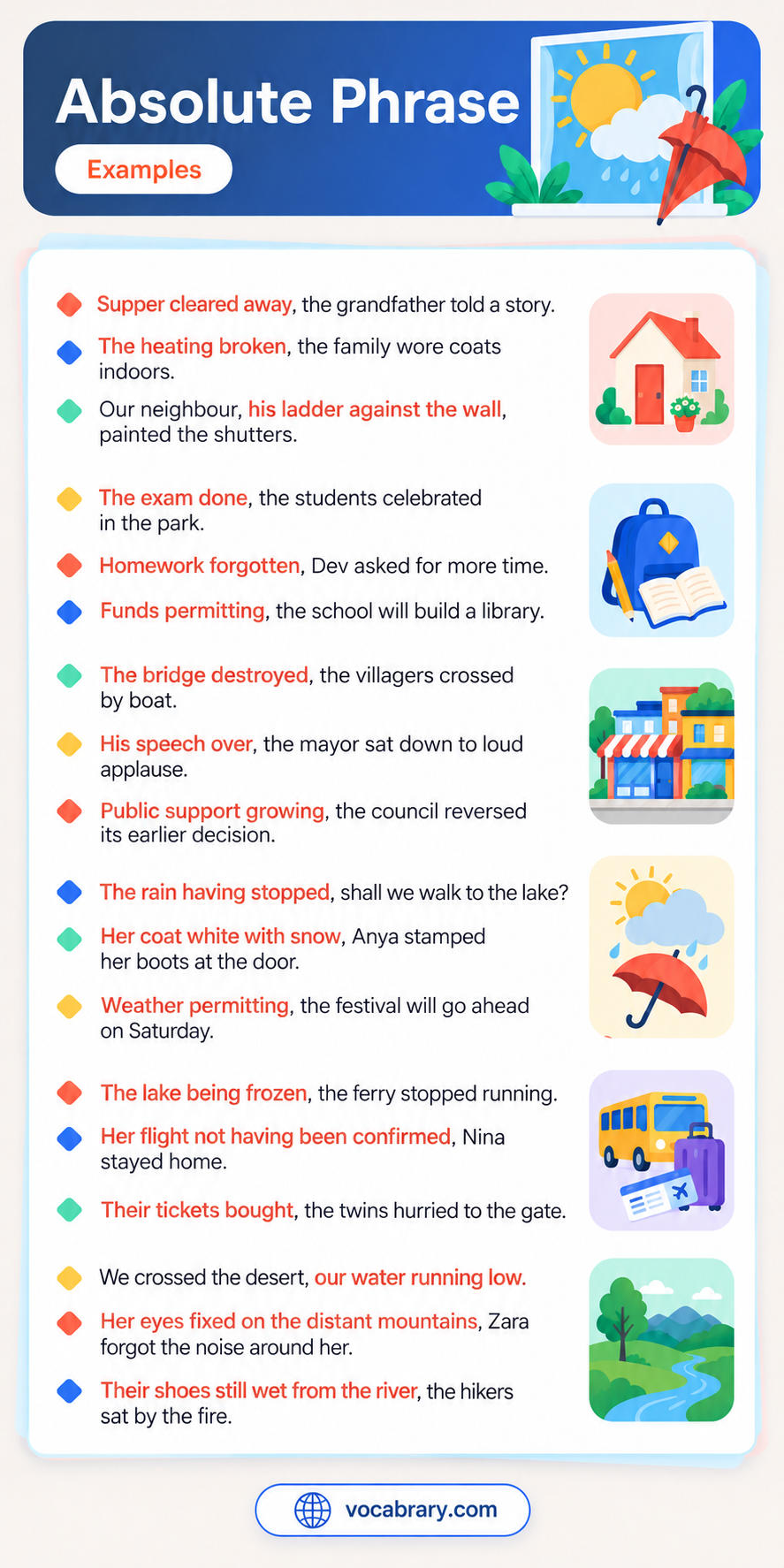
Common Absolute Phrase Examples
The rain having stopped, arms folded, and his face red with anger each pair a noun with a participle or an adjective, and each one modifies the rest of the sentence.
- The rain having stopped, we left the shelter.
- Arms folded, Hana waited by the door.
- The sun setting, the fishermen headed home.
- The clouds clearing, the match will start at two.
- Mateo stood at the window, his face red with anger.
- The work done, the crew went to lunch.
- Her bags packed, Salma called a taxi.
- The road being icy, the bus stayed in the depot.
- The children ran into the garden, their coats flapping behind them.
- Dinner over, the guests moved to the porch.
- Their luggage unpacked, the guests explored the cabin.
- Ravi sat quietly, his eyes fixed on the screen.
- The tide coming in, we packed the picnic.
- Her voice trembling, the girl read her poem.
- The final bell having rung, the caretaker locked the gym.
- The old dog lay by the fire, its tail wagging slowly.
- Their tickets bought, the twins hurried to the gate.
- His hands in his pockets, Omar strolled along the pier.
- The storm having passed, the farmers inspected their fields.
- The soup boiling, Ola set the table.
Absolute Phrase Structure
An absolute phrase has a noun or pronoun as its subject and a participle, an adjective, or a prepositional phrase as its predicate part. The patterns range from the sun setting to his hands in his pockets.
| Pattern | Example sentence |
|---|---|
| Noun + present participle | The sun setting, we walked home. |
| Noun + past participle | The work done, we left. |
| Noun + perfect participle | The rain having stopped, we left. |
| Noun + adjective (being omitted) | His face pale, he sat down. |
| Noun + prepositional phrase (being omitted) | His hands in his pockets, he waited. |
| Pronoun + participle | He being the youngest, we let him go first. |
| Fixed phrase | Weather permitting, we will sail. |
Absolute Phrases With Present Participles
A present participle ends in -ing and names an action in progress while the main clause happens. The clock striking midnight and the snow falling steadily are two examples of the pattern.
- The clock striking midnight, the guests began to leave.
- The snow falling steadily, we stayed indoors.
- Her heart pounding, Ana opened the envelope.
- The engine roaring, the truck climbed the hill.
- Night falling fast, the hikers hurried to the camp.
- The crowd cheering wildly, the runner crossed the line.
- Dawn breaking, the fishing boats left the harbour.
- The kettle boiling, Dad searched for the tea bags.
- Their voices rising, the two neighbours argued over the fence.
- The baby sleeping, we whispered in the kitchen.
- The wind picking up, Lucia tied down the tent.
- Prices rising, many families cut their spending.
- The lights flickering, the audience held its breath.
- The teacher watching, the pupils worked in silence.
Absolute Phrases With Past Participles
A past participle marks that the noun received an action that is already complete. Her homework done and the gate shut are two examples of the pattern.
- Her homework done, Mei watched a film.
- The gate shut, the guard walked home.
- The tea made, Grandma sat down.
- The windows broken, the shop closed for a week.
- His speech given, the minister left the stage.
- The table set, the family waited for the guests.
- The decision made, nobody wanted to argue.
- The bridge destroyed, the villagers crossed by boat.
- Our luggage lost, we bought clothes at the airport.
- The letter sent, Rosa felt calm again.
- The cake baked, Tom started the icing.
- The lesson ended, the students packed their bags.
- The door thrown open, a cold wind swept in.
- The tickets sold out, the fans went home.
Absolute Phrases With Perfect Participles
A perfect participle has the form having plus a past participle and marks an action completed before the main clause. The guests having left and the sun having set are two examples of the pattern.
- The guests having left, Maria cleaned the kitchen.
- The sun having set, the market began to close.
- The money having run out, the project stopped.
- The team having scored twice, the coach relaxed.
- Her train having been delayed, Zainab missed the opening.
- The judge having spoken, the court fell silent.
- The ice having melted, the river rose quickly.
- The children having gone to bed, the parents watched a film.
- The passengers having boarded, the ferry left the quay.
- The last page having been printed, the editor went home.
- Their supplies having run low, the climbers turned back.
- The storm having damaged the roof, the owners called a builder.
Absolute Phrases With Being Omitted
The participle being is dropped from many absolute phrases, leaving a noun followed by an adjective, a noun phrase, or a prepositional phrase. Her hair wet is a shortened form of her hair being wet, and head down is a shortened form of his head being down.
- Her hair wet, Sana ran to the bus stop.
- His shoes covered in mud, Ben knocked at the door.
- Head down, the boy walked past the principal.
- Eyes closed, the singer swayed to the music.
- The shop dark, we turned back.
- His coat over his arm, Mr Lee entered the hall.
- Their faces tired, the hikers reached the hut.
- The room silent, the speaker began.
- Her suitcase in her hand, Leila crossed the platform.
- Shoulders squared, he faced the judges.
- The windows open, the room smelled of rain.
- Hands full of bags, she kicked the door shut.
- The street empty, the cat crossed in peace.
- Her scarf around her neck, Anya stepped into the snow.
Absolute Phrases With Adjective and Prepositional Parts
When the predicate part is an adjective phrase or a prepositional phrase, the absolute phrase has no participle at all, as shown by The village under heavy snow. Her face red with anger and his eyes wide with surprise are two examples.
- Her face red with anger, she left the meeting.
- His eyes wide with surprise, Tomas read the letter again.
- Her cheeks pink from the cold, Nina came inside.
- His mouth full of bread, Dad could not answer.
- Their hands black with soot, the miners left the shaft.
- Her voice thick with emotion, the winner thanked her family.
- The sky grey with clouds, we cancelled the picnic.
- His pockets heavy with coins, the boy skipped to the shop.
- The house quiet after the party, Rosa fell asleep on the sofa.
- Her coat white with snow, Anya stamped her boots at the door.
- The village under heavy snow, drivers moved slowly.
- His shirt wet with sweat, the runner collapsed on the grass.
- The lake in perfect stillness, the fishermen cast their lines.
- Their legs sore from the climb, the hikers rested at the top.
Fixed Absolute Phrases
Weather permitting, time permitting, and all things considered are fixed expressions that work as absolute phrases. Each one has a noun and a participle, and each one states a condition or a judgement.
- Weather permitting, the festival will go ahead on Saturday.
- Time permitting, I will visit the old fort.
- God willing, we will meet again next year.
- All things considered, the team played well.
- Traffic allowing, we should arrive by six.
- Everything else being equal, the cheaper plan wins.
- Funds permitting, the school will build a library.
- Health permitting, my grandfather will visit us in spring.
- Conditions permitting, the pilot will land at dawn.
- Wind and tide permitting, the ferry will sail at dawn.
Absolute Phrases of Time
An absolute phrase of time states the moment when the main action happens, after another event ends. The meeting over and breakfast eaten answer the question when.
- The meeting over, everyone left the room.
- Breakfast eaten, the family set off for the lake.
- The exam done, the students celebrated in the park.
- The movie over, the audience filed out.
- The last guest gone, Hana locked the door.
- Winter over, the farmers started planting.
- The ceremony having concluded, the band began to play.
- Lunch eaten, the hikers resumed the climb.
- The speeches over, the dancing began.
- His shift over, Hamid took the bus home.
- Her call done, she returned to the table.
- The race run, the athletes shook hands.
- The sun now up, the market stalls opened.
- Supper cleared away, the grandfather told a story.
Absolute Phrases of Cause
An absolute phrase of cause states the reason for the main clause and answers the question why. The lake being frozen and her phone dead replace a clause that starts with because.
- The lake being frozen, the ferry stopped running.
- The shops being shut, we ate at home.
- Her phone dead, Dana asked a stranger for directions.
- The bus having broken down, the passengers walked.
- Money being short, they delayed the wedding.
- The stadium being full, thousands waited outside.
- The river rising fast, the villagers moved uphill.
- His leg injured, Kofi sat out the season.
- The tickets being expensive, many fans stayed home.
- Her car being in the garage, Ines took the train.
- The power gone, the class continued by candlelight.
- The visa not approved, Idris could not travel.
- The weather being so hot, the match began at dusk.
- The teacher being absent, the class studied in the library.
Absolute Phrases of Condition
The clauses if the weather holds, if the tide is right and if no one objects become the weather holding, the tide being right and no one objecting. These phrases state the condition for the main clause.
- The weather holding, the boats will leave at six.
- The tide being right, we can cross to the island at noon.
- The bank agreeing, the couple will buy the house.
- No one objecting, the committee will approve the plan.
- Her health allowing, my aunt will join the hike.
- The ice thick enough, the villagers will cross the lake.
- Funds being approved, work will begin in May.
- The wind staying calm, the balloon will rise at dawn.
- The tickets arriving on time, we will fly on Friday.
- The road still open, the convoy will reach the camp by night.
Absolute Phrases of Accompanying Circumstance
An absolute phrase of accompanying circumstance describes what is happening alongside the main action. Head held high and her chin in her hands describe a body part or an object that accompanies the subject during the main action.
- She entered the room, head held high.
- The soldiers marched past, their boots pounding the road.
- Mira sat on the steps, her chin in her hands.
- The old man walked slowly, his cane tapping on the stones.
- The children sat in a circle, their eyes fixed on the storyteller.
- The boy stood in the doorway, a book under his arm.
- The dancers spun across the stage, skirts flying.
- He left the hall, a smile on his face.
- Grandma listened to the radio, her knitting in her lap.
- The truck rattled along the road, its load swaying.
- We drove through the valley, the windows down.
- Tariq answered the question, his voice calm.
- The cat crossed the lawn, its tail high.
- The swimmers waited at the edge, goggles on.
Absolute Phrases After With
Many sentences place a noun and its predicate part after with, as in with her arms folded and with the radio playing softly. The words after with follow the absolute pattern, although some grammars label the whole with-group a prepositional phrase.
- She waited by the door with her arms folded.
- He ran down the hill with his coat flying behind him.
- Dad drove with the radio playing softly.
- The boy slept with his mouth open.
- Lena spoke with her eyes on the floor.
- They watched the fireworks with their feet in the water.
- Anya sat at the table with her pencil poised.
- The old man stood with his hat in his hand.
- The kids ate dinner with the television off.
- The farmer worked all day with the sun beating down.
- The cat sat on the sill with its tail curled around its paws.
- Tom stormed out with his bag half packed.
Absolute Phrase Position in a Sentence
An absolute phrase comes at the start of a sentence, after the subject, or after the main clause, and commas set it off in each position. One comma separates the phrase at the start or the end, and two commas set it off in the middle.
Absolute Phrase at the Start of a Sentence
An opening absolute phrase is followed by a comma and then the main clause. His speech over and night coming on state the situation before the main action.
- The rain stopping, a pale sun came out.
- His speech over, the mayor sat down to loud applause.
- The sky darkening, Nora hurried to close the shutters.
- Our tent pitched, we cooked supper over a small fire.
- The floodwater rising, the family moved upstairs.
- Her shift over, the nurse walked slowly to the station.
- The doors thrown open, a crowd poured into the hall.
- The coffee gone, Ben washed the cups.
- Their duty done, the guards returned to the barracks.
- Night coming on, the shepherd gathered his flock.
- The papers signed, the buyers received the keys.
- The orchestra tuned, the conductor raised his baton.
Absolute Phrase in the Middle of a Sentence
A middle absolute phrase follows the subject and is set off by a comma on each side. The mayor, her speech over, left the stage and Rosa, her bags packed, waited are two cases.
- The mayor, her speech over, left the stage.
- The goalkeeper, his gloves soaked, still caught the ball.
- Rosa, her bags packed, waited for the taxi.
- The children, their faces smeared with jam, ran into the garden.
- The old fisherman, his net mended, pushed the boat into the water.
- My uncle, his patience gone, shouted at the referee.
- Dr Reyes, her rounds complete, drove home through the rain.
- The soldiers, their rifles slung, crossed the bridge.
- The pilot, the engines humming, announced the final descent.
- Our neighbour, his ladder against the wall, painted the shutters.
Absolute Phrase at the End of a Sentence
A closing absolute phrase follows the main clause and has one comma before it. The dancer bowed, flowers covering the stage and Idris sat on the porch, a mug of tea in his hand are two cases.
- The dancer bowed, flowers covering the stage.
- Idris sat on the porch, a mug of tea in his hand.
- The convoy crossed the desert, dust rising behind it.
- The twins grinned, their cheeks streaked with paint.
- She spoke calmly, her hands steady on the table.
- The ship sailed into the bay, its flags snapping in the wind.
- The runner crossed the line, arms raised in triumph.
- The students left the lab, their notebooks full of data.
- The cat purred on the cushion, its eyes half closed.
- A lone sailor stood on the deck, one hand on the wheel.
- We walked down the beach, the waves washing over our feet.
- The teacher waited at the door, a stack of papers under her arm.
Absolute Phrases With Their Own Subjects
The noun in an absolute phrase is a different noun from the subject of the main clause. In The bus arriving late, Sam missed his appointment, the bus is the subject of the phrase and Sam is the subject of the clause, and The kettle whistling follows the same pattern.
- The bus arriving late, Sam missed his appointment.
- The waiter bringing the bill, we reached for our wallets.
- The lights going out, the audience gasped.
- The teacher’s back turned, the pupils began to whisper.
- The snow melting, the river swelled.
- The music playing softly, the couple danced.
- The ball rolling into the street, a driver braked hard.
- The kettle whistling, Anya ran to the stove.
- The curtain rising, the audience fell silent.
- The clock striking nine, the shop assistant turned the sign.
- Her mother calling from downstairs, Mei hid her phone.
- The alarm ringing, the neighbours rushed outside.
Absolute Phrases With Pronoun Subjects
A pronoun in an absolute phrase is in the subject form, as in he being the only guide and it being Sunday. Pronoun subjects occur in formal writing and in fixed phrases such as it being late.
- He being the only guide, we followed him through the cave.
- She having finished early, the others applauded.
- They being tired, the guide stopped the walk.
- We having arrived late, the doors were already closed.
- It being Sunday, the shops were shut.
- I being the oldest, the others asked me to speak.
- He having left, the room felt empty.
- She being a nurse, the neighbours called her first.
- They having won, the town held a parade.
- It being late, we said goodnight.
Absolute Phrases With Modifiers
An absolute phrase is extended by adverbs, prepositional phrases, and participial phrases added to the noun or the participle. The old house standing empty for years and her eyes fixed on the distant mountains are two examples.
- The old house standing empty for years, the council finally bought it.
- Her eyes fixed on the distant mountains, Zara forgot the noise around her.
- The last bus having left ten minutes earlier, we walked home in the dark.
- Their shoes still wet from the river, the hikers sat by the fire.
- The shop windows glowing in the early dusk, the street felt warm.
- A heavy bag slung over his shoulder, Kenji hurried up the steps.
- The prize money divided equally among the winners, nobody complained.
- Her speech carefully prepared the night before, Layla felt calm.
- The audience clapping loudly and rhythmically, the band played another song.
- The garden covered with a thick layer of frost, the gardener stayed indoors.
- His old car running again after weeks in the garage, Hugo drove to the coast.
- The village’s only road blocked by a fallen tree, the ambulance took the river path.
- Every seat taken and the aisles crowded, latecomers watched from the doorway.
- Her fingers numb with cold, Sana struggled with the zipper.
Absolute Phrases in Negative Sentences
A negative absolute phrase uses not or no inside the phrase, as in the bus not having arrived and no one being home. The negative word is inside the phrase, so the main clause stays positive.
- The bus not having arrived, we walked to school.
- No one being home, the postman left a note.
- The shop not yet open, we waited outside.
- Her flight not having been confirmed, Nina stayed home.
- Nothing remaining to say, the chairman closed the meeting.
- The lights not working, we lit candles.
- No taxis available, Ravi called his brother.
- The test not yet finished, the teacher gave ten more minutes.
- His name not on the list, the guard refused entry.
- The road not having been cleared, trucks turned back.
Absolute Phrases in Questions
In a question, the absolute phrase comes first and the main clause has question word order. The rain having stopped, shall we walk to the lake? and Dinner eaten, who will wash the dishes? follow this order.
- The rain having stopped, shall we walk to the lake?
- Dinner eaten, who will wash the dishes?
- The tickets bought, when do we leave?
- Weather permitting, will you join us on Saturday?
- The exam over, what will you do first?
- Her homework done, may Lena go outside?
- All things considered, was the trip worth the cost?
- The shops being closed, where should we eat?
- Time permitting, do you want to see the lighthouse?
- The meeting over, who has the keys?
Absolute Phrases in Passive and Reported Sentences
An absolute phrase comes before a passive main clause, and it stays inside the reported statement in reported speech. The report having been read, the plan was approved is a passive case, and She said that, the work done, she would go home is a reported case.
- The glass swept up, the shop was reopened by the owner.
- The report having been read, the plan was approved.
- The last card played, the winner was announced by the host.
- Her coat torn, the child was taken home by a neighbour.
- The bridge repaired, the road was reopened.
- She said that, the work done, she would go home.
- The coach told us that, weather permitting, practice would continue.
- Omar explained that, his bags packed, he was ready to leave.
- The guide announced that, the storm having passed, the hike would resume.
- Mina replied that, time permitting, she would join us later.
Absolute Phrase Examples at Home
Dinner cooked, the baby asleep and her sleeves rolled up state the situation in a house during cooking, baking or rest.
- Dinner cooked, Dad called everyone to the table.
- The baby asleep, we tiptoed down the hall.
- Her sleeves rolled up, Grandma began to bake.
- The dishes washed, the twins settled on the sofa.
- The heating broken, the family wore coats indoors.
- Mum sat at the kitchen table, her tea going cold.
- The laundry folded, Lucia put the basket away.
- Dad snoring in his chair, the children whispered.
- The lights off, the whole house was quiet.
Absolute Phrase Examples at School
Her hand raised, the test papers collected and the projector broken state the situation in a classroom before the main action.
- The bell having rung, the pupils filed out.
- Her hand raised, Zoe waited for the teacher.
- The test papers collected, Mr Obi dismissed the class.
- The projector broken, the teacher drew on the board.
- Classes over, the students gathered in the yard.
- The boy sat at his desk, his pencil tapping.
- The principal watching, nobody spoke in the corridor.
- Homework forgotten, Dev asked for more time.
- The library shut, the students studied in the hall.
Absolute Phrase Examples at Work
Office sentences use an absolute phrase to state the situation behind a decision, as in the deadline approaching, the contract signed, and sales rising.
- The deadline approaching, the team stayed late.
- The contract signed, the manager shook hands with the client.
- Her laptop open, Ines answered emails on the train.
- The meeting running long, several people checked their phones.
- Sales rising, the company hired six new staff.
- The report submitted, Omar took a day off.
- The printer broken, the office manager called a technician.
- Their budget cut, the department postponed the launch.
- Priya typed quickly, her eyes on the clock.
Absolute Phrase Examples for Travel
Our passports checked, the train delayed and the road blocked state the situation of a trip.
- The plane landing, the passengers fastened their belts.
- Our passports checked, we walked through the gate.
- The train delayed, travellers waited in the cafe.
- Luggage in hand, Hana ran for the bus.
- The map open on his knees, Tariq guided the driver.
- The ferry leaving at dawn, we woke before the sun.
- Hotel booked, we explored the old market.
- The road blocked, the coach took a long detour.
- We crossed the desert, our water running low.
Absolute Phrase Examples in the News
The votes counted, the storm having weakened, and the talks having failed are found in news reports. Each one states the situation before the main clause reports the result.
- The votes counted, the mayor claimed victory.
- The storm having weakened, officials lifted the warning.
- Rescue crews working through the night, the town waited for news.
- The talks having failed, both sides left the room.
- Prices up again, shoppers cut their spending.
- The fire brought under control, residents returned home.
- Hundreds of volunteers helping, the clean-up finished early.
- The highway blocked, police redirected traffic.
- The new law approved, the ministry published the rules.
Absolute Phrase Examples in Stories
The moon rising, her sword raised and hearts pounding state the situation in a story before a character acts.
- The moon rising, the wolves began to howl.
- Her sword raised, the knight faced the dragon.
- The door creaking open, Pip peered into the cellar.
- Night having fallen, the travellers lit a fire.
- Hearts pounding, the children crept toward the cave.
- The spell broken, the prince woke at last.
- The old witch laughed, her eyes glittering.
- The map torn in half, the brothers argued about the treasure.
- All hope lost, the sailors prayed for dawn.
Absolute Phrase Examples in Sports
Match reports use an absolute phrase to state the situation in the game, as in the whistle blown, time running out, and the score tied.
- The whistle blown, the players left the field.
- Time running out, the coach called a timeout.
- The crowd roaring, Lena stepped up to take the penalty.
- His ankle sprained, Marco left the pitch on a stretcher.
- The final lap beginning, the leader pulled ahead.
- The score tied, the match went into extra time.
- Her race won, Amina raised both arms.
- The referee watching closely, the defenders kept their hands down.
- The swimmer climbed out, water streaming from her hair.
Absolute Phrase Examples About Health
The test results back, his fever gone and her leg in a cast state the condition of a patient or the result of a treatment.
- The test results back, the doctor called the family.
- His fever gone, Ali returned to school.
- The wound cleaned, the nurse applied a bandage.
- Her pulse racing, the patient lay still.
- The treatment over, Mrs Kim went home to rest.
- Her leg in a cast, Daria used crutches for a month.
- Hands washed, the surgeon entered the theatre.
- The medicine taken, the boy slept well.
- His cough improving, the doctor reduced the dose.
Absolute Phrase Examples for Kids
Young learners spot an absolute phrase by finding a noun and an -ing or -ed word at the start of a sentence, as in our lunch eaten and the sun shining. A comma follows it.
- Our lunch eaten, we played outside.
- Her hands full, Mum opened the door with her foot.
- The sun shining, the kids ran to the park.
- His kite flying high, Ben laughed.
- The dog barking, the cat ran up a tree.
- The bell ringing, we lined up at the door.
- Our work done, we got a sticker.
- The rain gone, we splashed in puddles.
- Her bag packed, Mia waited for the bus.
- The snow falling, we built a snowman.
Short Absolute Phrase Sentences for Young Learners
Two and three word phrases such as lunch over and work done start a short sentence of four or five words, so beginners copy the pattern in one line.
- Lunch over, we play.
- Work done, she rests.
- Sun up, birds sing.
- Hands clean, we eat.
- Rain gone, we run.
- Bags packed, we go.
- School over, we cheer.
- Eyes shut, he sleeps.
- Dinner ready, we sit.
- Door shut, we wait.
Absolute Phrase Examples for Students
Exam answers use longer absolute phrases such as the evidence being incomplete and funding having been withdrawn, which state a cause or a condition for a formal claim.
- The evidence being incomplete, the committee postponed its ruling until spring.
- Funding having been withdrawn, the research team abandoned the experiment.
- The hypothesis confirmed, the scientists published their results.
- Several witnesses contradicting one another, the investigation took months.
- The treaty having been signed, both nations withdrew their troops.
- Prices continuing to rise, the government introduced new controls.
- Her argument firmly established, the author turned to the counterclaim.
- The final results announced, the commission closed its inquiry.
- The data collected over three years, the analysts drew their conclusions.
- Public support growing, the council reversed its earlier decision.
Short Paragraphs With Absolute Phrases
A rainy evening, a school morning, a hike, a football match, and a day at the clinic use absolute phrases to state the situation before the main action.
The drizzle having ended, we left the hut. Our boots soaked, we walked slowly along the lane. The old farmer waved from his gate, his dog barking happily. Night coming on, we reached the village.
The bell having rung, the pupils took their seats. Her hand raised, Zoe asked a question. The screen blank, the teacher wrote on the board instead. Lessons over, everyone ran for the bus.
Our water running low, the hikers climbed the last ridge. They reached the top, their legs sore from the climb. The sun setting, the valley turned gold. Weather permitting, they would camp there.
The scores level, the match went into extra time. Lena stepped forward, her heart pounding. The crowd roaring, she struck the ball hard. The goalkeeper beaten, the fans cheered.
The test results back, Dr Okafor smiled at Ali’s mother. Ali sat on the bed, his fever gone. The treatment finished, he went home to rest. His cough improving, he returned to school.
Mistakes With Absolute Phrases
Comma splices, dangling participles, a missing noun, a finite verb, an extra conjunction and wrong participle forms are common mistakes, as in The snow stopped, we went outside and Folded her coat, Mina left.
❌ The snow stopped, we went outside.
✅ The snow having stopped, we went outside.
A comma alone does not join two independent clauses, and the participle having stopped turns the first group into a phrase.
❌ Having finished the exam, the bell rang.
✅ The exam finished, the bell rang.
The participial phrase having finished has no matching subject in the main clause, so the absolute phrase supplies its own noun.
❌ Walking down the street, the trees were beautiful.
✅ Walking down the street, I admired the trees.
The participle walking must match the subject of the main clause, and trees do not walk.
❌ Weather permits, we will sail on Sunday.
✅ Weather permitting, we will sail on Sunday.
An absolute phrase uses a participle and not a finite verb such as permits.
❌ The film over everyone clapped.
✅ The film over, everyone clapped.
An introductory absolute phrase is followed by a comma.
❌ Because the snow having stopped, we went outside.
✅ The snow having stopped, we went outside.
Because introduces a finite clause, so an absolute phrase does not take a conjunction.
❌ The moon having risen.
✅ The moon having risen, the owls began to hunt.
An absolute phrase has no finite verb, so it must attach to a main clause to form a sentence.
❌ Folded her coat, Mina left the shop.
✅ Her coat folded, Mina left the shop.
An absolute phrase needs its own noun before the participle.
❌ The bed maked, Lina opened the window.
✅ The bed made, Lina opened the window.
The past participle of make is made, not maked.
Absolute Phrase Compared With Participial Phrase
An absolute phrase has its own subject and modifies the whole sentence, while a participial phrase has no subject of its own and modifies a noun in the main clause. The second type has its own set of sentences in participial phrase examples.
| Feature | Absolute phrase | Participial phrase |
|---|---|---|
| Own subject | Has its own noun or pronoun. | Shares the subject of the main clause. |
| Modifies | The whole sentence. | A noun in the main clause, such as the subject. |
| Example | The rain having stopped, we left. | Having finished the work, we left. |
| Verb form | Participle, with being omitted in many cases. | Participle. |
| Commas | Set off by commas in every position, except after with. | Set off by commas when it adds extra description. |
Related
- Participial Phrase Examples
- Participle Clause Examples
- Noun Phrase Examples
- Independent Clause Examples
- Participle Example Sentences
- Adverb Clause Examples
- Appositive Examples Sentences
FAQs
Q1. What are the parts of an absolute phrase?
An absolute phrase has two required parts, a noun or pronoun and a participle or another predicate part. The noun is the subject of the phrase, and the second part is a participle, an adjective, or a prepositional phrase. In the rain having stopped, rain is the noun and having stopped is the perfect participle.
Q2. How do you find an absolute phrase in a sentence?
You find an absolute phrase by looking for a noun with a participle where the noun is not the subject of the main clause. The phrase is set off by commas, and no conjunction joins it to the sentence. In The sun setting, we walked home, the phrase the sun setting has its own noun.
Q3. What is the difference between an absolute phrase and a participial phrase?
An absolute phrase has its own subject and modifies the whole sentence, while a participial phrase has no subject of its own and modifies a noun. In The rain having stopped, we left, the noun rain is the subject of the phrase. In Having finished the work, we left, the pronoun we is the subject of the main clause. See participial phrase examples for more.
Q4. Does an absolute phrase need commas?
An absolute phrase is set off by commas because it is not part of the main clause, except when with introduces it. At the start of a sentence it has one comma after it, in the middle it has a comma on each side, and at the end it has one comma before it. The comma marks the break between the phrase and the clause.
Q5. Why is weather permitting an absolute phrase?
The phrase weather permitting is an absolute phrase because weather is a noun with its own participle, permitting. It has no link to the subject of the main clause, as in Weather permitting, we will sail. Time permitting and funds permitting follow the same pattern as fixed expressions.
Q6. Can an absolute phrase omit the word being?
An absolute phrase is able to omit the word being when the predicate part is an adjective, a noun phrase, or a prepositional phrase. Her hair wet is a shortened form of her hair being wet, and her hands in her pockets is a shortened form of her hands being in her pockets. The shorter form is common when the predicate part is a short adjective or a prepositional phrase.
Q7. What jobs does an absolute phrase perform?
An absolute phrase performs four jobs, which are to state a time, a cause, a condition, or an accompanying circumstance. The meeting over states a time, the roads being icy states a cause, weather permitting states a condition, and head held high states a circumstance.
Q8. Is an absolute phrase a clause?
An absolute phrase is not a clause because it has no finite verb. A clause has a subject and a finite verb, while an absolute phrase has a noun and a participle. For that reason the phrase is unable to stand alone, and a writer attaches it to an independent clause.
Q9. What case does a pronoun take in an absolute phrase?
A pronoun in an absolute phrase is in the subject form, such as he, she, they, we, or it. In It being late, we said goodnight, the pronoun it is the subject of the phrase. Phrases such as he being the youngest are formal, and a noun is the usual choice in everyday writing.
Q10. How is an absolute phrase different from a dangling participle?
An absolute phrase is correct because it has its own noun, while a dangling participle is an error because it has no noun to match. In Walking down the street, the trees were beautiful, the participle walking has no person to attach to. The repair is to give the phrase a subject or to change the main clause.
Q11. Can an absolute phrase stand alone as a sentence?
An absolute phrase is a fragment when it stands alone, because it has no finite verb. The rain having stopped. is incomplete, and the repair is to attach it to a main clause, as in The rain having stopped, we left.
Q12. What are absolute phrase examples for kids?
Absolute phrase examples for kids are short openers such as lunch over and the sun shining. A child finds the phrase by looking for a noun and an -ing or -ed word before a comma, as in Our work done, we got a sticker.
Q13. Where does an absolute phrase go in a sentence?
An absolute phrase goes at the start, in the middle, or at the end of a sentence, and commas separate it from the clause in each position. At the start it states the situation, as in The doors thrown open, a crowd poured in. At the end it adds a description, as in She waited, arms folded. See noun phrase examples for the nouns inside these phrases.

Leave a Comment