
An adjective clause is a dependent clause that modifies a noun or pronoun, as in the girl who won. Most adjective clause examples begin with who, whom, whose, which, that, where, when, or why, and the clause follows the noun it describes.
What Is an Adjective Clause?
An adjective clause is a dependent clause with its own subject and verb that describes a noun or pronoun and identifies which one or what kind. School grammar uses the name adjective clause, while linguistic grammars call the same structure a relative clause, a name taken from the relative words that introduce it.
A noun clause differs because it replaces a noun, whereas an adjective clause follows a noun and describes it.
Noun or pronoun + relative word (who, whom, whose, which, that, where, when, why) + rest of clause = adjective clause
The scientist who discovered the cure gave a short speech.
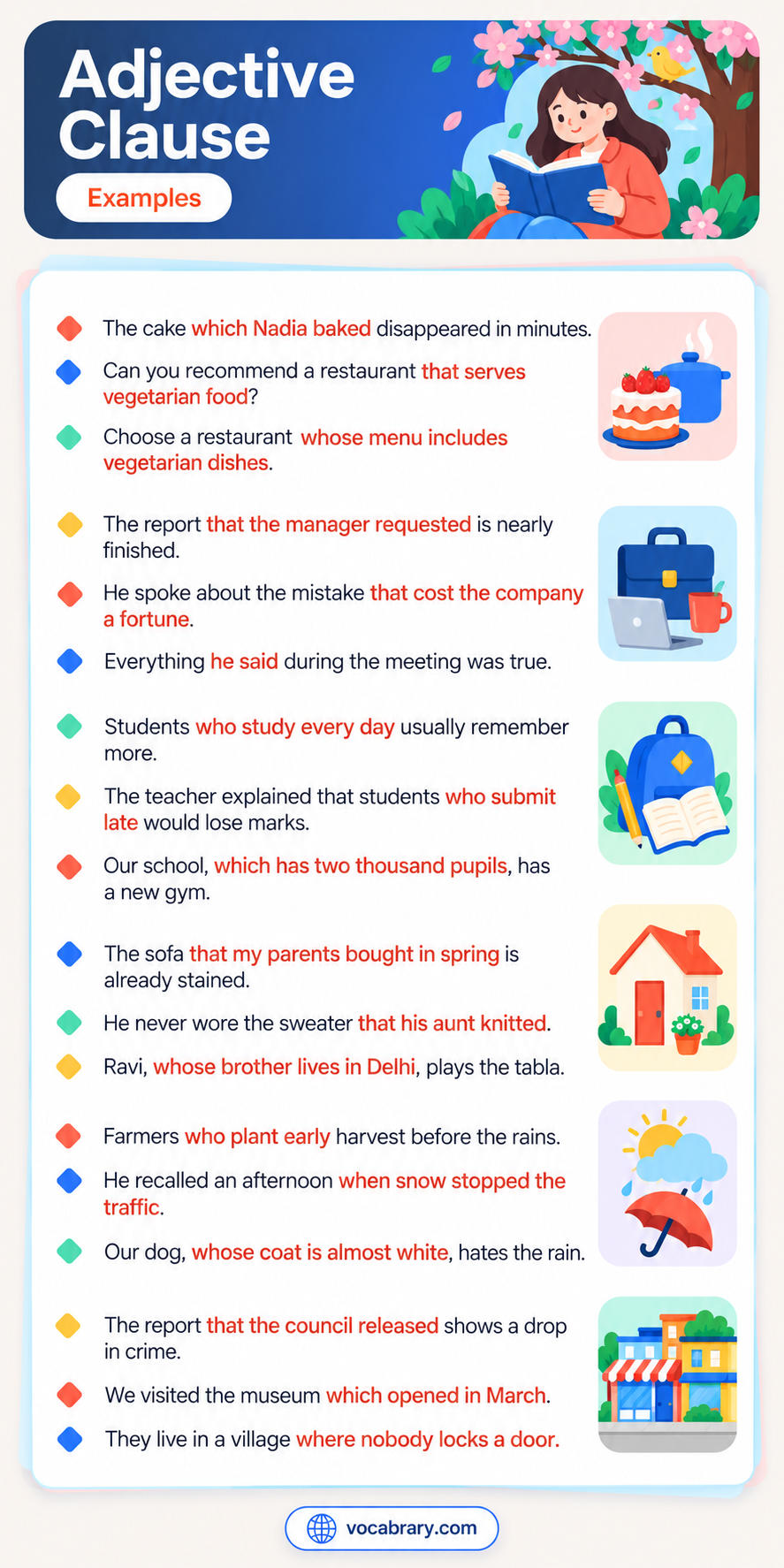
Common Adjective Clause Examples
The woman who lives next door, the umbrella that my aunt gave me and the village where Tariq grew up are adjective clauses that follow a noun and identify which one is meant.
- The woman who lives next door teaches music at the academy.
- I lost the umbrella that my aunt gave me.
- The village where Tariq grew up has a single bakery.
- A friend whose brother plays for the national team visited us.
- The film which we watched last night ended with a surprise.
- Students who study every day usually remember more.
- The day when the harvest began was warm and bright.
- She admired the painter whom the critics praised.
- The scarf that Ines knitted is hanging by the door.
- The bridge that crosses the river was repaired in spring.
- Lucía bought a coat that kept her warm in the snow.
- The man who fixed our roof refused any payment.
- The recipe that Grandma wrote down is stained with oil.
- We stayed at a hotel which overlooked the harbour.
- The girl who sat beside me forgot her pencil.
- I met a boy whose kite had tangled in a tree.
- The song that played at the wedding made everyone cry.
- This is the street where the festival begins.
- The bakery that opened last month sells excellent bread.
- The neighbour whom we invited brought a cake.
Adjective Clauses With Who
Doctors, farmers and cyclists are described by who treated my grandfather, who plant early and who crashed into the fence, clauses in which who is the subject and refers to a person.
- The doctor who treated my grandfather retired last spring.
- People who exercise regularly sleep better.
- I admire teachers who listen carefully.
- The boy who won the spelling contest is my cousin.
- The cyclist who crashed into the fence was unhurt.
- The woman who owns the bakery greets every customer by name.
- Farmers who plant early harvest before the rains.
- The singer who performed last received the longest applause.
- Mei is the only student who solved the final problem.
- The children who live near the river swim every summer.
- A stranger who looked lost asked me for directions.
- The pilot who landed the plane was praised by the passengers.
- Our guide, who has worked here for twenty years, knows every path.
- Volunteers who clean the beach meet every Saturday.
Adjective Clauses With Whom
A man admired most, a nurse and a trusted colleague are described by whom I admire most, whom she had met in the ward and whom we trusted. In each clause whom is the object.
- The man whom I admire most is my grandfather.
- She thanked the nurse whom she had met in the ward.
- The author whom the students interviewed signed their books.
- My cousin, whom I have not seen for years, is visiting next week.
- The candidate whom the committee selected begins in May.
- The colleague whom we trusted left the firm.
- The artist whom Sara praised declined the prize.
- Maria is the person whom they asked to lead the team.
- The friend whom I called did not answer.
- The woman whom everyone respected led the town for ten years.
Adjective Clauses With Whose
Whose names the owner or source of the noun that follows it, as in whose bicycle was stolen, whose house burned down, and whose paintings hung in the lobby. The antecedent is the person, animal, or thing that has that noun.
- The girl whose bicycle was stolen reported it to the police.
- I know a man whose dog can open doors.
- Writers whose books sell well receive many invitations.
- The family whose house burned down stayed with relatives.
- She admires teachers whose students become leaders.
- The company whose workers went on strike lost three contracts.
- A boy whose voice was unusually deep sang the solo.
- Choose a restaurant whose menu includes vegetarian dishes.
- The artist whose paintings hung in the lobby gave a short talk.
- The tree whose branches reached the roof was cut down.
- Ravi, whose brother lives in Delhi, plays the tabla.
- The student whose essay won the prize read it aloud.
Adjective Clauses With Which
A borrowed book, a restored tower and a long storm are described by which I borrowed from the library, which the city restored last year and which lasted all night, clauses about objects and places.
- The book which I borrowed from the library was overdue.
- We visited the museum which opened in March.
- The storm, which lasted all night, knocked down several trees.
- The old tower, which the city restored last year, now holds concerts.
- My laptop, which I bought in 2020, still works perfectly.
- The road which leads to the lake is closed in winter.
- Tea, which is grown in the hills, is the town’s main export.
- She wore a scarf which her grandmother had knitted.
- The theory, which scientists tested for years, was finally confirmed.
- The bridge, which many tourists photograph, is closed for repairs.
- He keeps a diary which nobody else has ever read.
- The cake which Nadia baked disappeared in minutes.
- Our school, which has two thousand pupils, has a new gym.
- The chair which stood by the window was broken.
Adjective Clauses With That
That we saw yesterday, that Tom repaired and that decided the championship are introduced by the word that, which refers to people, animals, or objects in a restrictive clause.
- The movie that we saw yesterday was far too long.
- Everything that Rosa said was true.
- I found the wallet that you lost.
- The bike that Tom repaired looks brand new.
- She is the best teacher that I have ever had.
- The photos that hang in the hallway show my grandparents.
- The only thing that scared him was the dark.
- The soup that Dad makes is famous in our street.
- Anything that grows in this soil needs plenty of water.
- The report that the committee published was criticised.
- We watched the match that decided the championship.
- The email that arrived this morning contained bad news.
- He spoke about the mistake that cost the company a fortune.
- The path that winds through the forest is steep.
Adjective Clauses With Where
After a place noun such as café, town, or room, the relative adverb where begins clauses like where we first met, where her parents were born and where the treaty was signed.
- The café where we first met has closed.
- She returned to the town where her parents were born.
- This is the room where the treaty was signed.
- I remember the beach where we collected shells.
- The garage where Ali works repairs old motorcycles.
- Show me the shelf where you found the book.
- The hospital where Dr Patel trains is two hours away.
- They live in a village where nobody locks a door.
- The stadium where the final was played holds fifty thousand people.
- The cottage where we spent the summer had no electricity.
- The park where children fly kites opens at dawn.
- Every classroom where the heater broke received a new heater on Friday.
Adjective Clauses With When
Words for a day, a season or a moment, such as day, season, and time, are followed by when we won the cup, when the lake freezes and when letters took weeks to arrive.
- I still remember the day when we won the cup.
- Winter is the season when the lake freezes.
- There was a time when letters took weeks to arrive.
- Saturday is the day when the market is busiest.
- The year when the drought began was the hardest for the farmers.
- She talked about the morning when her daughter was born.
- It was the moment when everything changed.
- Spring is the time when the orchard blooms.
- He recalled an afternoon when snow stopped the traffic.
- Do you recall the night when the power failed?
Adjective Clauses With Why
The noun reason is the antecedent in why I left early, why the match was cancelled and why the experiment failed, and the relative adverb why follows the noun reason.
- That is the reason why I left early.
- Nobody knows the reason why the match was cancelled.
- Tell me the reason why you are laughing.
- She explained the reason why the bridge closed.
- The reason why the experiment failed is still unknown.
- I understand the reason why he refused.
- Is there any reason why she should wait?
- Money was the reason why the family moved.
Restrictive Adjective Clauses
The clauses who miss the deadline, that barked all night and who finished second identify students, a dog and a runner, and no commas set them off.
- Students who miss the deadline lose ten points.
- The dog that barked all night belongs to the neighbours.
- I like sweaters that are made of wool.
- The teacher who taught me chemistry has retired.
- Books that have torn covers are sold at half price.
- The driver who stopped to help us refused a reward.
- Only guests who have tickets may enter the hall.
- The shirt that I bought on Monday has already lost a button.
- Plants that need little water suit the dry garden.
- The man who called this morning left no name.
- Children who read every day build a larger vocabulary.
- A shop that sells fresh bread opened on our street.
- The candidate who answered the question honestly won my vote.
- The runner who finished second was disqualified later.
Nonrestrictive Adjective Clauses
My sister, the Marlow River and Professor Lund are already identified, so who lives in Toronto, which floods every spring and who won the prize last year add extra facts between commas.
- My sister, who lives in Toronto, is a pilot.
- The Marlow River, which floods every spring, supplies the town with water.
- Mr Dube, who teaches physics, coaches the chess club.
- My phone, which I bought last week, has already cracked.
- Lagos, where my uncle lives, is my favourite city to visit.
- The festival, which draws thousands of visitors, takes place in June.
- Her grandmother, whom she adores, bakes on Sundays.
- Our dog, whose coat is almost white, hates the rain.
- The bakery on Pine Street, which opened in March, already has a queue.
- Professor Lund, who won the prize last year, will give the keynote.
- In July, when the schools close, the town grows quiet.
- The old library, where I studied as a child, will be demolished.
- Priya’s brother, who is a dentist, lives in Leeds.
- The mayor, who had promised lower taxes, resigned on Monday.
Adjective Clauses Without a Relative Pronoun
I borrowed, she wrote and you met yesterday follow their nouns with no introducer. This is correct only when the missing pronoun is the object of a verb or preposition in a restrictive clause.
- The novel I borrowed had a torn cover.
- Here is the letter she wrote.
- The person you met yesterday is my cousin.
- Everything he said during the meeting was true.
- The coat Lena wore was too big.
- I loved the song they played.
- The movie we watched had no ending.
- She is the teacher everyone respects.
- That is the mistake I made last year.
- The pizza Mario ordered arrived cold.
- The meal we cooked took three hours.
- The city they moved to is by the sea.
- Nobody liked the speech the minister gave.
- The first thing I noticed was the smell.
Adjective Clauses With Prepositions
In on which she sat and to whom I wrote, a preposition comes before whom or which, which is the formal pattern. In I wrote the letter with, the preposition ends the clause, which is the usual pattern in speech.
- The chair on which she sat collapsed.
- The friend to whom I wrote never replied.
- The house in which they lived was demolished.
- The tools with which he worked were sharpened daily.
- This is the pen I wrote the letter with.
- The girl he is dancing with is my sister.
- The city that we flew to was covered in snow.
- She is the woman for whom the song was written.
- The team that Raj plays for won again.
- The room in which the meeting took place had no windows.
- The people among whom she grew up spoke three languages.
- The subject we were arguing about has been forgotten.
- The candidate for whom I voted lost by two votes.
- The bed that the cat sleeps on is by the stove.
Adjective Clauses After Subjects
When an adjective clause describes the subject, it comes between the subject and its verb.
- The boy who sits behind me whispers constantly.
- The pie that Aisha baked vanished within minutes.
- A teacher whose lessons I loved wrote me a letter.
- The train that leaves at noon is always crowded.
- The tourists who arrived late missed the boat.
- The shop where I buy bread closes at five.
- The painting that hangs in the hall was a gift.
- Employees who work nights receive extra pay.
- The river that runs behind the school freezes in January.
- The girl whose phone rang blushed.
Adjective Clauses After Objects
Who speaks six languages, whose ears were too large and that moved her deeply follow the objects woman, puppy, and novel directly, so each clause is linked to the right noun.
- I met a woman who speaks six languages.
- She sold the car that her father gave her.
- They adopted a puppy whose ears were too large.
- We visited a village where nobody uses electricity.
- Dan hired a mechanic who repairs bicycles.
- Mina read a novel that moved her deeply.
- The council built a bridge which saves commuters an hour.
- I saw a cat that was chasing a squirrel.
- He praised the student who helped the new pupil.
- The museum bought a painting that nobody had seen for a century.
Adjective Clauses After Complements
After the linking verbs is, was, and became, the complement is described by a clause, as in who designed the bridge, that changed my mind, and where we met.
- Ravi is the engineer who designed the bridge.
- This is the book that changed my mind.
- That was the day when the river froze.
- She became a doctor whom patients trusted.
- Mila is a girl whose laughter fills the room.
- It was the café where we met.
- Brenton is a city that has excellent public transport.
- He remained the only one who understood the plan.
Adjective Clauses After Objects of Prepositions
Prepositions such as to, for, near, and from are followed by a noun that a clause modifies, as in who had sailed around the world, that was already late, and where herons nest.
- She talked to a man who had sailed around the world.
- We waited for the bus that was already late.
- He lives near a lake where herons nest.
- Sofia works for a company that makes toys.
- They sat beside a woman whose child was crying.
- I am grateful to everyone who helped me.
- The letter came from a friend whom I had met in Cairo.
- Dina laughed at the joke that Omar told.
Adjective Clauses After Pronouns
Anyone, those, something and nothing are pronouns modified by who wants a ticket, who arrive early, that Maria said and that happened that night.
- Anyone who wants a ticket should queue here.
- Those who arrive early get the best seats.
- Everyone who attended the concert received a poster.
- Something that Maria said stayed with me.
- Nothing that happened that night was reported.
- The proverb says he who hesitates is lost.
- Somebody who knows the road should drive.
- I will help anyone who asks.
- Those whom I trust know the secret.
- All that remained was a pile of ash.
- Many who joined the choir had never sung before.
- Everybody I invited came to the party on time.
Adjective Clause Subject-Verb Agreement
The verb in who plays the drums, who play the drums and who has a pilot’s licence agrees with the antecedent. A singular antecedent requires a singular verb, and a plural antecedent requires a plural verb.
- The boy who plays the drums lives next door.
- The boys who play the drums live next door.
- She is one of those teachers who inspire their students.
- He is the only one of my friends who has a pilot’s licence.
- Anyone who needs help is welcome.
- The people who need help are welcome.
- The team that wins receives a trophy.
- The teams that win receive trophies.
- A student who is late must sign the book.
- Students who are late must sign the book.
- The news that arrives by radio is always a day old.
- The shoes that stand by the door belong to Dad.
- She is the kind of person who always helps.
- These are the books that were damaged.
Adjective Clauses in Negative Sentences
In who did not pay and who had not studied, the negative word is in the adjective clause. In did not buy the dress that she had tried on, it is in the main clause.
- The man who did not pay was asked to leave.
- I have no friend who lives nearby.
- Nobody who read the book liked the ending.
- She did not buy the dress that she had tried on.
- There is nothing that I would change.
- The students who had not studied looked worried.
- We could not find the house where she had lived.
- He never wore the sweater that his aunt knitted.
- I do not know anyone who has met her.
- The teacher did not accept the excuse that Ali offered.
Adjective Clauses in Questions
Who is waving at us, that Mira recommended and where the accident happened appear inside questions, and the question mark closes the whole sentence and not the clause.
- Who is the woman who is waving at us?
- Have you read the book that Mira recommended?
- Do you know the man who owns that shop?
- Is this the street where the accident happened?
- Which of the students who took the test passed?
- Where is the jacket that I left here?
- Did you meet the author whose novel won the prize?
- Why did the company hire a manager whom nobody trusted?
- Can you recommend a restaurant that serves vegetarian food?
- Was the day when the bridge opened a holiday?
Adjective Clauses in Passive Sentences
That was broken yesterday, who were arrested last night and which was stolen in March contain passive verbs, because the noun before each clause names the person or thing affected by the action.
- The window that was broken yesterday has been repaired.
- The letter which was delivered this morning was addressed to my sister.
- The house, which was built in 1900, has been restored.
- The thieves who were arrested last night denied everything.
- The novel that was written by a teenager became a bestseller.
- The man who was given the award thanked his coach.
- The books that are borrowed most often are replaced yearly.
- The package that had been sent to the wrong address finally arrived.
- Rooms that are cleaned daily cost extra.
- The painting which was stolen in March was found in a barn.
Adjective Clauses in Reported Speech
After reporting verbs such as said, told, and asked, a farm, an island, and a scarf are described by who owned the farm, where birds had no fear of people, and that she had lost.
- She said that she knew the man who owned the farm.
- He told us about an island where birds had no fear of people.
- Mum asked me whether I had seen the scarf that she had lost.
- The teacher explained that students who submit late would lose marks.
- They announced that the road that leads to the harbour would close.
- Ali replied that the woman whom he had met was a doctor.
- The guide mentioned a cave where hermits had once lived.
- My neighbour said that the noise that came from the workshop had stopped.
Adjective Clause vs Noun Clause Examples
Who called, that Sam lost and where Lina grew up describe a noun in the first half of each sentence. The second half contains a noun clause such as why he called or where the school stood.
- I know the man who called, but I do not know why he called.
- Nadia found the wallet that Sam lost, and Sam wondered where he lost it.
- We visited the town where Lina grew up, and Lina remembers where the school stood.
- Show me the photo that you took, and tell me when you took it.
- The student who asked the question knew what the answer was.
- I admire the teacher whom everyone respects, and I wonder who chose her.
- She keeps the letter that her father wrote, and she knows what he wrote.
- They found the cave where the thieves hid, but nobody knew how the thieves found it.
Adjective Clause and Noun Clause Comparison
An adjective clause describes a noun that is already in the sentence, while a noun clause is the noun itself, as in the pair the man who called and I know who called. Study the noun clause page for the second type.
| Feature | Adjective clause | Noun clause |
|---|---|---|
| Job in the sentence | Modifies a noun or pronoun | Functions as a subject, object, complement, or appositive |
| Position | Directly after the noun it describes | In the place of a noun |
| Introducers | Who, whom, whose, which, that, where, when, and why | That, whether, if, and wh-words |
| Effect of removal | The main clause stays complete | The main clause becomes incomplete |
| Example | I met the girl who won. | I know who won. |
Adjective Clauses in Everyday Contexts
Home, school, work, travel, news, fiction, sports and health each contain people, places, and objects described by clauses, from that my parents bought in spring to who sleep badly.
Adjective Clause Examples at Home
Clauses about household objects, such as that my parents bought in spring, where she saves coins, and which had dripped for weeks, describe a sofa, a jar, and a dripping tap.
- The sofa that my parents bought in spring is already stained.
- My grandmother keeps a jar where she saves coins.
- The neighbour whose dog barks all night came to apologise.
- We painted the room that gets the most sunlight yellow.
- Dad fixed the tap which had dripped for weeks.
- The cousin who stays with us every summer teaches me chess.
Adjective Clause Examples at School
Classroom talk uses who marked my essay, whose homework is late, and that worried everyone to describe a teacher, pupils, and an exam.
- The teacher who marked my essay praised the introduction.
- Pupils whose homework is late stay behind after class.
- The library where we study opens at seven.
- The exam that worried everyone turned out to be easy.
- Mr Alves, who coaches the debate team, was proud of us.
- The pupil whom the class elected gave a short speech.
Adjective Clause Examples at Work
Office sentences use who covered my shift, whose contract expires in June, and which employs forty people to describe a colleague, a client, and a firm.
- The colleague who covered my shift received a thank-you note.
- The client whose contract expires in June called a meeting.
- We moved to an office where the windows open.
- The report that the manager requested is nearly finished.
- The firm, which employs forty people, plans to expand.
- Applicants who submit a portfolio are interviewed first.
Adjective Clause Examples for Travel
In travel plans and holiday stories, hotels, trains, and islands are identified by where we stayed, that leaves at six, and which has no roads.
- The hotel where we stayed overlooked a quiet bay.
- Passengers who miss the connection can rebook at the desk.
- The train that leaves at six arrives before lunch.
- We found a market where farmers sell cheese.
- The guide whom we hired knew every village.
- The island, which has no roads, can be reached only by boat.
Adjective Clause Examples in the News
News reports identify a mayor, residents, and a village with clauses such as who opened the clinic, whose homes flooded, and where the earthquake struck.
- The mayor who opened the clinic thanked the volunteers.
- Residents whose homes flooded were moved to a shelter.
- The report that the council released shows a drop in crime.
- The bridge, which collapsed in the storm, will be rebuilt.
- Police arrested the man who had stolen the van.
- The village where the earthquake struck received medical aid.
Adjective Clause Examples in Literature
In an invented story, a captain, a diary, and a forest receive clauses such as who sails the ghost ship, that reveals her family’s secret, and where the children hide.
- The captain who sails the ghost ship never speaks.
- Alina finds a diary that reveals her family’s secret.
- The forest where the children hide is full of mist.
- The king, whose daughter has vanished, offers a reward.
- The stranger whom everyone fears turns out to be a healer.
- The letter that Mira never sent is read at the end.
Adjective Clause Examples in Sports
Match reports identify a striker, a stadium, and a coach with clauses such as who scored twice, where the final took place, and whom the players trust.
- The striker who scored twice was carried off the pitch.
- Players whose passes miss the target train extra hours.
- The stadium where the final took place was full.
- The team, which had lost five games, finally won.
- Fans who arrived early got free caps.
- The coach whom the players trust keeps practice short.
Adjective Clause Examples for Health
Clinic notices and doctors’ advice use clauses such as who drink enough water, that the doctor prescribed, and where Ahmed works for patients, medicine, and a clinic.
- Patients who drink enough water recover faster.
- The medicine that the doctor prescribed must be taken with food.
- The clinic where Ahmed works offers free check-ups.
- Nurses whose shifts end at midnight receive a taxi voucher.
- The cough, which had lasted three weeks, finally stopped.
- People who sleep badly often feel anxious.
Adjective Clause Examples for Kids
Young learners read short lines such as the dog that barks and the boy who runs, and they see that a describing clause follows its noun.
- I like the dog that barks.
- Here is the boy who runs.
- This is the cake I made.
- She has a ball that bounces.
- Mum likes the song we sing.
- That is the girl who smiles.
- I see a bird that sings.
- We saw a house where owls live.
- He found a coin that shines.
- The boy whose kite flew away cried.
Adjective Clause Examples for Students
Exam-level sentences about researchers who study climate change and the theory that the committee rejected use adjective clauses in academic writing and in essay answers.
- Researchers who study climate change rely on decades of data.
- The theory that the committee rejected was later proven correct.
- The novel, which explores themes of migration, divides critics.
- Economists whose forecasts failed revised their models.
- The period when industrial production expanded changed urban life.
- A policy that benefits one group may disadvantage another.
- The experiment, which was repeated three times, produced consistent results.
- Authors whom critics ignored sometimes gain readers after their death.
- The conditions under which the study was conducted limit its conclusions.
- The reason why the empire collapsed remains disputed.
Adjective Clauses in a Short Paragraph
Two short passages about a beekeeper and a guitar use who lives upstairs and that he had admired for years, so learners meet adjective clauses inside continuous writing.
The woman who lives upstairs keeps bees. The honey that she sells is the best in the district. Her garden, where lavender grows beside the hives, attracts visitors who come from distant towns. Neighbours whose windows face the garden say the humming is soothing.
Omar bought the guitar that he had admired for years. The shop owner, who knew Omar’s father, lowered the price. The first song Omar played was one his father had loved.
Common Adjective Clause Mistakes
Common errors with adjective clauses include which after a person, that between commas, and a clause placed after the wrong noun.
❌ The man which lives next door is a nurse.
✅ The man who lives next door is a nurse.
In standard written English, a clause that modifies a person is introduced by who (or that), while which is used for animals and objects.
❌ My brother, that lives in Perth, is a chef.
✅ My brother, who lives in Perth, is a chef.
The word that does not introduce a nonrestrictive clause set off by commas, so who or which is needed.
❌ The book, that I borrowed, was overdue.
✅ The book that I borrowed was overdue.
The clause identifies the noun, so commas are not used around it.
❌ The students who is late must wait.
✅ The students who are late must wait.
The verb in the clause agrees with the antecedent students, which is plural.
❌ The girl who she won the prize is my cousin.
✅ The girl who won the prize is my cousin.
The word who is already the subject of the clause, so the added subject she is an error.
❌ The report was on the desk that I wrote.
✅ The report that I wrote was on the desk.
An adjective clause is placed next to the noun it modifies, so in the first line the clause describes desk instead of report.
❌ The house where I live in is old.
✅ The house where I live is old.
The word where already means in which, so the final in repeats the preposition.
❌ The man whose his car was stolen called the police.
✅ The man whose car was stolen called the police.
The word whose already expresses possession, so the pronoun his repeats the owner.
❌ Anyone who need help should ask.
✅ Anyone who needs help should ask.
The pronoun anyone is singular, so the verb in the clause takes -s.
❌ She is the teacher whom taught me.
✅ She is the teacher who taught me.
The word whom is an object form, and in this clause the relative word is the subject of taught.
❌ The movie what we saw was long.
✅ The movie that we saw was long.
In standard written English, what introduces noun clauses and questions, so an adjective clause uses that, which, or no pronoun at all.
Related
- Relative Clause Example Sentences
- Relative Pronoun Example Sentences
- Relative Adverbs Example Sentences
- Noun Clause Examples
- Adverb Clause Examples
- Dependent Clause Examples
- Subject-Verb Agreement Examples
- Complex Sentence Examples
FAQs
Q1. What are some common examples of adjective clauses?
Common examples of adjective clauses are who lives next door, that my aunt gave me, where Tariq grew up, and whose brother plays for the national team. Each clause has its own subject and verb and follows the noun it describes. In the woman who lives next door, the clause identifies which woman is meant.
Q2. How do you identify an adjective clause in a sentence?
You identify an adjective clause by finding a group of words with a subject and a verb that follows a noun and states which one or what kind. In The film that we watched ended late, the clause that we watched follows film and identifies it. A clause that replaces a noun is a noun clause instead.
Q3. Which words introduce an adjective clause?
An adjective clause is introduced by the relative pronouns who, whom, whose, which, and that, or by the relative adverbs where, when, and why. Who and whom refer to people, which refers to animals and objects, and that refers to either in a restrictive clause. The relative adverbs follow nouns of place, time, and reason.
Q4. Is an adjective clause the same as a relative clause?
An adjective clause is the school-grammar name for a clause that modifies a noun, and the same clause is called a relative clause in linguistic grammars. The first name describes the job of the clause, and the second names the relative words that introduce it. Some university grammars use relative clause as a wider term that also covers a clause such as sentential which, which modifies a whole sentence. The relative clause page covers that wider group.
Q5. What is the difference between a restrictive and a nonrestrictive adjective clause?
A restrictive adjective clause identifies the noun, while a nonrestrictive clause adds a fact about a noun that is already identified. In Students who miss the deadline lose points, the clause limits which students are meant. In My sister, who lives in Toronto, is a pilot, the clause only adds a fact about a sister who is already identified.
Q6. When does an adjective clause need commas?
A nonrestrictive adjective clause needs commas, and a restrictive clause takes none. The commas set off an added fact, and the sentence still identifies the same noun without it. A nonrestrictive clause is introduced by who, whom, whose, which, where, or when, and the word that is not used in it.
Q7. Can you leave out the relative pronoun in an adjective clause?
The relative pronoun is optional when it is the object of the verb or of a preposition inside a restrictive clause, as in the book I borrowed and the man I spoke to. The pronoun is required when it is the subject of the clause, as in the woman who lives next door. It is also required in a nonrestrictive clause and after a fronted preposition, as in the chair on which she sat.
Q8. Where does an adjective clause go in a sentence?
An adjective clause goes directly after the noun or pronoun it modifies, even when a short phrase separates them, as in the man in the corner who called. The noun is a subject, an object, a complement, or the object of a preposition. A clause placed after a different noun modifies that noun instead, so The report was on the desk that I wrote describes the desk.
Q9. Do you use who, which, or that in an adjective clause?
You use who or whom for people, which for animals and objects, and that for people, animals, or objects in a restrictive clause. The word whose expresses possession for people, animals, and objects. In a nonrestrictive clause between commas, writers use who or which and not that.
Q10. Does the verb in an adjective clause agree with the noun before it?
The verb in an adjective clause agrees with the antecedent, which is the noun before the relative word. In the boys who play the drums, the verb play is plural because boys is plural, and in the boy who plays the drums, the verb takes -s. The agreement rule is explained further on the subject-verb agreement page.
Q11. What is the difference between an adjective clause and a noun clause?
An adjective clause modifies a noun, whereas a noun clause functions as a noun. In I met the man who called, the clause who called describes the man. In I know who called, the clause who called is the object of know. The noun clause page covers the functions of the second type.
Q12. What are adjective clause examples for kids?
Adjective clause examples for kids are short lines such as I like the dog that barks, Here is the boy who runs, and This is the cake I made. Each line names a person or object and then adds a clause that identifies which one. Young learners read these lines aloud and then build their own with who, that, and where.
Q13. Why is the man which lives next door incorrect?
The phrase the man which lives next door is incorrect because which is not used to refer to a person in standard written English. The relative pronoun must be who or that, so the correct phrase is the man who lives next door. The word which is used for animals and objects, as in the dog which lives next door.

Leave a Comment