
An appositive is a noun phrase that renames the noun or pronoun beside it, as in my brother, a skilled carpenter. These appositive examples sentences begin with common cases that rename a person, a place, or an object.
What Is an Appositive?
An appositive is a noun or noun phrase placed next to another noun to rename or identify it. It differs from an adjective clause, which has its own subject and verb, as in Tom, who is a carpenter.
Noun + (comma) + appositive noun phrase + (comma)
My sister, a nurse in Leeds, called last night.
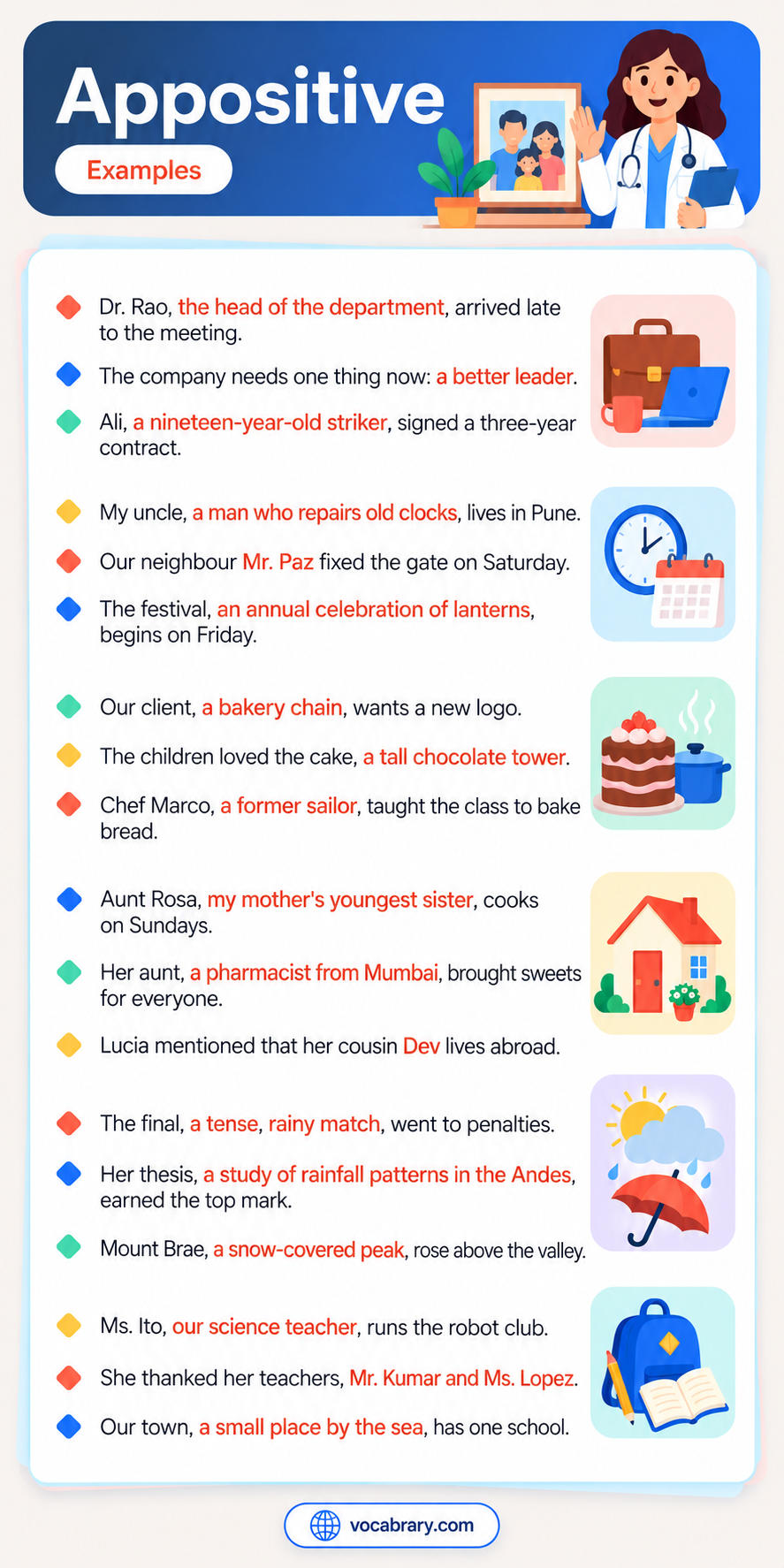
Common Appositive Examples Sentences
A retired pilot, a busy port city, and a small grey kitten are appositives that rename a neighbour, a city, and a cat. Each one renames the noun beside it with a second name or a description.
- My neighbour, a retired pilot, grows tomatoes on his balcony.
- Lagos, a busy port city, welcomed thousands of visitors that week.
- The writer Elena Marsh signed copies after the talk.
- Our teacher, Mrs. Okonkwo, gave us extra time for the test.
- Mount Alder, the highest peak in the region, is hard to climb in winter.
- Her brother, a talented drummer, joined the band last spring.
- We adopted Milo, a small grey kitten, in March.
- Dr. Alvarez, our family doctor, retired last year.
- The chef, a quiet man from Naples, cooked for forty guests.
- My uncle Farid repairs old radios for the whole street.
- Kofi, my best friend, lives two streets away.
- Our school, a low brick building by the river, opened in 1962.
- Principal Chen, a calm and fair leader, met every parent in person.
- The museum’s new curator, a historian from Cairo, loves old maps.
- Anya, the youngest member of the choir, sang the solo.
- They spent a week in Hoi An, a small town on the coast.
- Her favourite singer, Amara Diallo, will visit our city in June.
- The farmer sold his best cow, a brown Jersey named Daisy, at the fair.
- Mr. Tanaka, the bus driver, knows every child by name.
- The bakery, a family business since 1980, now sells bread online.
Appositive Structure
An appositive phrase consists of a head noun and modifiers such as adjectives, prepositional phrases, or clauses. The patterns range from my cousin Ravi to Lagos, a busy port city on the coast.
| Pattern | Example sentence |
|---|---|
| Noun + single-word appositive | My aunt Rosa bakes bread. |
| Noun + comma + noun phrase | Tom, a skilled carpenter, built the shelves. |
| Noun + appositive with modifiers | Lagos, a busy port city on the coast, grew fast. |
| Appositive before the noun | A skilled carpenter, Tom built the shelves. |
| Noun + colon + noun phrase | She wanted one thing: freedom. |
| Noun + dashes + noun phrase | Her pet – a grey parrot – speaks Spanish. |
Nonrestrictive Appositives With Commas
A nonrestrictive appositive adds an extra fact about a noun that is already identified, so commas set it off. In my mother, a nurse for thirty years and the sun, a star, the noun is unique, because a person has one mother and the sky has one sun.
- My mother, a nurse for thirty years, still works on weekends.
- The sun, a star at the centre of our solar system, rose over the ridge.
- Our principal, Mr. Haddad, announced the new timetable.
- Paris, the city where we met, still feels like home.
- My father, a tall quiet man, taught me to fish.
- Mount Brae, a snow-covered peak, rose above the valley.
- The captain, Lena Ortiz, thanked the supporters after the match.
- Our hometown, a sleepy village by the lake, has changed little.
- Grandpa’s watch, a gift from his own father, still keeps perfect time.
- The mayor, a former nurse, opened the new clinic.
- My sister, Ana, studies law in Lisbon.
- The Nile, a river flowing north through Egypt, supports millions of farmers.
- Her husband, Samir, repairs bicycles in the old market.
- The novel’s author, Hana Lindqvist, lives in Helsinki.
- Our headmistress, a woman of great patience, never raised her voice.
- The city council, a body of twelve elected members, meets on Thursdays.
Restrictive Appositives Without Commas
A restrictive appositive names which one is meant among several, so no commas set it off. The poet Elena Marsh and the word courage depend on the second noun to identify the first.
- The poet Elena Marsh read three poems at the library.
- My friend Dalia just moved to Oslo.
- The word courage is a noun.
- We watched the film Sunrise Bay twice last winter.
- The planet Mars looks red in the evening sky.
- The river Danube flows through several countries.
- My cousin Ravi lives in Perth.
- The singer Amara Diallo performed at the festival.
- His daughter Maya plays the flute.
- Have you met my neighbour Mr. Diaz?
- The letter Q looks like a circle with a small tail.
- The nickname Skipper stuck to him for years.
- Our dog Biscuit loves to roll in the snow.
- The number seven is lucky in several cultures.
- We admired the painter Lucia Ferro at the gallery.
- The song Moonlight Road plays at every wedding in town.
Restrictive and Nonrestrictive Appositives Side by Side
My cousin Ravi implies that the speaker has more than one cousin, and My only cousin, Ravi, names the one cousin the speaker has. The commas change what the reader learns about the number of people.
- My cousin Ravi plays the drums.
- My only cousin, Ravi, plays the drums.
- The author Salma Reyes visited our school.
- The author, Salma Reyes, spoke at our school last week.
- My neighbour Mr. Diaz is a pilot.
- My neighbour, Mr. Diaz, flies cargo planes.
- His daughter Maya won the race.
- His only daughter, Maya, won the race.
- Our dog Biscuit hates the vacuum cleaner.
- Our only dog, Biscuit, hates the vacuum cleaner.
Appositive at the Start of a Sentence
An appositive that opens a sentence renames the noun that follows it, and a comma separates the two. A retired pilot, Mr. Haddad and An experienced climber, Wen are examples.
- A retired pilot, Mr. Haddad now teaches maths.
- An experienced climber, Wen led the group up the ridge.
- A quiet boy, Tomas rarely spoke in class.
- The oldest bakery in town, Rosa’s Oven opens at five every morning.
- A friend of my father, Mr. Quinn offered us a ride.
- A keen gardener, Maria filled the yard with roses.
- The youngest player on the team, Idris scored the winning goal.
- A skilled carpenter, Yusuf built the cabinet in one day.
- A graduate of the local school, Nadia returned as a teacher.
- A woman of few words, Mrs. Ibrahim nodded and left.
- The author of three novels, Hana Lindqvist spoke about her writing.
- A cheerful host, Mateo welcomed everyone at the door.
Appositive in the Middle of a Sentence
An appositive in the middle of a sentence follows the noun it renames and takes a comma on both sides. Dr. Rao, the head of the department, arrived late to the meeting and Zainab, our class monitor, collected the permission slips use a comma on each side.
- Nora, a skilled carpenter, built the cabinet in a day.
- Dr. Rao, the head of the department, arrived late to the meeting.
- The river, a wide brown stream, flooded after the storm.
- Her aunt, a pharmacist from Mumbai, brought sweets for everyone.
- The house, a blue cottage with a red door, belongs to my uncle.
- Chef Marco, a former sailor, taught the class to bake bread.
- Zainab, our class monitor, collected the permission slips.
- The festival, an annual celebration of lanterns, begins on Friday.
- My laptop, a gift from my parents, broke during the exam.
- Mr. Kimura, the owner of the shop, greeted every customer by name.
- Their youngest child, a curious boy of four, opened every drawer.
- The tower, a narrow stone spire, dates from the last century.
- We, the members of the club, voted to change the rules.
- Oslo, the host city of the meeting, welcomed the delegates warmly.
Appositive at the End of a Sentence
An appositive at the end of a sentence follows the noun it renames, takes one comma before it, and closes with the final period. We hired Tom, a skilled carpenter and She called her aunt, a pharmacist are typical.
- We hired Tom, a skilled carpenter.
- She called her aunt, a pharmacist from Mumbai.
- The class visited Siena, a hill town full of churches.
- Nobody trusted the stranger, a man with a crooked smile.
- I bought a ticket for Saturday’s concert, a charity event.
- They spoke to the mayor, a former dentist.
- He thanked the donor, Mrs. Ng.
- We admired the statue, a bronze horse on a stone base.
- My uncle drives a taxi, an old yellow Volvo.
- Lucia adopted a puppy, a shy brown terrier.
- The children loved the cake, a tall chocolate tower.
- Rahul wrote to his professor, the author of the textbook.
- Mei visited her home village, a quiet place in the hills.
- We met the guide, a quiet young woman from Quito.
Appositive Phrases With Modifiers
An appositive phrase has a renaming noun with modifiers such as adjectives, prepositional phrases, participles, or a relative clause. the girl who won the spelling contest and a man who repairs old clocks are two examples with relative clauses.
- Leila, the girl who won the spelling contest, hugged her mother.
- Tokyo, a huge city of tall towers and quiet shrines, amazed the visitors.
- My uncle, a man who repairs old clocks, lives in Pune.
- Mr. Bello, a teacher respected by every student, retired in June.
- The harbour, a deep bay protected by two long piers, shelters hundreds of boats.
- Our dog, a clumsy puppy with enormous paws, knocked over the lamp.
- Sana, my friend from the swimming club, invited me to her party.
- The report, a long document filled with charts, took a week to write.
- The chef, an elderly woman born in Sicily, taught the class her recipe.
- My neighbour’s garden, a wild tangle of roses and beans, attracts bees.
- The festival, a three-day event held each spring, draws crowds from nearby towns.
- Her grandfather, a retired fisherman with weathered hands, told stories on the porch.
- Tariq, the boy sitting next to me, lent me his pen.
- The old library, a building that survived two fires, will reopen in autumn.
Appositives With Words, Years, and Place Names
Appositives follow general nouns such as word, year, island, and planet to name a specific one. The Greek island Crete and the year 2024 pair a general noun with its particular name.
- The word perseverance has twelve letters.
- The year 2024 was warm and dry in our region.
- The letter Z comes last in the English alphabet.
- The Greek island Crete attracts walkers in spring.
- The mountain Kilimanjaro is visible from the lodge on clear days.
- The name Amara was chosen for our new puppy.
- The month October brings heavy rain to the valley.
- We studied the verb run in grammar class.
- The small town Linden has one cinema and two bakeries.
- The planet Venus shines brightly at dawn.
- The Cornish village Polwenn has a market every Friday.
- The Indian state Kerala is famous for its backwaters.
Appositives With Colons
A colon introduces an appositive after a complete clause, and the appositive names what the clause mentions only in general terms. Maria had one clear goal for the season: victory and a single secret ingredient: smoked paprika follow a pattern used in formal writing.
- Maria had one clear goal for the season: victory.
- The recipe needs a single secret ingredient: smoked paprika.
- Since childhood, he has had one fear: heights.
- Only one subject mattered to him: music.
- Two things kept her going: hope and coffee.
- The committee reached a decision: a ban on night flights.
- We lost our best player: Marco Silva.
- The reason for the collapse was obvious: greed.
- The company needs one thing now: a better leader.
- Grandma gave us her final advice: patience and kindness.
- The judge asked for one more document: a signed receipt.
- The expedition faced one great enemy: the cold.
Appositives With Dashes
A pair of spaced dashes sets off an appositive that contains commas or needs strong emphasis. In Three cities – Paris, Rome, and Madrid – hosted the tour and The answer – a short, firm no – surprised everyone, dashes separate the appositive from the commas inside it.
- Her favourite instrument – the cello – stayed in its case.
- Three cities – Paris, Rome, and Madrid – hosted the tour.
- The answer – a short, firm no – surprised everyone.
- Her only luxury – a hot bath – waited at home.
- My brother – a quiet, careful man – never raises his voice.
- The team’s two stars – Ana and Idris – both missed the final.
- Our trip’s only problem – the rain – lasted four days.
- He carried everything he owned – a guitar, a blanket, and a map – on his back.
- She gave one reply – silence.
- The village’s main street – a dusty road lined with palms – leads to the sea.
- Two words – Thank you – ended the long dispute.
- Their best-known recipe – a lemon cake with honey – sold out daily.
Appositive Compared With a Series of Items
An appositive renames the same people or objects, while a series names separate ones. My cousins, Ana and Mei are the two cousins, but in my cousin, Ana, and Mei the names refer to different people, and Ana is the cousin.
- I invited my cousins, Ana and Mei.
- I invited my cousin, Ana, and Mei.
- She thanked her teachers, Mr. Kumar and Ms. Lopez.
- She thanked her teacher, Mr. Kumar, and Ms. Lopez.
- My two best friends, Dalia and Omar, live nearby.
- My best friend, Dalia, and Omar live nearby.
- The report thanks the donors, Mr. Park and Ms. Ruiz.
- The report thanks the donor, Mr. Park, and the volunteers.
- We met his parents, Mr. and Mrs. Silva, at the airport.
- We met his mother, Mrs. Silva, and two cousins at the airport.
Appositive Agreement With the Verb
The verb agrees with the head noun and not with the appositive. In The cause, two broken pipes, was found quickly, the verb is singular because the head noun cause is singular, and Mina, the captain of the team, is late today follows the same rule.
- Mina, the captain of the team, is late today.
- My friends, a doctor and a teacher, are visiting on Sunday.
- The result, three wins in a row, was a surprise.
- The cause, two broken pipes, was found quickly.
- The winners, Ana and I, thanked the coach.
- Our neighbours, the Okafors, are moving out in May.
- The committee chair, Dr. Rao, speaks first.
- The team’s mascot, a giant green frog, has delighted the crowd for years.
- Her two daughters, Maya and Zoe, share a room.
- The main attraction, the old clock tower, draws crowds every summer.
- His hobbies, chess and cycling, keep him busy.
- A new rule, no phones after nine, applies to everyone.
- My parents, both teachers, were born in Pune.
Appositives in Negative Sentences
A negative sentence uses the same positions and commas for the appositive, as in Dr. Chen, our new principal, did not attend and Nobody knew Marta, the new librarian. The negative word is part of the main clause, so the appositive stays the same.
- Dr. Chen, our new principal, did not attend the meeting.
- My brother, a keen swimmer, never goes near the sea in winter.
- The shop, a tiny place on Elm Street, doesn’t open on Sundays.
- Nobody knew Marta, the new librarian.
- The twins, Nina and Noor, hadn’t seen snow before.
- Our guide, a local historian, didn’t speak English.
- The cart, a light wooden frame, will not carry heavy loads.
- I haven’t met Jonas, her cousin from Norway.
- She never trusted the manager, a man with a quick temper.
- No one thanked Omar, the driver, for the long trip.
Appositives in Questions
In a question, the appositive stays beside its noun while the question word order applies to the main clause. Is Mr. Benitez, the music teacher, still on leave? and Who is Kemal, the man in the green coat? follow this order.
- Have you met Tara, our new neighbour?
- Is Mr. Benitez, the music teacher, still on leave?
- Did you read the novel by Hana Lindqvist, a writer from Finland?
- Who is Kemal, the man in the green coat?
- Where did Ravi, your younger brother, study?
- Will Ms. Ito, the head of sales, join the call?
- Why did Mr. Sato, the head chef, resign?
- Is Pablo, your friend from Madrid, coming tonight?
- Did you visit Cusco, a city high in the mountains, last summer?
- Do you know Dalia, the girl in the red scarf?
Appositives in Passive and Reported Sentences
In a passive sentence the appositive follows the noun it renames, and in reported speech the verb of the original statement shifts back in time while the appositive stays unchanged. Tom said that his brother, a pilot, would visit is a reported example, and The bridge, a narrow stone arch, was built in 1890 is a passive one.
- The bridge, a narrow stone arch, was built in 1890.
- The report was written by Dr. Okoye, our lead researcher.
- The village was founded by two brothers, Hasan and Idris.
- The song, a slow ballad, was recorded in one night.
- Zara, the youngest player, was chosen as captain.
- The prize was awarded to Lena, a student from Accra.
- Tom said that his brother, a pilot, would visit in May.
- She told us that Mr. Obi, the caretaker, had locked the gate.
- The mayor announced that the regatta, a weekend race, would begin on Friday.
- Mina explained that her dog, a golden retriever, was afraid of storms.
- He said that the museum, a former train station, closes at five.
- Lucia mentioned that her cousin Dev lives abroad.
Appositive Examples Sentences at Home
A retired seamstress, a fluffy white Persian, and the warmest room in the house rename a grandmother, a cat, and a kitchen. The appositives describe family members, pets, and rooms.
- My grandmother, a retired seamstress, keeps buttons in a tin.
- Our cat, a fluffy white Persian, sleeps on the sofa.
- Dad’s old radio, a gift from his father, still works.
- Aunt Rosa, my mother’s youngest sister, cooks on Sundays.
- The kitchen, the warmest room in the house, smells of cinnamon.
- Our neighbour Mr. Paz fixed the gate on Saturday.
- The new sofa, a deep green velvet one, arrived yesterday.
- My little brother, a very early riser, wakes us at five.
- The garden, a small patch of tomatoes and herbs, is Dad’s pride.
Appositive Examples Sentences at School
Our science teacher, the class monitor, and a former maths teacher are appositives that rename a teacher, a pupil, and a principal. Other appositives in this group name a room, an exam, and a project.
- Ms. Ito, our science teacher, runs the robot club.
- The library, a bright room on the second floor, opens at eight.
- Hamza, the class monitor, collected the worksheets.
- My classmate Elif won the spelling contest.
- Our principal, a former maths teacher, greets pupils at the gate.
- The exam, a three-hour paper, begins at nine.
- The school bus, a yellow minibus, arrives at half past seven.
- Their project, a model of the solar system, won first prize.
- In literature class we studied the poet Li Wen.
Appositive Examples Sentences at Work
Office sentences use an appositive to rename a person, a firm, or a date, as in a patient listener, a bakery chain, and Friday at noon.
- Our manager, a patient listener, answers every question.
- The company, a small firm in Leeds, hired six interns.
- Priya, the new accountant, starts on Monday.
- Our client, a bakery chain, wants a new logo.
- The meeting, a two-hour review, ended early.
- Mr. Cho, head of security, checks every door at night.
- Their product, a solar-powered lamp, sold out in a week.
- My colleague Ben will present the figures.
- The deadline, Friday at noon, cannot move.
Appositive Examples Sentences for Travel
A city full of temples, a rusty old boat, and a converted farmhouse rename a city, a ferry, and a hotel in travel sentences. The appositives describe places and vehicles.
- Our guide, a cheerful retired teacher, knew every street.
- The ferry, a rusty old boat, left at dawn.
- Kyoto, a city full of temples, was our last stop.
- The hotel, a converted farmhouse, had a swimming pool.
- Our train, the night express, was two hours late.
- The island, a quiet strip of sand and palms, has no cars.
- We flew with Aero Sur, a small regional airline, to the capital.
- Our driver Hassan waited at the station with a sign.
- Our hostel, a narrow house near the harbour, cost ten euros a night.
Appositive Examples Sentences in the News
The strongest of the season, the worst in fifty years, and a project costing ten million dollars rename a storm, a flood, and a bridge. The appositives state size, rank, or cost.
- The storm, the strongest of the season, hit the coast at dawn.
- Police arrested Victor Lane, a driver from the north, on Monday.
- The company’s chief, Ms. Valdez, resigned on Tuesday.
- The minister, a long-time critic of the plan, voted against it.
- The new bridge, a project costing ten million dollars, opens in May.
- The flood, the worst in fifty years, damaged two hundred homes.
- The mayor, a former teacher, promised new schools.
- Residents blamed the planning board, a panel of nine volunteers, for the delay.
- The coach, Hugo Perez, praised the young defenders.
Appositive Examples Sentences in Stories
In story sentences, an ancient creature with silver scales, a wise and gentle ruler, and a black stallion named Storm rename a dragon, a queen, and a horse. The appositives name characters and describe their traits.
- The dragon, an ancient creature with silver scales, guarded the cave.
- Queen Isolde, a wise and gentle ruler, opened the gates to the travellers.
- The knight’s horse, a black stallion named Storm, refused to cross the bridge.
- The witch, a woman with a crooked staff, lived at the edge of the marsh.
- Pip, a poor orphan boy, lived beside the river.
- Captain Reyes, a stern sailor with a scar, ordered the sails raised.
- The island, a green speck on the map, held a hidden harbour.
- Maya, the story’s narrator, never learns the stranger’s name.
- The stranger, a tall figure in a grey cloak, vanished at dawn.
Appositive Examples Sentences in Sports
Match reports use an appositive to rename a coach, a captain, or a final, as in a former sprinter, the team’s captain, and a tense, rainy match.
- Our coach, a former sprinter, runs every practice.
- Lena, the team’s captain, scored twice in the second half.
- Their rival, last year’s winner, arrived late to the ground.
- Ali, a nineteen-year-old striker, signed a three-year contract.
- The final, a tense, rainy match, went to penalties.
- Our goalkeeper Sam saved two shots in the last minute.
- The referee, a calm woman from Spain, handled the crowd well.
- The marathon, a 42-kilometre race through the old town, starts at seven.
- Their star player, a quick left winger, limped off the pitch.
Appositive Examples Sentences About Health
Health sentences rename a doctor, a medicine, and a clinic with appositives such as a heart specialist, a common painkiller, and a low white building near the market. The appositives state roles, uses, and places.
- Dr. Okafor, a heart specialist, explained the results.
- Aspirin, a common painkiller, comes in tablets of different strengths.
- My dentist, Dr. Lim, retired last year.
- The clinic, a low white building near the market, treats five hundred patients a week.
- The flu, a viral infection, spreads quickly in winter.
- Insomnia, a sleep disorder, affects millions of adults.
- Her physiotherapist, a young woman named Priya, designed the exercises.
- Vitamin D, a nutrient made in the skin, is also found in fish.
- The patient, a retired bus driver, recovered in two weeks.
Appositive Examples for Kids
Young learners spot an appositive by finding a second name for a noun, such as Rex for a dog or Mr. Bell for a teacher. The second name comes next to the noun, and commas set it off when it adds an extra fact.
- My dog, Rex, loves to run.
- Our teacher, Mr. Bell, reads us a story.
- I have a pet, a small white rabbit.
- Mom, my best cook, made soup.
- My friend Ben has a red kite.
- Grandpa, a funny old man, tells jokes.
- We saw Leo, the zoo’s oldest lion, asleep in the sun.
- Our class pet, a green turtle, eats lettuce.
- Our town, a small place by the sea, has one school.
Short Appositive Sentences for Young Learners
Four and five word lines such as Max, my dog, barks and Mum, a nurse, works nights are a short pattern for beginners, with one appositive in each line.
- Max, my dog, barks.
- Mum, a nurse, works nights.
- Sam, my friend, runs.
- Rex, a big dog, sleeps.
- Pip, our cat, purrs.
- Dad, a cook, smiles.
- Ann, my sister, sings.
- Gus, a clown, jumps.
- My toy, a bear, is soft.
- Mia, my twin, laughs.
Appositive Examples for Students
Exam answers use longer appositives such as a period of rapid technological change and a rise in the general level of prices, which add facts about an event or a process.
- Dr. Mira Sandoval, a pioneer of rainfall science, won the national prize.
- President Okello, the leader of the new republic, spent decades working for equality.
- The Industrial Revolution, a period of rapid technological change, transformed European cities.
- Photosynthesis, the process by which plants make food from light, supports almost all life on Earth.
- Her thesis, a study of rainfall patterns in the Andes, earned the top mark.
- The Treaty of Alder, a compromise between two rival powers, ended the long war.
- Democracy, a system in which citizens choose their leaders, depends on free elections.
- Dr. Patel, the author of the report, will present the findings.
- The French Revolution, an event that changed the politics of Europe, began in the eighteenth century.
- Inflation, a rise in the general level of prices, reduces the value of savings.
Short Paragraphs With Appositives
A family evening, a school morning, a day at the harbour, a football match, and a visit to the clinic use appositives to name people, places, and objects.
My grandmother, a retired seamstress, lives with us. She keeps her buttons in a tin, an old biscuit box from Lisbon. Every evening she tells stories about her village, a small place in the hills. My cousin Ravi listens for hours.
Ms. Ito, our science teacher, arrived early. She carried the experiment, a small model of a volcano, into the lab. Hamza, the class monitor, handed out the worksheets. The bell, a loud brass one, rang at nine.
We reached the harbour, a deep bay with two long piers, at dawn. The ferry, a rusty white boat, was already loading. Our guide, a retired fisherman, pointed at the island. The island, a green hill in the mist, was the place we had waited years to see.
Our team, the youngest in the league, played the final. Lena, the captain, scored first. The coach, a former sprinter, shouted from the line. At the end, the trophy, a tall silver cup, went to the home side.
Dr. Okafor, a heart specialist, met us at the clinic. The nurse, a kind young man named Idris, took my blood pressure. The test, a quick and painless one, lasted five minutes. My doctor, a woman of few words, smiled and nodded.
Mistakes With Appositives
Missing commas, an extra comma, a fragment made only of an appositive, and the wrong verb or pronoun case are common errors, as in My brother, Tom lives in Leeds and We visited Kyoto. An old capital.
❌ My brother, Tom lives in Leeds.
✅ My brother, Tom, lives in Leeds.
A nonrestrictive appositive in the middle of a sentence needs a comma on both sides.
❌ Mr. Diaz our neighbour is a pilot.
✅ Mr. Diaz, our neighbour, is a pilot.
An appositive that adds extra facts about a named person is set off with commas.
❌ We visited Kyoto. An old capital full of temples.
✅ We visited Kyoto, an old capital full of temples.
An appositive has no main verb, so it is a fragment when it stands alone as a sentence.
❌ The cause, two broken pipes, were found quickly.
✅ The cause, two broken pipes, was found quickly.
The verb agrees with the singular head noun cause and not with the plural appositive.
❌ Two players, Ana and me, won the cup.
✅ Two players, Ana and I, won the cup.
An appositive is in the same case as the noun it renames, and players is the subject.
❌ The coach thanked two players, Ana and I.
✅ The coach thanked two players, Ana and me.
An appositive is in the same case as the noun it renames, and players is the object of thanked.
❌ My neighbour Mr. Diaz, is a pilot.
✅ My neighbour, Mr. Diaz, is a pilot.
A single comma between a subject and its verb is an error, so the appositive takes a comma on each side.
❌ Dr. Rao, the head of the department arrived late.
✅ Dr. Rao, the head of the department, arrived late.
An appositive in the middle of a sentence closes with a second comma.
❌ The word, courage, is a noun.
✅ The word courage is a noun.
The appositive names which word is meant, so commas do not set it off.
❌ A skilled carpenter Tom built the shelves.
✅ A skilled carpenter, Tom built the shelves.
An appositive that opens a sentence is followed by a comma before the noun it renames.
Appositive Compared With Adjective Clause
An appositive and an adjective clause both add facts about a noun, but an appositive is a noun phrase and an adjective clause has its own subject and verb. The adjective clause examples page gives the clause in full.
| Feature | Appositive | Adjective clause |
|---|---|---|
| Core | A noun phrase. | A subject and a verb. |
| Verb | Has no main verb of its own. | Has its own verb. |
| Opening word | None. | A relative word such as who, which, or that. |
| Example | Tom, a skilled carpenter, built the shelves. | Tom, who is a skilled carpenter, built the shelves. |
| Commas | Two commas when nonrestrictive. | Two commas when nonrestrictive. |
| Conversion | Adding who is makes a clause. | Deleting who is makes an appositive. |
Related
- Noun Phrase Examples
- Proper Noun Example Sentences
- Nouns Example Sentences
- Adjective Clause Examples
- Relative Clause Example Sentences
- Prepositional Phrase Example Sentences
- Participial Phrase Examples
FAQs
Q1. What are the parts of an appositive phrase?
An appositive phrase has two parts, a renaming noun and its modifiers. The renaming noun is the head of the phrase, and adjectives, prepositional phrases, participles, or clauses add detail to it. In Tom, a skilled carpenter from Leeds, the noun carpenter is the head and skilled and from Leeds modify it.
Q2. How do you find an appositive in a sentence?
You find an appositive by looking for a noun phrase that renames the noun beside it and names the same person or object. In My sister, a nurse, called, the phrase a nurse names the same person as my sister. Removing a nonrestrictive appositive leaves a complete sentence, which confirms that the phrase adds an extra fact.
Q3. What is the difference between a restrictive and a nonrestrictive appositive?
A restrictive appositive identifies which noun is meant, while a nonrestrictive appositive adds extra facts about a noun that is already identified. My cousin Ravi is restrictive because the name separates one cousin from the others. My only cousin, Ravi, is nonrestrictive because the reader already has the cousin in mind.
Q4. When does an appositive need commas?
An appositive needs commas when it is nonrestrictive, meaning the sentence already identifies the noun without it. In the middle of a sentence it takes a comma on both sides, and at the end it takes one comma before it. A restrictive appositive takes no commas, as in the poet Elena Marsh.
Q5. Does an appositive at the start of a sentence take a comma?
An appositive at the start of a sentence takes a comma between it and the noun it renames. In A skilled carpenter, Tom built the shelves, the comma separates the appositive from the subject Tom. The same rule applies to a long appositive that opens a sentence.
Q6. How is an appositive different from a relative clause?
An appositive is a noun phrase with no main verb of its own, while a relative clause has its own subject and verb. Tom, a skilled carpenter, is an appositive, and Tom, who is a skilled carpenter, is a relative clause. Adding who is turns an appositive into a clause. See adjective clause examples for more.
Q7. How is an appositive different from a series of items?
An appositive renames one noun, while a series names separate people or objects. In I invited my cousins, Ana and Mei, the two names rename the cousins. In I invited my cousin, Ana, and Mei, Ana is the cousin and Mei is a different guest.
Q8. Can an appositive come before the noun it renames?
An appositive comes before the noun it renames when the writer opens the sentence with the description. In A retired pilot, Mr. Haddad now teaches maths, the appositive precedes the noun Mr. Haddad. A comma separates the two, as it does in the middle of a sentence.
Q9. Which verb form agrees with a noun that has an appositive?
The verb agrees with the head noun and not with the appositive. In The cause, two broken pipes, was found quickly, the verb is singular because cause is singular. A plural appositive such as two broken pipes does not change that.
Q10. Is an appositive a sentence fragment?
An appositive is a sentence fragment when it stands alone, because it has no subject and no main verb. An old capital full of temples. is a fragment, and the repair is to attach it to the noun it renames. The sentence We visited Kyoto, an old capital full of temples is complete.
Q11. Can a colon or a dash introduce an appositive?
A colon or a pair of dashes introduces an appositive in cases where commas are less suitable. A colon follows a complete clause, as in She had one goal: victory. A pair of spaced dashes sets off an appositive that has its own commas, as in Three cities – Paris, Rome, and Madrid – hosted the tour.
Q12. What are appositive examples for kids?
Appositive examples for kids are short sentences in which a noun gets a second name or a description. In My dog, Rex, loves to run, the name Rex renames the dog. Children spot the pattern by asking who or what is named twice.
Q13. Which types of nouns work as appositives?
Common nouns, proper nouns, and noun phrases work as appositives. A proper noun names a particular person or place, as in the poet Elena Marsh, while a common noun describes it, as in a busy port city. See noun phrase examples and proper noun example sentences.

Leave a Comment