
A noun phrase is a head noun or pronoun together with the words that describe or specify it, such as determiners, adjectives, and prepositional phrases. These 308 noun phrase examples are written for short phrases, adjectives, prepositional phrases, relative clauses, subjects, objects, appositives, questions, and everyday contexts from home to sports. You get model sentences for writing, speaking, and exam practice, together with related practice on verb phrases, prepositional phrases, and appositives.
Quick Answer: Noun Phrase Examples
- Subject: The tall lifeguard watched the swimmers.
- Direct object: Mia bought a bunch of red tulips.
- Subject complement: Her uncle is a famous violin maker.
- Object complement: The class chose Omar captain of the quiz team.
- After a preposition: The cat hid behind the wooden chest.
- Appositive: Lake Garda, a deep blue lake in Italy, attracts many visitors.
- With adjectives: A small round table stood by the window.
- With a relative clause: The woman who runs the bakery knows every customer.
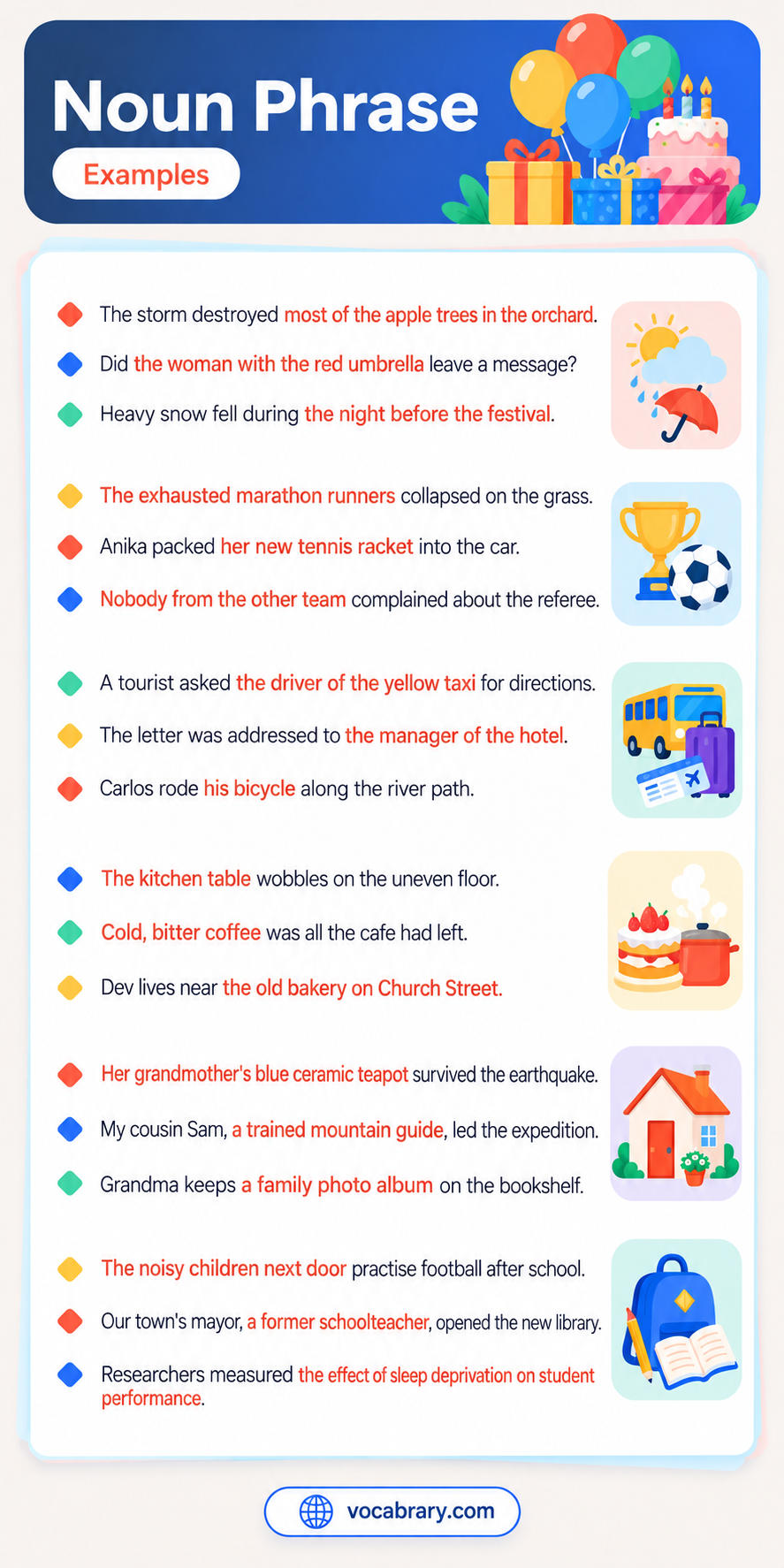
Noun Phrase Examples for Everyday Use
A noun phrase combines a noun with determiners, adjectives, and prepositional phrases, as in “a cold glass of milk”, “several tired passengers”, and “two friendly policemen”.
- The old bridge over the river closes at midnight.
- Amara bought a cold glass of milk at the station.
- My youngest cousin from Lagos visited us in July.
- Three small brown sparrows landed on the garden fence.
- The chef prepared a spicy lentil soup with fresh coriander.
- That tall girl in the red jacket is my sister.
- Several tired passengers waited beside the broken ticket machine.
- Ravi found an old photograph of his grandfather in the attic.
- The new library on Maple Street opens every day at nine.
- We watched a documentary about deep sea fish last night.
- Her grandmother’s blue ceramic teapot survived the earthquake.
- A tourist asked the driver of the yellow taxi for directions.
- Every student in the front row passed the oral test.
- Lucia wore a long silk scarf from Istanbul to the wedding.
- Two friendly policemen helped us find the lost wallet.
- The museum displays a gold crown from the fourteenth century.
- The noisy children next door practise football after school.
- Tom ordered a large pepperoni pizza with extra cheese.
- Our English teacher reads poems aloud every Friday.
- The farmer sold ten fresh eggs from his own hens.
Short Sentences with Noun Phrases
One or two words, including pronouns, form each noun phrase in this group.
Short Noun Phrase Examples with One or Two Words
Noun phrases of one or two words are used, as in “the dog”, “my brother”, and “those shoes”.
- The dog barked at the postman all afternoon.
- A bird sang outside my bedroom window.
- Snow covered the whole village by morning.
- Mina painted the old fence on Saturday.
- My brother plays the cello in a youth orchestra.
- This bus goes to the airport every hour.
- We saw some deer near the road at dusk.
- Cats sleep for most of the day.
- Hana planted a tree behind the school.
- Those shoes are too tight for him.
- Two eggs cracked inside the paper bag.
- Please close the door before you leave.
- Her phone rang twice during dinner.
- Carlos rode his bicycle along the river path.
Noun Phrase Examples with Pronouns
A pronoun forms a whole noun phrase, as in “everyone”, “something”, and “someone”.
- She plays chess every Sunday afternoon.
- The coach praised them after the final whistle.
- Everyone cheered when the lights came back on.
- Nobody answered the phone at the front desk.
- Ibrahim gave her a map of the old city.
- Something moved quietly behind the curtain.
- We finished the whole project before midnight.
- Please send these to the office by noon.
- Someone left an umbrella on the train.
- Ayesha heard nothing unusual during the night.
- They moved to Toronto in the spring of 2019.
- Who broke the window in the library?
Modifier Sentences with Noun Phrases
Words before the noun, or a phrase or clause after it, describe the noun.
Noun Phrase Examples with Adjectives Before the Noun
Describing words come before the noun, as in “a heavy wooden door”, “a cosy little cabin”, and “a mysterious blue envelope”.
- A heavy wooden door blocked the entrance to the cellar.
- Dr Mensah is a brilliant young scientist.
- Lena bit into a sweet red apple on the bus.
- The exhausted marathon runners collapsed on the grass.
- We rented a cosy little cabin near the lake.
- An enormous grey elephant crossed the dusty road.
- Yuki wrote her name on the dusty window.
- Fragrant yellow roses filled the hotel lobby.
- The shop sells handmade leather bags from Morocco.
- A mysterious blue envelope arrived on Monday morning.
- The frightened kitten hid behind the washing machine.
- Noor admired the shiny silver trophy on the shelf.
- Cold, bitter coffee was all the cafe had left.
- Grandpa told an amusing story at the dinner table.
Noun Phrase Examples with Several Adjectives
Two or more adjectives come before the noun, as in “a tall dark stranger”, “the big old oak tree”, and “my favourite worn leather jacket”.
- Mr Rossi owns a lovely little old Italian guitar.
- A tall dark stranger asked for a room.
- Two large round windows lit the narrow hallway.
- Esther inherited a beautiful antique silver necklace.
- The big old oak tree shaded the entire playground.
- We stayed in a charming small stone cottage.
- Those delicious fresh Thai noodles disappeared in minutes.
- Pedro drives a shiny new red sports car.
- My favourite worn leather jacket still fits perfectly.
- A famous young Brazilian striker signed for the club.
- She carried a heavy square wooden box upstairs.
- The rusty old iron gate squeaked in the wind.
Noun Phrase Examples with Compound Nouns
Compound nouns use two nouns together as the head of the phrase, as in “the kitchen table”, “a small leather phone case”, and “our weekend football match”.
- The kitchen table wobbles on the uneven floor.
- A school bus driver waved to the children.
- Anika packed her new tennis racket into the car.
- The city council meeting lasted four hours.
- I bought a small leather phone case online.
- Two police officers stood outside the bank.
- The old railway station is now a museum.
- Grandma keeps a family photo album on the bookshelf.
- Our weekend football match was cancelled because of fog.
- Selim won a free concert ticket in the raffle.
- A hot water bottle kept her feet warm.
- The morning news bulletin reported heavy traffic.
Noun Phrase Examples with Prepositional Phrases After the Noun
A prepositional phrase follows the noun, as in “the key to the cabinet”, “a bowl of vegetable soup”, and “a teacher at our school”.
- Nobody could find the key to the cabinet.
- I received a letter from my cousin in Perth.
- The road to the lake floods every spring.
- The woman in the green coat is my aunt.
- Sofia ordered a bowl of vegetable soup.
- A man with a long grey beard opened the gate.
- The cat on the roof refused to come down.
- We admired the view from the top of the hill.
- A cup of hot chocolate warmed him after the match.
- The students from the exchange programme arrived on Tuesday.
- Liam lost the book about birds of the Amazon.
- A teacher at our school won the national award.
- The noise from the street woke the baby.
- Dad fixed the leak under the kitchen sink.
Noun Phrase Examples with Relative Clauses After the Noun
Following the noun, a relative clause describes it, as in “the book that I borrowed”, “people who keep their promises”, and “anyone who arrives late”.
- The man who fixed our roof refused any payment.
- Where did you put the book that I borrowed?
- Mei visited a village where nobody locks their doors.
- The teacher who taught me chemistry retired last year.
- The bread that she baked this morning is already gone.
- I admire people who keep their promises.
- The film we saw on Friday made everyone laugh.
- Kofi met a pilot whose plane had crashed twice.
- Students who finish early may read quietly.
- The shop that opened on Elm Road sells only tea.
- She still remembers the summer when the river froze.
- The neighbours we met at the party invited us for lunch.
- A song that her father wrote played at the ceremony.
- Anyone who arrives late must sign the register.
Function Sentences with Noun Phrases
Subjects, objects, complements, and appositives are all noun phrases in this group.
Noun Phrase Examples as Subjects
The noun phrase subject begins the sentence, as in “the new teacher”, “several members of the choir”, and “a group of excited tourists”.
- The new teacher greeted every pupil at the door.
- An old black dog slept beside the stove.
- My parents’ neighbours from Kenya brought mangoes.
- The final exam in biology starts at nine.
- A heavy rainstorm over the mountains delayed the flight.
- Several members of the choir caught a cold.
- The smell of fresh bread drifted down the street.
- Our oldest cousin teaches physics in Delhi.
- The construction of the new stadium took three years.
- A group of excited tourists gathered around the guide.
- The first snowfall of the winter closed two schools.
- Her sudden laughter in the silent room surprised everyone.
- Both of my sisters speak Portuguese.
- That narrow bridge near the mill cannot carry trucks.
Noun Phrase Examples as Direct Objects
After a verb, the noun phrase is the direct object, as in “every loaf of rye bread”, “a lullaby from her childhood”, and “three plates of grilled fish”.
- Ana wrote a long letter to her grandmother.
- The baker sold every loaf of rye bread before noon.
- Tariq painted the front door of the cottage bright blue.
- The waiter carried three plates of grilled fish.
- Nobody noticed the small crack in the wall.
- She adopted a stray kitten with white paws.
- The committee approved the budget for the new playground.
- Our guide described the history of the old fort.
- He repaired the broken handle on the oven door.
- Maria admires women who lead their own companies.
- The storm destroyed most of the apple trees in the orchard.
- We booked two rooms with a view of the sea.
- The thief stole a silver watch and a leather wallet.
- Rosa sang a lullaby from her childhood.
Noun Phrase Examples as Subject Complements
Be, become, and remain are followed by a noun phrase that describes the subject, as in “an excellent pastry chef”, “a dangerous climb for beginners”, and “a complete waste of time”.
- Mr Okafor is a retired civil engineer from Enugu.
- This old house became the oldest museum in the region.
- Her brother remained a loyal friend through every difficulty.
- That building was the tallest tower in the city.
- My neighbour is an excellent pastry chef.
- Leila became the youngest captain in the team’s history.
- The winner was a quiet student from the back row.
- Yesterday’s storm was the worst weather of the decade.
- Dr Silva is my favourite teacher at the university.
- The package was a surprise gift from her cousins.
- Mount Hayden became a dangerous climb for beginners after the landslide.
- The meeting was a complete waste of time for everyone.
Noun Phrase Examples as Object Complements
After the object, a noun phrase names or renames it, as in “class president”, “director of the new laboratory”, and “captain for the second half”.
- The students elected Priya class president.
- The jury named her the winner of the contest.
- They called the puppy a clever little troublemaker.
- The board appointed Mr Dube director of the new laboratory.
- Fans consider him the greatest goalkeeper of his generation.
- The villagers made Ola chief of the fishing cooperative.
- The coach declared Kenji captain for the second half.
- We found the film a fascinating study of grief.
- The club members voted Hana treasurer of the sports society.
- Critics have labelled the novel a masterpiece of quiet suspense.
Noun Phrase Examples as Objects of Prepositions
Prepositions are followed by a noun phrase, as in “the lights of the harbour”, “the manager of the hotel”, and “the night before the festival”.
- She walked toward the lights of the harbour.
- We talked about the plan for the new park.
- The cat slept under the big wooden bench.
- Dev lives near the old bakery on Church Street.
- The letter was addressed to the manager of the hotel.
- They argued about the schedule for the holiday.
- A rabbit darted across the quiet road behind the school.
- Sana waited outside the doctor’s office until noon.
- The book was written by a young engineer from Nairobi.
- Heavy snow fell during the night before the festival.
- Everyone gathered around the long table by the window.
- I trust the opinion of a friend who studies law.
- He found a coin inside an old leather boot.
- She sailed past the small island with the white lighthouse.
Noun Phrase Examples as Appositives
An appositive is a noun phrase that renames the noun before it, as in “a retired nurse from Cork”, “a three-day celebration of music”, and “a spotted terrier named Biscuit”.
- My neighbour, a retired nurse from Cork, grows tomatoes.
- Mount Kita, the highest peak in the range, is closed in winter.
- Our teacher, Mrs Adeyemi, collects antique clocks.
- Raj, my oldest friend from school, called me last night.
- The festival, a three-day celebration of music, begins on Friday.
- We visited Lisbon, a hilly city beside the sea, in May.
- My cousin Sam, a trained mountain guide, led the expedition.
- The bakery, a tiny shop on the corner, closes at four.
- Dr Haas, the lead researcher on the project, announced the results.
- Her dog, a spotted terrier named Biscuit, chased the postman.
- I read a novel by Elena Vargo, a writer from Chile.
- Our town’s mayor, a former schoolteacher, opened the new library.
Complex Subject Sentences with Noun Phrases
Complex subjects contain a prepositional phrase or two nouns joined by and, as in “the box of chocolates”, “a bag of oranges”, and “one of the windows”.
- The box of chocolates is on the top shelf.
- The books on the highest shelf are mine.
- The cost of the repairs worries the owners.
- The teachers at that school work very long hours.
- A bag of oranges costs two dollars.
- The pilot and the engineer were waiting at the gate.
- The colour of the walls needs to change.
- The students in the back row were whispering.
- One of the windows was broken in the storm.
- The road between the two villages is closed today.
- The ideas in her essay impress the examiners.
- The leader of the three expeditions has returned safely.
Negative Sentences with Noun Phrases
No, not, nobody, never, or neither is used with a noun phrase.
- No student in the class finished the exam early.
- Not a single car passed us on the mountain road.
- There is no milk in the fridge this morning.
- She did not see the sign at the corner.
- Nobody from the other team complained about the referee.
- We did not receive any letters from the bank.
- He never found the answer to the last question.
- Neither of my brothers plays an instrument.
- They did not buy the house with the red roof.
- I have no idea about the date of the meeting.
Question Sentences with Noun Phrases
Questions use a noun phrase as a subject or an object, as in “the keys to the van”, “what time of day”, and “whose umbrella”.
- Who owns the green bicycle by the gate?
- Did you find the keys to the van?
- Is your sister from Manila coming tonight?
- Which book did you choose for the class?
- What time of day do the shops close?
- Have you met the new girl with the violin?
- Why did the bus to the airport leave early?
- Where is the report about the budget?
- Whose umbrella is lying on the sofa?
- Can a plane with one engine land safely in strong wind?
- Who borrowed the blue ladder from the garage?
- Did the woman with the red umbrella leave a message?
Passive and Reported Sentences with Noun Phrases
A noun phrase is the subject of a passive verb or is inside a reported statement, as in “the old bridge”, “the train to Madrid”, and “three witnesses to the accident”.
- The old bridge was repaired last year.
- A new hospital will be built near the harbour.
- The winning goal of the match was scored in injury time.
- She said that the train to Madrid had already left.
- He told us that the story of the lost ship was only a legend.
- The letters from the war were found in a trunk.
- The reporter claimed that the company’s new manager had resigned.
- Three witnesses to the accident were questioned by the police.
- Ayo explained that the road through the valley was closed.
- The prize for the best poem was awarded to a ten-year-old.
- The oldest tree in the park was struck by lightning.
Context Sentences with Noun Phrases
Homes, classrooms, offices, journeys, newsrooms, stories, sports, and clinics are the settings for the noun phrases.
Noun Phrase Examples for Home Life
At home, the noun phrases name kitchens, laundry, and family meals, as in “the warm kitchen”, “a pile of wet laundry”, and “my sleepy baby brother”.
- The warm kitchen smelled of cinnamon and baked apples.
- A pile of wet laundry covered the whole sofa.
- Dad hung a new picture of the mountains in the hallway.
- My sleepy baby brother refused his afternoon nap.
- Grandma made a pot of spicy chicken stew for the family.
Noun Phrase Examples for School Life
In the classroom, the noun phrases name lessons, projects, and classmates, as in “the final science project”, “a boring history lesson”, and “the head teacher’s long speech”.
- The final science project is due on Thursday.
- A boring history lesson made half the class yawn.
- I borrowed a pencil from the girl at the next desk.
- The head teacher’s long speech ended just before lunch.
- Our class presented a poster about renewable energy.
Noun Phrase Examples for Work
At the office, the noun phrases name reports, clients, and shifts, as in “the quarterly sales report”, “a difficult client from Dubai”, and “a reliable delivery driver”.
- The quarterly sales report landed on her desk at noon.
- Our manager met a difficult client from Dubai.
- The evening shift at the hospital starts at six.
- A reliable delivery driver is hard to find.
- Nadia emailed the schedule for next week’s training.
Noun Phrase Examples for Travel
On the road, the noun phrases name platforms, seats, and queues, as in “the ticket office” and “a quiet seat”.
- The crowded platform at Central Station was full of commuters.
- Jin asked for a window seat on the left side.
- We missed the last bus to the coast.
- A kind stranger with a large suitcase showed us the way.
- The long queue at passport control moved slowly.
- The ticket office closes at six.
- Mara found a quiet seat near the door.
Noun Phrase Examples for News Reports
In news reports, the noun phrases name councils, reports, and rainfall, as in “the city council” and “the mayor”.
- The city council approved a new bus route on Monday.
- A record rainfall in the northern provinces flooded hundreds of homes.
- Rescuers searched for the families of the missing sailors all night.
- An independent report on the factory fire blamed faulty wiring.
- The prime minister’s surprise visit to the clinic drew a crowd.
- The mayor opened the new bridge on Friday.
Noun Phrase Examples for Stories
Stories use noun phrases for lighthouses, gardens, and dragons, as in “a lonely lighthouse keeper” and “a storm of silver leaves”.
- In the novel, a lonely lighthouse keeper befriends a stranded sailor.
- The secret garden behind the crumbling wall was her only comfort.
- A storm of silver leaves swept across the empty courtyard.
- The poem describes the slow sorrow of an autumn evening.
- The dragon with the broken wing pleaded with the young knight.
Noun Phrase Examples for Sports
In sport, the noun phrases name strikers, crowds, and shootouts, as in “a tense penalty shootout” and “the home team”.
- The star striker of the visiting team missed an open goal.
- A tense penalty shootout decided the championship.
- The home crowd in the northern stand roared after the first goal.
- Coach Ito praised the effort of the younger players.
- A sudden injury to the goalkeeper changed the whole match.
- The home team scored twice after the break.
Noun Phrase Examples for Health
At the clinic, the noun phrases name fevers, nurses, and vaccines, as in “the nurse on duty”, “a short walk after dinner”, and “the new vaccine for children”.
- A mild fever and a sore throat kept Tomas in bed.
- The doctor recommended a balanced breakfast with plenty of fruit.
- The nurse on duty checked the patient’s temperature.
- A short walk after dinner lowers many people’s blood pressure.
- The new vaccine for children reached the clinic this week.
Kids and Student Sentences with Noun Phrases
The wording ranges from short beginner sentences to formal exam answers.
Noun Phrase Examples for Kids
For kids, noun phrases name everyday objects, animals, and people, as in “my red balloon”, “our teacher”, and “two noisy ducks”.
- My red balloon flew over the trees.
- The big yellow bus stopped at our corner.
- I hugged a little brown puppy at the park.
- Our teacher read us a funny story.
- The tiny green frog jumped into the pond.
- Mum cut a big slice of cake for me.
- Two noisy ducks swam across the lake.
- My best friend has a blue bike.
- The soft white blanket keeps me warm at night.
- That shiny new toy belongs to my sister.
Short Noun Phrase Examples for Beginners
Beginners use noun phrases of one or two words, as in “the cat”, “my dog”, and “her mum”.
- The cat sleeps.
- I kicked the ball.
- The sun is hot.
- My dog runs fast.
- We ate red apples.
- A bird sings.
- She hugged her mum.
- The moon is bright.
- He found a coin.
Noun Phrase Examples for Exams
Exam answers use formal wording about research, history, and society.
- The gradual decline of rural populations across the region concerns the planning committee.
- Researchers measured the effect of sleep deprivation on student performance.
- The author’s skilful use of irony in the final chapter transforms the ending.
- The study revealed a significant increase in the number of urban cyclists.
- The relationship between rainfall and crop yield in tropical countries remains uncertain.
- Several economic policies introduced after the election reduced unemployment.
- The essay analyses the causes of the industrial revolution in Britain.
- A detailed comparison of the two translations exposed several errors.
- Historians still debate the reasons for the sudden collapse of the empire.
- The widespread adoption of renewable energy by small businesses changed the market.
- The new survey produced reliable data.
- The authors reviewed the earlier studies carefully.
FAQs
Some noun phrase examples in a sentence are "The old bridge over the river closes at midnight," "Amara bought a cold glass of milk at the station," and "Our English teacher reads poems aloud every Friday." Each noun phrase has a head noun and the words that describe it. The three phrases range from three words to six words.
You use a noun phrase in a sentence as a subject, an object, or a complement. "The new teacher greeted every pupil at the door" has a noun phrase subject, and "The waiter carried three plates of grilled fish" has a noun phrase object. "My neighbour is an excellent pastry chef" has a noun phrase complement.
Noun phrase examples with adjectives put describing words before the noun. "A heavy wooden door blocked the entrance to the cellar" and "We rented a cosy little cabin near the lake" are two models. "The frightened kitten hid behind the washing machine" is a third.
Noun phrase examples with prepositional phrases put a phrase such as to the lake or in the green coat after the noun. "The road to the lake floods every spring" and "The woman in the green coat is my aunt" are two models. "We admired the view from the top of the hill" is a third.
Noun phrase examples with relative clauses put a clause after the noun to describe it. "The man who fixed our roof refused any payment" and "The teacher who taught me chemistry retired last year" are two models. "She still remembers the summer when the river froze" is a third.
Noun phrase examples as subjects begin the sentence with the phrase that names what the sentence is about. "The final exam in biology starts at nine" and "The smell of fresh bread drifted down the street" are two models. "Both of my sisters speak Portuguese" is a third.
Noun phrase examples as direct objects follow a verb and name what the action affects. "Ana wrote a long letter to her grandmother" and "Nobody noticed the small crack in the wall" are two models. "Rosa sang a lullaby from her childhood" is a third.
Noun phrase examples as appositives rename the noun before them. "Our teacher, Mrs Adeyemi, collects antique clocks" and "Mount Kita, the highest peak in the range, is closed in winter" are two models. "The bakery, a tiny shop on the corner, closes at four" is a third.
Noun phrase examples with pronouns use one word as the whole phrase. "She plays chess every Sunday afternoon" and "Everyone cheered when the lights came back on" are two models. "Someone left an umbrella on the train" is a third.
Noun phrase examples for kids use everyday objects, animals, and people. "My red balloon flew over the trees" and "The big yellow bus stopped at our corner" are two models. "The cat sleeps" is a shorter sentence for beginners.
Related:

Leave a Comment