
An adjective phrase is a head adjective together with the words that modify or complete it, as in very tall or afraid of dogs. These adjective phrase examples begin with intensifiers such as very and move on to phrases that end in a prepositional phrase, an infinitive, or a clause.
What Is an Adjective Phrase?
An adjective phrase is a head adjective plus its modifiers or complements, and the whole group describes a noun or pronoun. An adjective is a single word such as tall, while an adjective phrase is that adjective with the words around it, such as very tall for his age.
(Intensifier) + head adjective + (complement) = adjective phrase
Mia felt proud of her younger brother.
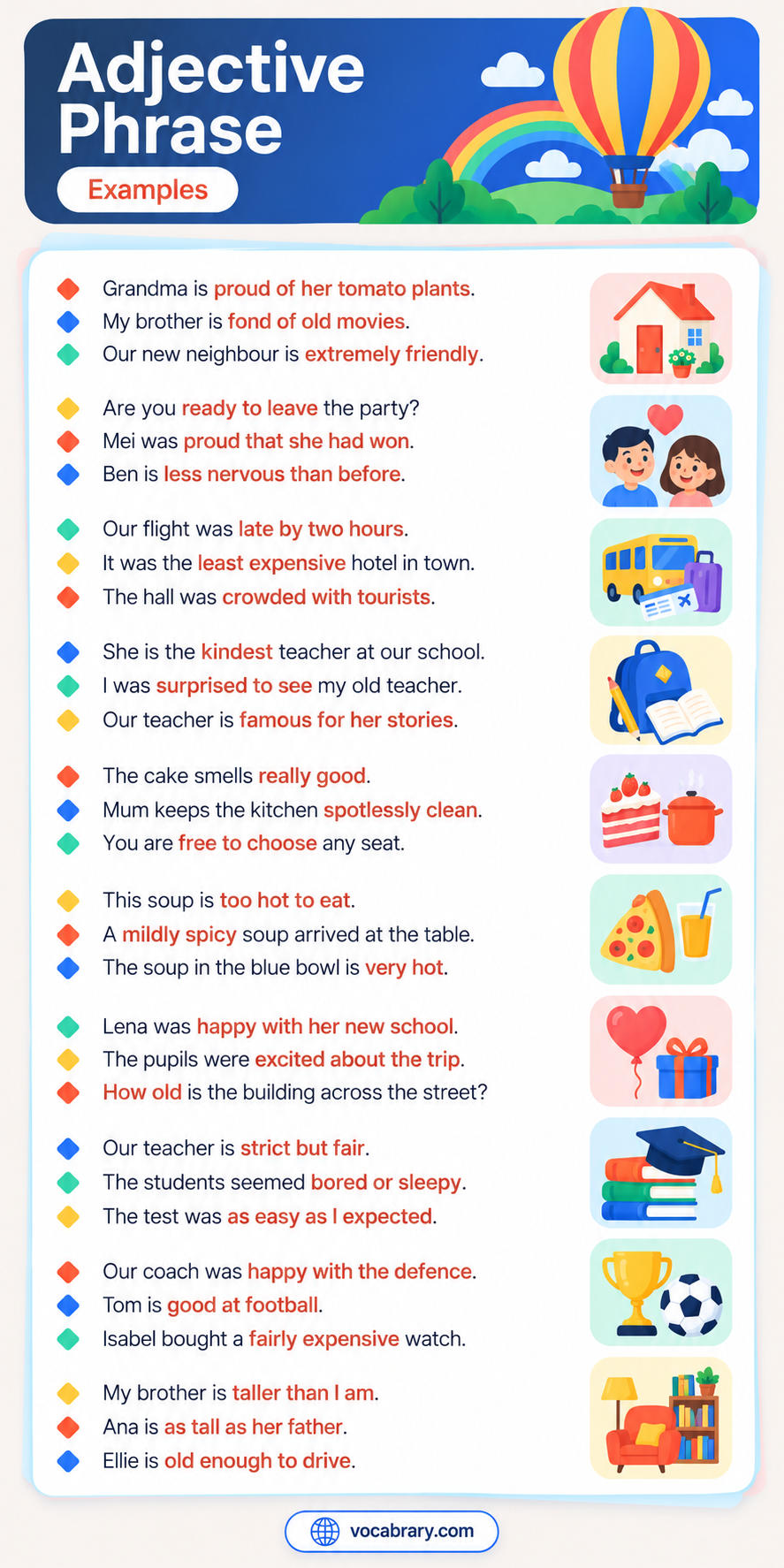
Common Adjective Phrase Examples
Proud of her brother, extremely friendly, and eager to learn are adjective phrases, and each one is a head adjective with the words that modify or complete it.
- Ibrahim felt proud of his choir after the concert.
- Our new neighbour is extremely friendly.
- The apprentices were eager to learn a new craft.
- My grandfather is afraid of flying.
- The exam turned out to be harder than we expected.
- Her answer to the last question was completely wrong.
- The children seemed delighted with the gift.
- This road is dangerous for cyclists.
- The hikers were proud of the climb at the summit.
- Rahul was sure that the bus had left.
- The river is deep enough for swimming.
- Their house is quite old and needs repairs.
- Dev looked worried about the results.
- Aisha is good at languages and enjoys debates.
- The plan sounds perfectly reasonable to everyone.
- Our team is ready for the final on Saturday.
- The cake from the corner bakery tasted surprisingly sweet.
- The kitchen smelled fresh and clean after the storm.
- Lena was happy with her new school.
- That puzzle is far too difficult for a six-year-old.
Adjective Phrase Examples With Intensifiers
Extremely hot, so tired, and too cold contain an intensifier before the head adjective, and the intensifier raises or lowers the degree of the quality.
- The tea was extremely hot, so Omar waited.
- Her speech was quite short but powerful.
- I am so tired after the long trip.
- The water is too cold for swimming today.
- The ending of the film was rather sad.
- This path is fairly steep near the top.
- The fabric feels really soft against my skin.
- The mountain looked incredibly beautiful at dawn.
- Mr Lee is highly respected in the village.
- Our guide was deeply moved by the story.
- The answer on the last page is absolutely correct.
- The streets were completely empty at midnight.
- My sister is very good at drawing.
- The box was far too heavy for one person.
- Nobody was quite ready when the taxi arrived.
- The lake looks so peaceful in the early morning.
Adjective Phrase Examples With Prepositional Complements
Afraid of large dogs, good at chess, and grateful for your help use a prepositional phrase as a complement, and each adjective is followed by a fixed preposition.
- Ayesha is afraid of large dogs.
- My brother is fond of old movies.
- The twins are good at chess.
- She was angry about the delay.
- We are grateful for your help.
- He seems interested in astronomy these days.
- The soup is full of vegetables.
- Hannah is proud of her garden.
- The villagers were worried about the flood.
- This book is similar to the first one.
- The manager was pleased with the results.
- Kofi is jealous of his cousin’s new bike.
- The hall was crowded with tourists.
- I am tired of waiting in queues.
- Our teacher is famous for her stories.
- The road is free from snow today.
Adjective Phrase Examples With To-Infinitive Complements
Eager to learn, ready to eat, and too thin to walk on end in an infinitive, and the infinitive completes the meaning of the adjective.
- The volunteers are eager to learn.
- Grandpa is happy to help with the gardening.
- These apples are ready to eat.
- The instructions were easy to follow.
- I was surprised to see my old teacher.
- She is likely to win the race.
- The ice is too thin to walk on.
- He was quick to apologise after the argument.
- We are delighted to announce the winners.
- The suitcase was too heavy to carry up the stairs.
- Marta is sorry to leave such a friendly town.
- The mountain is difficult to climb in winter.
- My cousin is determined to finish the course.
- You are free to choose any seat.
Adjective Phrase Examples With That-Clause Complements
Proud that she had won and certain that the bridge is safe end in a that clause, and the clause states what the feeling or the belief is about.
- Mei was proud that she had won.
- We are certain that the bridge is safe.
- He felt sure that he had locked the door.
- Sam was glad that the exams were over.
- The teacher is afraid that the trip will be cancelled.
- I am sorry that I missed your call.
- She was relieved that nobody had been hurt.
- Dad is happy that the rain has stopped.
- The doctor was aware that the patient was frightened.
- They were disappointed that the match was postponed.
- Rosa seemed convinced that her plan would work.
- Everyone is thankful that the storm passed quickly.
Adjective Phrases With Enough, Too, and So
Warm enough for swimming, too hot to drink, and so tired that he fell asleep express a quality in relation to a result, and the word enough, too, or so marks that relation.
- The lake is warm enough for swimming.
- Ellie is old enough to drive.
- The tea was too hot to drink.
- He was so tired that he fell asleep at dinner.
- This coat is big enough for two people.
- The movie was too long for young children.
- She was brave enough to speak first.
- The soup is too salty to finish.
- Our room was small enough to heat with one stove.
- The path was so narrow that only one person could pass.
- The answer was simple enough for a child to understand.
- The fog was too thick for the ferry to leave.
Adjective Phrase Examples Before Nouns
An incredibly generous donation and a rather lazy afternoon have a modified adjective before the noun. A phrase with a complement after the adjective, such as afraid of dogs, follows the noun instead.
- An incredibly generous donation saved the library.
- We spent a rather lazy afternoon by the river.
- She wore a brightly coloured scarf to the festival.
- That was a surprisingly easy test.
- A very tall boy waved from the back row.
- Isabel bought a fairly expensive watch.
- The absolutely brilliant idea came from a new intern.
- A mildly spicy soup arrived at the table.
- They live in a really old farmhouse.
- A terribly sad song played on the radio.
- Nina met an extremely polite young officer.
- The village has a remarkably quiet harbour.
- It was an unusually warm evening for November.
- He gave a truly honest answer.
- A slightly bitter taste stayed in her mouth.
Adjective Phrase Examples After Linking Verbs
Very hot, extremely angry, and completely realistic follow is, became, or sounds and describe the subject. See predicate adjectives for more of this pattern.
- The soup in the blue bowl is very hot.
- He became extremely angry during the meeting.
- The attic smelled damp and musty after the flood.
- Your plan sounds completely realistic to me.
- The fabric feels soft and warm against the skin.
- Their garden looks especially lovely in May.
- The children remained calm about the delay.
- She grew more confident of success.
- The milk went very sour overnight.
- Dad seemed a little worried about the cost.
- That chocolate cake tastes wonderfully rich today.
- The old bridge proved strong enough for the trucks.
- I feel much better after a long sleep.
- The streets stayed empty of cars.
- He appeared sure of the answer.
- Our new teacher is very kind to everyone.
Adjective Phrase Examples After the Noun
In a man afraid of nothing and students eager to learn, the adjective phrase follows the noun, as it does for phrases with complements and for words after something, anyone, and nobody.
- The man afraid of nothing stepped into the cave.
- Students eager to learn filled the front row.
- We rented a house big enough for six people.
- Anything sweet makes my little brother happy.
- I want someone honest for this job.
- A girl proud of her work showed us the poster.
- The best player available joined the squad.
- Is there anything cheaper than this?
- Nobody brave enough to climb the wall volunteered.
- Passengers angry about the delay crowded the desk.
- Something cold touched my arm in the dark.
- A shop open all night appeared at the corner.
- The woman fluent in four languages translated for us.
- We need volunteers ready to start at dawn.
Adjective Phrase Examples as Object Complements
Very happy, bright blue, and completely exhausted follow a direct object and describe it, as in The news made her very happy.
- The news made her very happy.
- We found the film quite boring.
- They painted the door bright blue.
- The long climb left us completely exhausted.
- Nobody considered the plan safe for children.
- Mum keeps the kitchen spotlessly clean.
- The noise drove the dog absolutely mad.
- The jury found him guilty of fraud.
- She pushed the window wide open.
- His speech made the audience extremely proud of the team.
Coordinated Adjective Phrases
Cold and wet, tired but happy, and short, polite, and firm join two or three adjective phrases with and, but, or commas, and the group works as one description.
- The hikers were cold and wet by evening.
- She looked tired but happy after the race.
- The soup was hot, thick, and delicious.
- Their answer was short, polite, and firm.
- The road was long and dusty.
- He sounded nervous yet excited on the phone.
- The lake is calm and very deep.
- Our room was small but surprisingly comfortable.
- The students seemed bored or sleepy.
- The soldier looked brave and a little frightened.
Comparative Adjective Phrase Examples
Taller than I am, more comfortable than the old one, and much happier than last week compare two items, and the word than introduces the second item. See comparative adjectives for the forms.
- My brother is taller than I am.
- This chair is more comfortable than the old one.
- She sounds much happier than last week.
- The second test was far more difficult.
- Winter here is colder than in Lisbon.
- The new phone is slightly lighter than the old model.
- Your handwriting is neater every year.
- The river grows wider and wider near the sea.
- Ben is less nervous than before.
- This path is a little steeper.
- Our team was less experienced than theirs.
- The sauce tastes even better the next day.
- Maria is much more careful than her sister.
- Their house is bigger than ours.
Superlative Adjective Phrase Examples
The most generous, the deepest, and the least expensive express the highest or lowest degree in a group, and the superlative adjective is preceded by the when it comes before a noun.
- She is the most generous person I know.
- That was the funniest film of the year.
- It was the least expensive hotel in town.
- Hana gave the most thoughtful answer in the class.
- This is the deepest lake in our region.
- The most dangerous part of the trail is the bridge.
- He told the saddest story I have ever heard.
- We found the quietest table in the café.
- It was the most exciting match of the season.
- She is the kindest teacher at our school.
- The cheapest ticket cost forty euros.
- Pablo is the least patient man in the office.
As Tall As and Other As-As Adjective Phrases
As tall as her father and as cold as ice compare two equal qualities with a pair of as words. See as…as comparisons for more.
- Ana is as tall as her father.
- The soup was as cold as ice.
- He is not as strong as he looks.
- My room is twice as big as yours.
- The test was as easy as I expected.
- She is as brave as a lion when she needs to be.
- The night felt as long as a year.
- This bag is as heavy as it looks.
- Their garden is just as lovely as ours.
- Nothing was as welcome as a hot bath.
Adjective Phrases Set Off by Commas
Afraid of the dark and empty for years are adjective phrases that add extra detail about a noun. A comma follows them at the start of a sentence, and commas surround them in the middle.
- Afraid of the dark, the boy slept with a lamp on.
- The old house, empty for years, was finally sold.
- Tired and hungry, the hikers reached the hut at dusk.
- My aunt, proud of her garden, invited the whole street.
- Eager to impress, Leo arrived an hour early.
- The kitten, small and shivering, hid under the bed.
- Careful not to wake the baby, she tiptoed down the hall.
- The runners, exhausted after the climb, collapsed on the grass.
- Nervous about the interview, Dina arrived early.
- The students, delighted with their grades, celebrated in the yard.
- Sure of her answer, Mei raised her hand at once.
- The village, quiet and snow-covered, looked peaceful from the hill.
Adjective Phrases in Negative Sentences
Very hot, hardly ready for the trip, and safe to drink appear in negative sentences, where not, hardly, or nobody changes the claim about the quality.
- The soup is not very hot this evening.
- The test was not as hard as we feared.
- Tom is hardly ready for the trip.
- He is not eager to speak in public.
- Nobody was happy about the delay.
- The water is not safe to drink.
- I am not sure that the shop is open.
- She was never afraid of heights as a child.
- The street was not crowded at all.
- The film was not good enough for a second viewing.
Adjective Phrases in Questions
How tall, afraid of heights, and ready to leave appear in questions, either at the front of the question or after the verb.
- How tall is your brother now?
- Is she really afraid of heights?
- Are you ready to leave the party?
- Why is he so angry today?
- How long is the bridge over the canal?
- Were the children happy with the gifts?
- How old is the building across the street?
- Is the harbour calm enough for sailing?
- Who is responsible for the damage?
- Is the recipe easy to follow?
- How difficult was the exam this morning?
Adjective Phrases in Reported Speech
Too tired to cook and dangerous in the rain appear after reporting verbs such as said and told, where the adjective phrase still describes the same noun or pronoun.
- She said that she was too tired to cook.
- He told us the road was dangerous in the rain.
- Tom explained that he was afraid of failing.
- The guide announced that the cave was safe for beginners.
- Maria admitted that she had been jealous of her sister.
- My uncle claimed that the hotel was very close to the beach.
- The teacher said the answer was completely wrong.
- They reported that the river was higher than last year.
Adjective Phrase Examples in Everyday Contexts
Adjective phrases describe people, places, and events in every setting, from proud of her tomato plants at home to good for the heart in health.
Adjective Phrases at Home
Wonderfully warm and too heavy to move describe a kitchen and a sofa in a household.
- The kitchen feels wonderfully warm on winter mornings.
- Grandma is proud of her tomato plants.
- The sofa is too heavy to move alone.
- Our new carpet is soft and very thick.
- The baby seems happy with the new toy.
Adjective Phrases at School
Strict but fair and excited about the trip describe a teacher and a class in school life.
- Our teacher is strict but fair.
- The pupils were excited about the trip.
- Today’s lesson was quite difficult for beginners.
- The library is quiet enough for studying.
- Ravi felt nervous about the oral test.
Adjective Phrases at Work
In an office, a director and a piece of software are described by pleased with the budget and easy to install.
- The director was pleased with the budget.
- Our office is close to the station.
- The new software is easy to install.
- She seems confident about the presentation.
- The deadline is much too tight for a small team.
Adjective Phrases While Travelling
Travellers use clean and surprisingly cheap for a hotel and crowded with swimmers for a beach.
- The hotel was clean and surprisingly cheap.
- Our flight was late by two hours.
- The beach is crowded with swimmers in July.
- We felt grateful for the driver’s patience.
- The mountain road is narrow and dangerous for drivers.
Adjective Phrases in the News
News reports about a mayor and a bridge use angry about the decision and open to traffic.
- The mayor was angry about the decision.
- Residents are worried that the river will rise.
- The new bridge is open to traffic.
- Officials seemed certain that the fire was an accident.
- The streets were empty and eerily silent.
Adjective Phrases in Literature
A castle and a queen in invented stories are described by dark and silent and fearful of the crown.
- The castle stood dark and silent on the hill.
- The young queen was fearful of the crown.
- Her voice was soft as falling snow.
- The knight, weary of the long war, laid down his sword.
- The garden was full of whispering leaves.
Adjective Phrases in Sports
Fast enough to beat any defender and slippery after the rain describe a striker and a pitch in a match.
- The striker is fast enough to beat any defender.
- Our coach was happy with the defence.
- The pitch was slippery after the rain.
- The crowd grew louder and louder.
- She is confident about the final.
Adjective Phrases in Health
A patient and a diet in health advice are described by strong enough to leave and rich in vegetables.
- Doctors say the patient is strong enough to leave.
- The nurse was gentle with the child.
- A diet rich in vegetables lowers the risk of illness.
- I felt a little dizzy after the run.
- Exercise is good for the heart.
Adjective Phrase Examples for Kids
Very small, soft and fluffy, and afraid of the dark are phrases a child uses to describe a pet, a toy, or a feeling.
- The puppy is very small.
- My cat is soft and fluffy.
- The cake smells really good.
- I am happy with my new shoes.
- Our bus driver is kind to everyone.
- The sun is bright today.
- She is afraid of the dark.
- This soup is too hot to eat.
- The elephant is much bigger than a dog.
- Tom is good at football.
Short Adjective Phrase Sentences for Young Learners
Short sentences with very big, so happy, and too hot let beginners practise the adjective phrase pattern with few words.
- It is very big.
- The tea is too hot.
- I am so happy.
- She is quite tall.
- The sky is very blue.
- He looks really sad.
- We are so tired.
- The ice is very cold.
- Dogs are good at running.
Adjective Phrase Examples for Students
Essays and exam answers use longer phrases such as sceptical of the proposed budget and rich in detail but weak in analysis, in a formal register.
- The results were far more encouraging than the committee had predicted.
- The committee was sceptical of the proposed budget.
- Voters seem increasingly doubtful that the reforms will succeed.
- The author is deeply sympathetic to the working poor.
- Historians remain uncertain whether the letter is genuine.
- The experiment was simple enough to repeat in any classroom.
- Applicants fluent in a second language receive extra marks in this scheme.
- The essay is rich in detail but weak in analysis.
- The policy was widely unpopular among rural voters.
- Economists are cautious about predicting a recovery.
Adjective Phrase Examples in a Short Paragraph
A short passage about Leo, who hikes up a wet hill with his sister, uses at least one adjective phrase in each sentence, so learners meet the structure inside continuous writing.
The morning was cold and very wet when the hikers set out. Leo felt nervous about the steep path, but his sister was calm and confident. The trail was muddy in places and too slippery for sandals. By noon, everyone was tired but cheerful. The view from the top was breathtaking and completely worth the effort. The guide seemed proud that nobody had quit, and they returned happy, hungry, and ready for a long sleep.
Common Adjective Phrase Mistakes
Errors in adjective phrases include wrong prepositions, a complement placed before the noun, misplaced enough, doubled comparatives, an adverb after a linking verb, and wrong commas.
❌ She is afraid from spiders.
✅ She is afraid of spiders.
The adjective afraid is followed by the preposition of, not from.
❌ A proud of her work girl showed us the poster.
✅ A girl proud of her work showed us the poster.
An adjective phrase with a complement follows the noun and does not stand before it.
❌ She is enough tall to ride the bus.
✅ She is tall enough to ride the bus.
The word enough follows the adjective it modifies.
❌ The test was too much difficult.
✅ The test was too difficult.
The word too modifies an adjective directly, while too much goes with nouns and verbs.
❌ He is more taller than his brother.
✅ He is taller than his brother.
A short adjective forms its comparative with -er and takes no more.
❌ She is the most smartest student.
✅ She is the smartest student.
A superlative is formed once, with either -est or most, and not with both.
❌ I am eager learning new languages.
✅ I am eager to learn new languages.
The adjective eager takes a to-infinitive as its complement.
❌ The soup tastes deliciously.
✅ The soup tastes delicious.
After a linking verb such as tastes, the describing word is an adjective and not an adverb.
❌ She is interested on music.
✅ She is interested in music.
The adjective interested is followed by the preposition in.
❌ A very tall, boy waved.
✅ A very tall boy waved.
No comma separates the last adjective phrase from the noun it describes.
❌ The boy, afraid of the dark slept with a lamp on.
✅ The boy, afraid of the dark, slept with a lamp on.
An adjective phrase that adds extra detail in the middle of a sentence needs a comma on both sides.
Adjective Phrase Versus Adjective Clause and Prepositional Phrase
Afraid of dogs is an adjective phrase, who is afraid of dogs is an adjective clause, and of dogs is a prepositional phrase inside the first two.
| Feature | Adjective phrase | Adjective clause | Prepositional phrase |
|---|---|---|---|
| Head | An adjective | A finite verb with its subject | A preposition |
| Example | Afraid of dogs | Who is afraid of dogs | Of dogs |
| Own subject and verb | No | Yes | No |
| Describes | A noun or pronoun | A noun or pronoun | A noun, verb, or adjective |
| Introduced by | The head adjective or its intensifier | Who, which, that, or whose | A preposition such as of, in, or with |
| Sentence | The man afraid of dogs stayed outside | The man who is afraid of dogs stayed outside | The man in the grey coat stayed outside |
Some grammars call any group of words that describes a noun an adjective phrase, including prepositional phrases such as in the grey coat, but the term here means phrases headed by an adjective. The adjective clause page covers adjective clauses in full.
Related
- Adjectives Example Sentences
- Descriptive Adjective Example Sentences
- Predicate Adjectives Example Sentences
- Adjective Clause Examples
- Comparative Adjectives Example Sentences
- Noun Phrase Examples
- Verb Phrase Examples
- Adverb Phrase Examples
FAQs
Q1. What are some examples of adjective phrases?
Examples of adjective phrases include very tall, afraid of dogs, eager to learn, and proud that she won. Each one is a head adjective with the words that modify or complete it. In Mia felt proud of her brother, the adjective phrase is proud of her brother.
Q2. What are the parts of an adjective phrase?
An adjective phrase has a head adjective and, in many phrases, an intensifier before it or a complement after it. The intensifier, such as very or so, states the degree of the quality. The complement, such as of dogs or to learn, completes the meaning of the adjective.
Q3. What is the difference between an adjective and an adjective phrase?
An adjective is one word that describes a noun, while an adjective phrase is the adjective together with its modifiers or complements. The word tall is an adjective, and very tall for his age is an adjective phrase. Both describe a noun or pronoun in the same way, but only the phrase contains extra words such as very and for his age.
Q4. Where does an adjective phrase go in a sentence?
An adjective phrase goes before the noun, after a linking verb, after the noun, or after the object of a verb. A phrase with only an intensifier, such as very tall, stands before the noun, as in a very tall boy. A phrase with a complement, such as afraid of nothing, follows the noun.
Q5. Why does an adjective phrase with a complement follow the noun?
An adjective phrase with a complement follows the noun because the complement follows the adjective and would separate the adjective from its noun if the phrase came first. We write a girl proud of her work, and a proud of her work girl is an error. Hyphenated forms such as an easy-to-read book work before a noun as compound adjectives.
Q6. What is the difference between an adjective phrase and an adjective clause?
An adjective phrase has no subject and finite verb of its own, while an adjective clause has both. Afraid of dogs is a phrase, and who is afraid of dogs is a clause. The adjective clause page covers the clause patterns in full.
Q7. What is the difference between an adjective phrase and a prepositional phrase?
An adjective phrase is headed by an adjective, while a prepositional phrase is headed by a preposition. In afraid of dogs, the whole group is an adjective phrase and of dogs is a prepositional phrase inside it. Some grammars call a prepositional phrase that describes a noun, such as in the grey coat, an adjectival phrase.
Q8. Which words work as intensifiers in an adjective phrase?
The words very, quite, so, too, extremely, rather, fairly, and really work as intensifiers before an adjective. Each one raises or lowers the degree of the quality, as in extremely hot and rather sad. The word enough follows the adjective instead, as in warm enough. Words such as absolutely and completely are used with adjectives of extreme degree, as in absolutely correct and completely empty.
Q9. Do comparative and superlative forms make adjective phrases?
Comparative and superlative forms make adjective phrases when they appear with their modifiers or complements, as in taller than I am and the most generous. The comparative uses -er or more, and the word than introduces the second item. The superlative uses -est or most and is preceded by the before a noun.
Q10. When does an adjective phrase need commas?
An adjective phrase needs commas when it adds extra detail about a noun and is not needed to identify that noun. At the start of a sentence, one comma follows the phrase, as in Afraid of the dark, the boy slept with a lamp on. In the middle of a sentence, a comma is placed on both sides of the phrase.
Q11. How do adjective phrases work after linking verbs?
An adjective phrase after a linking verb describes the subject of the sentence, as in The soup is very hot. Linking verbs such as is, seem, become, feel, and taste join the subject to the phrase. The predicate adjective page covers more cases.
Q12. What are the common mistakes with adjective phrases?
Common mistakes with adjective phrases are the wrong preposition, a complement placed before the noun, and enough placed before the adjective. Examples are afraid from spiders, a proud of her work girl, and enough tall. Each error is fixed by checking which preposition or complement the adjective takes and where the phrase is placed.
Q13. How do you find the adjective phrase in a sentence?
You find an adjective phrase by locating the adjective that describes a noun or pronoun, then adding the words that modify or complete it. In Mia felt proud of her brother, the adjective is proud, and the phrase is proud of her brother. A test is to ask whether a single adjective such as happy replaces the whole group.

Leave a Comment