
An adverb phrase is a head adverb together with the words that modify it, as in very quickly or much too early. These adverb phrase examples begin with an intensifier before an adverb and move on to comparatives, degree words, and the positions an adverb phrase takes in a sentence.
What Is an Adverb Phrase?
An adverb phrase is a head adverb plus its modifiers or complements, and the whole group answers how, when, where, how frequently, or to what degree. An adverbial prepositional phrase such as in a hurry does the same job but is headed by a preposition, and an adverb clause such as when the bell rang has its own subject and verb. Some grammars call every adverbial a phrase, but the term is used here only for phrases headed by an adverb.
(Intensifier) + head adverb + (complement) = adverb phrase
She spoke very quietly during the lesson.
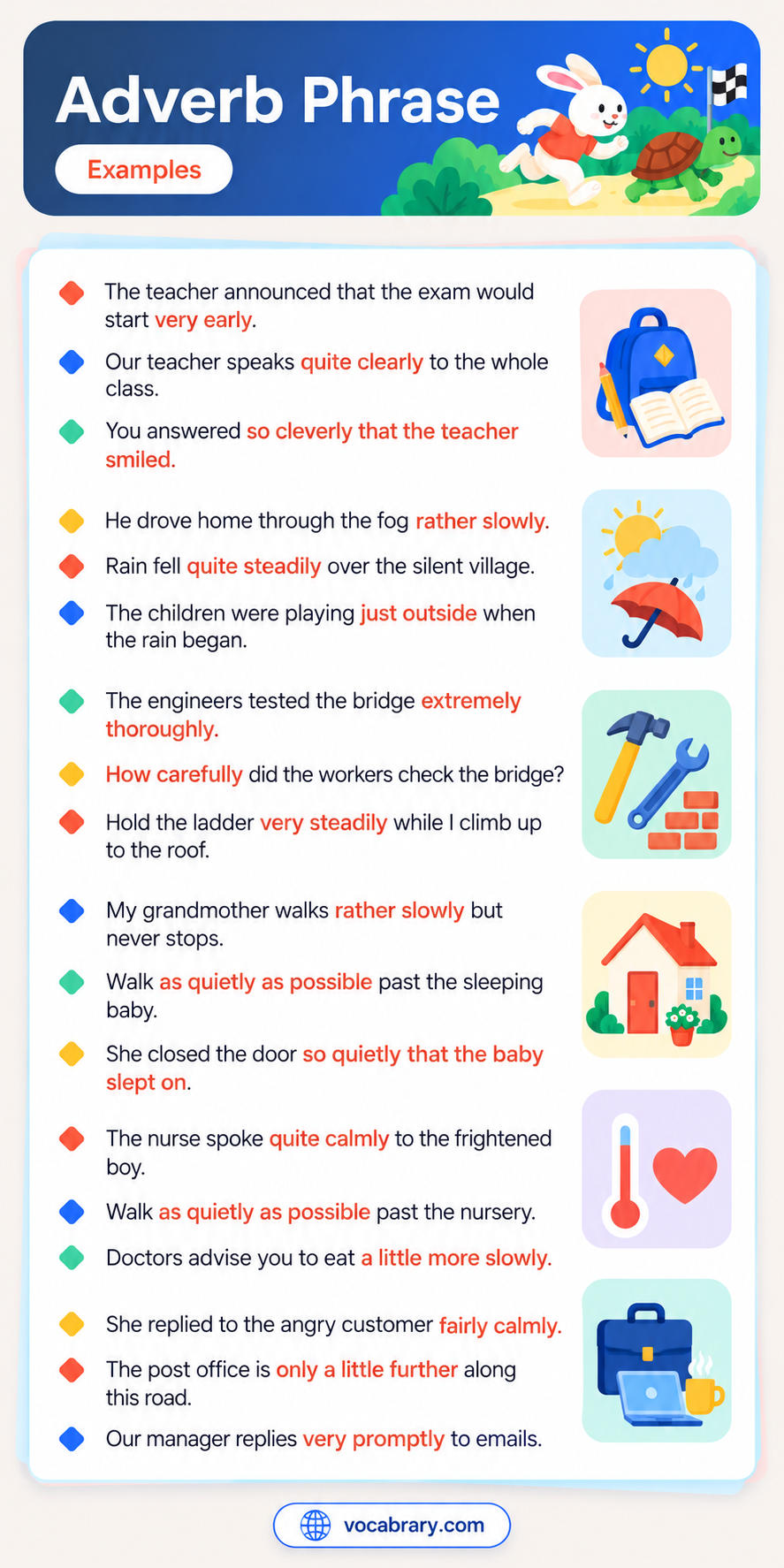
Common Adverb Phrase Examples
Very carefully, much too early, and remarkably well are adverb phrases, and each one is a head adverb with the words that modify or complete it.
- Kenji opened the box very carefully.
- The bus arrived much too early for the tour.
- Tom drives quite carefully on icy roads.
- We finished the project surprisingly quickly.
- My grandmother walks rather slowly but never stops.
- The children played so happily that nobody wanted to leave.
- He answered very politely and then sat down.
- The doctor arrived almost immediately after the call.
- Nina sings remarkably well for her age.
- The rain fell quite heavily all night.
- We parked quite far away from the entrance.
- I see my cousins fairly often in summer.
- Please speak a little more slowly.
- The kitten slept very soundly on the sofa.
- Hana works much harder than anyone else.
- The film we watched on Friday ended rather suddenly.
- You should finish as soon as possible.
- He plays the cello extremely well.
- The guests left very late last night.
- She answered so clearly that everyone understood.
Adverb Phrases of Manner
Very cautiously, quite slowly, and extremely badly describe how an action is done, and each one has an adverb of manner as its head. See adverbs of manner for the single-word forms.
- The old man walked quite slowly down the hill.
- She closed the door so quietly that the baby slept on.
- The team played extremely badly in the first half.
- He answered the question rather clumsily.
- The girl sang remarkably sweetly at the festival.
- Dad drove quite dangerously on the wet road.
- Please carry the vase extremely gently.
- The chef cut the vegetables very neatly.
- They argued quite politely for an hour.
- She danced so gracefully that the audience fell silent.
- The students listened really attentively to the guest.
- The kitten moved very cautiously across the ledge.
- Dr Mensah explained the plan unusually clearly.
- Aisha folded the letter rather carefully before she sealed it.
Adverb Phrase Examples of Time
Very soon, quite recently, and much too early describe the time of an action, and each one has an adverb of time as its head.
- The parcel will arrive very soon.
- We moved to Leeds quite recently.
- My alarm rang much too early on Sunday.
- Ayo got home rather late last night.
- She called me only yesterday about the party.
- The guests arrived very early on Sunday.
- The workers started almost immediately after lunch.
- The doctor will see you quite shortly.
- The shop opens fairly early on weekdays.
- Mum woke up unusually late this morning.
- My phone broke only recently, so it is almost new.
- Snow fell so early that the apples froze on the trees.
- The letter came surprisingly late in the week.
- Please come here right now and bring your bag.
Adverb Phrases of Place
Quite far away, very close by, and right there describe the place of an action, and each one has an adverb of place as its head.
- They live quite far away in a small village.
- The lost dog was found very close by.
- Put the heavy box right there by the door.
- The cafe is fairly near the station.
- We camped much too far from the water.
- Sit a bit closer to the stage.
- The children were playing just outside when the rain began.
- Go straight ahead until you reach the bakery.
- The hikers climbed much higher than the hut.
- Our seats were quite far back.
- The post office is only a little further along this road.
Adverb Phrase Examples of Frequency
Quite often, very rarely, and hardly ever describe how frequently an action is repeated, and each one has an adverb of frequency as its head. The adverbs of frequency page covers the single words.
- We visit my grandparents quite often.
- She very rarely misses a training session.
- The bus runs fairly regularly on Sundays.
- They eat out not very often.
- It snows here so frequently that the roads need clearing twice a week.
- The cat hardly ever sits still.
- Ravi almost never forgets a birthday.
- The shop closes early more and more often.
- We meet fairly frequently to plan the event.
- My neighbour practises the drums very occasionally.
- Maria goes swimming really often in summer.
- Our train almost always arrives on time.
Adverb Phrase Examples of Degree
Very nearly, almost entirely, and just a little give the degree of a quality or action, and the head adverb modifies a verb, an adjective, or another adverb. See adverbs of degree for more.
- She very nearly missed the last train.
- The garden was almost entirely flooded.
- The soup was nearly completely cold.
- He was fairly badly hurt in the fall.
- The film was only slightly funnier than the book.
- They were really quite pleased with the result.
- She almost completely forgot the question.
- It rained fairly heavily all morning.
- The ice is very nearly thick enough to skate on.
- The students were much more nervous than usual.
- I am just a little tired after the walk.
- The baby was hardly even awake when we arrived.
Adverb Phrase Examples With Very, Quite, So, and Too
Very fast, too quickly, and so late have an intensifier before the head adverb, and the intensifier raises or lowers the degree of the adverb.
- He ran very fast to catch the bus.
- She spoke too quickly for the class to follow.
- The bus came so late that we missed the film.
- The meeting in the hall ended quite abruptly.
- Lena replied extremely quickly to my email.
- The lights went out really suddenly.
- You drive much too fast for this road.
- They sang rather loudly at the party.
- The team trained very hard all winter.
- He laughed fairly nervously at the joke.
- The tea cooled far too slowly.
- You answered so cleverly that the teacher smiled.
- The students worked quite quietly in the library.
- She jumped incredibly high for her age.
Comparative Adverb Phrase Examples
More carefully than before, faster than his brother, and a little earlier make a comparison between two actions or two times, and the word than introduces the second item when it is stated.
- She drives more carefully than before.
- Omar runs faster than his brother.
- Please come a little earlier tomorrow morning.
- The baby sleeps less soundly than usual.
- Mia sings much better than I do.
- He speaks more clearly than he used to.
- The new bus runs far more often than the old one.
- Please walk a bit more slowly.
- Our team plays much better every week.
- She writes less neatly than her sister.
- The river flows more quickly in spring.
- They worked harder than ever before the final.
- Speak a little more loudly, please.
- The wind blew even harder during the night.
Superlative Adverb Phrase Examples
Earliest of all, most gracefully, and least often name the highest or lowest degree of an action among three or more, and each phrase begins with a superlative word.
- Ravi arrived earliest of all the guests.
- Mei performed best of the three singers on Saturday.
- She works hardest of all when the deadline is close.
- Of all the dancers, Ines moves most gracefully.
- The youngest child spoke most clearly.
- Our team trains the longest of all the squads in the league.
- That route is used least often.
- Paolo answered the most politely of all the candidates.
- The winner finished fastest of all the runners by three seconds.
- Of everyone, Jin listens most carefully.
Adverb Phrases With Enough, Too, and So That
Fast enough, too slowly, and so softly that nobody heard link an action to a result, and enough, too, or so is the degree word in each.
- Mina ran fast enough to win.
- He did not speak loudly enough for the back row.
- You arrived early enough to get a seat.
- The soup cooled too slowly for us to eat.
- She sang so softly that nobody heard.
- The plane flew high enough to clear the clouds.
- The students answered quickly enough for the teacher.
- The door closed too quietly to wake anyone.
- He spoke clearly enough for everyone to follow.
- She stood close enough to touch the painting.
- The team worked so efficiently that they finished early.
- It happened too fast for me to see.
As-As Adverb Phrases
As soon as possible, as fast as you can, and as carefully as a professional compare two degrees of an action with a pair of as words. See as…as comparison sentences for more.
- Please reply as soon as possible.
- Run as fast as you can.
- He cooked as carefully as a professional.
- She spoke twice as quickly as her teacher.
- Come as early as you like.
- They worked just as hard as the others.
- The boy waited as patiently as he could.
- Walk as quietly as possible past the nursery.
- Karim writes as neatly as his mother.
- The train arrived almost as quickly as the bus.
Adverb Phrase Examples at the End of a Sentence
Very politely, quite patiently, and remarkably smoothly come at the end of the clause, which is the normal position for an adverb phrase of manner.
- The students answered the visitor very politely.
- The children waited in line quite patiently.
- He drove home through the fog rather slowly.
- Zara packed her bag unusually quickly.
- The soldiers marched through the square very proudly.
- She replied to the angry customer fairly calmly.
- We walked back much more slowly.
- Ali laughed quite loudly at the story.
- The plane landed in the storm remarkably smoothly.
- The baker on our street works extremely early.
- They finished the job surprisingly fast.
- The youth orchestra played exceptionally well last night.
Adverb Phrase Examples at the Start With Commas
Quite suddenly and very slowly come first in the sentence, and a comma follows the adverb phrase. The comma is optional after a very short opener.
- Quite suddenly, the lights went out.
- Very slowly, the old gate opened.
- Surprisingly quickly, the crowd left the square.
- Rather unexpectedly, Mia won the prize.
- Quite honestly, I preferred the first version.
- Most carefully, the surgeon removed the splinter.
- Slowly and carefully, he lifted the lid.
- Almost immediately, the phone rang again.
- Very soon, the guests will arrive.
- Remarkably quietly, the children left the hall.
- Extremely reluctantly, Lena signed the form.
Adverb Phrases in Mid-Sentence Position
Very carefully, quite often, and almost always come between the subject and the verb, and no comma is needed between them and the verb they modify.
- She very carefully closed the door behind her.
- The manager quite often forgets his keys.
- Tom almost always walks to school.
- We very rarely eat meat at home.
- The old man quite suddenly stood up.
- They rather reluctantly accepted the offer.
- My sister fairly regularly sends us postcards.
- The cat very quietly crept under the table.
- The students quite happily left early.
- He quite rarely takes a holiday.
Coordinated Adverb Phrases
Slowly and carefully, quickly but quietly, and politely yet firmly join two adverbs or adverb phrases with a coordinator such as and, but, or yet, and the pair describes the action together.
- She worked on the model slowly and carefully.
- The thieves moved quickly but quietly.
- He answered the reporter politely yet firmly.
- The wind blew hard and steadily all night.
- You may arrive early or late, but call us first.
- The choir sang softly and very clearly.
- She replied calmly and quite politely.
- They walked slowly and rather sadly home.
- The kettle boiled quickly and quite noisily.
- Mia solved the puzzle quickly and very neatly.
Adverb Phrases in Negative Sentences
Very politely, fast enough, and as quickly as I expected are in negative sentences, where not, never, or nobody negates the action.
- She did not answer very politely.
- Nobody spoke very loudly in the library.
- He does not drive fast enough for the race.
- The team did not play particularly well.
- The train does not run very often on Sundays.
- He could not speak clearly enough to be understood.
- She did not react as quickly as I expected.
- We do not visit them very frequently.
- The oven does not heat evenly enough for baking bread.
- Tom never speaks too loudly in the library.
Adverb Phrase Examples in Questions
How quickly, how far away, and very late are in questions, either at the front of the question or after the verb.
- How quickly can you finish the report?
- How often do you visit your grandparents?
- How far away is the nearest hospital?
- Do you work very late on Fridays?
- How carefully did the workers check the bridge?
- Did she answer the judge quite honestly?
- How soon will the parcel arrive?
- How well does your brother speak Spanish?
- Why did he leave so early?
- Can you run fast enough to catch the bus?
- Is the train running much later than usual?
Adverb Phrases in Reported Speech
Too fast, extremely hard, and remarkably well are in the reported clause after verbs such as said and told, where the adverb phrase still describes the same action.
- She said that he drove too fast for the narrow road.
- He told us the baby slept very soundly.
- Tom explained that he had worked extremely hard all week.
- The coach claimed that the team had played remarkably well.
- My aunt said they lived quite far away.
- The teacher announced that the exam would start very early.
- Nadia asked whether the shop closed unusually late.
- The guide warned us to walk as quietly as possible.
Adverb Phrases in Commands
Very carefully, a little more slowly, and as quietly as possible follow an imperative verb, and the adverb phrase describes how to carry out the order.
- Drive very carefully on the mountain road.
- Please speak a little more slowly for the visitors.
- Walk as quietly as possible past the sleeping baby.
- Stir the sauce quite gently for five minutes.
- Close the gate very firmly behind you.
- Answer the questions as clearly as you can.
- Write your name rather more neatly on the form.
- Hold the ladder very steadily while I climb up to the roof.
- Cut the paper very straight along the line.
- Come home much earlier tonight than you did yesterday.
Adverb Phrases in Passive Sentences
Remarkably quickly and very carefully come after a passive verb phrase and describe the manner, time, or place of the action.
- The bridge was built remarkably quickly.
- The letters were sorted very carefully by hand.
- The old tower was repaired surprisingly cheaply.
- The winners were announced rather late in the evening.
- The patient was examined extremely thoroughly.
- The festival is held quite far away from the town.
- The tickets were sold much too quickly for us to buy any.
- The mistake was noticed very soon after the exam.
- The old coins were found fairly close to the surface.
- The report was written so carefully that nobody found an error.
Adverb Phrase Examples in Everyday Contexts
People use adverb phrases to describe how, when, or where something is done. Each setting has its own phrases, such as very slowly at home or extremely thoroughly at work.
Adverb Phrases at Home
A cook stirring the soup very slowly and a father who sleeps rather lightly are household routines described by adverb phrases.
- Grandma stirs the soup very slowly.
- The kids tidied their room surprisingly quickly.
- Dad sleeps rather lightly these days.
- The kettle whistled quite loudly in the empty kitchen.
- We eat dinner fairly late on weekends.
Adverb Phrases at School
In a classroom, extremely carefully describes how pupils listen, and far too early describes when the bell rang.
- The pupils listened extremely carefully to the story.
- Our teacher speaks quite clearly to the whole class.
- Aisha finished the test much sooner than the others.
- The bell rang far too early.
- Students must write as neatly as possible.
Adverb Phrases at Work
At work, remarkably efficiently describes a team’s audit, and very promptly describes a manager’s replies.
- The team completed the audit remarkably efficiently.
- Our manager replies very promptly to emails.
- The new printer works much faster than the old one.
- The office closes rather early on Fridays.
- The engineers tested the bridge extremely thoroughly.
Adverb Phrases While Travelling
Travel sentences use ridiculously early for a flight and quite slowly for a train.
- Our flight left ridiculously early, before breakfast.
- The train moved quite slowly through the mountains.
- We arrived very late at the hotel.
- The ferry runs fairly often in summer.
- The driver turned carefully but quickly around the bend.
Adverb Phrases in the News
News reports use quite sharply for rising prices and alarmingly quickly for a spreading fire.
- Prices rose quite sharply last month.
- The rescue team worked extremely fast after the flood.
- The minister answered the reporters very briefly.
- Voters turned out unusually early on election day.
- The fire spread alarmingly quickly through the old market.
Adverb Phrases in Literature
Invented stories use very softly for a princess’s speech and rather impatiently for a waiting captain.
- The princess spoke very softly to the dragon.
- Rain fell quite steadily over the silent village.
- The captain waited rather impatiently on the deck.
- The old clock struck quite slowly at midnight.
- She smiled faintly but warmly at the stranger.
Adverb Phrases in Sports
In a match, incredibly fast describes a striker’s run, and remarkably well describes a goalkeeper’s dives.
- The striker ran incredibly fast down the wing.
- Our goalkeeper dives remarkably well for his age.
- The team played much better in the second half.
- The runners started very quickly but tired near the end.
- She serves quite accurately under pressure.
Adverb Phrases in Health
Surprisingly quickly and very gently describe a recovering patient and a stretch before a run.
- The patient is recovering surprisingly quickly.
- Doctors advise you to eat a little more slowly.
- Her heart beats fairly regularly now.
- Stretch very gently before you run.
- The nurse spoke quite calmly to the frightened boy.
Adverb Phrase Examples for Kids
Very slowly, really fast, and so sweetly describe how an animal or a person moves, sings, or speaks.
- The turtle walks very slowly.
- I ran really fast to the gate.
- She sings so sweetly in the choir.
- Please talk a little more quietly.
- The baby slept quite soundly.
- My dog barks very loudly at the postman.
- We played very happily in the garden.
- The cat jumped extremely high.
- Mum drives quite carefully in the rain.
- He ate his lunch rather quickly.
Short Adverb Phrase Sentences for Young Learners
Three and four word sentences with very fast, so well, and too loudly give beginners an adverb phrase pattern short enough to read at once.
- She runs very fast.
- Walk quite slowly, please.
- He sings so well.
- We eat very late.
- Dogs bark too loudly.
- Birds sing very early.
- Draw very carefully.
- It ended quite quickly.
- I swim really well.
Adverb Phrase Examples for Students
Essays and exam answers use longer phrases such as far more thoroughly than in previous years and almost unanimously in formal writing.
- The committee reviewed the proposal far more thoroughly than in previous years.
- Prices have risen considerably faster than wages over the past decade.
- The narrator speaks surprisingly calmly about the loss.
- The data were analysed very rigorously by an independent team.
- The disease spread much more rapidly than experts had predicted.
- Citizens voted almost unanimously for the reform.
- The experiment was repeated quite independently in three laboratories.
- The two economies developed so differently that comparison became pointless.
- The speaker argued extremely persuasively against the proposal.
- The glacier is retreating faster than any model suggested.
Adverb Phrase Examples in a Short Paragraph
Two short passages about Samir, a baker who starts work before dawn, use one adverb phrase in every sentence, so learners meet the structure inside continuous writing.
Samir wakes very early every morning. He walks quite quietly past the sleeping houses. At the bakery, he works extremely quickly with the dough. The ovens heat fairly slowly on cold days.
Customers arrive much earlier on Saturdays. Samir greets each one very warmly. By noon, the shelves are empty, and he closes rather early. He sleeps quite soundly that afternoon.
Common Adverb Phrase Mistakes
An adjective in place of an adverb, a misplaced intensifier, and a manner phrase between a verb and its object are three of the errors learners make in adverb phrases.
❌ She sings very beautiful.
✅ She sings very beautifully.
The word that modifies a verb is an adverb, so beautiful becomes beautifully.
❌ He speaks English fluently very.
✅ He speaks English very fluently.
The intensifier very comes before the adverb it modifies.
❌ She ate quickly her lunch.
✅ She ate her lunch quickly.
An adverb phrase of manner is not placed between a verb and its direct object.
❌ He drove too much fast.
✅ He drove too fast.
The word too comes directly before an adverb, while too much goes with nouns and verbs.
❌ She runs more faster than her brother.
✅ She runs faster than her brother.
A short adverb forms its comparative with -er and takes no more.
❌ They arrived enough early.
✅ They arrived early enough.
The word enough follows the adverb it modifies.
❌ She studied hardly for the exam.
✅ She studied hard for the exam.
The adverb meaning with great effort is hard, while hardly means almost not at all.
❌ I very like this song.
✅ I like this song very much.
The word very does not modify a verb directly, so a verb takes very much after it.
❌ Quite sudden, the lights went out.
✅ Quite suddenly, the lights went out.
A phrase that modifies the whole clause needs an adverb, so sudden becomes suddenly.
❌ He walked, very slowly down the road.
✅ He walked very slowly down the road.
A single comma does not separate a manner phrase from the verb it modifies.
❌ She plays the piano very good.
✅ She plays the piano very well.
The word well is the adverb form that matches the adjective good.
Adverb Phrase Versus Adverbial Prepositional Phrase and Adverb Clause
Very quickly is an adverb phrase, in a hurry is a prepositional phrase used as an adverbial, and when the bell rang is an adverb clause.
| Feature | Adverb phrase | Prepositional phrase used as adverbial | Adverb clause |
|---|---|---|---|
| Head | An adverb | A preposition | A subordinating conjunction with a subject and finite verb |
| Example | Very quickly | In a hurry | When the bell rang |
| Own subject and verb | No | No | Yes |
| Sentence | She left very quickly | She left in a hurry | She left when the bell rang |
| Meaning | How, when, where, how frequently, or how much | How, when, where, or why | When, where, why, how, or under what condition |
| Other usage | The narrow sense used here | Some grammars call this an adverb phrase | Called an adverbial clause in some grammars |
Because grammar books differ, check which sense a textbook uses before applying its terms. The prepositional phrase page and the adverb clause page cover the other two columns in full.
Related
- Adverbs Example Sentences
- Adverbs of Manner Example Sentences
- Adverbs of Degree Example Sentences
- Adverb Clause Examples
- Prepositional Phrase Example Sentences
- Noun Phrase Examples
- Verb Phrase Examples
- Adjective Phrase Examples
FAQs
Q1. What are some examples of adverb phrases?
Examples of adverb phrases include very quickly, quite slowly, much too early, and more carefully than before. Each one is a head adverb with the words that modify or complete it. Some grammars count a single adverb such as quickly as a phrase of one word, but the examples on this page have at least two words.
Q2. What are the parts of an adverb phrase?
An adverb phrase has a head adverb and, when the phrase is longer than one word, an intensifier before it or a complement after it. The intensifier, such as very or so, changes the degree of the adverb. The complement, such as than before or that nobody heard, completes a comparison or a result.
Q3. What is the difference between an adverb and an adverb phrase?
An adverb is one word that modifies a verb, an adjective, or another adverb, while an adverb phrase is the adverb together with its modifiers or complements. The word quickly is an adverb, and very quickly is an adverb phrase. Both answer how, when, where, how frequently, or to what degree.
Q4. What is the difference between an adverb phrase and an adverb clause?
An adverb phrase has no subject and finite verb of its own, while an adverb clause has both. Very quickly is a phrase, and when the bell rang is a clause. The adverb clause page gives the clause patterns in full.
Q5. Is a prepositional phrase used as an adverbial an adverb phrase?
A prepositional phrase used as an adverbial, such as in a hurry, is not an adverb phrase in the narrow sense, because its head is a preposition. Some grammars call every adverbial a phrase, so the answer depends on the textbook. This page keeps the term for phrases headed by an adverb and treats the other kind on the prepositional phrase page.
Q6. What functions do adverb phrases have in a sentence?
Adverb phrases function as adverbials of manner, time, place, frequency, and degree. Very carefully answers how, much too early answers when, quite far away answers where, fairly often answers how frequently, and almost entirely answers to what degree. An adverb phrase also modifies an adjective or another adverb.
Q7. Where does an adverb phrase go in a sentence?
An adverb phrase goes at the end of the clause, at the start, or between the subject and the verb. Manner phrases such as very quietly come at the end of the clause, as in She spoke very quietly. Frequency phrases such as quite often come before the main verb or at the end, as in He quite often forgets and We visit them quite often.
Q8. Do adverb phrases need commas?
A comma follows an adverb phrase that opens the sentence, as in Quite suddenly, the lights went out, and the comma is optional after a very short opener. A phrase at the end of the clause or in mid-sentence takes no comma, as in She spoke very quietly. A single comma does not separate a manner phrase from the verb it modifies.
Q9. How do you form a comparative adverb phrase?
You form a comparative adverb phrase by adding -er to a short adverb or placing more or less before a longer adverb, then adding than and the second item. Examples are faster than his brother and more carefully than before. Words such as much, far, and a little indicate the size of the difference.
Q10. Which words work as intensifiers in an adverb phrase?
The words very, quite, so, too, extremely, rather, fairly, and really work as intensifiers before an adverb. Each one raises or lowers the degree of the adverb, as in very quickly and rather slowly. The word enough follows the adverb instead, as in fast enough.
Q11. Does an adverb phrase modify adjectives as well as verbs?
An adverb phrase modifies an adjective when its head adverb gives the degree of the quality, as in almost entirely flooded and just a little tired. It also modifies another adverb, as in very nearly finished. Adverb phrases of manner, time, place, and frequency modify a verb.
Q12. What are the common mistakes with adverb phrases?
The common mistakes with adverb phrases are an adjective in place of an adverb, a misplaced intensifier, and a manner phrase between a verb and its object. Examples are sings very beautiful, fluently very, and ate quickly her lunch. Each error is repaired by checking the word class of the head and the position of the phrase.
Q13. How do you find the adverb phrase in a sentence?
You find an adverb phrase by asking how, when, where, how frequently, or to what degree about the verb, then checking that the answer is headed by an adverb. In She spoke very quietly, the question how gives very quietly. The head is quietly, and very is its intensifier.

Leave a Comment