
An adverb clause is a dependent clause that modifies a verb, an adjective, an adverb, or a whole sentence, as in we left when the rain stopped. Most adverb clause examples begin with a subordinating conjunction such as when, because, if, or although, and each clause answers when, why, how, or under what condition.
What Is an Adverb Clause?
An adverb clause is a dependent clause with its own subject and verb that states the time, place, reason, condition, contrast, purpose, result, manner, or comparison of an action or a statement. A subordinating conjunction introduces it. An adjective clause differs because it modifies a noun, while an adverb clause modifies a verb, an adjective, an adverb, or a whole clause and is able to move to the front of its sentence.
Subordinating conjunction + subject + verb = adverb clause
Everyone cheered when the team scored.
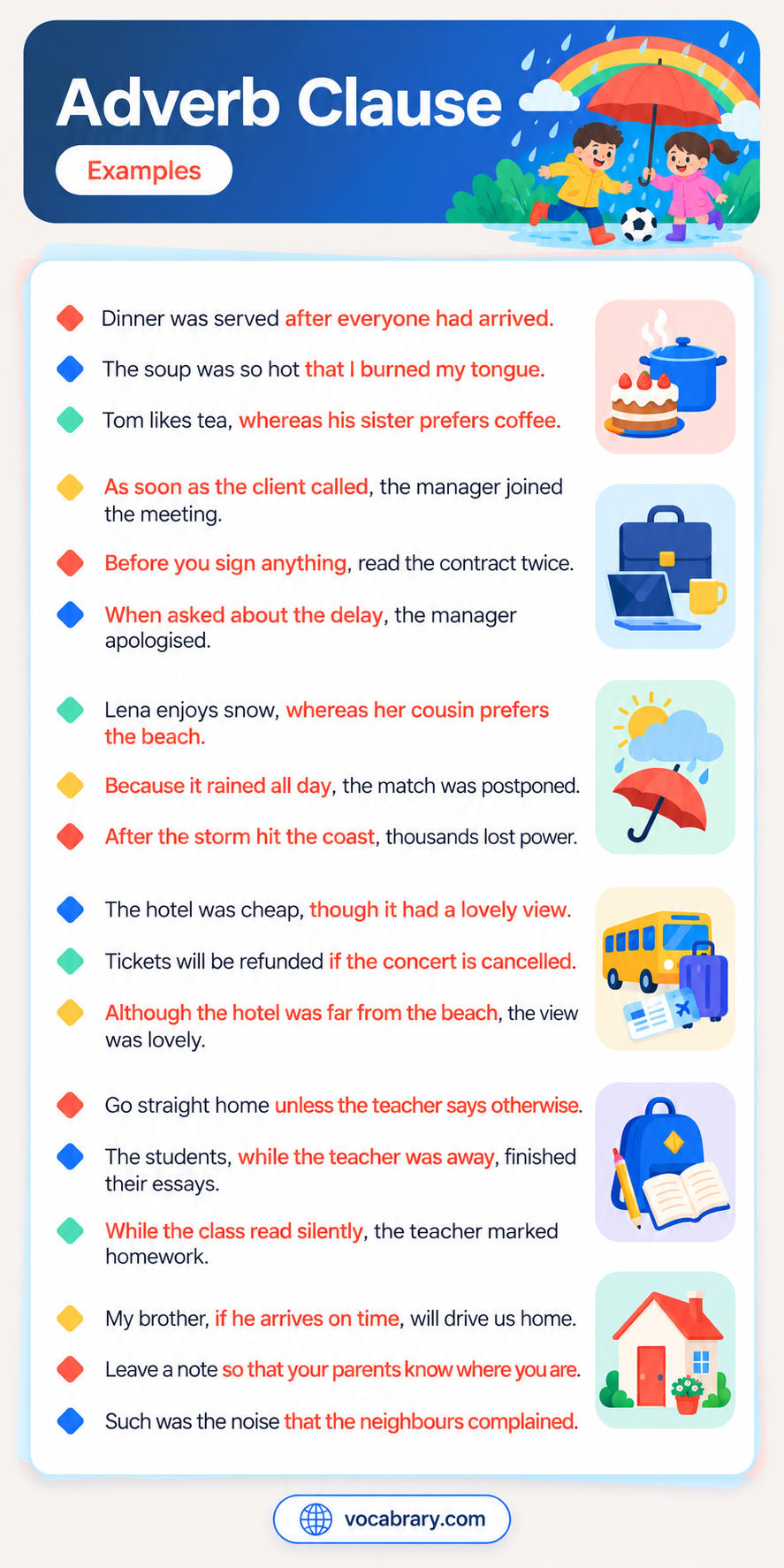
Common Adverb Clause Examples
When the rain stopped, because a storm approached and as soon as I land are clauses that each state a time or a reason for the main clause. The subordinating conjunction page gives the introducing words.
- When the rain stopped, the children ran outside.
- The picnic ended early because a storm approached.
- Although the hill was steep, the cyclists kept pedalling.
- I will call you as soon as I land.
- Hana practised daily so that she could join the choir.
- If you press this button, the lift opens.
- Leave the bags where the porter can reach them.
- He answered as if the question bored him.
- The coffee was so strong that I stayed awake all night.
- Zara swims farther than her coach expected.
- While Dad cooked, I set the table.
- Unless the bridge reopens, we will take the ferry.
- Since we arrived early, we found good seats.
- Ravi waited until the shop opened.
- After the guests left, we washed the dishes.
- Though the road was narrow, the bus passed easily.
- The baby cried whenever the music stopped.
- Once you learn the rules, the game is easy.
- She locked the door before she left.
- Wherever Kai travels, he sends postcards.
Adverb Clauses of Time
When the bell rang, before you eat and until the doctor calls your name are time clauses, and each one answers the question when. The time clause page gives a longer set.
Adverb Clause Examples With When, While, and As
When the bell rang, while I was cooking and as the sun set state when one event happens in relation to another, and each clause modifies the main verb.
- When the bell rang, the students lined up.
- While I was cooking, the phone rang.
- As the sun set, the temperature dropped quickly.
- Call me when you reach the station.
- The audience clapped while the singer bowed.
- As she opened the door, a cat ran out.
- He was washing the car when it started to rain.
- Whenever Dad travels, he brings us a gift.
- While Nia studied in the library, her brother played football.
- I met Sam as I was leaving the building.
- When I was a child, we lived near a river.
- Every time the doorbell rings, the dog barks.
Adverb Clause Examples With Before and After
Before you eat, after the storm passed and after he finished his homework state that one action happens earlier or later than another, as in washing hands, repairing fences, and finishing homework.
- Before the film began, we bought popcorn.
- Wash your hands before you eat.
- After the storm passed, the villagers repaired the fences.
- She felt calmer after she had spoken to her mother.
- After he finished his homework, Leo played the guitar.
- We left the hotel before the sun rose.
- Please lock the gate after you leave.
- Before Maria moved abroad, she sold her car.
- The concert ended after the band played three encores.
- Before you sign anything, read the contract twice.
- Dinner was served after everyone had arrived.
- He apologised before anyone asked him.
Adverb Clause Examples With Until, Since, and As Soon As
Until the doctor calls your name, since I was twelve and as soon as the whistle blew state when a period ends, when it starts, or which event is followed at once by an action.
- Wait here until the doctor calls your name.
- Until the rain stopped, nobody left the shelter.
- I have lived in Cairo since I was twelve.
- Since the new manager arrived, sales have doubled.
- As soon as the whistle blew, the players ran onto the pitch.
- She smiled as soon as she saw the gift.
- We will not start until everyone is seated.
- Once the paint dries, you can hang the picture.
- It has snowed since we woke up.
- By the time we reached the hall, the lecture had ended.
- I will tell you the news the moment I hear it.
- Aisha has not eaten since she left home.
Adverb Clauses of Place
The conjunctions where, wherever, and everywhere join where you can see the board, where the river bends and wherever the band played to a main clause and answer the question where.
- Sit where you can see the board.
- Wherever the band played, crowds gathered.
- We camped where the river bends.
- The children built a fort where the old tree fell.
- Leave your shoes where they will not get wet.
- Wherever Rita goes, she carries a notebook.
- Park where the signs allow it.
- Plant the roses where they get the morning sun.
- He stopped where the road divided.
- Everywhere the travellers went, they found friendly faces.
- I looked for the keys where I had left them.
- Wait where the path forks.
Adverb Clauses of Reason
Because the roads were icy, since it was late and because the pitch was flooded state the reason for an action, and the words because, since, as, and now that introduce such clauses.
- We stayed indoors because the roads were icy.
- Since it was late, the guests said goodnight.
- As the shop had closed, we walked home empty-handed.
- Ines was upset because nobody remembered her birthday.
- Because the bridge collapsed, the trucks took another route.
- He passed the exam because he had studied for months.
- The match was cancelled because the pitch was flooded.
- Now that the exams are over, we can travel.
- She left early because she had a train to catch.
- Since you know the way, you can lead us.
- I am laughing because the story was so funny.
- Because it was her turn, Jana opened the box.
- They moved to the coast because the air was cleaner.
- As you are the oldest, you should decide.
Adverb Clauses of Condition
If you heat ice, if it rains and unless you hurry state the situation in which the main clause is true, as in melting ice, a cancelled picnic, and a missed bus.
- If you heat ice, it melts.
- Unless it snows, the match will go ahead.
- You will pass if you revise every night.
- If I had more time, I would learn the violin.
- If she had known the answer, she would have spoken.
- We will cancel the picnic if it rains.
- Provided that you finish the report, you may leave early.
- You may borrow the car as long as you return it by six.
- If it gets dark, take a torch.
- I will lend you the book on condition that you take care of it.
- Had I known about the delay, I would have called you.
- If water reaches one hundred degrees Celsius, it boils.
- Unless you hurry, you will miss the bus.
- As long as the weather stays dry, the festival continues.
- If the door was locked, how did the thief get in?
- Call me if you need help.
Adverb Clauses of Concession and Contrast
Although she was exhausted, though the film was long and whereas his sister prefers coffee state a fact that contrasts with the main clause. The contrast clause page gives more cases.
- Although she was exhausted, Mina finished the race.
- Though the film was long, nobody left.
- Even though it was raining, we walked to school.
- Tom likes tea, whereas his sister prefers coffee.
- While I respect your opinion, I disagree with it.
- Although the ticket cost a fortune, the seat had a poor view.
- He kept smiling, even though his feet hurt.
- Even if you invite him, he will not come.
- The soup tasted wonderful, although it contained no salt.
- Whereas the north gets heavy snow, the south stays mild.
- However hard she tried, the door stayed shut.
- Whatever happens, we will stay together.
- Though he is rich, he lives in a tiny flat.
- Although I studied all night, I failed the quiz.
- Mia stayed calm, while everyone else panicked.
- No matter how loudly he shouted, nobody heard him.
Adverb Clauses of Purpose
So that he could win the marathon, so that everyone would understand and in order that we might avoid the traffic state the goal of an action. The purpose clause page gives further sets.
- He trained every morning so that he could win the marathon.
- She spoke slowly so that everyone would understand.
- We left early in order that we might avoid the traffic.
- Mum hid the presents so that the children would not find them.
- Write the address down so that you do not forget it.
- The school installed lights so that pupils could study in the evening.
- I am saving money so that I can travel next year.
- He whispered so that the baby would not wake.
- The teacher repeated the rule so that nobody would make the mistake again.
- Leave a note so that your parents know where you are.
- We took a map so that we would not get lost.
- Dr Singh explained the plan twice so that the patients would feel calm.
Adverb Clauses of Result
That I burned my tongue, that we gave up and that the streets flooded state the result of a quality or an event, and they follow so or such.
- The soup was so hot that I burned my tongue.
- It was such a lovely day that we stayed outside until dark.
- She spoke so quietly that nobody heard her.
- The queue was so long that we gave up.
- He ran so fast that he broke the record.
- It rained so heavily that the streets flooded.
- The film was so boring that half the audience fell asleep.
- Such was the noise that the neighbours complained.
- The box was so heavy that two men could not lift it.
- Ayesha was so nervous that her hands shook.
- There was so much traffic that the bus arrived an hour late.
- The puzzle was so difficult that nobody finished it.
Adverb Clauses of Manner
As if she had won the argument, as though it weighed nothing and the way my grandmother taught me state how an action is done. They are introduced by as, as if, as though, or the way.
- She spoke as if she had won the argument.
- He ran as though a dog were chasing him.
- Do it as I showed you.
- The twins dress as their mother did at their age.
- Cook the rice the way my grandmother taught me.
- He behaves as if he owned the place.
- She lifted the box as though it weighed nothing.
- Leave the room as you found it.
- The child stared as if he had never seen snow.
- Write the answer exactly as the question asks.
- You look as if you have seen a ghost.
- Mira folded the flag as the soldiers had taught her.
Adverb Clauses of Comparison
Comparison clauses begin with than or as, as in than his brother does, than we had feared and as his father did.
- Tom runs faster than his brother does.
- She is taller than I expected.
- He works as hard as his father did.
- The exam was easier than we had feared.
- It rained more than the forecast predicted.
- Mina sings better than she dances.
- The trip cost less than we had planned.
- The river is as wide as it was last year.
- The bread smells better than it tastes.
- She arrived earlier than anyone else had.
- This chair is not as comfortable as it looks.
- Leo reads more slowly than I do.
Introductory Adverb Clauses
When the meeting ended, if you need help and although the road was icy come before the main clause, and a comma follows each one.
- When the meeting ended, everyone went home.
- Because it rained all day, the match was postponed.
- If you need help, ask the librarian.
- Although the road was icy, the bus arrived on time.
- As soon as the curtain rose, the audience fell silent.
- Before she left for Rome, Sara packed a small umbrella.
- While the kettle boiled, Dad read the newspaper.
- After the guests had gone, the house was quiet.
- Since nobody answered, the postman left a note.
- Unless the weather improves, the ferry will stay in port.
- Whenever my sister visits, we cook together.
- Once the engine cooled, the mechanic opened the hood.
- Though he was nervous, Idris gave a fine speech.
- Where the path ends, a small cabin stands.
Trailing Adverb Clauses
Because the sea was rough, until you finish and when you leave follow the main clause, and no comma is used when the clause is needed to complete the meaning of the main clause.
- The ferry stayed in port because the sea was rough.
- Ask the librarian if the catalogue confuses you.
- The cricket match was abandoned because lightning struck nearby.
- Mum answered emails while the kettle boiled.
- We watch old films whenever the weather turns cold.
- The shop closed early since nobody was buying.
- I will wait until you finish.
- She packed an umbrella before the taxi arrived.
- The audience fell silent as soon as the lights dimmed.
- Close the windows when you leave.
- He apologised after he realised his mistake.
- Go straight home unless the teacher says otherwise.
- The mechanic opened the hood after the customer left.
- The workers sing while they work.
Trailing Adverb Clauses With a Comma
A clause of contrast, such as whereas her cousin prefers the beach or although it covered the whole year, is set off by a comma when it follows the main clause.
- Lena enjoys snow, whereas her cousin prefers the beach.
- The test was short, although it covered the whole year.
- Eli kept quiet, while his sister argued loudly.
- The hotel was cheap, though it had a lovely view.
- The film ends happily, whereas the book ends in tragedy.
Mid-Sentence Adverb Clauses
An adverb clause such as when the whistle blew or if he arrives on time is placed between the subject and the verb of the main clause, with a comma on each side of it.
- The team, when the whistle blew, rushed onto the pitch.
- My brother, if he arrives on time, will drive us home.
- The manager, although she was busy, answered every email.
- The children, as soon as the bell rang, ran to the gate.
- Lena, because she wanted to improve, practised every night.
- The ferry, unless the storm worsens, will leave at noon.
- The students, while the teacher was away, finished their essays.
- Ravi, even though he was tired, helped us move the sofa.
Reduced Adverb Clauses
While walking home, although tired and if necessary are shortened from full clauses by dropping the subject and a form of be, or by turning the verb into an -ing form. The shortened form is correct when the dropped subject is the main subject, and set phrases such as unless otherwise stated are the exception.
- While walking home, I met an old friend.
- When asked about the delay, the manager apologised.
- Although tired, Rosa finished the report.
- Before leaving the house, check the stove.
- If necessary, we will extend the deadline.
- After finishing the exam, the students left quietly.
- Once inside, the visitors removed their shoes.
- Though small, the island has three schools.
- She stopped when told to wait.
- While waiting for the bus, Ali read a magazine.
- Unless otherwise stated, all prices include tax.
- Since arriving in Lisbon, Tara has made five friends.
- When in Rome, do as the Romans do.
- He fell asleep while watching the film.
Adverb Clause vs Prepositional Phrase Examples
A clause such as after the audience had gone has a subject and a verb. A phrase such as after the concert has only a preposition and an object, so only the clause is the target in each sentence.
- We left after the concert, but Ravi stayed after the audience had gone.
- Mina studied during the break, and Tom slept while the teacher talked.
- Because of the fog, the ferry stopped, and the bus stopped because the road flooded.
- Before dinner, we washed our hands, and we set the table before the guests arrived.
- Despite the cold, we swam, and Lena went out although she had a fever.
- Until noon, the shop was empty, and nobody came until the sale began.
- With the key, he opened the box, and he opened it as if it were fragile.
- In case of fire, use the stairs, and take a torch in case the power fails.
Adverb Clause and Prepositional Phrase Comparison
An adverb clause contains its own verb, whereas a prepositional phrase contains only a preposition and its object, as in because it rained and because of the rain.
| Feature | Adverb clause | Prepositional phrase |
|---|---|---|
| Contains | A subject and a finite verb | A preposition and its object, with no verb of its own |
| Introduced by | A subordinating conjunction such as because, although, or when | A preposition such as because of, despite, or after |
| Reason example | Because it rained, we stayed in. | Because of the rain, we stayed in. |
| Time example | I left after the lesson ended. | I left after the lesson. |
| Contrast example | Although he was ill, he came. | Despite his illness, he came. |
Adverb Clauses in Negative Sentences
Until you apologise, although the path was steep and unless the owner is present are used in negative sentences, where the negative word is in the main clause or inside the adverb clause.
- I will not leave until you apologise.
- We did not stop, although the path was steep.
- If you do not hurry, you will miss the train.
- Nobody noticed while the thief climbed the fence.
- The shop never opens unless the owner is present.
- Because he had not slept, Kofi made mistakes.
- Do not touch the paint until it dries.
- Although nobody complained, the manager apologised.
- They could not hear the speaker because the microphone had failed.
- Sana did not call because she had no signal.
Adverb Clauses in Questions
When you arrive, because she was angry and while you cook appear inside questions, and the question mark ends the whole sentence.
- Will you call me when you arrive?
- If it rains, will the match still go ahead?
- Did Mia leave because she was angry?
- Why did you wait until the shop closed?
- Do we eat after the guests arrive?
- When the film ends, where should we meet?
- Are you still coming even though you have a cold?
- Do you sing while you cook?
- Should I bring an umbrella in case it rains?
- Since you know the town, which café do you recommend?
Adverb Clauses in Reported Speech and Passive Sentences
When she arrived, because the owner was ill and if the concert is cancelled follow reporting verbs and passive verbs such as said, told, was closed, and will be refunded.
- She said that she would call when she arrived.
- He told us that the shop would close because the owner was ill.
- Mum asked whether I would wait until the rain stopped.
- The trip was cancelled because the weather was poor.
- The window was broken while the children were playing.
- When the results were announced, the winner was congratulated.
- The bridge was closed after a crack had been found.
- The thief was caught as he left the building.
- The students were told to wait until the bell rang.
- Tickets will be refunded if the concert is cancelled.
Adverb Clauses in Everyday Contexts
Home, school, work, travel, news, fiction, sports and health each have typical time, reason, and condition clauses, from when Mum comes home to so that your body stays hydrated.
Adverb Clause Examples at Home
Dinner, a leaning shelf and a whistling kettle go with when Mum comes home, because it was leaning and if the kettle whistles, clauses used in a family kitchen or living room.
- When Mum comes home, we start dinner.
- The cat sleeps wherever the sun shines on the floor.
- Dad fixed the shelf because it was leaning.
- If the kettle whistles, turn off the stove.
- We tidy the living room before the guests arrive.
- Although it was midnight, the twins kept talking.
Adverb Clause Examples at School
After the bell rang, unless you submit the essay by Friday and although the question was hard are clauses about bells, essays, and hard questions in classroom talk.
- After the bell rang, the pupils packed their bags.
- The teacher repeated the lesson so that everyone understood.
- Unless you submit the essay by Friday, you will lose marks.
- Ana studied hard because the exam was difficult.
- While the class read silently, the teacher marked homework.
- Although the question was hard, Pedro answered it correctly.
Adverb Clause Examples at Work
As soon as the client called, once the payment clears and so that she could finish the report are clauses about a client’s call, a payment, and a late report in offices.
- As soon as the client called, the manager joined the meeting.
- We will ship the order once the payment clears.
- If sales keep rising, the firm will hire more staff.
- She worked late so that she could finish the report.
- Because the system crashed, nobody could log in.
- Whenever a deadline moves, the team holds a short meeting.
Adverb Clause Examples for Travel
Trains, window seats and delayed flights are the subjects of when the train arrived, so that we would get window seats and if the flight is delayed, clauses from journeys and airports.
- When the train arrived, passengers rushed to the doors.
- We booked early so that we would get window seats.
- If the flight is delayed, the airline will provide meals.
- Although the hotel was far from the beach, the view was lovely.
- The ferry waited until the fog lifted.
- Wherever we travelled, locals offered us tea.
Adverb Clause Examples in the News
Reports on local events use after the storm hit the coast, because the audit found errors and although the vote was close for storms, audits, and close votes.
- After the storm hit the coast, thousands lost power.
- The mayor resigned because the audit found errors.
- While rescue teams searched the area, residents waited at the shelter.
- Although the vote was close, the council approved the plan.
- Schools will reopen once the water supply is restored.
- If talks fail, the strike will begin on Monday.
Adverb Clause Examples in Literature
A dragon, a torn map and a stranger at midnight appear with as the dragon circled the tower, because the map was torn and when the clock struck midnight in invented tales.
- As the dragon circled the tower, the princess locked the door.
- The knight rode until his horse collapsed.
- Because the map was torn, the sailors lost their way.
- She smiled as though she knew a secret.
- When the clock struck midnight, the stranger vanished.
- Wherever the old poet walked, children followed him.
Adverb Clause Examples in Sports
Before the match began, as the striker scored and because the pitch was frozen are clauses about captains, strikers, and frozen pitches in match reports and team talks.
- Before the match began, the captain gave a short speech.
- The crowd cheered as the striker scored.
- Although they trailed at half time, the home side won.
- The coach cancelled practice because the pitch was frozen.
- If the referee blows the whistle, play stops.
- Runners train hard so that their legs stay strong in the final mile.
Adverb Clause Examples for Health
Clinic advice about a dizzy patient, a tablet, and a stitched cut uses if you feel dizzy, after you eat and although the cut looked small.
- If you feel dizzy, sit down at once.
- Take the tablet after you eat.
- Because she had a fever, Lara stayed in bed.
- The nurse waited until the patient woke.
- Although the cut looked small, it needed stitches.
- Drink water so that your body stays hydrated.
Adverb Clause Examples for Kids
Young learners read short lines such as when it rains and before you eat and see that a small clause with a subject and a verb states when, why, or where.
- When it rains, I jump in puddles.
- I smile because you are here.
- Wash up before you eat.
- If it snows, we sled.
- Wait until I say go.
- I sing while I walk.
- After I eat, I play.
- Sit where I can see you.
- She laughs when the dog barks.
- Stop when the light is red.
Adverb Clause Examples for Students
Exam answers about policy, evidence, and experiments use although the policy reduced unemployment, whereas early critics praised the novel and unless governments invest in renewable energy in formal writing.
- Although the policy reduced unemployment, it increased inflation in the following year.
- The experiment was repeated so that the results could be verified independently.
- Whereas early critics praised the novel, later readers questioned its structure.
- The committee postponed its decision because the data remained incomplete.
- Unless governments invest in renewable energy, carbon emissions will continue to rise.
- The population grew so quickly that housing became scarce.
- Once the evidence was examined, the court reversed its ruling.
- Students perform better when they receive timely feedback.
- Even though the study sample was small, the findings were statistically significant.
- Prices rose faster than wages did throughout the decade.
Adverb Clauses in a Short Paragraph
Two short passages about a late morning and a lake crossing use because her alarm had failed and until the sun set, so learners meet adverb clauses inside continuous writing.
Lena woke up late because her alarm had failed. While she brushed her teeth, she packed her bag. She ran to the station so that she could catch the early train. Although the platform was crowded, she found a seat as soon as the doors opened.
Mr Costa rowed across the lake until the sun set. Since the water was calm, he moved quickly. When he reached the far shore, he lit a fire so that he could cook supper.
Common Adverb Clause Mistakes
Common errors are a fragment, a doubled conjunction, a future tense after a time or condition word, a preposition before a full clause, a double negative, and a wrong tense or conjunction in other clauses.
❌ Because I was late.
✅ Because I was late, I missed the bus.
A clause that begins with a subordinating conjunction is dependent, so it needs a main clause to form a complete sentence.
❌ Although it was raining, but we went out.
✅ Although it was raining, we went out.
The word although already marks the contrast, so but repeats the contrast and is unnecessary.
❌ When I will arrive, I will call you.
✅ When I arrive, I will call you.
A time clause refers to the future with the present tense, and the future form with will is used only in the main clause.
❌ If it will rain, we will stay home.
✅ If it rains, we will stay home.
A condition clause about the future uses the present tense, and will is used in the main clause.
❌ Despite he was tired, he kept working.
✅ Although he was tired, he kept working.
The word despite is a preposition and takes a noun phrase or an -ing form, while although introduces a clause with a subject and a verb.
❌ Because of he was late, we left.
✅ Because he was late, we left.
The words because of form a preposition and need a noun phrase, so a clause needs because.
❌ Unless you don’t hurry, you will be late.
✅ Unless you hurry, you will be late.
The word unless already means if not, so the added don’t gives the clause two negatives.
❌ She studied hard so that she passes the exam.
✅ She studied hard so that she could pass the exam.
A purpose clause after a past main verb uses a past modal such as could or would.
❌ Since he was a child, he is afraid of dogs.
✅ Since he was a child, he has been afraid of dogs.
When since names a starting point in the past and the state continues now, the main clause uses the present perfect.
❌ He ran so fast than he broke the record.
✅ He ran so fast that he broke the record.
A result clause after so is introduced by that, while than introduces a comparison.
❌ Walking home, the rain started.
✅ While I was walking home, it started to rain.
The unstated subject of a reduced clause is the subject of the main clause, so Walking home, the rain started wrongly says that the rain was walking.
Related
- Subordinating Conjunction Example Sentences
- Time Clause Examples
- Clauses of Purpose Examples
- Clauses of Contrast Examples
- Complex Sentence Examples
- Dependent Clause Examples
- Noun Clause Examples
- Adjective Clause Examples
FAQs
Q1. What are some common examples of adverb clauses?
Common examples of adverb clauses are when the rain stopped, because the roads were icy, if you heat ice, and although she was exhausted. Each clause has its own subject and verb and begins with a subordinating conjunction. In We stayed indoors because the roads were icy, the clause states the reason for staying indoors.
Q2. How do you identify an adverb clause in a sentence?
You identify an adverb clause by finding a group of words with a subject, a verb, and a subordinating conjunction that answers when, where, why, how, or under what condition. In Call me when you arrive, the clause when you arrive answers when. An adverb clause is able to move to the front of the sentence, which a clause that modifies a noun is unable to do.
Q3. Which words introduce an adverb clause?
An adverb clause is introduced by a subordinating conjunction such as when, while, after, before, until, since, because, if, unless, although, though, even though, whereas, so that, as if, or than. Each word marks one relationship: because introduces a reason, unless introduces a negative condition, and whereas introduces a contrast.
Q4. What are the types of adverb clauses?
The types of adverb clauses are time, place, reason, condition, concession or contrast, purpose, result, manner, and comparison. A time clause answers when, a reason clause answers why, and a purpose clause answers for what purpose. A result clause follows so or such, and a comparison clause follows than or as.
Q5. Do you put a comma after an adverb clause?
A comma follows an adverb clause that opens the sentence, as in When the meeting ended, everyone went home. A comma is also placed on each side of an adverb clause that stands between the subject and verb of the main clause. A short introductory clause is written without the comma in informal texts, but the comma is the standard form.
Q6. Is a comma needed before an adverb clause at the end of a sentence?
A comma is not needed before a trailing adverb clause that completes the meaning of the main clause, as in The ferry stayed in port because the sea was rough. A comma is placed before a clause of contrast with although, though, whereas, or while, as in Tom likes tea, whereas his sister prefers coffee. A comma also separates a clause that is added as an afterthought.
Q7. What is the difference between an adverb clause and an adjective clause?
An adverb clause modifies a verb, an adjective, an adverb, or a whole clause, while an adjective clause modifies a noun or pronoun. In I left when it rained, the clause when it rained states when I left. In I left the day when it rained, the clause describes the noun day. The adjective clause page gives examples of the second type.
Q8. What is the difference between an adverb clause and a prepositional phrase?
An adverb clause contains a subject and a finite verb, whereas a prepositional phrase contains a preposition and its object. The clause because it rained corresponds to the phrase because of the rain, and the clause after the lesson ended corresponds to the phrase after the lesson. Words such as despite and because of are prepositions, so a clause needs although and because instead.
Q9. What is a reduced adverb clause?
A reduced adverb clause is an adverb clause shortened by dropping its subject and a form of be, or by changing the verb to an -ing form. While walking home comes from While I was walking home. The reduction is correct when the dropped subject is the same as the subject of the main clause, and set phrases such as if necessary and though small are the exception.
Q10. Is an adverb clause able to stand alone as a sentence?
An adverb clause is unable to stand alone as a sentence, because it is a dependent clause. The group of words Because I was late has a subject and a verb, yet it is incomplete without a main clause. Writers join it to one, as in Because I was late, I missed the bus.
Q11. Which tense follows when or if in an adverb clause about the future?
The present tense follows when, if, as soon as, before, after, and until in an adverb clause about the future. You write When I arrive, I will call you and If it rains, we will stay home. The word will is used in the main clause and not in the adverb clause, except in a polite request such as If you will wait here, I will call him.
Q12. What are adverb clause examples for kids?
Adverb clause examples for kids are short lines such as When it rains, I jump in puddles, Wash up before you eat, and I sing while I walk. Each line pairs a small clause with a short main clause. Young learners repeat the lines aloud and then change the subordinating conjunction.
Q13. What is the difference between an adverb clause and a noun clause?
An adverb clause modifies a verb, an adjective, an adverb, or a whole clause, while a noun clause functions as a subject, an object, or a complement. In I will leave when the train arrives, the clause when the train arrives answers when. In I know when the train arrives, the same words are the object of know, so they form a noun clause. The noun clause page gives more examples.

Leave a Comment