
A clause of purpose is an adverb clause that states why an action is done, as in she saved money so that she would own a home. Clauses of purpose examples also cover in order that and lest, plus the infinitive phrases to, in order to and so as to.
What Is a Clause of Purpose?
A clause of purpose is an adverb clause that states the goal of the main action. It is introduced by so that or the formal in order that and contains its own subject and a modal verb or a present-tense verb. A purpose phrase states the same goal with an infinitive and has no subject of its own.
Main clause + so that + subject + modal or present-tense verb = clause of purpose
Pia wore sunglasses so that the glare would not hurt her eyes.
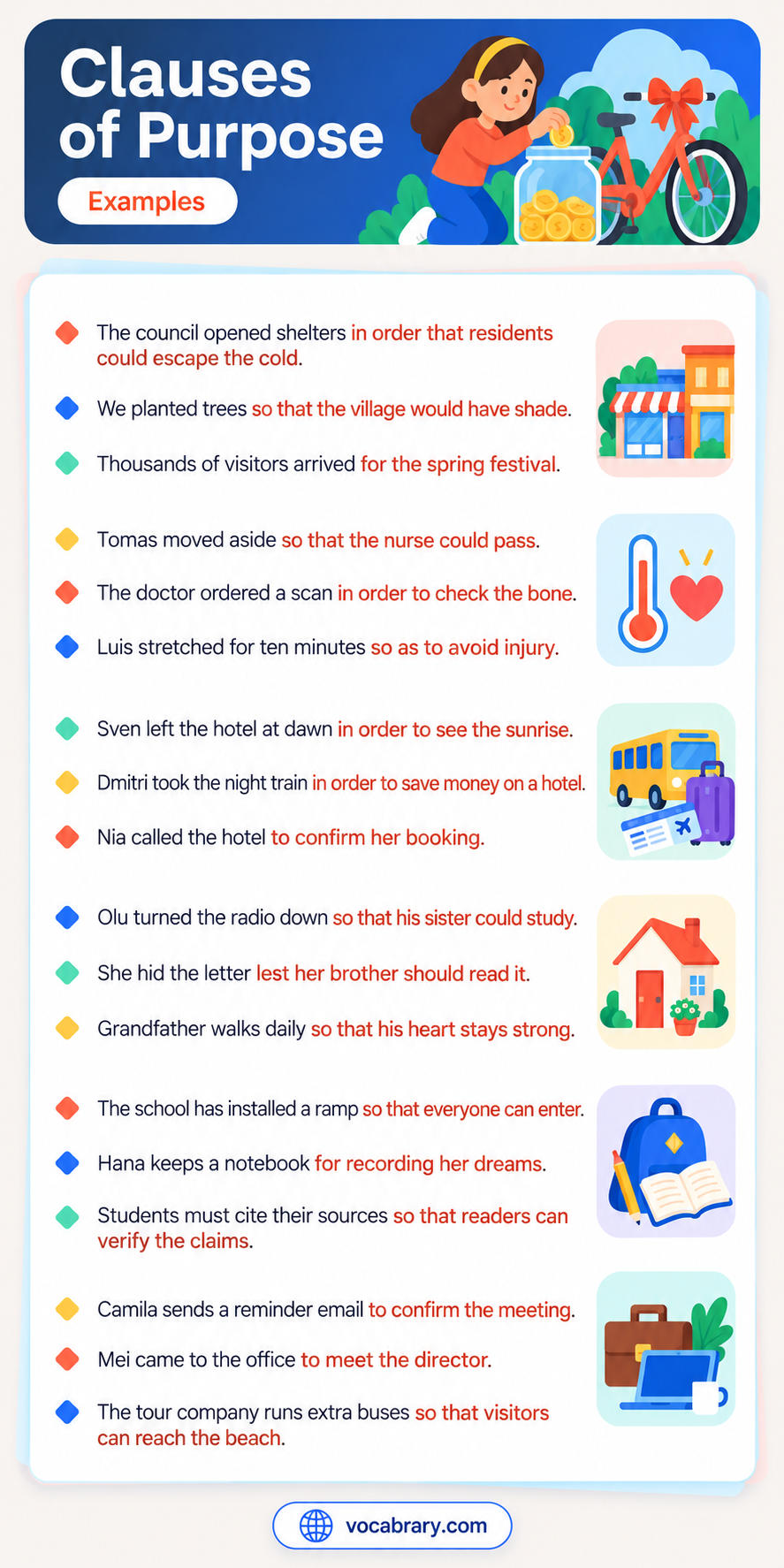
Common Clauses of Purpose Examples
So that she would not oversleep, to buy a bicycle and for fresh bread are purpose expressions, since each states the goal for which the main action is done.
- Mei set two alarms so that she would not oversleep.
- Kofi saved every coin to buy a bicycle.
- We left early in order to find a parking space.
- Hamid spoke slowly so that everyone could follow him.
- Priya wore a thick coat so as to stay warm.
- Omar went to the bakery for fresh bread.
- This old knife is for cutting bread.
- Ravi hid the gift lest his sister find it.
- Luis studied hard so that he could enter medical school.
- Nia called the hotel to confirm her booking.
- The council closed the road so that engineers could repair the bridge.
- Dmitri took notes in order to remember the lecture.
- She stood on a chair so as to reach the top shelf.
- We planted trees so that the village would have shade.
- Aiko turned on the heater so that the room would warm up.
- Rahul walked to work to save money.
- The teacher spoke clearly so that the back row could hear.
- Fatima opened the window to let in some fresh air.
- The club holds a market every spring in order that local farmers may sell their produce.
- Tomas wrote the address down so as not to forget it.
Purpose Clause Examples With So That
So that introduces a clause of purpose with its own subject and a modal verb or a present-tense verb, as in she studied so that she could pass. The tense of the modal matches the tense of the main verb.
So That With Can and Will
A present or future main verb takes can or will in the purpose clause. Two cases are so that I can catch the first bus and so that you will know the plan.
- I leave early so that I can catch the first bus.
- She will call tonight so that you will know the plan.
- Switch on the lamp so that we can see the map.
- Hana is saving money so that she can travel in the summer.
- Lock the gate so that the dog will not escape.
- The school has installed a ramp so that everyone can enter.
- I am explaining the rule again so that nobody will make the same mistake.
- Mum has packed lunch so that we can eat on the train.
- Speak up so that the whole class can hear you.
- Luis will set an alarm so that he can wake before sunrise.
So That With Could and Would
A past main verb takes could or would in the purpose clause, as in Zainab locked the door so that nobody could enter and Sven spoke softly so that the baby would not wake.
- Sven spoke softly so that the baby would not wake.
- Zainab locked the door so that nobody could enter.
- The mayor opened the gates so that crowds could reach the square.
- Camila wrote a list so that she would not forget the shopping.
- We took a taxi so that we could arrive before noon.
- The coach changed the plan so that every player would get a turn.
- Olu turned the radio down so that his sister could study.
- They built a fence so that the sheep would stay in the field.
- Mei gave him a map so that he could find the farm.
- The nurse lowered the blinds so that the patient could sleep.
So That With May and Might in Formal Writing
May and might are formal in a purpose clause, as in rooms are reserved so that visitors may rest and the treasurer filed the accounts so that shareholders might inspect them.
- The committee circulated copies so that members might study the report.
- Rooms are reserved so that visitors may rest between sessions.
- Notes are provided so that students may revise at home.
- The treasurer filed the accounts so that shareholders might inspect them.
- A shelter was built so that travellers might find rest.
- The charity publishes its budget so that donors may see how funds are used.
Purpose Clause Examples With In Order That
In order that is a formal link that introduces a clause of purpose with may, might, can, could, would or should, as in the law was amended in order that families might remain together.
- The law was amended in order that families might remain together.
- The museum reduced its prices in order that more schoolchildren could visit.
- Staff will attend training in order that standards may improve.
- The council extended the deadline in order that residents would have time to respond.
- He wrote under a pen name in order that his family should not be troubled.
- The charter was translated in order that every citizen might read it.
- The college offers evening classes in order that working adults can study.
- The delegates met in private in order that they could speak freely.
Purpose Phrase Examples With To-Infinitives
An infinitive phrase such as to repair the roof or to catch the last train states a purpose when its subject matches the main verb’s subject. The form is covered in infinitive phrase examples.
- Sven climbed the ladder to repair the roof.
- Priya ran to catch the last train.
- Omar visited the bank to open an account.
- We called the plumber to fix the leak.
- Luis went to the library to borrow a dictionary.
- Ana uses her phone to learn Spanish.
- The farmers rose at dawn to milk the cows.
- Hana wrote a letter to thank her teacher.
- Kofi stopped at the shop to buy some milk.
- The children gathered wood to build a fire.
- Nia wore gloves to protect her hands.
- Mei came to the office to meet the director.
- The team trained daily to win the league.
- Rahul took a taxi to arrive on time.
Purpose Phrase Examples With In Order To
In order to is a more explicit infinitive of purpose than to, as in in order to avoid the traffic, and it is common in essays and reports.
- We left at six in order to avoid the traffic.
- The company cut costs in order to survive the recession.
- Hana revised every night in order to pass the entrance exam.
- Researchers interviewed fifty families in order to understand local habits.
- Tomas arrived early in order to find a good seat.
- The city planted trees in order to reduce summer heat.
- Dmitri took the night train in order to save money on a hotel.
- She spoke to the manager in order to resolve the complaint.
- Ingrid saved her notes in order to prepare for the final test.
- The pupils lined up quietly in order to enter the hall.
- Zainab learned Portuguese in order to work in Brazil.
- The engineers tested the bridge twice in order to ensure its safety.
Purpose Phrase Examples With So As To
So as to is a formal infinitive of purpose, like in order to, as in so as to reach the summit before dark.
- The hikers started at dawn so as to reach the summit before dark.
- Lina spoke privately so as to avoid embarrassing him.
- The firm hired extra staff so as to meet the deadline.
- We walked quickly so as to be on time.
- Sven wore a helmet so as to protect his head.
- Aiko stretched her legs so as to relieve the cramp.
- The clerk checked each form twice so as to avoid errors.
- The shop opens early so as to serve commuters.
- Olu saved half his salary so as to buy a house.
- Hamid lowered his voice so as to calm the child.
Negative Purpose Examples With So As Not To and In Order Not To
Negative purpose is formed with so as not to, in order not to or so that with a negative modal, as in he whispered so as not to wake the baby. The word not comes before to.
- He whispered so as not to wake the baby.
- Priya left early in order not to miss the train.
- Zainab set a reminder so that she would not forget the appointment.
- We walked on tiptoe so as not to disturb the class.
- Kofi wore sunscreen in order not to burn.
- Mei wrote the password down so that she wouldn’t lose it.
- The driver slowed down so as not to skid on the ice.
- Tomas turned his phone off so that he would not be interrupted.
- The nurse closed the door in order not to wake the patients.
- Luis packed carefully so that the glasses would not break.
- Ingrid checked the map twice so as not to get lost.
- They kept the plan secret so that the surprise would not be spoiled.
Purpose Phrase Examples With For and a Noun
A phrase with for and a noun names the goal itself, as in went to the park for a walk and arrived for the spring festival.
- Nia went to the park for a walk.
- Thousands of visitors arrived for the spring festival.
- Hamid knocked on the door for help.
- We stopped at the café for a quick lunch.
- The students gathered in the hall for the prize ceremony.
- Ana ran to the shop for some matches.
- Dmitri phoned the clinic for an appointment.
- Luis went to the market for fresh figs.
- She stayed behind for a word with the teacher.
- I called my cousin for advice.
Purpose Phrase Examples With For and an -ing Form
A phrase with for and an -ing form names the general use of a thing, as in a ladle used for serving soup and a drill kept for making holes.
- This ladle is used for serving soup.
- Dad keeps a drill for making holes in the wall.
- The app is designed for tracking daily steps.
- Fatima bought a scale for weighing flour.
- This room is reserved for studying.
- A thermometer is a device for measuring temperature.
- We use a spreadsheet for planning the budget.
- The old barn is now used for storing grain.
- Hana keeps a notebook for recording her dreams.
- Scissors are tools for cutting paper and cloth.
Purpose Clause Examples With Lest
Lest is a formal conjunction with a negative meaning of its own, as in she whispered lest she wake the baby, and the verb is in the subjunctive or takes should.
- Ingrid whispered lest she wake the baby in the next room.
- The guard locked the vault lest thieves should enter.
- Tomas wrote the date down lest he forget it.
- The sailors reefed the sails lest the storm tear them.
- She hid the letter lest her brother should read it.
- The villagers kept silent lest the soldiers hear them.
- We checked the brakes twice lest the bus fail on the hill.
- Hana tidied the room lest her guests think her careless.
In Case Sentences Compared With Purpose Clauses
In case states a precaution against a possible event, not a goal, so take a coat in case it rains differs from take a coat so that you stay warm.
- Kofi packed a torch in case the power failed. Sven packed a torch so that he could read in the tent.
- Take an umbrella in case it rains. Take a hat so as to keep the sun off your face.
- Hana saved her files twice in case the laptop crashed. She saved them to share with her team.
- Mum made extra rice in case guests arrived. She made curry so that the guests could eat before the film.
- Omar carries a charger in case his phone dies. He carries a book to read on the train.
- We left a key with the neighbour in case we lost ours. We left a note so that the postman would use the side door.
- Priya wrote the address twice in case one copy was lost. She wrote it clearly so that the driver could read it.
- Dmitri bought travel insurance in case the flight was cancelled. He bought a guidebook to plan the route.
Purpose Clauses With a Different Subject
When the purpose has a different subject from the main verb, the sentence uses so that, or for with a noun and to. Two cases are so that the cat could come in and for you to sit on.
- She opened the door so that the cat could come in.
- I brought a chair for you to sit on.
- The teacher repeated the rule so that the pupils could write it down.
- Dad left the porch light on for us to find the house.
- Lina baked two cakes so that her guests could take one home.
- The council built a path for walkers to cross the marsh.
- Tomas moved aside so that the nurse could pass.
- The school opened a new gate for buses to enter safely.
- Mum cut the apple so that the baby could hold a piece.
- They cleared the table for the children to draw.
Tense Sequence in Purpose Clauses
The modal matches the time of the main verb, as in so that he could finish the project and so that he would arrive. Can or will follows a present or future verb, and could or would follows a past verb.
- Nia studies every evening so that she can pass the exam.
- Hamid studied late last night so that he could finish the project.
- Sven will leave a spare key so that you can enter.
- Mei has saved for years so that she can buy a small flat.
- Dmitri had hurried home so that he could see the final.
- The shop is open late this week so that customers can finish their holiday shopping.
- Luis was running so that he would arrive before the gates closed.
- They are painting the fence so that the house will look tidy for the wedding.
- Ana has booked a taxi so that we will not miss the flight.
- The pilot had changed course so that the plane could avoid the storm.
- We will cancel the picnic so that nobody will get wet.
- Kofi was practising scales so that his fingers would move faster.
Purpose Clauses in Questions
A purpose clause is placed after the question verb and its subject, as in did Hana take notes so that she could review them later and do you use this brush for painting walls.
- Did Hana take notes so that she could review them later?
- Did Omar bring a ladder to fix the gutter?
- Do you use this brush for painting walls?
- Did Nia leave early in order to catch the first bus?
- Will Sven call tonight so that Mira can plan the trip?
- Are the lights on so that the guests can see the path?
- Did the inspectors visit the bridge so as to measure the cracks?
- Is this cabinet meant for storing medicine?
- Did Tomas hide the key lest his son find it?
Purpose Clauses in Negative Sentences
A negative main clause is followed by the same purpose forms as an affirmative one. Two cases are nobody left early so that the speaker could finish and we never lock the gate so that the dog can come and go.
- Nobody left early so that the speaker could finish.
- We never lock the gate so that the dog can come and go.
- The shop does not open on Sundays so that staff can rest.
- Hana never raises her voice so as to keep the peace.
- The council has not raised fees so that families can afford the pool.
- Tomas does not carry cash to avoid theft.
- No one in the choir wears perfume so that singers with allergies can breathe.
- The museum never moves the exhibits in order that visitors may find their favourites.
Purpose Clauses in Reported Speech and Passive Sentences
A purpose clause follows a reporting verb or a passive verb as it follows an active verb, and its modal shifts to the past after a past reporting verb. Two cases are so that he could catch the ferry and so that every pupil could take part.
- Karim said that he was leaving early so that he could catch the ferry.
- The rules were changed so that every pupil could take part.
- The bridge was closed in order to be repaired.
- Ingrid explained that the gates stay locked so that no one can wander in.
- The documents were translated so that foreign investors could read them.
- The mayor announced that the road would be widened to ease traffic.
- The hall was cleaned in order that the exam might begin on time.
- Nadia told us that she took a map so as to avoid getting lost.
Purpose Clauses at Home
At home, so that everyone could eat together, to warm the room, and to keep us warm in winter state the reasons for serving dinner, heating a room, and knitting socks.
- Dad set the table so that everyone could eat together.
- Lina turns on the heater to warm the room.
- Mum hides the sweets on the top shelf so that the children cannot reach them.
- Ana washed the curtains in order to remove the smell of smoke.
- The family planted herbs by the kitchen window for cooking.
- Tomas lit a candle so as to create a calm mood.
- I use a timer for measuring cooking time.
- Grandmother knits wool socks to keep us warm in winter.
Purpose Clauses at School
Pupils copy a date, borrow a dictionary, and rehearse a play for stated goals, as in so that pupils could copy it and to check the spelling.
- The teacher wrote the date on the board so that pupils could copy it.
- Nia stayed after class for extra help.
- Kofi borrowed a dictionary to check the spelling.
- The school bought tablets in order that every pupil could research online.
- Mei highlights key words so as to remember them.
- The class rehearsed daily to perform well at the festival.
- Pupils leave their bags in the hall so that the corridor stays clear.
- The head teacher called an assembly to announce the new timetable.
Clauses of Purpose Examples at Work
Office sentences state why a manager hires assistants and why a clerk stamps forms, using so that the team could meet the deadline and to show that it was checked.
- The manager hired two assistants so that the team could meet the deadline.
- Camila sends a reminder email to confirm the meeting.
- Hamid backed up the files in order to prevent data loss.
- The firm opened a branch in Nairobi so as to reach new customers.
- We use a shared calendar for scheduling meetings.
- Ingrid took a course so that she could qualify for a promotion.
- The clerk stamped each form to show that it was checked.
- The company trained its staff in order that service would improve.
Clauses of Purpose Examples in Travel
Travellers book a window seat and exchange money for reasons such as so that she could sit by the window and so that she could pay the taxi.
- Aiko booked a seat early so that she could sit by the window.
- We arrived at the airport at five to check in our bags.
- Rahul carried a phrasebook to talk with local people.
- The tour company runs extra buses so that visitors can reach the beach.
- Sven left the hotel at dawn in order to see the sunrise.
- We took the ferry for the view of the coast.
- The pilot slowed the plane so as to avoid the storm.
- Fatima exchanged money so that she could pay the taxi.
Purpose Clauses in the News
Wages, shelters and satellites appear in reports with the reason for each decision, as in so that families could cope with prices and to measure ocean temperatures.
- The government raised wages so that families could cope with prices.
- Police closed the square to keep the crowd safe.
- The council opened shelters in order that residents could escape the cold.
- Scientists launched the satellite to measure ocean temperatures.
- The ministry published the figures so that the public could judge the results.
- Engineers drained the lake so as to repair the dam.
- Aid workers travelled by boat to reach the flooded villages.
- The city introduced a bus lane so that commuters would arrive faster.
Clauses of Purpose Examples in Literature
In invented fiction, a knight’s night ride and a widow’s hidden letter have motives stated by to reach the castle before dawn and lest her son should find it.
- The knight rode through the night to reach the castle before dawn.
- The widow hid the letter lest her son should find it.
- The stranger pulled his hood low so that nobody would recognise him.
- The villagers lit fires on the hill in order that the sailors could find the harbour.
- She sewed a map into her coat so as to keep it safe.
- The old sailor told his tale for the pleasure of the young listeners.
- The prince crept down the stairs so as not to wake the guards.
- The witch brewed a potion to heal the sleeping king.
Clauses of Purpose Examples in Sports
Calling a break, wearing white shirts and stretching before a race all have a goal, as in so that the players could rest and so as to avoid injury.
- The coach called a break so that the players could rest.
- Nia trains at dawn to prepare for the marathon.
- The team wore white shirts in order that supporters could spot them.
- Luis stretched for ten minutes so as to avoid injury.
- The referee stopped the game to check the screen.
- Kofi bought new boots for playing on wet grass.
- The club built a second pitch so that younger players could train.
- The runners drank water at each station in order not to become dehydrated.
Purpose Clauses in Health
Clinic decisions such as opening curtains for a patient or ordering a scan have a stated aim, as in so that the patient could see the garden and in order to check the bone.
- The nurse opened the curtains so that the patient could see the garden.
- Hana takes vitamins to support her immune system.
- The doctor ordered a scan in order to check the bone.
- Grandfather walks daily so that his heart stays strong.
- The clinic keeps a quiet room for resting after treatment.
- Omar uses a brace to support his knee.
- The pharmacist labelled each bottle so that patients would take the right dose.
- Ingrid drank water before the test in order not to faint.
Purpose Clause Examples for Kids
Brushing teeth and feeding birds are daily routines for a child, and each has a reason such as to keep them clean or so that they can eat in winter.
- I brush my teeth to keep them clean.
- We feed the birds so that they can eat in winter.
- Dad gave me a coat so that I would stay warm.
- The boy ran to catch the bus.
- I use crayons for drawing pictures.
- Mum went to the shop for bread.
- We close the gate so that the puppy cannot run out.
- Grandma lit a lamp so that we could read.
- Ben saved coins to buy a kite.
- I put my toys away so as not to trip.
Short Purpose Clauses for Young Learners
Three and four word sentences such as I read to learn and pens are for writing state a purpose in few enough words for beginners to copy onto one line.
- I run to win.
- We eat to grow.
- I read to learn.
- Cats climb to hide.
- Birds fly to find food.
- I smile to be kind.
- We sleep to rest.
- Pens are for writing.
- Ann goes for milk.
Clauses of Purpose Examples for Students
Essay and exam answers use longer purpose expressions, such as so that households can reduce their energy costs and in order to protect participants’ privacy, with formal verbs and precise nouns.
- Governments subsidise solar panels so that households can reduce their energy costs.
- The researchers anonymised the data in order to protect participants’ privacy.
- The author uses short sentences so as to create a sense of urgency.
- Policymakers introduced the tax to discourage excessive consumption.
- Students must cite their sources so that readers can verify the claims.
- The treaty was drafted in order that neither nation would feel disadvantaged.
- The novelist withholds the narrator’s name lest the reader should form a fixed image.
- Laboratories use sterile gloves for preventing contamination.
- The company diversified its products so as not to depend on a single market.
- The committee delayed the vote so that members could consider the new evidence.
Purpose Clauses in Short Passages
Three short passages about a market trip, a village shelter and a science club use purpose clauses and phrases in connected writing, so learners see the forms beside one another.
Zainab gets up at five to reach the market before the crowds. She carries two bags so that she can bring home vegetables and rice. She bargains politely in order not to offend the sellers, and she stops at the spice stall for fresh ginger.
Last winter the villagers built a shelter on the hill. They used heavy timber so that the wind could not move it. They painted it white so as to make it visible in the snow, and they left a lamp inside lest travellers should lose their way.
The science club met on Friday to test a homemade rocket. Ravi wore goggles in order to protect his eyes, and the others stood back so that the launch area would stay clear. They counted down aloud so as not to confuse the timing.
Purpose Clause Mistakes to Avoid
Extra words, wrong verb forms and a wrong tense after in case are the mistakes in this group, as in for to buy and in order to don’t wake.
❌ I went to the market for to buy bread.
✅ I went to the market to buy bread.
The words for to are not used together in standard English, so the infinitive to buy is used alone.
❌ She left early so that to catch the bus.
✅ She left early so that she could catch the bus.
So that introduces a clause with its own subject and verb, so it is not followed by to.
❌ I came here for see the manager.
✅ I came here to see the manager.
For is followed by a noun or an -ing form, and a base verb needs to.
❌ He spoke softly in order to don’t wake the baby.
✅ He spoke softly in order not to wake the baby.
Not comes before to in a negative infinitive of purpose.
❌ Take a coat in case you will be cold.
✅ Take a coat in case you get cold.
A clause after in case takes the present simple, not will, when it refers to the future.
❌ I went to the shop for buying milk.
✅ I went to the shop to buy milk.
A phrase with for and an -ing form names the general use of a thing, so a person’s particular action takes the to-infinitive.
❌ She whispered lest she did not wake the baby.
✅ She whispered lest she wake the baby.
Lest already has a negative meaning, so not is not added.
Purpose Clause and In Case Clause Comparison
Both structures follow a main clause, but a purpose clause states a goal, while an in case clause states a precaution against a possible event.
| Feature | Purpose Clause | In Case Clause |
|---|---|---|
| Meaning | The goal of the action | A precaution against a possible event |
| Introduced by | So that, in order that, to | In case |
| Verb form | A modal such as can or would, or a present-tense verb | The present or the past, with no will |
| Example | She wrote a note so that he would remember | She wrote a note in case he forgot |
| After a past main verb | Would, as in would remember | The past tense, as in forgot |
Related
- Adverb Clause Examples
- Infinitive Phrase Examples
- Clauses of Contrast Examples
- Complex Sentence Examples
- Time Clause Examples
- Subordinating Conjunction Example Sentences
- Dependent Clause Examples
FAQs
Q1. What is the difference between so that and in order that?
So that and in order that both introduce a clause of purpose with its own subject, but in order that is more formal. She studied so that she could pass suits everyday writing, while the law was amended in order that families might remain together suits formal documents. Both take a modal verb such as can, could, will or would, and a present-tense verb is also correct after a present main verb.
Q2. When is the to-infinitive used to express purpose?
The to-infinitive expresses purpose when the subject of the purpose is the same as the subject of the main verb, as in Sven climbed the ladder to repair the roof. The purpose states the reason for the action. When the subjects differ, so that or for with a noun and to is used, as in I brought a chair for you to sit on.
Q3. What is the difference between to and for in purpose?
To is followed by a base verb and states the goal of a person’s action, as in I went to the bank to open an account. For is followed by a noun or an -ing form, as in I went to the bank for advice and a drill is for making holes. The pattern for to followed by a verb is a mistake in standard English.
Q4. Which modal verbs follow so that?
The modal verbs that follow so that are can and will after a present or future main verb, and could and would after a past main verb. May and might are used in formal writing, as in copies are provided so that members may read the report. The modal matches the tense of the main verb. A present-tense verb without a modal also follows so that, as in so that the corridor stays clear.
Q5. What is the difference between in order to and so as to?
In order to and so as to both introduce an infinitive of purpose, and their meaning is the same. Both are more formal than a plain to. Both are followed by a base verb, and both form the negative with not before to.
Q6. How do you express negative purpose?
Negative purpose is expressed with so as not to, in order not to or so that with a negative modal, as in he whispered so as not to wake the baby. The word not comes before to in standard writing, so so as not to wake is correct. The formal conjunction lest has a negative meaning built in, so not is not added.
Q7. Do you put a comma before so that in a purpose clause?
A comma is not needed before so that when the clause states a purpose, as in She left early so that she could catch the bus. A comma before so signals a result instead, as in She left early, so she caught the bus. The writer chooses between the two by meaning, goal or result.
Q8. What does lest mean in a purpose clause?
Lest means so that not and introduces a formal clause about an outcome to be avoided, as in she whispered lest she wake the baby. The verb is in the subjunctive or takes should, so lest she wake and lest she should wake are both correct. Not is not added after lest.
Q9. What is the difference between a purpose clause and an in case clause?
A purpose clause states the goal of an action, while an in case clause states a precaution against a possible event. Take a coat so that you stay warm states a goal, and take a coat in case it rains states a precaution. A clause after in case takes the present for a present or future meaning, and it takes no will.
Q10. Must the subject of a purpose clause match the main clause?
The subject of a purpose clause with so that does not have to match the subject of the main clause, as in she opened the door so that the cat could come in. A to-infinitive purpose takes the subject of the main verb unless for with a noun is added. This is why so that is the form used when two different people are involved.
Q11. Which tense follows a past main verb in a purpose clause?
A past main verb is followed by could or would in a purpose clause when the purpose is set entirely in the past, as in Zainab locked the door so that nobody could enter. The modal shifts to its past form to match the main verb. A present or future main verb is followed by can or will.
Q12. What is the difference between a purpose clause and a result clause?
A purpose clause states the goal of an action, while a result clause states what followed from it. He spoke slowly so that everyone could follow states a goal, and he spoke so slowly that everyone could follow states a result. The position of so changes the meaning.
Q13. Is for plus an -ing form used for purpose?
A phrase with for plus an -ing form states purpose when it names the general use of a thing, as in this knife is for cutting bread. For a person’s particular action, the to-infinitive is used instead, as in Sven climbed the ladder to repair the roof. A phrase with for plus a noun states the goal directly, as in went to the shop for milk.

Leave a Comment