
A time clause is a dependent adverb clause that begins with a time word such as when, while or after and gives the time of the main action, as in when I arrive. Time clause examples cover how each conjunction links two actions and which verb tense follows it.
What Is a Time Clause?
A time clause is a dependent clause that begins with a time conjunction and states the time or the order of the main action. A time phrase has no subject and verb of its own, so after lunch is a phrase, but after we had lunch is a clause.
Time conjunction + subject + verb = time clause
The guests left when the music stopped.
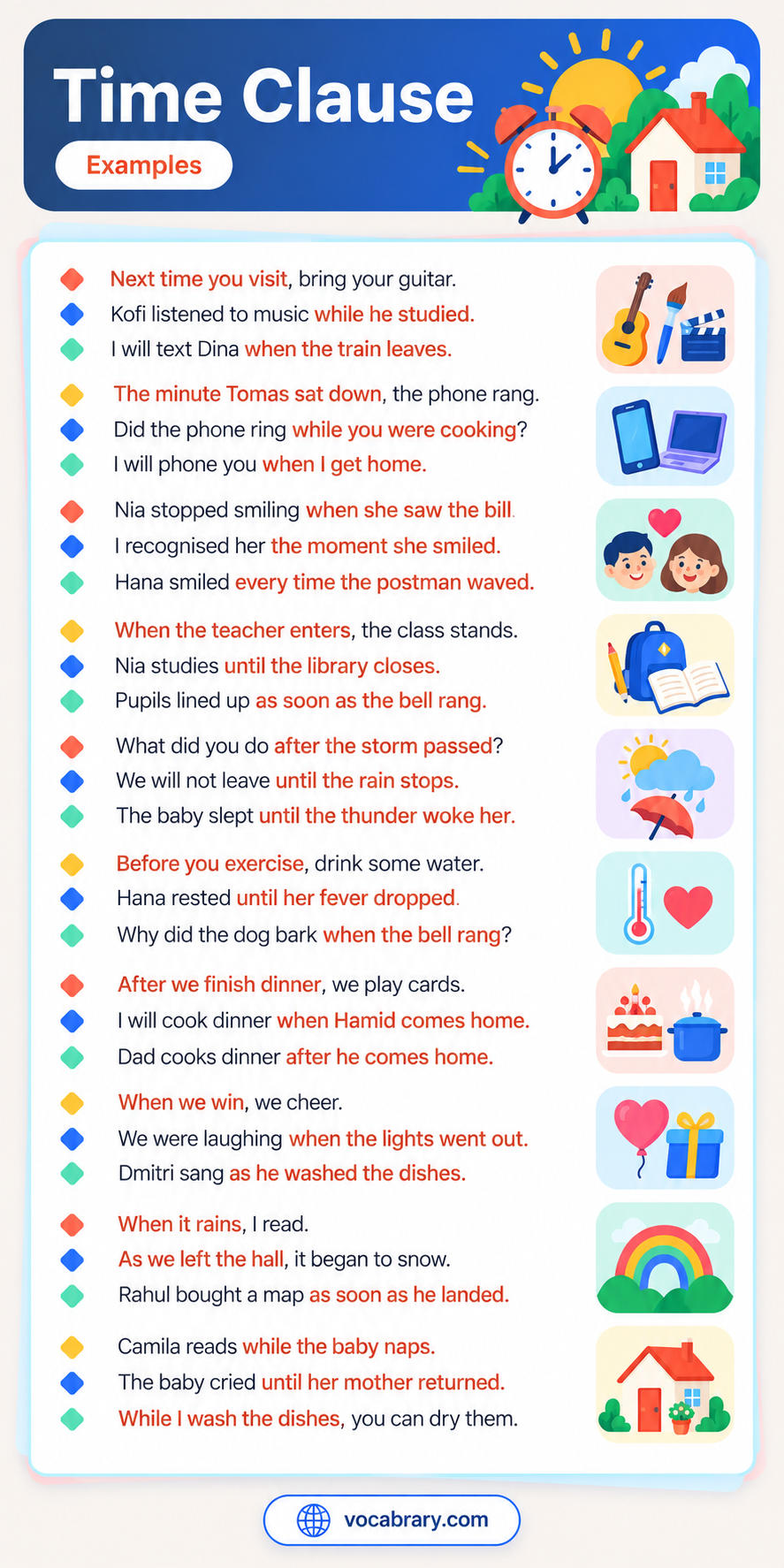
Common Time Clause Examples
When the bell rang, while she waited and after the film ended are time clauses, since each begins with a time word and states the time of the main action. Time clauses are a type of adverb clause.
- When the bell rang, the pupils ran into the yard.
- Priya read a magazine while she waited for the bus.
- We walked along the river after the film ended.
- Wash your hands before you eat.
- The baby slept until the thunder woke her.
- As soon as Kofi arrived, the meeting began.
- I have known Mei since we were children.
- Once the paint dries, we will hang the pictures.
- Whenever it snows, the children build a snowman.
- By the time we reached the station, the train had gone.
- The moment she opened the door, the dog rushed out.
- Dmitri sang as he washed the dishes.
- After the guests had gone, Camila blew out the candles.
- Hana smiled every time the postman waved.
- We stayed at the beach till the sun went down.
- Before the exam began, Olu took a deep breath.
- While the kettle boiled, Nia checked her messages.
- As the train pulled out, Aiko waved from the window.
- I will phone you when I get home.
- Rahul writes whenever he has a free hour.
Time Clause Examples With When
When joins two actions that are close in time, as in when I arrive for the future and when the phone rang for the past. It also names a general time, as in when I was ten.
- When I arrive, I will call you.
- I will cook dinner when Hamid comes home.
- When the phone rang, Ingrid was standing at the door.
- Luis lived in Quito when he was ten.
- When you have finished the test, hand in your paper.
- We were laughing when the lights went out.
- When water freezes in a pipe, it expands.
- Fatima felt nervous when she entered the hall.
- When the guests had left, Omar washed the plates.
- Call me when you need help.
- When Mei was a child, she collected shells.
- The shop closes when the last customer leaves.
Time Clauses With While and As
While and as join actions that run at the same time, as in while I wash the dishes and as she walked home. The past continuous is used for an action in progress, as in while Ana was sleeping.
- While I wash the dishes, you can dry them.
- While Ana was sleeping, the storm passed.
- Zainab sang as she walked home.
- As the sun set, the fishermen returned to the harbour.
- The phone rang while we were having dinner.
- As prices rose, fewer customers visited the shop.
- Kofi listened to music while he studied.
- While Ingrid was reading, her brother practised the piano.
- The crowd grew louder as the runners approached.
- I saw an accident while I was waiting for the bus.
- As he grew older, he spoke less about the war.
- She dropped her keys as she opened the car door.
Time Clauses With Before and After
Before introduces an action that comes later than the main action, and after introduces one that comes earlier, as in before you leave and after the match ended.
- Lock the door before you leave.
- After the match ended, the fans sang in the street.
- Before the guests arrive, we will light the candles.
- Rahul took a shower after he had finished the run.
- Before Sven moved to Oslo, he worked on a fishing boat.
- After Nia passed the exam, she celebrated with her cousins.
- Check the oil before you start the engine.
- Hana washed the dishes after everyone had eaten.
- Before the sun came up, the hikers had already left camp.
- We will leave after the speeches finish.
- Olu apologised before the meeting started.
- After the snow melted, green shoots pushed through the soil.
Time Clauses With Until and Till
Until and till mark the end of a continuing action or state, as in wait until the water boils and stayed till the lights went out.
- Wait quietly until the water boils.
- Mei stayed in the library till the lights went out.
- We will stay inside until the storm passes.
- The baby cried until her mother returned.
- Until the bridge reopens, drivers will use the ferry.
- Hamid kept practising until his fingers ached.
- Do not open the oven until the timer rings.
- Aiko lived with her aunt until she finished school.
- Keep stirring till the sauce thickens.
- The shop stayed open until the last bus left.
Time Clauses With Since
Since names the starting point of a period that continues to the present. The main clause then takes the present perfect, as in Nia has played the violin since she was six.
- Nia has played the violin since she was six.
- It has been two years since we last met.
- Hamid has lived in Leeds since he started university.
- Since the factory closed, the town has grown quiet.
- I have not eaten meat since I visited that farm.
- Camila has felt better since she changed her diet.
- The bridge has been closed since the storm damaged it.
- Since Luis joined the choir, his confidence has grown.
Time Clause Examples With Once and As Soon As
Once and as soon as join an action that follows right after another, as in once the guests are seated and as soon as the rain stops.
- Once the guests are seated, the waiters will serve soup.
- As soon as the rain stops, we will go out.
- I will email you as soon as I have the results.
- Once Tomas had signed the form, the clerk stamped it.
- The crowd cheered as soon as the singer appeared.
- Once you understand the rule, the exercises go quickly.
- Ingrid called her mother as soon as she landed.
- Once the snow stops, the plough will clear the road.
- As soon as the bell rings, the pupils will pack their bags.
- Zainab left once the speeches had ended.
Time Clauses With By the Time
By the time names a point by which an action is finished, so the main clause takes a perfect tense. Two cases are by the time you arrive, I will have left and by the time we got there, the shop had closed.
- By the time you arrive, I will have left.
- By the time we got there, the shop had closed.
- Priya will have studied for six years by the time she finishes university.
- The fire had spread by the time the ambulance arrived.
- The train will have gone by the time we reach the platform.
- By the time Omar was thirty, he had visited forty countries.
- By the time the film ends, the café will have closed.
- Rahul had finished the report by the time his boss called.
Time Clauses With Whenever and the Moment
Whenever, every time and each time link actions that repeat, while the moment, the minute and the instant link an action to one that follows at once.
- Whenever Kofi hears that song, he thinks of his school days.
- The moment she opened the door, the smell of bread reached her.
- Lina smiles every time she sees a rainbow.
- The minute Tomas sat down, the phone rang.
- Each time the bus stopped, more passengers climbed aboard.
- Hamid calls his mother whenever he travels.
- The instant the whistle blew, the swimmers dived.
- Every time it rains, the roof leaks.
- I recognised her the moment she smiled.
- Next time you visit, bring your guitar.
Time Clause Examples for Future Events
A time clause about the future takes the present simple, not will, as in I will call you when I arrive and Karim will lock up after the rain stops. The main clause takes the future form.
- I will text Dina when the train leaves.
- Karim will lock up after the rain stops.
- Before you go, I will make some sandwiches.
- Sven will wait until the shop opens.
- As soon as I get the tickets, I will text you.
- The kids will play while we cook.
- Hana will travel to Tokyo after she graduates.
- When the plane lands, the pilot will announce the weather.
- I will not sign anything until I read the contract.
- Once the results come out, we will celebrate.
- You will feel better as you rest.
- By the time you wake up, the snow will have melted.
- Zainab will meet us whenever she finishes work.
- The next time Ana visits, she will bring her sister.
Time Clause Examples With the Present Perfect
The present perfect in a time clause expresses an action completed before the main verb, as in when I have finished the report and after he has eaten.
- I will call you when I have finished the report.
- After he has eaten, Hamid will wash the plates.
- As soon as she has paid, we will leave the shop.
- You will see the difference once you have tried it.
- Until the glue has dried, nobody should touch the frame.
- When you have read the chapter, answer the questions.
- We will go outside after the rain has stopped.
- Once the doctor has examined him, Luis will know the result.
- I will not decide until I have spoken to Mei.
- By the time the guests have arrived, dinner will be ready.
Past Time Clause Examples With the Past Simple
A past time clause with the past simple states a completed action, as in when the storm hit and after Priya heard the news.
- When the storm hit, the lights went out.
- Priya cried after she heard the news.
- As we left the hall, it began to snow.
- Omar locked the gate before he went to bed.
- When Camila was young, her family moved twice.
- We waited until the last guest left.
- After Dmitri sold the shop, he travelled for a year.
- The moment the bell rang, the pupils jumped up.
- Aiko painted the wall as soon as the rain stopped.
- Nia stopped smiling when she saw the bill.
Past Time Clause Examples With the Past Continuous
The past continuous in a time clause expresses an action in progress when another began, as in while the children were playing and as she was leaving.
- The phone rang while I was cooking.
- As she was leaving, a stranger knocked on the door.
- While the children were playing, the sky turned dark.
- Tomas dropped his cup when he was talking to the manager.
- While we were driving through the hills, the engine began to smoke.
- Mei met her husband while she was studying in Seoul.
- As Luis was crossing the street, a cyclist swerved past.
- It started to rain while the band was playing.
Past Time Clause Examples With the Past Perfect
The past perfect in a time clause expresses an action finished before another past action, as in after she had finished the report and by the time we arrived.
- After she had finished the report, Fatima went home.
- By the time we arrived, the film had started.
- Kofi had cooked dinner before his guests arrived.
- When Nia had packed her bag, she called a taxi.
- Once the engineers had checked the bridge, traffic resumed.
- Hana realised her mistake after she had sent the email.
- Until the doctor had examined her, Zainab said nothing.
- The team celebrated as soon as they had won the final.
- Before Tomas had finished his sentence, the lights went out.
- After the storm had passed, the villagers repaired the roofs.
Time Clause Examples for Habits and Facts
Time clauses for habits and general facts use the present simple in both clauses, as in when ice melts and whenever the tide goes out.
- When ice melts, it becomes water.
- At sea level, water boils when it reaches one hundred degrees Celsius.
- Bees swarm when the hive becomes crowded.
- Whenever the tide goes out, crabs hide under the rocks.
- Our cat runs to the door as soon as it hears the key.
- After the sun sets, the desert grows cold.
- Plants lean toward the window while they grow.
- Before it rains, the air smells of earth.
Time Clause Examples at the Start of a Sentence
A time clause at the start of a sentence, such as when the lesson ended or after the guests left, is followed by a comma before the main clause.
- When the lesson ended, the pupils packed their bags.
- After the guests left, the house felt quiet.
- Before Sven leaves, he checks every window.
- While the soup simmers, Mei chops the herbs.
- As soon as the gates open, the crowd rushes in.
- Once Ana moved to Madrid, she made new friends.
- Until the engine cools, nobody should touch the hood.
- Whenever it thunders, the dog hides under the bed.
- By the time the bus came, we were soaked.
- Since the library opened, the street has been busier.
Time Clause Examples at the End of a Sentence
A time clause at the end of a sentence needs no comma, as in the visitors packed their cameras when the tour ended and the street felt calm after the parade passed.
- The visitors packed their cameras when the tour ended.
- The street felt calm after the parade passed.
- Olu washes his hands before he cooks.
- Camila reads while the baby naps.
- The kitchen staff mop the floor as soon as the last customer pays.
- Lina made friends quickly once she joined the team.
- Nobody left the room until the speech ended.
- The roof leaks whenever it rains hard.
- We reached the camp by the time the sun set.
- Kofi has felt calmer since the exams finished.
Time Clause Examples in Questions
In a question, the main clause is inverted and the time clause has statement word order, as in will you call me when you arrive and what did you do after the storm passed.
- Will you call me when you arrive?
- What did you do after the storm passed?
- Did the phone ring while you were cooking?
- Where will you stay when you visit Cairo?
- Have you eaten since you got home?
- Why did the dog bark when the bell rang?
- Are you able to wait until the train arrives?
- Why did Mei leave before the speeches began?
Time Clause Examples in Negative Sentences
The negative word is placed in the main clause or the time clause, as in we will not leave until the rain stops and Tomas has not called since he moved abroad.
- We will not leave until the rain stops.
- Priya did not sleep until the fever dropped.
- When the bus did not come, we walked home.
- Tomas has not called since he moved abroad.
- Before the doors opened, nobody entered the hall.
- Kofi never watches television while he eats.
- After the printer did not start, Hana wrote the report by hand.
- Do not call me until you have finished.
Time Clauses in Reported Speech and Passive Sentences
A time clause is added to a reported statement or a passive sentence. After a past reporting verb its tense moves back, as in Nadia said that she would call when she arrived. In the bridge was repaired after the flood ended, only the main verb is passive.
- Nadia said that she would call when she arrived.
- The bridge was repaired after the flood ended.
- Karim told us that the market closes when the sun sets.
- The mayor promised that taxes would fall once the budget was approved.
- The letter was opened as soon as it arrived.
- Ingrid explained that she had cooked before the guests arrived.
- The winners were announced after the judges had finished.
- The coach said that the team would train until the rain stopped.
Time Clauses at Home
Making breakfast, hanging washing and playing cards after dinner are routine home events, stated by clauses such as before she makes breakfast and after we finish dinner.
- Mum waters the plants before she makes breakfast.
- When the washing machine stops, I hang the clothes outside.
- Dad reads the paper while the coffee brews.
- After we finish dinner, we play cards.
- The dog barks whenever the doorbell rings.
- Once the cake cools, Lina will add the icing.
- I turn off the lights before I go to bed.
Time Clauses at School
Bells, tests and experiments occur at set moments in school, and time clauses such as as soon as the bell rang and before the exam starts state each moment.
- When the teacher enters, the class stands.
- Pupils lined up as soon as the bell rang.
- After the test ended, Kofi checked his answers.
- Nia studies until the library closes.
- While the experiment ran, the students took notes.
- Before the exam starts, switch off your phone.
- The head teacher spoke once the hall had filled.
Time Clauses at Work
Office sentences use when the client calls, after the project was approved, and once the contract is signed to give the timing of tasks about a client, a project, and a contract.
- When the client calls, put him through to me.
- The team celebrated after the project was approved.
- Camila checks her email before she starts a meeting.
- As soon as the report is ready, I will send it.
- Hamid worked until the office closed.
- While the manager was speaking, nobody used a phone.
- Once the contract is signed, the work begins.
Time Clauses in Travel
Passengers cross borders, board ferries, and catch flights in order, and clauses such as when we reach the border and after the ferry docked state each step.
- When we reach the border, we will show our passports.
- Aiko dozed while the train crossed the mountains.
- Before the flight departs, passengers must fasten their seat belts.
- After the ferry docked, we found a café by the harbour.
- The guide spoke as the bus climbed the hill.
- Once we check in, we will explore the old town.
- Rahul bought a map as soon as he landed.
Time Clauses in the News
Reports of votes, floods and storms state the order of events with clauses such as when the vote closed and before the storm reached the coast.
- When the vote closed, officials began counting.
- Rescue crews worked until darkness fell.
- After the flood receded, residents returned to their homes.
- The minister resigned as soon as the report was published.
- While the talks continue, prices remain steady.
- Police closed the road once the crash was reported.
- Before the storm reached the coast, thousands left the area.
Time Clause Examples in Literature
In invented fiction, a clock striking midnight and a knight crossing a bridge are placed in time by clauses such as when the clock struck midnight and after the knight had crossed the bridge.
- When the clock struck midnight, the door creaked open.
- The old sailor watched the horizon until the stars appeared.
- After the knight had crossed the bridge, the villagers sighed.
- She kept the letter until she was an old woman.
- As the candle burned low, the stranger began his tale.
- The moment the dragon roared, the horses fled.
- He wandered the moor before dawn broke.
Time Clauses in Sports
Time clauses such as when the final whistle sounded and once the match ended name the moments of a match, including whistles, goals, and finish lines.
- When the final whistle sounded, the crowd roared.
- Luis stretched before he ran the race.
- After our team scored, the stadium erupted.
- The coach waited until the players were ready.
- While the referee checked the screen, both teams stood still.
- Nia celebrated as soon as she crossed the line.
- Once the match ended, the teams shook hands.
Time Clause Examples in Health
Taking a tablet, waiting for a nurse and seeing a doctor follow one another in order, and clauses such as after you eat and as soon as the symptoms appear state that order.
- Take one tablet after you eat.
- When the nurse called his name, Omar stood up.
- Before you exercise, drink some water.
- Hana rested until her fever dropped.
- As soon as the symptoms appear, see a doctor.
- The patient recovered while the antibiotics worked.
- Once the test results arrive, the doctor will phone.
Time Clause Examples for Kids
A girl brushing her teeth, a boy reading after lunch and a dog running in a park are daily actions stated with clauses such as before I go to bed and when the sun shines.
- I brush my teeth before I go to bed.
- We play outside when the sun shines.
- After we eat lunch, we read a story.
- The dog runs when it sees the ball.
- Mum hugs me when I feel sad.
- While I eat breakfast, my sister draws pictures.
- Dad cooks dinner after he comes home.
- When it is dark, the owls hoot.
- I put on my shoes before I go out.
Short Time Clauses for Young Learners
Five word sentences such as when it rains, I read and sit down before you eat state a time in few enough words for beginners to copy onto one line.
- I eat after I play.
- When it rains, I read.
- Birds sing when dawn comes.
- I wait until Mum calls.
- After I eat, I nap.
- Sit down before you eat.
- Cats nap while we work.
- When we win, we cheer.
Time Clause Examples for Students
Essay and exam answers use time clauses such as once the data had been collected and whenever a currency weakens sharply to place events and results in order.
- Once the data had been collected, the researchers compared the two samples.
- Economists revised their forecast after inflation had fallen for three consecutive months.
- By the time the treaty was signed, both armies had suffered heavy losses.
- The tension rises as the narrator’s story unfolds.
- Until the committee publishes its findings, the proposal will remain unapproved.
- The population grew rapidly while the economy was shifting from farming to industry.
- Whenever a currency weakens sharply, imports become more expensive.
- Students should review their notes before they begin the essay.
Time Clauses in Short Passages
Three short passages about a morning routine, a ferry trip and a science lesson use time clauses with different tenses, so learners see the pattern in connected writing.
When the alarm rings, Ben gets up. He brushes his teeth before he eats breakfast. While the porridge cooks, he packs his bag. He will leave as soon as the bus arrives.
When we reached the harbour, the ferry had already arrived. We waited until the crew opened the gate. As the ferry left the shore, Amara waved at her cousins. After we had crossed the bay, we ate lunch on the deck.
The teacher explained that wax softens when it is heated gently. After the students had heated the beaker, they recorded the temperature. They will write their report once they have checked the results. By the time the bell rings, every group will have finished.
Time Clause Mistakes to Avoid
The mistakes in this group are a wrong tense after a time conjunction, as in when I will arrive, and a time clause left without a main clause, as in When the bell rang.
❌ She will text us when she will reach the hotel.
✅ She will text us when she reaches the hotel.
A time clause about the future takes the present simple, because the main clause already expresses the future.
❌ We will eat after the guests will arrive.
✅ We will eat after the guests arrive.
The word will is not used in a time clause that begins with after, so the present simple arrive is used instead.
❌ As soon as the bus will come, we will go.
✅ As soon as the bus comes, we will go.
The same pattern applies to as soon as, which takes the present simple for a future event.
❌ I live here since I was a child.
✅ I have lived here since I was a child.
A period that started in the past and continues now needs the present perfect in the main clause.
❌ When I was a child, I have lived in Dhaka.
✅ When I was a child, I lived in Dhaka.
A finished past time takes the past simple, not the present perfect.
❌ I will not leave until you don’t call.
✅ I will not leave until you call.
The main clause is already negative, so the clause after until is affirmative.
❌ When the bell rang.
✅ When the bell rang, the pupils left.
The first line is a dependent clause alone, so it is a fragment until a main clause is added.
Time Clause and Time Phrase Comparison
Both structures answer the question of when. A time clause such as after we had lunch has its own subject and verb, while a time phrase such as after lunch has neither. The prepositions of time page covers time phrases.
| Feature | Time Clause | Time Phrase |
|---|---|---|
| Subject and verb | Has both | Has neither |
| Introduced by | A time conjunction | A preposition |
| Example | After we had lunch | After lunch |
| Verb form | A finite verb with its own tense | No verb |
| Function | Adverb clause of time | Adverbial phrase of time |
Related
- Adverb Clause Examples
- Adverbs of Time Example Sentences
- Prepositions of Time Example Sentences
- Complex Sentence Examples
- Dependent Clause Examples
- Subordinating Conjunction Example Sentences
- Clauses of Purpose Examples
FAQs
Q1. What are the most common time conjunctions?
The most common time conjunctions are when, while, as, before, after, until, since, once, as soon as and whenever. Each one begins a time clause and links it to a main clause. The wider group of adverb clauses is covered in adverb clause examples.
Q2. Which tense is used in a time clause about the future?
A time clause about the future uses the present simple, as in I will call you when I arrive. The main clause takes the future form with will, while the time clause uses arrive in the present. The same pattern applies to after, before, until, once and as soon as.
Q3. Is will used in a time clause about the future?
A time clause that refers to the future does not use will, so when I arrive is correct and when I will arrive is a mistake. The main clause already expresses the future meaning. Conditional clauses with if follow the same pattern.
Q4. When is the present perfect used in a time clause?
The present perfect is used in a time clause to express that an action will be finished before the main verb, as in I will call you when I have finished. The perfect form makes completion before the second action explicit. The present simple is also correct when completion is not stressed.
Q5. What is the difference between when and while?
When links a point in time or a short action, as in when the phone rang. While links an action in progress, as in while I was cooking. A clause with while takes a continuous form when it names an action in progress, and a clause with when takes the past simple when it names a single completed event.
Q6. How do before and after differ in a time clause?
Before introduces an action that comes later than the main action, and after introduces an action that comes earlier. In I locked the door before I left, locking comes first, and in I locked the door after I arrived, arriving comes first. The choice of conjunction therefore changes the order of the two actions.
Q7. Do you put a comma after a time clause?
A comma follows a time clause that opens a sentence, as in When the bell rang, the pupils left. No comma is needed when the time clause ends the sentence, as in The pupils left when the bell rang. The comma separates the clause from the main clause in the first order only.
Q8. What is the difference between until and by the time?
Until marks the end of a continuing action, as in wait until I call. By the time marks a deadline for a finished action, as in by the time you arrive, I will have left. The main verb after by the time is in a perfect tense, such as the future perfect. The main verb with until names a continuing or repeated action.
Q9. How is since used in a time clause?
Since in a time clause names the starting point of a period that continues to the present, so the main clause takes the present perfect. I have lived here since I was a child is correct, and I live here since I was a child is a mistake. The clause after since is in the past simple when it names a past event.
Q10. What is the difference between a time clause and a time phrase?
A time clause has its own subject and verb, while a time phrase has neither. After we had lunch is a clause, and after lunch is a phrase. Both answer the question of when, and the phrase type is covered in prepositions of time.
Q11. Does a time clause use the past perfect?
A time clause takes the past perfect when its action was finished before another past action, as in After she had finished the report, she went home. The past perfect makes the order plain. The past simple is also correct with after and before when the order is already obvious.
Q12. How is as soon as used in a time clause?
As soon as joins two actions with almost no gap between them, as in As soon as the rain stops, we will go out. It follows the tense pattern of other time clauses, so the future is expressed with the present simple or the present perfect. It is close in meaning to once and the moment.
Q13. Do time clauses appear in questions and negative sentences?
Time clauses occur in questions and negative sentences, and the time clause has statement word order in both. Will you call me when you arrive? has a time clause in a question, and We will not leave until the rain stops has a negative main clause. The negative word is placed before the verb it negates.

Leave a Comment