
A noun clause is a dependent clause that functions as a noun and begins with a word such as that, what, who, whether, or how. These 311 noun clause examples are written for subjects, objects, complements, reported speech, indirect questions, and everyday contexts from home to sports. You get model sentences for speaking, essays, and exam practice, together with related practice on relative clauses, adverb clauses, and dependent clauses.
Quick Answer: Noun Clause Examples
- Subject: What Nina baked filled the kitchen with a warm smell.
- Direct object: Omar knows who borrowed his bicycle.
- Subject complement: The reason is that the road was flooded.
- Object of a preposition: We argued about where the picnic should be.
- Appositive: The claim that the lake is deep worried the swimmers.
- Whether clause: Ask the clerk whether the bank is open today.
- Reported speech: Ines said that she would arrive by noon.
- Whoever clause: Whoever finds the key should call me.
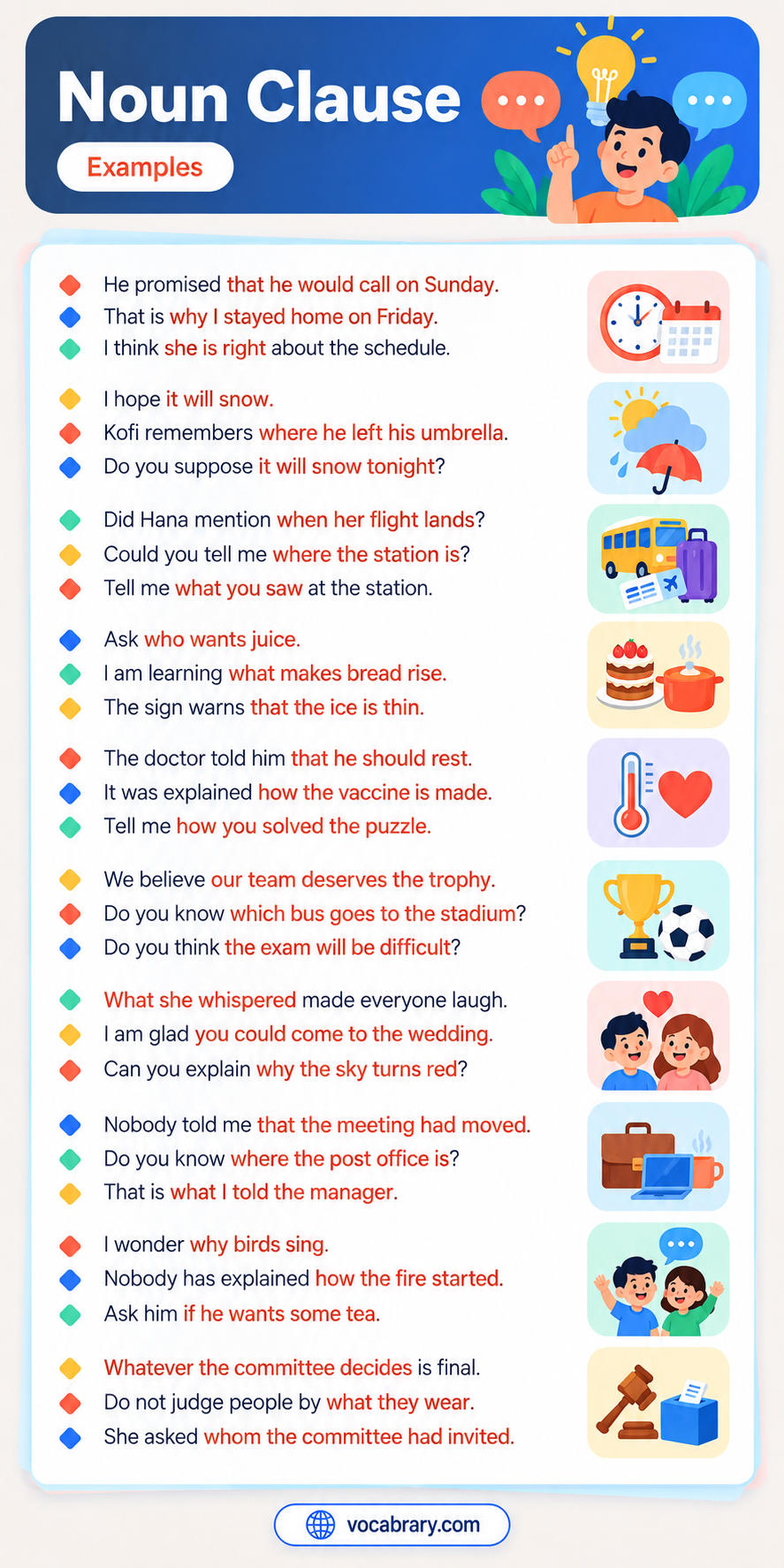
Noun Clause Examples for Everyday Use
Openers such as that, what, who, whether, and how begin a clause that stands where a noun would stand, as in “why the lights went out”, “whatever you decide”, and “which route we take”.
- Nobody knows why the lights went out.
- What Marta said surprised the whole committee.
- I hope that the train arrives on time.
- The teacher asked whether anyone had finished the exercise.
- Kofi remembers where he left his umbrella.
- Whoever finishes first wins a small prize.
- She wondered how the magician had escaped from the box.
- We understand that the shop closes at six.
- Whatever you decide will be fine with us.
- The detective discovered who had opened the window.
- Tomás told us what he had seen near the harbour.
- That the experiment failed disappointed the whole class.
- Please tell me when the concert begins.
- My sister does not care which route we take.
- The problem is that the battery is dead.
- Ingrid explained why she had changed her plans.
- I cannot believe how quickly the summer passed.
- They are still arguing about who should lead the project.
- He promised that he would call on Sunday.
- Nobody could say whose coat was left on the bench.
Function Sentences with Noun Clauses
Noun clauses function as subjects, objects, complements, and appositives, as in “that the plane would crash”, “how bees find flowers”, and “how the machine works”.
Noun Clause Examples as Subjects
At the start of a sentence, a noun clause names the subject of the verb, as in “that the bridge was closed”, “who left the gate open”, and “what Daniel cooked last night”.
- That the bridge was closed surprised the commuters.
- What she whispered made everyone laugh.
- Whether the team will travel depends on the weather.
- Why the old clock stopped remains a mystery to the family.
- Who left the gate open is still unknown.
- How the thief entered the building puzzled the police.
- Where we spend the holiday is entirely your decision.
- Whoever wrote this letter has beautiful handwriting.
- When the results will be published has not been announced.
- What Daniel cooked last night tasted better than any restaurant meal.
- That honesty pays is a lesson my father repeated every year.
- Which candidate wins the debate will shape the whole campaign.
- Whatever Amira paints sells quickly at the village market.
- Why anyone would climb the tower in a storm baffled the rescue crew.
Noun Clause Examples as Direct Objects
After a verb, a noun clause names the object, as in “that every student can improve”, “that the mayor had resigned”, and “who dropped the wallet”.
- Priya believes that every student can improve.
- The guide showed us where the river meets the sea.
- Hassan forgot what the teacher had assigned.
- I know who broke the window.
- The boy asked his mother if he could stay up late.
- The reporter learned that the mayor had resigned.
- She cannot decide which dress she should wear.
- We discovered how the machine works.
- Please check whether the door is locked.
- Lena told her brother what happened at the party.
- The pilot announced that the flight would be delayed.
- Joon-ho noticed that the paint had begun to peel.
- Nobody saw who dropped the wallet.
- Our neighbours decided where the new fence should stand.
- The coach said that practice starts at dawn.
- I will ask the waiter when the kitchen closes.
Noun Clause Examples as Subject Complements
Linking verbs such as is, was, or remains are followed by a noun clause, as in “that nobody saw the accident”, “what I told the manager”, and “how little the repair cost”.
- The truth is that nobody saw the accident.
- My main worry is whether the tickets will arrive in time.
- The question is who will pay for the repairs.
- Her wish was that her children would finish school.
- That is what I told the manager.
- The mystery remains why the bridge collapsed.
- This is where my grandfather grew up.
- The fact is that prices rose again in March.
- The surprise was how little the repair cost.
- Our plan is that we leave before sunrise.
- That is why I stayed home on Friday.
- The real issue is whether the committee can agree.
Noun Clause Examples as Objects of Prepositions
Prepositions such as about, over, for, and on are followed by a noun clause, as in “how bees find flowers”, “whether the bridge would hold”, and “whoever collects the most votes”.
- We talked about what the company should do next.
- Sakura is curious about how bees find flowers.
- The argument was over who deserved the trophy.
- You should pay attention to what the instructions say.
- Everyone worried about whether the bridge would hold.
- He is grateful for what his teachers did for him.
- She is certain of what she saw through the window.
- Our decision depends on how much money the club raises.
- The prize goes to whoever collects the most votes.
- Do not judge people by what they wear.
- Anil is thinking about where he wants to study.
- Give the parcel to whoever opens the door.
- I am not sure about why she left so early.
Noun Clause Examples as Appositives
A that clause follows a noun such as rumour, claim, news, or fact, as in “that the school will close”, “that kindness spreads quickly”, and “that the plane would crash”.
- The rumour that the school will close upset many parents.
- Nobody believed the claim that the river had changed its course overnight.
- She accepted the idea that practice builds skill faster than talent.
- The news that Omar had won a scholarship reached the village by evening.
- We heard the report that a storm was approaching the coast.
- Mei shared her belief that kindness spreads quickly.
- The fact that he apologised changed her mind.
- The proposal that the road should be widened divided the council.
- His fear that the plane would crash kept him awake.
- The doctor gave the warning that the medicine must be taken with food.
- Lucía rejected the suggestion that she had copied the essay.
Opening Word Sentences with Noun Clauses
Each clause begins with that, whether, a question word, or a word ending in -ever, as in “whoever needs a meal”, “which flavours were left”, and “whether the road is open”.
Noun Clause Examples with That
After verbs and adjectives such as said, glad, and sure, the clause begins with that, as in “that her cousins arrived safely”, “that the machine needs repair”, and “that the festival ends tomorrow”.
- Grandmother said that the soup needed more salt.
- Dina is glad that her cousins arrived safely.
- The scientists concluded that the water was safe to drink.
- Ravi is afraid that he left the stove on.
- It is obvious that the machine needs repair.
- We were surprised that the rain stopped so soon.
- The sign warns that the ice is thin.
- Aiko thinks that her brother plays the violin beautifully.
- It seems that the shop has moved to a new street.
- The lawyer argued that her client was never in the city.
- It is a pity that the festival ends tomorrow.
- Carlos is proud that his daughter finished the marathon.
- The report shows that sales doubled in two years.
- Hana was sure that the parcel would arrive by Monday.
Noun Clause Examples Without That
Leaving out that joins the clause directly to the verb or adjective, as in “she is right”, “the map was upside down”, and “it will snow tonight”.
- I think she is right about the schedule.
- Mehmet hopes the bus will come soon.
- We believe our team deserves the trophy.
- Ms Okafor said the exam was postponed.
- I am glad you could come to the wedding.
- They realised the map was upside down.
- Sofia knows her neighbour plays the piano at midnight.
- He promised he would return the book on Friday.
- Do you suppose it will snow tonight?
- I bet the shop has already closed.
- The boys felt the game was unfair.
- She assumed everyone had already left.
Noun Clause Examples with Whether and If
For a yes-or-no question inside a larger sentence, whether or if begins the clause, as in “if he wants some tea”, “whether the road is open”, and “if the library lends tablets”.
- I wonder whether the museum opens on Mondays.
- Ask him if he wants some tea.
- Nobody knows whether the signal will return before dark.
- The jury must decide whether the defendant is guilty.
- She asked whether I preferred tea or coffee.
- Whether the road is open depends on the snow.
- Kwame is not sure if the parcel has been sent.
- The question of whether schools should start later divides parents.
- I cannot tell whether he is joking or serious.
- Check if the oven is still on.
- They argued about whether the film was too long.
- Lola wants to know if the library lends tablets.
- He wondered whether or not the letter had arrived.
- The coach doubts whether the team will qualify.
Noun Clause Examples with Who and Whose
With who, whom, and whose, the clause names a person or a possessor, as in “who painted the mural”, “who wrote the anonymous letter”, and “who would drive us home”.
- Nobody knows who painted the mural.
- She asked whom the committee had invited.
- I cannot remember whose scarf this is.
- The teacher wondered who had left the door open.
- Who wrote the anonymous letter puzzled the family.
- Tell me whom you met at the conference.
- We still do not know whose idea the surprise party was.
- The photograph shows who was standing beside the mayor.
- Please say whom you want to sit beside.
- Detectives are trying to learn whose fingerprints are on the glass.
- He asked who would drive us home.
- It does not matter who calls first.
- Nobody is sure whose turn it is to cook.
Noun Clause Examples with What and Which
What or which begins the clause in “what you saw”, “what you should add first”, and “which flavours were left”.
- Tell me what you saw at the station.
- Nobody understood what the speaker meant.
- I cannot decide which jacket looks better.
- What the doctor recommended was a long rest.
- She showed me which button starts the engine.
- Kenji wondered what the noise in the attic was.
- Do you know which bus goes to the stadium?
- The recipe explains what you should add first.
- We argued over which film we should watch.
- Shirin asked what time the train leaves.
- The customer asked which flavours were left.
- I am learning what makes bread rise.
- What happened next shocked the audience.
- Check which tickets have already been sold.
- He told the police what he heard that night.
Noun Clause Examples with Where and When
Beginning with where, when, why, or how, the clause names a place, a time, a reason, or a manner, as in “where it hurts”, “when the shop opens”, and “how often the buses run”.
- Show me exactly where it hurts.
- Nobody remembers when the village was founded.
- Zainab explained why the meeting was cancelled.
- I will show you how the lock works.
- The map shows where the treasure is buried.
- Do you know when the shop opens?
- Mika could not understand why her phone kept freezing.
- He taught the children how birds build nests.
- When the parcel will arrive is not certain yet.
- Nobody asked how long the journey would take.
- Please explain how much the repairs will cost.
- She asked how often the buses run.
- Hugo wonders where all the pigeons go in winter.
- Tell me why you chose that university.
- I do not know how old the building is.
- The sign tells visitors where the path divides.
Noun Clause Examples with Whatever and Whoever
Words ending in -ever, such as whatever, whoever, whichever, and whomever, begin the clause in “whoever arrives first”, “whatever Selim chooses to cook”, and “whichever route you take”.
- Whoever arrives first should unlock the gate.
- You may eat whatever is left in the fridge.
- Please choose whichever seat you prefer.
- Whatever Selim chooses to cook is fine with me.
- Give the prize to whoever solves the puzzle.
- The cook serves whatever the farmers bring.
- Anna will invite whomever she chooses.
- Whichever route you take will lead to the lake.
- Take whatever you need from the shelf.
- I will support whoever wins the election.
- The shelter welcomes whoever needs a meal.
Reported Speech Sentences with Noun Clauses
Verbs such as said, told, replied, and asked repeat the words of a speaker, as in “that she was exhausted”, “that he should rest”, and “that the exam was cancelled”.
- Layla said that she was exhausted.
- The manager told the staff that the office would close early.
- Tom said he had finished the report.
- Aisha asked me where I had bought the lamp.
- The doctor told him that he should rest.
- The guard shouted that the gate was closing.
- She replied that she had never met the author.
- My uncle explained how the old engine had worked.
- The students reported that the heater was broken.
- He wondered aloud whether anyone had noticed his mistake.
- The announcer said that the match had been postponed.
- Nadia whispered that the exam was cancelled.
- Dev asked if the shop delivered on Sundays.
- The mayor promised that the road would be repaired by May.
Indirect Question Sentences with Noun Clauses
In indirect questions, a noun clause asks about or reports a question, as in “where the station is”, “what the visitors wanted”, and “when the bank opens”.
- Could you tell me where the station is?
- Do you know what time the film starts?
- I wonder how much this jacket costs.
- She asked why the train was late.
- Can you tell me who is sitting in the front row?
- Nobody asked what the visitors wanted.
- The clerk wanted to know how long we planned to stay.
- Do you remember where we parked the car?
- He asked what I did at weekends.
- Would you mind telling me when the bank opens?
- I do not understand why the printer stopped working.
- Tell me how you solved the puzzle.
- I would like to know which platform the Leeds train leaves from.
- Do you have any idea who owns this bicycle?
Negative Sentences with Noun Clauses
The main clause contains not, never, or nobody.
- I do not know where the keys are.
- She did not say that she was leaving.
- Nobody understands why the printer stops at noon.
- He never explained how he opened the safe.
- We did not realise that the shop was closed.
- They did not tell us what the surprise was.
- I do not think it will rain this afternoon.
- Rosa does not remember who gave her the book.
- The report does not show whether the test succeeded.
- Nobody told me that the meeting had moved.
- It is not known who painted the portrait.
- Jin did not ask how much the ticket would cost.
Question Sentences with Noun Clauses
Ending with a question mark, each sentence contains a noun clause, as in “where the post office is”, “what you will wear tonight”, and “when her flight lands”.
- Do you know where the post office is?
- Did she say that she would come?
- Can you explain why the sky turns red?
- Does anyone remember who won the quiz last year?
- Is it true that the museum is free on Sundays?
- Have you decided what you will wear tonight?
- Who told you that the concert was cancelled?
- Will the manager say whether the vacancy is filled?
- Did Hana mention when her flight lands?
- Do you think the exam will be difficult?
- Are you sure that the door is locked?
- Why does it matter who sits at the head of the table?
Passive Sentences with Noun Clauses
Passive constructions use a verb such as announced, believed, decided, or told, as in “that three villages lost power” and “how the vaccine is made”.
- It was announced that the school would reopen in August.
- It is believed that the painting is over two centuries old.
- It was decided that the festival should move indoors.
- It has been reported that three villages lost power.
- It is known that the river floods in spring.
- It was explained how the vaccine is made.
- Students were told that the exam had been moved.
- It was agreed where the new library would stand.
- It is said that the old mill is haunted.
- We were informed that the flight would leave late.
Context Sentences with Noun Clauses
Settings range from homes and classrooms to offices, journeys, newsrooms, stories, stadiums, and clinics.
Noun Clause Examples for Home Life
At home, the clauses describe meals, repairs, pets, and lost objects, as in “whether we had fed the cat”, “who put the ladder in the hallway”, and “that the roof needs repairs before winter”.
- My mother asked whether we had fed the cat.
- What Grandpa cooks on Sundays disappears within minutes.
- Nobody remembers who put the ladder in the hallway.
- The twins argued over which of them had broken the lamp.
- Dad says that the roof needs repairs before winter.
- I cannot find where I put the spare key.
Noun Clause Examples for School Life
In the classroom, the clauses describe lessons, exams, pupils, and announcements, as in “how a fraction becomes a decimal”, “what the students learned in the lab”, and “who won the spelling contest”.
- The teacher explained how a fraction becomes a decimal.
- Yusuf wondered whether the exam would include the poem.
- What the students learned in the lab surprised their parents.
- Ms Duarte told the class that homework was due on Thursday.
- Several pupils still do not know who won the spelling contest.
- The headmaster announced that the sports day had moved to Friday.
Noun Clause Examples for Work
At the office, the clauses describe reports, contracts, clients, and teams, as in “whoever signs the contract first” and “why the delivery was late”.
- The manager wants to know when the report will be ready.
- Whoever signs the contract first gets a discount.
- Our clients asked why the delivery was late.
- The intern realised that she had sent the email to the wrong address.
- It is not yet decided who will lead the new team.
- Leila explained how the accounting software handles refunds.
Noun Clause Examples for Travel
On the road, the clauses describe trains, ferries, hotels, and drivers, as in “where the nearest ferry stops” and “where we stay in Lisbon”.
- The conductor told us that the train to Porto leaves from platform four.
- Tourists often ask where the nearest ferry stops.
- We could not decide which hotel was closer to the beach.
- Where we stay in Lisbon depends on the price.
- The guidebook says that the market opens before sunrise.
- Please tell the driver where you want to get off.
Noun Clause Examples for News Reports
In news reports, the clauses describe councils, bridges, repairs, and fires, as in “who paid for the repairs”, “why the ferry sank”, and “how the fire started”.
- The newspaper reported that the council had approved the new library.
- Residents want to know who paid for the repairs.
- Why the ferry sank is still being investigated by the coastal authority.
- Officials confirmed that the bridge would reopen on Monday.
- Nobody has explained how the fire started.
- The mayor denied that any money had gone missing.
Noun Clause Examples for Stories
Narrators, sailors, heroes, and kings appear in the clauses of stories, as in “what the old sailor whispers” and “where his daughter has gone”.
- In the novel, Elena discovers that her mother wrote the letters.
- The narrator never reveals who buried the chest beneath the oak.
- What the old sailor whispers becomes the clue to the whole story.
- The poem asks whether memory is a gift or a burden.
- The hero learns how the dragon lost its voice.
- The story ends with the king asking where his daughter has gone.
Noun Clause Examples for Sports
On the pitch, the clauses describe coaches, referees, fans, and teams, as in “whoever scores first”, “which goalkeeper deserved the award”, and “that endurance wins long races”.
- The coach asked whether the striker was fit to play.
- Whoever scores first will gain a big advantage.
- Fans argued about which goalkeeper deserved the award.
- The referee explained why he cancelled the goal.
- Samir knows that endurance wins long races.
- Nobody expected that the underdogs would reach the semifinal.
Noun Clause Examples for Health
Clauses about health describe nurses, medicine, tests, and patients, as in “whether the tablets cause drowsiness”, “what you eat at breakfast”, and “when the test results arrive”.
- The nurse explained how often the medicine should be taken.
- Doctors recommend that patients drink plenty of water.
- Ahmed asked the pharmacist whether the tablets cause drowsiness.
- What you eat at breakfast affects your energy until noon.
- The clinic will tell you when the test results arrive.
- She realised that her cough had lasted for three weeks.
Kids and Student Sentences with Noun Clauses
Levels range from short sentences for beginners to formal sentences for exam answers.
Noun Clause Examples for Kids
For kids, short clauses contain everyday words, as in “he is kind”, “where the cat is”, and “why birds sing”.
- I know he is kind.
- Mum said we can go.
- I see what you made.
- Tell me where the cat is.
- I hope it will snow.
- Ask who wants juice.
- I wonder why birds sing.
- Dad knows how the toy works.
- Look at what I found!
- She thinks the dog is funny.
Noun Clause Examples for Exams
Exam answers use formal wording about research, essays, and surveys, as in “what it values most”, “that language shapes thought”, and “which factors caused the delay”.
- The author argues that urbanisation weakens traditional family structures.
- Whether renewable energy can replace coal entirely remains a question for economists.
- The survey revealed that most pupils prefer practical lessons.
- What a government spends on schools reflects what it values most.
- Researchers disagree about why the population of the island declined.
- That language shapes thought is a claim the linguist defends with three experiments.
- The essay explains how the printing press changed public opinion.
- It is essential that every candidate arrive before nine o’clock.
- The report does not specify which factors caused the delay.
- Historians still debate whether the treaty prevented or postponed the war.
FAQs
Some noun clause examples in a sentence are "Nobody knows why the lights went out," "I hope that the train arrives on time," and "Whoever finishes first wins a small prize." Each noun clause names a reason, a fact, or a person in the position of a single noun. The three sentences use why, that, and whoever.
You use a noun clause in a sentence wherever a noun would stand, as a subject, an object, or a complement. "That the bridge was closed surprised the commuters" has a clause subject, and "Priya believes that every student can improve" has a clause object. "The truth is that nobody saw the accident" has a clause complement.
Noun clause examples as subjects begin with a clause that names who or what the sentence is about. "What she whispered made everyone laugh" and "Who left the gate open is still unknown" are two models. "Whoever wrote this letter has beautiful handwriting" is a third.
Noun clause examples with that follow verbs and adjectives such as said, glad, and concluded. "Grandmother said that the soup needed more salt" and "Dina is glad that her cousins arrived safely" are two models. "The scientists concluded that the water was safe to drink" is a third.
Noun clause examples with whether and if state a yes-or-no question inside a longer sentence. "I wonder whether the museum opens on Mondays" and "Ask him if he wants some tea" are two models. "Kwame is not sure if the parcel has been sent" is a third.
Noun clause examples with who, what, and where begin the clause with a question word. "Nobody knows who painted the mural" and "Tell me what you saw at the station" are two models. "Show me exactly where it hurts" is a third.
Noun clause examples in reported speech repeat what a speaker said, asked, or promised. "Layla said that she was exhausted" and "The manager told the staff that the office would close early" are two models. "Aisha asked me where I had bought the lamp" reports a question.
Noun clause examples in indirect questions ask about a fact through a polite or reported question. "Do you know what time the film starts?" and "Could you tell me where the station is?" are two models. "I wonder how much this jacket costs" is a third.
Noun clause examples with whoever and whatever name any person or any object that fits the clause. "Whoever arrives first should unlock the gate" and "You may eat whatever is left in the fridge" are two models. "Take whatever you need from the shelf" is a third.
Noun clause examples for kids use short clauses and everyday words. "I know he is kind" and "Mum said we can go" are two models. "Look at what I found" is a third.
Related:

Leave a Comment