
A participle clause is a clause formed with a present participle, a past participle, or having plus a past participle that adds an action, a reason, or a description to the main clause. These 300 participle clause examples are written for present, past, and perfect participles, time, reason, result, condition, concession, questions, and everyday contexts from home to sports. You get model sentences for writing, speaking, and exam practice, together with related practice on participial phrases, relative clauses, and absolute phrases.
Quick Answer: Participle Clause Examples
- Present participle: Walking along the beach, Omar collected shells.
- Past participle: Surrounded by hills, the village stays cool in summer.
- Perfect participle: Having finished her homework, Lena went out to play.
- Time: Closing the gate, Hugo checked the latch twice.
- Reason: Feeling hungry, Tara made a sandwich.
- Result: The river overflowed, covering the low fields.
- Condition: Cooked slowly, the beans become very soft.
- Concession: Though tired from the journey, Mira joined the dinner.
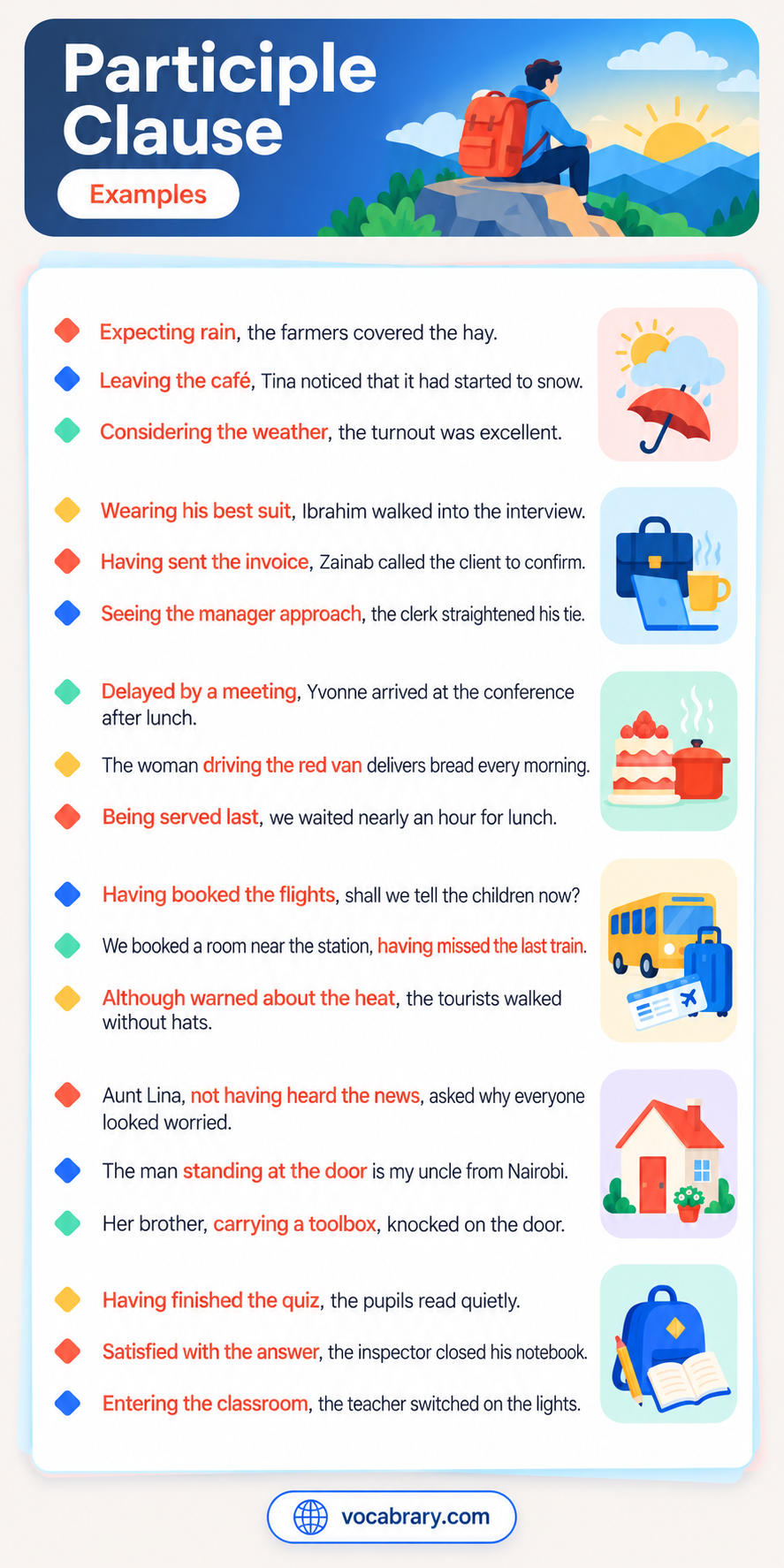
Participle Clause Examples for Everyday Use
A participle adds an action, a state, or a reason to the main clause, as in “walking home along the canal”, “surprised by the noise”, and “seeing the manager approach”.
- Walking home along the canal, I met a friend from primary school.
- Tired from the trip, Aiko slept until noon.
- Having finished the report, Omar left the office early.
- Opening the window, Grace let in the cool evening air.
- Surprised by the noise, the cat jumped off the sofa.
- Having lost the key, Tomas climbed through the kitchen window.
- Two students shared one umbrella, waiting for the bus.
- Written in a hurry, the letter contained three spelling mistakes.
- Not wanting to wake the baby, Priya closed the door quietly.
- Seeing the manager approach, the clerk straightened his tie.
- Born in a small village, Chen grew up speaking two dialects.
- Having studied French for years, Lucia found the interview comfortable.
- Grandpa stood by the garden gate, holding a cup of tea.
- Disappointed by the result, the coach thanked the fans anyway.
Form Sentences with Participle Clauses
Four forms of the participle are used: present, past, perfect, and passive, as in “being surrounded by reporters”, “having checked the oven”, and “exhausted after the marathon”.
Participle Clause Examples with Present Participles
Present participles use an -ing form for an action by the subject, as in “singing loudly”, “feeling nervous”, and “cooking dinner for ten guests”.
- Singing loudly, the children marched across the playground.
- Looking at the map, Kofi found a shorter route to the station.
- Standing on the balcony, Elena watched the fireworks over the harbour.
- He dropped his phone on the platform, running for the train.
- Feeling nervous, Dev rehearsed his speech once more.
- Smiling at the camera, the twins held up their certificates.
- Carrying two heavy bags, Mrs Alvarez climbed the stairs slowly.
- Hearing footsteps behind her, Nora turned around quickly.
- Driving through the desert, we saw a herd of camels near the road.
- Cooking dinner for ten guests, Hassan used every pot in the kitchen.
- Working late every night, Ingrid finished the project before the deadline.
- Shouting with excitement, the fans rushed onto the pitch.
- Reading under the lamp, Mei forgot about the time.
- Expecting rain, the farmers covered the hay.
Participle Clause Examples with Past Participles
A past participle describes a state or something done to the subject, as in “painted bright yellow”, “dressed in a green coat”, and “seen from the hill”.
- Painted bright yellow, the old bus looked cheerful in the sunshine.
- Covered in snow, the mountain glowed in the morning light.
- Exhausted after the marathon, Sipho fell asleep on the bus.
- Frightened by the thunder, the puppy hid under the table.
- Stolen from a small museum years ago, the painting has never been recovered.
- Dressed in a green coat, Yuki stood out in the crowd.
- Satisfied with the answer, the inspector closed his notebook.
- Left alone in the house, the dog barked until evening.
- Seen from the hill, the town looked like a toy village.
- Worried about the exam, Karim revised until midnight.
- Delighted with her new bicycle, Zara rode it round the block twice.
- Raised by their grandmother, the two brothers spoke three languages by the age of ten.
Participle Clause Examples with Perfect Participles
Having plus a past participle names something that happened before the main action, as in “having eaten breakfast”, “having missed the last train”, and “having failed the test once”.
- Having eaten breakfast, the hikers started up the trail.
- Having locked the shop, Mr Okafor walked to the bus stop.
- Chloe, having spent all her savings, borrowed money from her sister.
- Having read the instructions twice, Leo assembled the shelf without help.
- Having lived in Cairo for years, Salma knew the best bakeries.
- We booked a room near the station, having missed the last train.
- Having won the first set, Anika relaxed too soon.
- Dad, having checked the oven, put the bread inside.
- Having failed the test once, Rafael studied harder the second time.
- The scouts, having walked ten kilometres, were glad to rest.
- Having heard the weather forecast, Liam packed an umbrella.
- Mr Reyes closed the shop, having sold every loaf.
Participle Clause Examples with Being and Having Been
Being or having been is followed by a past participle, as in “being asked to leave”, “being served last”, and “being shown the wrong room”.
- Being asked to leave, the visitors gathered their coats.
- Having been warned about the storm, the sailors stayed in harbour.
- Being left out of the team, Nikos felt hurt.
- Having been trained by experts, the new guides handled the crowd calmly.
- Being served last, we waited nearly an hour for lunch.
- Having been refused a visa, Olu postponed the conference.
- Being watched by the whole class, Pedro forgot his lines.
- Having been repaired twice, the old clock now keeps perfect time.
- Being shown the wrong room, the guests returned to the front desk.
- Having been invited to the ceremony, Dr Mensah booked a flight at once.
- Being surrounded by reporters, the mayor stopped speaking.
- Having been built on soft ground, the tower leans slightly to the east.
Meaning Sentences with Participle Clauses
Time, reason, result, condition, and concession are the meanings of the participle clause, as in “although written fifty years ago”, “left in direct sunlight”, and “knowing the road was icy”.
Participle Clause Examples of Time
The participle clause names an action that happens before or at the same time as the main action, as in “crossing the bridge”, “turning the corner”, and “reaching the summit”.
- Crossing the bridge, we noticed a heron in the shallow water.
- Having paid the bill, Ravi left a tip on the table.
- Hearing the alarm, the staff walked calmly to the exit.
- Turning the corner, Isla almost bumped into the postman.
- Having stirred the sauce, Marco added a pinch of salt.
- Entering the hall, the guests fell silent.
- Having cleared the table, the girls washed the dishes.
- Reaching the summit, the climbers took photographs of the valley.
- Having taken his medicine, Grandpa went to bed early.
- Leaving the café, Tina noticed that it had started to snow.
- Having signed the form, Mr Tan handed it to the clerk.
Participle Clause Examples of Reason
Reasons for the main action or state are given in the participle clause, as in “not knowing the address”, “having no umbrella”, and “having lost his passport”.
- Not knowing the address, the courier called the customer.
- Being short of money, Andre cancelled his holiday.
- Feeling dizzy, Hana sat down on the nearest bench.
- Having no umbrella, we waited under a shop awning.
- Being a nurse, Ada recognised the symptoms at once.
- The organisers began the meeting ten minutes early, fearing a delay.
- Knowing the road was icy, Dad drove at half his usual speed.
- Having lost his passport, Ben spent the morning at the embassy.
- Wanting a quiet evening, Sofia switched off her phone.
- Realising her mistake, the cashier returned the extra change.
- Being the youngest in the team, Kwame carried the heaviest bag.
Participle Clause Examples of Result
Ending the sentence, a participle clause names the result of the main action, as in “flooding the whole kitchen”, “shattering on the tiled floor”, and “ruining the farmers’ wheat harvest”.
- The pipe burst, flooding the whole kitchen.
- A tree fell across the track, causing a long delay.
- The storm struck at midnight, leaving the roads icy.
- Prices rose sharply last winter, forcing many families to cut costs.
- The glass slipped from her hand, shattering on the tiled floor.
- The goalkeeper missed the ball, handing the visitors an easy goal.
- Heavy rain fell all week, ruining the farmers’ wheat harvest.
- Lightning hit the transformer, cutting power to the entire street.
- The company hired fifty new workers, doubling its output within a year.
- A thick fog covered the airport, grounding every morning flight.
Participle Clause Examples of Condition
The participle clause states a condition for the result in the main clause, as in “used properly”, “left in direct sunlight”, and “seen in poor light”.
- Used properly, the machine will last for ten years.
- Taken twice a day, these tablets reduce the swelling quickly.
- Heated gently, the chocolate melts without burning.
- Left in direct sunlight, the paint fades within a month.
- Planted in spring, the seeds grow quickly in warm soil.
- Handled with care, glass bottles can be reused many times.
- Seen in poor light, the stain looks black rather than blue.
- Given a fair chance, Mia would win the race.
- Kept in the fridge, fresh pasta stays good for three days.
- Served with rice, the curry makes a full meal.
Participle Clause Examples of Concession
A fact that contrasts with the main clause is stated by the participle clause, as in “although feeling ill”, “Admitting his mistake”, and “though badly injured”.
- Although feeling ill, Dara finished the whole race.
- Though living far from the sea, the family ate fresh fish every week.
- Although having studied all night, Tom still failed the quiz.
- Admitting his mistake, the manager still refused to resign.
- Although warned about the heat, the tourists walked without hats.
- Though born into wealth, Amara chose a life of teaching.
- Although trained as a chef, Paolo now repairs bicycles.
- Though badly injured, the goalkeeper played until the final whistle.
- Although given three chances, the applicant missed every answer.
- Though knowing the answer, Hye-jin kept quiet during the debate.
- Although written fifty years ago, the novel still feels modern.
Noun Modifier Sentences with Participle Clauses
Directly after a noun, the participle clause describes it, as in “standing at the door”, “built before 1950”, and “baked at the corner shop”.
- The man standing at the door is my uncle from Nairobi.
- The letter written in red ink belongs to the headmaster.
- Passengers travelling to Lisbon should go to gate twelve.
- The girl sitting by the window won the regional spelling contest.
- Houses built before 1950 need new wiring.
- Anyone wishing to join the club must sign the form.
- The woman driving the red van delivers bread every morning.
- Students caught cheating will lose their marks.
- The bread baked at the corner shop sells out by nine.
- Boys playing in the street must watch for cars.
- The photographs taken during the wedding are in the blue album.
- People living near the river received a flood warning.
- Any parcel left unattended will be removed by security.
Conjunction Sentences with Participle Clauses
Conjunctions such as while, after, before, since, when, once, if, unless, and although begin the participle clause, as in “while driving through the tunnel”, “while waiting for the doctor”, and “unless told otherwise”.
- Please switch off your phone while driving through the tunnel.
- After leaving school, Jamal worked on his uncle’s fishing boat.
- Before signing the contract, Ms Novak asked her lawyer to read it.
- Since moving to Toronto, Aisha has made many friends.
- While waiting for the doctor, Leila filled in the form.
- When asked about the delay, the pilot apologised politely.
- Once completed, the bridge will connect the two islands.
- If left alone, the toddler will play with the blocks for an hour.
- Unless told otherwise, the guards will lock the gates at ten.
- Although living in Madrid, Pavel still supports his home team.
- I bring a box of dates when visiting my aunt.
- While cleaning the attic, Rosa found her grandmother’s diary.
Position Sentences with Participle Clauses
The participle clause comes at the start, in the middle, or at the end of a sentence.
Participle Clause Examples at the Start
At the start of a sentence, the participle clause is followed by a comma, as in “opening the curtains”, “having crossed the border”, and “offered a free ticket”.
- Opening the curtains, Jo saw a rainbow over the roofs.
- Excited by the news, the children cheered.
- Having crossed the border, the drivers stopped for fuel.
- Wearing his best suit, Ibrahim walked into the interview.
- Offered a free ticket, Lena accepted at once.
- Opening the oven, Chef Marta smelled burnt sugar.
Participle Clause Examples in the Middle
After the subject, the participle clause is set inside commas, as in “exhausted by the heat”, “having missed the bus”, and “encouraged by the crowd”.
- The tourists, exhausted by the heat, rested under a tree.
- Our teacher, smiling broadly, handed back the exams.
- My cousin, having missed the bus, walked to the office.
- The driver, not knowing the road, stopped to ask.
- The runners, encouraged by the crowd, sprinted the last lap.
- Her brother, carrying a toolbox, knocked on the door.
Participle Clause Examples at the End
Ending the sentence, the participle clause follows the main clause, as in “listening to the rain”, “slamming the door”, and “purring softly”.
- Hana sat on the steps, listening to the rain.
- The boys ran across the field, laughing and shouting.
- She left the room, slamming the door.
- We spent the evening at the beach, watching the boats.
- The cat lay on the rug, purring softly.
- Ahmed walked home, humming a tune.
Negative Sentences with Participle Clauses
Not or never comes before the participle, as in “not having eaten since dawn”, “not understanding the question”, and “not having enough time”.
- Not having eaten since dawn, the hikers devoured the sandwiches.
- Never having seen snow, Kemal ran into the garden in his slippers.
- Not being able to swim, Olga stayed near the shore.
- Not understanding the question, Felix asked the teacher to repeat it.
- The guests left quietly, not wishing to cause trouble.
- Never having driven in a city, Yara chose the slow lane.
- Not being invited to the party, Jin spent the evening reading.
- Not having enough time, we skipped the museum café.
- Aunt Lina, not having heard the news, asked why everyone looked worried.
- Ewa ordered only a glass of water, not feeling hungry.
- Not wanting to disturb the meeting, Haruto waited in the corridor.
Question Sentences with Participle Clauses
Questions begin with a participle clause and end in a question, as in “feeling tired”, “having seen the results”, and “born in Lagos”.
- Feeling tired, did you still go to the gym last night?
- Having read the contract, do you understand the penalty clause?
- Walking to school, did Tariq see the accident on Elm Street?
- Having seen the results, will the committee change its plan?
- Not knowing the answer, why did you stay silent?
- Waiting at the airport, what did the passengers do for six hours?
- Born in Lagos, how did she come to study in Oslo?
- Having booked the flights, shall we tell the children now?
- Seeing the empty shelves, did the shopkeeper call the police?
- Left alone in the lab, what did the intern discover?
Reported Speech Sentences with Participle Clauses
A participle clause is used inside a reported statement, as in “having finished the report”, “hearing a loud bang”, and “walking along the beach”.
- Sara said that, having finished the report, she would leave early.
- The guide explained that, not knowing the weather forecast, the group had packed extra coats.
- Ali told us that, feeling ill, he had gone home before lunch.
- The witness reported that, hearing a loud bang, she had looked out of the window.
- Mr Park announced that, having been promoted, he would move to Seoul.
- She admitted that, having lost her ticket, she had paid the fare twice.
- The mechanic said that, using the right tool, he could repair the engine in an hour.
- Mina wrote that, walking along the beach, she had found a rare shell.
- The coach claimed that, trained properly, the squad would win the league.
- The teacher replied that, given more time, the class would finish the project.
- Tom told the officer that, not having seen the sign, he had parked there.
Fixed Expression Sentences with Participle Clauses
Fixed expressions comment on the whole sentence, as in “Judging by the clouds”, “taking everything into account”, and “Generally speaking”.
- Judging by the clouds, it will rain before noon.
- Strictly speaking, a tomato is a fruit.
- Considering the weather, the turnout was excellent.
- Speaking of food, have you tried the new noodle bar?
- Taking everything into account, the plan was a success.
- Putting it mildly, the delay was annoying.
- Roughly speaking, the trip takes three hours.
- Given the circumstances, the committee acted wisely.
- Generally speaking, cats sleep longer than dogs.
- Judging by her smile, the interview went well.
- Broadly speaking, the festival was a success.
- Frankly speaking, the soup needed more salt.
Same Subject Sentences with Participle Clauses
One person or group performs both the action in the participle clause and the action in the main clause, as in “entering the classroom”, “opening the box”, and “having seen the damage”.
- Entering the classroom, the teacher switched on the lights.
- Finishing his coffee, Ravi grabbed his coat.
- Having rehearsed for weeks, the choir sang without mistakes.
- Opening the box, Dana found a note from her brother.
- Reading the report, the editor found several errors.
- Crossing the street, the boy waved to his mother.
- Having seen the damage, the inspector ordered repairs.
- Packing her suitcase, Mina realised that her passport was missing.
- Standing at the gate, Luis could see the whole stadium.
- Hoping for a better price, the seller waited another week.
Context Sentences with Participle Clauses
Homes, classrooms, offices, journeys, newsrooms, stories, sports, and clinics are the settings for the participle clauses.
Participle Clause Examples for Home Life
At home, the clauses describe cooking, cleaning, and family evenings, as in “stirring the soup”, “having washed the windows”, and “given a new key”.
- Stirring the soup, Grandma hummed an old folk song.
- Tired after the long day, Dad fell asleep in the armchair.
- Having washed the windows, Mum hung the curtains back up.
- Hearing the doorbell, the dog rushed to the hall.
- Spilling milk across the floor, little Ravi began to cry.
- Given a new key, Beatriz opened the garage herself.
- Not wanting to waste food, Aunt Rosa froze the leftovers.
- The family played cards until ten, sitting by the fireplace.
Participle Clause Examples for School Life
In the classroom, the clauses describe lessons, quizzes, and pupils, as in “raising her hand”, “confused by the instructions”, and “not having studied the chapter”.
- Raising her hand, Nia asked about the homework.
- Having finished the quiz, the pupils read quietly.
- Confused by the instructions, Marcus asked for an example.
- Walking into the lab, the students put on their goggles.
- Praised by the headmaster, the choir smiled proudly.
- Not having studied the chapter, Ivan guessed several answers.
- Sitting at the back, Elif could barely hear the teacher.
- Given a longer break, the slower writers finished the essay.
Participle Clause Examples for Work
At the office, the clauses describe budgets, invoices, and deadlines, as in “reviewing the budget”, “working from home”, and “hired last spring”.
- Reviewing the budget, the accountant spotted a mistake in the totals.
- Having sent the invoice, Zainab called the client to confirm.
- Working from home, Pieter saved two hours on his commute.
- Delayed by a meeting, Yvonne arrived at the conference after lunch.
- Not receiving a reply, the manager sent a second email.
- Hired last spring, the designer already leads three projects.
- Having trained the new staff, Mr Das took a short holiday.
- Facing a tight deadline, the team skipped their lunch break.
Participle Clause Examples for Travel
On the road, the clauses describe gates, hotels, and delays, as in “waiting at the gate”, “delayed by fog”, and “having lost her luggage”.
- Waiting at the gate, we watched planes land one after another.
- Having booked a window seat, Noor enjoyed the view of the Alps.
- Delayed by fog, the ferry reached the island at midnight.
- Travelling through Vietnam, the couple tried a new noodle dish each day.
- Not speaking the language, Greta pointed at the menu.
- Having lost her luggage, Tamsin reported it at the desk.
- Stuck in traffic, the taxi driver turned off the engine.
- Arriving at the hotel, the guests were offered cold juice.
Participle Clause Examples for News Reports
In news reports, the clauses describe ministers, councils, and reports, as in “speaking at the summit”, “having lost the vote”, and “not expecting such a crowd”.
- Speaking at the summit, the minister promised new schools.
- Damaged by the flood, the bridge will stay closed until spring.
- Having lost the vote, the council withdrew its plan.
- Responding to the criticism, the company apologised in a short statement.
- Seen by millions of viewers, the interview changed the debate.
- Not expecting such a crowd, police closed three streets.
- Released this morning, the report criticises the old system.
- Having reviewed the evidence, the court dismissed the case.
Participle Clause Examples for Stories
Stories use participle clauses for lanterns, knights, and strangers, as in “Clutching the lantern”, “lost in the forest”, and “having lost his sword”.
- Clutching the lantern, Elara crept down the cellar steps.
- Having sworn to keep the secret, the knight rode north in silence.
- Lost in the forest, the children followed the sound of a stream.
- Not daring to breathe, the detective watched the door handle turn.
- Dressed as a merchant, the prince slipped through the city gates.
- Hearing a howl in the dark, the shepherd gathered his flock.
- Having lost his sword, the captain fought with a broken oar.
- Wrapped in a grey cloak, the stranger vanished into the mist.
Participle Clause Examples for Sports
In sport, the clauses describe strikers, teams, and finals, as in “Sprinting down the wing”, “injured in the first half”, and “pushed by the wind”.
- Sprinting down the wing, Diallo crossed the ball into the box.
- Having won the semi-final, the team celebrated with a quiet dinner.
- Injured in the first half, the striker watched the rest from the bench.
- Trailing by two goals, the home side changed its tactics.
- Not having played for months, the veteran needed time to find his rhythm.
- Pushed by the wind, the sailing boat crossed the line first.
- Warming up before the final, the swimmers stayed silent.
- Beaten by a single point, the rowers shook hands with the winners.
Participle Clause Examples for Health
At the clinic, the clauses describe pain, medicine, and recovery, as in “feeling a sharp pain”, “advised to rest”, and “treated early”.
- Feeling a sharp pain, Mr Obi called his doctor.
- Having taken the antibiotics for a week, Kira felt much stronger.
- Advised to rest, the athlete skipped training.
- Recovering from surgery, Grandpa walks around the garden each morning.
- Not eating enough protein, Kofi felt weak all week.
- Treated early, the infection healed within days.
- Checking her blood pressure, the nurse noted a small rise.
- Worried about his heart, Samir booked a full check-up.
Kids and Student Sentences with Participle Clauses
The wording ranges from short beginner sentences to formal exam answers.
Participle Clause Examples for Kids
For kids, participle clauses contain one to three words, as in “smiling”, “scared”, and “Sniffing”.
- Smiling, she waved.
- Tired, the puppy slept.
- Singing, Ben danced.
- Jumping up, Mia cheered.
- Scared, the cat hid.
- Eating lunch, we chatted.
- Having played, they rested.
- Waving goodbye, Dad left.
- Sniffing, the bear searched.
- Laughing loudly, the baby clapped.
- Wearing red boots, Sam splashed in puddles.
- Given a balloon, Lily giggled happily.
Participle Clause Examples for Exams
Formal wording about research, history, and literature is used in exam answers, as in “compared with earlier studies”, “faced with rising costs”, and “using a larger sample”.
- Having analysed the data from three experiments, the researchers concluded that the method was unreliable.
- Written in the early nineteenth century, the novel criticises the class system of its time.
- Not having considered the long-term effects, the council approved an unsafe plan.
- Compared with earlier studies, the new survey shows a sharper decline in reading.
- Having been denied access to the archive, the historian relied on private letters.
- Faced with rising costs, many small firms reduced their working hours.
- Using a larger sample, the second team obtained more reliable results.
- Seen in this light, the poet’s silence becomes a form of protest.
- Having established the main argument, the writer supports it with three examples.
- Published two decades ago, the study remains widely quoted in textbooks.
FAQs
Some participle clause examples in a sentence are "Walking home along the canal, I met a friend from primary school," "Tired from the trip, Aiko slept until noon," and "Having finished the report, Omar left the office early." Each clause uses a participle to add an action or a state to the main clause. The three sentences use a present, a past, and a perfect participle.
You use a participle clause in a sentence to add an action, a reason, or a description to the main clause. "Opening the window, Grace let in the cool evening air" adds an action, and "Not wanting to wake the baby, Priya closed the door quietly" adds a reason. "Surprised by the noise, the cat jumped off the sofa" adds a state.
Participle clause examples with present participles use an -ing form for an action by the subject. "Singing loudly, the children marched across the playground" and "Looking at the map, Kofi found a shorter route to the station" are two models. "Cooking dinner for ten guests, Hassan used every pot in the kitchen" is a third.
Participle clause examples with past participles describe a state or something done to the subject. "Painted bright yellow, the old bus looked cheerful in the sunshine" and "Covered in snow, the mountain glowed in the morning light" are two models. "Worried about the exam, Karim revised until midnight" is a third.
Participle clause examples with perfect participles use having plus a past participle for something that happened first. "Having eaten breakfast, the hikers started up the trail" and "Having locked the shop, Mr Okafor walked to the bus stop" are two models. "Having heard the weather forecast, Liam packed an umbrella" is a third.
Participle clause examples of time name an action that happens before or during the main action. "Crossing the bridge, we noticed a heron in the shallow water" and "Entering the hall, the guests fell silent" are two models. "Reaching the summit, the climbers took photographs of the valley" is a third.
Participle clause examples of reason give the cause of the main action or state. "Not knowing the address, the courier called the customer" and "Feeling dizzy, Hana sat down on the nearest bench" are two models. "Knowing the road was icy, Dad drove at half his usual speed" is a third.
Participle clause examples of result end with a participle that names what the main action caused. "The pipe burst, flooding the whole kitchen" and "A tree fell across the track, causing a long delay" are two models. "The storm struck at midnight, leaving the roads icy" is a third.
Negative participle clause examples use not or never before the participle. "Not having eaten since dawn, the hikers devoured the sandwiches" and "Never having seen snow, Kemal ran into the garden in his slippers" are two models. "Not being able to swim, Olga stayed near the shore" is a third.
Participle clause examples for kids use short clauses of one to three words. "Wearing red boots, Sam splashed in puddles" and "Given a balloon, Lily giggled happily" are two models. "Smiling, she waved" is a shorter sentence for beginners.
Related:

Leave a Comment