
A participial phrase is a present or past participle with its objects and modifiers, and it describes a noun or pronoun, as in standing by the window and covered in dust. These 300 participial phrase examples are written for present, past, perfect, negative, and passive forms, positions before and after nouns, questions, and everyday contexts from home to sports. You get model sentences for speaking, writing, and exam practice, together with related practice on participle clauses, gerund phrases, and absolute phrases.
Quick Answer: Participial Phrase Examples
- Present participle: The woman carrying the baby is my aunt.
- Past participle: The house built on the hill has a fine view.
- Perfect participle: Having locked the shop, Rami went home.
- Passive form: Being asked to sing, the child blushed.
- Negative form: Not knowing the way, we asked a stranger.
- Before a noun: The newly painted gate shone in the sun.
- Between commas: My cousin, working in Madrid, calls every Sunday.
- After a pronoun: Those standing near the door left first.
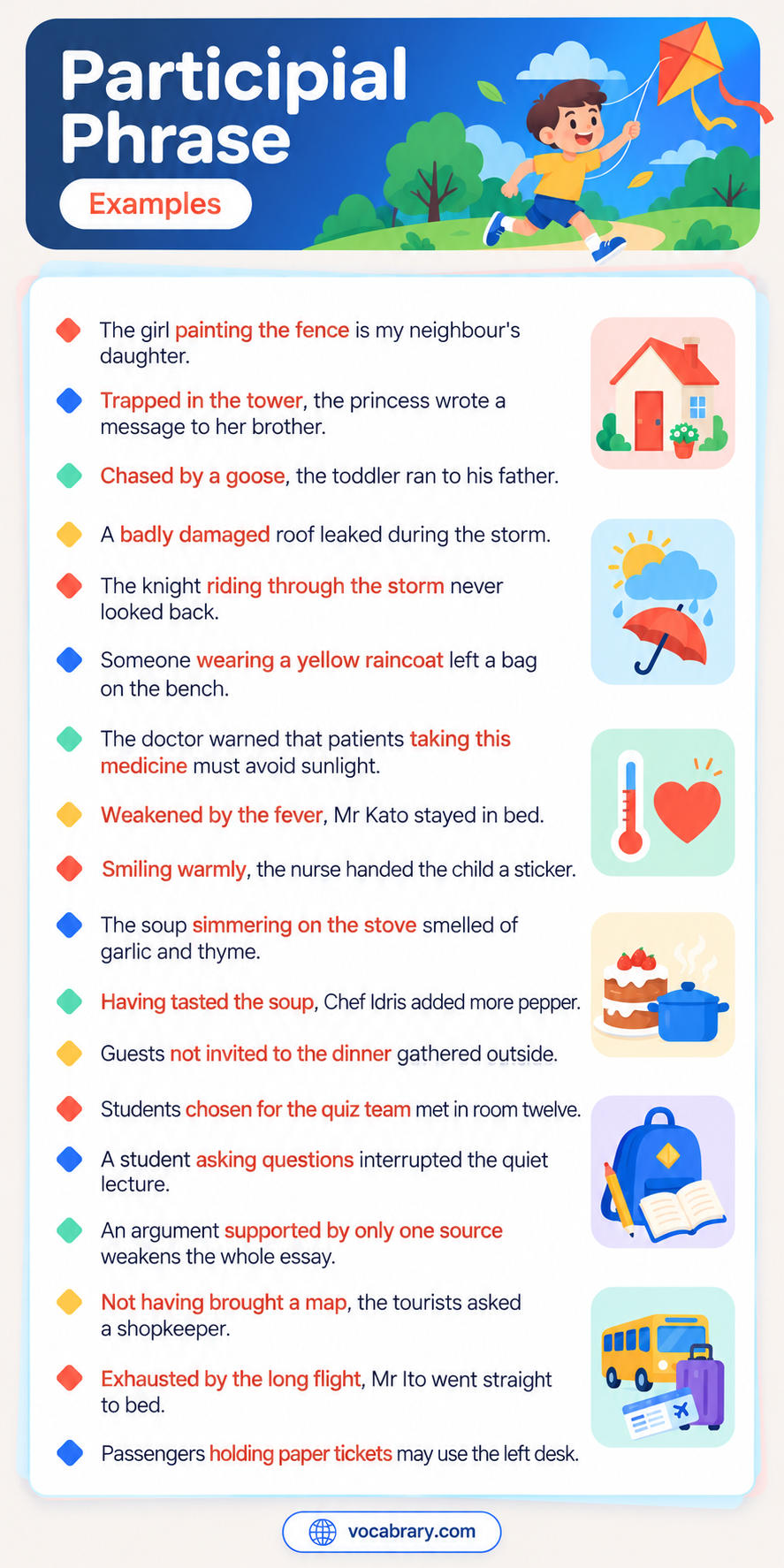
Participial Phrase Examples for Everyday Use
A participial phrase describes a noun or a person in each sentence, as in “standing by the window”, “written in green ink”, and “destroyed by the flood”.
- The girl standing by the window is my cousin from Quebec.
- Covered in dust, the old piano stood in the corner of the barn.
- We watched the children building a sandcastle near the pier.
- Walking along the beach, Maria found a purple shell.
- The letter written in green ink arrived this morning.
- Exhausted by the long flight, Mr Ito went straight to bed.
- The dog barking at the gate belongs to our neighbour.
- Having read the reviews, Sana bought the blue camera.
- Farmers working in the fields start before sunrise.
- The bridge destroyed by the flood was rebuilt in two months.
- Smiling warmly, the nurse handed the child a sticker.
- I found my keys hidden under a cushion.
- A boy carrying a violin stepped onto the stage.
- The cake decorated with strawberries disappeared in minutes.
Form Sentences with Participial Phrases
Six forms appear here: present, regular past, irregular past, perfect, passive, and negative, as in “never having tasted mango”, “having revised for a week”, and “knitted by her grandmother”.
Participial Phrase Examples with Present Participles
An -ing form begins each phrase, as in “tossing the frisbee”, “climbing the steep path”, and “approaching the station”.
- The girl tossing the frisbee is Sami’s older sister.
- Spectators waving red flags lined the road to the finish.
- Humming a quiet tune, Grandpa watered the roses.
- The girl practising the violin lives next door.
- I saw a man selling hot chestnuts at the corner.
- Climbing the steep path, the scouts sang a marching song.
- The teacher correcting our essays asked for another week.
- Cars crossing the old bridge must slow down.
- The cook chopping onions wiped his eyes.
- Looking through the telescope, Ines spotted a faint star.
- The baby sleeping in the pram did not wake during the storm.
- Kofi waved at a train approaching the station.
- Reading the menu carefully, Joss chose the lentil soup.
- The woman teaching the class has written four textbooks.
- The man repairing the roof is our landlord.
- Whistling a cheerful tune, the postman crossed the square.
- We listened to the choir singing in the courtyard.
Participial Phrase Examples with Regular Past Participles
A past participle ending in -ed begins each phrase, as in “painted by hand”, “pleased with the results”, and “knitted by her grandmother”.
- The plates painted by hand cost twice as much as the others.
- Surprised by the question, Hugo took a moment to answer.
- A village surrounded by mountains lies north of the lake.
- The meeting scheduled for Monday has been moved to Friday.
- Pleased with the results, the team returned to the lab.
- The fence repaired last week is already leaning again.
- A soup flavoured with ginger warmed the guests.
- Prepared in advance, the speech needed only a few changes.
- The tourists stranded at the airport slept on benches.
- She wore a scarf knitted by her grandmother.
- The team trained by Coach Ruiz won every match.
- Frightened by the siren, the horses ran to the far end of the field.
- The cottage painted bright yellow stands beside the river.
- Amused by the joke, the whole class laughed.
Participial Phrase Examples with Irregular Past Participles
Irregular past participles such as broken, known, chosen, and built begin the phrases, as in “broken in the storm”, “sung by the choir”, and “given a free ticket”.
- The window broken in the storm was replaced on Tuesday.
- Known for his patience, Mr Lopez never raised his voice.
- Players chosen for the final received a special badge.
- The lake frozen since December held the weight of the skaters.
- A necklace stolen from the shop was found in a bag.
- The poem sung by the choir was written for the festival.
- Taken by surprise, the goalkeeper dived too late.
- The shirt torn at the sleeve needs mending.
- Born in Accra, Efua moved to Dublin at twenty.
- Houses built on sand often crack within a few years.
- Given a free ticket, the student attended the concert.
- A lamp left on all night raised the electricity bill.
- Hidden behind a curtain, the cat watched the guests arrive.
- Struck by lightning, the old oak split in two.
- The songs written by Hana became famous.
Perfect Participial Phrase Examples
Having plus a past participle forms the phrase, as in “having finished her homework”, “having saved enough money”, and “having revised for a week”.
- Having finished her homework, Sunita watched a film.
- Having called the plumber, we mopped the kitchen floor.
- The pilot, having landed safely, thanked the passengers.
- Having tasted the soup, Chef Idris added more pepper.
- Having worked there for twenty years, Mrs Kaur knew every customer by name.
- Yusuf, having saved enough money, bought a secondhand motorbike.
- Having rowed across the bay, the crew collapsed on the sand.
- Having noticed the leak, Ms Brandt shut off the water.
- Having revised for a week, the pupils entered the exam hall calmly.
- The goalkeeper, having injured his wrist, left the field.
- Having searched every drawer, Anton gave up and called his sister.
- Having packed the car, Dad locked the front door.
- The cook, having burned the toast, opened a window.
Passive Participial Phrase Examples
Being or having been plus a past participle forms the phrase, as in “having been rejected twice”, “being cheered by thousands”, and “being offered a second slice”.
- Being followed by a stray dog, Lena walked faster.
- Having been rejected twice, the author submitted the novel again.
- Being told to wait, the visitors sat down in the lobby.
- Having been delayed by snow, the bus arrived after dark.
- The runner, being cheered by thousands, raised both arms.
- Having been chosen as captain, Naveen thanked his teammates.
- Being pulled out of the water, the swimmer coughed twice.
- Having been shown the plans, the mayor approved the design.
- Being offered a second slice, Tia politely refused.
- Having been built by volunteers, the shelter cost very little.
- Being asked for her ticket, Rosa searched her bag.
- Having been warned about the ice, the drivers slowed down.
Negative Participial Phrase Examples
Not or never comes before the participle in each phrase, as in “not wearing a coat”, “not cleared of snow”, and “not trusting the old ladder”.
- The boy not wearing a coat shivered at the bus stop.
- Not realising the shop was closed, Mina knocked for ten minutes.
- Students not completing the form will lose their place.
- Never having ridden a camel, Ola trembled at the sight.
- A road not cleared of snow stayed closed all morning.
- My neighbour, not wanting to argue, closed the window quietly.
- Not having brought a map, the tourists asked a shopkeeper.
- The man not paying attention missed his station.
- Not trusting the old ladder, Pia borrowed a new one.
- Guests not invited to the dinner gathered outside.
- Never having tasted mango, the toddler made a funny face.
- Not expecting visitors, Mum left the kitchen untidy.
- The man not carrying a ticket was asked to leave the train.
Position Sentences with Participial Phrases
A participial phrase comes before a noun, after a noun, after a pronoun, or at the start of a sentence, as in “climbing the fence”, “Disturbed by the noise”, and “covered with leaves”.
Participial Phrase Examples Before Nouns
An adverb and a participle come before the noun, as in “freshly baked”, “beautifully embroidered”, and “neatly folded”.
- The freshly baked bread cooled on the windowsill.
- A carefully planned route saved the hikers two hours.
- The recently opened museum attracts crowds on weekends.
- A badly damaged roof leaked during the storm.
- Nadia wore a beautifully embroidered shawl to the wedding.
- The widely admired author signed books for an hour.
- A slowly rising sun coloured the hills pink.
- The poorly lit corridor made the visitors nervous.
- We stayed in a newly renovated hotel near the harbour.
- A neatly folded towel lay on every bed.
- The loudly cheering crowd drowned out the announcer.
- Ellis finished a partly completed puzzle on the train.
- The carefully wrapped gift sat on the table.
- A tightly packed suitcase lay open on the bed.
Participial Phrase Examples After Nouns
With no commas, the phrase follows the noun directly, as in “sitting in the front row”, “explaining the new law”, and “picked this morning”.
- The student sitting in the front row asked three questions.
- Take the road leading to the lighthouse.
- I admire the artists exhibiting in the town hall.
- The tree growing beside the river is very old.
- She read an article explaining the new law.
- The boxes stacked near the door belong to the movers.
- We visited a cottage overlooking the sea.
- Ask the clerk standing behind the counter.
- The flowers picked this morning will last until Sunday.
- People applying for the job must bring a certificate.
- The path covered with leaves was slippery.
- The girl reading by the window is my niece.
- Pick up the bag left on the stairs.
Participial Phrase Examples Between Commas
Commas surround the phrase after a noun, as in “driving a taxi in Mumbai”, “sleeping under the table”, and “waiting at the station”.
- My uncle, driving a taxi in Mumbai, knows every shortcut.
- The bridge, built by local workers, carries both cars and bicycles.
- Mrs Patel, smiling at the camera, held up her prize.
- The mountain, covered in cloud, was invisible from the village.
- Our dog, sleeping under the table, ignored the doorbell.
- The mayor, speaking to reporters, denied the rumour.
- Lake Serene, frozen for weeks, attracted skaters from three towns.
- Dr Alvarez, known for her honesty, resigned from the board.
- The old clock, repaired by a neighbour, now chimes on time.
- My sister, waiting at the station, called to say the train was late.
- The pianist, dressed in black, bowed to the audience.
- Granny’s house, surrounded by apple trees, smells of cinnamon in autumn.
- The teacher, holding a stack of books, entered the room.
- Her car, parked outside the school, had a flat tyre.
Participial Phrase Examples at the Start of Sentences
At the start of a sentence, the phrase is followed by a comma, as in “opening the gate”, “chased by a goose”, and “wearing a heavy backpack”.
- Opening the gate, Ahmed stepped into the garden.
- Disappointed by the delay, the passengers complained at the desk.
- Having seen the film twice, Lucy refused to go again.
- Holding her breath, Greta slid under the rope.
- Chased by a goose, the toddler ran to his father.
- Stirring the paint, Walter listened to the radio.
- Encouraged by her coach, Bianca entered the regional contest.
- Frowning at the screen, the engineer typed a new command.
- Locked in the cellar, the old trunk stayed unopened for decades.
- Wearing a heavy backpack, Nico climbed the last hill.
- Disturbed by the noise, the owl left its branch.
- Armed with a map and a torch, the cousins entered the cave.
- Folding the map, Dev stepped out of the car.
- Tired after the match, the players went straight home.
Participial Phrase Examples After Pronouns
Pronouns such as she, those, anyone, and nobody are followed by the phrase, as in “exhausted by the climb”, “invited to the wedding”, and “hearing the alarm”.
- She, exhausted by the climb, sat down on a rock.
- Those waiting in the queue must show their tickets.
- Anyone holding a red card may enter the east gate.
- He, hoping for a reply, checked his phone every ten minutes.
- Everyone invited to the wedding received a printed map.
- We, delighted by the news, phoned all our cousins.
- Someone wearing a yellow raincoat left a bag on the bench.
- They, trained by the best coaches, won the relay by two seconds.
- Anyone hearing the alarm should leave through the nearest exit.
- Nobody standing in the doorway heard the announcement.
- Those living near the factory complained about the noise.
- Those sitting at the back could not hear the speaker.
- She, lost in thought, walked past the bus stop.
Participial Phrase Examples After Objects
In the predicate, the phrase follows a noun, as in “running toward the bus”, “limping on one leg”, and “made from recycled plastic”.
- Maria waved to her brother running toward the bus.
- The detective found the key hidden in a flowerpot.
- We photographed the hills covered in fresh snow.
- Ben asked the neighbour playing the piano upstairs to stop.
- The vet examined the puppy limping on one leg.
- I described the stranger wearing a green hat to the police.
- She kept the letter signed by the president in a drawer.
- They rescued a kitten trapped in a drainpipe.
- Lola bought a jacket made from recycled plastic.
- The guard stopped a man climbing the fence.
- Mira photographed the bird perched on the fence.
- We heard the children singing in the garden.
Question and Reported Sentences with Participial Phrases
Participial phrases are used in questions and in reported statements, as in “taking this medicine”, “entering the cave”, and “sent from Berlin”.
Participial Phrase Examples in Questions
Each question contains a participial phrase after a noun, as in “standing by the door”, “waiting outside”, and “sitting behind Rosa”.
- Who is the woman standing by the door?
- Did you see the car parked outside the bank?
- Have you read the book recommended by your teacher?
- Is the man wearing the blue jacket your brother?
- Which students waiting outside have tickets?
- Did the athlete injured last week finish the race?
- Where is the parcel sent from Berlin?
- Is the road closed by the flood open again?
- What is the name of the boy sitting behind Rosa?
- Can you hear the baby crying upstairs?
- Why did the shop offering free coffee close so early?
- Do you know the girl standing at the gate?
- Who owns the bicycle leaning against the wall?
Participial Phrase Examples in Reported Speech
Reports of what someone said, told, explained, announced, or warned contain the phrase, as in “waiting outside”, “started by a spark”, and “leading to the farm”.
- She said that the man waiting outside was her uncle.
- Tom told me that the vase broken by the cat was expensive.
- The guide explained that visitors entering the cave needed helmets.
- Nina mentioned that her brother, working in Dubai, would visit in May.
- The reporter said that the fire started by a spark had spread quickly.
- The coach announced that players arriving late would sit out.
- My aunt claimed that the soup cooked overnight tasted better.
- The clerk replied that parcels sent on Friday would arrive on Tuesday.
- He told them that the road leading to the farm was closed.
- The doctor warned that patients taking this medicine must avoid sunlight.
- Sara said that the child crying in the hall was lost.
- The guard told us that the gate locked at night opened at six.
Context Sentences with Participial Phrases
The settings are homes, classrooms, offices, journeys, newsrooms, stories, sports, and clinics.
Participial Phrase Examples for Home Life
At home, the phrases describe kitchens, living rooms, and family life, as in “simmering on the stove”, “hanging in the lounge”, and “wrapped in a blanket”.
- The soup simmering on the stove smelled of garlic and thyme.
- Waking before the others, Grandma lit the fire.
- A kettle whistling in the kitchen called everyone to tea.
- The curtains hanging in the lounge need washing.
- Dad found the remote hidden under the sofa.
- The baby laughing in her highchair threw a spoon.
- Wrapped in a blanket, Ana read until midnight.
- The photographs displayed on the wall show four generations.
- Mum found her glasses lying on the shelf.
Participial Phrase Examples for School Life
In the classroom, the phrases describe lessons, pupils, and teachers, as in “sitting near the board”, “completed on time”, and “returned late”.
- The pupils sitting near the board answered first.
- Handed the test papers, the class fell silent.
- The teacher explaining fractions drew a pie on the board.
- A project completed on time earns a bonus point.
- Having forgotten his pencil case, Ivor borrowed a pen.
- Students chosen for the quiz team met in room twelve.
- The library book returned late cost Amal a small fine.
- Excited about the trip, the third graders packed sandwiches.
- The girl raising her hand knew the answer.
Participial Phrase Examples for Work
At the office, the phrases describe staff, clients, and workplace routines, as in “answering the phones”, “reviewing the contract”, and “humming in the corner”.
- The employee answering the phones speaks four languages.
- Having updated the spreadsheet, Lourdes emailed the figures.
- Reports submitted after noon will be read tomorrow.
- The manager, reviewing the contract, circled two clauses.
- A client waiting in reception asked for a glass of water.
- Promoted last month, Terrence now supervises the night shift.
- The machine humming in the corner was installed in March.
- Staff working overtime receive a meal voucher.
- The engineer fixing the printer asked for a screwdriver.
Participial Phrase Examples for Travel
On the road, the phrases describe transport, tourists, and journeys, as in “arriving at platform four”, “packed with students”, and “holding paper tickets”.
- The train arriving at platform four is running late.
- Carrying only a small rucksack, Freya crossed three borders.
- The tourists queuing at the ticket office compared maps.
- A bus packed with students pulled out of the station.
- Having reached the hostel, the hikers dropped their boots.
- The ferry leaving at noon is full.
- Passengers holding paper tickets may use the left desk.
- The island visited by thousands each summer has only one café.
- Delayed by fog, the flight reached Lisbon after midnight.
Participial Phrase Examples for News Reports
News about officials, residents, companies, and public events contains the phrases, as in “speaking at the opening”, “closed since the flood”, and “accused of pollution”.
- The mayor, speaking at the opening, praised the volunteers.
- Residents evacuated from the valley returned on Sunday.
- Reporting from the scene, Ms Haddad described the damage.
- The bridge closed since the flood will reopen next month.
- Thousands marching through the capital demanded lower prices.
- Having reviewed the budget, ministers announced new cuts.
- The company, accused of pollution, denied the claim.
- A report published this week warns of rising sea levels.
- Workers striking outside the factory demanded higher pay.
Participial Phrase Examples for Stories
In stories, the phrases describe characters, creatures, and eerie scenes, as in “riding through the storm”, “drawn in blood”, and “swinging in the dark”.
- The knight riding through the storm never looked back.
- Hidden behind the tapestry, Isolde heard every word.
- A raven perched on the gate watched the travellers.
- The map drawn in blood led them to a cave.
- Having crossed the desert, the wanderer collapsed at the well.
- The old woman guarding the door offered no explanation.
- A lantern swinging in the dark warned the sailors.
- Trapped in the tower, the princess wrote a message to her brother.
- The ghost drifting along the corridor frightened the maid.
Participial Phrase Examples for Sports
On the pitch, the phrases describe players, teams, and matches, as in “running down the left wing”, “turning at the wall”, and “crossing the finish line”.
- The striker running down the left wing dodged two tackles.
- Having scored twice, Imran was carried off by his teammates.
- The team trailing by six points called a time-out.
- A swimmer turning at the wall pushes off with both feet.
- The ball kicked into the crowd was never found.
- Soaked by the rain, the cricketers waited in the pavilion.
- The athlete crossing the finish line raised both fists.
- Fans waving scarves filled the south stand.
- Injured in the first half, the winger watched the rest from the bench.
Participial Phrase Examples for Health
At the clinic, the phrases describe patients, doctors, and healthy habits, as in “resting in bed four”, “taken before breakfast”, and “specialising in allergies”.
- The patient resting in bed four is recovering well.
- Advised to drink more water, Miguel carried a bottle.
- A nurse checking the monitor noticed a change in the pulse.
- Tablets taken before breakfast need a full glass of water.
- Having stretched thoroughly, the runners felt ready.
- The child coughing in the corner was sent home.
- A doctor specialising in allergies joined the clinic.
- Weakened by the fever, Mr Kato stayed in bed.
- The boy limping into the clinic held his ankle.
Kids and Student Sentences with Participial Phrases
Short sentences about play and formal sentences for exam answers form the range here.
Participial Phrase Examples for Kids
For kids, the phrases are short and about children, animals, and toys, as in “running fast”, “broken yesterday”, and “barking loudly”.
- The boy running fast won.
- Smiling happily, Ana waved.
- Ducks swimming nearby quacked.
- Tired from playing, Sam napped.
- The toy broken yesterday was mended.
- A girl reading quietly smiled.
- Hearing the bell, we ran.
- Mum, holding my hand, waited.
- Dogs barking loudly scared us.
- Covered in mud, Leo laughed.
- The kite flying high looked tiny.
- Dressed in red, Mia danced.
- The cat sleeping on the mat purred.
Participial Phrase Examples for Exams
In exam answers, the wording is formal, as in “analysing the survey data”, “designed to reduce waste”, and “supported by only one source”.
- Researchers analysing the survey data found a steady rise in average screen time among teenagers.
- Having reviewed the available evidence, the historian rejected the popular explanation.
- The treaty signed after months of negotiation reduced tensions along the border.
- Faced with conflicting accounts, the investigator compared every statement against the written records.
- Policies designed to reduce waste require cooperation from households and businesses.
- The poem, written during a period of exile, expresses longing for a lost homeland.
- Scientists working in isolated stations must adapt to long periods of darkness.
- Encouraged by early results, the committee approved a larger trial.
- An argument supported by only one source weakens the whole essay.
- Having defined the main terms, the author builds the case for reform step by step.
- Economists studying the housing market warned of further price increases.
- Students preparing for exams benefit from regular sleep.
FAQs
Some participial phrase examples are "The girl standing by the window is my cousin from Quebec," "The bridge destroyed by the flood was rebuilt in two months," and "Having read the reviews, Sana bought the blue camera." Each participial phrase describes a noun or a person. The three sentences use a present participle, a past participle, and a perfect participle.
You use a participial phrase next to the noun or pronoun that it describes. "The student sitting in the front row asked three questions" has the phrase after a noun, and "Opening the gate, Ahmed stepped into the garden" has it at the start of the sentence. "She, exhausted by the climb, sat down on a rock" has it after a pronoun.
Participial phrase examples with present participles use an -ing form at the start of the phrase. "The girl tossing the frisbee is Sami’s older sister" and "Spectators waving red flags lined the road to the finish" are two models. "Cars crossing the old bridge must slow down" is a third.
Participial phrase examples with past participles use a form such as painted, broken, or sung at the start of the phrase. "The plates painted by hand cost twice as much as the others" and "The window broken in the storm was replaced on Tuesday" are two models. "The poem sung by the choir was written for the festival" is a third.
Perfect participial phrase examples use having plus a past participle. "Having finished her homework, Sunita watched a film" and "Having called the plumber, we mopped the kitchen floor" are two models. "The pilot, having landed safely, thanked the passengers" is a third.
Negative participial phrase examples use not or never before the participle. "The boy not wearing a coat shivered at the bus stop" and "Not realising the shop was closed, Mina knocked for ten minutes" are two models. "Never having ridden a camel, Ola trembled at the sight" is a third.
Participial phrase examples before a noun put an adverb and a participle in front of the noun. "The freshly baked bread cooled on the windowsill" and "A carefully planned route saved the hikers two hours" are two models. "The recently opened museum attracts crowds on weekends" is a third.
Participial phrase examples with commas put the phrase between two commas after a noun. "My uncle, driving a taxi in Mumbai, knows every shortcut" and "The bridge, built by local workers, carries both cars and bicycles" are two models. "Mrs Patel, smiling at the camera, held up her prize" is a third.
Participial phrase examples at the start of a sentence begin with the phrase and continue with a comma. "Opening the gate, Ahmed stepped into the garden" and "Disappointed by the delay, the passengers complained at the desk" are two models. "Holding her breath, Greta slid under the rope" is a third.
Participial phrase examples for kids use short phrases and short main clauses. "The boy running fast won" and "Smiling happily, Ana waved" are two models. "Ducks swimming nearby quacked" is a third.
Related:

Leave a Comment