
A gerund phrase is a phrase built on a gerund, which is the -ing form of a verb used as a noun, together with its objects and modifiers, as in reading novels before bed. Most gerund phrase examples function as subjects, objects, or complements.
What Is a Gerund Phrase?
A gerund phrase is a group of words built on a gerund, the -ing form of a verb used as a noun, together with the objects and modifiers of that verb. A participial phrase has the same -ing form but describes a noun, so Swimming daily keeps me fit has a gerund phrase and the man swimming daily has a participial phrase.
verb + -ing + objects and modifiers = gerund phrase (functions as a noun)
Her brother loves repairing old radios.
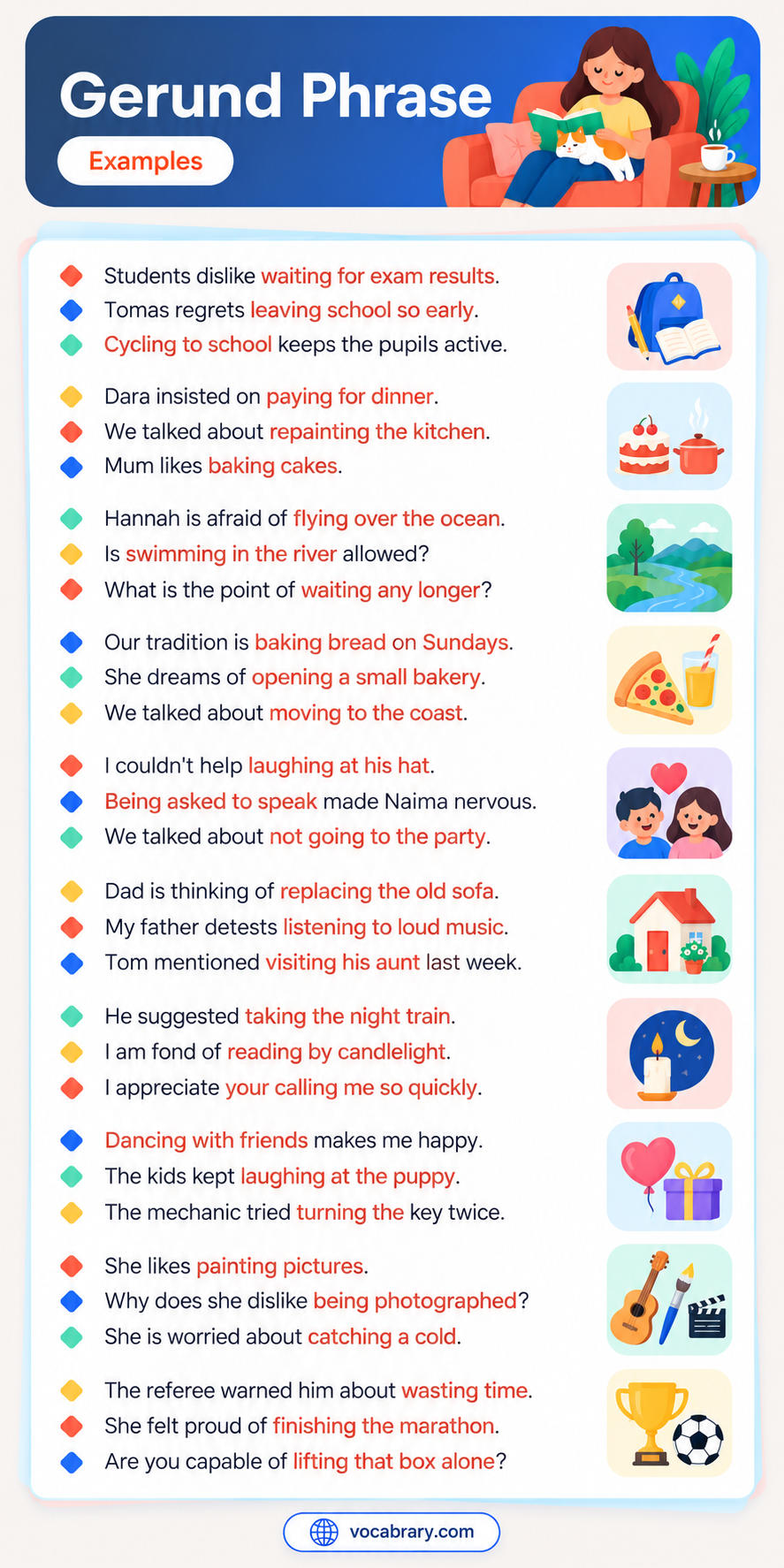
Common Gerund Phrase Examples
These gerund phrase examples, such as reading novels before bed and painting landscapes, each name an action as a noun, and the phrase includes the objects and modifiers of the -ing verb.
- Reading novels before bed helps Mei relax.
- She enjoys painting landscapes on quiet Sunday mornings.
- Grandpa is proud of growing his own vegetables.
- Singing in the shower is Leo’s daily habit.
- The kids kept laughing at the puppy.
- We talked about moving to the coast.
- Baking sourdough bread takes patience and a warm kitchen.
- Nobody minds waiting a few minutes.
- She improved her pronunciation by reciting poems aloud.
- My job is designing posters for local shops.
- Cycling to school keeps the pupils active.
- They suggested meeting after lunch in the garden café.
- Omar is thinking of starting his own company.
- I am tired of hearing the same excuse.
Gerund Phrases as Subjects
Gerund phrase examples that function as the subject, such as swimming in the lake every morning and raising a child, come before the verb in statements, and a single gerund phrase takes a singular verb.
- Swimming in the lake every morning keeps Pedro fit.
- Cooking for forty people requires careful planning.
- Learning a second language gives young people more job choices.
- Walking to work saves Gina about ten pounds a week.
- Raising a child takes patience and a great deal of love.
- Painting the old fence took the whole weekend.
- Collecting rainwater reduces the garden’s water bill.
- Waiting for the results made the whole family anxious.
- Playing the violin in public terrified young Elias.
- Driving through the desert at night is dangerous.
- Teaching adults to read gave Mrs Boateng great satisfaction.
- Sharing a flat with three students taught Lucia how to compromise.
Gerund Phrases as Direct Objects
A gerund phrase as a direct object follows a verb such as start, continue or hate, as in planning the trip and speaking French. It names what the subject does or feels.
- We started planning the trip in January.
- The students continued working through the exercises until the bell rang.
- Dad hates wasting food after a big family dinner.
- Kiran loves riding her bicycle along the river.
- I remember meeting your sister at the market.
- Luka tried adding more flour to the dough.
- She began studying law at nineteen.
- The farmers resumed harvesting the wheat after the rain.
- Chen prefers travelling by train on very long journeys.
- Pilar regrets selling the old house.
- The class practised speaking French before the oral exam.
- Anita welcomes working with new teams.
- The corner shop stopped selling fireworks after the new law.
- Finn keeps losing his glasses on the school bus.
Gerund Phrases as Subject Complements
A gerund phrase after a linking verb such as be or become is a subject complement, as in collecting old coins and teaching beginners, and it renames or identifies the subject.
- Her favourite hobby is collecting old coins.
- My main job is teaching beginners.
- His biggest fear was speaking in public.
- The best exercise is walking briskly for thirty minutes.
- Our tradition is baking bread on Sundays.
- Her dream became running a children’s hospital.
- The real challenge is keeping the students interested.
- My cousin’s specialty is repairing antique clocks.
- Their daily routine is jogging before breakfast.
- Fatima’s passion is designing gardens for small city flats.
Gerund Phrases as Appositives
A gerund phrase as an appositive renames a noun beside it and takes commas in these sentences, as in collecting stamps and driving a delivery van.
- Her hobby, collecting stamps, fills every weekend.
- Mr Ruiz’s job, driving a delivery van, starts at five.
- Their favourite pastime, playing cards after dinner, continues every Sunday.
- The new rule, wearing a helmet on site, applies to every visitor.
- My brother’s dream, sailing around the world, began in childhood.
- The doctor’s advice, sleeping eight hours a night, was easy to follow.
- Our main goal, finishing the bridge before winter, requires extra workers.
- Nadia’s talent, singing in four languages, amazed the judges.
Gerund Phrases After Verbs of Enjoyment and Dislike
Verbs such as enjoy, adore, dislike and mind take a gerund phrase, as in cooking for large families and closing the window, and the phrase names the activity that is liked, disliked, or objected to.
- Selim enjoys cooking for large families.
- Ana adores walking along the harbour at dusk.
- Kofi dislikes waiting in long queues.
- Would you mind turning down the radio?
- My father detests listening to loud music.
- I can’t stand hearing the same song all day.
- Mrs Park appreciates receiving handwritten cards.
- The twins love building towers from blocks.
- Tariq doesn’t mind sharing his room.
- Lucy enjoys sketching strangers on the train.
Gerund Phrases After Verbs of Completion and Avoidance
Verbs such as finish, avoid, quit and postpone take a gerund phrase, as in painting the fence and hitting the cyclist, and the phrase names an action that is ended, delayed, avoided, or continued.
- Ola finished painting the fence before lunch.
- The driver avoided hitting the cyclist by braking hard.
- Grandpa quit smoking cigars ages ago and never started again.
- They postponed repainting the hall until spring.
- The company delayed announcing the results.
- The prisoners narrowly escaped drowning in the flood.
- Don’t risk losing your job over a small lie.
- The band kept playing their old songs despite the rain.
- Hana gave up trying to fix the radio.
- The workers put off repairing the road until the flood receded.
- The mechanic stopped talking about the engine when the manager entered.
Gerund Phrases After Verbs of Suggestion and Thought
Verbs such as suggest, recommend, consider and deny take a gerund phrase, as in taking the earlier train and adopting a rescue dog, and the phrase names the action that is proposed, imagined or reported.
- Mira suggested taking the earlier train.
- The doctor recommended drinking more water.
- We are considering adopting a rescue dog.
- Can you imagine living without a phone?
- The suspect denied entering the building.
- Paulo admitted making a serious mistake.
- She mentioned moving to Lisbon in the spring.
- The job involves travelling to remote villages.
- I couldn’t help laughing at his hat.
- The council discussed widening the main road.
- Ravi recalls visiting the old fort as a boy.
- The guide advised bringing warm clothes.
Gerund Phrases as Objects of Verb and Preposition Pairs
Verbs joined to a preposition, such as insist on and look forward to, take a gerund phrase as the object of that preposition, as in paying for dinner and meeting your family.
- Dara insisted on paying for dinner.
- I look forward to meeting your family.
- The manager apologised for missing the call.
- Many people believe in giving second chances.
- The team succeeded in reaching the summit.
- She dreams of opening a small bakery.
- They talked about buying a boat.
- He relies on working at night.
- The jury accused him of lying under oath.
- Teachers thanked the parents for volunteering at the fair.
- Luca confessed to breaking the window.
- We object to paying extra fees.
Gerund Phrases as Objects of Prepositions After Adjectives
An adjective followed by a preposition, such as good at or afraid of, takes a gerund phrase as the object of that preposition, as in solving puzzles and flying over the ocean.
- Jin is good at solving puzzles.
- Hannah is afraid of flying over the ocean.
- The students are interested in learning Japanese.
- Mr Das is tired of repeating the same instructions.
- Our dog is excited about going to the park.
- She felt proud of finishing the marathon.
- Are you capable of lifting that box alone?
- The team is responsible for cleaning the lab.
- He is famous for cooking over an open fire.
- Olivia was worried about missing the bus.
- The village is known for making blue pottery.
- I am fond of reading by candlelight.
Gerund Phrases After Before, After, By and Without
Prepositions such as before, after, by and without, and phrases such as instead of and apart from, take a gerund phrase as their object, as in leaving the house and saying goodbye.
- Before leaving the house, Dad checked every window.
- After finishing her exams, Zara slept for a day.
- You learn faster by practising every day.
- He left the party without saying goodbye to the hosts.
- Instead of taking a taxi, they walked home.
- Besides teaching maths, Mr Ibrahim coaches the chess club.
- On entering the room, she noticed the open window.
- Despite studying all night, Hugo failed the quiz.
- The thief entered by breaking a back window.
- Since moving to Cairo, Amina has learned Arabic.
- They won the match through playing as a team.
- Apart from cooking dinner, Dad likes long walks by the river.
Gerund Phrases With a Possessive Before the Gerund
In formal writing, a possessive word comes before the gerund, as in his leaving early and your calling me so quickly, and the whole group functions as one noun phrase.
- His leaving early surprised the whole department.
- We were pleased about Maria’s winning the prize.
- I appreciate your calling me so quickly.
- Their arriving late delayed the ceremony.
- She was upset by my forgetting her birthday.
- The teacher objected to Ben’s talking during the test.
- Our being together meant more than the venue.
- Nobody liked the manager’s changing the schedule without notice.
- They were angry about her refusing the offer.
- We are grateful for your helping us move.
Gerund Phrases With an Object Form in Informal Usage
In informal English, an object pronoun or a plain noun comes before the gerund, as in him leaving and me opening the window, while formal writing uses the possessive form.
- Nobody in the hall minded him leaving through the side door.
- Did you mind me borrowing your pen?
- I don’t like you being alone at night.
- She remembers us singing on the bus.
- Can you imagine them winning the lottery?
- The neighbours complained about the dog barking all night.
- I hate people talking during films.
- I dislike him shouting at the staff.
Perfect Gerund Phrases With Having
A perfect gerund phrase combines having with a past participle, as in having taken the money and having invited us, and it names an action that finished before the action of the main verb.
- She denied having taken the money.
- I regret having said those words.
- Tomas is proud of having won the scholarship.
- Thank you for having invited us.
- He admitted having lied to the inspector.
- The old sailor boasted of having crossed the ocean alone.
- They were accused of having stolen the painting.
- Naomi remembers having visited that village as a girl.
- The pilot was praised for having landed the plane safely.
- Nobody remembers having seen the missing key.
- We apologise for having kept you waiting.
Passive Gerund Phrases With Being and Having Been
A passive gerund phrase uses being or having been before a past participle, as in being asked to speak and being interrupted, and the understood subject of the gerund receives the action.
- Being asked to speak made Naima nervous.
- She hates being interrupted while she is explaining a plan.
- Rafael remembers being carried on his father’s shoulders.
- We insisted on being told the truth.
- They avoided being seen by the guards.
- He denied having been warned about the storm.
- Lydia is proud of having been chosen as captain.
- The child enjoys being read to every night.
- Nobody likes being laughed at in front of the class.
- The actor dreaded being recognised in public.
- Being stuck in traffic annoys my father.
Negative Gerund Phrases With Not
A negative gerund phrase has not directly before the gerund, as in not telling the truth and not paying the bill.
- She regrets not telling the truth.
- Not knowing the answer is no shame.
- He was criticised for not paying the bill.
- We talked about not going to the party.
- Not exercising regularly weakens the heart.
- Thanks for not telling Mum about the broken lamp.
- Marta felt guilty about not calling her grandmother.
- He is worried about not finishing the project on time.
- Not wearing a seat belt is against the law on this island.
- Sven apologised for not replying sooner.
- I enjoy not having to set an alarm on Sundays.
- The scouts succeeded in not getting lost in the fog.
Gerund Phrases in Questions
In a question that uses an auxiliary verb, the auxiliary comes before the subject. The gerund phrase follows the verb that governs it, as in joining our team and writing the report, or is the subject, as in Is swimming in the river allowed?
- Do you mind opening the window?
- Is swimming in the river allowed?
- Did he mention moving to Berlin?
- Have you finished writing the report?
- Would you consider joining our team?
- What is the point of waiting any longer?
- Why does she dislike being photographed?
- Are you interested in learning to sail?
- Who suggested cancelling the picnic because of the clouds?
- How about eating outside tonight if the weather stays warm?
Gerund Phrases in Reported Speech
In reported speech, the gerund phrase follows the reporting verb or is part of the reported clause, as in leaving early and forgetting the keys.
- He said that leaving early was a mistake.
- Sara admitted forgetting the keys on the kitchen table.
- The manager suggested moving the meeting to Friday.
- She denied breaking the vase that stood in the hall.
- They told us that walking on the grass was forbidden.
- Tom mentioned visiting his aunt last week.
- The coach insisted on starting at six.
- My neighbour complained about parking in front of his gate.
- The reporter claimed that ignoring the warning caused the accident.
- Nina confessed to reading her sister’s diary.
Gerund Phrases With Verbs That Take Gerunds and Infinitives
Remember, stop, try and regret each take a gerund phrase with one meaning and an infinitive phrase with another, as in locking the door and adding a little salt.
- I remember locking the door before we left.
- She stopped smoking cigarettes years ago and now runs every morning.
- Try adding a little salt to the soup.
- Tomas regrets leaving school so early.
- She went on talking about her trip for an hour.
- The mechanic tried turning the key twice.
- I will never forget seeing the aurora over the lake.
- The company stopped printing paper maps last year.
- Mrs Lin regrets spending so much on a piano.
- Do you remember singing that song at the wedding?
Gerund Phrases at Home
In a home, a gerund phrase such as cooking dinner for the family or folding the laundry names a household job that a family member does, likes, or dislikes.
- Cooking dinner for the family is Dad’s favourite chore.
- Grandma loves knitting scarves by the window.
- Mum is fed up with washing the same cups.
- The children finished tidying their bedroom.
- Karim hates getting up before seven.
- Folding the laundry takes me twenty minutes.
- We talked about repainting the kitchen.
- Dad is thinking of replacing the old sofa.
Gerund Phrases at School
Reading aloud and completing every exercise are classroom activities, and each gerund phrase in this group names something a pupil or a teacher does.
- Reading aloud improves the pupils’ pronunciation.
- The teacher praised Ravi for completing every exercise.
- Students dislike waiting for exam results.
- Revising for two hours daily helped Lena pass.
- Our class suggested planting a garden behind the library.
- Amal is good at drawing maps.
- He apologised for forgetting his homework.
- Mr Evans insists on checking every answer twice.
Gerund Phrases at Work
Office duties such as meeting the deadline and training new employees are named by gerund phrases that describe what a manager, a team, or an employee does.
- Meeting the deadline required the whole team.
- The manager is considering hiring two designers.
- Sophia is responsible for training new employees.
- Answering emails takes up the first hour of Hugo’s day.
- They avoided raising prices during the crisis.
- She is tired of attending long meetings.
- Nobody should sign the report without checking the figures.
- The firm succeeded in cutting costs by ten percent.
Gerund Phrases in Travel
In travel writing, travelling alone and exploring the old streets of Hanoi are gerund phrases that name what a visitor does, plans, or fears.
- Travelling alone taught Greta to trust strangers.
- We enjoyed exploring the old streets of Hanoi.
- Passengers are prohibited from carrying large bottles of liquid.
- Waiting at the gate lasted three hours.
- Before boarding the plane, check your seat number.
- Ida dreams of sailing around the Greek islands.
- He suggested taking the night train.
- She is afraid of missing the connection.
Gerund Phrases in News Reports
News stories name decisions and accusations with gerund phrases such as cutting the budget and ignoring the warnings.
- Cutting the budget angered the teachers’ union.
- The minister denied receiving any gifts.
- Residents are worried about losing their homes to the river.
- The council discussed closing the old bridge.
- Reporting from the front line earned her an award.
- The witness recalled hearing a loud bang.
- Voters complained about waiting four hours to cast ballots.
- The police were accused of ignoring the warnings.
Gerund Phrases in Fiction
Dreams, risks and regrets of characters are named by gerund phrases such as falling down a very deep well and breaking his promise.
- Alice dreamed of falling down a very deep well.
- The captain risked sailing into the storm.
- Hearing the footsteps behind him terrified the thief.
- The old woman admitted hiding the key under the stone.
- The knight regretted breaking his promise.
- Nobody dared mention opening the iron door.
- Crossing the haunted bridge required courage.
- Elara couldn’t help whispering the spell.
Gerund Phrases in Sports
Training and match activities, such as running ten kilometres every morning and scoring late goals, are named by gerund phrases that describe what a player or a coach does.
- Running ten kilometres every morning built Dani’s stamina.
- The coach insisted on practising penalties.
- Our striker is famous for scoring late goals.
- Anna enjoys swimming laps before work.
- Losing the final taught the players humility.
- The referee warned him about wasting time.
- She avoided rushing the last lap.
- Winning the title gave the town a reason to celebrate.
Gerund Phrases in Health
A doctor advises or a patient follows the habits named by stretching before a run and walking for half an hour daily, two of the gerund phrases in this group.
- Stretching before a run reduces the risk of injury.
- The doctor recommended walking for half an hour daily.
- Marcus quit eating sugar last spring.
- Sleeping badly affects a person’s mood.
- Patients are advised against skipping meals.
- She is worried about catching a cold.
- Washing your hands often prevents many infections.
- Rosa is recovering from breaking her wrist.
Gerund Phrases for Kids
These short gerund phrase examples, such as reading books and singing songs, each combine an -ing verb with its object to name an activity as a noun.
- Swimming in water is fun.
- I love reading books.
- Dancing with friends makes me happy.
- She likes painting pictures.
- Sleeping well helps us grow.
- Dad enjoys fishing in lakes.
- We love singing songs.
- Playing outside is great.
- He hates cleaning up.
- Mum likes baking cakes.
- Eating fruit is healthy.
- I am good at jumping high.
Gerund Phrases for Students
Exam answers about policy and research use longer gerund phrase examples such as comparing urban and rural attitudes to recycling and verifying every source before publication, which name a process or a duty.
- Developing a reliable method for measuring rainfall requires cooperation between engineers and farmers.
- The author is criticised for overlooking the economic causes of the war.
- The historian objected to being denied access to the records.
- Governments must avoid imposing sudden restrictions on trade.
- Reducing carbon emissions remains the central challenge of the century.
- The study focuses on comparing urban and rural attitudes to recycling.
- Success in the course depends on submitting each assignment on time.
- Critics accuse the minister of misleading the public about the costs.
- Writing a persuasive essay demands a strong thesis and solid evidence.
- Researchers insist on verifying every source before publication.
- Many scholars question the value of memorising isolated facts.
Gerund Phrases in Short Passages
Four short passages about a morning walk, a school project, a bakery and a training week use gerund phrase examples such as walking along the river and baking bread in connected writing.
Tomas enjoys walking along the river. Watching the herons calms him before work. He ends the routine by buying a coffee at the corner café. His wife believes that starting the day outside is a good habit.
Our class is busy with a science project. Measuring the rainfall takes ten minutes each morning. Priya is responsible for recording the numbers. Everyone agrees that working as a team makes the task faster.
Mrs Okafor opened a bakery after years of teaching maths. Baking bread before dawn was her dream. She is proud of using local flour. Customers thank her for keeping the prices low.
The squad spent the week on fitness. Running up the hill was the hardest drill. Coach Ali insisted on stretching after every session. By Friday, the players were tired of hearing the whistle but ready to play.
Gerund Phrase Mistakes With Corrections
Errors with gerund phrases include an infinitive after a verb that takes a gerund, a base verb after a preposition, and a subject pronoun before a gerund. Examples are She avoids to talk and interested in learn Japanese.
❌ She avoids to talk about money.
✅ She avoids talking about money.
The verb avoid takes a gerund phrase, not an infinitive phrase.
❌ He is interested in learn Japanese.
✅ He is interested in learning Japanese.
A verb after the preposition in takes the -ing form.
❌ Thank you for to help me.
✅ Thank you for helping me.
A preposition such as for is followed by a gerund phrase, not by to and a base verb.
❌ Swim in the sea is relaxing.
✅ Swimming in the sea is relaxing.
A bare verb is unable to be the subject here, so the verb needs the -ing ending to function as a gerund.
❌ They were surprised at he winning the race.
✅ They were surprised at his winning the race.
A subject pronoun is not used before a gerund, so the sentence needs the possessive his or, in informal usage, the object form him.
❌ She denied have taken the money.
✅ She denied having taken the money.
A perfect gerund phrase uses having, not the base form have.
❌ She regrets don’t telling the truth.
✅ She regrets not telling the truth.
A gerund is made negative with not, and the finite form don’t does not combine with an -ing form.
❌ He hates being interrupt.
✅ He hates being interrupted.
A passive gerund phrase uses being with a past participle.
❌ I am used to wake up early.
✅ I am used to waking up early.
In the phrase be used to, the word to is a preposition, so the verb after it takes the -ing form.
Gerund Phrase Compared With Participial Phrase and Infinitive Phrase
A gerund phrase such as swimming daily and an infinitive phrase such as to swim daily are both able to name an action as a noun. A participial phrase such as the man swimming daily describes a noun.
| Feature | Gerund phrase | Participial phrase | Infinitive phrase |
|---|---|---|---|
| Function | Noun | Adjective | Noun, adjective or adverb |
| Form | Verb with -ing | Verb with -ing, -ed or having plus -ed | To plus a base verb |
| Subject example | Swimming daily keeps me fit. | Not a subject, because it describes a noun | To swim daily keeps me fit. |
| Object example | I enjoy swimming daily. | Not an object, because it describes the object, as in I know the man swimming daily. | I want to swim daily. |
| After a preposition | She is proud of swimming daily. | Not the object of a preposition | Is rarely the object of a preposition |
| Commas | Takes no commas as a subject or object, and takes commas as an appositive | Takes commas when it adds extra description | Takes no commas as a subject or object, and takes commas as an appositive |
| Replacement test | Replace it with the word it | Replace it with who or which plus a verb | Replace it with the word it in noun uses |
Related
- Gerund Example Sentences
- Participial Phrase Examples
- Infinitive Phrase Examples
- Verbal Noun Example Sentences
- Object Of Preposition Examples
- Noun Phrase Examples
- Verb Phrase Examples
- Participle Clause Examples
FAQs
Q1. What are the main functions of gerund phrases?
Gerund phrases function as nouns, so they are used in the same positions as other noun phrases. A gerund phrase is a subject, as in Raising a child takes patience, a direct object, as in She enjoys painting landscapes, or a subject complement, as in His hobby is collecting coins. It is also the object of a preposition or an appositive.
Q2. How do you form a gerund phrase?
You form a gerund phrase by adding -ing to a verb and then adding the objects and modifiers that the verb takes. The phrase reading novels before bed contains the gerund reading, the object novels and the modifier before bed. The words not, having, and being come before the gerund to make negative, perfect, and passive forms.
Q3. How do you tell a gerund phrase from a participial phrase?
A gerund phrase functions as a noun, while a participial phrase functions as an adjective. In Swimming daily keeps me fit, the phrase is the subject, so it is a gerund phrase. In the man swimming daily, the phrase describes the man, so it is a participial phrase. The participial forms are covered in the participial phrase examples.
Q4. How do you tell a gerund phrase from an infinitive phrase?
A gerund phrase uses a verb with -ing, while an infinitive phrase uses to plus a base verb. Both name an action as a noun in many positions, as in Swimming daily keeps me fit and To swim daily keeps me fit. The choice depends on the verb before the phrase, which the infinitive phrase examples cover in full.
Q5. Which verbs are followed by gerund phrases?
Verbs such as enjoy, avoid, finish, suggest, mind, deny, admit, consider, practise and keep are followed by gerund phrases, as in these gerund phrase examples. Each of these verbs takes a phrase that names an activity that is liked, ended, proposed or reported, as in She finished writing the report. A learner memorises these verbs, because other verbs such as want, hope and decide are followed by an infinitive phrase instead.
Q6. Which prepositions are followed by gerund phrases?
Prepositions such as in, on, at, by, for, without, before, after, about and of are followed by a gerund phrase when a verb comes next. Examples are good at solving puzzles, without saying goodbye and after finishing her exams. The word to is also a preposition in phrases such as look forward to and be used to, so the verb after it takes -ing.
Q7. Should a possessive come before a gerund?
A possessive before a gerund is the form used in formal writing, as in I appreciate your calling me. Informal usage allows an object pronoun or a plain noun, as in Nobody noticed him leaving. Both forms are understood, but formal essays use the possessive.
Q8. What is a perfect gerund phrase?
A perfect gerund phrase is formed from having plus a past participle, as in having taken the money. It expresses an action that was finished before the time of the main verb. The phrase follows verbs such as deny and admit and prepositions such as for and of.
Q9. What is a passive gerund phrase?
A passive gerund phrase is formed from being plus a past participle, as in being asked to speak. The understood subject of the gerund receives the action. The perfect passive form is having been plus a past participle, as in having been warned about the storm.
Q10. How do you make a negative gerund phrase?
You make a negative gerund phrase by placing not directly before the gerund. Examples are not telling the truth, not paying the bill and not knowing the answer. The word not negates the gerund and not the main verb.
Q11. Why does look forward to take a gerund phrase?
The expression look forward to takes a gerund phrase because to is a preposition in that expression. A preposition is followed by a noun form, and the gerund is the noun form of a verb. The same reasoning applies to be used to, object to and be committed to.
Q12. Do some verbs take both a gerund and an infinitive?
Some verbs take both a gerund phrase and an infinitive phrase, and the meaning changes with some of them. The sentence She stopped smoking means she quit, while She stopped to smoke means she paused in order to smoke. The verbs remember, forget, try and regret follow the same pattern.
Q13. Why do writers use gerund phrases?
Writers use gerund phrases to name an action as a noun in the position of a subject, an object or a complement. The phrase collecting rainwater is shorter than a clause such as the fact that people collect rainwater. Gerund phrase examples also let a writer begin a sentence with the activity itself.

Leave a Comment