
A gerund is a verbal, the -ing form of a verb that functions as a noun, as in swimming keeps her fit. These gerund example sentences use the form as a subject, an object, a complement and the word after a preposition, then move on to the verbs that take it.
What Is a Gerund?
A gerund is a verb form ending in -ing that names an action or an activity and functions as a noun in its sentence. A present participle also ends in -ing, but it forms part of a verb or modifies a noun, so swimming is a gerund in Swimming is fun and a participle in She is swimming.
Verb + -ing = gerund (subject, object, complement, or object of a preposition)
Her father enjoys fishing at dawn.
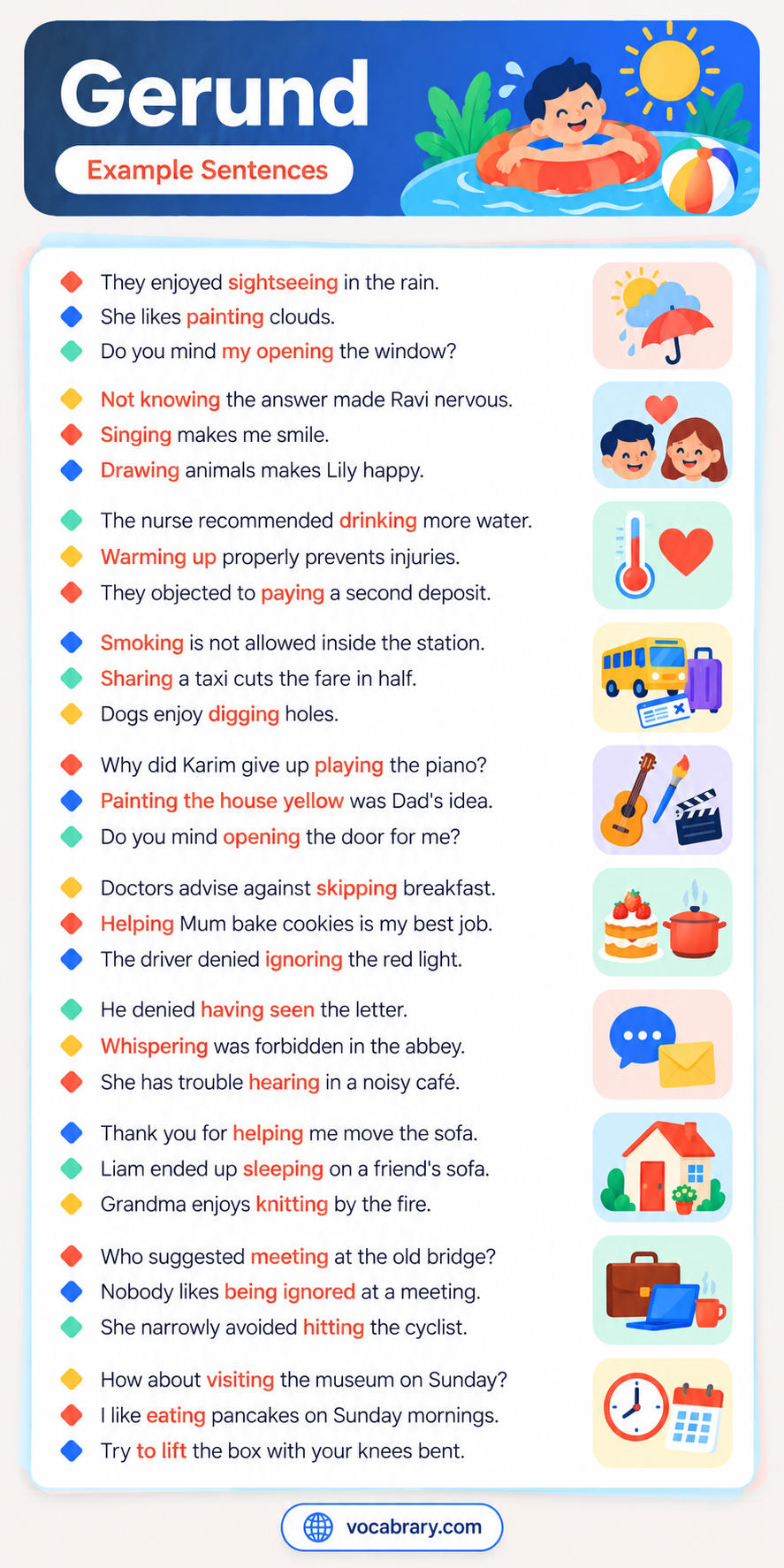
Common Gerund Example Sentences
Swimming, painting, reading, and cycling are common gerunds, and these gerund example sentences use each one to name an activity as a noun.
- Swimming keeps my grandfather strong at the age of seventy-nine.
- Her favourite hobby is painting landscapes in watercolour.
- We enjoyed walking along the river after dinner.
- Reading before bed helps Tariq fall asleep within minutes.
- Maria is fond of cooking for large groups of friends.
- Travelling by train gave the students time to talk.
- Nobody minded waiting in the rain for the bus.
- Dancing at the village festival lasted until midnight.
- He gave up smoking after his daughter was born.
- My sister loves collecting old maps from street markets.
- Learning a new language takes patience and daily practice.
- They talked about moving to Nairobi for a year.
- Cycling to school saves Hao forty minutes every morning.
- The chef is famous for baking bread in a stone oven.
- Laughing loudly in the library earned the boys a warning.
- Priya started writing poetry when she was nine.
- Gardening is the best cure for a stressful week.
- We were tired after climbing the hill all afternoon.
- Her dream is flying a small plane over the mountains.
- Listening carefully is the first step in any good interview.
Gerund as the Subject of a Sentence
Jogging, volunteering, and sharing begin these sentences and name the activity the sentence is about. A single gerund subject takes a singular verb, even when its object is plural, as in eating vegetables is healthy.
- Jogging along the beach clears Daniel’s head before work.
- Volunteering at the shelter taught Amara how much a small gift matters.
- Sharing a taxi cuts the fare in half.
- Lying to a friend damages trust quickly.
- Teaching young children requires enormous patience.
- Cheating during the exam will cost you the whole grade.
- Driving in heavy fog is dangerous for everyone on the road.
- Skiing in the Alps costs more than most students expect.
- Saving a little each month builds a safety net.
- Eating vegetables with every meal improves the whole family’s health.
- Painting the fence took Lars and his sons three Saturdays.
- Asking for help is no sign of weakness.
- Singing together calms the nervous choir before a concert.
- Making mistakes is part of learning any craft.
Gerund as the Object of a Verb
Quit, practise, and describe are verbs that take a gerund as the direct object, the noun phrase that receives the action of the verb.
- Rosa quit working night shifts when her contract ended.
- The pianist practises playing scales for an hour each morning.
- Our guide described crossing the desert on camels.
- Kenji mentioned leaving the company at the end of June.
- The mayor discussed building a new bridge over the creek.
- Lucia dislikes ironing shirts on Sunday evenings.
- Sunil recalls meeting his future wife at a charity dinner.
- The report recommended closing the old factory by June.
- They resented paying extra for the delayed delivery.
- Hana loves sketching strangers on the metro.
- The doctor advised resting for a week after the operation.
- Mr Okoye prefers walking to driving on sunny days.
- Beth began learning the cello at forty.
- Our neighbours reported hearing loud music last night.
Gerund as a Subject Complement
A gerund after the verb be follows the subject and identifies it, as in my favourite exercise is rowing and her job is training new pilots.
- My favourite exercise is rowing on the lake at sunrise.
- Her job is training new pilots for the airline.
- The best part of the holiday was snorkelling with the turtles.
- His only fault is talking too much during films.
- Our goal this year is saving enough for a small house.
- The hardest part of the course is writing the final essay.
- Her biggest fear was failing in front of her classmates.
- The plan is leaving at dawn to avoid the traffic.
- My cousin’s passion is restoring old motorbikes.
- Ivan’s plan for Sunday is sleeping until noon.
Gerunds After Prepositions
By training and without complaining are two phrases where a preposition is followed by a gerund. After a preposition the verb takes the -ing form, apart from a few uses of but and except.
- Lena improved her stamina by training every day.
- He left the office without complaining about the schedule.
- After finishing the test, the girls went to the playground.
- Before leaving, please switch off the lights.
- Zara is excellent at solving puzzles.
- I am interested in learning how bridges are built.
- They are afraid of losing their home.
- Instead of arguing, the brothers shook hands and left.
- Besides singing, Mei plays the violin and the drums.
- The mayor was criticised for ignoring the flood warnings.
- Despite studying until midnight, Omar failed the quiz.
- Thank you for helping me move the sofa.
- She insisted on paying for the whole meal.
- Are you tired of waiting for the results?
- The athlete was banned from competing for two seasons.
- On entering the hall, the guests found their names on small cards.
Verbs Followed by a Gerund
Enjoy, avoid, mind, suggest, finish, keep, consider, and admit are verbs that take a gerund as their object. An infinitive directly after these verbs is not standard English.
Enjoy, Avoid, Mind, and Finish
In enjoyed reading and finished painting, the main verb names a feeling, an avoidance, or an ending, and the gerund names the activity.
- Nadia enjoyed reading on the balcony every evening.
- The drivers avoided using the main road during the festival.
- I do not mind waiting if the coffee is hot.
- Would you mind closing the window, please?
- Tomas finished painting the shed before the rain arrived.
- Children enjoy splashing in puddles after a storm.
- She narrowly avoided hitting the cyclist.
- Hamid enjoys listening to the radio while he cooks.
- We finished packing at ten and left before breakfast.
- My aunt did not mind sharing her bedroom with two cousins.
- He avoids eating dinner after nine at night.
- The musicians enjoyed playing in the old stone church.
Suggest, Consider, Admit, and Keep
Suggested going, considered moving, admitted breaking and kept asking combine verbs of proposing, thinking, confessing and repeating with the -ing form.
- Fatima suggested going to the market before noon.
- The couple considered moving to the coast for a quieter life.
- The boy admitted breaking the greenhouse window.
- My little brother kept asking the same question all the way home.
- Our coach suggested starting the warm-up ten minutes earlier.
- Have you ever considered studying medicine abroad?
- The driver admitted driving faster than the limit.
- It kept raining for three days without a break.
- Ingrid suggested meeting at the station instead of the museum.
- The manager is considering opening a second branch in Lagos.
- She admitted taking the keys, though her sister had seen her.
- He kept working even after the lights went out.
Imagine, Risk, Postpone, and Practise
These four verbs name a thought, a danger, a delay, and a repeated drill, and the gerund after each one names the action involved.
- Can you imagine living on a boat for a year?
- The climbers risked losing the trail in the dense fog.
- The council postponed voting on the new road until spring.
- Aisha practises speaking French with her neighbour every Friday.
- The club postponed repairing the roof until the summer.
- I can’t imagine telling her the truth now.
- You risk catching a cold if you walk home in this rain.
- The school has postponed announcing the winners until next week.
- Diego practised parking between the cones until he stopped touching them.
- Nobody could imagine winning against such a strong team.
Verbs That Take a Gerund or an Infinitive
Begin, start, continue, love, hate, stop, remember, forget, regret, and try take either a gerund or an infinitive. The meaning stays the same for some of them and changes for the rest.
Same Meaning With a Gerund or an Infinitive
Started raining, continued to play, loves telling, and hates to wake are cases where either form has the same meaning, so began crying and began to cry describe the same event. After a verb already in -ing form, as in was beginning to darken, the infinitive is used to avoid two -ing forms in a row.
- It started raining just as the match began.
- The orchestra continued to play after the power cut.
- Yusuf loves telling stories about his village.
- Elena hates to wake up before sunrise.
- The baby began crying the moment the music stopped.
- The sky was beginning to darken over the harbour.
- My grandmother prefers to cook with fresh herbs.
- Our neighbours continued building the wall through the winter.
- Pablo started to learn the violin last autumn.
- Mei hates arriving late to class.
- The workers began to dig at six, and the foreman began shouting at seven.
- Camila loves to paint at the window on quiet mornings.
Stop, Remember, and Forget With Different Meanings
Stopped eating means ended a habit, while stopped to eat means paused in order to eat. Remember and forget follow the same split: the gerund refers to a past event and the infinitive to a task.
- Marta stopped eating sugar after her doctor’s warning.
- Marta stopped to eat a sandwich on the mountain path.
- I remember locking the door, so the thief must have had a key.
- Please remember to lock the door when you leave.
- Peter will never forget meeting the astronaut at the school fair.
- Don’t forget to feed the cat before you go.
- The students stopped talking when the head teacher entered.
- On the way home we stopped to buy some bread.
- Do you remember visiting the old fort with your cousins?
- Sara forgot to send the invitation, so nobody came.
Regret, Try, Go On, and Mean With Different Meanings
Regret, try, go on, and mean also change meaning with the form that follows. Regret telling refers to a past act, while regret to tell introduces bad news in formal writing.
- Ahmed regrets lending his bicycle to a stranger.
- We regret to inform you that the flight is cancelled.
- Try adding a little lemon if the soup tastes flat.
- Try to lift the box with your knees bent.
- After the break, she went on talking for another hour.
- After the speech, the minister went on to answer questions.
- Learning a trade means working for several years as an apprentice.
- I meant to call you, but the battery died.
- Jonas tried calling her office, but nobody answered.
- Mira regretted shouting at the referee after the game.
Gerunds After Phrasal Verbs and Fixed Expressions
Give up, look forward to, and it’s no use are phrasal verbs and fixed patterns that are followed by the -ing form. Each one takes a gerund and not an infinitive.
Gerunds After Phrasal Verbs
Give up, carry on, and take up are phrasal verbs, meaning a verb joined to a particle, and the gerund follows the whole unit.
- Grandpa gave up driving when his eyesight weakened.
- The band carried on playing despite the broken amplifier.
- Aisha took up running to prepare for a charity race.
- We put off painting the kitchen until the weekend.
- Liam ended up sleeping on a friend’s sofa.
- The teacher kept on repeating the instructions until everyone understood.
- Jorge set about repairing the roof before the rains arrived.
- She owned up to breaking the vase.
- The shop has cut down on using plastic bags.
- Eventually they got round to cleaning the garage.
Gerunds After Look Forward To and Be Used To
In look forward to and be used to, the word to is a preposition, so a gerund follows it, as in looking forward to seeing and used to waking.
- I am looking forward to seeing the northern lights.
- Rashid is used to waking at five because of the farm.
- They objected to paying a second deposit.
- We are committed to improving the school library.
- She is not accustomed to speaking in front of crowds.
- The new nurse got used to working nights within a month.
- Samira looks forward to meeting her pen friend in June.
- He admitted to feeling nervous before the interview.
Gerunds in Fixed Expressions
It is no use, is worth, can’t help, and there is no point in are followed by a gerund, and so are had difficulty and feel like.
- It is no use crying over spilt milk.
- The castle is worth visiting if you have a free afternoon.
- I can’t help laughing when my uncle tells that joke.
- There is no point in arguing with a locked door.
- Ben’s old bicycle is worth repairing rather than replacing.
- There is no harm in trying a different route.
- Do you feel like going for a walk?
- It’s no good waiting for a bus that has been cancelled.
- She has trouble hearing in a noisy café.
- It was no use looking for the keys in the dark garden.
- Everyone had difficulty understanding the weather warnings.
- My brother can’t stand queuing at the post office.
Possessive Plus Gerund Examples
My being late and Lucy’s winning are possessive forms placed before a gerund. Formal writing uses the possessive, while informal speech uses an object pronoun or a plain noun, as in I don’t like him shouting.
- We were surprised by his leaving the party so early.
- The teacher did not like Tom’s constant shouting in class.
- I appreciate your coming on such short notice.
- Her singing brought tears to the audience.
- The manager objected to their arriving without notice.
- Nobody noticed the dog’s barking at midnight.
- My being late again annoyed the whole team.
- The residents complained about the factory’s dumping waste in the river.
- Do you mind my opening the window?
- Lucy’s winning the scholarship delighted her family.
Negative Gerund Examples
Not knowing and never lending are negative gerunds, formed by placing not or never directly before the -ing form.
- Not knowing the answer made Ravi nervous.
- She regrets not telling her parents about the trip.
- Ali was upset about not being invited to the party.
- Never giving up is the lesson of the whole story.
- Not eating breakfast leaves Jonas tired by ten.
- I am proud of not losing my temper in the argument.
- They were fined for not wearing safety helmets.
- Not having a map did not stop the hikers from finding the lake.
- He insisted on never lending money to relatives.
- Not receiving a reply worried Chloe for a week.
Perfect and Passive Gerund Examples
Having finished, being praised, and having been told are the perfect, passive, and perfect passive gerunds, which add time or voice to the base -ing form.
Perfect Gerunds
Having seen and having left are perfect gerunds, formed from having plus a past participle, and they refer to an action completed before the main verb.
- He denied having seen the letter.
- She regrets having left school at sixteen.
- The prisoner admitted having stolen the painting.
- I am proud of having finished the marathon.
- Omar was accused of having cheated in the exam.
- They remember having met at a train station in Lyon.
- Alicia apologised for having forgotten the tickets.
- Nobody mentioned having noticed the smoke.
Passive Gerunds
Being interrupted and being chosen are passive gerunds, formed from being plus a past participle, and they name an action that happens to the subject.
- I hate being interrupted when I am speaking.
- Kofi enjoys being praised for his cooking.
- The twins dislike being compared with each other.
- She was delighted at being chosen for the national team.
- She hates being stopped by reporters on the street.
- Nobody likes being ignored at a meeting.
- The patient feared being sent home too early.
- Being laughed at made the child shy for weeks.
Perfect Passive Gerunds
Having been told and having been promoted are perfect passive gerunds, formed from having been plus a past participle, and they refer to an earlier action done to the subject.
- She was proud of having been chosen as team captain.
- He complained about having been told the wrong time.
- The staff were pleased at having been promoted together.
- After having been warned twice, the driver slowed down.
- I remember having been taught to swim in a cold lake.
- He was upset about having been dismissed without notice.
Gerund Phrase Examples
A gerund with its object, adverb, or prepositional phrase forms a unit that functions as one noun, as in reading old letters and waiting for the bus. The full structure is given on the gerund phrase examples page.
- Reading old letters gave Mia a strange comfort.
- Waiting for the bus takes twenty minutes in winter.
- Playing the guitar badly did not stop Gustav from performing.
- Walking through the forest at night frightened the youngest campers.
- Nina’s hobby is collecting stamps from distant countries.
- Painting the house yellow was Dad’s idea.
- We congratulated Leo on winning the regional chess title.
- Growing vegetables in small pots is possible on a balcony.
- The coach praised them for running the last lap together.
- Opening a bakery in a small town requires careful planning.
Gerunds in Negative Sentences
The main verb is negative in these sentences, and the gerund still names the activity, as in did not enjoy swimming and never stopped talking.
- Marcus did not enjoy swimming in the cold sea.
- The children never stopped talking during the film.
- She doesn’t mind walking to work in the rain.
- We could not avoid getting wet in the storm.
- He didn’t admit breaking the window until Friday.
- They don’t recommend driving through the pass in winter.
- My grandmother does not enjoy flying over the ocean.
- Nobody suggested leaving the meeting early.
- Dina has never considered quitting her job.
- It wasn’t worth waiting another hour for a table.
Gerunds in Questions
Do you mind, have you finished, and what about are question patterns with a gerund after the verb or the preposition.
- Do you mind opening the door for me?
- Have you finished writing your report?
- What about taking a taxi instead of the bus?
- Is swimming in this lake allowed?
- Why did Karim give up playing the piano?
- Would you consider teaching music at our school?
- How about visiting the museum on Sunday?
- Did she enjoy living in Seoul?
- Is climbing that mountain safe in October?
- Who suggested meeting at the old bridge?
- Are you interested in joining the debate club?
- What is the point of repeating the same mistake?
Gerunds in Reported Speech and Passive Sentences
Admitted, denied, apologised for, and was accused of are reporting and passive patterns followed by a gerund, as in admitted forgetting and was accused of stealing.
- Tomas said that he enjoyed gardening on rainy afternoons.
- She admitted forgetting her sister’s birthday.
- The driver denied ignoring the red light.
- Lucas apologised for being late to the meeting.
- The boy was accused of stealing apples from the orchard.
- The visitors were thanked for donating books to the school.
- She told us she was looking forward to starting university.
- Smoking is not allowed inside the station.
- The pupils were warned against running in the corridors.
- The mayor was praised for rebuilding the market so quickly.
- He explained that he had given up playing football after the injury.
- The thief was punished for breaking into three shops.
Gerund Compared With Present Participle and Verbal Noun
Singing is a gerund in Singing relaxes me, a present participle in She is singing, and a verbal noun in the singing of the choir. The verbal noun takes the and of, and the verbal noun example sentences page has more on this type.
| Feature | Gerund | Present participle |
|---|---|---|
| Job in the sentence | Works as a noun | Works as part of a verb or as a modifier |
| Example | Swimming relaxes me. | The girl swimming in the lake is my cousin. |
| Replacement test | Is replaced by it or a noun | Is replaced by a relative clause |
| After the verb be | Names what the subject equals | Forms a continuous tense |
Gerund or Present Participle
The same -ing word changes its job with its use. It is a gerund as a subject, as a complement that names the subject, or after a preposition, and it is a participle in a continuous tense or as a modifier.
- Dancing is a good way to stay fit, but the couple dancing near the stage are my parents.
- My hobby is collecting shells, but my neighbour is collecting shells for his museum.
- She is good at drawing portraits, while the children, drawing on the pavement, did not hear the call.
- Barking at strangers is the dog’s worst habit, and a barking dog woke the whole street.
- I dislike speaking in public, but the nurse, speaking softly, calmed the patient.
Gerund Sentences in Everyday Contexts
Gerunds appear in home, school, work, travel, news, fiction, sports, and health settings, and each gerund names an activity familiar from that setting.
Gerund Sentences at Home
Gerunds such as washing the dishes, feeding the cat and knitting by the fire name jobs and pastimes in a household.
- Washing the dishes took Ayesha ten minutes after dinner.
- My father hates folding laundry but loves ironing.
- Feeding the cat is Tomas’s first job every morning.
- We spent the weekend painting the spare room.
- Grandma enjoys knitting by the fire.
- Tidying the garage became a family project.
- Cooking together has made the twins more patient.
- Anna is thinking about buying a new sofa.
Gerund Sentences at School
In a classroom, gerunds name study habits such as reading aloud, revising and taking notes.
- Reading aloud helps Hugo remember new words.
- The teacher praised Elif for asking thoughtful questions.
- Revising a little every day is better than cramming the night before.
- Copying homework from a friend risks a zero for both pupils.
- Taking notes slowed down Farah’s reading at first.
- Mr Chen is good at explaining fractions.
- Rehearsing the school play took every evening of March.
- Listening to the instructions saved the group from a mistake.
Gerund Sentences at Work
Office duties such as attending meetings, answering emails and meeting the deadline are named by gerunds.
- Attending meetings takes up half of Carla’s week.
- She spends the first hour answering emails.
- Meeting the deadline required three late nights.
- The engineer is responsible for testing every machine.
- Delegating tasks is part of managing a team.
- Negotiating the contract took longer than expected.
- Our supervisor insisted on checking the figures twice.
- He is thinking of applying for a transfer to Dubai.
Gerund Sentences While Travelling
Gerunds name trip activities such as booking flights early, packing light and sightseeing in the rain.
- Booking flights early saved us two hundred pounds.
- We are looking forward to sailing around the islands.
- Packing light is the only way to travel with one bag.
- Nora loves exploring old towns on foot.
- Crossing the border took three hours.
- Checking the weather forecast before a flight saves a lot of stress.
- They enjoyed sightseeing in the rain.
- Driving through the desert at night requires careful planning.
Gerund Sentences in the News
News reports use gerunds for public events, as in voting, rebuilding the flooded school and campaigning for the election.
- Voting closed at eight in the evening.
- Residents welcomed the council’s plan for rebuilding the flooded school.
- The minister denied receiving gifts from the company.
- Campaigning for the election starts next month.
- Reporters were prevented from entering the courtroom.
- Protesting peacefully is allowed in the main square.
- The strike ended after the union agreed to resuming talks.
- Police advised drivers against crossing the flooded bridge.
Gerund Sentences in Fiction
In invented stories, gerunds such as hiding in the cellar, whispering and wandering the empty halls name the actions of characters.
- Hiding in the cellar was the boy’s only hope of survival.
- The captain dreaded returning to the island.
- Whispering was forbidden in the abbey.
- The detective could not resist opening the locked drawer.
- Her only comfort was wandering the empty halls at night.
- Climbing the tower felt like leaving the world behind.
- The old sailor never tired of telling the same legend.
- The villagers feared speaking the witch’s name.
Gerund Sentences in Sports
Sports sentences use gerunds such as training twice a day, scoring from impossible angles and warming up properly to name what players do.
- Training twice a day made the swimmers faster.
- The striker is famous for scoring from impossible angles.
- Warming up properly prevents injuries.
- Our captain insists on passing before shooting.
- The runner was disqualified for cutting the corner.
- Winning the championship is less important than playing fairly.
- Coaching teenagers requires energy and humour.
- The team practised defending corners for an hour.
Gerund Sentences About Health
Health habits are named by gerunds such as sleeping eight hours, stretching every morning and quitting sugar.
- Sleeping eight hours helps the body recover.
- The nurse recommended drinking more water.
- Stretching every morning has eased Walter’s back pain.
- Doctors advise against skipping breakfast.
- Walking after meals improves digestion.
- She succeeded in quitting sugar for a whole month.
- Meditating for ten minutes calms many patients.
- Avoid lifting heavy boxes until the wrist has healed.
Gerund Examples for Kids
Playing, jumping, drawing, and sharing are everyday activities that young pupils already do, and these gerund example sentences for kids use each one as a noun.
- Playing football is my favourite part of school.
- My little brother loves jumping in puddles.
- Drawing animals makes Lily happy.
- Sharing toys is a kind thing to do.
- I like eating pancakes on Sunday mornings.
- Singing in the bath is fun for Sam.
- The puppy enjoys chasing the ball in the garden.
- Helping Mum bake cookies is my best job.
- Do you like riding your bike to the park?
- Reading picture books makes bedtime special.
Short Gerund Sentences for Young Learners
Three and four word lines about swimming, running, and singing are a gerund pattern short enough for beginners to read aloud in one breath.
- Swimming is fun.
- I love dancing.
- Running makes me hot.
- She likes painting clouds.
- Eating is my hobby.
- Dogs enjoy digging holes.
- Singing makes me smile.
- We stopped talking.
- He hates cleaning rooms.
- Jumping keeps us fit.
Gerund Examples for Students
Exam answers about education, climate, and research use longer gerund example sentences, with a gerund phrase that begins the sentence or follows a preposition.
- Understanding historical sources requires comparing several accounts of the same event.
- By analysing the survey results, the researchers identified three distinct patterns.
- Reducing carbon emissions will depend on governments investing in public transport.
- Despite having studied the topic for years, the professor still revised his view.
- Writing a persuasive essay involves choosing evidence carefully.
- The experiment succeeded in proving that the new fertiliser doubled the harvest.
- Being able to argue both sides of a question is a mark of a mature debater.
- Critics blamed the failure on the committee’s neglecting the early warnings.
- Memorising formulas is less valuable than understanding where they come from.
- Having completed the first draft, Yasmin asked a friend to read it critically.
Gerunds in a Short Paragraph
Two short passages about Hana, a student in Osaka, use waking, studying, cooking and winning, so learners meet gerunds inside continuous writing.
Hana dislikes waking early, but studying before school is the only way to finish her homework. She spends the first hour reviewing vocabulary and the second practising piano. After eating a quick breakfast, she leaves without forgetting her umbrella.
At school she enjoys talking with her friends, and cooking class is her favourite lesson. Last week she was proud of winning the class prize for her soup. She hopes learning a few more recipes will lead to a career, and she is already thinking about opening a small café.
Common Gerund Mistakes
Gerund example sentences go wrong when enjoy, suggest, avoid or a preposition is followed by an infinitive or a base verb, as in I enjoy to swim and She is good at cook.
❌ I enjoy to swim every morning.
✅ I enjoy swimming every morning.
The verb enjoy takes a gerund as its object, and an infinitive is not used after it.
❌ She suggested to go home early.
✅ She suggested going home early.
The verb suggest takes a gerund, or a that clause such as suggested that we go, and not an infinitive.
❌ He avoided to answer the question.
✅ He avoided answering the question.
The verb avoid takes a gerund as its object.
❌ I look forward to meet you next week.
✅ I look forward to meeting you next week.
The word to in look forward to is a preposition, so a gerund follows it.
❌ She is good at cook Italian food.
✅ She is good at cooking Italian food.
A verb after the preposition at takes the -ing form.
❌ He is used to get up at five.
✅ He is used to getting up at five.
In the phrase be used to, the word to is a preposition, so the verb after it is a gerund.
❌ Thank you for to help me.
✅ Thank you for helping me.
A verb after the preposition for takes the -ing form.
❌ Before to leave, lock the door.
✅ Before leaving, lock the door.
A verb after the preposition before takes the -ing form.
❌ Do you mind to wait outside?
✅ Do you mind waiting outside?
The verb mind takes a gerund as its object.
❌ She finished to write the report.
✅ She finished writing the report.
The verb finish takes a gerund as its object.
Related
- Gerund Phrase Examples
- Infinitive Example Sentences
- Participle Example Sentences
- Verbal Noun Example Sentences
- Infinitive Phrase Examples
- Participial Phrase Examples
- Bare Infinitive Examples
FAQs
Q1. What are some common examples of gerunds?
Common gerunds are swimming, reading, cooking, dancing, running, travelling, and learning, and each one names an activity as a noun. Typical gerund example sentences use the form as a subject in Swimming is fun, as an object in I enjoy cooking, and after a preposition in She is good at drawing.
Q2. How do you identify a gerund in a sentence?
You identify a gerund by finding an -ing word that does the work of a noun. Try replacing the word with it or something: if the sentence still makes sense, as in I enjoy it, the word is a gerund. An -ing word after be that forms a continuous tense, as in she is singing, is a participle and not a gerund.
Q3. What is the difference between a gerund and a present participle?
A gerund works as a noun, while a present participle works as part of a verb or as a modifier. In Running tires me the word running is the subject, so it is a gerund, but in the running water it describes a noun, so it is a participle. Both forms end in -ing, so the label depends on the function of the word in the sentence.
Q4. Which verbs are followed by a gerund?
Verbs followed by a gerund include enjoy, avoid, mind, suggest, finish, keep, consider, admit, deny, practise, risk, imagine, and postpone. Phrasal verbs such as give up, carry on, and put off also take a gerund. No short set is complete, so learners memorise the most frequent verbs as pairs, such as finish writing and avoid driving.
Q5. Which verbs take both a gerund and an infinitive?
Begin, start, continue, love, hate, and prefer take both a gerund and an infinitive with the same meaning, so either form of these verbs is correct in gerund example sentences. Stop, remember, forget, regret, try, go on, and mean take both forms but change meaning. For example, stopped to rest states why someone paused, while stopped resting means the rest ended.
Q6. Does the verb stop take a gerund or an infinitive?
The verb stop takes a gerund when it means to end an activity, as in she stopped smoking. It is followed by an infinitive of purpose when it means to pause in order to do something, as in she stopped to smoke. The gerund is therefore the object of stop, and the infinitive states the reason for the pause.
Q7. Is a gerund a noun or a verb?
A gerund is a verb form that functions as a noun, so it has features of both classes. It names an activity like a noun and takes its own object or an adverb like a verb, as in reading novels quickly. Grammarians call a form of this kind a verbal.
Q8. Can a gerund have an object?
A gerund is able to have an object, so it is followed by a noun phrase naming what the action affects. In Painting the fence took three days, the phrase the fence is the object of painting. The whole unit is called a gerund phrase and functions as one noun.
Q9. Why does a preposition take a gerund and not an infinitive?
A preposition takes a noun or a noun-like form, and a gerund is the noun-like form of a verb. For that reason standard writing uses interested in learning and without asking, with a few exceptions such as nothing to do but wait. The infinitive marker to is different, because it is not a preposition in phrases such as want to go.
Q10. How do you form a negative gerund?
A negative gerund is formed by placing not or never before the -ing form, as in not knowing and never giving up. The word not stays before the gerund and does not need the auxiliary verb do. Gerund example sentences with a negative include She regrets not telling them and He insisted on never lending money.
Q11. What is a perfect gerund?
A perfect gerund is formed from having plus a past participle, as in having finished and having seen. It names an action completed before the time of the main verb. In He denied having seen the letter, the seeing happened before the denial.
Q12. Is a gerund singular or plural when it is the subject?
A single gerund subject is singular and takes a singular verb. The same is true even when the gerund has a plural object, as in Eating vegetables is healthy, because the whole phrase names one activity. Two gerunds joined by and take a plural verb, as in Reading and writing are skills.
Q13. Should you use his or him before a gerund?
Formal writing uses the possessive form before a gerund, as in I appreciate his coming. Everyday speech uses the object form, as in I appreciate him coming, and many speakers accept both. The possessive is the safer choice in formal essays, so students use it when marks depend on style.

Leave a Comment