
A bare infinitive is the base form of a verb used without the word to, as in she made him laugh. The first group of bare infinitive examples begins with plain cases after modal verbs, causative verbs, and verbs of perception, each placing the base verb after its trigger word.
What Is a Bare Infinitive?
A bare infinitive is the base form of a verb with no to before it, and it follows modal verbs and a few other verbs. It differs from a to-infinitive, which keeps the word to, as in to swim.
Modal verb or other trigger + (object) + base verb
The guide let us taste the honey.
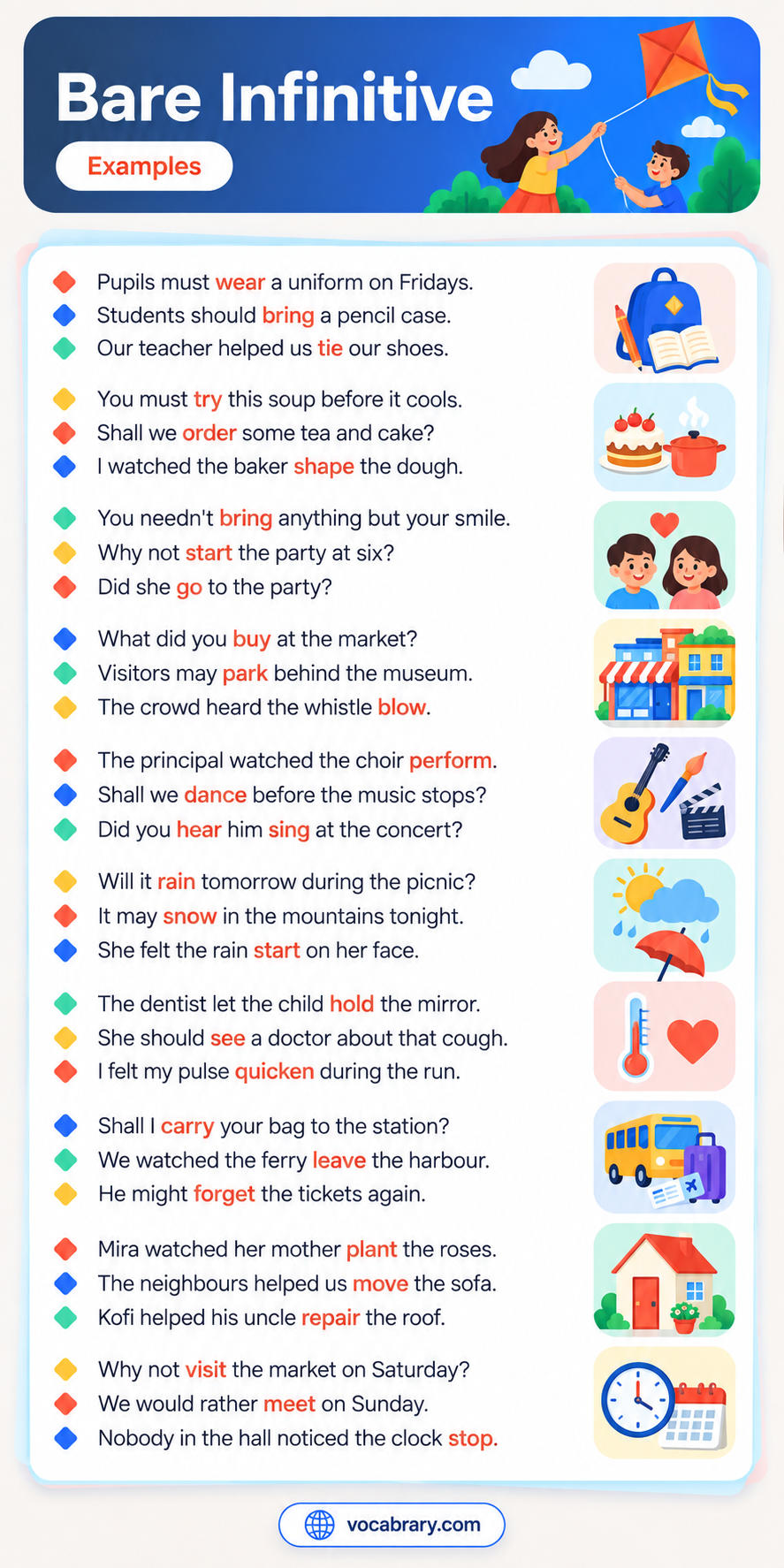
Common Bare Infinitive Examples
In She can swim, the coach made the team run, and we watched the sun set, a base verb follows a trigger word with no to between them.
- She can swim across the lake in ten minutes.
- The coach made the team run in the rain.
- We watched the sun set behind the hills.
- Mum let me stay up for the film.
- You had better pack tonight, because the taxi comes at dawn.
- I did not recognise him at first.
- They heard the choir sing in the old chapel.
- Would you rather walk or take the bus?
- He should call his grandmother this evening.
- The manager had the assistant print the contract.
- Why not visit the market on Saturday?
- Nadia helped her brother carry the boxes.
- Rather than paint the wall, Leo hung a poster.
- Tom will arrive at the station at six.
- Do you know the answer to question four?
- We felt the ground shake during the test.
- She must finish the report by Friday.
- The nurse made the patient rest after lunch.
- Nina saw a heron land on the roof.
- Dad lets us choose the film on Fridays.
Bare Infinitive Patterns
A bare infinitive follows a fixed trigger such as a modal verb, let, make, have, a verb of perception, had better, would rather, or a form of do. The patterns range from can swim to did not go.
| Trigger | Pattern | Example sentence |
|---|---|---|
| Modal verb | Modal + base verb | She can swim. |
| Let | Let + object + base verb | Mum let me stay. |
| Make | Make + object + base verb | The coach made them run. |
| Have | Have + object + base verb | He had the clerk send the letter. |
| Perception verb | See, hear, watch + object + base verb | I saw him leave. |
| Had better | Had better + base verb | You had better go. |
| Would rather | Would rather + base verb | I would rather stay. |
| Do-support | Do, does, or did + base verb | She did not go. |
Bare Infinitive After Modal Verbs
A modal verb such as can, should, or must is followed by the base form of the main verb with no to. Ought is the exception among these modals, because it takes to, as in ought to leave.
Bare Infinitive After Can and Could
Ability, permission, and possibility are expressed by can and could, and the main verb stays in the base form, as in can speak and could run.
- Lena can speak four languages fluently.
- Can you hear the music from here?
- My grandfather could run a mile before breakfast.
- Tara could see the island from her window.
- Our parrot can fly across the whole garden.
- They can start the lesson without us.
- Could you open the window, please?
- Mina could not find her keys anywhere.
- Penguins can swim very fast underwater.
- We can meet at the station at noon.
- Our dog can open the garden gate.
- Anyone can learn this dance with patience.
Bare Infinitive After May and Might
May and might express permission and possibility, as in may leave and might rain, and the next verb has no to.
- You may leave the table after dessert.
- It might rain on Saturday afternoon.
- May I borrow your pen for a minute?
- She may join us later this evening.
- He might forget the tickets again.
- Visitors may park behind the museum.
- The final result might surprise you completely.
- We may need more chairs for the party.
- Students may use a dictionary in the exam.
- It may snow in the mountains tonight.
Bare Infinitive After Will and Would
Promises, plans, and past habits use will and would, followed by the base form, as in will call and would walk.
- I will call you tomorrow morning.
- She would walk to school every day as a child.
- Will they come to the wedding?
- The train will leave at nine.
- He said he would help us move.
- Would you pass the salt, please?
- We will win if we stay calm.
- My uncle would tell stories by the fire.
- The shop will open next week.
- They would sing together every evening.
- Will you marry me next summer, Aisha?
- It will take about an hour.
Bare Infinitive After Shall and Should
Offers, suggestions, and advice use shall and should with a base verb, as in shall dance and should drink.
- Shall we dance before the music stops?
- You should drink more water on hot days.
- I shall return to the village before midnight.
- She should see a doctor about that cough.
- Shall I carry your bag to the station?
- We should leave early to avoid traffic.
- Students should read the instructions twice.
- Should I wait for you outside?
- They should arrive at the hotel by now.
- Shall we order some tea and cake?
Bare Infinitive After Must and Needn’t
Must expresses duty or strong belief and needn’t expresses a lack of need, and each is followed by the base form, as in must stop and needn’t come.
- Drivers must stop at a red light.
- You must try this soup before it cools.
- We must hurry or we will miss the bus.
- You needn’t come if you are tired.
- Visitors must sign the book at the gate.
- She mustn’t forget her passport at the hotel.
- Pupils must wear a uniform on Fridays.
- You needn’t bring anything but your smile.
- He must be very proud of his daughter.
- We needn’t book a table on a weekday.
Bare Infinitive After Let
Let is followed by an object and a bare infinitive to express permission, as in let Nora steer and let her finish. The pattern also includes the contraction let’s.
- Uncle Sami let Nora steer the boat across the bay.
- The guard let the tourists climb the tower for free.
- Let me carry that tray for you.
- The teacher let the class choose their own partners.
- Don’t let the milk boil over.
- Her parents let Hana travel to Seoul alone.
- Let’s meet outside the cinema at seven.
- Please let us know when you arrive.
- He let the puppy sniff every corner of the room.
- The landlord let the tenants keep a small dog.
- Please let her finish her sentence.
- Grandma let the twins crack the eggs.
Bare Infinitive After Make
Make is followed by an object and a bare infinitive to express force or a cause, as in made the sprinters repeat and made the whole audience weep. See causative verb example sentences for the full pattern.
- The coach made the sprinters repeat the drill six times.
- The sad ending made the whole audience weep.
- Her mother made Lina thank the neighbour in person.
- A loud crash made the baby jump.
- The rules made every cyclist wear a helmet.
- The officer made us empty our bags on the table.
- His clumsy dance made the whole room laugh.
- The tutor made the students rewrite the opening paragraph.
- Heavy snow made the bus crawl along the road.
- The smell of baking bread made Rosa hurry home.
- The editor made Aiko cut the essay by half.
- The long wait made several customers walk out.
Bare Infinitive After Have
When the subject arranges for someone else to act, have takes an object and a bare infinitive, as in had the sailors raise and had the clerk draft.
- The captain had the sailors raise the flag at dawn.
- Diego had the waiter repeat the specials.
- She had her assistant cancel the afternoon meeting.
- The head had the caretaker open the hall early.
- We had a plumber inspect the pipes before winter.
- I had a friend proofread my application.
- The mayor had the clerk draft a short speech.
- Jonas had the mechanic listen to the engine.
- The editor had a writer shorten the article.
- Layla had the guide point out the best trails.
Bare Infinitive After Help
Help takes an object and either a bare infinitive or a to-infinitive with no change in meaning, as in helped his sister paint and helped the guest lift.
- Tomas helped his sister paint the fence.
- The porter helped the guest lift the suitcase.
- A kind stranger helped us push the car out of the mud.
- Priya helps her grandmother cook on Sundays.
- Can you help me find my glasses?
- The guide helped the tourists read the map.
- Kofi helped his uncle repair the roof.
- This song helps me relax after work.
- Wei helped the children cross the busy road.
- The new app helps farmers track the weather.
- Chidi helped the old man carry his shopping.
- Volunteers helped the villagers rebuild the school.
Bare Infinitive After Verbs of Perception
Verbs such as see, watch, hear, and feel are followed by an object and a bare infinitive when the speaker perceives a complete action. See verbs of perception example sentences for the contrast with the -ing form.
Bare Infinitive After See and Watch
Saw a fox cross and watched the balloon rise describe a whole action seen from start to finish.
- I saw a fox cross the road at dawn.
- We watched the balloon rise over the valley.
- Nadia saw her friend wave from the bus.
- The children watched the magician pull a rabbit from his hat.
- Nobody saw the thief enter the shop.
- Hiro watched the train disappear into the tunnel.
- She saw the old man fall and called for help.
- We watched the athletes run the final lap.
- Did you see him take the keys?
- Mira watched her mother plant the roses.
- They saw the plane land on the grass strip.
- I watched the baker shape the dough.
Bare Infinitive After Hear and Listen To
A whole sound or event heard from start to finish is found in heard the door slam and listened to the old man tell.
- We heard the orchestra tune up before the concert.
- She heard the door slam and ran downstairs.
- I listened to the old man tell his story.
- Nobody in the building heard the alarm ring.
- Ravi heard someone knock at the window.
- We listened to the band play until midnight.
- Did you hear the baby cry?
- She heard the neighbours argue through the wall.
- I overheard the manager say something about a raise.
- Everyone in the kitchen heard the glass break.
Bare Infinitive After Feel and Notice
Felt the boat tip and noticed him leave describe a whole action that the speaker feels or observes.
- We felt the bridge sway in the wind.
- She felt the rain start on her face.
- He felt his heart race before the speech.
- I noticed him leave the room quietly.
- Nobody in the hall noticed the clock stop.
- Tara noticed the young waiter smile at her.
- We felt the boat tip to one side.
- She noticed the stranger follow her.
- Ben felt the bed move beneath him.
- They noticed the lights go out.
- Scientists observed the ice melt within a week.
Bare Infinitive After Had Better
Had better is followed by a bare infinitive to give advice or a warning, as in had better leave and had better not touch, and the negative places not after better. See verb phrase examples for more patterns.
- You had better leave before the storm arrives.
- We had better hurry or we will miss the train.
- She had better tell the truth.
- You had better not touch that wire.
- I had better go home now.
- They had better book a table early.
- He had better apologise to her tonight.
- You had better take an umbrella.
- The team had better practise harder this week.
- We had better not wait any longer.
Bare Infinitive After Would Rather and Would Sooner
Preferences use would rather and would sooner with a base verb, as in would rather stay and would sooner sleep.
- I would rather stay home tonight.
- She would rather cycle than drive to work.
- Would you rather have tea or coffee?
- They would rather wait than rush the decision.
- He would rather starve than ask for help.
- I would sooner sleep than watch a film.
- We would rather meet on Sunday.
- She would rather not talk about it.
- Would you rather sit by the window?
- Grandpa would rather fix the clock himself.
Bare Infinitive After Why Not and Why Don’t
A suggestion opens with why not or why don’t and a base verb, as in why not ask and why don’t we try.
- Why not ask the neighbours for advice?
- Why don’t we try the new cafe?
- Why not take the early train?
- Why not write her a short letter?
- Why don’t you sit down for a minute?
- Why not start the party at six?
- Why don’t they join us for dinner?
- Why not let the children choose?
Bare Infinitive After Rather Than and But
Rather than and the pattern nothing but are followed by a bare infinitive, as in rather than wait and did nothing but complain. The pattern all she did was laugh takes a bare infinitive too.
- Rather than wait for the bus, we took a taxi.
- She chose to walk rather than take the bus.
- He did nothing but complain all day.
- All she did was laugh at the joke.
- Rather than argue, Tara left the room.
- They did little but sit in the garden.
- Rather than buy a new phone, he repaired his old one.
- The twins do nothing but play football.
- Rather than throw the bread away, Mum made toast.
- All I did was ask a simple question.
Bare Infinitive in Negative Sentences
A negative sentence places not after a modal verb or after do-support (do, does, or did), and the main verb stays in the base form. Did not see and won’t tell are two cases.
- Lena did not see the message until Monday evening.
- She doesn’t eat meat or fish.
- They didn’t go to the match.
- We do not live near the sea.
- He won’t tell anyone about the surprise.
- You shouldn’t touch the stove with wet hands.
- Maria cannot come to the party tonight.
- The shop doesn’t open on Sundays.
- I don’t know his new address in Leeds.
- Nobody in the house could explain the noise.
- They wouldn’t listen to advice from anyone.
- You mustn’t run by the pool.
- The children didn’t want to leave.
- Ana would never forgive him for the lie.
Bare Infinitive in Questions
A question places the modal verb or the form of do before the subject, and the main verb stays in the base form. Did she go and can you swim are two cases.
- Did she go to the party?
- Can you swim a hundred metres without stopping?
- Do they know the answer to the riddle?
- Does your brother play the piano?
- Should we wait for the others?
- Would you rather stay or leave?
- Why did he leave so early?
- Will it rain tomorrow during the picnic?
- What did you buy at the market?
- Where do your cousins live these days?
- Why not call her now, before dinner?
- Must we go home so soon?
- Did you hear him sing at the concert?
- How did the thief enter the house?
Bare Infinitive Compared With To-Infinitive in One Sentence
A bare infinitive after a modal, let, make, or a perception verb stands beside a to-infinitive after a verb such as want or decide. Can swim is bare, and want to learn is a to-infinitive.
- I can swim, but I want to learn diving.
- She made him leave, and then she told him to return.
- We must go now, but we hope to come back.
- Dad let me drive, and then he asked me to stop.
- They heard her sing, and they begged her to continue.
- You should rest, and the doctor advised you to sleep.
- I would rather stay, but I promised to go.
- He helped me carry the box and offered to stay.
- We watched the match end, and we decided to leave.
- She will call, and I plan to answer.
- You had better hurry, because I refuse to wait.
- The teacher made us read, and she allowed us to discuss.
Passive Reversal From Bare Infinitive to To-Infinitive
In the passive, make, see and hear are followed by a to-infinitive instead of a bare infinitive. The active made the visitor wait becomes the passive was made to wait.
- The guard made the visitor wait outside, and the visitor was made to wait until noon.
- Her parents made Lina apologise in person, and Lina was made to apologise to the neighbour too.
- We saw the driver leave the van, and the driver was seen to leave it unlocked.
- They heard him say the word twice, and he was heard to say it a third time.
- The teacher made the pupils rewrite the poem, and the pupils were made to rewrite it again.
Bare Infinitive Examples at Home
At home, a base verb follows made us tidy, can fix, and saw the cat jump.
- Mum made us tidy our bedrooms before lunch.
- Dad can fix almost any leaking tap.
- Grandma let the twins stir the soup.
- We heard the kettle whistle in the kitchen.
- You should turn off the lights when you leave.
- I saw the cat jump onto the shelf.
- Aunt Rosa will bring dessert on Sunday.
- The neighbours helped us move the sofa.
Bare Infinitive Examples at School
School sentences about pupils, teachers, and a principal use must raise, made the class copy, and heard the bell ring, with the base verb after a modal, make, or a perception verb.
- Pupils must raise a hand before speaking.
- Mr Obi made the class copy the poem.
- The teacher let Zoe read her story aloud.
- We heard the bell ring at noon.
- Students should bring a pencil case.
- Can you solve the third problem?
- Miss Ito helped the pupils draw the map.
- The principal watched the choir perform.
Bare Infinitive Examples at Work
Office sentences use a bare infinitive after a modal, make, let, or a perception verb, as in made the team rewrite, must sign, and see the client arrive.
- The manager made the team rewrite the proposal.
- Employees must sign in at the front desk.
- Priya will present the figures on Monday.
- Ines helped her colleague fix the spreadsheet.
- The director let staff leave early on Friday.
- We should book the meeting room today.
- Did anyone see the client arrive?
- The new software helps clerks sort invoices.
Bare Infinitive Examples for Travel
A harbour, a gate, and a fountain are trip settings, and watched the ferry leave, must show, and made us wait describe what happens there.
- We watched the ferry leave the harbour.
- Passengers must show a passport at the gate.
- The guide made us wait by the fountain.
- You had better book the hotel early.
- Can we leave our bags at the station?
- Hana heard the pilot announce a delay.
- Nobody could find the right platform.
- The driver let us stop at the lookout.
Bare Infinitive Examples in the News
A factory closing, a river rising, and a bridge opening are news events described by made the factory close, saw the river rise, and will open.
- Officials made the factory close after the fire.
- Residents saw the river rise overnight.
- The mayor will open the new bridge on Friday.
- Police heard the suspect shout from the roof.
- The minister would not answer any questions.
- Voters should register before the deadline.
- The storm made hundreds of families leave their homes.
- Reporters watched the crowd gather outside the court.
Bare Infinitive Examples in Stories
In fairy tales and adventures, a base verb follows made the prince sleep, let the stranger enter, and saw the dragon rise.
- The witch made the prince sleep for a hundred years.
- The knight saw the dragon rise from the cave.
- The queen let the stranger enter the castle.
- Pip heard a voice call his name from the marsh.
- The old sailor would tell stories by the fire.
- The wind made the lanterns swing.
- The wizard had a servant guard the door.
- They watched the ship vanish beyond the horizon.
Bare Infinitive Examples in Sports
Match reports use a bare infinitive after make, let, or a perception verb, as in made the squad jog, let the game continue, and watched the striker hit.
- The captain made the squad jog two extra laps.
- Lena can kick a ball with either foot.
- The referee let the game continue.
- We watched the striker hit the post.
- Players must wear shin guards during every match.
- The crowd heard the whistle blow.
- Marco helped his teammate stand up.
- Our captain will lead the team onto the pitch.
Bare Infinitive Examples About Health
A clinic, a corridor, and a running track are health settings, and made him rest, had the patient sit, and felt my pulse quicken describe what happens there.
- The doctor made him rest for a week.
- You should drink water throughout the day.
- The nurse had the patient sit in the corridor.
- I felt my pulse quicken during the run.
- Patients must fast before the operation.
- The physio helped Ali walk without a stick.
- Can you breathe deeply and slowly?
- The dentist let the child hold the mirror.
Bare Infinitive Examples for Kids
Young learners find a bare infinitive by looking for a base verb right after a word such as can, must, or let’s, as in can jump and Let’s play.
- I can jump over the little stream.
- Mum lets me help her bake cookies.
- We saw a bird sit on the fence.
- You must hold the rope with both hands.
- Can you hear the rain on the roof?
- Dad made me eat my peas.
- I will share my toys with my friend.
- Let’s play hide and seek!
- Did you see the rabbit hop?
- Our teacher helped us tie our shoes.
Short Bare Infinitive Sentences for Young Learners
Short lines of two to four words, such as I can run and Let’s go, state a pattern with one bare infinitive.
- I can run.
- Let’s go!
- We must wait.
- She can sing.
- I will try.
- Dad made me smile.
- You should rest.
- They can swim.
- Did you eat?
- Let me see.
Bare Infinitive Examples for Students
Exam answers need longer sentences with bare infinitives such as must submit and would rather delay, which state rules, preferences, and observations in formal language.
- Candidates must submit their essays by noon on Friday.
- The committee would rather delay the vote than risk an error.
- Researchers watched the colony grow over twelve weeks.
- The government should protect wetlands that shelter rare birds.
- Witnesses heard the defendant repeat the same denial.
- Rather than summarise the report, the speaker analysed its flaws.
- Auditors made the firm disclose every payment.
- Scholars cannot ignore the evidence from the second excavation.
- The new policy will reduce waste in schools.
- Citizens may appeal against any decision within thirty days.
Short Paragraphs With Bare Infinitives
A school morning, a day at home, a football match, a hospital visit, and a trip to the coast use bare infinitives after modals, let, make, and perception verbs.
Ms Idowu made the class learn the poem by heart. She let Tomi recite the first verse, and we heard his voice shake. Pupils must speak clearly, so nobody dared laugh. By noon we could say every line.
Dad made the boys sweep the porch. Mum can mend a torn sleeve in minutes, so she helped Dad hang the new curtains. We heard the toaster pop and saw the dog creep under the table. Aunt Lena will visit on Sunday.
The manager made the squad jog two laps. Ruth can strike a ball with either foot, and the fans watched her curl a free kick past the wall. The referee let the play go on. We should score soon if we stay patient.
The surgeon made Omar lie still for an hour. A nurse had him drink a glass of water, and he felt the pain fade. The therapist helped him stand up slowly. He must come back on Friday.
We watched the tide roll in over the sand. The guide made us stay behind the rope, and Hana heard a gull cry overhead. We had better pack a coat. Nobody could see the far shore through the mist.
Mistakes With Bare Infinitives
Adding to after a modal, let, make, or a perception verb, and putting a past or -s form after did or does, are common errors. She can to swim and I didn’t went are two cases.
❌ She can to swim.
✅ She can swim.
A modal verb is followed by the base form without to.
❌ He let me to leave early.
✅ He let me leave early.
Let is followed by an object and a bare infinitive.
❌ I saw him to cross the street.
✅ I saw him cross the street.
In the active, a verb of perception is followed by an object and a bare infinitive, not a to-infinitive.
❌ She made me to cry.
✅ She made me cry.
Make in the active is followed by an object and a bare infinitive.
❌ I didn’t went to school.
✅ I didn’t go to school.
After did the main verb is in the base form, and only did is in the past tense.
❌ Does she likes tea?
✅ Does she like tea?
After does the main verb is in the base form, and only does has the -s ending.
❌ You had better to leave now.
✅ You had better leave now.
Had better is followed by a bare infinitive.
❌ He was made go to the office.
✅ He was made to go to the office.
In the passive, make is followed by a to-infinitive.
❌ I would rather to walk home.
✅ I would rather walk home.
Would rather is followed by a bare infinitive.
❌ Why not to ask her?
✅ Why not ask her?
Why not is followed by a bare infinitive.
❌ She must goes now.
✅ She must go now.
A modal verb is followed by the base form, with no -s ending.
❌ We heard her to sing.
✅ We heard her sing.
Hear is followed by an object and a bare infinitive.
Bare Infinitive Compared With To-Infinitive
A bare infinitive is the base verb alone, while a to-infinitive adds the word to before the base verb. The infinitive example sentences cover the second type in full.
| Feature | Bare infinitive | To-infinitive |
|---|---|---|
| Form | The base verb alone. | To + base verb. |
| Follows | Modals, let, make, have, perception verbs. | Want, decide, hope, ask, and many other verbs. |
| Example | She can swim. | She wants to swim. |
| Passive of make | Not used. | He was made to wait. |
| Negative | Not before the verb: did not go. | Not before to: decided not to go. |
| Exception | Ought takes to: ought to leave. | Ought is followed by to. |
Related
- Infinitive Example Sentences
- Infinitive Phrase Examples
- Causative Verb Example Sentences
- Verbs of Perception Example Sentences
- Helping Verb Example Sentences
- Gerund Example Sentences
- Verb Phrase Examples
FAQs
Q1. What is the form of a bare infinitive?
The form of a bare infinitive is the base verb with no to in front of it. It has no -s, -ed, or -ing ending, so the verbs swim, go, and leave are bare infinitives in She can swim, They did not go, and We saw him leave.
Q2. Which verbs take a bare infinitive?
Modal verbs, let, make, have, help, and the verbs of perception take a bare infinitive. The expressions had better, would rather, why not, and rather than take one as well, and the helper do takes one in negatives and questions. The verb ought is the exception, because it takes to.
Q3. What is the difference between a bare infinitive and a to-infinitive?
A bare infinitive has no to, while a to-infinitive has to before the base verb. A bare infinitive follows modals, let, make, have, and perception verbs, and a to-infinitive follows verbs such as want, decide, and hope. See infinitive example sentences for the second type.
Q4. Why do modal verbs take a bare infinitive?
Modal verbs take a bare infinitive because they are helping verbs, and the main verb after a modal stays in the base form with no ending. In She can swim, the modal expresses ability, and swim has neither to nor -s. The page on helping verbs covers the class.
Q5. Does help take a bare infinitive or a to-infinitive?
The verb help takes either a bare infinitive or a to-infinitive, and the meaning stays the same. He helped me carry the box and He helped me to carry the box are both correct. The bare form is shorter.
Q6. What happens to a bare infinitive after make in the passive?
A bare infinitive after make becomes a to-infinitive in the passive. The active sentence They made him wait becomes He was made to wait. The verbs see and hear follow the same rule, as in He was seen to leave.
Q7. How do verbs of perception work with a bare infinitive?
Verbs of perception take an object and a bare infinitive when the speaker perceives a whole action from start to finish. I saw him cross the road means the speaker watched the full crossing. I saw him crossing the road uses the -ing form for an action in progress. See verbs of perception example sentences.
Q8. Is the verb after did a bare infinitive?
The verb after did is a bare infinitive, because did marks the past tense and the main verb stays in the base form. In She did not go, the verb go has no ending. The same rule applies after do and does in negatives and questions.
Q9. What does had better take?
Had better takes a bare infinitive, as in You had better leave. In the negative, not follows better, as in You had better not touch it. The form expresses advice or a warning and is not followed by to.
Q10. Is an imperative the same as a bare infinitive?
An imperative has the same base form as a bare infinitive, but it is classed as a separate mood. In Come here, the verb has no ending, just as a bare infinitive has none. The imperative gives a command, while a bare infinitive depends on another word such as a modal.
Q11. Why does ought take to?
The verb ought takes to because it is one of the few modal-like verbs, with used to and have to, that are followed by a to-infinitive. In You ought to leave, the word to is required in standard written English. The negative form is ought not to leave.
Q12. What are bare infinitive examples for kids?
Bare infinitive examples for kids are short sentences with a base verb after a word such as can, must, or let’s. In I can jump, the verb jump has no to. Children find the pattern by checking that the verb has no ending after the helper word.
Q13. Can a bare infinitive stand alone as a sentence?
A bare infinitive is unable to stand alone as a sentence, because it needs a trigger such as a modal or a causative verb. Swim across the lake is a command, but that is an imperative and not a bare infinitive. See infinitive phrase examples for phrases built on infinitives.

Leave a Comment