
A cleft sentence is a sentence that divides one clause into two parts in order to put one part in focus, as in It was Maria who called. These cleft sentence examples cover it-clefts, wh-clefts, reverse wh-clefts, and all-clefts, with focus on subjects, objects, time, and place.
What Is a Cleft Sentence?
A cleft sentence splits one clause into a main clause plus a second clause, so that a chosen part of the message is in focus. A simple sentence states the same facts in one clause with no special focus: Maria called is a simple sentence, and It was Maria who called is a cleft sentence.
It + be + focus + who or that clause | What + clause + be + focus
It was the rain that ruined the picnic.
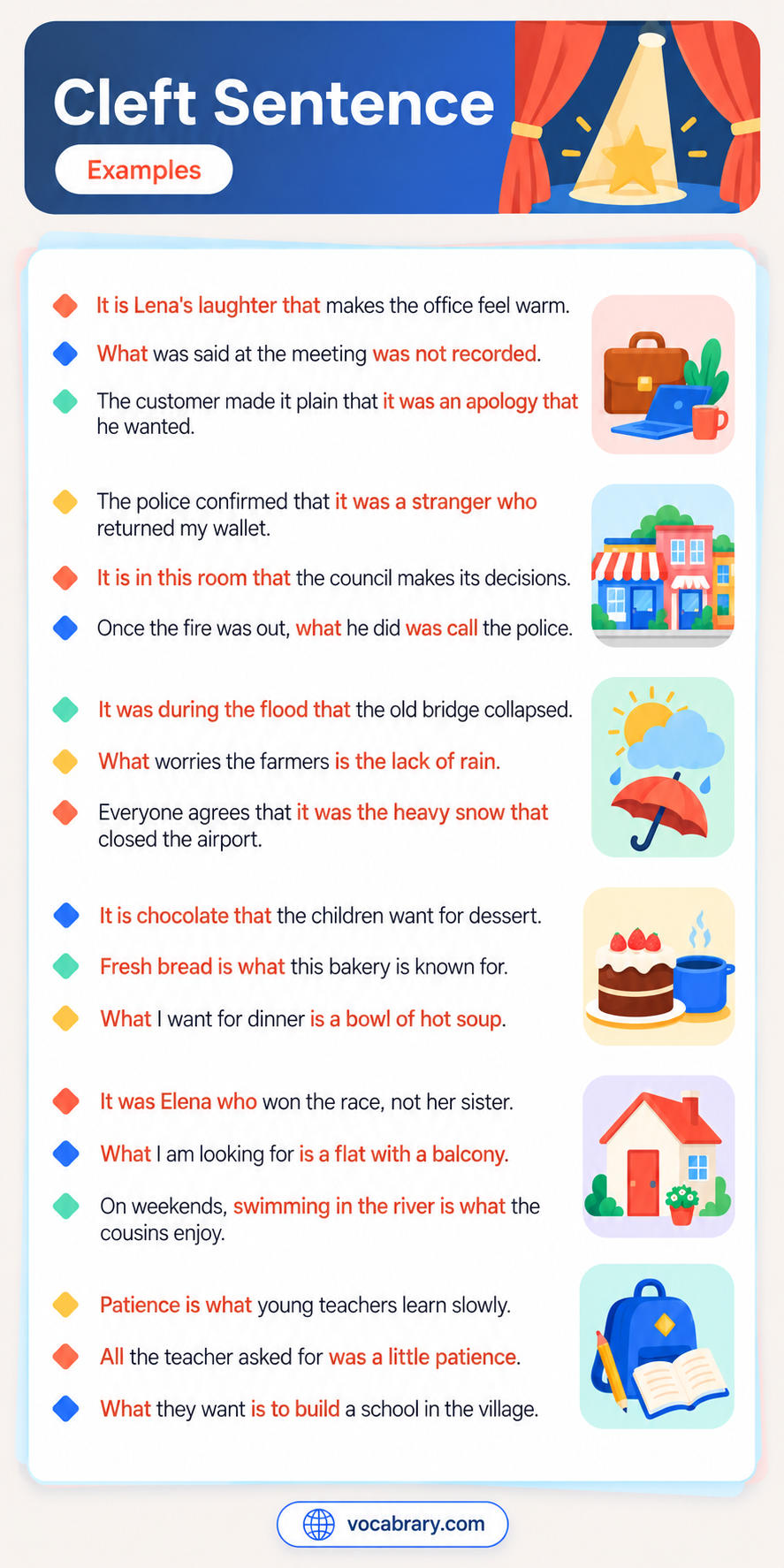
Common Cleft Sentence Examples
Cleft sentences such as It was Maria who called and What I need is a rest divide one message into a frame and a focus. The focus is the part that the speaker wants the listener to notice.
- It was Maria who called the office this morning.
- What I need is a rest after the long journey.
- It was the hail that damaged the greenhouse roof.
- All she wanted was a quiet evening at home.
- A glass of water is what the runners wanted at the finish line.
- It is next week that the results arrive.
- What he did was apologise to every guest.
- It was in Lisbon that they first met.
- The person who helped me was a stranger at the bus stop.
- There was a boy who waited at the gate all afternoon.
- It was his honesty that impressed the committee.
- What surprised everyone was the speed of the repairs.
- It’s the dog that barks at night, not the cat.
- What I love most is the smell of fresh bread.
- It was during the flood that the old bridge collapsed.
- Peace is all the villagers want after the war.
- It was Ravi who found the missing key under the sofa.
- What happened next was that the lights went out.
- It was because of the storm that the match ended early.
- Trust is what a good team needs most.
It-Clefts With the Subject in Focus
In an it-cleft, the subject in focus follows it was and precedes who or that. Examples are It was Kofi who painted the fence and It was the engine that failed. The clause after who or that has the form of a relative clause, a pattern described in relative clause example sentences.
- It was the engine that failed on the steep hill.
- It was Kofi who painted the fence on Sunday.
- It is the council that approves the budget each year.
- It was my sister who told me the secret.
- Everyone agrees that it was the heavy snow that closed the airport.
- It was the children who broke the window, not the neighbours.
- It is the librarian who orders the new books.
- It was a small dog that frightened the burglar.
- It was Dr. Rahman who discovered the error in the report.
- It is Lena’s laughter that makes the office feel warm.
- The police confirmed that it was a stranger who returned my wallet.
- It was the twins who won the science prize.
It-Clefts With the Object in Focus
An object in focus follows it was or it is, and that or whom introduces the rest. Examples are It was a red coat that she bought and It was Tomas whom they invited.
- It was a red coat that she bought in the winter sale.
- It was Tomas whom they invited to the opening.
- It is the final chapter that I like best.
- Later I realised that it was my keys that I had left on the train.
- It was this very song that my grandmother sang to me.
- It is chocolate that the children want for dessert.
- It was the report that the manager rejected, not the budget.
- It was a letter from Cairo that she opened first.
- It is French that Sofia studies on Saturdays.
- It was the old clock that the thief took.
- The customer made it plain that it was an apology that he wanted.
- It was the blue vase that the movers dropped.
It-Clefts With Time Phrases in Focus
A time phrase in focus follows it was or it is, and that introduces the rest. Examples are It was last winter that we moved and It was after midnight that the phone finally rang.
- It was last winter that we moved to the coast.
- It is in September that the new term begins.
- It was in the spring that the swallows returned to the barn.
- It was after midnight that the phone finally rang.
- It is on Fridays that the market sells fresh fish.
- My diary says that it was during the interval that Hana lost her glasses.
- It was only last week that I learned the news.
- It was at dawn that the fishermen left the harbour.
- It was not until June that the rain stopped.
- Mina insists that it was five years ago that Leila first visited Nairobi.
It-Clefts With Place Phrases in Focus
A place phrase in focus follows it was or it is, and that introduces the rest. Examples are It was in the library that we met and It was at the station that Omar lost his ticket.
- It was in the library that we met.
- It was at the station that Omar lost his ticket.
- It is in the north that the winters are coldest.
- Everyone knew that it was under the bed that the cat had hidden its toy.
- It was on the third floor that the fire started.
- It was in a small village near Seville that she grew up.
- It is here that the old road meets the river.
- It was beside the lake that the children found the boat.
- It was at my uncle’s farm that I learned to ride.
- It is in this room that the council makes its decisions.
It-Clefts With Reason and Manner in Focus
A reason or manner phrase in focus follows it was or it is, and that introduces the rest. Examples are It was because of the fog that the flights were cancelled and It was by practising every day that Mina improved.
- It was because of the fog that the flights were cancelled.
- It was by practising every day that Mina improved her piano playing.
- It is for her patience that the pupils respect her.
- It was through hard work that the team reached the final.
- Neighbours say that it was out of kindness that he gave away his coat.
- It was with a smile that the waiter handed me the bill.
- It is by listening carefully that you learn a language.
- It was for safety reasons that the bridge was closed.
Wh-Clefts, or Pseudo-Clefts
A wh-cleft starts with a what clause, continues with a form of be, and ends with the focus, as in What Dina needs is a holiday and What she wanted was to leave.
- What Dina needs is a holiday after this tiring term.
- What she wanted was to leave before dark.
- Once the fire was out, what he did was call the police.
- What the children like is a story before bed.
- What worries me is the cost of the repairs.
- In the end, what we bought was a small house near the harbour.
- What I like about the city is its quiet parks.
- If the lights fail, what you should do is wait until the engineer arrives.
- What the team lacks is experience.
- What he said was that the road was closed.
- At the final, what impressed the judges was her courage.
- What I am looking for is a flat with a balcony.
- After long debate, what they decided was to postpone the wedding.
- What Lina enjoys is hiking in the hills.
- What she gave me was a map of the old town.
- What matters most to the coach is discipline.
Reverse Wh-Clefts
A reverse wh-cleft places the focus first and the what clause last, as in A warm shower is what Ravi needs and Honesty is what matters most to us.
- A warm shower is what Ravi needs after the marathon.
- Honesty is what matters most to us.
- A quiet life is what my grandparents wanted.
- To the judges, courage is what counted.
- Fresh bread is what this bakery is known for.
- The noise from the road is what worries the owners.
- A strong coffee is what Tomas orders first.
- On weekends, swimming in the river is what the cousins enjoy.
- Patience is what young teachers learn slowly.
- This small flat is what we were looking for.
- For the youngest children, a bedtime song is what they ask for.
- Time is what the new team lacks.
All-Clefts
An all-cleft replaces what with all and marks the focus as the only item, as in All I want is peace and All she did was smile.
- All I want is peace and quiet.
- All she did was smile at the camera.
- All we need is more time to finish the project.
- After the long walk, all the children wanted was an ice cream.
- All he asked for was a glass of water.
- All you have to do is press the green button.
- In the drawer, all I could find was an old key.
- All the team needs is one good result.
- Years later, all Nadia remembers is the smell of rain.
- All they heard was the wind in the pines.
There-Clefts
Some grammars call a sentence with there is or there was, a noun, and a relative clause an existential cleft, or a there-cleft. The relative clause describes the noun, as in There is a shop on the corner that sells fresh bread and There are people who never read the instructions.
- There is a shop on the corner that sells fresh bread.
- There are people who never read the instructions.
- There was a girl at the door who wanted to see you.
- There is something in the garden that frightens the cat.
- There were two men outside who asked for directions.
- There is a problem with the engine that nobody has noticed.
- There was a note on the table that explained everything.
- There are students in this class who speak four languages.
Clefts With Place, Person, Time, and Reason Nouns
A noun such as place, person, day, or reason opens the frame and takes a relative clause. Examples are The place where we met was a bus stop and The reason why he left was the noise.
- The place where we met was a bus stop.
- The person who fixed the roof was my neighbour.
- The reason why he left was the noise.
- The day when we arrived was a Friday.
- The month when the river floods is April.
- The thing I regret is not calling earlier.
- The town where I was born is Kandy.
- The reason she resigned was her health.
- The only person who knows the code is the caretaker.
- The time when the shop is busiest is lunchtime.
- The room where we study is the one with the blue door.
- The one who called was my aunt Esi.
Clefts for Contrast and Correction
A cleft sentence expresses contrast or correction when the focus is paired with a denial, as in It was not Tom but Sam who broke the vase and It wasn’t the heat that bothered me.
- It was not Tom but Sam who broke the vase.
- It wasn’t the heat that bothered me; it was the noise.
- It was Spain, not Portugal, that they visited last summer.
- It isn’t money that makes people happy, but good friends.
- It was Elena who won the race, not her sister.
- It is the second train that goes to the coast, not the first.
- What I wanted was not a gift but an apology.
- It wasn’t Monday that the shop closed; it was Tuesday.
- It was the writing, not the story, that disappointed the critics.
- It is quality, not quantity, that counts in this workshop.
- What he needs is a teacher, not a friend.
- It was you who promised to call, not me.
Clefts That Put a Verb or a Whole Clause in Focus
Verbs and whole clauses take the wh-cleft frame, as in What I did was lock the door and What happened was that the power failed. In the second sentence the focus is a noun clause, a pattern covered in noun clause examples.
- What happened was that the power failed during the storm.
- What I did was lock the door and turn off the lights.
- What she does is teach physics at the local college.
- What the committee decided was that the fee would rise.
- What they want is to build a school in the village.
- What Mr. Park did next was open the window.
- What I mean is that the plan is too expensive.
- What the doctor advised was to rest for a week.
Agreement and Tense in Clefts
When the focus is the subject, the verb in the clause agrees with the focus, as in It is the pupils who decide and It was Priya who was waiting. The form of be after it marks the time, as in It will be Tuesday that the results are posted. A singular is is standard in a wh-cleft even before a plural focus, as in What we need is more volunteers.
- It is the pupils who decide the theme of the concert.
- It is the manager who decides the schedule.
- It was the children who were shouting in the corridor.
- It was Priya who was waiting outside the door.
- It will be Tuesday that the results are posted.
- It has been the rain that has delayed the harvest.
- What we need is more volunteers for the weekend.
- What I will do is call the school tomorrow.
- What we have been doing is testing the new engine.
- What she had wanted was a quiet life.
- What worries the farmers is the lack of rain.
- It is we who are responsible for the delay.
- It was they who paid for the repairs.
- It is you who have the tickets.
Negative Clefts
In negative cleft sentence examples, not is placed in the frame or in the clause, as in It wasn’t Rosa who told him and What I don’t understand is why the shop closed.
- It wasn’t Rosa who told him the news.
- It isn’t the money that worries me.
- What I don’t understand is why the shop closed.
- It was not until midnight that the guests left.
- It isn’t Paul who forgot the tickets.
- What I didn’t expect was such a warm welcome.
- It wasn’t in the kitchen that I found the keys.
- It isn’t the first time that the bus has been late.
- What he never tells us is where he goes at night.
- It was never Omar who complained about the food.
Questions With Clefts
A cleft question inverts be and it, as in Was it Maria who called and What was it that frightened the horse. This inversion follows the pattern in inversion examples.
- Was it Maria who called the office?
- Is it the weather that bothers you?
- What was it that frightened the horse?
- Who was it that left the gate open?
- Where was it that you found the key?
- Why is it that the bus is always late?
- How is it that you know my name?
- Is it Friday that the new term starts?
- Was it the noise that woke the baby?
- When was it that you moved to Madrid?
- Was it in Rome that they got married?
- What is it that you want from me?
Clefts in Reported Speech and Passive Sentences
In reported speech the cleft sentence is placed inside the reported clause, as in He said that it was the noise that kept him awake. In a passive cleft the verb in the clause is passive, as in It was the bridge that was damaged by the flood.
- He said that it was the noise that kept him awake.
- She explained that what she wanted was a quiet life.
- The guide told us that it was in this room that the treaty was signed.
- It was the bridge that was damaged by the flood.
- What was needed was a better plan.
- It was the old tower that was restored last year.
- The reporter wrote that it was the mayor who had approved the plan.
- What was said at the meeting was not recorded.
Cleft Sentence and Simple Sentence Pairs
A simple sentence and its cleft version share the same facts, as in Leila fixed the engine and It was Leila who fixed the engine.
- Simple: Leila fixed the engine. Cleft: It was Leila who fixed the engine.
- Simple: I need a holiday. Cleft: What I need is a holiday.
- Simple: They met in Paris. Cleft: It was in Paris that they met.
- Simple: She wants peace. Cleft: All she wants is peace.
- Simple: Hugo broke the lamp. Cleft: It was the lamp that Hugo broke.
- Simple: The noise annoyed him. Cleft: What annoyed him was the noise.
- Simple: We arrived on Friday. Cleft: It was on Friday that we arrived.
- Simple: Noor lost the map. Cleft: It was the map that Noor lost.
Clefts in Everyday Contexts
Cleft sentence examples from a house, a classroom, an office, a border, a newsroom, a story, a stadium, and a clinic each put a person, a place, a time, or a need in focus.
Clefts at Home
In It was my brother who left the tap running the focus is a person, and in All the baby needs is a quiet nap the focus is a need.
- It was my brother who left the tap running.
- What I want for dinner is a bowl of hot soup.
- All the baby needs is a quiet nap.
- It is in the kitchen that the whole family gathers.
Clefts at School
It was Mr. Haddad who taught us puts a teacher in focus, and What the pupils enjoy most is the science fair puts an event in focus.
- It was Mr. Haddad who taught us how to write essays.
- What the pupils enjoy most is the science fair.
- It was in the second term that Zara joined the choir.
- All the teacher asked for was a little patience.
Clefts at Work
It is the clients who pay for the new equipment and What the firm needs is a younger design team place a group and a need in focus.
- It is the clients who pay for the new equipment.
- What the firm needs is a younger design team.
- It was last quarter that sales began to fall.
- The person who answers the phone is the receptionist.
Clefts While Travelling
A place and a memory become the focus in It was at the border that the guard checked our papers and What I remember about Kyoto is the quiet gardens.
- It was at the border that the guard checked our papers.
- What I remember about Kyoto is the quiet gardens.
- All the tourists wanted was a seat in the shade.
- It was the delayed train that made us miss the ferry.
Clefts in the News
In news reports, the focus is an official in It was the mayor who announced the new tax and a demand in What the voters want is lower prices.
- It was the mayor who announced the new tax.
- What the voters want is lower prices.
- It was on Tuesday that the storm reached the coast.
- It was not the speech that surprised reporters, but the silence afterwards.
Clefts in Fiction
In stories, It was the dragon that burned the village puts a character in focus, and There was a woman in the tower who never spoke to anyone introduces one.
- It was the dragon that burned the village.
- What the knight feared was the silence of the forest.
- There was a woman in the tower who never spoke to anyone.
- All the prince wanted was to go home.
Clefts in Sports
A sports cleft names a player in It was the goalkeeper who saved the final penalty and a quality in A strong defence is what wins the league.
- It was the goalkeeper who saved the final penalty.
- What the coach demands is full effort.
- It was in the last minute that the home team scored.
- A strong defence is what wins the league.
Clefts in Health
It is sleep that helps the body recover and What the doctor recommended was a daily walk place a habit and a treatment in focus.
- It is sleep that helps the body recover.
- What the doctor recommended was a daily walk.
- All the patient needs is rest and clean water.
- It was the cough that worried the nurse most.
Cleft Sentence Examples for Kids
Short cleft sentences about the cat and a new red kite let young learners stress one part of a message.
- What I like is ice cream on a hot day.
- It was the cat that knocked over the cup.
- All I want is a new red kite.
- It was Mia who drew the big yellow sun.
- What my dog loves is a long walk.
- It was in the garden that I found the frog.
- A bike is what my brother wants for his birthday.
- It is Saturday that we go to the park.
- What I hear is a bird in the tree.
Short Cleft Sentences for Young Learners
Five word lines such as It was Tom who ran and All I want is milk are complete clefts for beginners.
- It was Tom who ran.
- All I want is milk.
- What I like is cake.
- It was Sam who won.
- Milk is what I want.
- It was Mum who called.
- What I need is sleep.
- It was Rex that barked.
- All we need is time.
- It was Anna who sang.
Cleft Sentence Examples for Students
Exam answers and essays use longer clefts such as It was not until the final chapter that the narrator revealed her motive and What distinguishes the two theories is their treatment of evidence.
- It was not until the final chapter that the narrator revealed her motive.
- What the experiment demonstrated was that the sample had been contaminated.
- It is the lack of funding, not the lack of interest, that limits the research.
- Social inequality is what the author criticises throughout the novel.
- All the committee requires is a short written summary of the findings.
- It was only after the data had been checked that the team published its conclusions.
- What distinguishes the two theories is their treatment of evidence.
- It is in the final paragraph that the writer states her main claim.
- There are researchers who doubt the results of the first trial.
- What the reader remembers is the imagery of the opening scene.
- It was the arrival of the railway that changed the town’s economy.
Clefts in Short Passages
Two short passages about a storm and a picnic use cleft sentence examples in running text, with it was Friday that and What she wanted was between ordinary sentences.
The storm struck late in the week, and it was Friday that it reached our village. What surprised everyone was the speed of the wind. It was the old oak that fell first, and all we heard was a loud crack. The person who reached us first was our neighbour Mr. Bello, and what he brought was a torch and a flask of tea.
Our class planned a day out, and it was Amina who suggested the picnic. What she wanted was a quiet place by the river, so it was to the old bridge that we walked. All the children needed was a ball and some shade, and there were birds on the water that sang until sunset.
Cleft Sentence Mistakes and Corrections
Wrong relative words, wrong verb forms, an extra it, and a missing it are the errors in this group, and each pair is followed by one reason.
❌ It was Maria which called me.
✅ It was Maria who called me.
The relative word for a person in an it-cleft is who or that, not which.
❌ It was the wind what ruined the picnic.
✅ It was the wind that ruined the picnic.
An it-cleft uses a relative word such as that or who after the focus, not what.
❌ It was the children who was shouting.
✅ It was the children who were shouting.
The verb in the relative clause agrees with the plural focus children.
❌ All I want are peace.
✅ All I want is peace.
The focus peace is singular, so the verb be is is.
❌ What she did it was call the police.
✅ What she did was call the police.
The pronoun it is extra, because the what clause is already the subject.
❌ It was in the library were we met.
✅ It was in the library that we met.
The word after a place focus is that, and were is a form of the verb be, not a relative word.
❌ Was Maria who called?
✅ Was it Maria who called?
A cleft question has it after the verb be.
❌ It was Ravi whom found the key.
✅ It was Ravi who found the key.
The relative word is the subject of found, so who is used and not whom.
❌ What he did was apologising to the guests.
✅ What he did was apologise to the guests.
After a wh-cleft with the verb do, the focus verb is in the base form, not the -ing form.
❌ It were the dogs that barked.
✅ It was the dogs that barked.
The pronoun it takes the singular form was, even before a plural focus.
❌ It was yesterday that I have met her.
✅ It was yesterday that I met her.
A finished time in the past takes the past tense, not the present perfect.
❌ The person who helped me were a stranger.
✅ The person who helped me was a stranger.
The subject person is singular, so the verb is was.
Cleft Sentence Compared With Simple Sentence
A cleft sentence uses two clauses to put one part in focus, while a simple sentence states the same facts in one clause. For the order of words in ordinary statements, see word order examples.
| Feature | Cleft sentence | Simple sentence |
|---|---|---|
| Number of clauses | Two clauses | One clause |
| Focus | Marked by the frame | Marked only by stress or position |
| Example | It was Maria who called. | Maria called. |
| Length | Longer | Shorter |
| Purpose | Contrast, correction, and emphasis | Neutral statement |
Related
- Word Order Examples
- Inversion Examples
- Noun Clause Examples
- Relative Clause Example Sentences
- Simple Sentence Examples
- Complex Sentence Examples
- Dependent Clause Examples
FAQs
Q1. What are some common cleft sentence examples?
Common cleft sentence examples include It was Maria who called, What I need is a rest, A rest is what I need, and All I want is peace. Each one divides a single clause into a frame and a focus. The focus is the part that the speaker wants the listener to notice.
Q2. How do you form an it-cleft?
An it-cleft is formed with it, a form of be, the focus, and a who, that, or whom clause, as in It was Maria who called. The focus is a noun phrase, a phrase of time or place, or a reason, as in It was in Lisbon that they first met. The word who is used for people, and that is used for people and objects.
Q3. What is a wh-cleft, and how does it differ from an it-cleft?
A wh-cleft begins with a what clause, then a form of be, then the focus, as in What I need is a rest. An it-cleft begins with it and puts the focus before the relative clause, as in It was a rest that I needed. The wh-cleft, also called a pseudo-cleft, is the standard frame when the focus is a verb phrase, as in What he did was apologise.
Q4. What is a reverse wh-cleft?
A reverse wh-cleft puts the focus first and the what clause last, as in A rest is what I need. It has the same meaning as the wh-cleft What I need is a rest. The focus in this order is a noun phrase in Honesty is what matters most to us.
Q5. How do you use an all-cleft?
An all-cleft is a wh-cleft in which all replaces what, as in All I want is peace. The sentence states that the focus is the only wish or action, and the same pattern is used in All she did was smile. The verb be follows the pattern of a wh-cleft, so All we need is more time has the singular is.
Q6. What is a there-cleft?
A there-cleft, called an existential cleft in some grammars, introduces a new person or object with there is or there was. A relative clause describes it, as in There is a shop on the corner that sells fresh bread. The relative clause begins with who for people and that for objects. The verb after there agrees with the noun that follows, so you write there are people who never read the instructions.
Q7. Why do speakers use cleft sentences for contrast and emphasis?
Speakers use cleft sentences for contrast and emphasis because the frame separates one part of the message from the rest. In It wasn’t the heat that bothered me; it was the noise, the focus the noise replaces the assumed cause. Cleft sentences are common in speeches, debates, and explanations.
Q8. Which parts of a sentence take focus in a cleft?
The focus of a cleft sentence is a subject, an object, a phrase of time or place, a reason, or a whole clause. You write It was Kofi who painted the fence, It was a red coat that she bought, It was last winter that we moved, and It was in the library that we met. Verbs and whole clauses take the wh-cleft frame, as in What he did was apologise.
Q9. How do agreement and tense work in cleft sentences?
The verb in the relative clause of an it-cleft agrees with the focus, so you write It is the pupils who decide and It is the manager who decides. The form of be after it marks the time, as in It was last year that we moved and It will be Tuesday that the results are posted. In a wh-cleft the verb be is singular before a singular focus, and a singular is is also standard before a plural focus, as in What we need is more volunteers.
Q10. How do you make a cleft sentence negative?
A cleft sentence is made negative by adding not to the frame verb or to the clause. You write It wasn’t Rosa who told him and It isn’t the money that worries me. A wh-cleft takes the negative inside the what clause, as in What I don’t understand is why the shop closed.
Q11. How do you ask a question with a cleft?
A cleft question inverts be and it, as in Was it Maria who called and Is it the weather that bothers you. A question word comes first in a wh-question, as in What was it that frightened the horse and Why is it that the bus is always late. The relative clause has the order of a statement.
Q12. How is a cleft sentence different from a simple sentence?
A cleft sentence uses two clauses and puts one part in focus, while a simple sentence uses one clause and marks focus only through stress or word order. Maria called is a simple sentence, and It was Maria who called is a cleft sentence. Both give the same facts, but the cleft version marks the person who called as the new or contrasting part.
Q13. What are the most common cleft sentence mistakes?
Common cleft sentence mistakes are using which or what in place of who or that, dropping it in a question, and adding an extra it in a wh-cleft. Writers also mismatch the verb with the focus and use the present perfect with a finished past time. A check that the frame contains that or who and that each verb agrees corrects most of these errors.

Leave a Comment