
A compound sentence is a type of sentence that joins two or more independent clauses with a coordinating conjunction, a semicolon, or a colon, as in the rain stopped, and the match began. These compound sentence examples start with the seven coordinating conjunctions and then turn to semicolons, conjunctive adverbs, colons, and three-clause patterns.
What Is a Compound Sentence?
A compound sentence links two or more independent clauses of equal rank, each with its own subject and verb, using a comma plus a coordinating conjunction, a semicolon, or a colon. A complex sentence differs because one clause depends on another, so The rain stopped, and the match began is compound, while The match began after the rain stopped is complex.
Independent clause + comma + coordinating conjunction + independent clause = compound sentence
Mina set the table, and Joon poured the water.
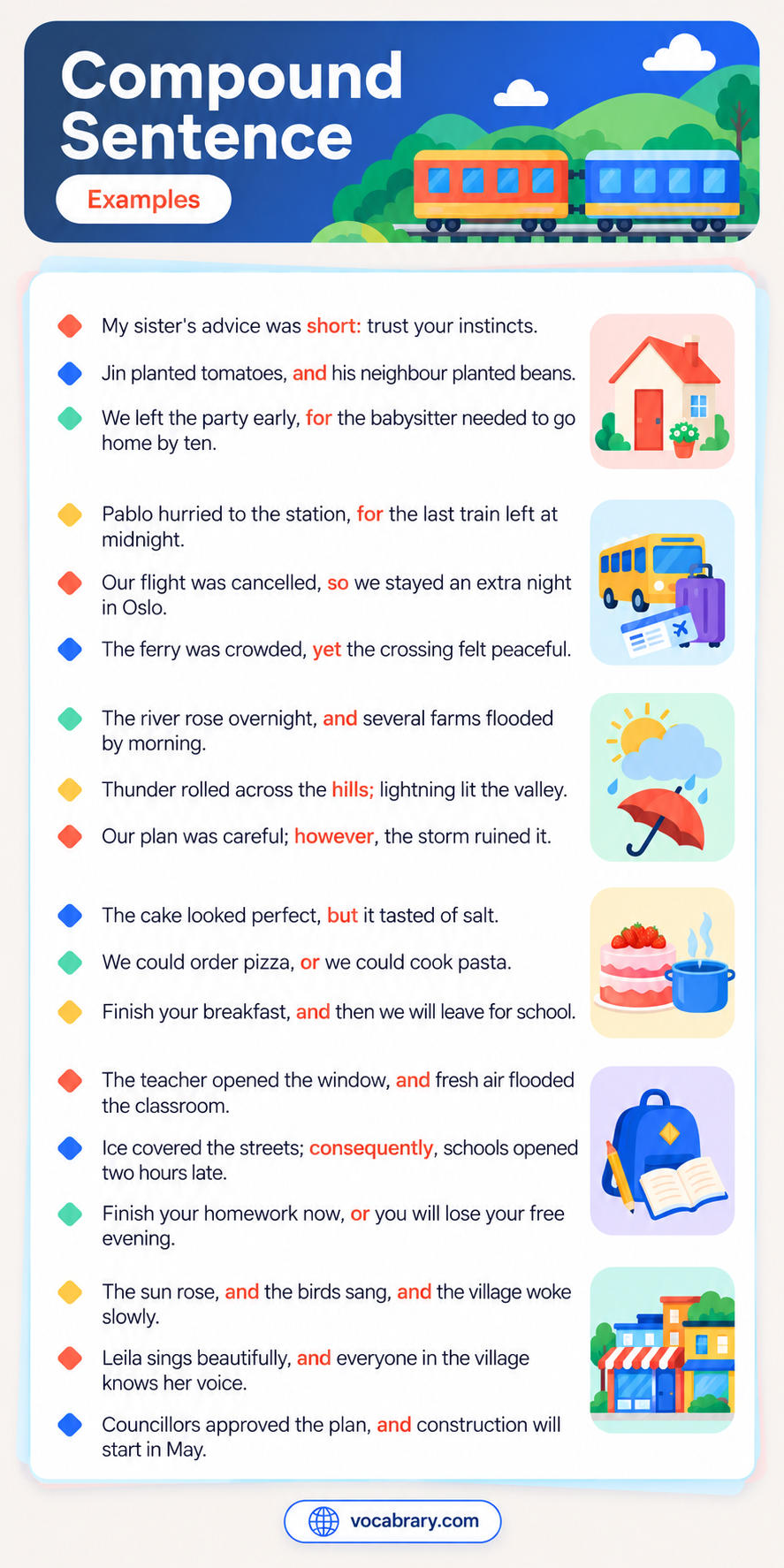
Common Compound Sentence Examples
The seven coordinating conjunctions for, and, nor, but, or, yet, and so form the acronym FANBOYS and join most compound sentence examples. Typical cases are The rain stopped, and the match began on time and The shop was closed, so we went home; the coordinating conjunction example sentences page lists each word with its own models.
- The rain stopped, and the match began on time.
- Ada packed the car, and Luis checked the map.
- I wanted to leave early, but the traffic was heavy.
- We can take the train, or we can drive.
- The shop was closed, so we went home.
- Nobody answered the door, yet the lights stayed on.
- The sky darkened; thunder rolled across the valley.
- Maria loves painting, and her brother prefers music.
- The bus was late; however, the driver apologised to every passenger.
- Kofi studied all night, but he still felt unprepared.
- The plan was simple: we would leave at dawn.
- Hana plays the flute, and Omar plays the drums.
- The museum opens at ten, but the gift shop opens at nine.
- You must hurry, or the train will leave without you.
- The children were exhausted, so they slept the whole way home.
- Leila sings beautifully, and everyone in the village knows her voice.
Compound Sentences With For for Cause
The conjunction for introduces a reason, as because does, and joins the reason to the clause before it. Compare Tara packed an umbrella, for the forecast promised heavy rain and The villagers cheered, for the long drought had finally ended.
- He stayed indoors all weekend, for the roads were covered in ice.
- Tara packed an umbrella, for the forecast promised heavy rain.
- The villagers cheered, for the long drought had finally ended.
- I trusted the old guide, for he had walked the pass a hundred times.
- Mina kept silent, for she had promised her sister to keep the secret.
- The crew worked through the night, for the ship had to sail at dawn.
- We left the party early, for the babysitter needed to go home by ten.
- The shop closed for a week, for the owner was recovering from surgery.
- Grandfather wore his warmest coat, for the wind off the sea was bitter.
- Pablo hurried to the station, for the last train left at midnight.
Compound Sentences With And for Addition
The conjunction and adds a second, related clause of equal weight. The sun set behind the hills, and the village lights came on is one case, and Dev washed the plates, and Priya dried them is another.
- The sun set behind the hills, and the village lights came on.
- Dev washed the plates, and Priya dried them.
- Thunder rumbled in the distance, and a cold wind swept through the market.
- Our team practised hard, and the effort paid off in the final.
- The teacher opened the window, and fresh air flooded the classroom.
- Rosa speaks Spanish, and her husband speaks Portuguese.
- The band finished its last song, and the crowd demanded an encore.
- Jin planted tomatoes, and his neighbour planted beans.
- A fox crossed the road, and the driver slowed down.
- The doctor wrote a prescription, and the nurse explained the dosage.
- Snow covered the roofs, and children dragged sleds up the hill.
- The orchestra tuned its instruments, and the hall fell silent.
- Esra finished the report, and her manager approved it the same day.
- The river rose overnight, and several farms flooded by morning.
Compound Sentences With But for Contrast
But marks contrast between two clauses, and the second clause opposes or limits the first. In I like tea, but my sister prefers coffee the preferences differ, and in The ticket was cheap, but the seat was uncomfortable the qualities differ.
- I like tea, but my sister prefers coffee.
- The ticket was cheap, but the seat was uncomfortable.
- Marcus trained for months, but he missed the qualifying time.
- The movie was long, but nobody left early.
- Anita wanted the red coat, but the shop had sold it.
- It rained all morning, but the festival went ahead.
- Our flat is small, but the view of the harbour is wonderful.
- The cake looked perfect, but it tasted of salt.
- He apologised twice, but she did not answer.
- The path was steep, but the climbers reached the top before noon.
- Lina studies medicine, but her twin brother studies law.
- The phone rang loudly, but the baby kept sleeping.
- The old car is slow, but it has never failed us.
- Elena smiled politely, but her eyes showed her disappointment.
Compound Sentences With Or for Alternative
Or expresses a choice between two clauses. In You can wait here, or you can come with me the clauses state two options. In Take an umbrella, or you will get soaked the second clause states the consequence of ignoring the command.
- You can wait here, or you can come with me.
- We could order pizza, or we could cook pasta.
- Finish your homework now, or you will lose your free evening.
- Take an umbrella, or you will get soaked.
- Ravi will call tonight, or he will write a letter tomorrow.
- Pay the fine today, or the council will add a penalty.
- You can study French, or you can study German.
- The team must win this game, or it will leave the tournament.
- Either the printer is broken, or someone forgot to load the paper.
- Leave before noon, or the roads will be jammed.
- We might go to the beach, or we might visit the old fort.
- Sign the form by Friday, or your place will go to another student.
Compound Sentences With Nor
Nor joins a second negative clause, and the auxiliary verb comes before its subject. Sample sentences are He did not call, nor did he leave a message and I have not read the book, nor have I seen the film.
- He did not call, nor did he leave a message.
- The shop had no bread, nor did it have any milk.
- Tomás never apologised, nor did he explain his absence.
- She could not see the stage, nor could she hear the singers.
- The council did not reject the plan, nor did it approve it.
- I have not read the book, nor have I seen the film.
- The old road was not wide, nor was it well lit.
- Jana did not forget the meeting, nor did she arrive late.
Compound Sentences With Yet
Yet states a contrast that is unexpected after the first clause. The outcome is unexpected in The task looked impossible, yet the team finished it by Friday and in She studied very little, yet she passed with distinction.
- The task looked impossible, yet the team finished it by Friday.
- She studied very little, yet she passed with distinction.
- The soup smelled strange, yet it tasted delicious.
- The road was icy, yet the bus arrived on time.
- He is wealthy, yet he lives in a tiny flat.
- The speech was short, yet it moved the whole audience.
- Our garden gets little sun, yet the roses bloom every June.
- Omar had never sailed, yet he steered the boat with confidence.
- The recipe has only three steps, yet it takes all afternoon.
- The exam was difficult, yet most students finished early.
Compound Sentences With So for Result
So introduces a result. In The battery was dead, so I borrowed my brother’s phone and It started to snow, so the school closed early, the first clause states the cause and the second states the outcome.
- The battery was dead, so I borrowed my brother’s phone.
- It started to snow, so the school closed early.
- Lara lost her keys, so she called a locksmith.
- The roads were flooded, so the buses stopped running.
- Dad burned the toast, so we ate cereal.
- The tickets sold out quickly, so we watched the match at home.
- Nobody understood the question, so the teacher repeated it slowly.
- The window was broken, so the caretaker covered it with wood.
- Felix forgot his lunch, so his friends shared theirs.
- The meeting ran late, so the manager ordered sandwiches.
- Our flight was cancelled, so we stayed an extra night in Oslo.
- The paint was still wet, so nobody touched the door.
- Amira speaks three languages, so the hotel hired her as a guide.
- The river froze, so the villagers crossed it on foot.
Compound Sentences With a Semicolon
A semicolon joins two closely related independent clauses with no conjunction. Both The river was wide; the current was strong and Hana prefers tea; her husband prefers coffee follow this pattern. The second clause begins with a lowercase letter unless it starts with a proper noun or the word I.
- The first exam was easy; the second was far harder.
- Some people prefer mornings; others work best at night.
- The road was closed; traffic moved through the village instead.
- Dina cooked the meal; her cousin set the table.
- The river was wide; the current was strong.
- Snow fell all night; by dawn the town was silent.
- Our house has a garden; theirs has a pool.
- The speaker paused; the audience leaned forward.
- Hana prefers tea; her husband prefers coffee.
- The mayor spoke first; two councillors followed.
- Thunder rolled across the hills; lightning lit the valley.
- I read the report; my colleague reviewed the budget.
- The train was late; nobody complained.
- Winter was long; spring arrived with relief.
Compound Sentences With a Semicolon and Conjunctive Adverb
A conjunctive adverb after a semicolon states the link between two clauses and takes a comma after it in standard written style, except for short adverbs such as then. The adverb is chosen by meaning, as listed on the conjunctive adverbs example sentences page: addition, contrast, result, or sequence.
Addition With Moreover and Furthermore
The adverbs moreover, furthermore, and in addition add a further fact. Examples are The apartment is close to the station; moreover, the rent is low and Sana trains every morning; furthermore, she follows a strict diet.
- The apartment is close to the station; moreover, the rent is low.
- Sana trains every morning; furthermore, she follows a strict diet.
- The hotel offers free breakfast; in addition, it provides a shuttle to the airport.
- The tutor explained the formula; besides, he gave extra practice sheets.
- The new library is quiet; furthermore, it opens until midnight.
- Ivan wrote the speech; moreover, he rehearsed it twice.
- The course covers grammar; in addition, it trains students to write essays.
Contrast With However and Nevertheless
The adverbs however, nevertheless, and instead mark a turn against the first clause. Two cases are The forecast promised sunshine; however, clouds covered the sky by noon and The road was dangerous; nevertheless, the drivers continued toward the pass.
- The forecast promised sunshine; however, clouds covered the sky by noon.
- The road was dangerous; nevertheless, the drivers continued toward the pass.
- Mei wanted to walk; instead, she took the bus because of the rain.
- The salary is low; nevertheless, many graduates apply for the job.
- Our plan was careful; however, the storm ruined it.
- Ahmed rarely cooks; instead, he orders food every evening.
- The hotel looked cheap; however, the rooms were spotless.
Cause and Result With Therefore and Consequently
Therefore and consequently state a result in The bridge was damaged; therefore, officials closed it to traffic and in Rainfall was far below average; consequently, the harvest failed.
- The bridge was damaged; therefore, officials closed it to traffic.
- Rainfall was far below average; consequently, the harvest failed.
- The printer jammed twice; as a result, the report arrived late.
- Ines saved for years; thus, she bought the house without a loan.
- The ticket price doubled; hence, fewer tourists visited the castle.
- Inspectors found a fault in the wiring; therefore, the factory stopped production.
- Ice covered the streets; consequently, schools opened two hours late.
Time and Sequence With Then and Meanwhile
Then, meanwhile, and afterward mark the order of events in time: Tamar chopped the onions; then she heated the oil and Dad cooked dinner; meanwhile, the children set the table.
- Tamar chopped the onions; then she heated the oil.
- Dad cooked dinner; meanwhile, the children set the table.
- The guests ate dessert; afterward, they played cards until midnight.
- Tara finished the course; subsequently, she joined the laboratory.
- The storm passed; later, the villagers cleaned the streets.
- The pilot checked the instruments; next, she contacted the tower.
- The band tuned up; finally, the curtain rose.
Compound Sentences With a Colon
A colon joins two independent clauses when the second clause explains or restates the first. Cases are Everyone knew the result: the older team had trained harder and Dad gave one rule: nobody touches the oven. Style guides differ on whether a colon counts as a joiner in a compound sentence.
- Everyone knew the result: the older team had trained harder.
- Dad gave one rule: nobody touches the oven.
- The weather was perfect: the sky was blue and the sea was calm.
- Lena had one fear: the train would leave without her.
- Everything was ready: the tables were set.
- The village looked deserted: every shop was shut.
- My sister’s advice was short: trust your instincts.
- The decision was final: the council would not reopen the case.
Compound Sentences With Three Clauses
Compound sentences with three clauses add a second joiner. Models include I wanted to stay, but Tom wanted to leave, so we flipped a coin and Rain fell all week, so the river rose, and the lower fields flooded.
- I wanted to stay, but Tom wanted to leave, so we flipped a coin.
- The sun rose, and the birds sang, and the village woke slowly.
- Ana sketched the design, and Luis built the model, but the client rejected both.
- We could hike to the lake, or we could rent bikes, or we could stay in camp.
- The movie began, and the lights dimmed, yet nobody stopped talking.
- Rain fell all week, so the river rose, and the lower fields flooded.
- Maya called twice, but nobody answered, so she left a message.
- The baby cried, and the dog barked, but the toddler slept through it all.
- Dad lit the fire, and Mum made cocoa, and the children told stories.
- The shop was crowded; however, the queue moved fast, and we paid in minutes.
- The ferry was late, so we missed lunch, but dinner at the harbour was wonderful.
- Hector trained daily, and his coach praised him, yet he still doubted his speed.
Compound Sentences With a Different Subject in Each Clause
When each clause has its own subject, a comma is placed before the coordinating conjunction, except in very short clauses. Standard cases are Sara plays the violin, and her sister plays the piano and Tom washed the car, and Jenny mowed the lawn.
- Sara plays the violin, and her sister plays the piano.
- The teacher explained the task, but the students misunderstood it.
- Tom washed the car, and Jenny mowed the lawn.
- My parents live in Pune, but my brother lives in Dubai.
- The bakery sells bread, and the grocer sells cheese.
- The sun was shining, yet a cold wind blew from the north.
- The judges praised the dancers, and the audience cheered.
- Rita wrote the invitations, and Sam addressed the envelopes.
- The windows were open, so the curtains moved in the breeze.
- The coach shouted instructions, but the players could not hear him.
- Chidi cooked the rice, and Mariam prepared the sauce.
- The film starts at eight, but the doors open at seven.
Negative Compound Sentences
Negative words such as not, never, and nobody appear in either clause or in both. My phone did not ring, and no message arrived negates both clauses, while Rina did not enjoy the film, but she liked the music negates only the first.
- The elevator was not working, so we climbed eight floors.
- Rina did not enjoy the film, but she liked the music.
- I have never been to Peru, nor have I met anyone from there.
- The shop does not accept cards, so bring cash.
- We were not hungry, yet we ordered dessert.
- The students did not finish the test, and the teacher extended the time.
- Nobody saw the accident, but several people heard the crash.
- The bus did not stop, and the passengers shouted from the pavement.
- Leo never complains, but everyone knows he is tired.
- The garden is not large, but it grows plenty of vegetables.
- My phone did not ring, and no message arrived.
- You must not touch the paint, or the colour will smear.
Compound Sentences That Ask Questions
In a compound interrogative both clauses are questions, and the sentence ends with one question mark. Look at Did you call the doctor, or did Ana write to the clinic? and Where is the key, and who has it?
- Did you call the doctor, or did Ana write to the clinic?
- Is the shop open, or has it closed for the afternoon?
- Will Maria cook dinner, or will we order takeaway?
- Where is the key, and who has it?
- Does the bus stop here, or must we walk to the corner?
- Are you ready to order, or do you need more time?
- Did the experiment work, and what did the team learn from it?
- Is Tom coming to the party, or has he cancelled again?
- Have you finished the report, and did you send it to the manager?
- Are the children asleep, or are they still reading?
Compound Sentences With Commands
A command followed by a statement forms a compound sentence. The imperative clause has an understood subject, you, in Sit down, and I will bring you some water and in Close the window, or the rain will soak the carpet.
- Sit down, and I will bring you some water.
- Close the window, or the rain will soak the carpet.
- Finish your breakfast, and then we will leave for school.
- Call me tonight, and I will explain everything.
- Hurry up, or we will miss the ferry.
- Wake Tom early, for the train leaves at six.
- Tell the truth, and nobody will be angry.
- Save your work now, or the file will be lost.
- Take the stairs, for the elevator is broken.
- Practise every day, and your playing will improve.
Passive Compound Sentences
In passive compound sentence examples, the subject receives the action in one or both clauses. Illustrations are The cake was baked on Friday, and it was decorated on Saturday and The bridge was closed, so the traffic was diverted.
- The cake was baked on Friday, and it was decorated on Saturday.
- The windows were cleaned, but the doors were left dirty.
- Dinner was served at eight, and coffee was offered afterwards.
- The bridge was closed, so the traffic was diverted.
- All the letters were signed, and they were posted the same day.
- Several rules were explained, yet some players broke them.
- Every ticket was sold, so extra seats were added.
- The suspect was questioned, but he was released that night.
- The fence was painted white, and the gate was painted green.
- The report was finished on Monday, but it was not approved until Friday.
Compound Sentences as Exclamations
A compound sentence ends in an exclamation mark when the whole sentence expresses strong feeling or a warning. What a view this is, and how lucky we are to see it! and Watch the step, or you will fall! each end with one exclamation mark.
- What a view this is, and how lucky we are to see it!
- The goal was spectacular, and the crowd went wild!
- It is freezing outside, but the soup smells wonderful!
- Watch the step, or you will fall!
- How heavy the box is, and how far we must carry it!
- The fireworks started, and the whole sky lit up!
- Hurry, for the show is about to begin!
- We won the cup, and nobody can believe it!
Compound Sentences at Home
Household sentences join two chores or events, as in Grandpa watered the plants, and I swept the porch and The kettle boiled, but nobody noticed the whistle.
- Grandpa watered the plants, and I swept the porch.
- The kettle boiled, but nobody noticed the whistle.
- Mum opened the oven, and the smell of fresh bread filled the kitchen.
- Our dog barks at strangers, yet he loves every guest after five minutes.
- The sofa is old, but it is still comfortable.
- It was late, so I turned off the television.
Compound Sentences at School
Two school events share one sentence in The bell rang, and the students hurried to class and Rahul forgot his homework, so the teacher gave him extra time.
- The bell rang, and the students hurried to class.
- Ms. Davies handed out the papers, but nobody started before the signal.
- Our school has a pool, and it has a rooftop garden too.
- Rahul forgot his homework, so the teacher gave him extra time.
- The library is quiet, yet the cafeteria is always loud.
- We study algebra on Mondays, and we study geometry on Thursdays.
Compound Sentences at Work
Office sentences link a decision to its result, as in The manager approved the budget, and the team started the project. They also set two facts together, as in Sales rose in March, yet profits stayed flat.
- The manager approved the budget, and the team started the project.
- Our printer jammed, so I emailed the files to the front desk.
- The meeting began at nine, but the director arrived at ten.
- Sales rose in March, yet profits stayed flat.
- Eva writes the reports, and Carlos presents them to the board.
- The deadline is Friday; therefore, everyone must finish by Thursday evening.
Compound Sentences for Travel
Travel sentences report a trip and what happened on it. Two cases are Our train left at noon, and it reached the coast by evening and The airline lost my bag, but it delivered it the next day.
- Our train left at noon, and it reached the coast by evening.
- The airline lost my bag, but it delivered it the next day.
- We wanted a window seat, so we checked in early.
- The hotel is modest, but the staff are generous.
- The road to the lake is long, and the last stretch is unpaved.
- The ferry was crowded, yet the crossing felt peaceful.
Compound Sentences in the News
Reports on a council vote, a flood, and a minister’s resignation join an event with its result. Examples are Councillors approved the plan, and construction will start in May and Floods closed the highway, so drivers used the coastal road.
- Councillors approved the plan, and construction will start in May.
- Floods closed the highway, so drivers used the coastal road.
- The mayor denied the rumour, but reporters kept asking.
- Unemployment fell last month, yet prices continued to rise.
- A new clinic opened downtown, and hundreds of residents registered.
- The minister resigned on Tuesday; consequently, the party named a replacement.
Compound Sentences in Fiction
In stories, The door creaked open, and a cold draft swept the hall and The wolf howled once, and the forest fell silent join two clauses to describe a scene.
- The door creaked open, and a cold draft swept the hall.
- Nora searched the attic, but she found only dust and old letters.
- The captain gave the order, and the crew raised the sails.
- The wolf howled once, and the forest fell silent.
- The knight drew his sword, yet the dragon only yawned.
- Mist covered the moor, so the travellers lost the path.
Compound Sentences in Sports
Match sentences about a shot, a save, and a whistle join two events, as in The striker shot twice, but the goalkeeper saved both attempts and The referee blew the whistle, and the crowd groaned.
- The striker shot twice, but the goalkeeper saved both attempts.
- Our team trained hard, and it won the league title.
- The race began at dawn, and the leaders passed the first marker in minutes.
- Coach Murphy substituted two players, but the score stayed level.
- Maya swims every morning, and her brother runs in the evening.
- The referee blew the whistle, and the crowd groaned.
Compound Sentences About Health
Health sentences join two facts about care or habits, as in Regular exercise strengthens the heart, and good sleep restores energy and Sugar tastes pleasant, yet too much of it harms the teeth.
- Dr. Patel examined the child, and the nurse recorded his temperature.
- I drink water every hour, but my throat still feels dry.
- Regular exercise strengthens the heart, and good sleep restores energy.
- The patient felt dizzy, so the nurse helped him sit down.
- The clinic opens at eight, but the pharmacy opens at nine.
- Sugar tastes pleasant, yet too much of it harms the teeth.
Compound Sentences About Food
Two kitchen or restaurant events join in Mum chopped the onions, and Dad stirred the pot and The soup was too spicy, so Leo drank three glasses of water.
- Mum chopped the onions, and Dad stirred the pot.
- The bread was fresh, but the butter had melted.
- We ordered two curries, and the waiter brought extra rice.
- Fatima baked the cake; meanwhile, her sister whipped the cream.
- The soup was too spicy, so Leo drank three glasses of water.
- The market sells mangoes, yet the best ones sell out by nine.
Compound Sentences in Nature
Outdoor scenes join two events in A heron stood in the shallows, and a small fish darted away and The tide went out, and children raced across the wet sand.
- A heron stood in the shallows, and a small fish darted away.
- The mountain looked close, but the hike took six hours.
- Leaves fell from the oak, and squirrels gathered the acorns.
- The tide went out, and children raced across the wet sand.
- Wolves hunt at night, so the shepherds guard the flock until dawn.
- The pond froze overnight, yet the ducks swam in the open water by the reeds.
Compound Sentences for Kids
Short sentences such as I ran, and Tom jumped and It rained, so we stayed inside follow one pattern: short clause, comma, joining word, short clause. These compound sentence examples use one joiner each.
- I ran, and Tom jumped.
- The sun is hot, but the pool is cool.
- Mia has a cat, and Sam has a dog.
- It rained, so we stayed inside.
- We can walk, or we can ride.
- The cake is big, and it is yummy.
- Dad cooked, and I helped.
- The bird sang, and the frog jumped.
- I like milk, but Ben likes juice.
- It was dark, so we turned on the light.
Compound Sentences for Students
Compound sentence examples for essays and exams on economics, climate, and literature use longer clauses. Consider The factory increased production, but it failed to improve working conditions and The government cut the budget; consequently, several public libraries closed.
- The factory increased production, but it failed to improve working conditions.
- Climate change threatens coastal cities; therefore, governments must invest in flood defences.
- The author introduces a young narrator, and her voice shapes the entire novel.
- The experiment produced unexpected results, so the researchers repeated it twice.
- Some economists favour lower taxes; however, others argue for higher public spending.
- The treaty ended the war, yet it created new tensions across the region.
- Urban populations are growing rapidly, and housing shortages are becoming more severe.
- Social media connects people instantly, but it also spreads false stories quickly.
- The government cut the budget; consequently, several public libraries closed.
- Students must submit the essay on time, or the department will deduct marks.
Compound Sentences in a Short Paragraph
Three connected passages about a cold Saturday, a school trip, and a power cut use compound sentences in running text, so learners meet connected compound sentence examples joined by and, but, so, and yet.
Saturday was cold, but we still went to the lake. Dad rented a boat, and I held the map. The wind grew strong, so we turned back early. We were tired, yet nobody wanted to go home.
Our class visited the science museum, and the guide showed us a giant telescope. Mei asked about the stars, but the guide laughed at her long list of questions. The bus left at four, so we hurried to the gift shop. I bought a small globe, and Mei bought a book about planets.
The power went out at eight, and the whole street fell dark. Mum found two candles, but she could not find any matches. Dad searched the kitchen drawers, and I checked the garage. We finally found a lighter, so we ate dinner by candlelight.
Common Mistakes With Compound Sentences
Comma splices, fused sentences, a misplaced semicolon, an extra comma, and a wrong sentence label are the errors in this group, and each pair corrects one of them in compound sentence examples.
❌ The rain stopped, the match began.
✅ The rain stopped, and the match began.
A comma alone is unable to join two independent clauses, so a coordinating conjunction is added after the comma.
❌ The phone rang I answered it.
✅ The phone rang, and I answered it.
Two independent clauses with no punctuation or conjunction form a fused sentence, and the comma plus and joins them.
❌ I wanted to go, however, it rained.
✅ I wanted to go; however, it rained.
A conjunctive adverb that joins two clauses follows a semicolon, not a comma, and takes a comma after it.
❌ The concert was cancelled; because the singer was ill.
✅ The concert was cancelled because the singer was ill.
A semicolon joins independent clauses, and because the singer was ill is a dependent clause, so no semicolon is used before it.
❌ The sentence She laughed and cried is a compound sentence.
✅ The sentence She laughed and cried is a simple sentence with a compound predicate.
Only one subject, she, is present in the sentence, so the two verbs form one independent clause.
❌ She was tired, but, she kept working.
✅ She was tired, but she kept working.
No comma follows a coordinating conjunction that joins two clauses, unless an interrupting phrase comes next.
❌ We left early; and we arrived on time.
✅ We left early; we arrived on time.
A semicolon replaces the coordinating conjunction in a sentence without internal commas, so the two are not used together.
Compound Sentences Compared With Simple Sentences
A compound sentence has two or more independent clauses, each with its own subject and verb, while a simple sentence with a compound predicate has one subject for several verbs. The two patterns differ in subjects, clauses, and punctuation, and the single-clause sentence models page covers the one-clause pattern in full.
| Feature | Compound sentence | Simple sentence with a compound predicate |
|---|---|---|
| Subjects | Its own subject in each clause | One subject shared by every verb |
| Independent clauses | Two or more | One |
| Comma before the conjunction | Yes, between the two clauses | No, when only two verbs share the subject |
| Semicolon option | Yes | No |
| Example | Sam grabbed his keys, and Ana opened the door. | Sam grabbed his keys and opened the door. |
Related
- Independent Clause Examples
- Coordinating Conjunction Example Sentences
- Conjunctive Adverbs Example Sentences
- Simple Sentence Examples
- Complex Sentence Examples
- Compound Complex Example Sentences
- Correlative Conjunction Example Sentences
- Starting a Sentence With And or But
FAQs
Q1. What are the seven coordinating conjunctions used in a compound sentence?
The seven coordinating conjunctions are for, and, nor, but, or, yet, and so, remembered as FANBOYS. Each one joins two independent clauses and states a relationship: addition, contrast, cause, result, or alternative. The coordinating conjunction example sentences page gives each word its own set of models.
Q2. Does a compound sentence need a comma?
A compound sentence needs a comma before the coordinating conjunction, except when the two clauses are very short, as in I ran and Tom jumped. A semicolon replaces both the comma and the conjunction. Two verbs that share one subject need no comma, because that pattern forms a simple sentence.
Q3. How many independent clauses does a compound sentence have?
A compound sentence has at least two independent clauses and no dependent clause. Compound sentence examples with three or more clauses are possible, as in I wanted to stay, but Tom wanted to leave, so we flipped a coin. Each added clause needs its own subject, its own verb, and a joiner.
Q4. What is the difference between a compound sentence and a complex sentence?
A compound sentence joins independent clauses of equal rank, while a complex sentence joins one independent clause to a dependent clause. The sentence The rain stopped, and the match began is compound, and The match began after the rain stopped is complex. More models of the second type appear on the complex sentence examples page.
Q5. Is "Sam grabbed his keys and ran" a compound sentence?
The sentence Sam grabbed his keys and ran is a simple sentence with a compound predicate, not a compound sentence. One subject, Sam, has two verbs, so the sentence contains one independent clause. The sentence Sam grabbed his keys, and Ana ran is compound because it has two subjects.
Q6. Can a compound sentence use a semicolon?
A compound sentence uses a semicolon when two independent clauses are closely related and no conjunction joins them. The sentence The river was wide; the current was strong is an example. A semicolon also precedes a conjunctive adverb such as however or therefore when that adverb joins two clauses.
Q7. How do you punctuate a conjunctive adverb in a compound sentence?
You punctuate a conjunctive adverb with a semicolon before it and a comma after it when it joins two independent clauses, although a short adverb such as then needs no comma. The sentence The road was closed; therefore, we took the ferry follows this pattern. A comma before the adverb instead of a semicolon creates a comma splice.
Q8. Does a compound sentence use a colon?
A compound sentence uses a colon when the second independent clause explains or restates the first. The sentence Everyone knew the result: the older team had trained harder is one example. Style guides differ on this use, so a semicolon is the safer choice when the link is not an explanation.
Q9. What is a comma splice in a compound sentence?
A comma splice is an error in which a comma alone joins two independent clauses, and it is a frequent fault in learner compound sentence examples, as in The rain stopped, the match began. Three repairs are available: add a coordinating conjunction after the comma, replace the comma with a semicolon, or split the clauses into two sentences. The corrected version is The rain stopped, and the match began.
Q10. What is a run-on sentence in compound sentences?
A run-on sentence in a compound pattern joins two independent clauses with no punctuation and no conjunction, as in The phone rang I answered it. The error is also called a fused sentence. Adding a comma plus and, or a semicolon, repairs it.
Q11. Can a compound sentence be a question or a command?
A compound sentence is able to be a question, a command, or an exclamation as well as a statement. Did you call the doctor, or did Ana write to the clinic? is a compound question. Sit down, and I will bring you some water joins a command to a statement.
Q12. How do you identify a compound sentence?
You identify a compound sentence by finding two or more subject-verb units that each stand alone as a sentence. If a coordinating conjunction, a semicolon, or a colon joins them and no clause begins with a word like because or who, the sentence is compound. A dependent clause added to it would make the sentence compound-complex, as on the compound complex example sentences page.
Q13. Why do writers use compound sentences?
Writers use compound sentences to state a relationship between two statements of equal weight, such as addition, contrast, cause, or result. A compound sentence also joins two statements into one sentence in place of two short sentences. A long run of them becomes repetitive, so writers mix them with simple sentences and complex sentences.

Leave a Comment