
A compound-complex sentence is a type of sentence that has two or more independent clauses and at least one dependent clause, as in I stayed home because it rained, and my sister joined me. These compound complex example sentences cover clause orders, punctuation, and the kinds of dependent clause.
What Is a Compound-Complex Sentence?
A compound-complex sentence combines a compound sentence and a complex sentence: it has at least two independent clauses and at least one dependent clause. A compound sentence has no dependent clause, so I stayed home, and my sister joined me is compound, while adding because it rained makes the sentence compound-complex.
Independent clause + coordinator + independent clause + subordinator + dependent clause (in any order)
I stayed home because it rained, and my sister joined me.
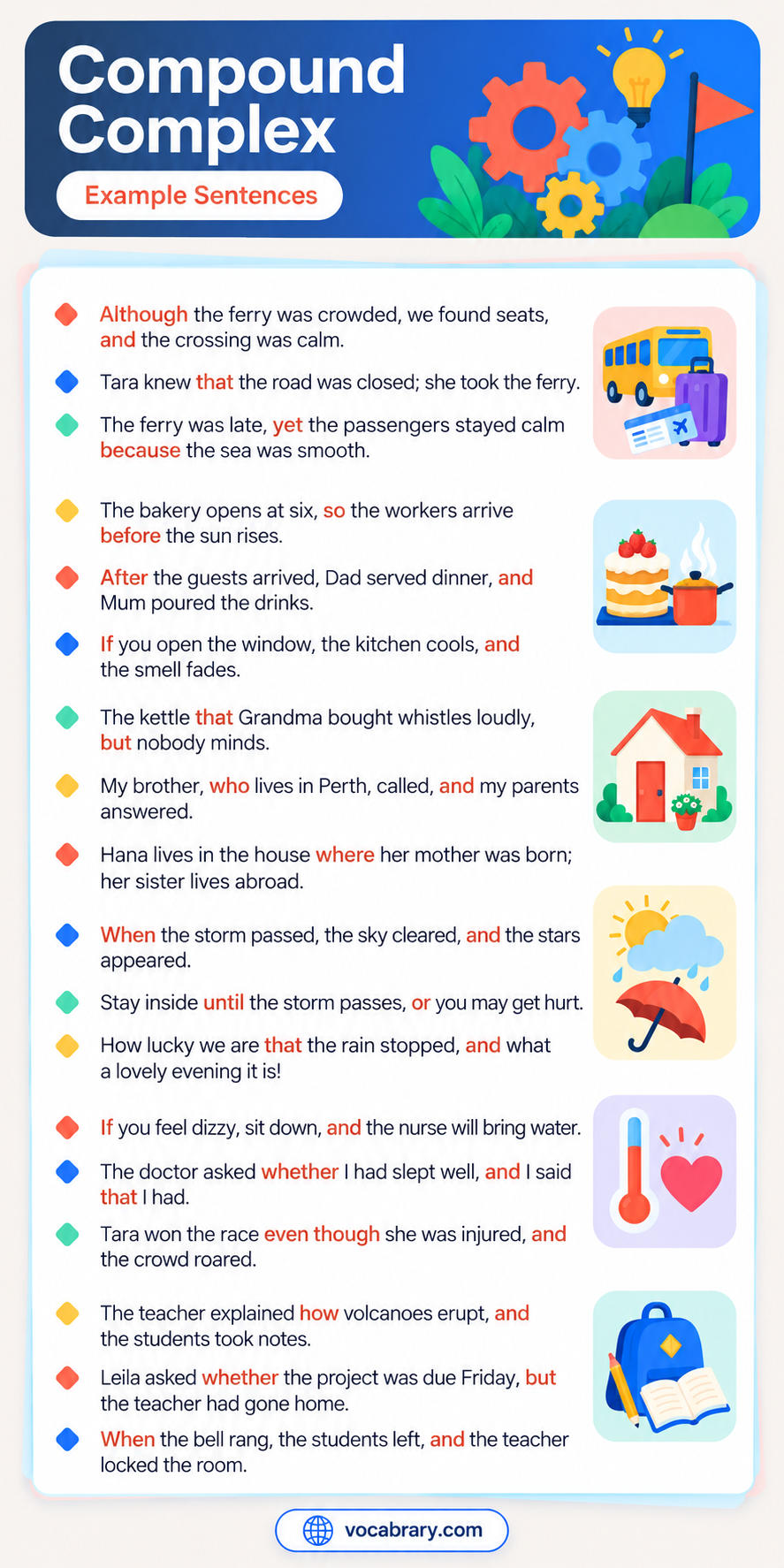
Common Compound Complex Example Sentences
Two independent clauses and one dependent clause are the minimum parts, as in Mina stayed indoors because it snowed, and her cousin joined her. Another case is Although the bus was late, we waited, and it finally arrived; the shorter pattern is covered on the compound sentence examples page.
- Mina stayed indoors because it snowed, and her cousin joined her.
- Although the bus was late, we waited, and it finally arrived.
- The teacher smiled when the class applauded, but she did not speak.
- Ravi studied hard, so he passed the exam that many students feared.
- If you finish early, call me, or I will start without you.
- The storm ended, and the villagers returned to the houses that the flood had damaged.
- Because the road was closed, Mia walked, and her brother cycled.
- Dad cooked dinner while Mum worked, and the children set the table.
- The museum, which opened in May, is free, but the cafe is expensive.
- After the match ended, the fans cheered, and the players waved.
- Lena knew that the exam was hard, yet she felt confident.
- The coach praised the team because it played well; however, he warned them about the final.
- We can leave now, or we can wait until the rain stops.
- Since Hana lives near the station, she walks to work, but her husband drives.
- The cake that Mum baked disappeared quickly, and nobody admitted who ate it.
- When the lights went out, the audience gasped, and the actors froze.
Compound-Complex Sentence Patterns
These compound complex example sentences follow several clause orders, and the order of independent clauses (IC) and dependent clauses (DC) determines the punctuation. The orders range from IC, coordinator, IC + DC to DC, IC, coordinator, IC.
Pattern IC, Coordinator, IC + DC
In the pattern IC, coordinator, IC + DC, the dependent clause is attached to the second independent clause. Models include The rain stopped, and the match began after the pitch dried and Maya called twice, but nobody answered because the phone was off.
- The rain stopped, and the match began after the pitch dried.
- Maya called twice, but nobody answered because the phone was off.
- We could take the train, or we could drive if the roads are dry.
- Tom likes tea, but his sister prefers the coffee that the cafe sells.
- The shop was closed, so we bought bread from the stall that stands by the bridge.
- Dina wrote the report, and Omar checked the figures before the board met.
- The ferry was late, yet the passengers stayed calm because the sea was smooth.
- Ana loves painting, and she sells the pictures that she finishes in spring.
- The path was steep, but the climbers kept going until they reached the summit.
- I wanted to leave, but Tom insisted that we stay.
- The bakery opens at six, so the workers arrive before the sun rises.
- Grandpa tells stories, and the children listen while they drink cocoa.
- The printer jammed twice, so I emailed the files since the deadline was close.
- The garden looked lovely, for the roses had bloomed as the weather warmed.
- Priya trained daily, and her coach said that she would win.
- Our team lost the semifinal, yet the fans cheered as the players left the pitch.
Pattern DC, IC, Coordinator, IC
In the pattern DC, IC, coordinator, IC, an introductory dependent clause is followed by a comma. Compare When the bell rang, the students left, and the teacher locked the room with Although it was freezing, we walked to the lake, and the children skated.
- When the bell rang, the students left, and the teacher locked the room.
- Although it was freezing, we walked to the lake, and the children skated.
- If you leave now, you will catch the bus, or you will wait an hour.
- Because the river flooded, the road closed, so the villagers used the ferry.
- After the guests arrived, Dad served dinner, and Mum poured the drinks.
- Since the shop was closed, Tomás went home, but his brother kept searching.
- As soon as the whistle blew, the runners dashed forward, and the crowd cheered.
- Unless the weather improves, the festival will move indoors, and tickets will cost more.
- While Dina cooked, her cousin laid the table, and the guests chatted.
- Though the film was long, nobody left, and the applause lasted a minute.
- Before the sun rose, the fishermen sailed, but their wives stayed at the harbour.
- Whenever it snows, the school closes, so the children build snowmen.
- Once the paint dries, I will hang the pictures, and you can move the furniture.
- Because Leo forgot his keys, he rang the bell, but nobody answered.
- Although Hana was nervous, she sang first, and the judges applauded.
- When the storm passed, the sky cleared, and the stars appeared.
Pattern IC + DC, Coordinator, IC
In the pattern IC + DC, coordinator, IC, the dependent clause is placed inside or after the first independent clause. Typical cases are The man who owns the shop smiled, and the customers laughed and Mr. Alves said that the exam was hard, and the class groaned.
- The man who owns the shop smiled, and the customers laughed.
- My brother, who lives in Perth, called, and my parents answered.
- The book that Mei lent me was long, but I finished it.
- Anna, when she heard the news, cried, and her friends comforted her.
- The students who passed the test celebrated, and the others studied again.
- The painting that hangs in the hall is old, yet it looks new.
- Our neighbour, whose dog barks all night, apologised, but nothing changed.
- Mr. Alves said that the exam was hard, and the class groaned.
- Mum’s cake, which she baked at dawn, disappeared, and nobody confessed.
- The coach, although he was tired, stayed late, so the players trained again.
- A road that leads to the lake is narrow, but it is beautiful.
- The woman whom I met yesterday is a surgeon, and her husband is an engineer.
- Our museum, which opened in June, attracts crowds, and the gift shop sells postcards.
- The boy who found the wallet returned it, so the owner rewarded him.
Pattern IC + DC, Semicolon, IC
A semicolon replaces the coordinator when the independent clauses are closely related. Examples are The river rose because the snow melted; the villagers moved to higher ground and Dina trusts the plan that Omar drew; she doubts the budget.
- The river rose because the snow melted; the villagers moved to higher ground.
- Dina trusts the plan that Omar drew; she doubts the budget.
- Mum cleaned the kitchen after the guests left; Dad washed the cars.
- Some people like winter because it snows; others enjoy summer.
- Mei studied until the library closed; her brother slept.
- The team that trained hardest won the trophy; the others went home.
- I will call you if I find the receipt; Ravi will email the manager.
- Nobody knew why the bus stopped; the driver stayed silent.
- The coach said that the match was close; the fans disagreed.
- Nobody left although the film was long; the applause lasted a minute.
- Hana lives in the house where her mother was born; her sister lives abroad.
- The soup that Dad cooked was spicy; the children drank water.
- The festival begins after the rain stops; the parade starts at noon.
- Tara knew that the road was closed; she took the ferry.
Pattern With a Semicolon and Conjunctive Adverb
A conjunctive adverb after a semicolon links two independent clauses and is followed by a comma, and the dependent clause is in either one. The conjunctive adverbs example sentences page covers more of these adverbs. Cases are The rain that fell overnight flooded the cellar; therefore, we called a plumber and If the weather holds, the match will start at noon; otherwise, officials will postpone it.
- The train was late because a signal failed; however, the staff apologised.
- Although the road was icy, we arrived on time; moreover, nobody was hurt.
- The rain that fell overnight flooded the cellar; therefore, we called a plumber.
- When Dad retired, he sold the shop; meanwhile, Mum started a new business.
- The store closed early because the manager was ill; consequently, we shopped elsewhere.
- Ana studied until the library closed; nevertheless, she failed the test that she had feared.
- If the weather holds, the match will start at noon; otherwise, officials will postpone it.
- The author wrote the novel while she lived abroad; furthermore, she translated it herself.
- After the storm ended, volunteers cleaned the beach; afterward, they planted trees.
- Hana believes that practice matters; however, her coach prefers rest.
- The lab that Dr. Evans founded grew quickly; thus, the university added a new wing.
- Because the tickets sold out, the club added a second concert; accordingly, thousands more fans attended.
Pattern With Two Dependent Clauses
Two dependent clauses stand in one sentence, either side by side or nested. Cases are I think that she left early because she felt ill, but nobody confirmed it and The man who owns the shop says that business is slow, but he stays hopeful.
- Because the road was closed, we waited until the plough came, and the children slept.
- I think that she left early because she felt ill, but nobody confirmed it.
- When the teacher entered, the class stood because it was the custom, and silence fell.
- The man who owns the shop says that business is slow, but he stays hopeful.
- If you finish early, tell me what you discovered, and I will pass it on.
- Mei knows that the exam will be hard although she studied, yet she feels calm.
- After Dad cooked the dinner that everyone enjoyed, we played cards, and the evening ended happily.
- The book that Tara lent me explains how volcanoes form, and I read it twice.
- Although the road was long, we reached the village before the sun set, and supper waited.
- Since Leo moved, he has learned how the buses run, but he still gets lost.
Pattern With Three Independent Clauses
Three independent clauses with a dependent clause extend the pattern. Cases are The sun rose, the birds sang, and the village woke as the baker opened his shop and Dina cooked, Omar cleaned, and the guests arrived before the table was ready.
- I wanted to leave, Tom wanted to stay, and we argued until Mum intervened.
- Because the river rose, the bridge closed, the ferries stopped, and the town waited.
- The sun rose, the birds sang, and the village woke as the baker opened his shop.
- Dina cooked, Omar cleaned, and the guests arrived before the table was ready.
- Although it rained, the match continued, the crowd stayed, and the home team won.
- The ferry was late, so we missed lunch, but dinner was wonderful because the chef cooked fresh fish.
- Maya called twice, but nobody answered, so she left a message that explained everything.
- When the lights failed, Dad lit candles, Mum found matches, and the children told stories.
Compound-Complex Sentences With Noun Clauses
A noun clause functions as the object or the subject of a clause. Cases are Ravi knows that the shop closes at six, but he still hopes that it stays open and What Mei painted impressed the judges, and the museum bought it. The noun clause examples page covers more roles.
- Ravi knows that the shop closes at six, but he still hopes that it stays open.
- I wonder whether she called, and I hope that she is safe.
- The coach announced that the match was cancelled, and the players went home.
- What Mei painted impressed the judges, and the museum bought it.
- Nobody knows why the bridge collapsed, but engineers are investigating.
- Hana asked where the station was, and a stranger pointed north.
- The teacher explained how volcanoes erupt, and the students took notes.
- Tom told me that he had lost his keys, so I lent him mine.
- It is obvious that the plan failed, but nobody knows who is responsible.
- She said that the soup was cold, yet she ate it all.
- We learned that the museum was closed, so we visited the park.
- Dr. Evans doubts whether the experiment worked, but she will repeat it.
Compound-Complex Sentences With Adjective Clauses
An adjective clause begins with who, which, that, whose, or where and describes a noun. Cases are I met a woman who designs bridges, and she invited me to her office and The cafe where we met has closed, but the owner opened another. The adjective clause examples page gives further models.
- I met a woman who designs bridges, and she invited me to her office.
- The cafe where we met has closed, but the owner opened another.
- The students whom the principal praised smiled, and their parents applauded.
- Mr. Okoye, who teaches physics, lent me a book, and I finished it overnight.
- The house that my grandfather built is old, but it remains strong.
- Lisbon, where I studied, is lovely, and I visit it every year.
- The artist whose paintings hang here is local, and she teaches evening classes.
- We stayed at a hotel that overlooked the sea, but the rooms were noisy.
- The train which left at noon arrived late, so we missed the ferry.
- Elena found the key that she had lost, and she opened the old trunk.
- My neighbour, whose garden is famous, sells flowers, and tourists photograph them.
- The bridge that the council repaired reopened, yet the traffic is still heavy.
Compound-Complex Sentences With Adverb Clauses
An adverb clause gives time, reason, condition, or contrast and begins with a subordinating conjunction. The subordinating conjunction example sentences page covers more of them.
Time Clauses With Until, After, and Before
Time subordinators such as until, after, and before give the time of the main action. Compare We waited until the doors opened, and the queue moved quickly with Before the sun rose, the fishermen left, and the harbour fell silent.
- We waited until the doors opened, and the queue moved quickly.
- After Dad parked the car, Mum unpacked the bags, and the children ran inside.
- The bell rang as the teacher finished, but the students stayed seated.
- Before the sun rose, the fishermen left, and the harbour fell silent.
Reason Clauses With Because and Since
Reason subordinators such as because and since give the cause of the action in the independent clause. Take Mia stayed home because she felt ill, and her friends sent flowers and Since the roads were icy, the bus stopped, so we walked.
- Mia stayed home because she felt ill, and her friends sent flowers.
- Since the roads were icy, the bus stopped, so we walked.
- The match was delayed because several players were late, but the fans stayed.
- As nobody answered, the courier left a note, and he returned later.
Condition Clauses With If and Unless
Condition subordinators such as if, unless, and provided that state the circumstance for the main action. Examples are If the weather holds, we will hike, or we will visit the museum and Unless you hurry, you will miss the ferry, and the next one leaves tomorrow.
- If the weather holds, we will hike, or we will visit the museum.
- Unless you hurry, you will miss the ferry, and the next one leaves tomorrow.
- The plants will die if nobody waters them, so please check the garden.
- Provided that everyone helps, we will finish early, and the party can start.
Contrast Clauses With Although and While
Contrast subordinators such as although, even though, and while introduce a fact that opposes the main action. Cases are Although the soup was cold, Leo ate it, and he asked for more and While Lina enjoys the city, her sister prefers the coast, but both love travel.
- Although the soup was cold, Leo ate it, and he asked for more.
- Tara won the race even though she was injured, and the crowd roared.
- While Lina enjoys the city, her sister prefers the coast, but both love travel.
- Though the exam was hard, most students passed, yet a few cried.
Commas Before the Coordinator in Compound-Complex Sentences
A comma goes before the coordinating conjunction that joins two independent clauses of ordinary length, even when one of those clauses contains a dependent clause. Compare Ravi paid the bill after the waiter apologised, and the manager offered dessert with Nina speaks softly because she is shy, yet her ideas are bold.
- Ravi paid the bill after the waiter apologised, and the manager offered dessert.
- The students who studied passed, but the ones who skipped class failed.
- Lara liked the apartment that faced the sea, yet she chose a cheaper one.
- We booked early since prices rise in summer, so we saved a lot.
- Omar fixed the engine while it was cold, for he had no time later.
- Dara waited until the rain eased, and her friends joined her.
- Tamar believes that exercise helps, and her doctor agrees.
- I forgot the map that you gave me, but the guide knew the way.
- The play ended after midnight, so the audience hurried to the last bus.
- Nina speaks softly because she is shy, yet her ideas are bold.
- The lights flickered as the storm arrived, and the generator started.
- The cook tasted the sauce that simmered on the stove, and he added salt.
Commas After an Introductory Dependent Clause
A dependent clause that opens the sentence is followed by a comma, and a second comma comes before the coordinator that joins the independent clauses. Compare Whenever Grandpa visits, he brings cake, and the children cheer with Unless someone volunteers, the trip will be cancelled, and the money will be refunded.
- Whenever Grandpa visits, he brings cake, and the children cheer.
- Because the printer broke, Eva wrote the notes by hand, but the manager wanted copies.
- After the lecture ended, students asked questions, and the professor answered them.
- If the train is late, we will take a taxi, or we will wait at the cafe.
- While the pizza baked, Sam made a salad, and Lena set the table.
- Although Rosa disliked the film, she stayed, for her friends enjoyed it.
- As the sun set, the hikers reached camp, and they cooked supper.
- Since Kenji speaks Japanese, he guided the tourists, and they thanked him.
- Until the doctor arrives, the patient must rest, and the nurse will monitor him.
- Even though the road was long, we enjoyed the drive, and we sang songs.
- Once the exams ended, the school held a party, and the teachers joined the dancing.
- Unless someone volunteers, the trip will be cancelled, and the money will be refunded.
Commas Around Nonrestrictive Clauses
A nonrestrictive adjective clause adds an extra fact about a noun that is already identified, and commas surround it. Take My sister, who lives in Paris, visits in May, and we cook together and The castle, which stands on a hill, is open daily, but the tower is closed.
- My sister, who lives in Paris, visits in May, and we cook together.
- The castle, which stands on a hill, is open daily, but the tower is closed.
- Mr. Alves, whose shop closed last year, now teaches, and his students adore him.
- The lake, where we swim every summer, froze early, so we skated instead.
- Dr. Chen, who wrote the report, will present it, and the board will vote.
- The festival, which begins on Friday, is free, but parking costs extra.
- Our teacher, who loves poetry, reads aloud, and the class listens quietly.
- Chidi’s bike, which he repaired himself, runs perfectly, yet he wants a new one.
- The town, where my parents met, holds a fair, and thousands attend.
- Lena’s brother, whom I met at the fair, plays drums, and he teaches music.
Negative Compound-Complex Sentences
Negative words such as not, never, and nobody are in the independent clause, the dependent clause, or both. Compare Although I was angry, I did not call, and he did not write with The shop does not open until nine, so we cannot buy bread earlier.
- Although I was angry, I did not call, and he did not write.
- Unless you register, you will not get the certificate, and nobody will remind you.
- Mia stayed in because it rained, but she did not complain.
- We never eat before the guests arrive, nor do we start without them.
- Although he studied hard, he did not pass, and he did not retake the test.
- Nobody knows why the museum closed, and nobody has explained it.
- The shop does not open until nine, so we cannot buy bread earlier.
- I do not know where the keys are, and I cannot find the spare set.
Compound-Complex Sentences That Ask Questions
A compound-complex question joins two question or statement clauses and includes a dependent clause. Compare Do you know where the bank is, or should we ask a stranger? with Is this the book that you wanted, or do you prefer the red one?
- Do you know where the bank is, or should we ask a stranger?
- Did the teacher say that the test is on Friday, or did she say Monday?
- If it rains, will we stay home, or will we take umbrellas?
- Who is the woman who spoke, and why did she leave early?
- Are you coming because Mia invited you, or did Tom ask you?
- When the results arrive, will you call me, and will you tell Dad?
- Is this the book that you wanted, or do you prefer the red one?
- Can you tell me what time the museum opens, and is it free on Sundays?
Passive Compound-Complex Sentences
At least one clause has a passive verb group, formed with a form of be plus a past participle. Typical cases are The window was broken when the storm hit, and the glass was swept away and The suspect was released because the evidence was weak, but he was watched.
- The window was broken when the storm hit, and the glass was swept away.
- The prize was awarded to the girl who wrote the best essay, and she was applauded.
- Although the road was repaired, it was closed again, and drivers were diverted.
- The package was delivered after I left, but it was returned the next day.
- Since the bridge was damaged, traffic was diverted, and the shops were closed.
- The suspect was released because the evidence was weak, but he was watched.
- It was announced that the school would close, and parents were informed by email.
- The letters that were posted yesterday arrived today, but the parcel was delayed.
Commands in Compound-Complex Sentences
A command is an independent clause with an understood you, and the sentence adds a second independent clause and a dependent clause. Compare Call me when you arrive, and I will meet you at the gate with Stay inside until the storm passes, or you may get hurt.
- Call me when you arrive, and I will meet you at the gate.
- If you see Tara, give her this note, or leave it on her desk.
- Wash your hands before you eat, and the cook will be grateful.
- Stay inside until the storm passes, or you may get hurt.
- Remember that the library closes at five, or you will lose your chance.
- Take a jacket in case it gets cold, for the evening wind is sharp.
Reported Speech in Compound-Complex Sentences
In reported speech, what someone said or asked becomes a noun clause inside a compound-complex sentence. Take She said that she was tired, and she went to bed and Mum asked where I had been, but I did not answer.
- She said that she was tired, and she went to bed.
- The doctor asked whether I had slept well, and I said that I had.
- Tom explained that he had lost his keys, but nobody believed him.
- The coach announced that the team would travel by train, and the players cheered.
- Mum asked where I had been, but I did not answer.
- The guide said that the castle was old, and she showed us the tower.
- Hassan replied that he would arrive early, so we waited.
- The pilot told us that the flight would be late, and passengers sighed.
Compound-Complex Sentences as Exclamations
An exclamation with two independent clauses and a dependent clause ends with one exclamation mark. Typical cases are How lucky we are that the rain stopped, and what a lovely evening it is! and Hurry before the doors close, or you will miss the show!
- How lucky we are that the rain stopped, and what a lovely evening it is!
- When the fireworks started, everyone cheered, and the sky blazed with colour!
- I cannot believe that we won, but here is the cup!
- What a pity it is that you missed it, for the concert was wonderful!
- Although it was freezing, the swimmers dived in, and the crowd roared!
- Hurry before the doors close, or you will miss the show!
Compound-Complex Sentences at Home
In a household, When Mum calls, we gather for dinner, and Dad serves the soup and The kettle that Grandma bought whistles loudly, but nobody minds each combine two actions with a dependent clause.
- When Mum calls, we gather for dinner, and Dad serves the soup.
- The kettle that Grandma bought whistles loudly, but nobody minds.
- Dad fixed the tap because it leaked, and I mopped the floor.
- If you open the window, the kitchen cools, and the smell fades.
- Our cat sleeps on the radiator because it is warm, and the dog sleeps beside it.
- The twins share a room that has bunk beds, but each has a desk.
Compound-Complex Sentences at School
School sentences such as Although the test was hard, most students finished early, and the teacher smiled and The class that won the quiz celebrated, and the others applauded describe tests, reading, and quizzes.
- Although the test was hard, most students finished early, and the teacher smiled.
- The pupils who read daily improved fastest, and the head teacher praised them.
- Leila asked whether the project was due Friday, but the teacher had gone home.
- After the bell rang, the corridors filled, and the caretaker locked the gym.
- We cleaned the lab before the inspector arrived, so the visit went smoothly.
- The class that won the quiz celebrated, and the others applauded.
Compound-Complex Sentences at Work
Office sentences about budgets, deadlines, and reports include The manager said that the budget would grow, and the team cheered and Unless sales improve, the shop will close in June, and the staff will move.
- The manager said that the budget would grow, and the team cheered.
- Because the deadline moved, we worked late, but nobody complained.
- The report that Eva wrote impressed the board, and she received a bonus.
- We will start when everyone arrives, or we will begin without the director.
- Carlos asked if the printer was fixed, but the technician had left.
- Unless sales improve, the shop will close in June, and the staff will move.
Compound-Complex Sentences for Travel
A delayed flight and a hotel by the bay are travel scenes. They are in While we waited at the gate, the flight was delayed, and the snacks sold out and The hotel where we stayed overlooks the bay, but the rooms are small.
- While we waited at the gate, the flight was delayed, and the snacks sold out.
- The hotel where we stayed overlooks the bay, but the rooms are small.
- Hana checked whether her passport was valid, and she packed the tickets.
- We booked the tickets as soon as the sale began, so we paid less.
- The train that goes to the coast leaves at noon, but the bus is cheaper.
- Although the ferry was crowded, we found seats, and the crossing was calm.
Compound-Complex Sentences in the News
News events such as announcements, floods, and protests are reported in these sentences. Two are Officials announced that the bridge would reopen, and commuters welcomed the news and Residents protested because the council cut the bus service, and the vote was delayed.
- Officials announced that the bridge would reopen, and commuters welcomed the news.
- After the flood receded, volunteers cleaned the streets, and shops reopened.
- The mayor, who took office in January, promised parks, but funding is uncertain.
- Residents protested because the council cut the bus service, and the vote was delayed.
- Reporters asked why the factory closed, but the owner declined to comment.
- If the storm continues, schools will stay shut, and the roads will close.
Compound-Complex Sentences in Fiction
Story sentences about wolves, a sealed trunk, and a false map include these compound complex example sentences. Two are When the moon rose, the wolves howled, and the travellers lit a fire and Elena opened the trunk that had been sealed for years, and she found a map.
- When the moon rose, the wolves howled, and the travellers lit a fire.
- The sailor told a story that nobody believed, but the children listened.
- Elena opened the trunk that had been sealed for years, and she found a map.
- The knight rode until he reached the tower, but the gate was locked.
- She knew that the map was false, yet she followed it anyway.
- Although the dragon looked fierce, it slept, and the village breathed again.
Compound-Complex Sentences in Sports
Sports sentences about an injured striker, a penalty save, and a final whistle are in this group. Two are Because the striker was injured, the coach changed the plan, and the team adapted and If our team wins, it reaches the final, and the city celebrates.
- Because the striker was injured, the coach changed the plan, and the team adapted.
- The crowd cheered when the goalkeeper saved the penalty, and the captain waved.
- Ayesha, who trains daily, won the race, but her rival demanded a rematch.
- The referee blew the whistle as the clock hit ninety, and the stadium emptied.
- If our team wins, it reaches the final, and the city celebrates.
- Everyone agreed that the match was the best of the year, and the fans sang.
Compound-Complex Sentences About Health
If you feel dizzy, sit down, and the nurse will bring water and Doctors recommend exercise because it strengthens the heart, but rest matters too cover dizziness, medicine, and sleep.
- If you feel dizzy, sit down, and the nurse will bring water.
- The nurse explained how the medicine works, and the patient took notes.
- Doctors recommend exercise because it strengthens the heart, but rest matters too.
- The patient who arrived first was seen at nine, and the others waited.
- After Dad quit smoking, his breathing improved, and his cough vanished.
- Dr. Rahman said that sleep is essential, so she urged patients to rest.
Readable Compound-Complex Sentences
A long sentence is readable when each clause has one fact, the subject is near its verb, and the joiners are varied. Two models are When the power failed, the hospital switched to its generator, and no patient lost treatment and Since the harvest was poor, prices rose, and families who had little savings struggled.
- Although the trail was steep and the day was hot, we finished the climb, and the view rewarded us.
- After she revised the draft that her editor had marked, Priya sent it back, and the editor approved it.
- The committee met on Tuesday, and it voted that the park would stay open until midnight.
- When the power failed, the hospital switched to its generator, and no patient lost treatment.
- Since the harvest was poor, prices rose, and families who had little savings struggled.
- Dr. Ito checked the results twice, but she found no error that could explain the delay.
- If the council approves the plan, builders will start in March, and the road will reopen by June.
- The bakery sold out before noon, so the owner baked a second batch that lasted all afternoon.
- Although Lena was new, she led the meeting, and the team that she managed delivered early.
- The pilot warned us that turbulence was coming, and the crew secured the carts before it began.
Breaking Up an Overlong Compound-Complex Sentence
An overlong compound-complex sentence is divided into shorter sentences that each have their own subject and verb, as with The committee studied the proposal for months and The fishermen returned.
Before: Although the committee had studied the proposal for months and had heard every objection from residents, it approved the plan on Tuesday, and the mayor, who had opposed it, resigned.
After: The committee studied the proposal for months and heard every objection from residents. It approved the plan on Tuesday, and the mayor, who had opposed it, resigned.
Before: When the storm reached the coast, the harbour closed, the ferries stopped, the fishermen returned, and the villagers, who had prepared for days, gathered in the hall because the power failed.
After: When the storm reached the coast, the harbour closed and the ferries stopped. The fishermen returned, and the villagers gathered in the hall because the power failed. They had prepared for days.
Compound-Complex Sentences for Kids
Short sentences such as I smile when I see Mia, and she waves and If it rains, we stay in, and Mum bakes give young learners a first model. These compound complex example sentences keep every clause to a few words.
- I smile when I see Mia, and she waves.
- If it rains, we stay in, and Mum bakes.
- The dog that barks is Rex, but he is nice.
- We play after we eat, and Dad watches.
- When the bell rings, we line up, and Ms. Bo smiles.
- I know that you are kind, and I like you.
- Tom sings while I draw, and Mum claps.
- Because it was dark, we slept, but the owl hooted.
- The boy who runs is fast, and he wins.
- Although I was scared, I jumped, and it was fun.
Compound-Complex Sentences for Students
Exam and essay writing uses compound complex example sentences to present an argument across several clauses. Two are Although renewable energy is costly, governments invest in it, and public support is growing and The author suggests that loneliness shapes the narrator, but the ending remains ambiguous.
- Although renewable energy is costly, governments invest in it, and public support is growing.
- The author suggests that loneliness shapes the narrator, but the ending remains ambiguous.
- Because deforestation destroys habitats, species decline, and farmers who depend on rain suffer.
- Researchers found that sleep improves memory, yet many students ignore this evidence.
- The policy that the council adopted reduced traffic, but air quality did not improve.
- While some economists favour tax cuts, others prefer public spending, and the debate continues.
- The novel, which is set in Lagos, explores memory, and its narrator questions every claim.
- If global temperatures keep rising, sea levels will increase, and coastal cities must prepare.
- The historian argues that the treaty failed because both sides distrusted each other, and later events confirm this.
- Since urban populations are growing, housing is scarce, and governments that delay face criticism.
Compound-Complex Sentences in a Short Paragraph
Three short passages about a flooded road, a market stall, and a storm contain only compound-complex sentences, each with two independent clauses and at least one dependent clause.
Rain fell all morning because a storm had stalled over the hills, and the road to the lake flooded. When the water rose, the farmers moved their cows, but the youngest calf refused to leave. Dad carried it on his shoulders until they reached the barn, and everyone cheered.
Samir sells fruit at the market that opens on Saturdays, and the regular shoppers greet him warmly. Although mangoes cost more in winter, he keeps the price fair, so customers return every week. A girl who wears a blue hat asks for a peach, and Samir gives her the ripest one because he likes her smile.
Nadia asked whether the storm would pass, and her father said that it would end by dusk. Because the thunder sounded close, she hid under the blanket, but she listened as he explained how lightning forms. When the sky cleared, they went outside, and a rainbow stretched over the roof.
Common Mistakes With Compound-Complex Sentences
This group corrects comma splices, missing commas, faulty parallelism, doubled conjunctions, and wrong labels in compound-complex sentences.
❌ We stayed home because it rained, my sister joined us.
✅ We stayed home because it rained, and my sister joined us.
A comma alone is unable to join two independent clauses, so the coordinator and is added after the comma.
❌ When the final bell rang at the end of the long afternoon the students left and the teacher locked the room.
✅ When the final bell rang at the end of the long afternoon, the students left, and the teacher locked the room.
A comma follows a long introductory dependent clause, and another comma comes before the coordinator that joins the two independent clauses.
❌ I wanted to leave, however, Tom wanted to stay because he liked the party.
✅ I wanted to leave; however, Tom wanted to stay because he liked the party.
A conjunctive adverb that joins two independent clauses follows a semicolon or a period, not a comma.
❌ The manager praised the team because they finished early and for their patience.
✅ The manager praised the team because they finished early and because they stayed patient.
The two reasons must have the same grammatical form, so each one is a clause beginning with because.
❌ The coach wanted the players to train harder, to eat better, and sleeping earlier, but they refused because the schedule was tough.
✅ The coach wanted the players to train harder, to eat better, and to sleep earlier, but they refused because the schedule was tough.
Items in a series need the same form, so the third verb takes to like the first two.
❌ Because the road was closed, so we waited, and the bus arrived late.
✅ Because the road was closed, we waited, and the bus arrived late.
A subordinator and so both link the clauses, so only the subordinator is kept.
❌ The sentence I stayed home because it rained is compound-complex.
✅ The sentence I stayed home because it rained is complex.
The sentence has one independent clause and one dependent clause, so a second independent clause is needed to make it compound-complex.
❌ Although he was tired, but he finished the race, and the crowd cheered.
✅ Although he was tired, he finished the race, and the crowd cheered.
Although and but both signal contrast, so the sentence keeps only although.
❌ The book, that I borrowed, was long, and I finished it.
✅ The book that I borrowed was long, and I finished it.
The clause identifies which book is meant, so commas do not set it off.
Clause Analysis of Three Sample Sentences
In clause analysis, independent clauses stand alone, and dependent clauses begin with a subordinator or a relative pronoun.
Sentence 1: Although the road was icy, we arrived on time, and the children cheered.
Sentence 2: The teacher said that the test was short, but the students still worried.
Sentence 3: Mei bought the book that Tara recommended; she finished it before the weekend ended.
| Sentence | Clause | Clause type | Marker |
|---|---|---|---|
| Sentence 1 | Although the road was icy | Dependent (adverb clause) | Although |
| Sentence 1 | We arrived on time | Independent | None |
| Sentence 1 | The children cheered | Independent | And |
| Sentence 2 | The teacher said | Independent | None |
| Sentence 2 | That the test was short | Dependent (noun clause) | That |
| Sentence 2 | The students still worried | Independent | But |
| Sentence 3 | Mei bought the book | Independent | None |
| Sentence 3 | That Tara recommended | Dependent (adjective clause) | That |
| Sentence 3 | She finished it | Independent | Semicolon |
| Sentence 3 | Before the weekend ended | Dependent (adverb clause) | Before |
Compound-Complex Sentences Compared With Complex and Compound Sentences
A compound-complex sentence has two or more independent clauses and at least one dependent clause, while a complex sentence has one independent clause and a compound sentence has no dependent clause. The pages on complex sentence examples and single-clause sentence examples cover the other types.
| Feature | Compound-complex sentence | Complex sentence | Compound sentence |
|---|---|---|---|
| Independent clauses | Two or more | One | Two or more |
| Dependent clauses | One or more | One or more | None |
| Joining words | A coordinator or semicolon plus a subordinator or relative pronoun | A subordinator or relative pronoun | A coordinator or a semicolon |
| Example | I stayed home because it rained, and my sister joined me. | I stayed home because it rained. | I stayed home, and my sister joined me. |
Related
- Compound Sentence Examples
- Complex Sentence Examples
- Simple Sentence Examples
- Independent Clause Examples
- Dependent Clause Examples
- Coordinating Conjunction Example Sentences
- Subordinating Conjunction Example Sentences
- Conjunctive Adverbs Example Sentences
FAQs
Q1. What patterns does a compound-complex sentence follow?
A compound-complex sentence follows any order of at least two independent clauses and at least one dependent clause. Common orders are IC, coordinator, IC + DC; DC, IC, coordinator, IC; and IC + DC, coordinator, IC. A semicolon or a semicolon plus a conjunctive adverb replaces the coordinator in the same patterns.
Q2. How do you identify a compound-complex sentence?
You identify a compound-complex sentence by counting its clauses and classifying them as independent or dependent. If two or more clauses stand alone and at least one begins with a subordinator or a relative pronoun, the sentence is compound-complex. One standalone clause with a dependent clause makes the sentence complex, and two standalone clauses with none make it compound.
Q3. What is the difference between a compound-complex sentence and a compound sentence?
A compound-complex sentence contains at least one dependent clause, while a compound sentence contains only independent clauses. The sentence I stayed home, and my sister joined me is compound. Adding because it rained gives I stayed home because it rained, and my sister joined me, which is compound-complex, and the compound sentence examples page covers the shorter pattern.
Q4. Where does the comma go in a compound-complex sentence?
The comma goes before the coordinating conjunction that joins two independent clauses, and a second comma follows a dependent clause that opens the sentence. The sentence When the bell rang, the students left, and the teacher locked the room uses both commas. A dependent clause that closes the sentence and gives a time or a reason, as in We waited until the doors opened, takes no comma before it.
Q5. Does a compound-complex sentence need a semicolon?
A compound-complex sentence needs a semicolon only when the writer uses it in place of a comma plus a coordinator. The sentence The river rose because the snow melted; the villagers moved to higher ground uses a semicolon between two closely related independent clauses. In other sentences, a comma plus a coordinator joins the independent clauses.
Q6. Can a compound-complex sentence have more than one dependent clause?
Compound complex example sentences with two or more dependent clauses are possible, provided the sentence also has at least two independent clauses. The sentence I think that she left early because she felt ill, but nobody confirmed it has two dependent clauses and two independent clauses. Each extra clause adds length, so readability needs attention.
Q7. Can a compound-complex sentence have three independent clauses?
A compound-complex sentence with three independent clauses is possible when at least one dependent clause is also present. In Dina cooked, Omar cleaned, and the guests arrived before the table was ready, three independent clauses combine with one adverb clause. Longer patterns of this kind need precise punctuation to stay readable.
Q8. Is "I stayed home because it rained" a compound-complex sentence?
The sentence I stayed home because it rained is complex, not compound-complex, because it has one independent clause and one dependent clause. A second independent clause is needed to make the sentence compound-complex. Adding and my sister joined me adds that second clause.
Q9. How long should a compound-complex sentence be?
Compound complex example sentences stay readable at 25 words or fewer when each clause has one fact. Longer versions work when the clauses are short and the joiners are varied. A sentence over 35 words is better split at a coordinator.
Q10. How do you break up an overlong compound-complex sentence?
You break up an overlong compound-complex sentence at a coordinator or a semicolon, then give each new sentence its own subject and verb. Keep each dependent clause with the independent clause it modifies. The result is two or three shorter sentences, each of which is easier to follow than the original. A part that keeps two independent clauses follows the pattern on the compound sentence examples page.
Q11. What is faulty parallelism in a compound-complex sentence?
Faulty parallelism is a mismatch in grammatical form between items that share a job, such as a clause paired with a phrase. In The manager praised the team because they finished early and for their patience, a clause is joined to a phrase. Using two because clauses repairs the error.
Q12. What is a comma splice in a compound-complex sentence?
A comma splice is an error in which a comma alone joins two independent clauses, as in We stayed home because it rained, my sister joined us. Three repairs are available: add a coordinator after the comma, replace the comma with a semicolon, or split the clauses into two sentences. The corrected version is We stayed home because it rained, and my sister joined us.
Q13. Why do writers use compound-complex sentences?
Writers choose compound complex example sentences to combine two related statements with a reason, a condition, or a description in a single sentence. The form is used in explanations and arguments, where each clause gives a separate fact. A long run of them is hard to read, so writers mix them with shorter sentences.

Leave a Comment