
A quantifier is a determiner or phrase that states how much or how many of a noun is present, as in many students or a little water. The noun decides which quantifier fits, so the speaker first asks whether it is countable: many attaches to students, and much to water. Quantifiers example sentences contrast many with much and a few with a little through everyday nouns, from cousins and apples to bread and cake.
What Is a Quantifier?
A quantifier is a determiner or phrase placed before a noun to show an amount, whether large, small, partial, or zero. A number such as three gives an exact count, while a quantifier such as several gives a rough amount.
Quantifier + plural countable noun, or quantifier + uncountable noun
There are many books on the shelf, but only a little time to read them.
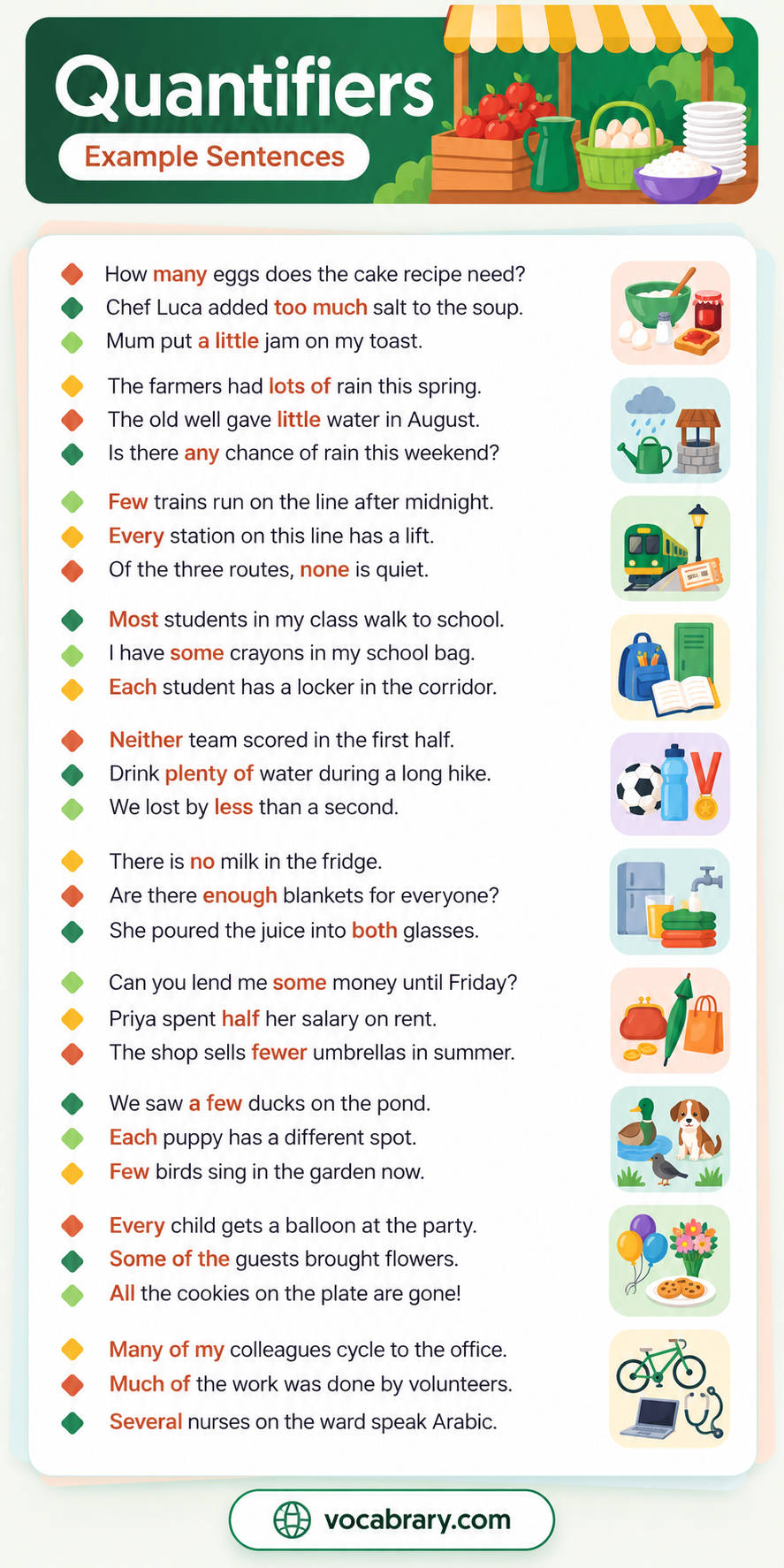
Common Quantifiers Example Sentences
Some bread, many cousins, a few apples, and a little cake are common quantifier phrases, and each one states how much of a noun is present.
- We bought some bread and a few apples at the market.
- Dina has many cousins in Jordan and a few in Spain.
- There is a little cake left, if anyone wants it.
- Did you buy any eggs when you went to the shop?
- Most of my classmates ride the bus to school.
- All visitors must sign the book at the front desk.
- We have plenty of blankets for the cold nights.
- Kenji doesn’t earn much money, but he saves every month.
- Several neighbours helped us move the piano on Saturday.
- There aren’t enough chairs for forty guests.
- Each runner received a bottle of water at the finish line.
- Every boy and girl in the choir wore a red scarf.
- Both my brothers play the cello in the town orchestra.
- You may sit on either bench by the fountain.
- Neither lorry blocked the narrow bridge.
- Our village uses less firewood than it did a decade ago.
- There are fewer buses on the island during the winter months.
- No letters arrived at the office today.
- None of the neighbours recognised the stranger at the gate.
- A lot of birds gather on the lake in October.
Quantifiers With Some and Any in Sentences
Some tea and any sugar show the pair that learners meet first in quantifiers example sentences. Some is used in statements and offers, while any is used in negatives and questions.
Affirmative Sentences With Some
Some advice, some sandwiches, and some students show the main use of some, which states an unspecified amount in a statement and fits both plural countable nouns and uncountable nouns.
- Amira packed some sandwiches for the long train ride to Lahore.
- Some students stayed behind to help the teacher clean the lab.
- I need some advice about choosing a university in Canada.
- There is some cold rice in the fridge if you are hungry.
- Takumi found some old coins under the floorboards of his grandfather’s house.
- We heard some strange noises coming from the attic last night.
- The baker added some raisins to the dough before baking.
- Some visitors arrived early, and the rest came after lunch.
Negative Sentences and Questions With Any
A kitchen without any sugar and a shopper asking about any photographs show the two settings where any replaces some: a negative statement and an ordinary question.
- We don’t have any sugar, so the tea will taste bitter.
- Did Leila bring any photographs from her trip to Morocco?
- There weren’t any tickets left for the Saturday concert.
- Is there any chance of rain this weekend?
- Nobody gave Tariq any reason for the delay.
- Have you got any brothers or sisters in Australia?
- She hasn’t made any mistakes in the last three tests.
- I can’t find any matching socks in this drawer.
Some in Offers and Requests
Would you like some tea? and Could I have some water? are polite offers and requests, and suggestions such as Shall we get some ice cream? work the same way. Each expects a yes, so it keeps some even though it is a question.
- Would you like some more rice, Ms Okafor?
- Could I have some water, please?
- Why don’t we order some dumplings to share?
- Can you lend me some money until Friday?
- Would anyone like some help with the heavy boxes?
- May I offer you some fresh bread from the oven?
- Shall we get some ice cream after the match?
- Could you pass me some of those napkins?
Sentences With Any Meaning No Matter Which
Any child in a swimming pool and any seat on an empty bus show any used in a statement to mean no matter which, so the word works in affirmative sentences without a negative.
- Any child can learn to swim with enough patience.
- Take any seat you like, because the bus is almost empty.
- Any teacher in this school will gladly explain the rules.
- You may call me at any time during the weekend.
- Choose any colour, and the tailor will match the thread.
- Any of the three routes gets you to the harbour before noon.
- Almost any recipe tastes better with fresh herbs.
- Bring any book that interests you to the reading club.
Many and Much Quantifiers for Countable and Uncountable Nouns
Many books and much homework show how the two words differ: many goes before plural countable nouns, while much goes before uncountable nouns. Both noun types are covered at countable noun sentences and uncountable noun sentences.
Plural Countable Noun Sentences With Many
Many students, many novels, and many languages share one feature: each noun is countable and plural, which is why many fits.
- Many students walk to school along the river path.
- Ngozi has read many novels by Chinua Achebe.
- Many languages are spoken in a single street in Toronto.
- Mr Adeyemi has taught many generations of children in this village.
- Not many tourists visit the island in winter.
- Many shops on the high street now close at five.
- The museum owns many paintings that nobody has ever seen.
- Sofia made many friends during her first term in Madrid.
Uncountable Noun Sentences With Much
Much traffic, much money, and much snow name quantities that nobody counts one by one. Much is used in negatives and questions, in affirmative sentences after so, too, and as, and in formal phrases.
- There isn’t much traffic on the ring road at this hour.
- Ravi doesn’t owe much money to the bank.
- We didn’t spend much time at the museum.
- Is there much snow on the mountain road today?
- There is much to admire in her early poetry.
- Too much noise came from the street, so she closed the window.
- We didn’t get much daylight in the valley in December.
- I don’t have much patience with careless drivers.
Questions With How Many and How Much
How many eggs and how much rice are the standard questions about amount, and the same words open indirect questions such as Tell me how many languages your cousin speaks.
- How many eggs does the cake recipe need?
- Nobody knows how much rice the cooks will need for twelve guests.
- Tell me how many languages your cousin speaks.
- How much time do we have before the train leaves?
- Do you know how many players are on a volleyball team?
- How much homework did the teacher give you?
- Ask the driver how many stops remain before the harbour.
- How much water does a camel drink after a desert crossing?
Too Many, Too Much and So Many Sentences
Too many cars, too much salt, and so many guests describe an amount greater than needed, while as many as and as much as set an amount equal to another amount.
- There are too many cars on the road this morning.
- Chef Luca added too much salt to the soup.
- So many children came to the party that we ran out of cake.
- Kaito has so much work that he skipped lunch.
- Take as many biscuits as you like.
- Mira ate as much pasta as her brother did.
- Don’t pour too much water into the plant pot.
- Too many cooks spoil the broth, says the proverb.
A Lot of, Lots of and Plenty of Sentences
A lot of birds, lots of rain, and plenty of space work with both plural countable nouns and uncountable nouns, so each one fits either noun type.
- We saw a lot of herons by the river this morning.
- Lots of people queued outside the bakery before sunrise.
- There is plenty of space in the boot for your suitcases.
- Hana has a lot of patience with younger children.
- Plenty of restaurants near the station serve vegetarian meals.
- The farmers had lots of rain this spring.
- Thanks to the new software, we save a lot of time every week.
- There were plenty of volunteers at the beach clean-up.
- A lot of my neighbours grow tomatoes on their balconies.
- Don’t worry, because there is plenty of food for everyone.
- Nikos has lots of ideas but very little free time.
- She drinks a lot of green tea during winter exams.
- A lot of work is waiting for us on Monday morning.
- Our team scored a lot of goals in the second half.
Few and a Few in Contrast Sentences
A few friends and few visitors show a contrast of sense. A few means a small number that is still enough, while few means almost none and sounds negative or disappointed.
A Few in Sentences With a Positive Sense
A few questions, a few seats, and a few words of Japanese all describe a small number that is welcome or sufficient for the purpose.
- Tomas invited a few friends for dinner, and the evening was lovely.
- I have a few questions about the schedule.
- A few nurses stayed late to welcome the new patients.
- We bought a few souvenirs at the airport shop.
- There are a few seats left near the front.
- Selin speaks a few words of Japanese, which impressed the hotel staff.
- After a few minutes the rain stopped.
- Only a few guests brought gifts, but the baby loved them.
Few in Sentences With a Negative Sense
Few people at a lecture and few shops open on Sundays describe a number so small that the speaker is disappointed or concerned.
- Few people attended the lecture, so the speaker felt discouraged.
- Very few shops in the village stay open on Sundays.
- Few students finished the exam in under an hour.
- Sadly, few visitors remember the old lighthouse keeper.
- Few of the candidates had any experience with the machine.
- He has few friends in the city, and he misses home.
- Few trains run on the line after midnight.
- Few doctors work in the mountain villages, so patients travel for hours.
Sentences With Little and a Little
A little salt and little hope make the same contrast for uncountable nouns. A little means a small amount that is enough, while little means almost none.
A Little in Sentences With a Positive Sense
Salt in a sauce, milk in a cup, and patience with a problem each name a small amount that is enough for the purpose.
- Add a little salt, and the sauce will taste better.
- We still have a little time before the film starts.
- Mei speaks a little French, enough to order lunch in Lyon.
- A little patience will solve most of these problems.
- Could you spare a little milk for my coffee?
- There is a little tea left in the blue pot.
- He gave the cat a little water in a saucer.
- A little rain fell in the evening, enough to cool the air.
Little in Sentences With a Negative Sense
Little hope, little snow, and little time describe an amount too small to count for much, so the speaker sounds worried or sorry.
- There is little hope of finding the missing key today.
- Little snow fell on the hills this winter, so the rivers ran low.
- Ibrahim had little time to prepare for the interview.
- Little evidence supports the claim, according to the report.
- We have little money left after paying the rent.
- Very little light reached the bottom of the well.
- The old well gave little water in August.
- They showed little interest in the new project.
Sentences Using Several and Enough
Several neighbours and enough bread show two quantifiers with different senses. Several means more than two but not many, and enough means as much as is needed.
- Several neighbours brought food to the new family.
- Sana has visited several countries in South America.
- Several buses were late because of the fog.
- We waited several hours at the airport.
- The mayor met several shop owners on Tuesday.
- Several of her paintings hang in the town hall.
- I tried several keys before the door finally opened.
- Is there enough bread for everyone at the table?
- We didn’t buy enough paint for the hallway.
- Jorge saved enough money to buy a second-hand bicycle.
- Do you have enough time to finish the report today?
- There was enough light in the room for reading.
- Enough volunteers signed up, so the committee closed the registration.
- They didn’t bring enough water for the long hike.
Most, All and Half Example Sentences
Most students, all passengers, and half the cake state a share of a whole, from the greater part to the entire group. Most and all stand before a plural or uncountable noun, with or without a determiner such as the or my. Half also stands before a singular noun with a determiner, as in half the cake.
- Most students in my class walk to school.
- All passengers must show their tickets at the gate.
- Half the cake disappeared before the guests arrived.
- Most coffee is grown in tropical highlands.
- All children need time to play outdoors.
- Most nurses on the ward work night shifts twice a month.
- All the shops on Market Street close at six.
- Priya spent half her salary on rent.
- Most cheese in this region is made from sheep’s milk.
- All music is welcome at the festival.
- Most people in the village speak two languages.
- All my cousins live within an hour of the coast.
- Half an hour later, the bus finally arrived.
- Most trains from Pune run on time.
No and None of Sentences
No students and none of the guests state that the amount is zero, and they work in two ways. No goes directly before a noun, while none of is followed by a determiner and a noun or by a pronoun.
- There is no milk in the fridge.
- No students arrived late for the exam today.
- None of the guests knew the groom.
- I have no idea where the keys are.
- None of the soup was left by nine o’clock.
- None of them understood the instructions.
- She had no time to explain, so she left a note.
- No two fingerprints are exactly alike.
- None of the tickets sold in advance cost more than ten euros.
- No shops opened on the national holiday.
- None of my friends lived in this city when I arrived.
- We found no evidence of a break-in.
Sentences With Each and Every
Each pupil and every child take a singular noun and a singular verb. Each refers to the members of a group one by one, and every refers to all the members together.
- Each pupil received a certificate at the ceremony.
- Every child in the village goes to the new school.
- Each of the winners gets a small trophy.
- Every morning, Grandma waters the plants on the balcony.
- We gave each guest a paper lantern.
- Every seat in the theatre was taken.
- Each day brings a new lesson for the young apprentice.
- Every one of the players trained twice a day.
- The coach spoke to each player separately.
- Every shop on the street displays a flag during the festival.
- Each of these paths leads to the waterfall.
- Almost every house in the valley has a vegetable garden.
- The teacher shook hands with each student at the door.
- Every Sunday, the market square fills with farmers and bakers.
Both, Either and Neither Sentences for Two Items
Both hands, either side, and neither answer are the pair quantifiers, and each of them refers to exactly two people or objects.
- Both my sisters study law in Berlin.
- You can park on either side of the street.
- Neither answer is correct, so try again.
- Both the teachers and the students enjoyed the trip.
- Neither driver was hurt in the collision.
- I will take either train, because both reach Leeds by noon.
- Both of her parents grew up in Nairobi.
- There is a bakery on either end of the street.
- Neither of the candidates has written a speech yet.
- Both cakes taste of lemon and cardamom.
- Either one of the twins will collect the parcel.
- Neither of the roads is open after the landslide.
- She holds a pen in both hands.
- Neither option appealed to Rosa after the long discussion.
Quantifiers Fewer and Less in Contrast Sentences
Fewer cars and less traffic show a distinction that formal writing requires. Fewer goes before plural countable nouns, and less goes before uncountable nouns and before measures such as less than ten minutes.
- There are fewer cars on the road during the holidays.
- We produce less waste since we started composting.
- Fewer students enrolled in the evening course this year.
- Drink less coffee in the afternoon if you want to sleep.
- The new oven uses less electricity than the old one.
- Fewer than twenty people attended the meeting.
- Ayaan spends less time on his phone than his sister.
- Choose fewer words and the message becomes stronger.
- Less sugar in the recipe gives a lighter cake.
- There were fewer mistakes in her second draft.
- Less than ten minutes remained on the clock.
- The shop sells fewer umbrellas in summer.
- Eating less meat is a goal for many families in our town.
- With fewer tourists, the beaches felt peaceful again.
Quantifier Sentences With Most of and None of
Most of the villagers, all of them, and none of the soup show the of-phrase pattern. The quantifier is followed by of and a determiner or pronoun that refers to something specific.
Most of and All of Before Specific Nouns
Most of the villagers, half of the class, and each of the boys name a part of a known group, so a determiner such as the or my must stand between of and the noun.
- Most of the villagers speak both Hindi and Marathi.
- All of the water in the tank was used for the garden.
- Some of the guests brought flowers.
- A few of the neighbours offered to help with the move.
- Many of my colleagues cycle to the office.
- Much of the coastline is protected by law.
- Half of the class passed with distinction.
- Each of the boys carried a lantern.
All of and None of Before Pronouns
All of them, none of us, and both of you replace the noun phrase with a pronoun, and the pronoun always takes its object form after of.
- All of them arrived before the first bell.
- Mina baked cookies, and most of them were gone in an hour.
- None of us had ever seen snow.
- Some of it spilled on the carpet.
- Both of you should check the schedule.
- A few of us stayed to wash the dishes.
- Neither of them wanted to speak first.
- Several of them offered to translate for the visitors.
Verb Agreement in Quantifiers Example Sentences
In each student has, many students have, and much of the water is, the verb in quantifiers example sentences agrees with the quantifier in the first two and with the noun in the third.
Singular Verb Sentences With Each and Every
Each student, every window, and much of the rice take a singular verb, as do a little with an uncountable noun and either and neither before a singular noun.
- Each student has a locker in the corridor.
- Every window in the house was broken by the storm.
- Much of the rice was ruined by the damp.
- A little salt is enough for this soup.
- Less noise is allowed after ten o’clock.
- Either road leads to the lake.
- Neither parent was present at the meeting.
- Either of the keys opens the front door.
Plural Verb Sentences With Many and Several
Many tourists, several roads, and both sisters take a plural verb, because each quantifier stands before a plural countable noun.
- Many tourists visit the temple at sunrise.
- A few bakeries still make bread by hand.
- Several roads were closed after the snowfall.
- Both sisters work at the hospital.
- Fewer children play in the street than before.
- Few shops in the high street accept cheques now.
- A few children are waiting outside the cinema.
- Both of the players have returned from injury.
Quantifiers Where the Noun Decides the Verb
A lot of milk and a lot of children, most of the cake and most of the cakes show that some, all, most, and a lot of take their verb from the noun that follows.
- A lot of milk was spilled on the floor.
- A lot of children were singing in the yard.
- All of the sand is wet after the tide.
- All of the boats are in the harbour.
- Most of the cake was eaten at the party.
- Most of the cakes were sold by noon.
- Some of the soup is still warm.
- Some of the soups on the menu are vegetarian.
Examples of Quantifiers in Different Sentence Positions
A quantifier phrase fills the same positions as other noun phrases. Many students as a subject, plenty of paint as an object, and with little money after a preposition show three of them.
Quantifier Phrases in Subject Position
Many students, several engineers, and each pupil open the sentence as the subject, and the verb that follows agrees with the noun.
- Many students from the village travel to the city for college.
- Several engineers inspected the bridge on Monday.
- Each pupil brings a packed lunch on trip days.
- A few clouds drifted over the harbour at noon.
- Most of the audience stood up to applaud.
- No passengers were injured in the accident.
Quantifier Phrases in Object Position
Plenty of paint, some wild berries, and enough rope come after the verb, where they name what the subject buys, finds, or needs.
- Wei bought plenty of paint for the garden fence.
- The children gathered some wild berries by the stream.
- Our guide carried enough rope for all twelve climbers.
- Abena ate a few grapes on the way to school.
- The farmer sold most of his apples at the weekend market.
- I saw several deer near the edge of the forest.
Quantifier Phrases After Prepositions
With little money, for many years, and in every room show quantifiers inside prepositional phrases, where they still stand before their noun.
- Hamid travelled across Europe with little money.
- She has lived in this town for many years.
- A small lamp stood in every room of the cottage.
- We spoke about several possible plans over breakfast.
- She poured the juice into both glasses.
- They danced to a lot of songs at the concert.
Negative Sentences With Quantifiers
Not any, not many, and none of each make a sentence negative. Not any, no, and none of state zero, while not many and not much state a small amount that is less than expected.
- We haven’t got any eggs for breakfast.
- Not many people noticed the missing painting.
- There isn’t much hot water in the morning.
- She didn’t take any photographs at the wedding.
- No news arrived from the village after the flood.
- They don’t have enough tents for the whole group.
- There aren’t many buses on Sundays.
- Haruto didn’t eat much at lunch because he felt unwell.
- None of the books on the shelf belonged to me.
- I didn’t see either of the twins at the party.
- Selam has hardly any friends in the city yet.
- Not all the guests ate meat, so we cooked fish as well.
Questions About Amounts With Any, Much and Enough
Do you have any change?, How much does it cost?, and Are there enough blankets? are everyday questions where a quantifier asks about the amount of a noun.
- Do you have any change for the bus?
- How much does a ticket to Mombasa cost?
- Are there enough blankets for everyone?
- Did many people come to the opening?
- Does either of you speak Portuguese?
- Has every student handed in the form?
- Could you spare a little time for a quick question?
- Were all the doors locked before you left?
- Have several of you used this app before?
- How many of the players are injured?
- Is there plenty of parking near the stadium?
- Did both of your brothers go to the same school?
- Would either day suit you for a meeting?
Quantifiers in Reported Speech and Passive Sentences
Tickets sold, players in helmets, and homes damaged by a storm show that a quantifier keeps its form when a sentence is reported or put in the passive.
Reported Speech Sentences With Quantifiers
Reporting verbs such as said, told, and explained keep the quantifier, and the verb moves one tense back after a past reporting verb.
- Maria said that some of the tickets had already been sold.
- The coach told us that every player had to wear a helmet.
- He explained that few people knew the real story.
- She told me there was not much time left.
- The manager announced that all employees would receive a bonus.
- Luis said that neither of the offers was good enough.
Passive Sentences With Quantifiers
In a passive sentence, a quantifier phrase that was the object becomes the subject, and the agent, when it is stated, follows after by.
- Many houses were damaged by the storm.
- Most of the bread is baked before dawn.
- Several letters were delivered to the wrong address.
- Each ticket must be checked at the gate.
- All the paintings were moved to a safer room.
- Much of the work was done by volunteers.
Examples of Quantifiers Used Without a Noun
Many were invited and I will take a little show quantifiers standing alone when the noun is already known, so the quantifier works as a pronoun.
- Plenty of people applied, and many were invited for an interview.
- Do you want more soup? I will take a little.
- The cakes smelled so good that several disappeared before noon.
- I invited ten friends, but few came.
- Much has changed since I left the village.
- Both are available for the interview on Tuesday.
- Each of these jams has a different flavour.
- Of the three routes, none is quiet.
- Some like tea, and others prefer coffee.
- We needed ten volunteers and found enough.
A Number of and a Great Deal of in Sentences
A number of passengers, a great deal of effort, and a handful of supporters are longer phrases that function as one quantifier, and several of them belong to formal writing.
- A number of passengers complained about the delay.
- The class put a great deal of effort into the school play.
- A large amount of rubbish was left on the beach.
- Cliffs near the harbour hold a large number of nesting birds.
- Researchers cite a good deal of evidence for this view.
- A couple of hours later, the bus came.
- Only a handful of supporters stayed until the end.
- With a bit of luck, we will win the raffle.
- In the end, the majority of villagers voted for the new bridge.
- We need only a small amount of oil for the pan.
Quantifiers Example Sentences for Everyday Settings
Homes, schools, offices, journeys, newsrooms, stories, stadiums, and clinics are settings with their own nouns and amounts, and quantifiers example sentences cover each one.
Home Sentences With Every, a Little and Both
Soup on the stove, water from a tap, and candles for a power cut are household amounts that quantifiers state.
- Every room in our flat faces the courtyard.
- There is a little soup left for tonight’s dinner.
- Both bathrooms in our house need new taps.
- Mum bought several tins of tomatoes at the market.
- Not much furniture fits in the narrow hallway.
- Some of the plates are chipped, but most of them are fine.
- We use less water since we fixed the leaking tap.
- My grandmother keeps plenty of candles for power cuts.
School Day Sentences With Few, Each and Neither
Pupils in a uniform, homework on a Tuesday, and textbooks for a year are counted and measured in school life.
- Every pupil wears a green sweater on Fridays.
- Few students stay for the extra science class.
- The teacher gave each group a map of Africa.
- Many classrooms now have interactive screens.
- Neither exam was easy, but both were fair.
- We have enough textbooks for the whole year.
- All the pupils in Year 5 sang at the assembly.
- There isn’t much homework tonight, thankfully.
Work and Office Sentences With Several and Fewer
Colleagues, meetings, budgets, and applicants are the amounts that an office reports, and each is counted or measured with a quantifier.
- Several colleagues volunteered to organise the leaving party.
- The office has fewer meetings since the new manager started.
- All employees must register their holiday dates in March.
- We don’t have much budget left for the quarter.
- Most of the team works from home on Wednesdays.
- Each department sends a monthly report to the director.
- Plenty of applicants had experience in teaching.
- There is no parking space for visitors at the factory.
Travel Sentences With a Lot of and Few
Ferries, luggage, hotels, and flights are counted by travellers, and quantifiers state how many or how much of each.
- Many tourists take the early ferry to the island.
- We had a lot of luggage, so we took a taxi.
- Few hotels in the old town offer free breakfast.
- Both flights were delayed by the storm.
- There wasn’t any room on the last bus.
- Every station on this line has a lift.
- Most of the journey passes through quiet farmland.
- We spent a little time in Prague and much more in Vienna.
News Report Sentences With Several and No
Towns without power, residents in shelters, and commuters on a strike day are amounts that reporters state with quantifiers.
- Several towns lost power during the overnight storm.
- Many residents were moved to temporary shelters.
- Fewer people voted in this election than in the last.
- Little progress was made at the talks on Friday.
- Some experts warn that food prices will rise.
- No injuries were reported after the fire.
- Most commuters ignored the advice to stay home.
- Plenty of rain is expected across the north this week.
Story Sentences With Neither and Both
A narrator uses quantifiers for wolves near a cabin, villagers at a well, and brothers with swords.
- Some nights the wolves came close to the cabin.
- All the villagers gathered at the well at dusk.
- Neither sister spoke as the carriage rolled on.
- There was little light in the cellar, only a candle.
- Each door in the corridor led to a different dream.
- Both brothers drew their swords at once.
- She had no friends in the village except an old fisherman.
- Every night the old sailor told the boys a new tale.
Sports Sentences With Both, Each and Most of
Players on a pitch, fans outside a stadium, and runners in a marathon are counted by commentators with quantifiers.
- Every player ran two laps before the match.
- Neither team scored in the first half.
- Many fans waited outside the stadium for autographs.
- Both goalkeepers made several saves in the second half.
- Few teams have won the cup three years in a row.
- Most of the runners finished the marathon in under five hours.
- Each swimmer must touch the wall with both hands.
- We lost by less than a second.
Health Advice Sentences With Plenty of and Less
Water on a long hike, salt in a diet, and nurses on a ward are the amounts that health advice states with quantifiers.
- Drink plenty of water during a long hike.
- Many doctors recommend a short walk after dinner.
- Eat less salt if your blood pressure is high.
- Few patients reported side effects from the new treatment.
- Both knees ached after the marathon.
- She takes a little honey for a sore throat.
- Several nurses on the ward speak Arabic.
- No medicine should be taken without advice from a pharmacist.
Quantifier Examples for Kids
Quantifiers example sentences for kids use crayons in a school bag, balloons at a party, and ducks on a pond, so the amounts stay short and concrete.
Quantifier Sentences for Young Children
Toys, cookies, and puppies are items that children see and count, so these sentences use quantifiers such as some, many, and a few.
- I have some crayons in my school bag.
- There are many stars in the sky tonight.
- Mum put a little jam on my toast.
- Every child gets a balloon at the party.
- We saw a few ducks on the pond.
- There is no milk in my cup.
- Both of my shoes are muddy.
- There is not much juice left in the bottle.
- May I have some more pasta, please?
- Each puppy has a different spot.
- I have too many toys to carry!
- All the cookies on the plate are gone!
Short Quantifier Sentences for Young Learners
Short lines about pencils, apples, and ducks give beginners a pattern to copy and read aloud.
- I have a few red pencils.
- She eats some apples every day.
- We need a lot of apples for the pie today.
- I read a little every day.
- He has no brothers at all.
- Both ducks swam away from the bridge.
- Few birds sing in the garden now.
- Many stars shine in the sky tonight, Mum.
Quantifiers Example Sentences for Exams and Essays
Quantifiers example sentences for exams come from essays, reports, and formal answers, where phrases such as a great deal of and the majority of are common.
- Few researchers dispute the central finding of the study.
- Little attention has been paid to the effects of noise on memory.
- A great deal of time was spent on the final report.
- A number of students submitted late assignments.
- The majority of respondents preferred online lessons.
- Neither theory fully explains the results of the experiment.
- Each of the three essays must include at least two sources.
- Several studies show that sleep improves memory.
- Fewer than ten percent of participants dropped out of the trial.
- Much of the debate concerns who should pay for the scheme.
- Both authors argue that cities need more green space.
- Plenty of evidence supports the claim, but little of it is recent.
Quantifiers in Short Paragraphs
A market, a classroom, a clinic, a harbour, and a garden each supply a short passage of quantifiers example sentences in connected writing.
Many stalls opened at dawn in the Accra market. Some sold fruit, and others sold cloth. Every seller shouted a price, and few shoppers paid the first one. By noon most of the mangoes were gone, and only a little shade remained under the awnings.
All the students in Mrs Banerjee’s class were nervous before the test. Each desk had a few sharpened pencils on it. Several pupils checked their notes one last time. No one spoke when the papers arrived, and neither of the boys by the window looked up.
Many patients arrive at the clinic before it opens. Both nurses on the early shift start at six. Most of the morning visits take less than ten minutes. A lot of the work is paperwork, and every form needs two signatures.
Several fishing boats left the harbour before sunrise. Each crew carried plenty of nets and enough fuel for two days. Few people watched them go, and not much noise broke the calm. Most of the boats returned at dusk with a good deal of fish.
Some gardeners plant roses, and others prefer vegetables. In our garden every bed holds a few herbs. Much of the soil is dry in August, so we give a little water each evening. Both tomato plants have plenty of fruit, and none of it is ripe yet.
Quantifier Table With Example Sentences by Noun Type
Many, much, a few, a little, and several each fit one noun type, while a lot of fits both plural countable nouns and uncountable nouns.
| Quantifier | Plural countable noun | Uncountable noun | Example |
|---|---|---|---|
| Many | Yes | No | Many books are on the shelf. |
| Much | No | Yes | Much rain fell overnight. |
| A few | Yes | No | A few guests arrived early. |
| A little | No | Yes | A little milk is left. |
| Few | Yes | No | Few shops open on Sundays. |
| Little | No | Yes | Little hope remained. |
| Several | Yes | No | Several roads were closed. |
| Fewer | Yes | No | Fewer cars use this road. |
| Less | No | Yes | Less noise is allowed. |
| A lot of | Yes | Yes | A lot of work is waiting. |
| Plenty of | Yes | Yes | Plenty of time remains. |
| Some | Yes | Yes | Some tea is on the stove. |
| Any | Yes | Yes | Any seat is free. |
| Enough | Yes | Yes | Enough bread was baked. |
| Most | Yes | Yes | Most cheese is made here. |
| All | Yes | Yes | All children need sleep. |
| No | Yes | Yes | No letters arrived. |
Quantifier and Number Sentences Compared
A quantifier gives a loose amount, while a number gives an exact count. Both stand before a noun, but only some quantifiers fit uncountable nouns, and numbers never do without a unit.
| Feature | Quantifier | Number |
|---|---|---|
| Amount stated | A rough or relative amount | An exact amount |
| Sample words | Several, many, a few, a little | Three, forty, a hundred |
| Uncountable nouns | Some quantifiers fit, such as much and a little | None fit without a unit such as litres |
| Question answered | How many? How much? | How many? |
| Verb agreement | The noun decides, as in many students are | The number decides, as in one student is and two students are |
| Example | Several tickets were sold. | Seven tickets were sold. |
FAQs
Q1. What are the most common quantifiers in English?
The most common quantifiers in English are some, any, many, much, a lot of, a few, a little, enough, most, and all. Each one states an amount before a noun, and the choice depends on whether the noun is countable or uncountable. Some and any fit both noun types in quantifiers example sentences, while many and much each fit only one.
Q2. What is the difference between many and much?
Many and much differ in the type of noun that follows each word. Many goes before plural countable nouns, as in many books, and much goes before uncountable nouns, as in much water. In affirmative sentences, speakers use a lot of in place of both.
Q3. When do you use a few instead of few?
You use a few when a small number is enough or welcome, and few when the number is almost zero. I have a few friends here sounds welcoming, while I have few friends here sounds disappointed. Both words go before plural countable nouns in quantifiers example sentences.
Q4. What is the difference between a little and little?
The words a little and little differ in sense in the same way as a few and few. A little means a small amount that is enough, as in a little sugar, while little means almost none, as in little hope. Both go before uncountable nouns in quantifiers example sentences.
Q5. How do you choose between some and any?
You choose some for affirmative statements and for offers or requests that expect a yes, and any for negatives and ordinary questions. We have some milk and We don’t have any milk show the pair. Any is also used in statements to mean no matter which, as in Any seat is free.
Q6. Do quantifiers take singular or plural verbs?
Quantifiers take singular or plural verbs according to the word that follows them. Each, every, either, neither, much, and a little take singular verbs, while many, several, both, and a few take plural verbs. With most, all, some, and a lot of, the verb agrees with the noun after of, so most of the cake was eaten and most of the cakes were eaten are both correct.
Q7. Which quantifiers need of before a noun?
The quantifiers that need of are a lot of, lots of, plenty of, a number of, a great deal of, and none of. Most, all, some, many, and few take of only when a determiner or pronoun follows, as in most of the villagers and all of them. Without that determiner, the word stands directly before the noun.
Q8. What is the difference between each and every?
Each and every both take a singular noun and a singular verb, but they refer to the group in different ways. Each refers to members one by one, as in each pupil received a prize, while every refers to all the members together, as in every pupil passed. Each is also used for two items, but every is used for three or more.
Q9. How do you use both, either, and neither?
Both, either, and neither refer to exactly two people or objects. Both means the two together and takes a plural verb, either means one or the other, and neither means not one and not the other. Either and neither take a singular verb before a singular noun, as in neither driver was hurt.
Q10. Is a lot of formal or informal?
The phrase a lot of is neutral enough for most spoken and written English, and lots of is more informal. Quantifiers example sentences for academic essays replace both with many, much, a large number of, or a great deal of. The phrase a lot without of works only as a pronoun or adverb and never goes before a noun.
Q11. What is the difference between a quantifier and a number?
A quantifier states a rough or relative amount, while a number states an exact count. Several tickets is a quantifier phrase, and seven tickets is a number phrase. Numbers never fit an uncountable noun without a unit, but quantifiers such as much and a little do.
Q12. Is a quantifier the same as a determiner?
A quantifier is a type of determiner when it stands before a noun and shows how much or how many. Determiners also include articles, demonstratives, and possessives, which show which noun or whose noun instead of amount. The full set is covered in the determiners example sentences.

Leave a Comment