
A countable noun is a noun with both a singular and a plural form, unlike an uncountable noun, as in one apple and three apples. That pair of forms is exactly what water lacks: a speaker counts two eggs but measures two litres of water. In everyday speech, countable noun example sentences count book, chair, student, and egg one unit at a time, with a or an before the singular and an ending on the plural.
What Is a Countable Noun?
A countable noun is a noun with both a singular form and a plural form, so it combines with a number, with a or an, and with words such as many and few. An uncountable noun such as water has no plural form and takes much and little instead.
A or an + singular noun, or number, many, few + plural noun
Three students found an egg and two feathers in the garden.
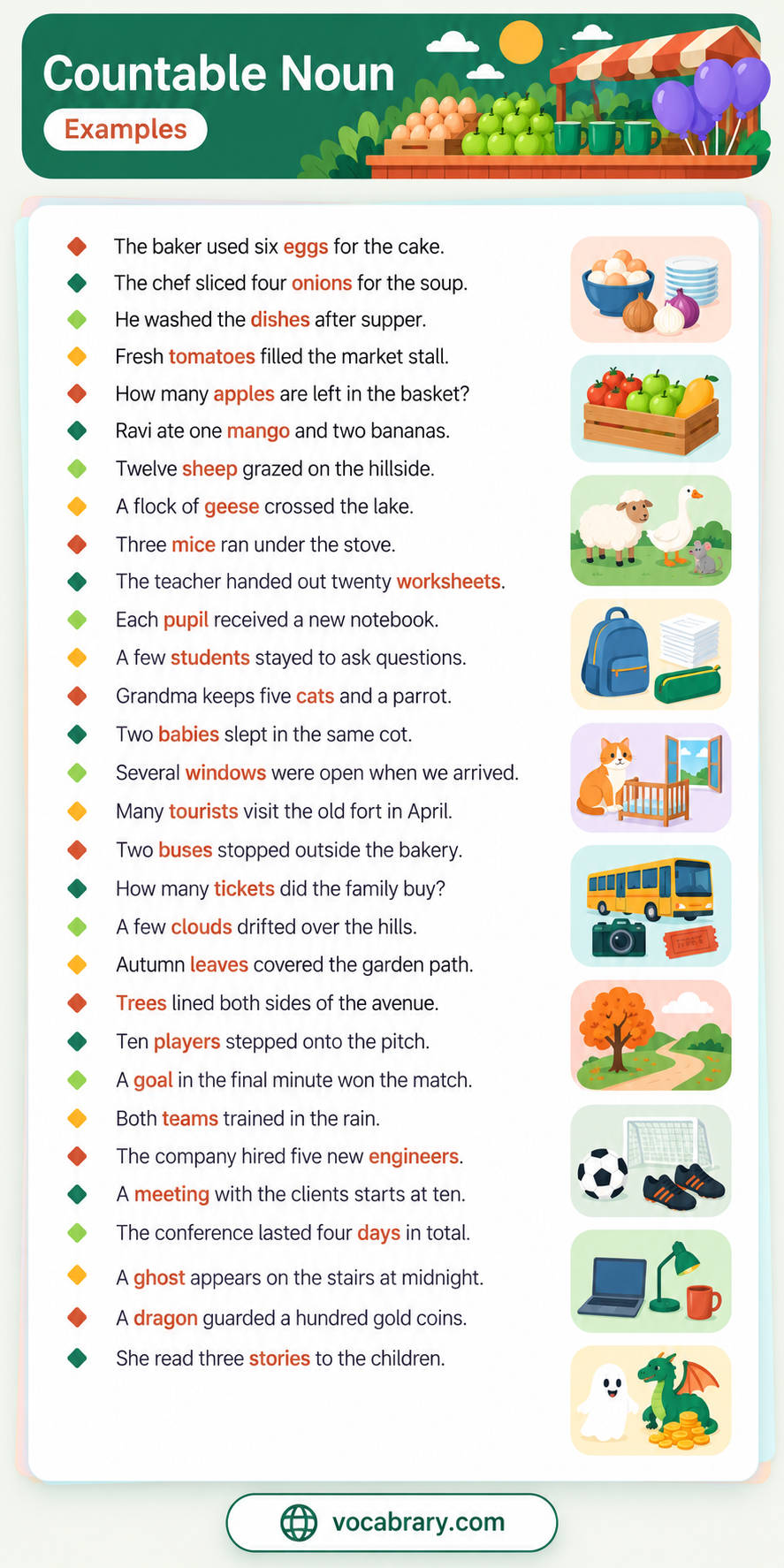
Countable Noun Example Sentences for Everyday Use
Book, chair, student, and egg are countable nouns that name items a person counts one by one, and each has a plural form such as books.
- Maya put one book on the shelf and two on the desk.
- A chair broke during the party.
- Three students waited outside the principal’s office.
- The baker used six eggs for the cake.
- Our class planted five trees along the road.
- A bus arrives at the stop every ten minutes.
- Daniel found two coins under the sofa.
- The museum owns a hundred paintings from the nineteenth century.
- A child ran across the playground with a kite.
- Several birds nested in the old barn.
- She bought an orange and three bananas at the market.
- Two women carried baskets of fruit through the square.
- Every teacher received a small gift on the last day.
- My uncle repairs clocks in a workshop near the harbour.
- A single candle lit the long hallway.
- The farmer sold twelve cows at the spring fair.
- Five boats left the harbour before the storm.
- An idea came to her halfway through the lecture.
- The librarian stamped each ticket with a date.
- A few friends joined us for dinner on Friday.
Indefinite Article Sentences With Countable Items
A singular countable noun needs a determiner, and a or an is the determiner that marks one item. A determiner is a word placed before a noun to introduce it, and the choice between a and an depends on the sound that begins the next word.
Articles Before Vowel and Consonant Sounds
A book, an egg, a university, and an hour show that the choice depends on sound and not on spelling, since university begins with a consonant sound and hour begins with a vowel sound.
| Sound that begins the word | Determiner | Example |
|---|---|---|
| Consonant sound | A | A book lay on the desk. |
| Vowel sound | An | An apple lay on the counter. |
| Vowel letter with a consonant sound | A | A university opened in our town. |
| Silent h with a vowel sound | An | An hour passed before the bus came. |
| Adjective between the determiner and the noun | The sound that begins the adjective sets the choice | An old chair stood by a new desk. |
Singular Item Sentences With a Book and an Hour
Book, orange, hour, and uniform each stand beside a or an, and every sentence names exactly one countable item.
- I read a book on the train this morning.
- She peeled an orange after lunch.
- An egg rolled off the counter.
- Hana studies at a university in the north of Japan.
- We waited an hour for the bus.
- He wore a uniform to the ceremony.
- An umbrella stood in the corner by the door.
- A hospital opened near our village last spring.
- It was an honour to meet the president.
- Priya adopted a kitten from the animal shelter.
- An old chair creaked beside the fireplace.
- She found a euro in her coat pocket.
Plural Countable Noun Example Sentences
A countable noun forms its plural with -s, -es, -ies, -ves, or an irregular change. The last letters of a regular singular noun determine which ending applies.
Plural Spelling Patterns With Examples
Book, box, city, day, knife, potato, and mouse show the plural patterns, and the ending of the singular noun determines which pattern applies.
| Ending of the singular noun | Plural pattern | Singular | Plural |
|---|---|---|---|
| Most nouns | Add -s | Book | Books |
| S, x, sh, or ch | Add -es | Box | Boxes |
| Consonant + y | Change y to -ies | City | Cities |
| Vowel + y | Add -s | Day | Days |
| F or fe in many nouns | Change to -ves | Knife | Knives |
| Consonant + o in words such as potato and tomato | Add -es | Potato | Potatoes |
| Other words in o, and roof, chief, and cliff | Add -s | Piano | Pianos |
| Irregular nouns | Change the vowel or the whole word | Mouse | Mice |
Regular Plurals With -S in Sentences
Book, tree, coin, and street add -s to form the plural, which is the regular pattern for most countable nouns.
- Maria carried six books home from the library.
- Trees lined both sides of the avenue.
- The shop sells old coins and stamps.
- Narrow streets wound through the old town.
- Three cats slept on the warm wall.
- The boys kicked a ball against the fence.
- Bright flowers filled the window boxes.
- Two days passed before the letter arrived.
- The students handed in their essays on time.
- My grandmother keeps bees at the edge of the orchard.
- Hundreds of stars appeared over the desert.
- Both keys were hanging on the same hook.
Sentences With Plurals Ending in -ES
Bus, box, dish, and church add -es because each ends in s, x, sh, or ch, and potato and tomato add -es after the letter o.
- Two buses stopped outside the bakery.
- The movers carried ten boxes upstairs.
- He washed the dishes after supper.
- Old churches stand in every village of the valley.
- Farmers dug the potatoes before the first frost.
- Fresh tomatoes filled the market stall.
- The watches on display were all handmade.
- Several wishes came true on her birthday.
- Two wooden benches stood under the oak tree.
- The foxes hid in the long grass.
- Two brushes hung beside the sink.
- The heroes of the story rescue a village from a flood.
-IES and -VES Plurals in Sentences
Baby, city, leaf, and knife change their endings, since a consonant followed by y becomes -ies and many nouns ending in f or fe change to -ves.
- Two babies slept in the same cot.
- Busy cities grow around rivers and ports.
- She read three stories to the children.
- Autumn leaves covered the garden path.
- He sharpened the knives before dinner.
- Two wolves crossed the frozen lake at dusk.
- The shelves were full of dusty books.
- Their lives changed after the move to Canada.
- Many countries joined the new trade agreement.
- The ladies at the front waved to the cameras.
- Three families shared the old farmhouse.
- Two thieves escaped through the open window.
Irregular Plural Sentences With Children and Mice
Child becomes children, mouse becomes mice, and sheep has the same form in the singular and the plural. The irregular plural noun example sentences page lists more of these nouns.
- Five children played in the courtyard.
- Three mice ran under the stove.
- The men repaired the road by hand.
- Her feet were sore after the long hike.
- A dentist checked the teeth of every pupil.
- A flock of geese crossed the lake.
- Twelve sheep grazed on the hillside.
- The people of the village gathered at the well.
- Both women work as engineers at the airport.
- Several fish swam below the little bridge.
- Researchers described two new species of frog.
Number Sentences With One, Ten and One Hundred
One comes before a singular countable noun, while two, ten, and one hundred come before a plural countable noun, as in one ticket and ten chairs.
- Ravi ate one mango and two bananas.
- Ten players stepped onto the pitch.
- Our hotel has fifty rooms and a roof garden.
- Only one ticket remained for the evening show.
- The bakery sold three hundred loaves before noon.
- Two hours later the storm had passed.
- Fifteen runners finished the race in the rain.
- She has four brothers and no sisters.
- The climb to the lighthouse has two hundred steps.
- Seven dancers performed on the small stage.
- I counted thirty pages in the report.
- Nine countries sent teams to the tournament.
- We need twelve chairs for the meeting.
- Zoe borrowed twenty dollars from her aunt.
Many and Several Example Sentences
Many and several are quantifiers that come before a plural countable noun, as in many books and several students, and both name more than two items.
- Many tourists visit the old fort in April.
- Several students forgot their calculators at home.
- How many apples are left in the basket?
- Many houses along the coast were repaired.
- We saw several deer near the edge of the forest.
- There are not many seats left on the evening flight.
- Several neighbours brought food to the party.
- Too many cooks spoil the broth, says the old proverb.
- Many languages are spoken in this city.
- Several trains were cancelled because of snow.
- Many people enjoy walking by the river on Sundays.
- Dr Mehta has treated many patients with the same illness.
- Several windows were open when we arrived.
Few, a Few and Fewer Example Sentences
Few means not many, a few means some, and fewer means a smaller number, and all three come before a plural countable noun, as in few seats and fewer cars.
- Few visitors came to the museum in January.
- A few students stayed to ask questions.
- There are fewer cars on the road during the holidays.
- Few people in the room knew the answer.
- We have a few apples left, enough for a pie.
- The new method means fewer mistakes in the reports.
- Few trees survived the long drought.
- A few clouds drifted over the hills.
- Fewer than ten tickets were sold on the first day.
- Fewer children walk to school than before.
- Nadia took a few photos of the sunset.
- Very few shops opened on the holiday.
Many and Much, Few and Little Compared in Sentences
Many books and much water, few books and little water, and fewer books and less water show the pairs that separate countable from uncountable nouns.
| Meaning | Countable noun | Uncountable noun |
|---|---|---|
| A large number or amount | Many books | Much water |
| Hardly any | Few books | Little water |
| Some | A few books | A little water |
| A smaller number or amount | Fewer books | Less water |
| A question about quantity | How many books? | How much water? |
Questions With How Many Before Plural Nouns
How many asks for a number, and a plural countable noun follows it, as in how many eggs and how many students.
- How many eggs do we need for the cake?
- How many students are in your class?
- How many languages does your cousin speak?
- How many stops are there before the airport?
- How many cups of tea did you drink today?
- How many minutes are left in the lesson?
- How many tickets did the family buy?
- How many countries border Germany today?
- How many chairs fit around this table?
- How many birds do you see in the tree?
Subject Position Sentences With Countable Nouns
A countable noun in subject position names who or what the sentence is about, and the verb agrees with its number, as with student in the student is and eggs in the eggs are.
- The student is writing an essay about rivers.
- Two eggs are enough for this recipe.
- A bus leaves from platform five every hour.
- Three dogs chased the ball across the field.
- The children are building a snowman in the garden.
- A tree blocks the view from the kitchen window.
- Several candles were burning on the table.
- The teacher has marked every test.
- My friends are waiting at the gate.
- Each ticket costs ten euros at the door.
Object Position Sentences With Countable Nouns
A countable noun follows a verb as its object, as with apples in bought apples and note in wrote a note.
- Hana bought six apples at the market.
- The nurse wrote a note for the doctor.
- Tomas lost his keys on the way home.
- We painted three walls blue last weekend.
- The children found a turtle by the pond.
- Mia sent two postcards from Lisbon.
- The chef sliced four onions for the soup.
- Dad fixed the bicycle in ten minutes.
- She told the students to open their books.
- The tourists photographed every statue in the square.
Prepositional Phrases With Countable Nouns
In, on, with, between, and past introduce a countable noun in phrases such as in a box and between two houses, and the noun is the object of the preposition.
- The kitten hid in a box under the stairs.
- She spoke with three teachers after the concert.
- A narrow lane runs between two houses.
- The bird sat on a branch outside the window.
- We walked past ten shops before we found the bakery.
- Rainwater collected in several buckets on the porch.
- The path leads through a tunnel and over a bridge.
- He climbed up the ladder with a paintbrush.
Negative Sentences With No and Not Many
No, not, and not many make a countable noun negative or limited, as with no students, not a single ticket, and not many shops.
- There are no tickets left for tonight’s show.
- She did not eat a single grape.
- Not many shops open on Sunday mornings.
- No students arrived before eight o’clock.
- He does not own a car.
- There aren’t any eggs in the fridge.
- We saw no tourists at the temple that day.
- Neither answer on the sheet was correct.
- I haven’t read a single page of the report.
- The hotel doesn’t have enough rooms for the whole group.
Reported Speech and Passive Sentences With Buses and Tickets
Buses, tickets, and windows keep their plural form in reported speech, and a countable noun is the subject of a passive verb such as were cleaned.
- She said that three buses were late.
- The guide told us that two tickets had been lost.
- He explained that the boxes had been moved upstairs.
- Ten new trees were planted along the road.
- The windows were cleaned before the guests arrived.
- Two suspects were questioned by the police.
- The teacher asked how many students had finished.
- A letter was sent to every parent.
- Farmers reported that several cows had escaped.
- The bridge was built in only eighteen months.
Countable Versus Uncountable Noun Sentences
Egg, chair, and idea are countable, while water, rice, and furniture are uncountable, and the two groups take different determiners, quantity words, and verbs.
Countable and Uncountable Features Compared
Eggs and water differ in six features, from the plural form to the question about quantity.
| Feature | Countable noun | Uncountable noun |
|---|---|---|
| Plural form | Eggs, chairs, plans | No plural, as in water and furniture |
| A or an | An egg, a chair | No a or an |
| Numbers | Three eggs | Three kilos of rice |
| Quantity words | Many, few, fewer | Much, little, less |
| Question about quantity | How many eggs? | How much water? |
| Verb agreement | Agrees with singular or plural | Singular verb |
Sentences With Chair and Furniture or Coin and Money
Chair and furniture, coin and money, and loaf and bread show the same meaning in a countable and an uncountable noun, and each sentence uses both.
- Anna bought three chairs, and the shop delivered the furniture on Friday.
- A coin fell out of his pocket, and the money rolled under the sofa.
- Each suitcase was heavy, and the luggage filled the whole trolley.
- The agency found two jobs for her, but the work was far away.
- Five songs played, and the music lasted an hour.
- The shop sells ten rings, though the jewellery is expensive.
- Seven loaves sat on the shelf, and the bread was still warm.
- A single letter arrived, and the rest of the mail came late.
- Three tips helped her, and the advice was welcome.
- Two cars blocked the lane, and the traffic stopped for an hour.
- Mia packed four dresses, and the clothing filled one case.
- Dad bought five tools, and the equipment filled the shed.
Nouns With Countable and Uncountable Meanings
Chicken, paper, hair, glass, and time change between a countable and an uncountable use, as with a chicken for the bird and chicken for the meat.
Countable and Uncountable Meanings Compared
A chicken is a bird and chicken is meat, a paper is an essay and paper is a material, and the other five nouns follow the same split.
| Noun | Countable meaning | Uncountable meaning |
|---|---|---|
| Chicken | A bird | The meat of the bird |
| Paper | An essay or a newspaper | The material |
| Hair | One strand | The whole covering of the head |
| Glass | A drinking container | The material |
| Time | An occasion, as in three times | Duration, as in some time |
| Room | A part of a building | Space |
| Coffee | One cup | The drink or the powder |
Countable Meaning Sentences for Chicken and Paper
A chicken in a yard, a paper for a class, a single hair in a soup, and a glass of juice are countable uses, and each takes a, an, or a plural ending.
- A chicken pecked at the seeds in the yard.
- Ravi wrote a paper on climate change for his class.
- She found a hair in her soup and called the waiter.
- Pour the juice into a glass, please.
- We visited the museum three times last year.
- The hotel has a free room on the third floor.
- I ordered a coffee and a croissant.
- A light flickered in the window of the old barn.
- He read three papers before breakfast.
- Two glasses stood beside the sink.
- Grandma keeps her own chickens at the back of the house.
- It was a time of great change in the village.
Uncountable Meaning Sentences for Chicken and Paper
Chicken for dinner, paper for a printer, long hair, and broken glass are uncountable uses, and each takes no a, no an, and no plural ending.
- We had chicken and rice for dinner.
- The printer ran out of paper on Monday.
- Her long black hair shone in the sun.
- Broken glass covered the pavement outside.
- Time passes quickly during the holidays.
- There is plenty of room for everyone at the table.
- Fresh coffee smells wonderful in the morning.
- Light filled the hall through the tall windows.
- Is there enough paper for the whole class?
- Cut the chicken into small pieces.
- Hair grows about a centimetre a month.
- Windows made of thick glass keep out the noise.
Home and School Sentences With Cups and Desks
Cup, bedroom, pupil, and desk are countable nouns from homes and classrooms, where each names an item that a family or a teacher counts.
- Dad put three cups and a plate on the tray.
- Our flat has two bedrooms and a small balcony.
- Each pupil received a new notebook.
- Grandma keeps five cats and a parrot.
- The teacher handed out twenty worksheets.
- My sister collects stamps in an old album.
- Three desks were moved to the back of the room.
- A bell rang at the end of every lesson.
- There are thirty chairs in the school hall.
- Mum packed two sandwiches for each child.
Sentences About Work and Travel
Engineer, passenger, suitcase, and room are countable nouns from offices and journeys, where each names a person or an item that is counted.
- The company hired five new engineers.
- Every employee gets a badge on the first day.
- Our flight left from one of the busiest airports in Europe.
- The tour guide counted twenty passengers on the coach.
- A suitcase went missing between Madrid and Lisbon.
- The office has three printers and one scanner.
- We booked two rooms in a small hotel near the harbour.
- The conference lasted four days in total.
- A meeting with the clients starts at ten.
- Many tourists photographed the old cathedral.
News Report and Sports Sentences With Plural Nouns
Earthquake, player, goal, and witness are countable nouns from headlines and match reports, where each names an event or a person that a reporter counts.
- Two earthquakes shook the region last week.
- Five players scored in the tournament.
- The mayor visited three schools after the flood.
- Dozens of volunteers cleaned the beach.
- A goal in the final minute won the match.
- Both teams trained in the rain.
- Reporters asked several questions at the press conference.
- The marathon attracted ten thousand runners.
- A witness described the accident to the police.
- Two new stadiums will open before the championship.
Sentences About Clinics and Laboratories
Test, cell, planet, and patient are countable nouns from clinics and laboratories, where each names an item that a doctor or a researcher counts.
- The doctor ordered three tests for the patient.
- A cell divides into two new cells.
- Scientists observed several planets through the telescope.
- Nurses check each patient twice a night.
- Each tablet contains five milligrams of the drug.
- Researchers counted forty bacteria in the sample.
- The laboratory bought two new microscopes.
- An experiment tested four different fertilisers.
Story Sentences With Ghosts and Dragons
Sister, ghost, dragon, and letter are countable nouns from stories, where each names a character or an object that a writer counts.
- Three sisters live in a lonely house on the moor.
- A ghost appears on the stairs at midnight.
- The old sailor told us two stories about the sea.
- Seven dwarfs share a cottage in the forest.
- A dragon guarded a hundred gold coins.
- The hero finds four keys hidden in the castle.
- Two brothers set out on a long journey across the mountains.
- A letter arrives on the morning of the wedding.
Countable Noun Example Sentences for Kids
Nose, duck, doll, and spider are early countable nouns that children count, and short sentences about a body part, an animal, and a toy fit a first lesson.
- I have one nose and two eyes.
- Look at the three little ducks!
- She has a doll and two teddy bears.
- A spider has eight thin legs.
- We saw four cows in the field.
- There are five apples in the basket.
- My dad has two big red cars.
- The boy has ten red balloons.
- Two birds sit on the wire.
- I see a kite and many stars.
- He ate an egg for breakfast.
- Our class has twelve girls and ten boys.
Countable Noun Sentences for Students and Exams
Cause, recommendation, argument, and theory are countable nouns that appear in essays and exam answers, and longer sentences show how a number or a quantity word goes with each one.
- Researchers identified three causes of the decline in bee populations.
- The report makes ten recommendations to the council.
- Each argument in the essay needs one clear example.
- Many economists disagree about the effects of the new tax.
- Two studies reached opposite conclusions last year.
- The author presents four characters with different values.
- A growing number of citizens vote online.
- Historians have found several letters written during the siege.
- The committee reviewed fifty applications from eleven countries.
- Both theories explain part of the evidence.
- Every candidate must submit two references.
- The museum displays a collection of two hundred ancient coins.
Countable Nouns in Short Paragraphs
A market trip, a zoo visit, a school library, a storm, and a packed suitcase each use several countable nouns in a row, so learners meet countable nouns inside running text.
Maya bought three tomatoes, two onions, and a loaf at the market. She also found four eggs and a small bag of rice. At home she cooked a meal for six people.
The zoo has two elephants, five monkeys, and a very old tortoise. Every child in the group counted the animals twice. Ten minutes later, a keeper gave them three bananas to share.
Our school library has nine shelves. On each shelf there are about forty books. Last week, two students found a rare atlas with several maps.
A storm damaged four houses in the village. Two families moved into the school hall, and three volunteers brought blankets and hot meals. By Friday the roads were open again.
Tomas packed a suitcase for his trip. He took two shirts, three pairs of socks, and a jacket. At the airport he showed his passport and two tickets to an officer.
FAQs
Q1. What are some examples of countable nouns?
Examples of countable nouns are book, chair, student, egg, tree, bus, and idea. Each noun names an item that a person counts one by one, and each has a plural form such as books, chairs, and students. Some abstract nouns such as idea and plan are countable too, since two ideas and three plans are both correct.
Q2. How do you identify a countable noun in a sentence?
You identify a countable noun by testing whether a number or the word a fits before it. The phrases three eggs and a chair work, so egg and chair are countable. The phrases some furniture and a piece of furniture take no plural form, so furniture is uncountable, and water follows the same pattern in its general meaning.
Q3. What is the difference between countable and uncountable nouns?
A countable noun has a singular and a plural form and takes a number, while an uncountable noun has no plural form and takes no number directly. Countable nouns go with many, few, and fewer, and uncountable nouns go with much, little, and less. Uncountable nouns include water, rice, and furniture.
Q4. What are the rules for making a countable noun plural?
Most countable nouns form the plural by adding -s, as in book and books. Nouns ending in s, x, sh, or ch add -es, as in box and boxes, and a consonant followed by y changes to -ies, as in city and cities. Irregular nouns such as child, mouse, and foot change their vowels or their whole form, as in children, mice, and feet.
Q5. Do countable nouns go with many or much?
Countable nouns go with many, as in many books and many students. The word much goes with uncountable nouns, as in much water and much time. The questions follow the same split: how many for countable nouns and how much for uncountable ones.
Q6. What is the difference between few and a few?
The word few means not many and gives the sentence a negative meaning, as in few people came. The phrase a few means some and gives a positive meaning, as in a few people came. Both come before a plural countable noun.
Q7. Is it fewer or less with countable nouns?
Fewer is the standard choice with plural countable nouns, as in fewer cars and fewer mistakes. The word less goes with uncountable nouns, as in less traffic and less water. The word fewer is the comparative form of few, and less is the comparative form of little.
Q8. How do you use a and an with countable nouns?
You use a before a singular countable noun that begins with a consonant sound, and you use an before one that begins with a vowel sound. The sound that begins the word determines the choice, not the spelling, so you write a university and an hour. Plural countable nouns take neither a nor an.
Q9. Is people a countable noun?
The word people is a countable noun that is the plural of person, so it takes a plural verb, as in the people are waiting. You speak of three people, not three peoples. The form peoples is used when it names several nations or ethnic groups.
Q10. Is information a countable noun?
The noun information is uncountable, so it has no plural form. You write some information or a piece of information. The nouns advice and furniture follow the same pattern.
Q11. Can a noun be both countable and uncountable?
Some nouns are countable in one meaning and uncountable in another. A chicken is a bird, while chicken is meat, and a paper is an essay, while paper is a material. Hair, glass, and time follow the same split.
Q12. Are collective nouns countable nouns?
Collective nouns are countable nouns, because each one has a plural form that names more than one group, as in two teams and three flocks. The singular form names a group as one unit, as in a team or a flock. Numbers and a or an go before them like any other countable noun.
Q13. What are some countable noun example sentences for kids?
Countable noun example sentences for kids use small numbers and familiar items. Typical lines are I have one nose and two eyes and There are five apples in the basket. Each sentence pairs a number with a noun that children see daily.

Leave a Comment