
A conjunctive adverb is an adverb that links two independent clauses and expresses how they relate, as in the bus was late; however, we arrived on time. While but joins clauses by itself, the adverb leaves them separate, so a semicolon or full stop precedes however and a comma follows it. Both the semicolon before and the comma after recur in conjunctive adverb example sentences for however and nevertheless, therefore and consequently, moreover, and meanwhile.
What Is a Conjunctive Adverb?
A conjunctive adverb connects two independent clauses or two sentences by showing contrast, result, addition, time, comparison, or emphasis. A coordinating conjunction such as but joins clauses with a comma, whereas a conjunctive adverb needs a semicolon or a full stop before it when it joins two clauses.
Independent clause; conjunctive adverb, independent clause
The forecast was bad; nevertheless, the crew set sail at dawn.
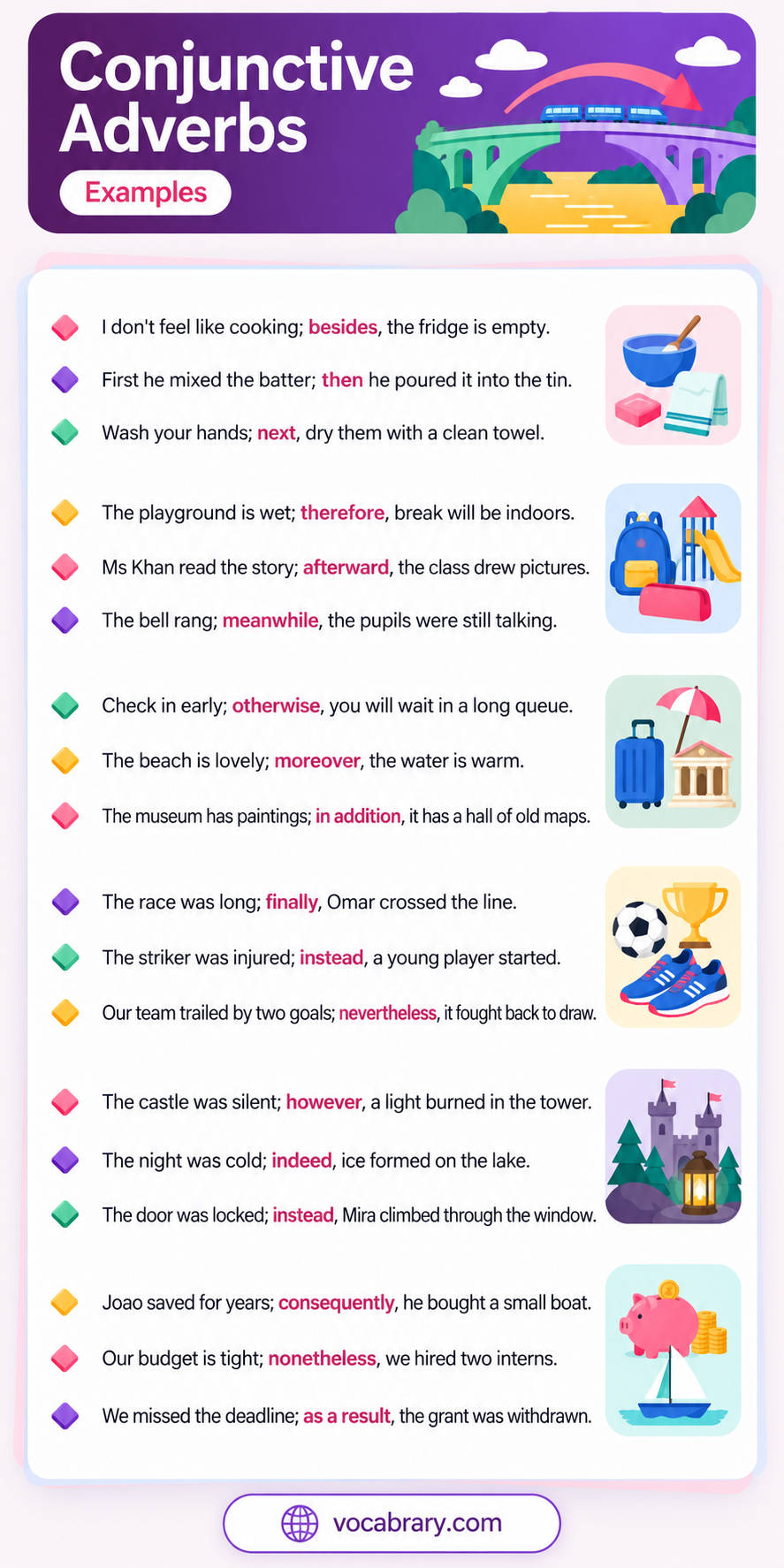
Conjunctive Adverb Example Sentences for Everyday Use
Late buses, cheap hotels, long speeches, and bad forecasts appear in everyday conjunctive adverb example sentences. In every case the adverb links a second clause to the first and shows how the two relate.
- The bus was late; however, we arrived on time.
- Pedro studied all night; therefore, he felt ready for the exam.
- The hotel is cheap; moreover, it overlooks the beach.
- Dad washed the dishes; meanwhile, Mum fed the baby.
- It rained all day; nevertheless, the festival went ahead.
- Leave before six; otherwise, you will miss the ferry.
- We had no milk; Tara drank black tea instead.
- The new phone is fast; furthermore, its battery lasts two days.
- Ella wrote the report; likewise, her partner prepared the slides.
- I don’t feel like cooking; besides, the fridge is empty.
- The speech was long; still, nobody left early.
- First he mixed the batter; then he poured it into the tin.
- The runners trained for months; finally, the marathon day arrived.
- The treaty looked fragile; indeed, it collapsed within a year.
- The shop raised its prices; consequently, many customers went elsewhere.
- The garden is small; however, it gets plenty of sun.
- The film was too long; thus, many viewers left before the end.
- Mina missed the bus; meanwhile, her brother waited at the station.
- The tests were difficult; nonetheless, most pupils passed.
- Ravi speaks French; he also reads Arabic.
Example Sentences by Conjunctive Adverb Function
However, therefore, moreover, meanwhile, likewise, indeed, and otherwise each express one function, such as contrast, result, addition, time, comparison, emphasis, or alternative.
| Function | Conjunctive adverbs | Example sentence |
|---|---|---|
| Contrast | However, nevertheless, nonetheless, still, instead | The film was long; however, nobody left. |
| Result | Therefore, consequently, thus, accordingly, hence | Fares doubled; therefore, many workers cycled instead. |
| Addition | Moreover, furthermore, besides, also, in addition | The museum is free; moreover, it has a cafe. |
| Time | Meanwhile, then, finally, afterward, subsequently | The soup simmered; meanwhile, Hana filled the bowls. |
| Comparison | Likewise, similarly, in the same way | Frogs lay eggs in water; similarly, many fish lay their eggs there. |
| Emphasis | Indeed, in fact, certainly | It was warm; in fact, it was hot by noon. |
| Alternative | Otherwise, instead | Wear a seat belt; otherwise, you may be fined. |
Contrast Sentences With Conjunctive Adverbs
However, nevertheless, still, and instead mark a second clause that opposes, softens, or replaces the first clause.
However in a Sentence
A freezing sea, a slow start, a shy girl, and an expensive ticket each appear with however, which marks a contrast with the first clause.
- The sea was freezing; however, the children swam for an hour.
- Our start was slow; however, the team won the second half.
- She is very shy; however, on stage she is fearless.
- The contract looked fair; however, the lawyer found three errors.
- The new rule is popular. However, not every student agreed with it.
- Mara loves cities; her sister, however, prefers the countryside.
- The ticket was expensive. However, the seats were excellent.
- Her first novel failed; however, the second one became a bestseller.
- Tom promised to call; he did not, however, ring that night.
- I understand your view; however, I disagree with it.
- Prices fell in March; however, they rose again in May.
- The test was long; the questions were fair, however.
- The path looked safe; however, a sign warned of landslides.
- Winter is cold here; however, the houses are warm.
- The shop is small; however, it stocks rare books.
Nevertheless and Nonetheless Example Sentences
A fierce storm, a broken leg, and a heavy defeat show nevertheless and nonetheless meaning in spite of that. Both words are more formal than however.
- The storm was fierce; nevertheless, the ferry sailed on time.
- Arjun broke his leg; nonetheless, he finished the course.
- The defeat was heavy; nevertheless, the fans cheered their team.
- The risks are high; nonetheless, the board approved the project.
- Money was short; nevertheless, the family took a holiday.
- The tutor was strict; nonetheless, the students loved her class.
- The road was blocked; nevertheless, the drivers found a detour.
- It is a small village; nonetheless, it has a fine library.
- The offer was generous; nevertheless, Lucia refused it.
- I was frightened; nonetheless, I opened the door.
Still and Instead in Sentences
A hard year, a cancelled bus, and a meeting that is off show still meaning all the same and instead naming a replacement.
- It was a hard year; still, the farm made a profit.
- Nobody expected rain; still, Lena packed an umbrella.
- Sam is not rich; still, he gives to charity.
- The bus was cancelled; instead, we shared a taxi.
- Pia did not watch television; she read a novel instead.
- We could not afford a hotel; we camped instead.
- The shop had no brown bread; instead, I bought a loaf of rye.
- Don’t text him tonight; call him instead.
- The meeting is off; instead, we will talk on Friday.
- Tom skipped lunch; instead, he went for a run.
Result Sentences With Therefore and Consequently
Therefore, consequently, thus, and accordingly state the result of the first clause, as with a cancelled test, a rising river, and a doubled rent. Each of these adverbs connects a cause in the first clause to its effect in the second.
- The test was cancelled; therefore, students went home early.
- The river rose overnight; consequently, the road closed at dawn.
- The mixture cooled slowly; thus, the crystals grew larger.
- The rules changed in May; accordingly, we updated every contract.
- Rent doubled; therefore, many students moved out.
- Joao saved for years; consequently, he bought a small boat.
- Birds need open water; thus, the lake is protected.
- Demand fell sharply; accordingly, the factory cut shifts.
- The tickets were free; therefore, the hall filled quickly.
- The vote was tied; thus, the chair decided the matter.
- Our supplier failed; consequently, the shop closed for a week.
- Nobody replied; therefore, Rosa sent a second email.
- The lake froze; consequently, the skating school opened early.
- Wages rose; accordingly, the union adjusted its demands.
- The pass was snowed in; therefore, the rally started late.
Addition Sentences Using Conjunctive Adverbs
Moreover, furthermore, besides, also, and in addition add a second fact that supports the first.
Moreover and Furthermore Example Sentences
A patient tutor, a free park, and a calm pilot show moreover and furthermore adding a second fact of the same kind.
- Our tutor is patient; moreover, she explains every step twice.
- The park is free; moreover, it opens before dawn.
- The pilot was calm; furthermore, he spoke to every passenger.
- Mei won the race; moreover, she broke the school record.
- The laptop is light; furthermore, its screen is bright outdoors.
- The course is cheap; moreover, it includes a certificate.
- The tour guide spoke four languages; moreover, he knew every street.
- Wind power is clean; furthermore, it costs little to run.
- The report is accurate; moreover, it is well written.
- The soup is nourishing; furthermore, it takes ten minutes to make.
- Damien trains daily; moreover, he eats carefully.
- The hostel is clean; moreover, breakfast is free.
Besides and In Addition in Sentences
A flat that is too small, a school with a chess club, and a coat that is waterproof show besides, in addition, and also adding a further fact.
- I don’t want to go; besides, the tickets are sold out.
- The school offers music; in addition, it runs a chess club.
- The flat is too small; besides, the rent is high.
- The library is quiet; it is also open on Sundays.
- Wei cooked dinner; in addition, he washed every dish.
- The coat is warm; it is also waterproof.
- Karina plays chess; in addition, she coaches two teams.
- The museum has paintings; in addition, it has a hall of old maps.
- The manager apologised; she also offered a refund.
- It is too late to start; besides, we lack the tools.
- The course teaches writing; it also trains public speaking.
Time and Sequence Sentences Showing Order of Events
Meanwhile, then, finally, afterward, later, and subsequently show how two events relate in time, either at the same moment or one after the other.
Sentences With Meanwhile and Then
Boiling pasta, a bowl of flour, and a curtain that falls show meanwhile for two events at once and then for one event after another.
- The pasta boiled; meanwhile, Giulia chopped the basil.
- First mix the flour and eggs; then add the milk slowly.
- The mayor spoke first; then the band played.
- The storm passed at noon; meanwhile, the river kept rising.
- Mina cleaned the room; meanwhile, Joe painted the door.
- The curtain fell; then, the audience stood and cheered.
- The pupils sat the exam; meanwhile, the teachers prepared the marking scheme.
- Peel the potatoes; then cut them into thick slices.
- The oven heated up; meanwhile, Ines greased the tin.
- Stir the sauce slowly; meanwhile, boil the noodles.
- Knock twice; then wait for the door to open.
Sentences With Finally and Afterward
A long argument, a finished race, and a late party show finally, afterward, and later marking the last step or a step further on.
- We argued for an hour; finally, Dina gave in.
- Armand finished the race; afterward, he drank two litres of water.
- The company opened in 2010; subsequently, it built three more factories.
- The guests ate; later, they danced until midnight.
- Wash your hands; next, dry them with a clean towel.
- The doctor examined the boy; afterward, she wrote a note for the school.
- Pavel studied law; later, he became a judge.
- Mix the paint well; finally, apply two coats.
- Kofi lived in Accra for ten years; later, he moved to Lagos.
- He packed his bags; afterward, he locked the flat.
Comparison Sentences With Likewise and Similarly
Likewise and similarly show that the second clause matches the first, as in two donors who give and two trees that lose their leaves.
- Chen donated books; likewise, his sister gave toys.
- Birds build nests; similarly, bees build hives.
- Spanish nouns have gender; similarly, French nouns are masculine or feminine.
- Ayo greeted every guest; likewise, his wife welcomed every child.
- Rain feeds the rivers; similarly, melting snow feeds the lakes.
- The first tower was built of stone; likewise, the second used local granite.
- The mayor lowered her salary; likewise, the councillors accepted a cut.
- Maple trees lose their leaves in autumn; similarly, oaks drop theirs.
- Mum donates blood twice a year; likewise, my uncle gives blood each spring.
- The first poem rhymes; likewise, the second ends with a rhyme.
- Lena thanked the guests; likewise, her brother thanked the cook.
Emphasis Sentences With Indeed and In Fact
Indeed and in fact strengthen the first clause, as when a late guest misses the whole opening act or a mild day turns out to be warm.
- She was late; in fact, she missed the whole first act.
- Sam is kind; indeed, he is the kindest man I know.
- The plan worked; in fact, it worked better than expected.
- It was not cold; in fact, the afternoon was warm.
- The exam was hard; indeed, only five pupils finished.
- He is not lazy; in fact, he works twelve hours a day.
- The city is old; indeed, its walls date from Roman times.
- The play was a success; indeed, it ran for ten years.
- The food is cheap; in fact, a meal costs less than a coffee.
- The hike was hard; indeed, two walkers turned back at noon.
Otherwise in a Sentence
Wear a helmet, water the plants, and book now each name an action, and otherwise states what happens if the action is skipped. In past sentences such as I took a coat; otherwise, I would have been freezing, it states what would have happened.
- Wear a helmet; otherwise, the police will fine you.
- Water the plants today; otherwise, they will die.
- Lock the gate; otherwise, the dog will escape.
- She was a skilled driver; otherwise, the trip would have ended badly.
- Check your answers; otherwise, you will lose easy marks.
- I took a coat; otherwise, I would have been freezing.
- Book now; otherwise, the cheap tickets will be gone.
- Finish your homework; otherwise, you will stay in.
- The map was accurate; otherwise, we would have been lost.
- Keep the receipt; otherwise, the shop will refuse a refund.
Sentences by Position of the Conjunctive Adverb in the Clause
A conjunctive adverb stands at the start of the second clause, inside it, or at its end, and in conjunctive adverb example sentences the position changes the emphasis and the punctuation.
Start-of-Clause Sentences With Moreover and Nevertheless
Moreover, the road was repaired free of charge and Nevertheless, the committee voted to continue show the adverb opening the second clause, followed by a comma.
- Moreover, the road was repaired free of charge.
- Nevertheless, the committee voted to continue.
- Meanwhile, the guests were arriving at the gate.
- Consequently, many shops closed on Mondays.
- Instead, the team chose a quiet evening at home.
- Finally, the doors opened and the crowd moved inside.
- Otherwise, the schedule will not work.
- Furthermore, the results were published online.
- Indeed, nobody had noticed the missing key.
- Likewise, the teachers received a small bonus.
Mid-Clause Sentences With However and Therefore
Her answer, however, surprised the examiners and the pilot therefore turned back place the adverb after the subject, an auxiliary, or be, with commas on both sides when the pause is long.
- Her answer, however, surprised the examiners.
- The mayor, moreover, promised free bus passes.
- The pilot therefore turned back to Rome.
- We were nevertheless pleased with the result.
- The students, meanwhile, waited outside the hall.
- He had indeed left the key under the mat.
- The manager has instead chosen a younger candidate.
- Tariq, consequently, missed the first lesson.
- Maya, furthermore, spoke four languages fluently.
End-of-Clause Sentences With Nonetheless and Instead
I will finish the report nonetheless and she wrote a letter instead put the adverb last, after a comma when the pause is long.
- The garden is small; the fruit is delicious, however.
- Leila did not call; she wrote a letter instead.
- The trip was expensive; we enjoyed it, nevertheless.
- The speech was long. People listened, however.
- He refused the money; he went home instead.
- I am tired; I will finish the report nonetheless.
- Nothing worked; we kept trying, nevertheless.
- The shop has no bread; we bought rolls instead.
Semicolon and Comma Sentences With Conjunctive Adverbs
A semicolon before the adverb and a comma after it join two independent clauses, and a full stop in place of the semicolon gives the same result with two sentences.
| Pattern | Punctuation | Example sentence |
|---|---|---|
| Between two clauses | Semicolon before, comma after | The road was closed; however, we arrived. |
| New sentence | Full stop before, comma after | The road was closed. However, we arrived. |
| Inside a clause | Commas on both sides when a pause is intended | We, however, arrived. |
| End of a clause | Comma before | We arrived, however. |
| Short adverb after the subject | No commas needed | We therefore stayed home. |
- The river rose quickly; consequently, the village was evacuated.
- Our supplier closed. Moreover, prices rose.
- Ravi was ill; nevertheless, he sat the exam.
- The data are incomplete; the study is therefore unreliable.
- Manu trained daily. Hence he won the race.
- We planned a picnic; instead, we visited the museum.
- Costs are rising; thus, many shops are closing.
- The lab lost power; accordingly, the samples were moved.
- We missed the deadline; as a result, the grant was withdrawn.
- The ice is thin; we therefore stay off the lake.
- Nina sings well; she also plays the cello.
- The hall was cold; the audience, however, stayed to the end.
Coordinating Conjunction and Conjunctive Adverb Sentences Compared
The tea was cold, but Rita drank it and the tea was cold; however, Rita drank it state the same contrast, and the two sentences differ in punctuation and in position.
| Feature | Conjunctive adverb | Coordinating conjunction |
|---|---|---|
| Words | However, therefore, moreover, otherwise | But, so, and, or, yet |
| Punctuation before it | Semicolon or full stop | Comma |
| Position | Start, middle, or end of the second clause | Between the two clauses only |
| Example sentence | The bag is cheap; moreover, it is light. | The bag is cheap, and it is light. |
- The tea was cold, but Rita drank it anyway.
- The tea was cold; however, Rita drank it anyway.
- Dan studied hard, so he passed.
- Dan studied hard; therefore, he passed.
- Hurry up, or we will miss the train.
- Hurry up; otherwise, we will miss the train.
- The plan is cheap, and it is quick.
- The plan is cheap; moreover, it is quick.
- The road is steep, yet cyclists love it.
- The road is steep; nevertheless, cyclists love it.
Sentences With Conjunctive Adverbs After Negative Clauses
The tickets were not cheap, nobody answered, and the shop did not open show conjunctive adverbs after negative first clauses. The negative word belongs to the first clause only.
- The tickets were not cheap; nevertheless, we bought four.
- Nobody answered the phone; therefore, Ines left a message.
- It did not snow; instead, a cold rain fell all week.
- The shop did not open; instead, we ate at the café.
- He is not rich; however, he is generous.
- We did not hear the alarm; consequently, we left late.
- The soup was not hot; moreover, it had no salt.
- Do not touch the wires; otherwise, you will get a shock.
- The film was not long; still, it felt endless.
- She had not slept; indeed, she had not eaten all day.
- The road is not safe; thus, the council closed it.
Direct Question Sentences With Then and However
Why, then, did you leave and is the offer, however, still open show conjunctive adverbs inside direct questions, set between commas after the first word or the subject.
- Why, then, did you leave so early?
- Is the offer, however, still open?
- Should we, therefore, cancel the trip?
- Should we leave now, or instead wait for Jin?
- Does the new plan, moreover, save money?
- Is the road open, or are we instead taking the ferry?
- Did Marco, afterward, speak to the manager?
- Can the hotel, nevertheless, refuse our booking?
- Meanwhile, what is the team doing about the leak?
- Will the shop open on Monday, or is it instead closed for repairs?
Reported Speech and Passive Sentences With Nevertheless and Subsequently
The phrases said the road was safe, was nevertheless opened, and was subsequently sent show conjunctive adverbs in reported speech and in passive verb phrases.
- The mayor said that the road was safe; however, residents stayed away.
- Priya explained that she was ill; therefore, she could not attend.
- The guide told us that the museum was closed; instead, he showed us the garden.
- The report states that costs rose; moreover, it says quality fell.
- Mum said that we should hurry; otherwise, we would miss the show.
- The bridge was nevertheless opened on Friday.
- The scheme was therefore abandoned by the council.
- The letters were subsequently sent to every family.
- The vote ended at noon; the ballots were meanwhile counted by hand.
- The suspect was finally released at dawn.
Conjunctive Adverbs in Everyday Settings
Broken heaters, hard tests, jammed printers, and cancelled flights are the daily settings where conjunctive adverbs link cause, contrast, and time.
Home Sentences About Heaters and Leftover Soup
A broken heater, a small kitchen, a basket of washing, and leftover soup are the household cases in this group. Each one is followed by a second clause that adds contrast, time, or result.
- The heater broke; therefore, we wore coats indoors.
- Dad cooked the rice; meanwhile, Mum chopped the vegetables.
- The kitchen is small; however, it has a lovely window.
- The washing was dry; then Nadia folded it carefully.
- We wanted pizza; instead, we ate leftover soup.
- The baby woke at five; consequently, nobody slept after that.
School Sentences About Tests and Playgrounds
Pupils and teachers deal with a hard test, a read-aloud story, a wet playground, and a surprise film, and a conjunctive adverb links each one to a second clause.
- The test was hard; nevertheless, most pupils passed.
- Ms Khan read the story; afterward, the class drew pictures.
- The playground is wet; therefore, break will be indoors.
- Ali forgot his homework; moreover, he lost his pencil case.
- The bell rang; meanwhile, the pupils were still talking.
- We expected a quiz; instead, the teacher showed a film.
Work Sentences About Meetings and Printers
Office workers deal with a long meeting, rising sales, a jammed printer, and a late invoice, and a conjunctive adverb links each one to a second clause.
- The meeting ran long; however, the manager stayed to the end.
- Sales rose by ten percent; furthermore, costs fell.
- The printer jammed; therefore, Omar emailed the file.
- Finish the invoice today; otherwise, payment will be late.
- The team worked overnight; finally, the website went live.
- Our budget is tight; nonetheless, we hired two interns.
Travel Sentences About Trains and Flights
Travellers meet a crowded train, a midnight arrival, a cancelled flight, and a warm beach, and a conjunctive adverb links each one to a second clause.
- The train was crowded; nevertheless, we found two seats.
- We reached the hotel at midnight; then we slept until noon.
- The flight was cancelled; instead, the airline offered a train ticket.
- The beach is lovely; moreover, the water is warm.
- Fog covered the mountain; meanwhile, the guide waited at the hut.
- Check in early; otherwise, you will wait in a long queue.
Sentences for Wider Settings Beyond Home and Work
Resigning ministers, silent castles, wet pitches, and bitter medicine are wider settings where conjunctive adverbs link events.
News Report Sentences About Ministers and Storms
Reporters cover rising prices, a resigning minister, a severe storm, and an old dam, and a conjunctive adverb links each one to a second clause.
- Prices rose in March; consequently, wages became a main issue.
- The minister resigned; meanwhile, the opposition called for an election.
- The storm was severe; nevertheless, power returned within a day.
- The dam is old; furthermore, it has never been inspected.
- Talks failed on Monday; subsequently, both sides returned to the negotiating room.
- The vote was close; however, the result was clear.
Story Sentences About Castles and Dragons
Story writers describe a silent castle, a waking dragon, a lost map, and a locked door, and a conjunctive adverb links each one to a second clause.
- The castle was silent; however, a light burned in the tower.
- The knight drew his sword; meanwhile, the dragon woke.
- She had lost her map; nevertheless, she walked on into the forest.
- The old man smiled; then he vanished into the fog.
- The door was locked; instead, Mira climbed through the window.
- The night was cold; indeed, ice formed on the lake.
Sports Sentences About Deficits and Wet Pitches
Players and coaches face a two-goal deficit, a wet pitch, a long race, and an injured striker, and a conjunctive adverb links each one to a second clause.
- Our team trailed by two goals; nevertheless, it fought back to draw.
- The coach praised the defence; moreover, she thanked the fans.
- The pitch was wet; therefore, the referee delayed the start.
- Nina won the first set; meanwhile, her rival rested.
- The race was long; finally, Omar crossed the line.
- The striker was injured; instead, a young player started.
Health Sentences About Coughs and Medicine
Patients and nurses deal with a persistent cough, a bitter medicine, a dizzy feeling, and a blood test, and a conjunctive adverb links each one to a second clause.
- Leo had a cough; therefore, the nurse sent him home.
- The medicine tasted bitter; nevertheless, Grandpa took every dose.
- Drink more water; otherwise, you will feel dizzy.
- The doctor checked his heart; afterward, she ordered a blood test.
- Sleep is vital; moreover, it improves memory.
- The clinic opens at nine; meanwhile, patients wait in the garden.
Conjunctive Adverb Sentences for Kids
Socks and shoes, a rainy day, a sandcastle, and a kitten in a tree give young learners a first look at then, instead, finally, and still in conjunctive adverb example sentences for kids.
- First I put on my socks; then I put on my shoes.
- It was raining; instead, we played games indoors.
- Mum cooked dinner; meanwhile, Dad set the table.
- We built a sandcastle; finally, we added a flag on top.
- I like apples; I also like pears.
- The park was closed; however, we found a playground.
- My sister can swim; moreover, she can dive.
- Put on your coat; otherwise, you will be cold.
- The kitten was small; still, it climbed the tree.
Short Conjunctive Adverb Sentences for Young Learners
I woke up; then I had breakfast and it rained; instead, we stayed home give beginners a short pattern with then, instead, and meanwhile.
- I woke up; then I had breakfast.
- It rained; instead, we stayed home.
- Tom ran; meanwhile, Ana walked slowly.
- First we ate lunch; finally, we cleaned up.
- Wear a hat; otherwise, your head will be cold.
- I have a cat; I also have a fish.
- It was late; however, we played on.
- Gran sewed; meanwhile, I fed the hens.
Conjunctive Adverb Sentences for Students
Conjunctive adverb example sentences for exams use conversely, subsequently, accordingly, and thereafter in longer sentences with two full clauses, and these lines give secondary students a model to adapt in an essay.
- The study had a small sample; nevertheless, its results were widely cited.
- Renewable energy is costly to install; conversely, it is cheap to run.
- Literacy improved sharply; consequently, wages rose across the region.
- The first experiment failed; subsequently, the team redesigned the equipment.
- Critics praised the novel; furthermore, it sold half a million copies.
- The policy reduced waste; however, it also raised costs for small shops.
- Supporters expected a quick vote; instead, the debate lasted three weeks.
- The author’s early work was ignored; indeed, only two reviews appeared.
- Public transport is expensive; accordingly, many commuters drive.
- The statistics are reliable; nonetheless, they require careful interpretation.
- Taxes rose in 2019; thereafter, spending on schools increased.
- The data support the claim; likewise, earlier surveys reached the same result.
Conjunctive Adverbs in Short Paragraphs
Four short passages about a football match, a new bakery, a storm warning, and a small flat use however, meanwhile, and consequently, so learners meet conjunctive adverbs inside running text.
The match began badly; however, the home team scored just before half time. Meanwhile, the visiting coach changed three players. The crowd was loud; moreover, the weather was perfect. Finally, the referee blew the whistle, and the home team celebrated.
Sofia wanted to open a bakery. She had no savings; nevertheless, she asked the bank for a loan. The bank agreed; furthermore, it offered training. Consequently, the bakery opened in April, and indeed the first week was a success.
The storm warning came at noon. Farmers brought in the cattle; meanwhile, children helped to close the shutters. Then the wind rose. The power failed; therefore, the village used candles. Afterward, neighbours shared hot soup.
Our flat is small; however, it is bright. The rent is low; besides, the market is close. We wanted a bigger kitchen; instead, we bought a folding table. Therefore, we have no plans to move.
FAQs
Q1. What are some common conjunctive adverbs?
Common conjunctive adverbs are however, therefore, moreover, furthermore, nevertheless, meanwhile, consequently, otherwise, instead, likewise, besides, then, thus, also, finally, still, and indeed. Each one links two independent clauses and shows contrast, result, addition, time, comparison, or emphasis. Phrases such as in addition and as a result work in the same way.
Q2. What is the difference between a conjunctive adverb and a coordinating conjunction?
A conjunctive adverb needs a semicolon or a full stop before it, while a coordinating conjunction needs only a comma. In the road was steep, yet cyclists loved it, the word yet is a coordinating conjunction. In the road was steep; nevertheless, cyclists loved it, the word nevertheless is a conjunctive adverb.
Q3. How do you punctuate a conjunctive adverb?
You punctuate a conjunctive adverb with a semicolon before it and a comma after it when it joins two independent clauses. A full stop replaces the semicolon when the clauses form two sentences. Inside a clause, the adverb takes commas on both sides, and at the end it takes one comma before it.
Q4. Do you put a semicolon before however?
A semicolon goes before however when however opens the second of two independent clauses in one sentence. A sentence such as the bus was late; however, we arrived on time follows that pattern. When however stands inside a clause, no semicolon is needed, as in the answer, however, surprised us.
Q5. Where does a conjunctive adverb go in a sentence?
A conjunctive adverb goes at the start of the second clause, inside it after the subject, or at its end. However, we arrived opens the clause, we, however, arrived places the adverb inside, and we arrived, however closes the clause. Each position changes the emphasis slightly, and the middle position puts the adverb between commas.
Q6. What is the difference between however and nevertheless?
However and nevertheless both show contrast, but nevertheless is more formal and means in spite of that. However also fits sentences where two facts differ without any conflict, as in Mara loves cities; her sister, however, prefers the countryside. Nevertheless is used in sentences where something happens despite an obstacle.
Q7. Is “also” a conjunctive adverb?
Many grammar references classify also as a conjunctive adverb of addition when it links a second clause to the first, as in the library is quiet; it is also open on Sundays. It stands inside the second clause, and it is not a conjunction. For that reason, she plays the piano, also she sings is a comma splice.
Q8. Can a conjunctive adverb start a sentence?
A conjunctive adverb starts a sentence when the sentence follows another sentence that it relates to, as in the ticket was expensive. However, the seats were excellent. A comma follows the adverb. Both the semicolon form and the full-stop form are correct.
Q9. What are conjunctive adverbs of contrast?
Conjunctive adverbs of contrast are however, nevertheless, nonetheless, still, instead, and conversely. They show that the second clause opposes, softens, or replaces the first. In the storm was fierce; nevertheless, the ferry sailed, nevertheless marks the ferry sailing in spite of the storm.
Q10. What is the difference between moreover and furthermore?
Moreover and furthermore both add a second fact in the same direction, and in most sentences either word works. Both words belong to formal writing and link a series of facts in longer arguments. Both take a semicolon before them and a comma after them.
Q11. What are conjunctive adverbs for kids?
Conjunctive adverbs for kids are short linking words such as then, also, instead, finally, and meanwhile. A line like first I put on my socks; then I put on my shoes teaches the order of two actions. Conjunctive adverb example sentences for kids keep both clauses short and use a semicolon before the adverb.
Q12. How do you identify a conjunctive adverb in a sentence?
You identify a conjunctive adverb by finding the word that links two independent clauses and moves inside the second clause. In the road was closed; however, we arrived, the word however moves to we, however, arrived without a change in meaning. A conjunction such as but is unable to move in this way.

Leave a Comment