
Starting a sentence with and is a sentence opening that puts a coordinating conjunction at the front of a new sentence instead of inside the last one, as in The lights went out. And nobody moved. Style guides accept starting a sentence with and or but, and the real risk is overuse, not bad grammar.
What Is Starting a Sentence With And or But?
A sentence that begins with and, but, or, so, yet or nor gives the second statement its own capital letter, its own full stop and its own emphasis. A coordinating conjunction inside a sentence joins two clauses with a comma, as in She waited, but nobody came, while the opening breaks the same idea into two sentences.
First sentence. + And / But / Or / So / Yet / Nor + second sentence.
The team trained for eleven months. But the final lasted nine minutes.
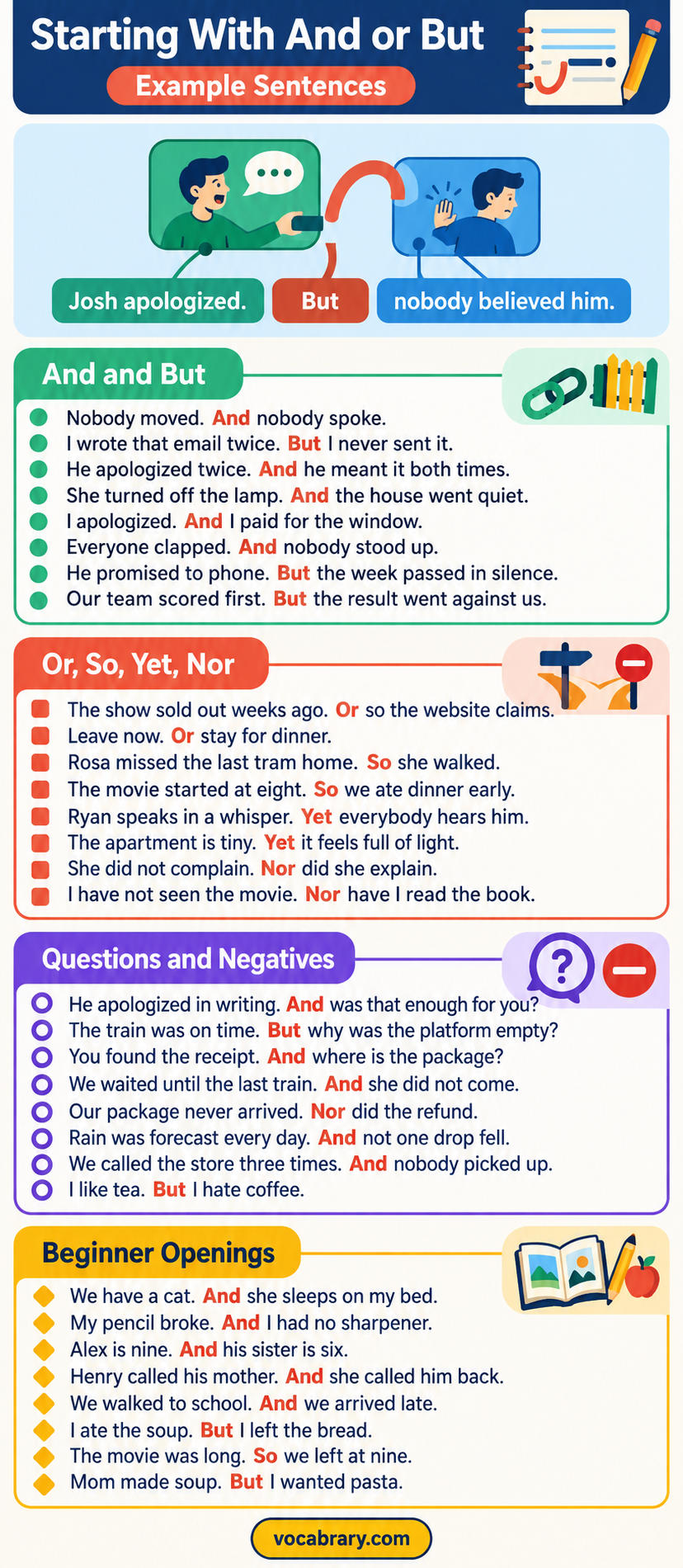
Common Sentences That Start With And or But
Rain that empties a street, a door nobody answers, and a blue sofa that arrives green open these sentences, where the second statement adds to the first or turns against it.
- Rain stopped at noon. And the whole street came outside.
- Ravi knocked three times. But nobody answered the door.
- We packed the car by six. And we still missed the ferry.
- Critics loved the film. But half the cinema left before the interval.
- Nadia saved for two years. And she bought a flat last spring.
- Everyone promised to help with the move. But only Tom turned up.
- Nobody moved. And nobody spoke.
- I wrote that email twice. But I never sent it.
- Grandma planted the plum tree in 1978. And it still fruits every August.
- Our bus was late again. But the driver apologised to every passenger.
- My laptop died in the middle of the lecture. And the charger was at home.
- Sam trained all winter for the marathon. But a broken toe ended his race.
- Tickets sold out in four minutes. And the band added a second night.
- Layla studied every evening for a month. But the exam asked about the one chapter she skipped.
- Builders finished the roof on Friday. And heavy rain started on Saturday.
- We ordered a blue sofa in March. But a green one arrived.
- He apologised twice. And he meant it both times.
- Portugal led by two goals at half time. But the second half went badly.
- A letter arrived on Tuesday morning. And nobody opened it until Thursday.
- Our neighbours spent the whole summer painting their house bright yellow. But the council asked them to paint it again in November.
- Marta speaks four languages fluently. But she refuses to order coffee in anything except English.
- Snow was forecast all week. And the sky stayed bright until Sunday.
Sentences That Open With And
Cake that disappears, a phone ringing at midnight, and a bill after a free trial show what and does at the front: it adds one more fact to the last statement.
- Yusuf finished his homework before dinner. And he read two chapters afterwards.
- Grandad told the same fishing story three times. And we laughed three times.
- Our flight landed an hour early. And the luggage arrived with us.
- She turned off the lamp. And the house went quiet.
- Priya won the county final in June. And she won the national title in August.
- Rent went up in January. And the heating broke a week later.
- Dad fixed the gate on Saturday morning with a borrowed drill and a jar of new screws. And it has held ever since.
- Cake disappeared from the kitchen. And so did my brother.
- The phone rang at midnight. And nobody spoke on the other end.
- Karim signed the lease on Monday. And he moved in on Tuesday.
- Free trials end quietly. And the first bill lands the same day.
- Two wolves crossed the track ahead of us. And a third followed a minute later.
- I apologised. And I paid for the window.
- Leila learned to swim at forty. And she now teaches her grandchildren every Sunday at the leisure centre in Leeds.
- Snow fell for six hours. And the village school closed for the week.
- Our cat pushed the glass off the table. And he watched it fall.
- Ahmed studied medicine for six years. And his sister studied law for five.
- Farmers here plant in April. And they harvest in September.
- Everyone clapped. And nobody stood up.
- Mum baked bread every Friday of my childhood. And the whole house smelled of yeast until Sunday.
Sentences That Open With But
A holiday booking that vanishes, a bright forecast that turns to hail, and a quiet cat that wrecks a curtain lie behind the sentences that open with but, where the second statement contradicts the first.
- Hana booked the holiday in February. But the airline cancelled the route in June.
- Everyone expected a long trial. But the jury returned in forty minutes.
- Forecasters promised sunshine. But hail arrived at three.
- Our cat sleeps eighteen hours a day. But she destroyed a curtain last night.
- I revised every formula in the book. But the paper tested the one chapter I had ignored.
- Dmitri trained with the first team all season. But the manager left him out of the final squad.
- Rents keep rising in the city centre. But wages have stayed still since 2019.
- We arrived at the restaurant on time. But our table had gone to somebody else.
- The parcel said fragile. But the cup inside was in four pieces.
- Sofia speaks softly. But every person in the room listens.
- Two thousand people applied. But the college offered only forty places.
- He promised to phone. But the week passed in silence.
- Aunt Rosa is eighty-one. But she still cycles to the market every Thursday morning with an empty basket.
- Bees vanished from the orchard for three summers. But they came back the year we stopped spraying.
- Our team scored first. But the result went against us.
- Josh apologised. But nobody believed him.
- Tuition doubled between 2012 and 2020. But the number of applicants doubled as well.
- Salma had never held a camera before that winter. But her photographs won a prize in the spring exhibition.
- Rain ruined the picnic. But the day ended around a kitchen table with borrowed chairs and too much bread.
- We booked the cheapest seats. But the usher moved us to the front row.
Coordinating Conjunction Openings With Or, So, Yet, and Nor
And and but do most of the front-of-sentence work, while or offers an alternative, so draws a consequence, yet concedes a contrast, and nor extends a negative.
| Opening word | Effect in the sentence | Example sentence |
|---|---|---|
| And | Adds one more fact to the statement before it | And the bill arrived the next morning. |
| But | Turns the new sentence against the one before it | But nobody answered the door. |
| Or | Offers an alternative to what was just said | Or we walk to the station. |
| So | States the outcome of the sentence before it | So we cancelled the whole trip. |
| Yet | Grants the first statement and contrasts it | Yet she finished ahead of everybody. |
| Nor | Extends a negative to a second statement | Nor did his brother phone back. |
Sentences That Open With Or
A late bus, a flooded footpath, and a sold-out show force the choice behind each sentence that opens with or, where the new sentence names a second route the reader still has.
- We take the six o’clock train. Or we drive through the night and sleep at a service station.
- Bring your own tent. Or rent one at the gate for eleven pounds.
- Finish the essay tonight. Or ask your tutor for three more days.
- The show sold out weeks ago. Or so the website claims.
- Send the form before Friday. Or hand it in at the office on Monday morning.
- You wait for the next bus. Or you walk twenty minutes along a flooded footpath.
- Pay for the year in one go. Or spread the cost across twelve months.
- Leave now. Or stay for dinner.
- Sanjay wants the job in Manchester. Or he wants the transfer to Lisbon, and he refuses to say which.
- Learn the irregular verbs properly this term. Or repeat the same mistakes in every essay you write next year.
Sentences That Open With So
A cancelled ferry, a burnt dinner, and a broken boiler explain the sentences that open with so, where the new sentence states what followed from the sentence before it.
- The ferry was cancelled at dawn. So we spent an extra night in Bilbao.
- Dinner burnt while I answered the door. So we ate cheese sandwiches and laughed about it.
- Our boiler broke in December. So the whole family slept in one room for a fortnight.
- Nobody volunteered. So the coach picked names out of a hat.
- Rosa missed the last tram home. So she walked.
- Prices rose twice in one term. So the student union opened a food bank in the library basement.
- The printer jammed ten minutes before the deadline. So Marcus emailed the file instead.
- Three players were injured before kick-off. So a fifteen-year-old started in goal.
- Elena forgot her passport. So her sister drove to the airport with it.
- Nobody read the notice on the door. So forty people queued outside a closed building for an hour.
Sentences That Open With Yet
A runner with a broken toe, a novel rejected twenty times, and a frosted orchard fill the sentences that open with yet, where the second statement admits the first and contradicts it.
- Ibrahim ran on a broken toe. Yet he finished the race in under four hours.
- Publishers rejected the novel twenty times. Yet it sold a million copies within two years.
- Frost killed half the apple blossom in April. Yet the orchard gave its best crop in a decade.
- She had never taught before. Yet her classes filled first.
- The bridge was built in 1846. Yet it still takes lorries every day.
- Our house flooded twice in five years. Yet nobody on the street wanted to move away.
- Ravi speaks in a whisper. Yet everybody hears him.
- The recipe asks for eight ingredients and ninety minutes of work. Yet my grandmother finished it in half the time without a single measuring spoon.
- Tickets cost eighty pounds. Yet the hall sold out in a morning.
- Anya caught a chest infection on the morning of the audition. Yet the director offered her the lead part.
Sentences That Open With Nor
A brother who never phones, a landlord who repairs nothing, and a committee that answers no letters open with nor, where the helping verb jumps ahead of the person acting.
- Salim never answered my message. Nor did his brother phone back.
- Our landlord refused to repair the roof. Nor would he return the deposit.
- I have never visited Rome. Nor have I learned a word of Italian.
- The committee ignored every letter from the residents. Nor did anybody from the council attend the meeting in March.
- Marek’s dog will not walk past the butcher’s shop. Nor will he ride in the back of a car.
- She did not complain. Nor did she explain.
- Peter has no interest in cricket. Nor does his father, who grew up beside a county ground in Sussex.
- That machine has never worked properly since the day it arrived. Nor has the company sent an engineer to look at it.
Short Punch Sentences in Fiction
An empty room behind an open door, a knife on a spotless table, and a train that leaves with nobody aboard drive these fiction openings, where but and and land like a blow.
- Nadia turned the lock without effort. And the room beyond it was empty.
- Mara counted the money twice. But four hundred pounds had gone.
- Snow covered the tracks by morning. And the tracks led nowhere.
- He swore he had burned every photograph. But one survived in a drawer under the shirts.
- The train pulled out at ten past six. And nobody was on it.
- She heard the car door slam. And then she heard her name.
- Everyone in the village knew the story of the drowned bell, and everyone told it differently. But nobody rang it.
- The knife was still on the kitchen table. And the kitchen was spotless.
- Detective Ryan read the confession three times. But the handwriting belonged to a dead woman.
- Rain hammered the caravan roof all night. And by dawn the field had turned to mud.
- He reached for the letter. But his hand stopped an inch short of it.
- Lights went out across the whole harbour at nine minutes past eleven. And every boat sounded its horn at once.
- She had rehearsed the apology for nine years. But the words came out wrong.
- From the lane the house looked ordinary, with white shutters and a red gate. But the cellar door had been bricked up from the inside.
Openings in Speeches, News and Marketing Copy
A coach speaking at half time, a council blamed after a flood, and a free trial that renews itself move the opening out of fiction and into public speech, news reporting and sales writing.
Openings in Speeches and Public Talks
A coach at half time, a mayor after a flood, and a graduate thanking a teacher turn to and or but when one sentence must land alone in a listening room.
- We have lost four matches in a row. But we have never been closer to playing well.
- Tonight we thank the nurses who worked through the storm. And we thank the families who waited for them.
- Our river broke its banks twice this winter. And this council failed to act after the first time.
- Every graduate here worked for this. But none of you worked alone.
- Ten years ago this hall was due for demolition. Yet it has hosted a thousand weddings since.
- I promised three changes at the last election. And I have delivered two of them.
- My teacher told me to write a hundred words a day for a year, whatever else happened in my life. And I did.
- Numbers alone will not persuade this room. So let me tell you about one family in Ward Nine.
- You will hear that the plan costs too much. But doing nothing has already cost us more.
- Thank you for the award. And thank you for the twenty years of rejection that came before it.
- We opened the shelter with eleven beds. And the building now sleeps ninety people every night.
- Nobody in my family had finished school before me. So this degree is theirs as much as mine.
Openings in Journalism and Headlines
A verdict after a long trial, a budget that misses a promise, and a striker returning from injury make up the news sentences, where reporters open with but to mark the turn in a story.
- Ministers pledged fifty new hospitals in 2019. But three have opened since.
- The jury deliberated for eleven days. And it acquitted both defendants on every charge.
- Flood defences held along the western bank. But the eastern side of the town took two metres of water.
- Inflation eased for a third month. And food prices rose again.
- City signed the striker for a record fee in July. But he has started only four games.
- Talks ended at four in the morning without a signature. So the strike begins on Monday.
- The report ran to four thick volumes. And it named nobody.
- Rail companies promised compensation within a week. But passengers waited an average of fifty-one days for a refund, according to the regulator.
- Two hundred jobs went at the plant in March. And the council learned about it from the radio.
- Doctors warned about the shortage in January. Yet the first order was placed in June.
- Ticket prices for the final fell overnight. And the stadium still had empty rows.
- Officials described the investigation as thorough, independent and fully resourced. But the family of the victim refused to attend the press conference.
Openings in Blogs and Marketing Copy
A free trial that renews itself, a kitchen gadget nobody uses, and a newsletter nobody reads run through the marketing sentences, where a one-word opening keeps the reader moving down the screen.
- Everybody talks about writing every morning. But almost nobody does it for a fortnight.
- We tested nineteen coffee grinders in one kitchen. And two of them broke in the first week.
- You have read this advice before. And you have ignored it before.
- Our first launch sold eleven copies. But the eleven buyers wrote to us, and their notes rebuilt the product.
- The subscription costs less than a sandwich. And it takes four minutes a week.
- Most kitchen drawers have a spiraliser in them. But almost none of those spiralisers have been used twice.
- Start with one paragraph tonight. Or start with one sentence.
- We wrote this newsletter for six months without a single reply. And we kept writing it.
- Our old checkout took nine clicks. So we rebuilt it in three.
- You already own the camera. So stop waiting for a better one.
- Every advert promises quick fluency. But a language takes a thousand quiet hours, and nobody sells that honestly.
- The trial lasts thirty days. And the reminder arrives on day twenty-seven.
- Readers skip long paragraphs. So we cut ours in half and doubled the time readers stayed.
- Price rises on Friday. But subscribers who joined this week keep the old rate for life.
Openings in Dialogue
Arguments over a borrowed car, a refused second helping, and a child asking one more question fill the dialogue lines, where speakers start a fresh sentence with and or but to press a case.
- "I told you the tickets were non-refundable. And you booked them anyway."
- "We have talked about this twice. But nothing has changed in the kitchen rota."
- "You promised to return the car by seven," Nadia said. "And it is now half past nine."
- "Fine, take the last slice. But do not pretend you asked me first."
- "And what exactly did you say to her mother?" Dad asked from the doorway.
- "The doctor said rest," Omar told his brother. "So put the ladder down."
- "But everybody else is going," Leo said, with the confidence of a nine-year-old lawyer.
- "I heard the whole argument through the wall. And I heard who apologised first."
- "Or we stay in and watch the rain," Ana suggested, already taking off her coat.
- "You are welcome to borrow the van on Saturday. But bring it back with a full tank and no scratches."
- "And then he sold the boat," Grandad said, as though that explained the last forty years.
- "Yet you signed the contract," the solicitor said quietly, turning the contract towards him.
Openings in Emails and Messages
A delayed invoice, a meeting moved twice, and a parcel left with a neighbour run through the email lines, where and or but opens a sentence that softens or corrects the one before it.
- Thank you for sending the draft. But the second invoice still has last year’s address on it.
- I have booked the room for Thursday at ten. And I have asked Priya to bring the projector.
- We moved the meeting twice already. So Friday afternoon is our final offer.
- Your parcel arrived this morning. And I left it with the neighbour at number twelve.
- Apologies for the slow reply. But the whole team has been in Lisbon since Monday.
- Everything is signed at our end. And the accounts department pays on the last working day of the month.
- I read your proposal twice on the train. And the third part answered the question I had been asking for a year.
- Happy to meet next week. Or we settle the whole thing in ten minutes on the phone.
- The plumber came on Tuesday. But the leak under the sink started again last night.
- Please send the figures before noon. And please copy in Hassan this time.
- We loved the first design. Yet the client wants the logo in green.
- Great news about the grant. And congratulations to everybody who wrote that application.
- Attached is the revised budget. But the travel line still needs your approval.
- Sorry to chase again. And thank you for your patience with all my chasing.
Openings in Academic Writing
Research prose accepts the opening where a finding turns against the last sentence, and rejects it where three short openings in a row break an argument into fragments.
Academic Sentences That Keep the Opening
A sample that fails to replicate, a model with the wrong sign, and a survey with a low response rate earn an opening but, because each reverses the finding just reported.
- The first two trials produced the same effect size. But the third failed to replicate it in a larger sample.
- Temperature explains most of the variation in the model. Yet rainfall predicts the timing of every recorded bloom.
- Our survey reached four thousand households. But the response rate fell under nine per cent.
- Earlier studies treated the two dialects as one. And the 2019 corpus shows a split going back six generations.
- Cost alone justifies the older method. But accuracy does not.
- Historians long dated the wall to the fourth century. Yet the timbers beneath it were felled in 388.
- Instruments measured depth to the nearest centimetre. So errors of a metre point to an operator mistake.
- Both groups improved during the first term. But only the reading group held the gain a year later.
Academic Sentences Rewritten Without the Opening
Three openings in a row weaken a paragraph on migration data, funding cuts, and soil samples, so each pair rewrites the run of short sentences as one joined sentence.
- ❌ The data were incomplete. And the funding ended. But the team published anyway. ✅ The data were incomplete and the funding ended, but the team published anyway.
- ❌ Rainfall fell by a third. And yields dropped. And prices doubled. ✅ Rainfall fell by a third, yields dropped, and prices doubled.
- ❌ We collected sixty soil samples. But twelve were contaminated. So we analysed forty-eight. ✅ Twelve of our sixty soil samples were contaminated, so we analysed the remaining forty-eight.
- ❌ Migration rose after 1994. And wages stayed flat. But unemployment fell. ✅ Migration rose after 1994 and wages stayed flat, yet unemployment fell.
- ❌ The theory predicts three outcomes. But the trial tested one. And the paper claims support for all three. ✅ The theory predicts three outcomes, but the trial tested only one, so the claim of support for all three is unearned.
- ❌ Participants completed the task. And they repeated it. And they scored higher. ✅ Participants completed the task twice and scored higher on the second attempt.
Openings in Classic Literature
Genesis in the King James Bible, Mrs Bennet in Pride and Prejudice, and the silent Woodman in A Tale of Two Cities open sentences with and or but centuries before the ban.
- Genesis 1 in the King James Bible of 1611 moves from day to day on one opening word: And God said, Let there be light.
- Mrs Bennet contradicts her husband in Jane Austen’s Pride and Prejudice of 1813. But it is, she insists, when he claims to have heard nothing about Netherfield.
- Elizabeth corrects her mother in the same novel, reminding her that the assemblies will bring introductions enough. But you forget, mamma, she begins.
- Charles Dickens turns from revolution to two quiet figures in A Tale of Two Cities of 1859. But that Woodman and that Farmer work silently, he writes, while France slides towards terror.
- A young woman creeps along a wall in the same Dickens novel. And so exactly was the expression repeated on her face, the narrator adds, that the two seem one person.
- Virginia Woolf lets one thought run into the next in The Waves of 1931, where sentences that open with and follow a speaker’s mind rather than a grammar lesson.
- Orlando of 1928 gives Woolf the same freedom, and a sentence that opens with but swings Orlando from one century to the next.
- Ernest Hemingway joins plain statements with and throughout The Old Man and the Sea of 1952. And a new sentence starting the same way keeps the old fisherman’s day moving.
- William Faulkner hands the opening to his narrators in As I Lay Dying of 1930, where a sentence beginning with and copies the way the Bundren family actually speaks.
- George Orwell uses the turn in Nineteen Eighty-Four of 1949. But the Party has already rewritten the record, the novel keeps reminding Winston.
- Margaret Atwood opens sentences with and in The Blind Assassin of 2000, tying an old woman’s memories to the newspaper cuttings between chapters.
- Doris Lessing opens sentences with and in Prisons We Choose to Live Inside of 1986, where each new statement adds to the argument she has just made.
Joined Sentences Split Into Two
A broken bus, a burnt cake, and a lost passport appear twice in each pair, first as one joined sentence and then as two, so the force of the opening shows.
- Our bus broke down, and we walked the last mile. → Our bus broke down. And we walked the last mile.
- She revised for a month, but the paper defeated her. → She revised for a month. But the paper defeated her.
- Take the motorway, or you will miss the wedding. → Take the motorway. Or you will miss the wedding.
- Our cake burnt, so we bought biscuits. → Our cake burnt. So we bought biscuits.
- Dan lost his passport, yet he reached Warsaw on time. → Dan lost his passport. Yet he reached Warsaw on time.
- I did not phone, nor did I write. → I did not phone. Nor did I write.
- Farid cooked for nine people, and nobody helped him. → Farid cooked for nine people. And nobody helped him.
- The shop reopened in April, but the old owner had gone. → The shop reopened in April. But the old owner had gone.
- We planted forty bulbs, and six came up. → We planted forty bulbs. And six came up.
- Book a table now, or eat at the counter. → Book a table now. Or eat at the counter.
- The lift was broken, so Grandma climbed five flights with her shopping. → The lift was broken. So Grandma climbed five flights with her shopping.
- He signed the lease in March, yet he never collected the keys. → He signed the lease in March. Yet he never collected the keys.
- Anita practised the speech aloud for a week, and she still forgot the third paragraph in front of four hundred people. → Anita practised the speech aloud for a week. And she still forgot the third paragraph.
- Rain fell all weekend, but the match went ahead. → Rain fell all weekend. But the match went ahead.
Openings in Questions and Negative Sentences
A missing invitation, a refused refund and an alarm that never sounded push the opening into a question or into a second refusal, so but, and and nor do the joining work.
Openings in Questions
A missing invitation, a bill nobody explains, and a night with no phone call turn into questions that open with but or and, tied to whatever was said a moment earlier.
- Yusuf was at the wedding all evening. But who invited him?
- They charged us twice for the same night. And who is going to refund it?
- Somebody locked the gate at seven. So how did the dog reach the road?
- Nobody phoned the hospital until morning. But why did the ward wait so long?
- You have read the whole file. And what do you make of the last paragraph?
- The council promised a decision in June. But where is the letter?
- We have two hours before the train. Or shall we walk into town and eat first?
- Everybody agrees the roof needs replacing. And who pays for it?
- Her flight landed at midnight. But how did she reach the hotel without a passport?
- The recipe feeds four. So what do we do about the other eleven guests arriving at seven?
- He apologised in writing. And was that enough for you?
- They rebuilt the bridge in nine weeks after the flood of 2019 carried the old one away. But will it survive a February flood?
Openings in Negative Sentences
A refused refund, a dog that will not pass the butcher, and a brother who never writes back give the negative openings, where but, and or nor adds a second refusal.
- Rosa asked twice for a refund. But the shop would not give one.
- My brother left in 2011. And he has never written back.
- The committee heard the complaint. But nobody wrote anything down.
- We waited until the last train. And she did not come.
- Halim promised to cover the shift. But he has not answered his phone since Thursday.
- Our parcel never arrived. Nor did the refund.
- Our landlord took the deposit in cash. And he gave us no receipt.
- Lena studied in Paris for three years. But she never once ate at a restaurant near the school.
- Smoke filled the corridor and the alarm never sounded. Nor did the sprinklers work.
- Ben trained hard all season. But the coach did not pick him.
- Rain was forecast every day. And not one drop fell.
- They advertised the job in March. But they have not interviewed a single applicant.
Openings for Students and Beginners
Late homework, a lost library card, a cat asleep on a bed and a rainy Sunday keep these openings inside the vocabulary of a first-year class, with every line short enough to copy.
Sentences With And or But Openings for Students
Late homework, a lost library card, and a football match in the rain give students sentences that open with and or but, each one short enough to copy into an essay paragraph.
- My teacher set three questions. And she asked for all three by Friday.
- I finished the history project on Wednesday. But I left it on the kitchen table.
- School closed early for the storm. And the buses left at one o’clock.
- Maya revised every night for a fortnight. But she still felt sick before the maths paper.
- The library fined me two pounds. And I had already lost the card.
- We planted sunflowers in March. And the tallest reached two metres by August.
- Rain soaked the pitch before kick-off. But the referee started the match anyway.
- Tom joined the choir in September without telling anybody in his family. And he sang a solo at the Christmas concert in front of all of them.
- Our science lab smelled of vinegar. So we opened every window.
- I read the whole chapter twice. But the question asked about the footnotes.
- Amina forgot her gym kit. So she borrowed a shirt three sizes too big.
- Our exams finish on the eighteenth. And the holidays start the same afternoon.
- Everybody copied the diagram from the board. But nobody labelled the axes.
- A trip to the museum cost nine pounds. And the coach broke down on the way back.
Short Openings for Beginners
A cat on a bed, a broken pencil, and a rainy Sunday make the beginner sentences, where every line runs under ten words and the opening word is and or but.
- I like tea. But I hate coffee.
- We have a cat. And she sleeps on my bed.
- My pencil broke. And I had no sharpener.
- It rained on Sunday. But we went out anyway.
- Ali is nine. And his sister is six.
- The shop was open. But the bread had gone.
- Hassan called his mother. And she called him back.
- Dogs bark at night. But ours never does.
- We walked to school. And we arrived late.
- That bag was heavy. So Dad carried it.
- I ate the soup. But I left the bread.
- She plays the guitar. And she sings.
- My brother is tall. But he plays no sport at all, and he never watches it either.
- The film was long. So we left at nine.
A Short Paragraph Built on And and But Openings
Eight connected lines follow one family through a power cut in Ibadan, a cold supper by lamplight, and a neighbour with a generator, so the openings appear inside a paragraph.
- On the first Friday in June the power failed across our whole street in Ibadan.
- And the fridge had been full since the market that morning.
- Mum lit two candles and put the fish back on the ice from the cooler.
- But the ice had already turned to water by eight o’clock.
- Our neighbour Mr Adeyemi knocked at nine with a generator on a trolley.
- Yet he refused every naira my father offered him for the fuel.
- We ate a cold supper of bread, oranges and smoked fish around one lamp.
- So the evening turned into a picnic, and my little sister called it the best of her life.
Related
FAQs
For starting a sentence with and or but in daily writing, one example is "Rain stopped at noon. And the whole street came outside." Another opening is "And nobody spoke."
When starting a sentence with and or but to mark a contrast, one example is "Forecasters promised sunshine. But hail arrived at three." Another opening is "But the week passed in silence."
To state a result, one example is "Rosa missed the last tram home. So she walked." Another opening is "So the coach picked names out of a hat."
For a surprising turn, one example is "She had never taught before. Yet her classes filled first." Another opening is "Yet nobody on the street wanted to move away."
To extend a negative, one example is "She did not complain. Nor did she explain." Another opening is "Nor have I learned a word of Italian."
When a writer offers an alternative, one example is "Leave now. Or stay for dinner." Another opening is "Or spread the cost across twelve months."
A dialogue example is "I told you the tickets were non-refundable. And you booked them anyway." Another opening is "But do not pretend you asked me first."
In a speech, one example is "Every graduate here worked for this. But none of you worked alone." Another opening is "But doing nothing has already cost us more."
Research prose uses starting a sentence with and or but to reverse a finding, as in "Cost alone justifies the older method. But accuracy does not." Another opening is "But the third failed to replicate it in a larger sample."
In a workplace message, one example is "The plumber came on Tuesday. But the leak under the sink started again last night." Another opening is "But the travel line still needs your approval."
Related:

Leave a Comment