
A coordinating conjunction is a joining word that links two words, phrases, or clauses of equal rank, as in bread and butter. Learners meet the same seven FANBOYS words in coordinating conjunction example sentences everywhere, and the most common of them, and, but, and so, already handle most of what people say each day.
What Is a Coordinating Conjunction?
A coordinating conjunction joins two grammatical units of the same rank: word with word, phrase with phrase, or clause with clause. A subordinating conjunction makes one clause depend on another, and a correlative conjunction works in a fixed pair, while a coordinating conjunction leaves both sides independent.
Word + coordinating conjunction + word, or Clause, + coordinating conjunction + clause
Hassan ordered tea, but his sister asked for coffee.
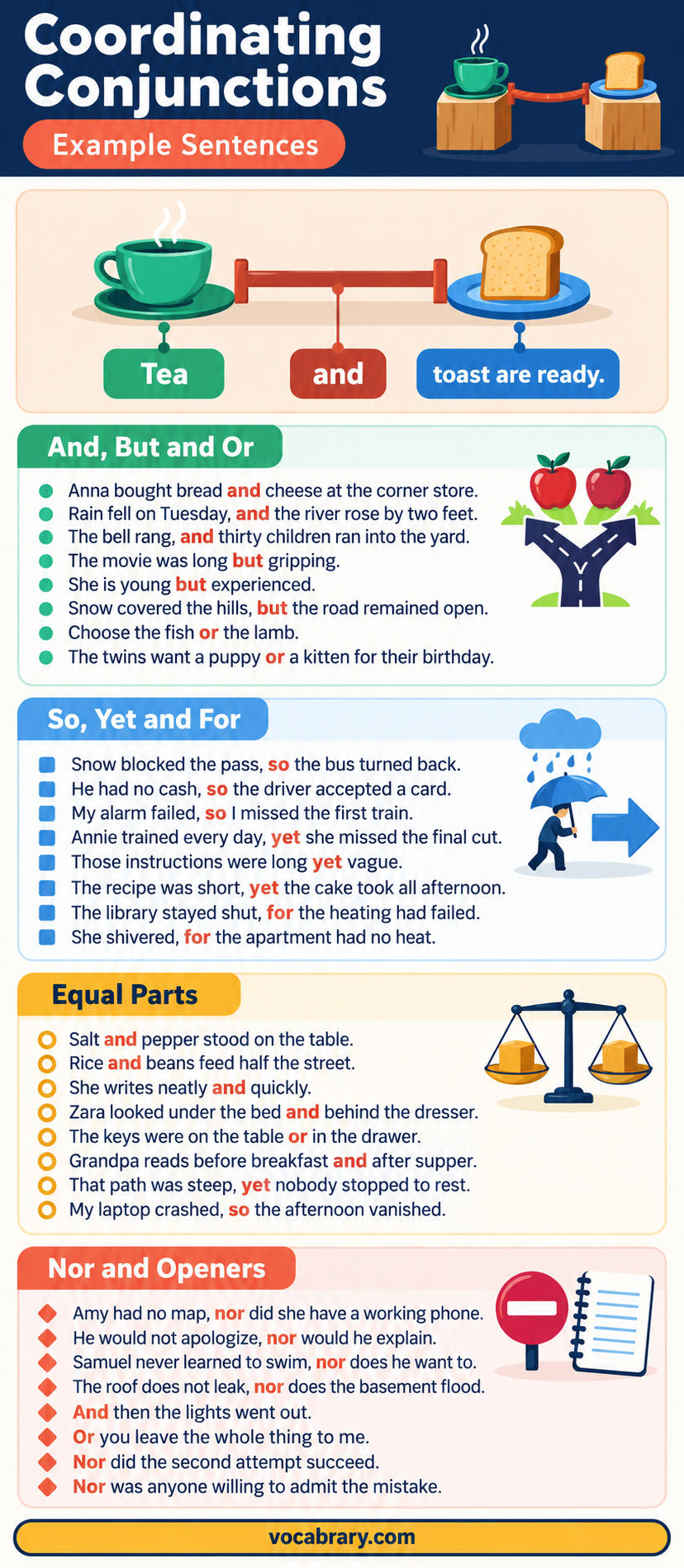
Common Coordinating Conjunction Examples in Sentences
Packed books, a closed bakery, a flat battery, and a postponed match make up the everyday coordinating conjunction example sentences, where two halves of equal rank join as one.
- Ayesha packed her books and left for the library.
- The shop was open, but the bakery next door had closed.
- We ordered rice and grilled fish.
- Daniel was exhausted, so he went to bed before nine.
- Choose the blue folder or the green one.
- Nobody answered the door, nor did the lights come on.
- Marta studied all weekend, yet the exam still surprised her.
- The road was closed, for a tree had fallen across it.
- Bring your passport and a printed ticket.
- Lucas wanted the job, but the interview went badly.
- Tea or coffee arrives with every breakfast here.
- Rain fell all morning, so the match was postponed.
- She spoke quietly yet firmly.
- The car would not start, for the battery was flat.
- Kofi does not eat meat, nor does he drink milk.
- Put the milk in the fridge and the bread in the bin.
- Jasmine loves winter, but her sister prefers summer.
- Our flight was delayed, so we ate dinner at the airport.
- Write in pen or in pencil.
- Admission to the museum was free, yet hardly anyone visited.
- Hassan called twice and sent a message.
- Muna’s soup was cold, but nobody complained.
- Take the bus or walk along the river.
- Rosa apologised twice, for she had completely forgotten about the Monday morning planning meeting.
The Seven FANBOYS Coordinating Conjunctions in One Place
For, and, nor, but, or, yet, and so are the seven words English uses to join equals, and their first letters spell FANBOYS. Each one names a different relation between the two halves it joins.
| Conjunction | Job it does | Example sentence |
|---|---|---|
| For | Gives the reason for the first clause | Nadia carried an umbrella, for the sky had turned grey. |
| And | Adds a second part of the same rank | Amara bought bread and cheese. |
| Nor | Adds a second negative | Kofi does not eat meat, nor does he drink milk. |
| But | Sets one half against the other | Hugo wanted the window seat, but his sister had taken it. |
| Or | Offers a choice or a consequence | Take the bus, or you will arrive late. |
| Yet | Marks a surprising contrast | Anita trained every day, yet she missed the final cut. |
| So | Names the outcome of the first clause | The lift was broken, so we climbed the stairs. |
Coordinating Conjunction Sentences With And
Bread and cheese, a nurse who checked a pulse and wrote a number, and thirty children running into a yard show and adding a second part of the same rank.
- Amara bought bread and cheese at the corner shop.
- The nurse checked his pulse and wrote the number on a chart.
- Fatima swims every morning and cycles home afterwards.
- Put on your coat and gloves before you go outside.
- My cousin plays the violin and the cello.
- Rain fell on Tuesday, and the river rose by half a metre.
- Lucas washed the dishes, and his brother dried them.
- We visited the castle and the harbour in one afternoon.
- Ivan opened his laptop, and forty new messages appeared.
- Bring a torch and a spare battery to the camp.
- The bell rang, and thirty children ran into the yard.
- Salt and pepper are on the middle shelf.
- Nadia trained for six months on the coast road, and she finished the city marathon in under four hours.
- Sort the socks and fold the towels.
Coordinating Conjunction Sentences With But
A taken window seat, six unanswered job applications, and a cancelled concert show but setting one half of a sentence against the other.
- Hugo wanted the window seat, but his sister had taken it.
- The film was long but gripping.
- Priya applied for six jobs, but nobody replied.
- Our team played well, but the other side scored twice in the last ten minutes of the match.
- Coffee wakes me up, but it ruins my sleep.
- She is young but experienced.
- The recipe asked for saffron, but the shop had none.
- Tariq speaks Arabic but not Turkish.
- I knocked three times, but the flat stayed silent.
- Snow covered the hills, but the road remained open.
- Marina booked the tickets early, but the concert was cancelled a week later.
- His suitcase looked small but heavy.
- Dad promised to call, but his phone battery died.
- Eli finished the exam, but he skipped the final question.
Coordinating Conjunction Sentences With Or
A choice between fish and lamb, a warning about a missed ferry, and two ways to pay show or offering an alternative or a consequence.
- Choose the fish or the lamb.
- We travel by train or by coach.
- Answer now, or the offer expires at midnight.
- Hurry, or you will miss the ferry.
- Yusuf reads on the balcony or in the kitchen.
- Pay online or at the counter.
- The twins want a puppy or a kitten for their birthday.
- Leave a note or send a text.
- Rita will fly on Thursday or drive down on Friday.
- Turn left at the church, or you will end up on the motorway towards Bergen.
- Milk or juice comes with the children’s meal.
- Sign the form yourself or ask your guardian to sign it for you.
Coordinating Conjunction Sentences With So
A broken lift, a forgotten umbrella, and a snowed-in mountain pass show so naming the outcome that the first clause produced.
- The lift was broken, so we climbed six flights of stairs.
- Mira forgot her umbrella, so she arrived at the office soaked.
- Snow blocked the pass, so the bus turned back.
- He had no cash, so the driver accepted a card.
- Our dog barks at strangers, so we warn every visitor before opening the gate.
- Our class finished early, so the teacher handed out a puzzle.
- Pedro sprained his ankle, so the coach replaced him at half time.
- Nothing was left in the fridge, so Layla ordered noodles.
- Signal kept dropping, so I rewrote the report on paper.
- My alarm failed, so I missed the first train.
- Rents rose sharply last year, so three families on our street moved to the outskirts of the city.
- Thunder rolled over the valley, so the campers packed up quickly.
Coordinating Conjunction Sentences With Yet
A runner who trained daily and missed the cut, roses flowering in December, and a thirty-year-old machine beating a new one show yet marking a surprising contrast.
- Anita trained every day, yet she missed the final cut.
- Those instructions were long yet vague.
- Gabriel apologised twice, yet his friend refused to answer the phone.
- Winter arrived in October, yet the roses kept flowering until December.
- Her manner was soft yet commanding.
- We booked the earliest flight, yet we still reached the wedding after the ceremony had ended.
- The machine is thirty years old, yet it prints faster than the new one.
- Sami earns little, yet he saves a third of every payslip.
- Rain hammered the tent, yet the children slept through it.
- Old yet reliable, the ferry crosses the strait four times a day.
- Farida read the contract closely, yet she overlooked the penalty clause.
- That road looked flat yet climbed steadily for eight kilometres.
Coordinating Conjunction Sentences With For
A grey sky, a crying baby, and a captain who crossed the Atlantic eleven times show for giving the reason behind the first clause, much as because does.
- Nadia carried an umbrella, for the sky had turned grey.
- We left the party early, for the baby had started crying.
- The library stayed shut, for the heating had failed.
- Ravi refused the second helping, for he had already eaten at his aunt’s house.
- Everyone spoke softly, for the baby was asleep in the next room.
- She shivered, for the flat had no heating.
- Sailors on the coast respected the old captain, for he had crossed the Atlantic eleven times in a single winter.
- I locked the gate twice, for the neighbours had reported a break-in.
- Our grandmother rarely leaves the village now, for the long journey tires her.
- Farmers watched the sky all week, for the harvest depended on three dry days.
Coordinating Conjunction Sentences With Nor
A parcel that never arrived, a seller who never answered, and a lake that never froze show nor adding a second negative, with the verb moving in front of the noun that follows.
- Kofi does not eat meat, nor does he drink milk.
- The parcel never arrived, nor did the seller answer my emails.
- Amina had no map, nor did she have a working phone.
- He would not apologise, nor would he explain.
- The old radio does not switch on, nor does the alarm clock beside it.
- We had no tickets, nor did we have the patience to queue for two hours in the rain.
- Rosa never complained about the noise, nor did her husband.
- Our landlord did not repair the boiler, nor did he reply to the letter.
- Snow did not fall that winter, nor did the lake freeze.
- Sanjay never learned to swim, nor does he want to.
Coordinating Conjunctions Joining Words, Phrases, and Clauses
Salt and pepper, under the bed and behind the wardrobe, and two full clauses about washing dishes show the three sizes a coordinating conjunction joins.
Two Words Joined by a Coordinating Conjunction
Salt and pepper, yes or no, and a small yet powerful engine join single words, and no comma comes between them.
- Salt and pepper stood on the table.
- Hot or cold drinks arrive with the meal.
- Tired but happy, the runners collected their medals at the end of the long coastal race.
- Ahmed plays guitar and drums.
- The answer is yes or no.
- Rice and beans feed half the street.
- Slowly but surely, the queue moved forward.
- A small yet powerful engine drives the ferry.
- Buy apples or pears for the pie.
- She writes neatly and quickly.
- Old but sturdy, the bridge still bears lorries.
- Coffee, tea, or juice comes with every breakfast served in the hotel dining room.
Two Phrases Joined by a Coordinating Conjunction
Under the bed and behind the wardrobe, before breakfast and after supper, and on the windowsill or under the radiator join matching phrases without a comma.
- Zara looked under the bed and behind the wardrobe.
- Walk to the corner or along the canal path.
- The keys were on the table or in the drawer.
- Yusuf works in the mornings and on Saturday afternoons.
- Running in the rain but never in the snow keeps Ines fit through the winter months.
- Park behind the bakery or across from the pharmacy.
- Grandad reads before breakfast and after supper.
- We searched through the attic and down in the cellar.
- Painting the fence but not the gate took two full days.
- Leave the parcel with the porter or at the reception desk beside the main entrance.
- Travelling by night and sleeping by day suited the crew.
- The cat sleeps on the windowsill or under the radiator.
Two Independent Clauses Joined With a Comma
A locked office and a self-starting alarm, a steep path nobody rested on, and a frosted pitch that ended a game join complete clauses, each taking a comma before the conjunction.
- Hannah locked the office, and the alarm switched itself on.
- The train was late, but the connection waited at the junction.
- Book the table now, or the restaurant will be full by seven.
- Diego skipped lunch, for the meeting had overrun by an hour.
- That path was steep, yet nobody stopped to rest.
- Frost covered the pitch, so the referee called the game off.
- Maya did not phone, nor did she send a message.
- We packed the tent, and the children carried the cooking pots.
- My laptop crashed, so the afternoon vanished.
- Farid revised for three weeks, yet the grades disappointed him.
- Our queue stretched round the corner, but the doors opened on time.
- Rain washed the streets, and the air smelled of wet stone for the rest of the evening.
- Anya turned off the lamp, for the neighbours had complained about the light.
- Take the coast road, or you will spend an hour in traffic near the docks.
Coordinating Conjunction Examples in Daily Life
Kettles, corridors, invoices, and jammed printers supply the coordinating conjunction example sentences learners meet most, from the kitchen to the payroll office.
At Home
A boiled kettle, a scratched sofa, and neighbours drilling at nine are the household moments where and, but, and so join two halves of one statement.
- Mum boiled the kettle, and Dad set out the cups.
- The washing machine finished, but nobody emptied it.
- Sweep the hallway or mop the kitchen floor.
- Our cat scratched the sofa, so we bought a scratching mat.
- Nadia cooked dinner, for her flatmate had worked a double shift.
- The freezer hummed all night, yet the ice cream still melted.
- Grandma does not use the oven, nor does she trust the microwave.
- Ali painted the bedroom and varnished the floorboards.
- Bills arrived on Monday, and the rent was due on Friday.
- We wanted a quiet evening at home, but the neighbours upstairs started drilling at nine o’clock.
At School
A ringing bell, forgotten homework, and a science lab with no sink give the classroom versions, where the conjunction links two equal statements.
- The bell rang, and the corridor filled with noise.
- Leila forgot her homework, so the teacher gave her until Friday.
- Revise the verbs or practise the spellings tonight.
- Our science lab has no sink, nor does it have a fume cupboard.
- Tom sat at the back, yet he heard every word of the lecture.
- Pens and rulers are kept in the top drawer.
- The head teacher announced the trip, but half the class had already booked family holidays abroad.
- Sofia answered every question, for she had read the chapter twice.
- Hand in the essay and keep a copy for yourself.
- Break lasted ten minutes, so nobody had time to finish a sandwich.
At Work
A paid invoice, a jammed printer, and a server that went down at noon are the office cases, where so and but connect a cause with its consequence.
- Karim sent the invoice, and the client paid within a day.
- The printer jammed again, so Rania used the one downstairs.
- Finish the slides or ask Marco to take over.
- Our manager praised the draft, yet she asked for another version.
- Nobody booked the meeting room, nor did anyone order the coffee.
- Sales dropped in March, but the summer figures recovered everything.
- Ivan stayed until eight, for the audit started the next morning.
- Sign the contract and return one copy by courier.
- The server went down at noon, so two hundred orders waited in a queue until the evening.
- Yasmin runs the payroll and the training schedule.
Shopping and Food Sentences With Coordinating Conjunctions
Sold-out croissants, November strawberries, and lentils soaked overnight show coordinating conjunctions at the market stall and the kitchen counter.
- Bread and olives filled the basket.
- The bakery had run out of croissants, so we bought pastries instead.
- Pay by card or in cash at the far till.
- Dina wanted strawberries, but the market sold only apples in November.
- Our trolley was full, yet we had forgotten the milk.
- The restaurant does not serve pork, nor does it cook with alcohol.
- Mehmet ordered lamb, for the fish had sold out an hour earlier.
- Rinse the lentils and soak them overnight.
- Prices rose again last month, and shoppers across the country switched to the cheaper supermarket brands.
- Chop the onions finely or grate them into the pan.
Travel, Weather, and Sports Sentences With Coordinating Conjunctions
Delayed flights, fog over an airfield, and a chipped goal show the same seven words at work on the road, under the weather, and on the pitch.
Travel
A late flight that landed on time, a passport lost in Lisbon, and a ferry that stops running in January gather the travel cases, where and, but, and so join two equal clauses.
- Our flight boarded late, but it landed on schedule.
- Buy the ticket online or at the station kiosk.
- Hana lost her passport in Lisbon, so the embassy issued an emergency document.
- The ferry does not run in January, nor does the coastal bus.
- We drove through the mountains, and the road climbed for forty kilometres.
- Dmitri packed light, for the airline charged for every extra bag.
- The hostel looked shabby, yet the beds were spotless.
- Rain delayed the crossing, so passengers waited in the terminal.
- Take the night train or fly in the morning.
- Aisha had visited Cairo twice before, and she knew every alley near the old spice market.
Weather
Thunder over a valley, fog on an airfield, and hail on a greenhouse pair one weather event with whatever followed it.
- Thunder rolled across the valley, and the lights flickered twice.
- Fog covered the airfield, so every morning flight was cancelled.
- The sun blazed all week, yet the reservoir stayed half empty.
- Snow fell overnight, but the main road was passable by seven.
- Take a coat or borrow an umbrella from the rack.
- Hail battered the greenhouse, for the storm had swung inland.
- Winds did not drop, nor did the rain ease before dusk.
- Rain soaked the washing and ruined the picnic.
Sports
A chipped goal, a runner who led three laps and finished fourth, and a pitch hardened by frost bring coordinating conjunctions onto the field.
- Our goalkeeper dived early, but the striker chipped the ball over him.
- Maria led for three laps, yet she finished fourth.
- The referee blew the whistle, so both teams left the pitch.
- Train on Tuesday or join the Saturday session.
- Kenji does not play rugby, nor does he watch it.
- Jonas scored twice, and the crowd chanted his name.
- Frost had hardened the pitch, for the temperature had dropped under minus five.
- Warm up properly and stretch afterwards.
Coordinating Conjunctions in Short Stories
A lighthouse keeper, a fishing boat flashing three times, and frozen salt spray run one short narrative where every sentence turns on a coordinating conjunction.
- The old lighthouse keeper climbed the stairs, for the lamp had gone dark an hour before.
- Wind tore at his coat, but he reached the top.
- He wound the mechanism twice, and the beam swept out across the water.
- A fishing boat answered with three short flashes, so the keeper knew the crew had seen him.
- Nobody came up the path that night, nor did the radio crackle once.
- Salt spray froze on the glass, yet the light kept turning.
- Dawn arrived grey and slow.
- The keeper made tea and wrote the hour in his logbook.
- His hands shook from the cold, so the letters leaned to one side.
- Boats returned to the harbour, and the village woke to the smell of diesel.
Sentences That Open With a Coordinating Conjunction
And then the lights went out, But the door was already locked, and Nor was anyone willing to admit the mistake all begin with a conjunction. The opening reads naturally whenever the sentence before it supplies the missing half.
- And then the lights went out.
- But nobody had warned us about the roadworks.
- So we cancelled the trip.
- Or you leave the whole thing to me.
- Yet she never once complained about the long hours.
- And that was the last anyone heard of the parcel.
- But the door was already locked from the inside.
- Nor did the second attempt succeed.
- So the committee voted again on Thursday morning.
- Yet the bridge held through the whole flood.
- Nor was anyone willing to admit the mistake.
- For he had promised his mother that he would return home before dark on Sunday.
Comma Placement in Coordinating Conjunction Sentences
Nina studying two languages, Hugo and his commute, and a thin peppery soup each appear twice, once joining words or phrases without a comma and once joining two clauses with one.
- Nina studied French and Italian at university.
- Nina studied French, and her brother studied Italian.
- Hugo wanted the job but not the commute.
- Hugo wanted the job, but the commute put him off.
- Take the bus or the tram into town.
- Take the bus, or you will arrive after the doors close.
- Amara sings and plays the oud.
- Amara sings, and her cousin plays the oud at every family wedding in the mountain village.
- The soup was thin yet peppery.
- The soup was thin, yet every bowl came back empty.
- Ravi cycles to work and back again.
- Ravi cycles to work, and his colleague drives.
Run-On Sentences Rewritten With a Coordinating Conjunction
A missed bus, a flooded road, and a failed heating system arrive first as run-on sentences, then repaired with so, and, or nor.
- ❌ Mia missed the bus she walked to school. ✅ Mia missed the bus, so she walked to school.
- ❌ The shop was open the bakery had closed. ✅ The shop was open, but the bakery had closed.
- ❌ Hurry up you will miss the ferry. ✅ Hurry up, or you will miss the ferry.
- ❌ Ravi stayed inside the wind was too strong. ✅ Ravi stayed inside, for the wind was too strong.
- ❌ She apologised he refused to answer. ✅ She apologised, yet he refused to answer.
- ❌ Leila packed the tent Sam carried the poles. ✅ Leila packed the tent, and Sam carried the poles.
- ❌ The heating failed the hot water stopped too. ✅ The heating failed, and the hot water stopped too.
- ❌ Dan did not call he did not write. ✅ Dan did not call, nor did he write.
- ❌ The road flooded the school closed for two days. ✅ The road flooded, so the school closed for two days.
- ❌ Anna trained hard she missed the podium. ✅ Anna trained hard, yet she missed the podium.
Coordinating Conjunction Examples for Kids
Cats and dogs, a broken kite cord, and a plaster after a fall keep the vocabulary within reach of primary readers.
- Ben likes cats and dogs.
- The kite flew high, but the cord snapped.
- Eat your carrots or try the peas.
- Lily fell over, so Mum put on a plaster.
- The puppy barked at the postman, and the kitten hid under the bed.
- Sam does not like peas, nor does he like beans.
- Grandad told a story, for the rain would not stop.
- My bike is old yet fast.
- Wash your hands and come to the table.
- Zoe wanted ice cream, but the van had gone.
- Pick a red crayon or a blue one.
- Snow fell all night, so school closed in the morning.
Short Coordinating Conjunction Sentences for Young Learners
Tom and Ana at play, a sunny afternoon, and rain that never stopped a game make four-word to seven-word sentences for a first year of conjunction work.
- Tom and Ana play outside.
- I am tired, so I will sleep.
- Cats or dogs make good pets.
- She is small but strong.
- We ran fast and won.
- Dad cooks, and Mum bakes.
- The sun is out, so we swim.
- Milk or juice is fine.
- Rain fell, yet we played on.
Coordinating Conjunction Examples for Students
A hypothesis that failed a second trial, a late essay, and a moved deadline give the academic cases, where yet and but mark a reversal in an argument.
- The hypothesis looked sound, yet the second trial produced different figures.
- Cite the source or paraphrase the passage in your own words.
- Maria submitted the essay late, so the tutor deducted five marks.
- Our seminar starts at nine, and the reading goes out on Monday.
- He did not attend the lecture, nor did he read the handout.
- Revise the formulas and practise past papers.
- The deadline moved to Friday, but the word count stayed the same.
- Jomo chose history, for the archive work suited him.
- Draft the introduction first or write the method while the experiment is fresh in your memory.
- Exam grades arrived by email, and the whole cohort celebrated in the square.
A Paragraph Built on Coordinating Conjunctions
Amina at the market before six and Mr Oduya counting children on a school trip run two connected paragraphs where a coordinating conjunction links each pair of clauses.
Amina reached the market before six, for the ripest tomatoes disappear by seven. She filled one basket with peppers and onions. The fishmonger had already sold his mackerel, so she chose sardines instead. Rain started as she paid, but her umbrella was in the car. She waited under the awning, and the stallholder poured her a glass of tea. Nobody else stayed behind, nor did the rain last long. Amina walked home along the wet street, yet her shopping stayed dry.
Mr Oduya counted the children twice, for two of them had wandered towards the fountain. The coach arrived ten minutes late, but the driver made up the time on the ring road. Half the class slept, and the rest sang the same song for an hour. Nobody had brought a spare jacket, nor had anyone checked the forecast. Clouds gathered over the hills, so the teachers moved the picnic indoors. The museum café was crowded and noisy. Every child left with a postcard, yet the loudest cheer came for the bus ride home.
Related
- Parts of Speech Example Sentences
- Subordinating Conjunction Example Sentences
- Correlative Conjunction Example Sentences
FAQs
One example is "Alice packed her books and left for the library." Another is "Daniel was exhausted, so he went to bed before nine."
To add a part, one example is "Oliver mowed the lawn and trimmed the hedge." Another is "The bell rang, and thirty children ran into the yard."
For a reason, one example is "We left the party early, for the baby had started crying." With a result, one example is "Snow blocked the pass, so the bus turned back."
An example with but is "Hugo wanted the window seat, but his sister had taken it." Another, with yet, is "Annie trained every day, yet she missed the final cut."
For a second negative, one example is "The package never arrived, nor did the seller answer my emails." Another is "Snow did not fall that winter, nor did the lake freeze."
A choice between two options is made in "Choose the fish or the lamb." Another is "Pay online or at the counter."
For young children, one example is "Ben likes cats and dogs." Another is "The kite flew high, but the cord snapped."
In school, one example is "Cite the source or paraphrase the passage in your own words." Another is "The hypothesis looked sound, yet the second trial produced different figures."
A travel example is "Take the night train or fly in the morning." Another is "Rain delayed the crossing, so passengers waited in the terminal."
One example of an opener is "And then the lights went out." Another is "Nor did the second attempt succeed."
Related: