
A compound noun is a noun made of two or more words that together name one thing, as in toothbrush, bus stop or mother-in-law. Most compound noun example sentences use plain household words, where the two parts name a single object instead of two separate ones.
What Is a Compound Noun?
A compound noun joins two or more whole words into one name, written as one word (notebook), as two words (bus stop), or with a hyphen (mother-in-law). A portmanteau blends parts of two words into a new one, such as brunch, while a compound noun keeps both words whole.
Noun + noun, adjective + noun, verb + noun, or preposition + noun
Jonas left his toothbrush beside the swimming pool.
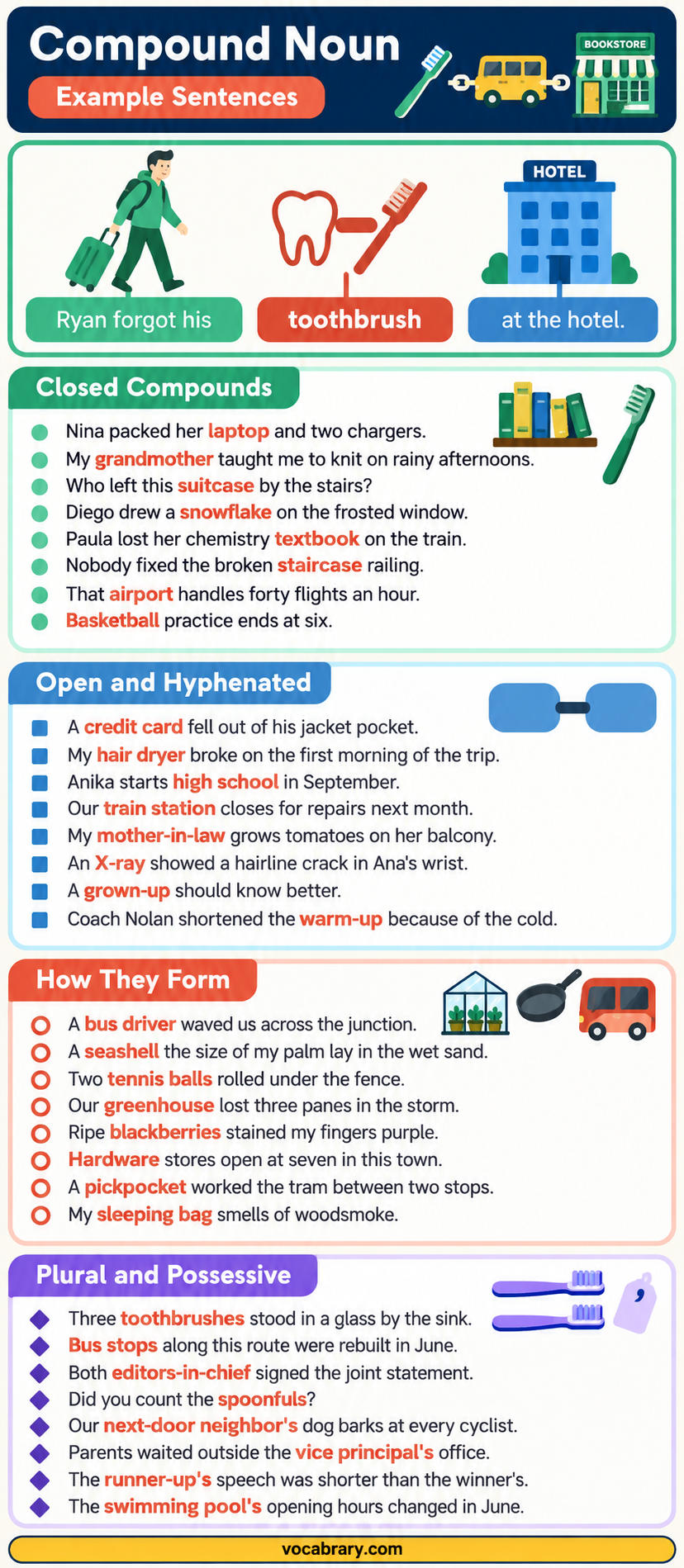
Common Compound Noun Example Sentences
A forgotten toothbrush, a bus stop outside the building and a washing machine that stops mid-cycle are the everyday cases, where two plain words name one object that a learner already knows.
- Ravi forgot his toothbrush at the hotel.
- Our bus stop was moved two streets east last week.
- Grandma keeps her old letters in a shoebox under the bed.
- A firefighter brought the cat down the ladder while the crowd clapped.
- My notebook disappeared somewhere between the maths class and the library.
- Sofia swims in the swimming pool before breakfast every morning.
- Did you lock the front door?
- Our washing machine stopped mid-cycle again.
- Nobody answered the doorbell.
- Marco bought a second-hand bookshelf for his new flat.
- The living room smells of fresh paint.
- A thunderstorm woke the whole street at four in the morning.
- Leo paid twice as much for that haircut as he expected.
- Two police officers knocked at the neighbour’s door before dawn.
- Hana finished her homework at the kitchen table.
- My alarm clock rang ten minutes late.
- I never trust a weather forecast in March.
- His wheelchair fits through the narrow hallway without scraping the paint.
- A rainbow appeared over the football ground after the hail stopped.
- The toothpaste tube was empty by Friday.
- Emma packed her raincoat and left without saying goodbye.
- Has the postman been yet?
- Every classroom on this floor got new blinds in July.
- Amara’s birthday party started an hour late.
- That traffic light at the corner stays red for ages.
- Nobody at the table touched the ice cream.
- Sami left his sunglasses on the roof of the car.
Compound Noun Examples by Spelling
Toothbrush, bus stop and mother-in-law show the three spellings English gives a compound noun: one solid word, two separate words, and a hyphenated form that keeps the parts joined.
| Compound noun | How it is written | Example sentence |
|---|---|---|
| Toothbrush | One word | Ravi packed a spare toothbrush for the school trip. |
| Notebook | One word | Elena filled a whole notebook during the history lesson. |
| Firefighter | One word | A firefighter climbed through the kitchen window. |
| Bus stop | Two words | We waited at the bus stop until the rain eased. |
| Swimming pool | Two words | The swimming pool closes for cleaning every Monday. |
| Washing machine | Two words | Dad repaired the washing machine himself. |
| Ice cream | Two words | Mira bought vanilla ice cream for her cousins. |
| Mother-in-law | Hyphenated | My mother-in-law grows tomatoes on her balcony. |
| Check-in | Hyphenated | Check-in opened two hours before the flight. |
| Merry-go-round | Hyphenated | The twins rode the merry-go-round four times. |
| T-shirt | Hyphenated | Karim wore a plain white T-shirt to practice. |
| Editor-in-chief | Hyphenated | The editor-in-chief approved the cover at midnight. |
Closed Compound Nouns Written as One Word
Laptop, playground, earthquake and sunflower have fused so completely that the join no longer shows, and English now treats each one as a single dictionary word.
- Nina packed her laptop and two chargers.
- A sunflower grew taller than the garden fence.
- My grandmother taught me to knit on rainy afternoons.
- The keyboard stopped working halfway through the exam.
- Children ran across the playground the moment the bell rang.
- Kofi reads the newspaper over breakfast every Sunday morning while the rest of us sleep.
- Who left this suitcase by the stairs?
- An earthquake shook the coastal towns just after midnight.
- Our weekend plans collapsed when the rain started.
- Diego drew a snowflake on the frosted window.
- The waterfall freezes solid by January.
- A lighthouse blinked twice every thirty seconds.
- Priya lost her chemistry textbook on the train.
- My wristwatch lost four minutes overnight.
- Mr Duarte wiped the blackboard before the next lesson began.
- Nobody fixed the broken staircase railing.
- Dad refilled the cupboard with tinned soup and rice.
- That airport handles forty flights an hour.
- A scarecrow wore Uncle Bo’s old coat all summer.
- Basketball practice ends at six.
Open Compound Nouns Written as Two Words
A bus stop, a swimming pool and a credit card keep their two words apart, yet each pair names one thing and takes a single determiner.
- We waited at the bus stop for twenty minutes in the drizzle before anyone told us the route had changed.
- Rosa booked the swimming pool for her daughter’s party.
- A credit card fell out of his jacket pocket.
- Ice cream melted down Tom’s wrist before he reached the bench.
- Their living room has two windows facing the harbour.
- Set the alarm clock for half past five.
- My hair dryer broke on the first morning of the trip.
- Peanut butter and banana was Yusuf’s favourite school lunch.
- Fasten your seat belt before the taxi moves.
- The fire engine blocked half the lane.
- Anika starts high school in September.
- Who spilled orange juice on the sofa?
- Freshly painted, the coffee table wobbled on the uneven floor.
- A parking lot behind the cinema charges four euros an hour.
- Bella left her running shoes in the hall.
- Real estate prices dropped for the third quarter in a row.
- Our train station closes for repairs next month.
- A police officer directed traffic around the flooded crossing.
- The nurse checked my grandfather’s blood pressure twice that afternoon.
- Science fiction takes up two shelves in Omar’s bedroom.
Hyphenated Compound Noun Examples
Family words such as mother-in-law and brother-in-law, the airport check-in, and a fairground merry-go-round keep their hyphens, which mark the parts as one name rather than three loose words.
- My mother-in-law grows tomatoes on her balcony.
- Check-in opened two hours before the flight.
- The twins rode the merry-go-round four times without stopping.
- Karim wore a plain white T-shirt to football practice.
- An X-ray showed a hairline crack in Ana’s wrist.
- Our runner-up thanked the judges and left quickly.
- Well-being lessons start after the winter break.
- Jonas met his brother-in-law at the ferry terminal.
- A grown-up should know better.
- Every passer-by stopped to watch the fire crew force the shutters open on the corner shop.
- Mother-of-pearl buttons decorated my aunt’s old jacket.
- My great-grandfather sailed from Cork as a young man.
- The get-together ended before ten.
- A forget-me-not grew between two paving slabs.
- Coach Ndlovu shortened the warm-up because of the cold.
- Self-control deserted me in front of the chocolate cake.
- A drive-in cinema reopened outside town last spring.
Compound Nouns Formed From Two Word Classes
Bus driver, greenhouse, pickpocket, sunrise and downpour come from five different recipes, since English builds compound nouns by welding a noun, an adjective, a verb or a preposition onto a second word.
Noun Plus Noun Compound Nouns
Bus driver, tablecloth and apple tree pair two nouns, and the first noun narrows the second one down to a type, a place or a purpose.
- A bus driver waved us across the junction.
- Marta dropped her handbag in the taxi.
- The tablecloth still shows last year’s coffee stain.
- A seashell the size of my palm lay in the wet sand.
- Toothache kept Rafael awake until three in the morning.
- Nobody swept the fireplace after Christmas.
- Every apple tree in the orchard flowered early this year.
- Ivan ordered chicken soup and a bread roll.
- Two tennis balls rolled under the fence.
- A milkman still delivers to our street on Tuesdays.
- Grandpa built the birdhouse from scrap timber.
- Did you find my hairbrush?
- The motorway stayed closed until the tanker was moved.
- Sunglasses cost more at the airport than anywhere else in the city.
- Lena bought a teapot with a chipped lid at the flea market for two euros.
Adjective Plus Noun Compound Nouns
A greenhouse, a blackbird and a whiteboard begin with an adjective, though the adjective no longer describes the second word freely and the pair names one fixed thing.
- Our greenhouse lost three panes in the storm.
- A blackbird nests in the hedge every April.
- Ms Okoro projected the diagram onto the whiteboard.
- Software updates slowed the old machine to a crawl.
- Ripe blackberries stained my fingers purple.
- The highway narrows to one lane after the bridge.
- Mia sketched a blueprint for her treehouse.
- Nobody warned us about the quicksand near the estuary.
- Dad still writes shorthand he learned at his first job.
- A darkroom at the back of the studio still smells of the chemicals my father used.
- Hardware shops open at seven in this town.
- Grandma called Grandpa her sweetheart for sixty years.
- Every grandparent in the hall stood up for the anthem.
- Wholemeal bread sells out by nine.
Verb Plus Noun Compound Nouns
A pickpocket, a watchdog and a diving board start with a verb or an -ing form, which names what the second word does or what it is used for.
- A pickpocket worked the tram between two stops.
- The watchdog barked at every passing cyclist.
- Nadia forgot her driving licence at home.
- Chewing gum stuck to the underside of the desk.
- Boys queued at the diving board all afternoon.
- My sleeping bag smells of woodsmoke.
- A searchlight swept the harbour wall.
- Drinking water ran out on the second day of the hike, so we boiled melted snow.
- Patients waited in the waiting room for over an hour.
- Hugo scrubbed the frying pan twice.
- Playground repairs finished ahead of schedule.
- Did you pack the chopping board?
Noun Plus Verb Compound Nouns
Sunrise, rainfall and handshake put the verb second, so the noun names what acts and the verb names the action itself.
- Sunrise over the lake turned the water copper.
- A firm handshake ended the interview.
- Rainfall in October doubled last year’s total.
- Mira photographed the sunset from the pier.
- Snowfall closed both mountain passes.
- Aiden had a nosebleed during the maths test.
- Nightfall caught the walkers two miles from the hostel with one torch between them.
- My haircut turned out shorter than I asked for.
- Daybreak found the fishermen already at sea.
- Sunburn ruined the last day of the holiday.
Preposition-Based Compound Nouns
Downpour, underpass, income and outskirts hang a preposition on a verb or a noun, and the preposition gives the direction, the timing or the position.
- A downpour soaked the queue outside the theatre.
- Bystanders filmed the whole argument.
- Her income barely stretches past the rent.
- An outbreak of flu emptied half the office.
- Rafael wore his father’s heavy overcoat to the funeral.
- The underpass floods after heavy rain.
- Onlookers gathered near the bridge.
- Emilia never talks about her upbringing.
- Background noise ruined the recording.
- An afterthought made him turn back for the umbrella.
- Farmers on the outskirts grow melons and tomatoes.
- Our outlook for the harvest improved after Sunday’s rain soaked the fields for six hours.
Compound Noun Examples at Home and in the Kitchen
Doormats, light bulbs, dishwashers and saucepans crowd an ordinary house, so the rooms a learner knows best supply more compound nouns than any lesson on formation.
Compound Nouns Around the House
A doormat outside the flat, a garage door that jams and wallpaper stripped in two days name parts of a home that no single word describes.
- A doormat with the word Welcome lies outside every flat on this floor.
- My bedroom window faces the courtyard.
- Dad screwed a new light bulb into the hall lamp.
- Housework takes our whole Saturday morning.
- Nobody dusts the windowsill behind the curtain.
- An armchair by the fire came with the house.
- The hallway smells of wet coats.
- Hana watered the houseplants before leaving for Lisbon.
- Our garage door jams in cold weather.
- Bedtime for the twins is half past seven.
- A bedside table wobbles whenever I reach for my glasses.
- Who unplugged the vacuum cleaner?
- The back garden floods every winter.
- Painters stripped the old wallpaper in two days.
- Sami fixed the doorknob with a borrowed screwdriver.
Compound Nouns in the Kitchen
Saucepans over the stove, a blocked kitchen sink and a missing bottle opener are kitchen compound nouns, each one naming a tool or a fitting by the job it does.
- A dishwasher hums behind the counter.
- Saucepans hang over the stove.
- Grandma keeps her cookbook collection on the bottom shelf.
- The kitchen sink blocked again on Sunday.
- Nobody remembered the bottle opener.
- Teaspoons disappear in this house.
- Two oven gloves hang beside the pantry door.
- Yasmin warmed the soup in the microwave oven.
- A rolling pin rolled off the counter and cracked a floor tile in the corner.
- My corkscrew snapped in the middle of the cork.
- Four tablespoons of sugar went into the batter.
- Did anyone refill the saltshaker?
Compound Noun Examples at School and at Work
Schoolbags, timetables, deadlines and night shifts show the same two-word naming at a desk and in an office, where the compound noun names a routine rather than an object.
Compound Nouns in the Classroom
A forgotten schoolbag, a timetable that changes every term and a field trip to the salt marshes are school compound nouns that pupils meet from the first week.
- Homework piled up during exam week.
- Every classmate signed the leaving card.
- Our head teacher cancelled the trip to the coast.
- A pencil case burst open on the stairs.
- Ines forgot her schoolbag on the bus.
- Textbooks arrived three weeks late.
- The timetable changes every term.
- Nobody sat at the back of the science lab.
- Break time lasts fifteen minutes.
- A field trip to the salt marshes is planned for the last week of June.
- Miss Alvarez collected the report cards on Friday afternoon.
- Schoolyard games get louder after lunch.
- Did you finish the spelling test?
- The grammar lesson ran past the bell.
Compound Nouns in the Office
Deadlines that move forward, an unbooked conference room and a nervous job interview turn workplace talk into compound nouns that name events as well as objects.
- Our deadline moved forward by two days.
- Coworkers booked a leaving lunch for Dana.
- My business card still shows the old address.
- Overtime paid for their holiday in Crete.
- Nobody booked the conference room.
- A job interview on Monday made Leila nervous for the whole of the previous weekend.
- Paychecks arrive on the last Friday of the month.
- The night shift starts at ten.
- Priyanka left her briefcase in the lobby.
- Teamwork saved the project after two failed attempts.
- A salesperson phoned four times before lunch.
- Did the staff meeting end early?
- Workplace rules changed after the inspection.
Compound Noun Examples in Travel and Transport
Boarding passes, rush hour, a sleeper train and a ferry terminal belong to journeys, where a compound noun names the ticket, the vehicle or the hour with two words at once.
- Passports and boarding passes went into one envelope.
- A backpack split open on the baggage carousel.
- Rush hour turned a ten-minute drive into an hour.
- My boarding pass would not scan at the gate.
- Traffic jams stretch for miles on Friday evening.
- Ahmed booked a sleeper train from Cairo to Aswan.
- The ferry terminal smells of diesel.
- Nobody warned us about the speed limit on that road.
- A roundabout near the airport confuses every visitor.
- Life jackets are under each seat.
- Our road trip ended in a garage outside Toulouse.
- Did you keep the bus ticket?
- Windshield wipers failed halfway through the storm.
- Tomas left his travel adapter in the hotel socket.
- A zebra crossing outside the school was repainted last week after months of complaints.
Compound Noun Examples in Technology
Passwords that expire, a frozen video call and a dead smartphone battery give learners compound nouns they use in English before they use them in grammar.
- Passwords expire every ninety days at the bank, and nobody remembers the new one.
- My smartphone battery died before lunch.
- A website crashed under the ticket rush.
- Headphones stayed in Kai’s pocket all morning.
- The touchscreen stopped responding in the cold.
- Nobody backed up the hard drive.
- Screenshots proved what the seller had promised.
- A search engine answered the question in seconds.
- Our video call froze twice.
- Voicemail from the clinic explained the delay.
- Did you save the spreadsheet?
- Yara charges her smartwatch overnight.
Compound Noun Examples in Sport
Goalkeepers, scoreboards, free throws and warm-up drills fill match reports, and each one names a role, a fitting or a moment of play in two joined words.
- The goalkeeper dived left and pushed the ball wide with the last touch of the match.
- Football boots dried by the radiator.
- Our tennis court floods every spring.
- A scoreboard showed nine minutes left.
- Halftime came with the score level.
- Nobody defeated Dinesh at table tennis.
- Teammates helped the injured striker off the pitch.
- A free throw decided the whole game.
- Ice hockey draws huge crowds in Helsinki.
- My brother trains on the running track at dawn.
- Basketball courts filled up straight after school.
- Did you watch the high jump final?
- Warm-up drills lasted twenty minutes.
Compound Noun Examples in Food and Drink
Popcorn, milkshakes, olive oil and tea bags name what people eat and drink, and every one of them joins two words that stay separate elsewhere.
- Popcorn went everywhere during the film.
- A milkshake costs four pounds at that cafe.
- French fries arrived cold and unsalted.
- My aunt bakes gingerbread every December.
- Olive oil from Puglia tastes of cut grass.
- Nobody finished the apple pie.
- Pancakes with lemon are a Tuesday tradition here.
- A coffee shop opened where the bakery used to be.
- Watermelon juice stained the white tablecloth.
- Two tea bags in one cup is far too strong for anyone in this family.
- Grapefruit for breakfast wakes Dad up faster than coffee.
- Did you order the cheeseburger?
- Soft drinks were free at the party.
Compound Noun Examples in Nature and Weather
Snowstorms, hailstones, riverbanks and treetops name weather and ground that a one-word noun leaves vague, which is why nature writing uses so many of them.
- Moonlight reached the far wall of the cave.
- A snowstorm closed the pass for three days.
- Wildlife returned to the marsh after the dredging stopped.
- My cousin photographs treetops from a drone.
- Hailstones dented the roof of Dad’s car.
- Nobody swam after the jellyfish warning.
- Sunlight reached the kitchen through a broken shutter.
- A heat wave kept the class indoors for a fortnight and ruined the sports day.
- Raindrops gathered along the washing line.
- The riverbank collapsed under the old willow.
- Seashore birds scattered when the dog ran past.
- Did you hear that thunderclap?
- Windmills turn slowly on the ridge behind the village.
Plural Forms of Compound Nouns in Sentences
Toothbrushes, mothers-in-law, passers-by and attorneys general show where the -s goes, since the plural lands on the word that names the thing rather than on the end of the whole compound.
- Three toothbrushes stood in a glass by the sink.
- Both mothers-in-law arrived on the same train.
- Two passers-by pulled the driver out of the canal.
- Runners-up received a silver medal and a certificate each.
- Our two sons-in-law cooked the entire Sunday dinner between them.
- Bus stops along this route were rebuilt in June.
- Swimming pools across the city close for most of August while the filters are replaced.
- Four T-shirts dried on the balcony rail.
- Check-ins at the new desk take under a minute.
- Both editors-in-chief signed the joint statement.
- Village fairs had two merry-go-rounds and a coconut shy.
- Attorneys general from six states joined the case.
- Three courts-martial followed the inquiry.
- Grown-ups talked politics while the children played outside.
- Did you count the spoonfuls?
- Toothpicks littered the table after the meal.
- Police officers blocked both ends of the street.
- Washing machines were on sale at half price.
Possessive Forms of Compound Nouns in Sentences
A mother-in-law’s greenhouse, the editor-in-chief’s email and a goalkeeper’s gloves take the apostrophe at the very end of the compound, even when the plural moves elsewhere.
- My mother-in-law’s greenhouse survived the autumn gale.
- Sanjay ignored the editor-in-chief’s email until morning.
- Our next-door neighbour’s dog barks at every cyclist.
- A goalkeeper’s gloves cost more than his boots.
- Parents waited outside the head teacher’s office.
- My grandmother’s cookbook has notes in three languages.
- Both sisters-in-law’s children share a bedroom at the cottage every summer without a single argument.
- That bus driver’s route changes on Sundays.
- A firefighter’s helmet weighs more than it looks.
- The runner-up’s speech was shorter than the winner’s.
- Elena drove her brother-in-law’s van as far as Galway.
- The swimming pool’s opening hours changed in June.
- Our classmates’ parents booked the coach.
- One police officer’s notebook was full by Tuesday.
Compound Nouns and Word Pairs With the Same Spelling
Greenhouse against green house, blackbird against black bird, and darkroom against dark room turn on stress, since the compound noun takes its main stress on the first word.
- A greenhouse keeps seedlings warm through winter, while a green house is one somebody painted green.
- Blackbirds whistle before dawn, though a black bird in the field is any bird with dark feathers.
- Photographers develop film in a darkroom, while a dark room is one with the curtains shut.
- Tourists queue outside the White House, but a white house on our street sold last week.
- Toddlers eat in a highchair, while a high chair at the counter suits nobody under six feet.
- Removal firms send a moving van, while a moving van in traffic is any van under way.
- Campers unroll a sleeping bag, while a sleeping bag of cement is nonsense.
- Builders nailed a blackboard to the classroom wall, though the black board leaning in the yard was only a painted timber off-cut.
- A bluebird nests in the orchard, while a blue bird in a cartoon is drawn that colour.
- Chefs cook on a hotplate, while a hot plate from the oven burns your fingers.
Compound Nouns in Short Paragraphs
A missed school bus, a lost boarding pass and a thunderstorm that knocks out the streetlights put four or five compound nouns into every running sentence, the way ordinary speech uses them.
My alarm clock rang twice before I found my schoolbag under the bedroom window. Mum had already packed a lunchbox, a water bottle and two tea bags for the staff room. I missed the school bus and ran the whole way to the bus stop on the corner. A traffic light held me outside the fire station for a full minute. By the break time bell, my homework was still in the notebook at home. The head teacher wrote my name on the whiteboard and asked about the field trip form.
Our road trip began at the ferry terminal two hours before sunrise. Dad checked every seat belt twice and argued with the sat nav about the motorway exit. My sister lost her boarding pass somewhere between the car park and the check-in desk. A rainstorm hit the coast, so the windscreen wipers worked for the whole journey. We ate French fries at a service station and slept in a guest house near the railway station. By nightfall the suitcase wheels had given up on the cobblestones.
The doorbell rang while the washing machine was still on its last cycle. My grandmother brought a cheesecake and a jar of peanut butter for the children. Dad switched off the television and moved the armchair nearer the fireplace. A thunderstorm knocked out the streetlights along the whole road. We found a torch in the cupboard under the staircase and lit two candlesticks. By bedtime the power cut had ended and the dishwasher had finished on its own.
Related
FAQs
An everyday example is "Ryan forgot his toothbrush at the hotel." Another is "Our washing machine stopped mid-cycle again."
One closed example is "An earthquake shook the coastal towns just after midnight." Another is "Diego drew a snowflake on the frosted window."
With two words, one example is "Rosa booked the swimming pool for her daughter’s party." Another is "Fasten your seat belt before the taxi moves."
A hyphenated example is "Jonas met his brother-in-law at the ferry terminal." Another is "Check-in opened two hours before the flight."
Around the house, one example is "Dad screwed a new light bulb into the hall lamp." Another is "Painters stripped the old wallpaper in two days."
A classroom example is "Irene forgot her schoolbag on the bus." Another is "Did you finish the spelling test?"
One travel example is "Rush hour turned a ten-minute drive into an hour." Another is "My boarding pass would not scan at the gate."
A food example is "Olive oil from Puglia tastes of cut grass." Another is "My aunt bakes gingerbread every December."
Among plurals, one example is "Both mothers-in-law arrived on the same train." Another is "Two passers-by pulled the driver out of the canal."
One possessive example is "That bus driver’s route changes on Sundays." Another is "A goalkeeper’s gloves cost more than his boots."
Related: