
A stative verb is a verb that describes a state of its subject, such as a thought, a feeling, or a possession, instead of an action, as in she knows the answer. A state has no stages that unfold, so know excludes the progressive form that an action verb accepts, as in she is running. That restriction is why stative verb example sentences stay in the present or past tense, with verbs such as know, love, and own each joined to an object or complement.
What Is a Stative Verb?
A stative verb names a state that lasts over time, such as knowing, loving, owning, or costing. It differs from a dynamic verb, which names an action or event that starts, continues, and stops.
Subject + stative verb in the present or past tense + object or complement
Nadia knows the answer, and she owns the book.
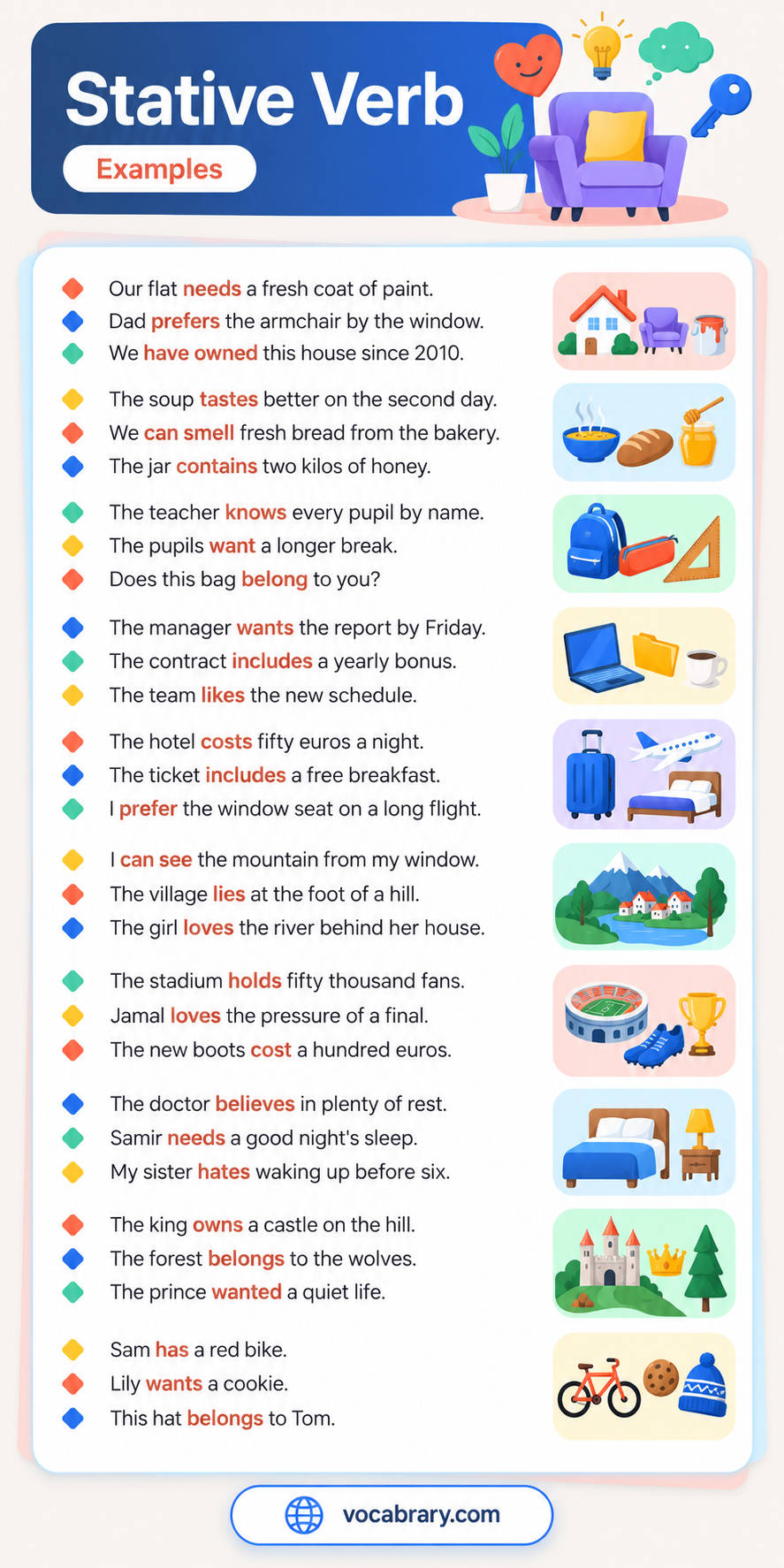
Common Stative Verb Example Sentences
A student who knows an answer, a film fan who loves old films, and a ticket that costs twenty pounds show states and not events. The verb in every sentence reports a condition that stays the same while the sentence is true.
- Nadia knows the answer to every question about the Nile.
- I believe your story about the missing key.
- Mateo loves old black-and-white films from the nineteen fifties.
- My sister hates waking up before six.
- The ticket for the evening concert costs twenty pounds.
- That house belongs to a retired judge.
- Our flat needs a fresh coat of paint.
- Priya prefers green tea to coffee in the morning.
- The jar contains two kilos of honey.
- Kofi owns three bicycles and a motorbike.
- She wants a quiet weekend by the sea.
- This suitcase weighs twenty kilos when it is full.
- I understand your problem, and I want to help you fix it.
- The soup tastes better on the second day.
- The children seem happy with their new teacher.
- He remembers every name on the team.
- This word means happiness in Portuguese.
- Hassan likes spicy food, especially with rice and lime.
- The price includes breakfast and parking.
- Nuria resembles her grandmother around the eyes and mouth.
- I doubt the train will arrive on time.
- Our team needs one more goal.
- The kitchen smells of garlic and fresh basil tonight.
- Amir lacks experience in sales, but he learns quickly.
- The lake exists only in the rainy season.
Sentences for Each Stative Verb Group by Meaning
Stative verbs form groups by meaning: thought, feeling, possession, appearance, measure, and the senses. Know, love, own, seem, cost, and see are one case from each group.
| Category | Typical verbs | Example sentence |
|---|---|---|
| Thought and knowledge | Know, believe, understand, remember | Tomas knows the way. |
| Feeling and preference | Love, like, hate, want, prefer | Lena loves the sea. |
| Possession and containment | Own, belong, have, contain | Omar owns a bakery. |
| Appearance and being | Seem, appear, resemble, exist | The plan seems sensible. |
| Measure and cost | Cost, weigh, measure, last | The ticket costs ten euros. |
| Senses | See, hear, smell, taste, feel | I can see the harbour. |
Thought and Knowledge Sentences With Know and Believe
Know, believe, understand, remember, and doubt report what a person thinks or knows. A teacher who knows the rules, a child who believes in dragons, and a tourist who remembers a name show the same pattern.
- Ms Ibrahim knows the rules of the game.
- Little Sam believes in dragons and tells everyone about them.
- I understand the instructions now that you have explained them.
- Karim remembers his first day at the factory.
- The tourist remembers the name of the hotel.
- Elena doubts the story is true.
- We suppose the shop is closed on Sundays.
- Ayesha recognises the song from her childhood.
- The students realise the test is difficult.
- Nobody agrees with the new plan.
- Mum trusts the old doctor who treated us as children.
- I imagine the weather is cold in Oslo.
- Jonas knew the answer before the teacher finished the question.
- Rosa recalls a long summer in Seville.
Feeling and Preference Sentences With Love and Hate
Love, like, hate, want, need, and prefer report a feeling or a wish that lasts. A grandfather who loves gardening, a boy who hates broccoli, and a manager who prefers email name a settled attitude.
- Grandpa loves gardening on Sunday mornings.
- Little Ben hates broccoli and hides it under his plate.
- The manager prefers email to phone calls.
- Zara wants a bicycle for her birthday.
- We need a taxi to the airport.
- Mina likes the new neighbour who lives upstairs.
- My cousin dislikes crowded trains during the morning rush hour.
- Ravi adores his younger sister and carries her backpack.
- Chidi fears the dark basement under his grandmother’s house.
- Everyone wishes the team good luck.
- Sofia appreciates the help from her classmates.
- I enjoy quiet evenings by the river.
- Hana envies her brother’s talent for music.
- The mayor wants a new park in the east of the city.
Possession Sentences With Own and Belong
Own, belong, possess, have, and contain name who owns something or what a container contains. A farmer who owns a field, a bag that belongs to a student, and a jar that contains honey fit this group.
- The farmer owns a field beside the river.
- This bag belongs to a student in class five.
- The museum possesses a rare Roman coin.
- Ravi has an old camera in his bag.
- The wooden box contains old photographs of our village.
- The package includes a charger and a case.
- The company owes its workers three months of pay.
- The report consists of ten short chapters.
- She has a headache this morning.
- That library holds over a million books.
- My neighbours own a cottage in Wales.
- The soup contains no salt, so the doctor approves it.
- The ring belonged to my great-grandmother.
- Our school has two science labs.
Seem and Appear in Sentences About Appearance
Seem, appear, resemble, exist, and be describe how a person or thing looks or what it is. A tired-looking child, a sensible plan, and a girl who resembles her mother show appearance and likeness.
- The child seems tired after the long drive.
- The plan appears sensible to the committee.
- Lucia resembles her mother in every photograph.
- Unicorns exist only in stories and old paintings.
- The old man looks older than his age.
- The soup appears thick and creamy.
- Your idea sounds wonderful, so let us try it.
- The twins resemble each other closely.
- That path seems longer than the main road.
- Wolves exist in the mountains of Poland.
- The garden is full of roses.
- Everyone in the room seemed nervous.
- The village lies at the foot of a hill.
- This old coin appears genuine to the museum expert.
Measure and Cost Sentences With Cost and Weigh
Cost, weigh, measure, last, and equal state a number that stays true over time. A ticket that costs ten euros, a parcel that weighs two kilos, and a pool that measures twenty-five metres fit this group.
- The new phone costs four hundred dollars.
- The parcel from my aunt weighs two kilos.
- The table measures two metres across.
- The film lasts two hours, including the interval.
- Two plus two equals four, as every child learns.
- The new bridge costs forty million pounds.
- My suitcase weighs more than yours.
- The school pool measures twenty-five metres from end to end.
- The weekly meeting lasts forty minutes in the main office.
- This coat costs half as much as the one in the window.
- The bill for the group dinner totals eighty dollars.
- The tower is a hundred metres tall.
Sense Verb Sentences With Can See and Can Hear
See, hear, smell, taste, and feel name a state of perception when they are used with can. I can see the mountain reports what the eyes receive, and I am seeing a doctor uses see as an action with the meaning of visiting.
- I can see the mountain from my window.
- Priya can hear music from the next flat.
- We can smell fresh bread from the bakery.
- Diego can taste lemon in the cake.
- Hana can feel the cold through her gloves.
- Nobody could see the stage from the back row.
- Can you hear that noise upstairs?
- Tomas can see the island on a clear day.
- I can smell smoke in the corridor.
- Mina could hear her neighbour practise the violin.
- The patient can feel a slight tingle in his fingers.
- Can you taste the ginger in this soup?
Present Tense Sentences Instead of the Continuous
A stative verb in a state meaning takes the present tense, as in I know and she owns, and not the present continuous. Adverbs such as always, really, and still stay before the verb and do not change the tense.
- I really know the answer this time.
- Dalia still loves her old school.
- My brother always prefers the window seat.
- The shop never has milk after six.
- Ingrid fully understands the problem with the old engine.
- This room smells of paint because the walls are new.
- They truly believe the story about the hidden treasure.
- Wei already owns two copies of the book.
- Our dog hates thunder and hides under the bed.
- That watch costs more than a car.
- The children want a story before bed.
- Samir needs a good night’s sleep.
Past and Present Perfect Sentences With Stative Verbs
A state in the past takes the past tense, and a state that continues to the present takes the present perfect with for or since. I have known her for ten years is correct, and I have been knowing her is not.
- I knew the answer yesterday, but today I forgot it.
- She believed him at first, but later she checked.
- Zoe has known Priya for ten years.
- We have owned this house since 2010.
- My grandfather loved old trains and collected tickets all his life.
- Tariq has wanted a drone since December.
- They had lived in Seoul before they moved to Madrid.
- The factory belonged to a family from Leeds.
- I have understood the lesson since the teacher drew the diagram.
- Mei has hated spiders since childhood.
- The ticket cost less last year.
- Hassan has remembered that story for fifty years.
Sentences for Stative Verbs With Dynamic Meanings
Think, have, see, taste, weigh, and be have both a stative and a dynamic meaning, and the continuous tense fits only the dynamic meaning. I think she is right is a state of opinion, while I am thinking about my holiday is an action in progress.
Think and Expect in Opinion and Activity Sentences
Think, consider, expect, and imagine are stative when they express an opinion or a belief and dynamic when they name an activity or an event. A student who thinks a test was hard and a student who is thinking about a plan show both meanings.
- I think the test was difficult.
- I am thinking about my next holiday.
- Karim considers the offer fair and wants to accept it.
- The board is considering three proposals this week.
- Lena thinks Paris is the best city for art.
- Lena is thinking of moving to Lisbon.
- Most people in the village expect rain tomorrow afternoon.
- Priya is expecting a baby in May.
- Ravi imagines the sea is warm today.
- Dalia is imagining a house on a hill.
Sentences With Have and See
Have is stative when it means own and dynamic when it means eat, hold, or experience. See is stative when it means understand and dynamic when it means meet.
- Tomas has a new motorbike with a bright red tank.
- Tomas is having lunch with his parents.
- I see your point, and I agree with most of it.
- I am seeing the dentist on Friday.
- We have two cats and a rabbit.
- We are having a great time in Rome.
- She has a bad cold, so she stayed at home.
- She is having a bath, so please call back later.
- They have a garden behind the house.
- They are having a party on Saturday.
- Mum sees the problem clearly after reading the long report.
- Mum is seeing a doctor about her knee.
Taste and Smell in Quality and Action Sentences
Taste, smell, feel, and look are stative when they describe a quality and dynamic when someone performs the action. A cook who tastes the soup and a soup that tastes salty show both uses.
- The soup tastes salty because I added too much stock.
- The chef is tasting the soup.
- The roses by the fence smell sweet in the evening.
- Dad is smelling the milk to check it.
- The new fabric feels soft against the skin.
- The nurse is feeling the patient’s wrist.
- She looks tired after the long night shift.
- She is looking at the map.
- The cake in the oven smells of cinnamon and orange.
- Omar is smelling each spice before he buys it.
Weigh and Measure in Sentences
Weigh and measure are stative when they give a quantity and dynamic when a person checks it. Appear is stative when it means seem and dynamic when it means perform.
- The cardboard box weighs five kilos with the books inside.
- The clerk is weighing the box.
- The room measures four metres by five.
- Dan is measuring the table with a long tape.
- The young actor appears nervous before the opening night.
- The singer is appearing at the arena tonight.
- The backpack weighs nearly eight kilos.
- Mrs Ali is weighing the flour for the cake.
- The garden measures ten metres across.
- The tailor is measuring the customer.
Be as a State and as Behaviour in Sentences
Be is stative when it describes what someone is and dynamic in the continuous when it describes how someone is behaving for a short time. A neighbour who is silly and one who is being silly differ in time span.
- Sofia is polite to everyone she meets at work.
- Sofia is being polite today because her manager is visiting.
- Our neighbour is silly and tells jokes all day.
- Our neighbour is being silly with the new puppy.
- He is careless by nature and often loses his keys.
- He is being careless with the money.
- You are rude to interrupt people when they speak.
- You are being rude to the waiter.
- The boy is quiet by nature and rarely speaks in class.
- The boy is being quiet because he is shy today.
Informal Sentences With Loving and Liking
In informal English, a speaker uses a stative verb in the continuous to stress a feeling that is changing or temporary. The slogan I’m loving it, a child liking a school more each week, and a traveller missing home are the best-known cases.
- I’m loving the weather here in Lisbon.
- Mina is really liking her new school.
- We’re loving the new house and its sunny garden.
- I’m hating this traffic more with every passing minute.
- Tom is missing his family on his first trip abroad.
- I’m hoping to see you next week.
- Ines is wondering whether the shop is open.
- I’m understanding more of the lectures each week.
- They’re loving the festival in Seville.
- He is hating every minute of the long meeting.
Negative Sentences With Stative Verbs
A negative sentence with most stative verbs uses do not, does not, or did not with the base form. A traveller who does not know the road, a student who does not understand a rule, and a family that does not own a car show the pattern.
- I don’t know the road to the station.
- She doesn’t like olives, but she eats the bread.
- They don’t own a car because they live in the city.
- I don’t believe him, because his story keeps changing.
- It doesn’t cost much to join the club.
- Karim doesn’t understand the rule about silent letters.
- We don’t need a taxi because the station is close.
- Nobody remembers the old teacher’s name.
- The jar doesn’t contain any sugar.
- The bag doesn’t belong to me.
- My brother didn’t want the last biscuit.
- Elena doesn’t like either of the two films.
- I don’t mind the noise from the street at night.
- The soup doesn’t taste salty enough, so add a little more.
Question Sentences With Know and Belong
Most questions with a stative verb begin with do, does, or did and keep the base form. Examples are do you know the answer and what does this word mean. A question with who as the subject needs no helping verb.
- Do you know the answer to the last question?
- Does this bag belong to you?
- What does this word mean in the second line?
- How much does the ticket cost?
- Which colour do you prefer for the bedroom walls?
- Do you remember my name from the conference last year?
- Who owns this car parked outside the bakery?
- Does the soup taste salty to you, or is it fine?
- Do they have a car, or do they use buses?
- Can you hear the music from the party next door?
- Why do you hate Mondays more than every other day?
- Did she understand the question in the written exam?
- Does your brother like football or does he prefer tennis?
- Who wants a second slice of cake?
Stative Verbs in Reported Speech and Passive Sentences
In reported speech a stative verb moves one tense back after a past reporting verb unless the fact is still true, and in the passive it takes a form of be plus the past participle. She said she needed rest, he told us he owned a farm, and a house owned by a judge show both patterns.
- She said that she needed some rest.
- He told us that he owned a farm.
- Omar said he didn’t understand the question.
- The manager said the tickets cost forty pounds.
- The house is owned by a retired judge.
- The painting is known as The Blue Door.
- The suspect is believed to be abroad.
- Mrs Haddad is loved by all her students.
- The prize is desired by every competitor.
- The guide told us the castle belonged to a duke.
Stative Verb Sentences With Adverbs and Objects
Many stative verbs take an object or a complement, and an adverb of degree or frequency stands before the verb. Really, completely, and always are adverbs that stand before understand, prefer, and want in these sentences.
- I completely understand your concern about the late delivery.
- She really prefers the blue one.
- Tomas always wants the last word.
- They never doubt their coach, even after a defeat.
- Wei still remembers the old address.
- My uncle owns a small farm and three horses.
- We still need the tickets for the show.
- The twins both love swimming and cycling.
- She seems happy with the result.
- The plan sounds sensible to the whole team.
Sentences About Home With Love and Belong
A grandmother who loves her garden, a kettle that costs little, and a house that belongs to a family show states in the home. Each one reports a lasting fact.
- My grandmother loves her garden and waters it daily.
- The kettle costs very little at the corner shop.
- This house belongs to my aunt.
- Our kitchen smells of coffee every Sunday morning.
- Dad prefers the armchair by the window.
- The old sofa needs new cushions before the guests arrive.
- The cupboard under the stairs contains old tools and paint.
- My brother hates washing dishes after a big family dinner.
- The cat belongs to our neighbour.
- We own two small rugs from Morocco.
School Sentences With Know and Understand
A teacher who knows the answer, a pupil who understands a rule, and a library that contains thousands of books show states in a school, each reporting knowledge, preference, or ownership.
- The teacher knows every pupil by name.
- Zainab understands the grammar rule after one short lesson.
- The library contains thousands of books.
- Miguel needs a new pencil case.
- Our class prefers the afternoon timetable.
- The pupils want a longer break.
- The head teacher believes in strict uniforms.
- Anna remembers the whole poem from her first year at school.
- The new textbook costs twenty pounds at the school shop.
- The school owns a small telescope.
Stative Verbs in Work Sentences With Want and Own
A manager who wants a report, a company that owns a warehouse, and a contract that includes a bonus show states in a job, each reporting a need, a fact, or an arrangement.
- The manager wants the report by Friday.
- The company owns a warehouse in Rotterdam.
- The contract includes a yearly bonus.
- Our client prefers a morning meeting.
- The new software costs a lot.
- Ingrid knows the whole system better than anyone else.
- The office needs more chairs for the new staff.
- The accountant believes the figures are correct.
- This job requires two years of experience.
- The team likes the new schedule.
Travel Sentences With Cost and Overlook
A hotel that costs little, a room that overlooks the sea, and a tour leader who knows the city show states on a trip, each reporting a price, a view, or a piece of knowledge.
- The hotel costs fifty euros a night.
- Our room on the third floor overlooks the sea.
- The tour leader knows the old city very well.
- This train has a restaurant car.
- The ticket includes a free breakfast.
- Tourists love the sunset at the harbour.
- The museum belongs to the city council.
- My suitcase weighs too much for the airline’s limit.
- The direct flight to Cairo lasts four hours.
- I prefer the window seat on a long flight.
Believe and Contain in News Report Sentences
A government that believes in reform, a report that contains new figures, and a factory that employs thousands show states in news, each stating a fact or an opinion.
- The government believes in gradual reform.
- The report contains new figures on housing.
- The factory employs two thousand workers.
- Residents fear another flood after the heavy rain.
- The mayor wants a new bridge.
- The bank owns most of the land.
- Experts doubt the figures are correct.
- The scandal involves several senior officials.
- Prices depend on the weather during the harvest season.
- The new law covers all small businesses.
Own and Love in Story Sentences
A king who owns a castle, a girl who loves a river, and a forest that belongs to wolves show states in a story, each setting a scene, a character, or a feeling.
- The king owns a castle on the hill.
- The girl loves the river behind her house.
- The stranger at the gate seems kind but tired.
- Nobody believed the old woman’s tale.
- The forest belongs to the wolves.
- Elias feared the dark tunnel behind the old mill.
- The map included a village that no longer existed.
- The prince wanted a quiet life.
- The little cottage smelled of woodsmoke and baked apples.
- She knew the secret all along.
Sports Sentences With Believe and Need
A coach who believes in discipline, a team that needs a goal, and a trophy that weighs five kilos show states in sport, each reporting a view, a need, or a fact.
- The coach believes in strict discipline.
- Our squad needs a win to stay in the league.
- The silver trophy weighs five kilos and needs two hands.
- The captain knows every player’s strength.
- Jamal loves the pressure of a final.
- The stadium holds fifty thousand fans.
- The new boots cost a hundred euros.
- The referee seems tired by the end.
- The club owns its own training ground.
- Aisha prefers swimming to running in the summer months.
Sentences About Health With Need and Taste
A doctor who believes in rest, a medicine that tastes bitter, and a patient who needs sleep show states about health, each reporting a condition, a need, or a quality.
- The doctor believes in plenty of rest.
- The cough medicine tastes bitter, so children dislike it.
- The patient needs more sleep before the doctor’s next visit.
- Rita has a sore throat and a slight fever.
- My knee hurts when I climb stairs.
- Grandpa hates taking tablets with his morning tea.
- The syrup contains honey and lemon.
- The nurse knows the patient’s history.
- The clinic costs less than the private hospital.
- I feel dizzy in the morning.
Stative Verb Example Sentences for Kids
Young learners meet stative verbs through everyday likes, wants, and facts such as liking pizza, having a bike, and knowing a song, each stating something about a child’s life.
- I like pizza.
- Sam has a red bike.
- My dog loves bones.
- Lily wants a cookie.
- We know the song.
- The box contains toys.
- This hat belongs to Tom.
- Mum needs a cup of tea.
- I see a bird.
- The cake tastes sweet.
- Ben hates peas.
- The ball costs two pounds.
Stative Verb Example Sentences for Students
Exam-level sentences place a stative verb in a longer clause, as in the author believes that education changes society and the novel consists of twelve short chapters. Writers who state a view, define a term, or describe a fact use these patterns.
- The author believes that education changes society.
- The word derives from a Latin root.
- The study involves more than two thousand participants.
- Scientists know that ice floats on water.
- The theory requires a large amount of data.
- The poem contains several images of the sea.
- Economists doubt that the policy will reduce prices.
- The novel consists of twelve short chapters.
- The data suggest a link between sleep and memory.
- The area of a circle equals pi times the radius squared.
- The treaty remains in force today.
- The committee owns the rights to the report.
Short Paragraphs With Stative Verbs
Running text about a house, a teacher, a market, a flat, and a hotel uses stative verbs to describe people and places without any event.
My grandmother lives in an old house by the river. She owns a garden full of roses and loves every plant. The house belongs to our family, and it contains many photographs. The kitchen smells of bread, and the whole place seems peaceful.
Our teacher knows every pupil by name. She believes that everyone needs encouragement. The classroom contains two hundred books, and she wants the children to read them. Everyone understands that she cares about the class.
The market smells of spice and fruit. A basket of mangoes costs three pounds, and a bag of rice weighs two kilos. The sellers know their customers, and the customers trust the sellers. Everything in the market seems fresh.
Kofi has a small flat in the city. It belongs to his uncle, and it costs him little. He likes the view and prefers the quiet evenings. The kitchen contains only a kettle and two cups, but he needs nothing more.
The hotel stands on a hill above the sea. Its rooms have balconies, and each balcony overlooks the harbour. Guests love the view. The price includes breakfast, and the staff know every visitor’s name.
Stative and Dynamic Verb Sentences Compared
A stative verb names a state, while a dynamic verb names an action or event, and the difference determines whether the continuous tense fits. Further action verb example sentences show the dynamic side.
| Feature | Stative verb | Dynamic verb |
|---|---|---|
| Meaning | A state that lasts. | An action or event with a start and an end. |
| Continuous tense | Not used in the state meaning. | Used to show an action in progress. |
| Question answered | What is the situation? | What is happening? |
| Example with one meaning | She owns a car. | She drives a car. |
| Example with a different verb | I know the answer. | I am running a race. |
FAQs
Q1. How do you identify a stative verb in a sentence?
You identify a stative verb by checking whether it names a state or an action in progress. Know, love, and own name states, so they take simple forms such as I know, while run and write name actions, so I am running uses the continuous form. A second check is whether the continuous form changes the meaning of the verb.
Q2. What is the difference between a stative verb and a dynamic verb?
A stative verb names a state that lasts, while a dynamic verb names an action or event with a start and an end. She owns a car reports a fact, and she drives a car reports an action. See action verb example sentences for the dynamic side.
Q3. Why are stative verbs not used in continuous tenses?
Stative verbs are not used in continuous tenses because continuous tenses show an action in progress, while a state continues unchanged. For this reason I know is correct and I am knowing is not. The rule has exceptions in informal English and in verbs with a second, dynamic meaning.
Q4. What are examples of stative verbs?
Common stative verbs include know, believe, understand, love, like, hate, want, need, prefer, own, belong, seem, appear, remember, mean, cost, and contain. Each one reports a thought, a feeling, a possession, an appearance, or a measure.
Q5. Is have a stative verb?
Have is stative when it means own or possess, as in Tomas has a new motorbike. It is dynamic when it means eat, take, or experience, as in Tomas is having lunch. The continuous tense fits only the dynamic meaning.
Q6. Is think a stative or a dynamic verb?
Think is stative when it expresses an opinion and dynamic when it names the act of thinking about something. I think the test was difficult is a state of opinion. I am thinking about my holiday is an action in progress.
Q7. Can you say I am loving it?
The phrase I’m loving it is an informal exception, because love is stative in standard grammar. Informal speech uses the continuous to show a feeling that is changing or temporary, as in I’m loving the weather here. Formal writing and exams use I love it.
Q8. Are sense verbs such as see and hear stative?
Sense verbs such as see, hear, smell, taste, and feel are stative when they report what a person perceives. They are used with can in that meaning, as in I can see the mountain. They are dynamic when a person performs the action, as in the chef is tasting the soup.
Q9. Is be a stative verb?
Be is stative in most sentences, because it reports what a person or thing is, as in Sofia is polite. It is dynamic in the continuous when it describes temporary behaviour, as in Sofia is being polite today. Further linking verb example sentences show the main pattern of be.
Q10. What is the difference between stative verbs and linking verbs?
Stative verbs are defined by their meaning, while linking verbs are defined by their pattern, so some verbs are both. Seem is stative and links the subject to a complement, as in the child seems tired. Know is stative but takes an object, as in she knows the answer.
Q11. Do stative verbs have a perfect tense?
Stative verbs form the present perfect, especially with for or since. I have known her for ten years is correct, and I have been knowing her is not. The same pattern applies to own, want, and love.
Q12. Do stative verbs have a passive voice?
Many stative verbs that take an object have a passive voice, as in the house is owned by a judge and the painting is known as The Blue Door. Stative verbs without an object, such as belong and exist, have no passive. Read more in transitive verb example sentences.

Leave a Comment