
An intransitive verb is a verb that completes its clause without a direct object, unlike a transitive verb such as kick, as in the baby slept. Because only a word that answers what or whom counts as an object, a phrase added afterwards leaves the verb intransitive: in the garden answers where, and quietly answers how. So in intransitive verb example sentences, arrive, sleep and laugh each pass that question and remain complete however many adverbs or phrases follow.
What Is an Intransitive Verb?
An intransitive verb is a verb that needs no object to complete its meaning, so no word answers the question what or whom after it. It differs from a transitive verb, which takes a direct object.
Subject + intransitive verb (+ adverb or prepositional phrase)
The train arrived at noon.
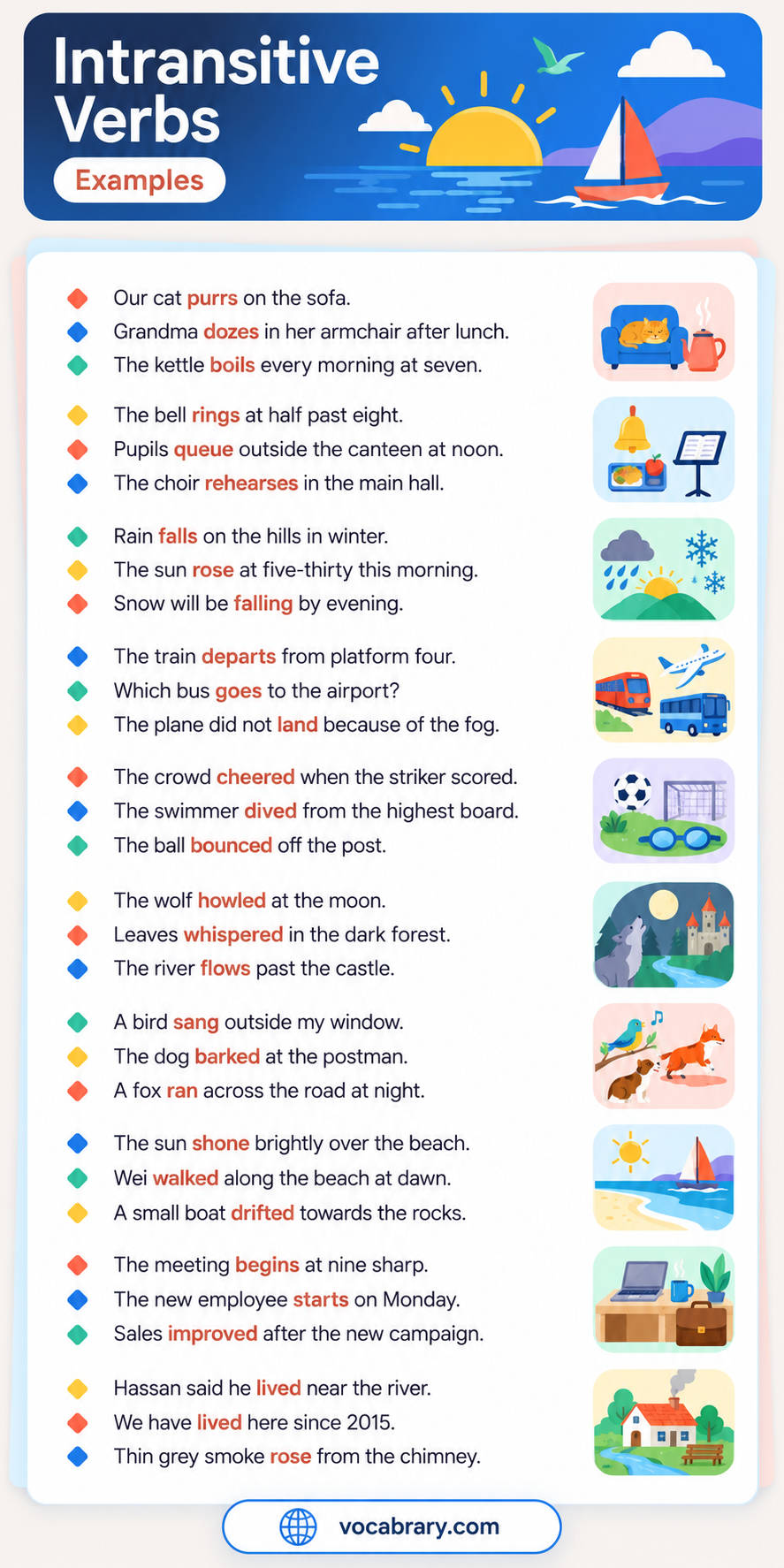
Common Intransitive Verb Example Sentences
A baby who sleeps, a guest who arrives, and a leaf that falls each complete a statement with the verb alone. None of the verbs in these sentences has a direct object.
- The baby slept through the whole thunderstorm.
- Our guests arrived at seven with flowers and a cake.
- Mateo laughed at his own joke.
- A single leaf fell onto the water.
- The accident happened near the old bridge.
- Dinosaurs existed millions of years ago.
- Zara went to the market with her grandmother.
- Visitors come to the village every summer.
- The river flows past the castle.
- Kofi smiled when he saw the results.
- The temperature dropped below zero overnight.
- A tall stranger appeared at the door.
- The children played in the garden until dark.
- Her voice trembled with excitement when she began to speak.
- The old clock stopped at midnight.
- Rain fell all afternoon on the empty playground.
- My cousin lives in Osaka with his wife and two sons.
- The audience applauded for a full minute.
- Ines waited outside the cinema for almost an hour.
- The candle flickered and went out.
- Prices rose sharply in March after the new tax began.
- Lucia sneezed twice during the speech.
- The plane landed safely in Dublin.
- Wei walked along the beach at dawn.
- A bird sang outside my window.
Intransitive Verb Sentence Patterns
An intransitive verb takes three common patterns: alone, followed by an adverb, or followed by a prepositional phrase. A baby who slept, a guest who arrived late, and a train that left at six show the three.
| Pattern | Structure | Example sentence |
|---|---|---|
| Verb alone | Subject + verb | The baby slept. |
| Verb and adverb | Subject + verb + adverb | The guest arrived late. |
| Verb and prepositional phrase | Subject + verb + preposition + noun | The train left at six. |
Verb Plus What or Whom Test Sentences
A verb is intransitive when the question what or whom after it produces no answer in the sentence. Arrived what, slept what, and laughed whom all fail, so arrive, sleep, and laugh are intransitive there.
- Mina arrived late. Arrived what? No answer, so arrive is intransitive.
- The baby slept all night. Slept what? No answer.
- Kofi laughed loudly. Laughed whom? No answer.
- The snow melted by noon. Melted what? No answer.
- Rosa sneezed twice. Sneezed what? No answer.
- The bus stopped outside the school. Stopped what? No answer.
- Leila swims every morning. Swims what? No answer.
- A storm developed over the sea. Developed what? No answer.
- The audience clapped for a minute. Clapped what? No answer.
- Dan coughed during the lecture. Coughed what? No answer.
- Rain fell on the tent. Fell what? No answer.
- The tourists waited in the rain. Waited what? No answer.
Happen, Exist and Occur Example Sentences
Happen, exist, occur, appear, and vanish describe that something is, begins, or ends. An accident near a bridge, a species that existed long ago, and a rainbow that appeared after a storm belong to this group.
- The accident happened at the corner of Elm Street.
- Wolves existed in this forest until the nineteenth century.
- A rainbow appeared over the harbour after the storm.
- The meeting occurred while the manager was abroad.
- The magician’s coin vanished in front of the whole class.
- A strange silence settled over the room.
- Several problems arose during the first week.
- A new idea emerged from the discussion.
- The old king died peacefully in 1990.
- Snow remains on the mountain until June.
- Nothing changed in the village after the last election.
- A faint glow showed on the horizon.
- The festival began with a parade of drummers.
- Dust gathered on the unused piano.
- Trouble started when the lights went out.
- Silence fell over the crowded hall.
Examples of Intransitive Verbs of Motion
Go, come, arrive, fall, rise, walk, run, and swim describe how a person or thing moves from one place to another. A bus that departs, a sun that rises, and a swimmer who swims across a lake each move without a direct object.
Go, Come and Arrive in Sentences
A student who goes to school, a cousin who comes from Lima, and a parcel that arrives on Friday all name a trip. The place is named after a preposition or an adverb, not as an object.
- Camila goes to school by bicycle.
- Her husband comes from Lima and speaks three languages.
- The parcel arrived on Friday afternoon.
- We went home early because of the rain.
- The delegates arrived in Geneva on Monday.
- Please come here for a moment.
- Hassan returned to Cairo after ten years abroad.
- The last bus departed at midnight.
Fall, Rise and Sink Sentences
A leaf that falls, a sun that rises, and a boat that sinks all move downward or upward without an object. The past tense forms are fell, rose, and sank.
- Snow fell on the village all night.
- The sun rose behind the hills at six.
- The old boat sank slowly into the lake.
- Prices rise every winter in the north.
- The curtain fell at the end of the second act.
- Thin grey smoke rose from the chimney.
- The kite dropped into the river.
- The balloon floated above the fields.
Sentences With Walk, Run and Swim
A walker on a beach, a runner in a park, a swimmer in a lake, and a cat on a tree describe movement by the body. Each verb is followed by a place phrase, not an object.
- Marta strolled along the river at dusk.
- The runners ran through the park in the rain.
- Leila swam across the lake in twenty minutes.
- The cat climbed up the tree and refused to come down.
- Tomas jogs around the stadium before breakfast.
- The children crawled under the fence.
- A fox ran across the road at night.
- Hana skated down the long hill.
Body Action Sentences With Sleep, Laugh and Cry
Sleep, laugh, cry, smile, sneeze, yawn, and faint name actions of the body that need no object. A baby who sleeps, a child who laughs, and a viewer who cries at a film show how the verb stands alone.
- The baby sleeps for twelve hours at night.
- The children laughed until their stomachs hurt.
- Nadia cried when the film ended.
- Ravi smiled at the photographer and waved to the crowd.
- Grandpa snores every night after dinner.
- Lucia yawned during the long lecture.
- The runner fainted near the finish line.
- Aisha blushed deeply when everyone applauded at the end.
- The patient breathed slowly and evenly.
- Tom shivered in the cold wind.
- The baby coughed twice and fell asleep.
- Dalia sighed and closed her notebook.
- The audience gasped at the final twist.
- My brother sweats badly in hot weather.
Sentences With an Adverb After the Verb
An adverb after an intransitive verb gives the manner, the time, or the place of the action. Slept soundly, arrived early, and sang beautifully show adverbs of manner and time.
- The baby slept soundly all night long.
- The postman arrived early on Monday morning.
- The choir sang beautifully at the wedding.
- Tomas spoke quietly during the exam.
- Dark clouds gathered rapidly over the hills.
- The students worked hard all term.
- She waited patiently for her turn.
- The bus left late again this morning.
- Rain fell heavily on the tin roof.
- Amir answered politely when the teacher called him.
- The kettle boiled quickly on the new gas stove.
- Everyone cheered loudly when the lights came on.
- The old dog walks slowly now.
- Mei laughed nervously before she walked on stage.
- The sun shone brightly over the beach.
- He works nearby, so he walks home for lunch.
- The flowers bloomed early this year.
- The engine ran smoothly after the repair.
Sentences With a Prepositional Phrase After the Verb
A prepositional phrase after an intransitive verb adds a place, a time, or a reason. In the garden, at noon, and because of the rain are three phrases that follow the verb without becoming objects.
- The neighbours chatted in the garden.
- The cleaners arrived at noon with their own equipment.
- The match stopped because of the rain.
- My uncle works at a hospital in Nairobi.
- The cat slept on the warm windowsill.
- Priya lives with her grandparents in a small village.
- The train ran through the tunnel.
- Hana stayed at home during the holidays.
- A small boat drifted towards the rocks.
- The concert ended at midnight with a loud round of applause.
- Ingrid travelled across Europe by train.
- The snow lay on the roof for a week.
- Mina sat beside her grandfather on the wooden bench.
- The dog barked at the postman.
- A single light burned in the window.
- Dalia hid behind the curtain during the game.
- Rosa worked for a bank in Madrid.
- The river runs into the sea near the town.
Listen to, Wait for and Look at Example Sentences
Listen to, wait for, look at, depend on, and agree with look as if the noun is an object. The noun is the object of the preposition, so the verb itself has no direct object, as explained in object of preposition examples.
- Nadia listened to the radio while she cooked.
- We waited for the bus in the rain.
- Tom looked at the map for a long time.
- Prices depend on the season and on the weather.
- She agreed with her brother about the route.
- The children laughed at the clown.
- This house belongs to my aunt.
- Dalia cares for her grandmother every weekend.
- Ravi talked about his trip to Peru.
- The boat arrived at the harbour at dusk.
- She apologised to the neighbour for the noise.
- Kofi believes in hard work and honest effort.
- I searched for my keys all morning.
- Everyone stared at the screen in silence.
- He hopes for good weather on Saturday.
- The team relies on its goalkeeper.
- She smiled at the baby across the crowded bus.
- Amir complained about the noise from the building site.
- The students thought about the question for a minute.
- We looked for the lost cat everywhere.
Intransitive Verbs in Active Voice Sentences
Died, occurred, and vanished are used in the active voice, because an intransitive verb forms no passive on its own and a passive needs a direct object to become the subject. A few verb-plus-preposition combinations, such as sleep in, allow a passive with the preposition left behind, as in the bed was slept in.
- Nobody died in the fire at the old warehouse.
- The earthquake occurred at dawn near the northern coast.
- Hail fell on the greenhouse for an hour.
- The visitors arrived by coach from the capital.
- Several accidents happened during the first week.
- The giant tortoise lived for over a hundred years.
- A small crowd gathered outside the theatre.
- Their friendship lasted for fifty years.
- The ancient city existed for six centuries.
- The ancient ship vanished near the reef.
- A sudden storm arrived from the west.
- The festival took place in the old market square.
Verbs Used as Intransitive and Transitive in Sentences
Open, break, melt, ring, and boil are intransitive when something happens to the subject and transitive when somebody acts on an object. The door opened and she opened the door use the same verb in both patterns.
Open, Close and Break Sentences
A door that opens, a shop that closes, and a glass that breaks are intransitive sentences. A person who opens a window, closes a gate, or breaks a plate makes each verb transitive.
- The door opened slowly, and Sara opened the window.
- The shop closed at six, and Ana closed the shutters.
- The glass broke on the tiles, and the child broke a plate.
- The curtain opened at eight, and the manager opened the show.
- The lid shut tightly, and Omar shut the box.
- The branch snapped in the wind, and Leo snapped a twig.
- The wall cracked in the frost, and the boys cracked a nut.
- The window shattered in the storm, and the ball shattered the other pane.
- The bag tore on the nail, and Zoe tore the old letter.
- The line split in two, and the teacher split the class into groups.
Melt, Boil and Freeze in Paired Sentences
Ice that melts, water that boils, and a pond that freezes are intransitive sentences about a change in the subject. A sun that melts snow, a cook who boils an egg, or frost that freezes pipes makes each verb transitive.
- Ice melts at zero degrees, and the sun melts the snow on the roof.
- Water boils at one hundred degrees, and Tom boils an egg for breakfast.
- The pond froze overnight, and the frost froze the pipes.
- The rice cooked slowly, and Ali cooked the lentils.
- The candle burned all night, and the cook burned the sauce.
- The paint dried in an hour, and Rina dried the dishes.
- The butter softened in the sun, and the baker softened the dough.
- The soup cooled quickly, and Mum cooled the milk in the sink.
- The mud hardened in the heat, and the heat hardened the clay.
- The sauce thickened on the stove, and Chidi thickened the soup with flour.
Ring, Start and Change Sentences
A phone that rings, an engine that starts, and weather that changes are intransitive sentences. A person who rings a bell, starts a car, or changes a plan acts on an object.
- The phone rang twice, and Dalia rang her mother.
- The engine started at once, and Leo started the car.
- The weather changed by noon, and Hana changed her plans.
- The bell rang at nine, and the caretaker rang it again.
- The match began at three, and the referee began the second half.
- The ship sank near the coast, and the storm sank two fishing boats.
- The window shook in the wind, and the child shook the bottle.
- The car stopped at the lights, and Kenji stopped the car.
- The meeting ended at noon, and the chairman ended the debate.
- The wheel turned slowly, and the potter turned the wheel.
Present, Past and Future Tense Sentences
An intransitive verb takes the same tense endings as any other verb, and the sentence remains complete in every tense. Arrives, arrived, and will arrive differ only in time, not in pattern.
- The bus arrives at ten every morning.
- The bus arrived at ten yesterday.
- The bus will arrive at ten tomorrow.
- Kofi sleeps eight hours every night.
- Kofi slept badly after the storm.
- Kofi will sleep late on Sunday.
- The sun rises in the east.
- The sun rose at five-thirty this morning.
- The sun will rise at six tomorrow.
- Our neighbours live in a flat above the bakery.
- The family lived in Seoul for six years.
- The choir will sing at the wedding.
- Rain falls on the hills in winter.
- Rain fell on the hills for three days.
Continuous and Perfect Tense Sentences
A continuous tense shows an action in progress, and a perfect tense shows an action completed before a stated or implied time. Is sleeping, has arrived, and had stopped keep the verb complete without any object.
- The baby is sleeping in the next room.
- The guests have arrived at the hotel.
- Rain had stopped by the time we left.
- Priya is waiting for the bus.
- The children were playing outside when it started to rain.
- Prices have risen twice this year.
- The sun is setting behind the mountains.
- We have lived here since 2015.
- The lift has stopped again between the second and third floors.
- Dalia was crying when I came in.
- The river had flooded before the army arrived.
- Tourists are gathering in the main square.
- Snow will be falling by evening.
- Mei has travelled to Peru three times.
Negative Sentences With Not, Never and No One
A negative sentence adds not, never, or no one to an intransitive verb and keeps the pattern complete. A guest who did not arrive, a baby that never sleeps, and a train that does not stop show the negative forms.
- Our guests did not arrive on time.
- The baby never sleeps after nine.
- The express train does not stop at our village.
- Nobody answered from inside the house.
- Rain did not fall all summer.
- The children don’t play outside in winter.
- Nothing moved on the frozen lake.
- I have not slept well this week.
- Mei will not come to the party.
- The old fountain doesn’t work any more.
- No one laughed at the joke.
- The plane did not land because of the fog.
- She never complains about the weather.
- Kofi has not arrived at the meeting yet.
Question Sentences With Auxiliaries and Question Words
A question with an intransitive verb begins with an auxiliary such as do, does, did, will, or have, or with a question word such as when and where. When the guests arrive, where the children play, and who laughed all leave the verb without an object.
- When did the guests arrive at the hotel yesterday?
- Where do the children play after school?
- Who laughed at the teacher during the assembly?
- Did the baby sleep well last night?
- Why did the train stop in the middle of the field?
- Have the prices risen again since last winter?
- What happened at the party after the music stopped?
- Does your cousin live in Berlin?
- How long did the storm last?
- Will Tomas come with us to the lake tomorrow?
- Is the baby sleeping peacefully in the cot now?
- Which bus goes to the airport?
- Why did everyone stand up when the judge entered?
- Where did the cat hide during the loud fireworks?
Intransitive Verbs in Reported Speech Sentences
In reported speech, the intransitive verb remains complete inside the reported clause. Guests who had arrived, trains that had stopped, and a baby who was sleeping appear in the reported statements.
- Omar said that the guests had arrived.
- She told us that the train had stopped outside the city.
- The nurse said the baby was sleeping.
- Lena explained that the accident had happened at dawn.
- Hassan said he lived near the river.
- The guide told the tourists that the bus would leave at nine.
- My aunt said that prices had risen again.
- The teacher asked whether the students had arrived.
- Priya said that the match had ended in a draw.
- The mayor said that the festival would begin on Friday.
Sentences About Everyday Life at Home
A baby who sleeps, a kettle that boils, and a cat that purrs on the sofa show verbs for everyday life in a house. These verbs name events that happen at home.
- The baby sleeps in the room upstairs.
- The kettle boils every morning at seven.
- Our cat purrs on the sofa.
- Grandma dozes in her armchair after lunch.
- The tap in the kitchen dripped all night.
- Rain leaked through the old roof.
- The children giggled under the blanket.
- My father snores in the next room.
- The smoke alarm beeped at midnight.
- Dinner simmered on the stove for an hour.
Sentences About the School Day
A bell that rings, a pupil who arrives late, and a class that laughs at a joke describe daily school life. These verbs name events in a school building, and none takes an object.
- The bell rings at half past eight.
- Samir arrived late again and sat at the back.
- The class laughed at the teacher’s joke.
- Pupils queue outside the canteen at noon.
- Our team practises on Tuesday afternoons.
- The head teacher spoke at assembly.
- Rain dripped from the classroom window.
- Several students fainted in the heat.
- The choir rehearses in the main hall.
- Anna graduated with honours last summer.
Office and Factory Sentences With Begin, Travel and Stop
A meeting that begins, a manager who travels, and a machine that stops show verbs in an office or a factory. These verbs name events that need no object.
- The meeting begins at nine sharp.
- Our manager travels to Lagos twice a month.
- The printer stopped in the middle of a report.
- Sales improved after the new campaign.
- Ingrid resigned last Friday after six years at the firm.
- The factory closes on public holidays.
- The new employee starts on Monday.
- The lift broke again this morning.
- Nikolai retired after thirty years at the same factory.
- The deadline passed without a word from the client.
Examples of Intransitive Verbs in Travel Sentences
A plane that touches down, a train that departs, and a tourist who wanders through a market show movement through a trip. These verbs name a trip or a stop without a direct object.
- The plane landed in Dublin at dawn.
- The train departs from platform four.
- Tourists wandered through the old market.
- We travelled by coach across the mountains.
- The ferry sailed at noon despite the strong wind.
- Our flight arrived two hours late.
- The family stayed in a small guesthouse.
- The taxi waited outside the station.
- A backpacker hitchhiked along the coast.
- The bus stopped at every village.
News Report Sentences With Break Out and Resign
A fire that breaks out, a minister who resigns, and a storm that approaches appear in news reports. These verbs state an event without naming an object.
- A fire broke out in the warehouse.
- The minister resigned on Tuesday after the scandal broke.
- A powerful storm approached slowly from the Atlantic coast.
- Unemployment fell for the third month.
- Protesters gathered outside the parliament on a cold morning.
- The bridge collapsed during the flood.
- Talks between the two countries continued overnight.
- Temperatures soared across the south during the heatwave.
- The negotiations failed at the last minute.
- An earthquake struck at dawn, just before the market opened.
Story Sentences With Howl, Creak and Vanish
A wolf that howls, a door that creaks, and a hero who vanishes into the fog appear in story scenes without objects. These verbs name events in a story.
- The wolf howled at the moon.
- The old door creaked open in the cold wind.
- The hero vanished into the fog.
- Thunder rumbled over the castle all through the night.
- The princess wept beside the fountain.
- A shadow moved along the wall.
- The lantern flickered and died as the wind grew stronger.
- Elias trembled as the footsteps drew near.
- The stranger smiled at the children and disappeared.
- Leaves whispered in the dark forest.
Sprint, Bounce and Cheer in Match Sentences
A runner who sprints, a ball that bounces, and a crowd that cheers show verbs of play and result. These verbs name a movement or an event during a match.
- The runner sprinted down the final straight.
- The ball bounced off the post.
- The crowd cheered when the striker scored.
- Our team lost in the semi-final.
- The swimmer dived from the highest board.
- The match ended in a draw.
- The cyclist crashed on the last bend.
- Jamal trained twice a day before the race.
- The favourite won easily in the final round.
- Both players collapsed after the final point.
Sentences About Illness and Recovery
A patient who recovers, a fever that drops, and a wound that heals describe the body in sickness and health. These verbs name a state or an event in the body without an object.
- The patient recovered quickly after the operation.
- His fever dropped by morning after a night of rest.
- Rita sneezes whenever the pollen count is high.
- The wound healed in a fortnight.
- My knee aches in cold weather.
- Malik coughed all night and slept very little.
- The swelling shrank within a day.
- She slept badly after the injection.
- Grandpa tires easily these days after a short walk.
- The pain faded after the tablets.
Intransitive Verb Example Sentences for Kids
Young learners meet intransitive verbs through everyday actions such as sleeping, jumping, and laughing. The verbs are followed by nothing, a short place word, or a time word, and never by an object.
- The baby sleeps.
- I jump on the bed.
- Dogs bark at night.
- The sun shines today.
- Birds fly in the sky.
- We laugh at the clown.
- Tom runs to the park.
- The rain falls on the roof.
- My cat purrs on my lap.
- The bus stops here.
- Lily smiles at me.
- Fish swim in the pond.
Longer Sentences for Students With Adverbs and Clauses
Exam-level sentences place an intransitive verb in a longer clause with an adverb, a prepositional phrase, or a subordinate clause. Descriptions of a trend, an event, or a decline use these patterns.
- Global temperatures rose steadily throughout the twentieth century.
- The experiment failed because the equipment malfunctioned.
- Unemployment declined sharply after the reforms.
- Opposition to the plan grew as the costs increased.
- The treaty lasted for only three years.
- Several species vanished from the region during the drought.
- The poet wrote with great emotion.
- Public opinion shifted after the broadcast.
- The population expanded rapidly in the nineteenth century.
- The company collapsed within a year of the scandal.
- The tension continued to build throughout the second act.
- Early settlers arrived from the north.
Short Paragraphs With Intransitive Verbs
A morning in a village, a ride by train, a night in a storm, a football match, and an afternoon on a bench describe a sequence of events without objects.
The rooster crowed at dawn. The villagers woke, stretched, and gathered at the well. The sun rose slowly, and mist drifted across the fields. By eight the market opened, and the first customers arrived.
Our train left at noon and travelled through the mountains. Snow fell outside the window. Passengers slept, chatted, or stared at the white hills. At dusk the train slowed and stopped at a tiny station.
The storm arrived after midnight. Thunder rolled across the valley, and rain hammered on the roof. The children woke and cried. Their mother sat beside them until the lightning faded. By dawn everyone slept.
The match started late. The crowd roared as the players ran onto the pitch. Rain fell, and the ball skidded across the grass. In the last minute a striker dived, scored, and collapsed with joy. The stadium erupted.
The old woman walked slowly to the bench and sat down. Pigeons gathered around her feet. She smiled and waited. A boy ran past, stopped, and waved. The afternoon passed peacefully.
Intransitive Verb Sentences Compared With Transitive Verb Sentences
An intransitive verb and a transitive verb differ in whether an object follows. The sentences the door opened and she opened the door show that some verbs belong to both classes, as transitive verb example sentences also show.
| Feature | Intransitive verb | Transitive verb |
|---|---|---|
| Direct object | The verb takes none. | The verb takes one. |
| Test of what or whom | The question gets no answer. | The question gets an answer. |
| Passive voice | The verb forms no passive. | The verb forms a passive, with exceptions such as have and resemble. |
| Example with one verb | The door opened. | She opened the door. |
| Example with a different verb | Mina arrived late. | Mina bought a ticket. |
FAQs
Q1. How do you identify an intransitive verb in a sentence?
You identify an intransitive verb by asking the question what or whom after the verb and checking that no word answers it. In Mina arrived late, arrived what gets no answer, so arrive is intransitive. In Mina bought a ticket, bought what gets the answer a ticket, so buy is transitive.
Q2. What is the difference between an intransitive verb and a transitive verb?
An intransitive verb makes a complete statement without an object, while a transitive verb takes a direct object. In the baby slept, nothing follows the verb, and in the baby ate an apple, the noun apple completes ate. More transitive verb example sentences show the object pattern.
Q3. Does an intransitive verb take an object?
An intransitive verb takes no direct object, although it is followed by an adverb or a prepositional phrase in many sentences. She sang beautifully and she sang in the choir both contain intransitive sing. A noun after a preposition, as in listen to music, is the object of the preposition and not of the verb.
Q4. Do intransitive verbs have a passive voice?
Intransitive verbs form no passive voice on their own, because a passive sentence needs a direct object to become the subject. The accident happened has no passive form. A few verb-plus-preposition combinations, such as sleep in, allow a passive like the bed was slept in.
Q5. Is listen an intransitive verb?
Listen is an intransitive verb, because the noun after listen to belongs to the preposition and not to the verb. In Nadia listened to the radio, the radio is the object of to. The verb is not followed directly by a noun, and the preposition to links it to the radio.
Q6. What are some examples of intransitive verbs?
Common intransitive verbs include arrive, sleep, laugh, fall, happen, exist, go, come, rise, and die. Each one makes a complete statement, as in dinosaurs existed and the sun rose. Many more appear in the example groups on this page.
Q7. Why is arrive followed by at instead of an object?
Arrive is an intransitive verb, so the place after it needs a preposition. The preposition at is used before a building or a point, and in before a city or country, as in we arrived at the hotel and we arrived in Rome. The noun after the preposition is the object of the preposition, not of arrive.
Q8. Which verbs are both intransitive and transitive?
Open, break, melt, ring, boil, start, change, and many other verbs belong to both classes. They are intransitive when something happens to the subject, as in the ice melted, and transitive when somebody acts on an object, as in the sun melted the ice. The meaning shifts slightly between the two patterns.
Q9. Are verbs of motion intransitive?
Most verbs of motion are intransitive, because go, come, arrive, fall, rise, walk, and swim are followed by a place phrase and not by an object. A few, such as cross and climb, are transitive in sentences like she crossed the road and he climbed the hill. The test of what or whom determines the label for each sentence.
Q10. How is an intransitive verb different from a linking verb?
An intransitive verb is complete without a complement, while a linking verb joins the subject to a complement that describes or renames it. The soup tastes salty contains a linking verb because salty describes the soup. The baby slept contains an intransitive verb because nothing more is needed. See linking verb example sentences for the second pattern.
Q11. Do intransitive verbs need an adverb or a preposition?
Most intransitive verbs need neither an adverb nor a preposition, because the verb alone makes a complete sentence, as in the baby slept. A few, such as live and behave, need an adverb or a prepositional phrase to complete the meaning, as in she lives in Osaka. Other adverbs and phrases add the manner, the time, or the place, as in the baby slept soundly in the cot.
Q12. What is the difference between rise and raise?
Rise is intransitive and raise is transitive, so rise takes no object while raise takes one. The sun rises is complete, and she raises her hand needs the noun hand. The forms are rise, rose, risen and raise, raised, raised.

Leave a Comment