
An interrogative adverb is an adverb that opens a question asking for a time, place, reason, or manner, unlike an interrogative pronoun, as in when will the train leave. Once the question word is chosen, the reply is fixed: when will the shop open needs a time, at nine, and where is the shop a place. That link between question and reply governs interrogative adverb example sentences, which open with when, where, why, and how, each asking for one missing fact.
What Is an Interrogative Adverb?
An interrogative adverb is a question word that asks for a time, a place, a reason, a manner, or a degree, and it modifies the verb of the question. An interrogative pronoun such as who or what asks for a person or thing and works as a subject or object.
Interrogative adverb + auxiliary verb + subject + main verb
Amira asked where her umbrella was and when the last train left.
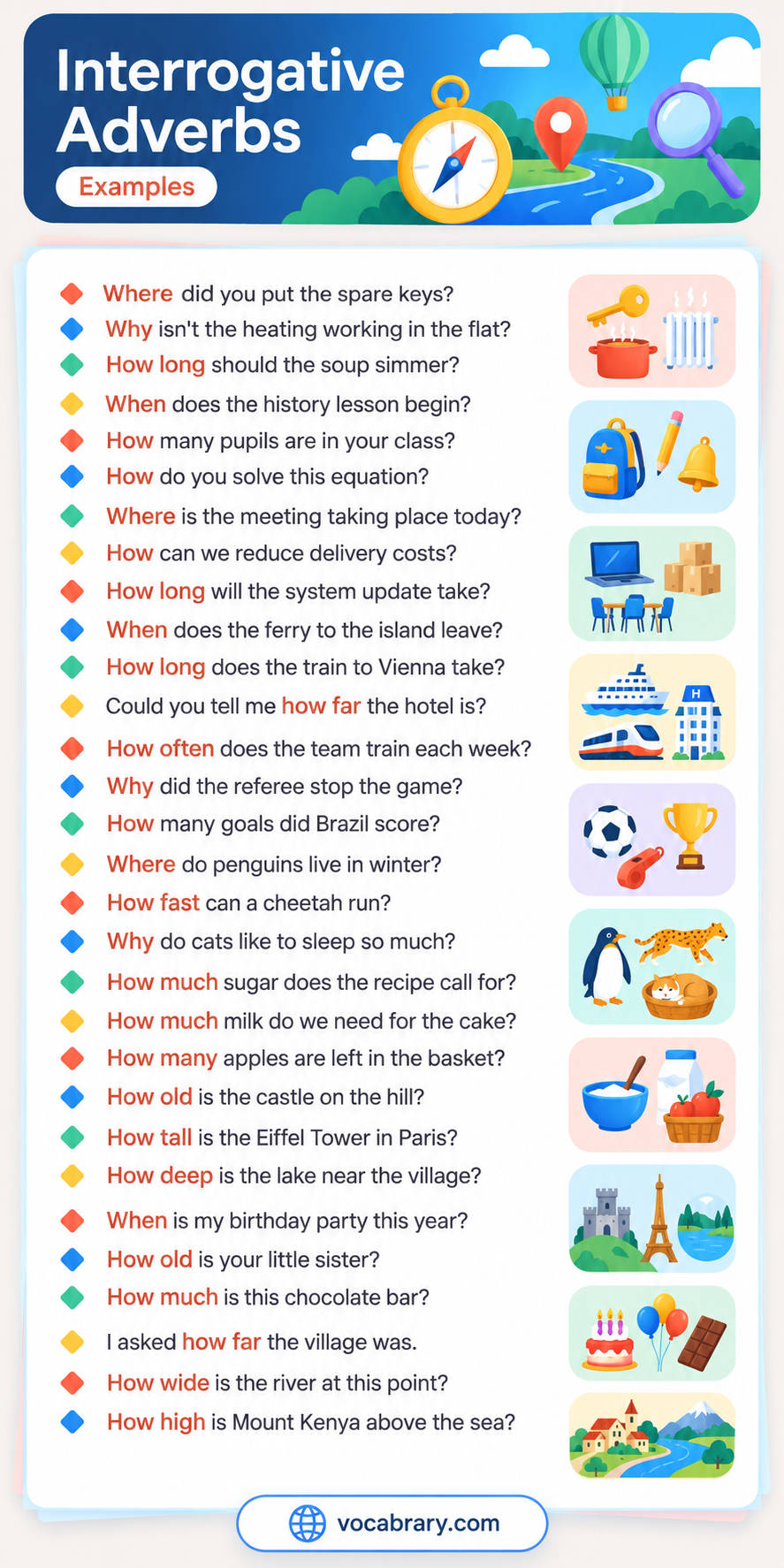
Interrogative Adverb Example Sentences for Everyday Use
Train times, parking spots, closed bakeries, and ticket prices appear in everyday interrogative adverb example sentences. In every case the question word comes first and asks for one missing fact.
- When does the next train leave for Lyon?
- Where did you park the car this morning?
- Why is the bakery closed on Mondays?
- How do you spell your surname?
- How much does a ticket to Cairo cost?
- How many brothers and sisters does Amara have?
- How long has Tomas lived in this city?
- How often do you visit your grandparents?
- How far is the beach from the hotel?
- How old is the castle on the hill?
- Where can I buy fresh bread near here?
- When will the results be announced online?
- Why did the lights go out during the concert?
- How did Ines open the locked door?
- Where did your cousin study medicine?
- When did the museum open its new wing?
- How tall is the tallest building in Dubai?
- Why are the children laughing so loudly?
- How fast can a cheetah run?
- How well does Marco speak Japanese?
Time and Place, Reason and Manner Questions With Answers
When, where, why, and how each open a question about time, place, reason, or manner, and a word after how adds quantity, length, frequency, distance, or age.
| Interrogative adverb | Asks about | Example question | Short answer |
|---|---|---|---|
| When | Time | When does the shop open? | It opens at nine. |
| Where | Place | Where do you live? | I live in Nairobi. |
| Why | Reason | Why did you leave? | I was tired. |
| How | Manner or means | How did you get here? | We came by bus. |
| How much | Quantity or price | How much is the soup? | It costs four euros. |
| How many | Number | How many people came? | About forty came. |
| How long | Duration | How long is the lesson? | It lasts an hour. |
| How often | Frequency | How often does it rain? | It rains twice a week. |
| How far | Distance | How far is the school? | It is about a mile away. |
| How old | Age | How old is your cat? | She is nine years old. |
Time Questions With When
When does the shop open, when did you arrive, and when will the winners receive their prizes are the time questions in this group. Each one asks for a date, an hour, or a period.
- When does the shop open on Sundays?
- When did you arrive at the airport?
- When will the winners receive their prizes?
- When is your sister’s wedding this summer?
- When was the telephone invented, and by whom?
- When do the swallows return to the village?
- When can we expect the delivery of the sofa?
- When did Hana start learning the violin?
- When does the film end tonight?
- When are you leaving for Kolkata?
- When should I take this medicine?
- When did the storm hit the coast?
- When will the new bridge open to traffic?
- When does the library close on Fridays?
Place Questions With Where
Where do you live, where did you park, and where is the nearest pharmacy ask for a place, a position, or a direction. Where also pairs with from and to, as in where are you from.
- Where do you live in the city now?
- Where did you park the bicycle yesterday?
- Where is the nearest pharmacy, please?
- Where can I change some money?
- Where does the new teacher live?
- Where are the children playing this afternoon?
- Where did Mia put her glasses?
- Where do these buses go after the bridge?
- Where are you from originally, if you don’t mind?
- Where should we meet on Saturday morning?
- Where has the cat gone this time?
- Where were you born, Mr Okoye?
- Where will the concert take place?
- Where does the river begin in the mountains?
- Where is the exit from the car park?
Reason Questions With Why
Why did you leave early, why is the sky red, and why don’t we walk ask for a cause or a suggestion. Why also stands alone in the short question why not.
- Why did you leave the party so early?
- Why is the sky red this evening?
- Why are the shops closed on a weekday?
- Why do bees leave the hive in spring?
- Why don’t we walk to the beach instead?
- Why did Elena change her phone number?
- Why does the moon change shape every night?
- Why has the train stopped between stations?
- Why would anyone sell a house like this?
- Why were the windows left open overnight?
- Why is Grandpa smiling at the newspaper?
- Why did the museum raise its ticket prices?
- Why not ask the teacher for help?
- Why are the streets so quiet this morning?
Manner Questions With How
How do you make pancakes, how did the thief enter, and how is your mother ask for a way, a means, or a state of health or feeling.
- How do you make pancakes without eggs?
- How did the thief enter the building?
- How is your mother feeling this morning?
- How can the children cross the busy road safely?
- How did Selim open the heavy iron gate?
- How was the concert last night?
- How do birds find their way home?
- How should we thank the volunteers after the event?
- How did you get to the airport so quickly?
- How does this washing machine work?
- How are the children getting on at school?
- How could the plan fail so badly?
- How do you pronounce this long word?
- How did Yusuf learn to swim at forty?
Questions With How Much and How Many
In how much money and how many students, the adverb how combines with much or many to ask about quantity. How much goes with uncountable nouns and prices, and how many goes with countable plural nouns.
- How much does this jacket cost?
- How many people came to the party?
- How much milk do we need for the cake?
- How many languages does Chen speak?
- How much time do you have before the meeting?
- How many eggs are in the fridge?
- How much did the repairs cost you last year?
- How many pages did you read last night?
- How much is a single ticket to Prague?
- How many times have you visited Rome?
- How much sugar does the recipe call for?
- How many apples are left in the basket?
- How much has the price of bread risen since January?
- How many brothers does the new teacher have?
Duration, Frequency and Distance Questions
How long, how often, and how far ask about duration, frequency, and distance, and each one takes the usual question word order.
Duration Questions With How Long
How long does the flight take and how long have you been waiting ask for a period of time, and how long also asks for a length.
- How long does the flight to Madrid take?
- How long have you been waiting here?
- How long will the bridge across the bay stay closed?
- How long did the meeting last this morning?
- How long will you stay in Lisbon?
- How long has Amir worked at the hospital?
- How long does it take to bake the bread?
- How long was the queue at the border?
Frequency Questions With How Often
How often do you check your email and how often does the bus run ask how many times something happens in a period.
- How often do you check your email each day?
- How often does the bus run on Sundays?
- How often should I water this plant?
- How often did your family visit the sea?
- How often does Leila call her mother?
- How often do the volcanoes erupt?
- How often have you seen the northern lights?
- How often do you change your toothbrush?
Distance Questions With How Far
How far is the airport and how far did the runners go ask for a distance, and the answer gives a number of metres, miles, or minutes.
- How far is the airport from here?
- How far did the runners go on Saturday?
- How far is it to the next village?
- How far can this car travel on one tank?
- How far did Naledi walk to school as a child?
- How far is Mars from the Earth?
- How far have we driven since breakfast?
- How far is the supermarket on foot?
Questions With How Old, How Tall and How Fast
How old is your grandmother, how tall is the Eiffel Tower, and how fast was the train going join how to an adjective or an adverb to ask for a measurement.
- How old is your grandmother now?
- How old was Mozart when he wrote his first piece?
- How tall is the Eiffel Tower in Paris?
- How fast was the train going near the bend?
- How big is the new stadium in the north?
- How deep is the lake near the village?
- How heavy is your suitcase at the check-in?
- How high is Mount Kenya above the sea?
- How wide is the river at this point?
- How loud was the thunder during the storm?
Examples of Interrogative Adverbs in Direct Questions
A direct question puts the auxiliary verb before the subject, as in where does Mia work, except when the question phrase contains the subject, as in how many guests arrived. The auxiliary is do, does, or did for most verbs, and be, have, or a modal verb otherwise.
| Question type | Pattern | Example question |
|---|---|---|
| With do, does, did | Adverb + do + subject + base verb | Where does Mia work? |
| With be | Adverb + be + subject | Where is the station? |
| With a modal | Adverb + modal + subject + base verb | How can I help? |
| With have or has | Adverb + have + subject + past participle | Where have you been? |
| With be and -ing | Adverb + be + subject + -ing form | Why is the dog barking? |
Do, Does and Did Question Sentences
Where does Mia work and when did your parents move use do, does, or did before the subject and the base form of the verb after it.
- Where does Mia work during the week?
- When did your parents move to Canada?
- How do you cook rice without a rice cooker?
- Where did the thieves hide the paintings?
- When does the bus to the airport leave?
- How did the fire start in the warehouse?
- How often does your team practise?
- When do the shops close in your town?
Sentences With Be After the Adverb
Where is the post office and why are you so happy use am, is, are, was, or were before the subject.
- Where is the post office on this street?
- Why are you so happy today?
- When was the Great Wall built?
- How is the weather in Oslo today?
- Where were you at midnight on Friday?
- How old are the children now?
- Why is the road closed again?
- When is the deadline for applications?
Modal Verb Question Sentences
How can I reach the manager and when will the parcel arrive use a modal verb such as will, should, or must before the subject.
- How can I reach the manager by phone?
- When will the parcel arrive at my house?
- Where should we put the new sofa?
- How could the thief enter without a key?
- When must the forms be returned to school?
- Where might Rosa have left her bag?
- How should I thank the teacher?
- Why must we leave before the speeches?
Have, Has and Continuous Question Sentences
Where have you been and why is the dog barking use have, has, or a form of be before the subject and a participle after it.
- Where have you been all afternoon?
- How long has the shop been closed?
- Why has the lift stopped between the floors again?
- Why had the guests left before dinner?
- Where are they going on holiday this year?
- Why is the dog barking at the gate?
- How are you getting to the airport tomorrow?
- How have they managed without electricity?
Many and Much Questions Without Inversion
How many guests arrived and how much snow fell are questions where the phrase with how is the subject, so no auxiliary comes before it.
- How many guests arrived before midnight?
- How much snow fell on the mountain overnight?
- How much water leaked from the pipe?
- How many trains run to the coast every hour?
- How many players joined the match on Saturday?
- How much money disappeared from the safe?
- How many birds nest on the cliff?
- How many windows broke during the storm?
Interrogative Adverbs in Indirect Questions
Could you tell me where the station is and I wonder where Hassan left his bicycle show an interrogative adverb inside a longer sentence. The subject comes before the verb, and no do is added.
| Direct question | Indirect question |
|---|---|
| Where does she live? | I know where she lives. |
| When did the film start? | Tell me when the film started. |
| Why is the shop closed? | Do you know why the shop is closed? |
| How can I get there? | Could you explain how I can get there? |
| How much does it cost? | I wonder how much it costs. |
Indirect Questions After Polite Phrases
Could you tell me where the station is and do you know when the museum opens are polite requests that keep the question mark but lose the inversion.
- Could you tell me where the station is?
- Do you know when the museum opens?
- Can you explain how this machine works?
- Would you mind telling me why the flight is late?
- Do you know how much this bag costs?
- Could you tell me how far the hotel is?
- Do you have any idea how long the repairs will take?
- Can you tell me how many people live here?
Indirect Questions After Verbs of Knowing and Asking
I wonder where Hassan left his bicycle and nobody knows when the old clock was built are statements, so they end with a full stop.
- I wonder where Hassan left his bicycle.
- Nobody knows when the old clock was built.
- I don’t understand how the magician did that trick.
- He wants to know where the money went.
- Tell me why you are smiling.
- We still do not know when the ferry will arrive.
- Please remember where you put the spare key.
- I can’t remember how often we visited my aunt as children.
- They could not decide where to eat dinner.
Short Answer Sentences for Interrogative Adverb Questions
When does the film start and where is Priya each get a full-sentence answer. The answer states the missing fact in a short sentence.
- When does the film start? It starts at eight.
- Where is Priya? She is in the garden.
- Why did you miss the bus? I woke up late.
- How did you get to work? I cycled.
- How much is the ticket? It costs twelve euros.
- How many eggs are left? Only three are left.
- How long is the film? It lasts two hours.
- How often do you swim? I swim twice a week.
- How far is the station? It is about a mile away.
- How old is your brother? He is nine years old.
- Where were you born? I was born in Kyoto.
- When will you call me? I will call you tonight.
Negative Questions With Interrogative Adverbs
Why didn’t you call, why can’t we use the main entrance, and why isn’t the heating working are negative questions, and the contracted not stands after the auxiliary verb.
- Why didn’t you call me last night?
- Where haven’t you looked for your keys?
- Why won’t the shop open before ten?
- Why can’t we use the main entrance?
- Why isn’t the heating working in the flat?
- Why doesn’t Dina eat meat or fish?
- Why wouldn’t Karim join the trip?
- Why weren’t the windows closed before the storm?
- Why aren’t the neighbours at home?
- Why shouldn’t children play outside in the rain?
- Where aren’t the buses running today?
- Why hasn’t the postman delivered the parcel?
Interrogative Adverbs in Reported Speech
She asked where I lived and he wanted to know when the exam started show a direct question moved into reported speech. The tense shifts back, and the subject comes before the verb.
| Direct question | Reported question |
|---|---|
| Where do you live? | She asked where I lived. |
| When will the exam start? | He asked when the exam would start. |
| Why did you enter? | The officer asked why we had entered. |
| How does it work? | He asked how it worked. |
- She asked where I lived as a child.
- He wanted to know when the exam started.
- The nurse asked why the patient had left the ward.
- Tom asked how much the ticket cost.
- The guide explained how the machine worked.
- Mina asked her father how long the journey would take.
- Nobody told us why the road was closed.
- The reporter asked where the mayor had been that night.
- Grandma asked how often we had visited the lake.
- The inspector wanted to know how many people had seen the accident.
- I asked how far the village was.
- He asked her when she would be back.
Interrogative Adverb Sentences Compared With Pronouns
Where did you buy this coat and what did you buy at the market differ in what they ask for. An interrogative adverb asks about circumstances, while an interrogative pronoun asks for a person or thing.
| Feature | Interrogative adverb | Interrogative pronoun |
|---|---|---|
| Words | When, where, why, how | Who, whom, whose, what, which |
| Asks for | Time, place, reason, manner | A person or a thing |
| Function | Modifies the verb | Works as a subject or an object |
| Example question | Where did Leo go? | Who did Leo meet? |
- Where did you buy this coat?
- Where did you leave your umbrella, and what else did you forget?
- When did the guests arrive at the hotel?
- Where did Sana go, and who went with her?
- Why did Sana call you so late?
- Why did Sana leave early, and whom did she tell?
- How did Leo repair the clock?
- How did Leo reach the shop, and which bus did he take?
- How much does the cheese cost?
- Where is the box, and what is in it?
Interrogative and Relative Adverb Sentences Compared
Where do you work and the office where I work use the same word in different jobs. An interrogative adverb opens a question, while a relative adverb joins a clause to a noun.
- Where do you work these days?
- Where is your office? The office where I work is near the river.
- When did the war end in that country?
- When did the strike start? I remember the day when it ended.
- Why did he leave the company?
- Why was she upset? I know the reason why she was upset.
- Where is the house with the red door?
- Where did Mozart live? This is the house where Mozart lived as a boy.
- When does the shift start on Fridays?
- When do we finish early? Friday is the day when we finish work early.
Question Sentences for Everyday Contexts
Spare keys, dripping taps, history lessons, and project deadlines are the daily settings where interrogative adverbs ask for missing facts.
Home Questions About Spare Keys and Soup
Spare keys, a dripping tap, an oven, and a pot of soup are the household cases in this group. Each question asks for a place, a reason, a way, or a length of time.
- Where did you put the spare keys?
- Why is the kitchen tap dripping again?
- How do I switch off the oven?
- When does the washing machine finish its cycle?
- How much milk is left in the fridge?
- How long should the soup simmer?
School Questions About Lessons and Quizzes
Pupils ask about a history lesson, a science laboratory, a cancelled quiz, and an equation. Each question asks for a time, a place, a reason, or a method.
- When does the history lesson begin?
- Where is the science laboratory on this floor?
- Why did the teacher cancel the quiz?
- How many pupils are in your class?
- How do you solve this equation?
- How often do you have gym lessons?
Work Questions About Deadlines and Meetings
In an office, a project deadline, a meeting room, delivery costs, and a system update lead to questions about a time, a place, a method, or a duration.
- When is the project deadline for the report?
- Where is the meeting taking place today?
- How can we reduce delivery costs?
- Why did sales fall in March?
- How many staff attended the training session?
- How long will the system update take?
Travel Questions About Tickets and Flights
Travellers ask about a metro ticket, a ferry to the island, a hotel by the beach, and a late flight. Each question asks for a place, a time, a distance, or a price.
- Where can I buy a metro ticket?
- When does the ferry to the island leave?
- How far is the hotel from the beach?
- How much is a taxi to the airport?
- Why was our flight delayed by two hours?
- How long does the train to Vienna take?
Question Sentences Beyond Home and Work
Earthquakes, wizards, finals, and headaches are wider settings where interrogative adverbs ask about events, plots, scores, and symptoms.
News Report Questions About Earthquakes and Rates
An earthquake, a Saturday protest, a rate rise, and a new tunnel are the news cases in this group. Each question asks for a time, a place, a reason, a number, or a cost.
- When did the earthquake strike the region?
- Where did the protest begin on Saturday?
- Why did the central bank raise interest rates?
- How many people lost power during the storm?
- How much will the new tunnel cost?
- How did the flood affect nearby farms?
Story Questions About Sailors and Dragons
An old sailor, a locked tower, a returning dragon, and a secret passage are the story cases in this group. Each question asks for a place, a way, a time, or a reason in the plot.
- Where did the old sailor hide the treasure?
- Why does the king trust the stranger?
- How did the wizard escape the locked tower?
- When will the dragon return to the valley?
- How long had the girl waited at the gate?
- Where does the secret passage lead?
Sports Questions About Matches and Sprints
Fans ask about a final match, Brazil’s goals, a hundred-metre sprint, and a weekly training session. Each question asks for a time, a number, a place, or a speed.
- When does the final match begin?
- How many goals did Brazil score?
- Where will the next Olympics be held?
- How fast did the sprinter run the hundred metres?
- Why did the referee stop the game?
- How often does the team train each week?
Health Questions About Headaches and Injections
Patients ask about an injection, a headache, a bandage, and a sore throat. Each question asks for a feeling, a time, an amount, or a reason.
- How do you feel after the injection?
- When did the headache start this morning?
- How often should I change the bandage?
- Why does my throat hurt in the morning?
- How much water should I drink every day?
- Where exactly does it hurt, Mrs Alvarez?
Interrogative Adverb Example Sentences for Kids
Red balls, blue skies, birthday parties, and paper planes give young learners early questions to ask, and these interrogative adverb example sentences for kids keep each one short.
- Where is my red ball, Mum?
- Why is the sky blue today?
- When is my birthday party this year?
- How do you make a paper plane?
- How many crayons are in the box?
- How old is your little sister?
- Where do penguins live in winter?
- Why do cats like to sleep so much?
- How much is this chocolate bar?
- When do we go to the zoo?
Short Questions for Young Learners
Where is my school bag, why is it so dark, and how old are you give beginners a short question pattern of six words.
- Where is my school bag, please?
- Why is it so dark outside?
- How old are you this year?
- When do we eat lunch today?
- How many cats do you have?
- Where do you go after school?
- Why is the baby crying again?
- When is the next bus coming?
Student Sentences for Exams and Essays
Exam questions use how, why, and how far in longer sentences, and an interrogative adverb also begins a clause inside a statement about what is unknown. These interrogative adverb example sentences give secondary students a model for essays and debates.
- How might governments reduce plastic waste in rivers?
- Why did the revolution fail to bring lasting reform?
- When did the printing press first reach the region?
- Where does the author place the turning point of the novel?
- How far does the evidence support the writer’s claim?
- How often do historians revise their view of the war?
- The examiner asked how the candidate had reached her conclusion.
- It is unclear when the manuscript was written.
- Scientists still debate why the dinosaurs disappeared.
- How much influence did newspapers have on voters in 1900?
- Few experts can explain how the pyramids were built so precisely.
- Where and when did the first universities appear?
Interrogative Adverbs in Short Paragraphs
Four short passages about a station, a lost phone, a school trip, and a clinic visit use where, when, why, and how, so learners meet interrogative adverbs inside running text.
Layla arrived at the station and asked where the ticket office was. A guard explained how to find it, and she asked when the next train left. He did not know why the board showed no times. How long she waited was a mystery, but the train came at last.
Omar was unable to find his phone. He asked himself where he had used it last and when he had heard it ring. His sister asked why he never charged it. How he lost it, nobody knew, but it turned up under the sofa.
Our class went to a science museum. The guide asked us how a magnet works and why compasses point north. Pupils asked how old the exhibits were and where the oldest one came from. How many questions we asked, the guide never counted.
Grandpa went to the clinic on Monday. The nurse asked him when the pain began and how strong it was. He explained where it hurt and how long it lasted. The doctor asked why he had waited a week, and Grandpa smiled.
FAQs
Q1. What are the interrogative adverbs in English?
The interrogative adverbs in English are when, where, why, and how, together with compounds such as how much, how many, how long, how often, how far, and how old. Each one opens a question about time, place, reason, manner, quantity, duration, frequency, distance, or age. How also combines with adjectives and adverbs, as in how tall and how fast.
Q2. What is the difference between an interrogative adverb and an interrogative pronoun?
An interrogative adverb asks about circumstances such as time, place, reason, and manner, while an interrogative pronoun asks for a person or thing. In where did Leo go, the word where is an adverb that asks for a place. In who did Leo meet, the word who is a pronoun that stands for a person.
Q3. Do interrogative adverbs need an auxiliary verb?
Interrogative adverbs need an auxiliary verb in most direct questions, and the auxiliary comes before the subject. The form is where does Mia work, with does before Mia, and not where Mia works. One exception is a question where the phrase with how is the subject, as in how many guests arrived.
Q4. How do you form an indirect question with an interrogative adverb?
You form an indirect question by placing the interrogative adverb after a phrase such as I wonder or could you tell me, and then using subject plus verb order. The direct question where does she live becomes I wonder where she lives. The word do disappears, and the verb takes its usual form, such as lives after she.
Q5. What is the difference between how much and how many?
How much asks about uncountable nouns and prices, while how many asks about countable plural nouns. How much milk is left uses the uncountable noun milk, and how many eggs are left uses the countable plural eggs. A price question such as how much is the ticket also takes how much.
Q6. Is “how” an adverb?
How is an interrogative adverb when it opens a question about manner, means, or state, as in how did you open the door. It is also the first word in compound question phrases such as how much and how old. How also introduces a clause in sentences such as that is how he did it.
Q7. Do you use a question mark after an indirect question?
An indirect question inside a statement ends with a full stop, as in I wonder where Hassan left his bicycle. A question mark belongs only to a sentence that is a question as a whole, as in do you know where the station is? The interrogative adverb inside the clause does not change this rule.
Q8. Where does the interrogative adverb go in a question?
The interrogative adverb goes at the start of the question, before the auxiliary verb. When does the shop open and why did you leave are interrogative adverb example sentences that begin with the question word. A preposition also stands at the end of the question, as in where are you from.
Q9. What is the difference between interrogative adverbs and relative adverbs?
Interrogative adverbs open questions, while relative adverbs join a clause to a noun. The word where asks for a place in where do you work, but it introduces a clause in the office where I work, where it is a relative adverb.
Q10. How do negative questions work with interrogative adverbs?
A negative question places the contracted not after the auxiliary verb, and the interrogative adverb remains at the start. Why didn’t you call me asks for the reason behind a missing call, and the question expresses surprise or complaint. The full form is why did you not call me, which sounds more formal.
Q11. How do interrogative adverbs change in reported speech?
Interrogative adverbs stay the same in reported speech, but the word order and the tense change. Where do you live becomes she asked where I lived, with the subject before the verb and the verb in the past tense. The question mark disappears because the sentence is now a statement.
Q12. What are interrogative adverbs for kids?
Interrogative adverbs for kids are the question words where, when, why, and how that young learners use every day. Interrogative adverb example sentences for kids stay short, as in where is my red ball and why is the sky blue. Teachers add how many and how old once the first four are secure.
Q13. How do you identify an interrogative adverb in a sentence?
You identify an interrogative adverb by finding the question word that asks for a time, place, reason, or manner and that modifies the verb. In when does the train leave, the word when asks for a time and modifies leave. A question word that stands for a person or thing, such as who or what, is a pronoun instead.

Leave a Comment