
An adverb of reason is an adverb or phrase that states the cause of an action or the result of an earlier statement, as in the road flooded; therefore, the match ended. While because joins a cause to its main clause, therefore links two independent clauses, so a semicolon or a full stop precedes it and a comma follows. That punctuation is what adverbs of reason example sentences repeat: a semicolon before therefore and a comma after it.
What Is an Adverb of Reason?
An adverb of reason is a word or phrase that gives the cause of an action or the result of an earlier statement, and it answers the question “why?” A conjunction of reason such as because joins a dependent clause of cause to a main clause, whereas an adverb of reason such as therefore links two independent clauses or two sentences. Both types are covered on the conjunctive adverb sentences and subordinating conjunction sentences pages.
Independent clause; therefore, independent clause
The bridge was closed for repairs; therefore, the buses took another route.
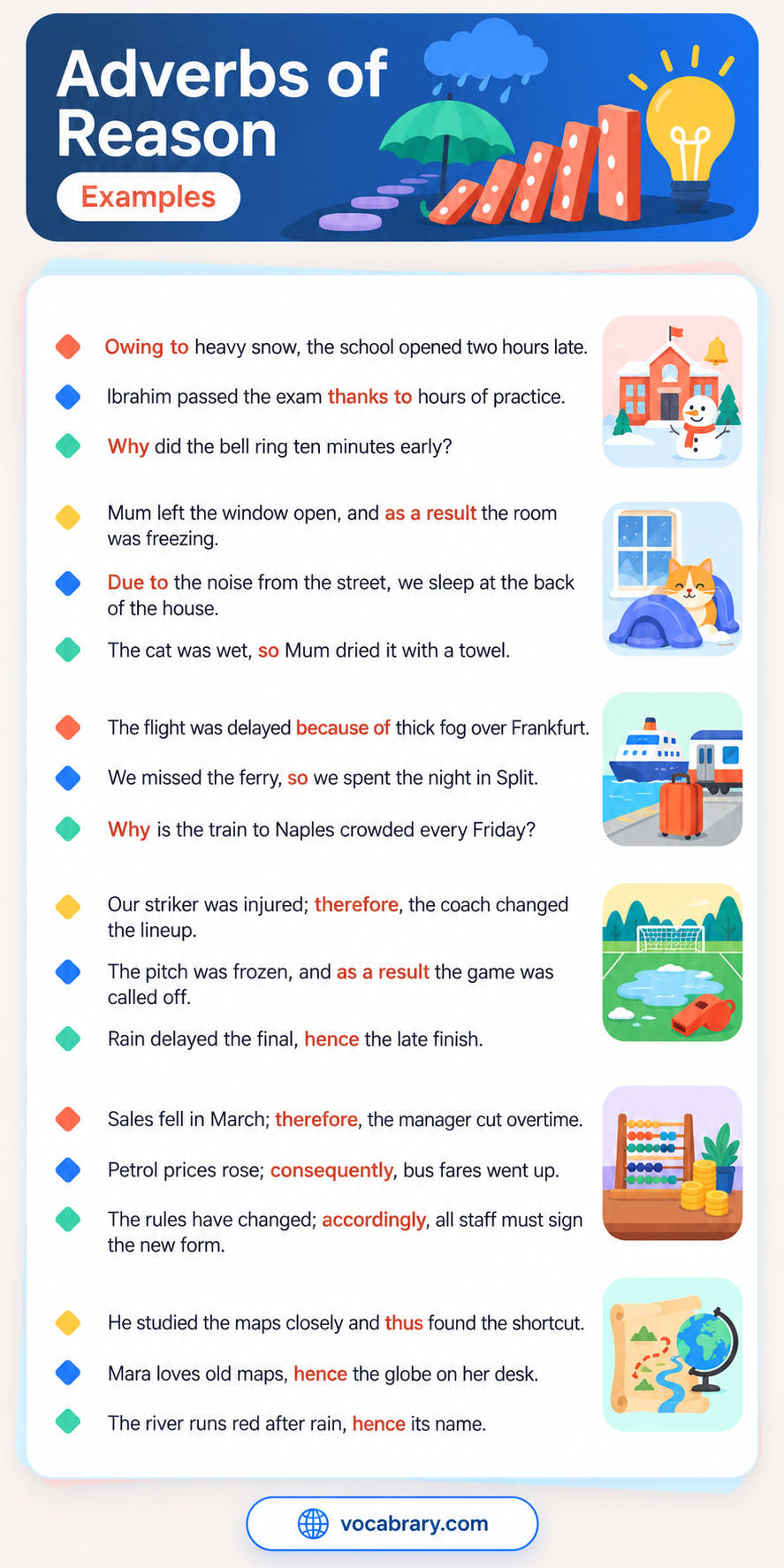
Adverbs of Reason Example Sentences for Everyday Use
Therefore, consequently, as a result, and because of are the reason words that appear in everyday adverbs of reason example sentences. Each one answers the question why by naming a cause or a result.
- The road was flooded; therefore, the match was cancelled.
- Mia studied every night; consequently, she passed with distinction.
- The shop was closed, so we bought bread at the station.
- As a result, the factory hired forty new workers.
- Nobody answered the door; thus, the courier left a card.
- The new bridge reduces traffic, hence the happier commuters.
- Tom forgot his umbrella, and for that reason he arrived soaked.
- Why are you smiling at your phone?
- Our train arrived late because of a signal failure near Leeds.
- The team trained hard all winter; accordingly, they won the spring league.
- Rain began at noon; as a result, the picnic moved indoors.
- For this reason, the museum closes at four on Mondays.
- Her passport had expired, and therefore she could not board the plane.
- The river froze overnight; consequently, the ferry stopped running.
- Oil prices rose sharply, so many families cut their heating.
- Due to a power cut, the cinema cancelled the evening show.
- Aisha speaks three languages, hence her job at the embassy.
- That is why the old library needs a new roof.
- The ticket machine broke; thus, passengers queued at the desk.
- Owing to heavy snow, the school opened two hours late.
Therefore Example Sentences
Sold-out tickets, a frozen pipe, and a missed bus each lead to a result introduced by therefore. Therefore states a logical result, and it suits formal and everyday writing alike.
- The concert was sold out; therefore, we watched it on the screen outside.
- The pipe froze overnight; therefore, the plumber arrived at seven.
- Karim missed the last bus; therefore, he walked home along the canal.
- The team lost two players; therefore, the coach changed the formation.
- All the evidence agrees; therefore, the committee accepted the claim.
- Water boils at a lower temperature on mountains; therefore, rice takes longer to cook.
- She had never visited Kyoto; therefore, she bought a guidebook.
- The ice is thin, and we therefore stay off the lake.
- Fiona is the youngest member; she therefore pays the lowest fee.
- Two sides of the triangle are equal; the triangle is therefore isosceles.
- The tank was empty, and the car therefore stopped on the hill.
- The soil was too dry; therefore, the seeds never grew.
- The shop sells only fresh bread, and the queue is therefore long at eight.
Sentences With Thus and Hence
Thus and hence are formal reason adverbs, as in thus preventing the glass from cracking and hence the long queue. Thus means as a result or in this way, and hence means for this reason.
Thus in a Sentence
A closed bridge, a signed treaty, and slowly heated glass each show thus stating a result or a way. Thus is formal, and a comma after it is optional.
- The bridge was unsafe; thus, engineers closed it for repair.
- The two samples gave identical results, and the claim was thus confirmed.
- Both parties signed the treaty; thus, the war ended after nine years.
- The mixture is heated slowly, thus preventing the glass from cracking.
- Rainfall doubled in spring, thus raising the river by two metres.
- Salaries were frozen; thus, many teachers left the profession.
- Add the water slowly and stir; thus you avoid lumps in the batter.
- The council ignored the warnings, and the plan thus collapsed.
- Her essay was well argued and thus earned the top mark.
- He studied the maps closely and thus found the shortcut.
Hence in a Sentence
Hence the long queue, hence its name, and hence the globe show hence followed by a noun phrase. Hence also introduces a full clause, as in prices fell by half; hence, sales doubled.
- The bakery opens at dawn, hence the long queue at six.
- Mara loves old maps, hence the globe on her desk.
- Prices fell by half; hence, sales doubled in a month.
- The river runs red after rain, hence its name.
- Forty percent of the staff were ill; hence, the office closed for a week.
- The airline lost our bags, hence our late arrival at the hotel.
- Fares rose sharply, hence the protest at the station.
- Yara trained as a nurse, hence her calm manner in emergencies.
- He was born in Wales, hence his love of choirs.
Consequently and Accordingly Example Sentences
Heavy snow, doubled costs, a new rule, and colder weather lead to results in this group. Consequently states the result, and accordingly states a response fitted to the situation.
- Heavy snow blocked the pass; consequently, the rally was postponed.
- Costs doubled; consequently, the council dropped the project.
- Dina skipped breakfast; consequently, she felt faint by ten.
- Sales rose steadily, and consequently the shop hired two assistants.
- The company ignored safety rules; consequently, it paid a heavy fine.
- Demand for tickets was huge; consequently, extra trains were added.
- The rules have changed; accordingly, all staff must sign the new form.
- Rain was forecast for the weekend; accordingly, the organisers booked a tent.
- The weather turned colder, and we dressed accordingly.
- The judge heard both sides; accordingly, she reduced the fine.
- The test was harder this year; accordingly, the pass mark was lowered.
- Applications doubled, and the committee accordingly extended the deadline.
- Our teacher was ill; consequently, the lesson was cancelled.
- Plan your route carefully and pack accordingly.
Reason Phrases in Short Sentences
As a result, as a consequence, for that reason, and for this reason are adverbial phrases that give the meaning of therefore in several words.
As a Result and as a Consequence Sentences
A closed airport, a failed harvest, and quickly improving Spanish are results introduced by as a result. The phrase takes of plus a noun when the cause follows it.
- As a result, the airport closed for six hours.
- The harvest failed; as a result, bread prices doubled.
- Lila practised daily, and as a result her Spanish improved quickly.
- As a consequence, the committee postponed its decision until May.
- Ahmed lost his keys, and as a result he waited outside for an hour.
- The tunnel was flooded. As a result, the trains ran on a single track.
- As a result of the new law, smoking is banned in all parks.
- Sales fell by a third as a result of the strike.
- As a consequence of poor planning, the event ran two hours late.
- The factory cut its energy use, and as a result its costs dropped.
For That Reason and for This Reason Sentences
An icy path, a broken lift, and a visitor allergic to nuts are causes that the phrases for that reason and for this reason refer back to. Both phrases point to the cause just named.
- The path is icy, and for that reason the park is closed today.
- For this reason, visitors must book a time slot online.
- Our lift is broken; for that reason, the clinic moved downstairs.
- Daniel is allergic to nuts, and for this reason he reads every label.
- For that reason alone, the committee rejected the offer.
- The children are tired, and for that reason we are leaving early.
- She wanted to see the sea, and for this reason she moved to Lisbon.
- For this very reason, the doctor asked Grandpa to rest.
- Nobody trusted the figures, and for that reason the audit began.
Cause and Result Sentences With So
It was late, so we left and the soup was cold, so Rafael warmed it up show so joining a result to a cause. So is a coordinating conjunction, and a comma stands before it, but it needs no semicolon.
- It was late, so we left the party.
- The soup was cold, so Rafael warmed it up.
- Mum had a headache, so she went to bed early.
- Prices are high this month, so we are staying home.
- The shop was closed, so I ordered the book online.
- Maya was thirsty, so she bought a bottle of water.
- My phone died, so I borrowed Sam’s.
- The road was icy, so the bus driver went slowly.
- It started to rain, so the match stopped at half time.
- We missed the ferry, so we spent the night in Split.
Examples of Adverbs of Reason With Why
Why did the train stop, I wonder why Hassan left, and that is why the water tastes of metal show why as the question word for a reason. Why is an interrogative adverb in questions and a relative adverb in phrases such as that is why.
Direct Question Sentences With Why
Why did the train stop and why is the sky red are direct questions in which why comes first and the auxiliary verb comes before the subject.
- Why did the train stop in the middle of the tunnel?
- Why is the sky red this evening?
- Why are the children so quiet today?
- Why didn’t Nadia come to the party?
- Why does the moon change shape?
- Why have the prices gone up again?
- Why was the museum closed on Tuesday?
- Why do birds fly south in winter?
- Why can’t we use the front door?
- Why would anyone leave a job like that?
- Why did Omar leave the restaurant before dessert?
- Why hasn’t the parcel from Hamburg arrived yet?
Indirect Question Sentences With Why
I wonder why Hassan left and do you know why the shop closed put why inside a longer sentence, and the subject comes before the verb again.
- I wonder why Hassan left the meeting so early.
- Do you know why the shop closed at noon?
- Nobody explained why the lights went out.
- Can you tell me why the bus is late?
- She asked why the sky turns orange at sunset.
- The teacher wants to know why you missed the test.
- I cannot understand why the printer keeps jamming.
- Tell me why you chose this university.
- Nobody knows why the old clock stopped in 1998.
- The reporter asked why the road was still closed.
That Is Why and the Reason Why Sentences
In that is why, which is why, and the reason why, the word why works as a relative adverb that refers to a cause. The relative adverb sentences page covers that use in full.
- The pipes are old, and that is why the water tastes of metal.
- Leila hates crowds, which is why she avoids the market.
- The reason why the bridge closed is still unknown.
- Our flight leaves at dawn, and that is why we packed last night.
- He lost his passport, which is why he missed the trip.
- This is why we recommend an early start.
- Nobody told me the reason why the meeting moved.
- That is why Priya never lends her bicycle.
- There is a reason why the café is always full.
- That’s why the hotel offers free breakfast.
Because of, Due to and Thanks to Example Sentences
Because of the fog, due to a strike, owing to illness, and thanks to a neighbour are phrases that give a reason before a noun. None of them takes a full clause after it.
- The flight was delayed because of thick fog over Frankfurt.
- Due to a strike, the trains stopped at noon.
- Owing to illness, the singer cancelled the concert.
- We found the lost dog thanks to a kind neighbour.
- Because of the rain, the football match moved to Sunday.
- The shop closed early due to staff shortages.
- Owing to road works, buses use the side street.
- Ibrahim passed the exam thanks to hours of practice.
- Many plants died because of the late frost.
- On account of her age, Grandma took the lower bunk.
- Because of you, I arrived on time.
- The match was abandoned owing to a floodlight failure.
- Hana missed the call because of her broken phone.
- In view of the weather, the organisers cancelled the parade.
Purpose Phrases With Infinitives and So That
To buy bread, in order to avoid the traffic, and so as to afford a trip answer why by naming a purpose rather than a cause. The infinitive with to is the shortest form, and so that introduces a purpose clause.
- Jin went to the bakery to buy bread for lunch.
- We left early in order to avoid the traffic.
- Maria saved every month so as to afford a trip to Peru.
- He raised his hand to ask a question.
- Zainab studies at night so that she can work in the day.
- The students stood in order to see the stage.
- I called the clinic to change my appointment.
- Dad took the long road so that we could see the lake.
Contrast Sentences for Adverbs of Reason and Conjunctions
Because the pipe froze, the shop closed and the pipe froze; therefore, the shop closed state the same cause and result in different grammar. The subordinating conjunction sentences page covers the first form, and the conjunctive adverb sentences page covers the second.
| Feature | Adverb of reason | Conjunction of reason |
|---|---|---|
| Common words | Therefore, thus, hence, consequently | Because, since, as |
| What it joins | Two independent clauses or sentences | A main clause and a dependent clause |
| Punctuation | Semicolon before, comma after | Comma only when the dependent clause comes first |
| Example sentence | The pipe froze; therefore, the shop closed. | Because the pipe froze, the shop closed. |
- Because the rain was heavy, the match stopped at half time.
- The rain was heavy; consequently, the match stopped at half time.
- Since Omar had no key, he rang the bell.
- Omar had no key; therefore, he rang the bell.
- The flight left late because the crew arrived late.
- The crew arrived late; as a result, the flight left late.
- As the shop was closed, we walked to the next street.
- The shop was closed; accordingly, we walked to the next street.
- Ines took a taxi because her bus never came.
- Her bus never came; for that reason, Ines took a taxi.
Semicolon and Comma Sentences With Therefore and Thus
A semicolon before therefore and a comma after it join two independent clauses, as in the soil was dry; therefore, the crop failed. A comma after thus and hence is optional.
| Position | Pattern | Example sentence |
|---|---|---|
| Between two clauses | Clause; adverb, clause | The soil was dry; therefore, the crop failed. |
| Start of a sentence | Adverb, clause | Therefore, the crop failed. |
| Inside a clause | Subject, adverb, verb | The crop, therefore, failed. |
| After and or but | No commas around the adverb | The soil was dry, and the crop therefore failed. |
- The soil was dry; therefore, the crop failed.
- The river rose quickly. Consequently, the village was evacuated.
- Our supplier closed; as a result, prices rose.
- Ravi was ill; thus he missed the final.
- The roads were icy; accordingly, the buses ran late.
- The data are incomplete; the study is therefore unreliable.
- It was raining; for that reason, the parade moved indoors.
- Manu trained daily. Hence, he won the race.
- The road is flooded, and therefore the school is closed.
- The lab lost power; consequently, the samples spoiled.
- Costs are rising; thus, many shops are closing.
- We missed the deadline; as a result, the grant was withdrawn.
Adverbs of Reason in Different Sentence Positions
Reason adverbs stand at the start of a clause, in the middle, or at the end, and each position changes the emphasis. Only accordingly and phrases such as as a result and for that reason stand at the end.
Therefore and Consequently at the Start of a Sentence
Therefore, the committee rejected the budget and Consequently, three flights to Madrid were cancelled show reason adverbs opening a sentence, followed by a comma.
- Therefore, the committee rejected the budget.
- Consequently, three flights to Madrid were cancelled.
- As a result, the village gained a new school.
- For this reason, the museum charges a small fee.
- Thus, the experiment proved the theory.
- Accordingly, the manager changed the schedule.
- Hence, the council ordered a new timetable for the northern line.
- For that reason, Yasmin refused the offer.
- Therefore, Grandma stayed at home on Sunday evening.
- Because of this, the road remains closed.
Therefore and Consequently in Mid-Sentence Position
The committee therefore rejected the budget and the final match was consequently cancelled place the adverb between the subject and the main verb, after the verb be, or after an auxiliary verb.
- The committee therefore rejected the budget.
- The final match was consequently cancelled at noon.
- Dina has thus completed the course.
- The two sides had accordingly agreed to talk.
- The road, therefore, will stay closed until May.
- Tickets were consequently sold out within an hour.
- Rina was thus the first woman to win the prize.
- The old bridge is therefore unsafe for lorries.
- The students had accordingly prepared two presentations.
Accordingly and as a Result Ending a Clause
Dressed accordingly and lost their jobs as a result show reason phrases at the end of a clause. Accordingly, as a result, as a consequence, and for that reason stand in this position.
- The weather turned cold, and we dressed accordingly.
- The storm damaged the roof, and the repairs were costly as a result.
- The factory closed, and many workers lost their jobs as a result.
- Nobody trusted the website, and Ayesha left for that reason.
- The rules changed, and we adjusted our plans accordingly.
- The harvest was poor, and bread was expensive as a consequence.
- He was rude to the customers and was fired for this reason.
- The exam was harder than usual, and the teachers marked accordingly.
Examples of Adverbs of Reason in Negative Sentences
A jury that did not convict, a restaurant with no seat ready, and a lift that is not working show reason words in denied statements. The negative word belongs to one clause, and the reason word links it to another.
- The evidence was weak; therefore, the jury did not convict him.
- The roads were not icy, and consequently the buses ran on time.
- Nobody called ahead; as a result, no seat was ready.
- Lena did not revise; thus, she failed to recognise the question.
- The lift is not working, so we are taking the stairs.
- The shop was not open, and for that reason we left empty-handed.
- There was no hot water; therefore, nobody took a shower.
- The tickets were not cheap, hence the small crowd.
- The results are not final; accordingly, the board has not announced a winner.
- The flight did not leave on time because of a technical fault.
Questions With for What Reason, How Come and Why
For what reason, how come, and why are the question forms that ask for a cause, and because of the flood occurs in a yes-or-no question.
- For what reason did the airline cancel the flight?
- How come the shop is closed today?
- Why is the water cold this morning?
- Why did you choose to study medicine?
- Why didn’t the alarm ring this morning?
- Is that why you were late this morning?
- Why else would the door be open?
- Is the road closed because of the flood?
- Did the match end early for that reason?
- Why do we celebrate the harvest in October?
- Why hasn’t anyone fixed the lamp?
Reported Speech and Passive Sentences With Therefore and Thus
Therefore in a report, as a result in an announcement, and thus in a passive verb phrase show reason words in reported speech and passive sentences. The reason word keeps its meaning in both.
- The manager said that the shop had closed; therefore, no deliveries were expected.
- Sara explained that the train was late because of a signal failure.
- The pilot announced that, as a result of the storm, the plane would land in Lyon.
- Tom told us that he was tired and therefore would skip the party.
- The report states that the bridge was consequently closed to lorries.
- The match was therefore postponed until Saturday.
- The old school was thus converted into a library.
- Funds were consequently transferred to the hospital.
- The road was closed because of flooding.
- The staff were told why the office was moving.
Everyday Adverbs of Reason Sentences by Setting
Broken boilers, flooded school halls, crashed servers, and missed ferries are the daily settings where adverbs of reason explain a cause.
Sentences About Household Problems and Their Results
A broken oven, a leaking washing machine, a failed boiler, and street noise are the causes. Each cause is linked to a result by a reason word.
- The oven is broken; therefore, we are eating cold sandwiches.
- Mum left the window open, and as a result the room was freezing.
- The washing machine leaked; consequently, the kitchen floor flooded.
- The baby slept badly, so everyone was tired at breakfast.
- Our boiler failed in January; for that reason, we bought a new one.
- Due to the noise from the street, we sleep at the back of the house.
School Problem and Result Sentences
Forgotten books, a flooded hall, heavy snow, and cancelled exams are the causes, and each one leads to a result named by a reason word.
- Many pupils forgot their books; therefore, the teacher lent out her own copies.
- The hall was flooded; as a result, assembly moved to the playground.
- Because of snow, the school trip to the farm was postponed.
- Ewa revised every evening; consequently, her grades rose.
- Why did the bell ring ten minutes early?
- The exam was cancelled, hence the quiet corridors.
Work Problem and Decision Sentences
Falling sales, a crashed server, staff shortages, and a changed brief are the causes, and each one leads to a decision named by a reason word.
- Sales fell in March; therefore, the manager cut overtime.
- The server crashed, and as a result nobody could send email.
- Owing to staff shortages, the cafeteria closes at two.
- The client changed the brief; accordingly, the designers started again.
- Our budget was cut, hence the smaller office party.
- The system update failed; consequently, payroll was delayed.
Travel Delay Sentences With Therefore and as a Result
Fog on a runway, engineering works, a missed ferry, and a closed border are the causes, and each one leads to a delay named by a reason word.
- Fog covered the runway; as a result, flights to Oslo were cancelled.
- Due to engineering works, trains between Leeds and York stop early.
- We missed the last ferry, so we slept at the harbour hotel.
- The border was closed; therefore, lorries queued for miles.
- Why is the train to Naples crowded every Friday?
- Rina booked early, and for that reason she got the window seat.
Sentences by Wider Setting From News to Health
A burst dam, a storm on an island, a frozen pitch, and a high fever are wider settings where adverbs of reason explain events.
Consequently and Because of in News Report Sentences
Rising petrol prices, a burst dam, record rainfall, and slowing inflation are the causes, and each one leads to a result reported with a reason word.
- Petrol prices rose; consequently, bus fares went up.
- The dam burst, and as a result thousands left their homes.
- Because of record rainfall, the river burst its banks.
- Turnout broke a record; thus, the new government gained a strong mandate.
- The factory closed owing to a fire, and hundreds lost work.
- Inflation slowed; accordingly, the central bank cut interest rates.
Therefore and Hence in Story Sentences
A dead lamp, a cold silence, a storm on an island, and a cruel king are the causes, and each one leads to a turn in the plot.
- The lamp had gone out; therefore, the sailors steered by the stars.
- She never forgave him, hence the silence at the dinner table.
- A storm struck the island, and as a result the ship never arrived.
- Why did the old man lock the cellar door every night?
- The king was cruel; consequently, the people left the valley.
- The dragon feared the knight’s sword, and for that reason it fled.
Sports Sentences With Therefore and as a Result
An injured striker, a frozen pitch, a late goal, and a rain delay are the causes, and each one leads to a result named by a reason word.
- Our striker was injured; therefore, the coach changed the lineup.
- The pitch was frozen, and as a result the game was called off.
- Because of a late goal, Brazil won the semi-final.
- The captain trained all summer; consequently, she broke the club record.
- Why did the referee stop the match?
- Rain delayed the final, hence the late finish.
Sentences About Health With Therefore and Due to
A high fever, a sprained ankle, a crowded clinic, and extra water are the causes, and each one leads to an effect named by a reason word.
- Ali had a high fever; therefore, the doctor ordered rest.
- Sleep improves memory, and for that reason teenagers need eight hours.
- Due to a sprained ankle, Nina missed the race.
- Maya drank more water; as a result, her headaches stopped.
- The clinic was crowded, so we waited for two hours.
- Why does a fever make you feel cold?
Adverbs of Reason Sentences for Kids
Wet cats, cold wind, thunder, and a blue sky give young learners reasons to say so, because of, and why in adverbs of reason example sentences for kids.
- It rained, so we stayed inside and played games.
- I was hungry, so I ate my sandwich.
- We wore coats because of the cold wind.
- Why is the sky blue, Dad?
- The cat was wet, so Mum dried it with a towel.
- That is why we wear hats in the sun.
- The park was closed because of the rain.
- My puppy was scared, so he hid under the bed.
- I was cold, so I put on my red scarf.
- Why do we brush our teeth every night?
- We stayed home because of the thunder.
Short Adverbs of Reason Sentences for Young Learners
I was late, so I ran and it was dark, so we hurried give beginners a short pattern with so, and a few lines add because of and why.
- I was late, so I ran.
- It was dark, so we hurried home.
- Dad was tired, so he slept.
- Why is the grass wet today?
- The bus was full, so we walked.
- We stayed in because of the storm.
- The soup was hot, so I waited.
- That is why I wear boots.
Academic Adverbs of Reason Sentences for Students
Adverbs of reason example sentences for exams use consequently, hence, thereby, and accordingly in longer sentences with a stated cause, as essays and reports require.
- The data were incomplete; consequently, the researchers delayed their report.
- The treaty failed to address trade; thus, tensions remained high.
- Demand exceeded supply, hence the steep rise in rents.
- The committee found the evidence inconclusive and accordingly dismissed the case.
- The company reduced its emissions, thereby qualifying for a government grant.
- In consequence, the council abandoned the proposal.
- The author lost her sight at forty; for this reason, her later novels rely on sound and touch.
- Its location made the port wealthy; as a result, rival cities built harbours of their own.
- The experiment lacked a control group, and its findings are therefore unreliable.
- Literacy rates rose after 1950, thus widening the market for newspapers.
- Owing to a shortage of skilled labour, the building programme fell two years behind.
- The premise is false; hence, the conclusion cannot stand.
Using Adverbs of Reason in Short Paragraphs
Four connected passages about a flooded river, a swimming team, a bakery, and a hike use so, therefore, and as a result inside continuous writing.
Heavy rain fell all night; as a result, the river rose by two metres. The bridge was unsafe, so the council closed it at dawn. Because of the closure, buses took a longer road. Consequently, many commuters arrived late, and that is why the station was crowded at nine.
Leila wanted to join the swimming team, so she trained every morning. Because of her hard work, her times improved quickly. The coach was impressed; therefore, he chose her for the regional meet. For this reason, Leila’s parents bought her a new swimsuit.
The café sold the best bread in town, hence the long queue at the door. The baker had broken his oven, so he used his neighbour’s. Owing to the delay, the first customers waited an hour. The baker gave them free rolls; thus, the morning’s trouble was soon forgotten.
The hikers started late because of a puncture. Consequently, darkness fell before they reached the hut. They had packed torches, so they continued safely. Accordingly, the guide chose the wider path. As a result, everyone arrived by ten.
FAQs
Q1. What are some examples of adverbs of reason?
Common adverbs of reason are therefore, thus, hence, consequently, accordingly, and phrases such as as a result and for that reason. Each one explains why an action happened or states the result of an earlier clause. Adverbs of reason example sentences also use related words such as because of, so, and why.
Q2. What is the difference between an adverb of reason and a conjunction?
An adverb of reason links two independent clauses or sentences, while a conjunction of reason joins a dependent clause to a main clause. In the pipe froze; therefore, the shop closed, the word therefore is an adverb, and a semicolon or full stop must stand before it. In because the pipe froze, the shop closed, the word because is a conjunction and needs no semicolon.
Q3. Is therefore an adverb or a conjunction?
Therefore is a conjunctive adverb, which means it links two clauses in meaning without joining them in grammar. A semicolon or a full stop must stand between the clauses, and a comma alone is not enough. The conjunctive adverb sentences page gives the full set of these words.
Q4. Do you put a comma after therefore?
A comma follows therefore when the word opens a sentence or a clause, as in the soil was dry; therefore, the crop failed. Inside a clause, commas on both sides are optional, as in the crop, therefore, failed. After and or but, no commas surround the adverb.
Q5. What is the difference between thus and hence?
Thus means as a result or in this way, while hence means for this reason and also stands before a noun. A sentence such as the bakery opens at dawn, hence the long queue uses hence with a noun phrase. A sentence such as the glass was heated slowly, thus preventing cracks uses thus with an -ing phrase.
Q6. Is “so” an adverb of reason?
So works as a coordinating conjunction when it joins a result to a cause, as in it was late, so we left. Some grammar books name it among reason words because it answers why. The grammar differs from therefore, since so needs a comma before it and no semicolon.
Q7. What is the difference between because and because of?
Because introduces a clause with its own subject and verb, while because of introduces a noun phrase. Because it rained, we stayed in and because of the rain, we stayed in mean the same thing. A noun phrase follows because of, as in because of the rain and because of the delay.
Q8. Where does therefore go in a sentence?
Therefore goes at the start of a clause, between the subject and the verb, or after the verb be. Therefore, the committee rejected the budget and the committee therefore rejected the budget are both correct. At the end of a clause, therefore sounds stiff, and phrases such as as a result suit that position better.
Q9. Is “why” an adverb?
Why is an interrogative adverb when it opens a question, as in why did the train stop? It is a relative adverb in phrases such as the reason why and that is why. Both uses ask for or refer to a reason, and the interrogative adverb sentences page covers the first one.
Q10. What is the difference between as a result and as a result of?
As a result stands alone and states an effect, while as a result of is followed by a noun that names the cause. The harvest failed; as a result, bread prices doubled uses the first form. Bread prices doubled as a result of the failed harvest uses the second.
Q11. What are adverbs of reason for kids?
Adverbs of reason example sentences for kids use short words such as so, because of, and why. A line like it rained, so we stayed inside teaches the cause and result in a few words. Questions such as why is the sky blue? show young learners how to ask for a reason.
Q12. How do you identify an adverb of reason in a sentence?
You identify an adverb of reason by asking why the action happened and looking for the word that links the answer to the earlier statement. In the road was flooded; therefore, the match was cancelled, the word therefore links the result to its cause. A second test is to replace the word with as a result, and the sentence keeps its meaning.

Leave a Comment