
An adverb of manner is an adverb that modifies a verb by stating how the action is done, as in she spoke quietly. Yet the way an action is done defines the class, not the ending -ly: hard in she worked hard has no ending, and hardly in she hardly worked means almost not. That is why adverbs of manner example sentences pair the -ly forms with irregular fast, well, and hard, so each adverb is judged by the action it describes.
What Is an Adverb of Manner?
An adverb of manner states the way, the style, or the speed at which an action is done, and it answers the question how. An adjective describes a noun instead, so a quick reply uses an adjective while she replied quickly uses an adverb.
Subject + verb + (object) + adverb of manner; adjective + -ly = adverb
The chef sliced the onions carefully and served them warmly.
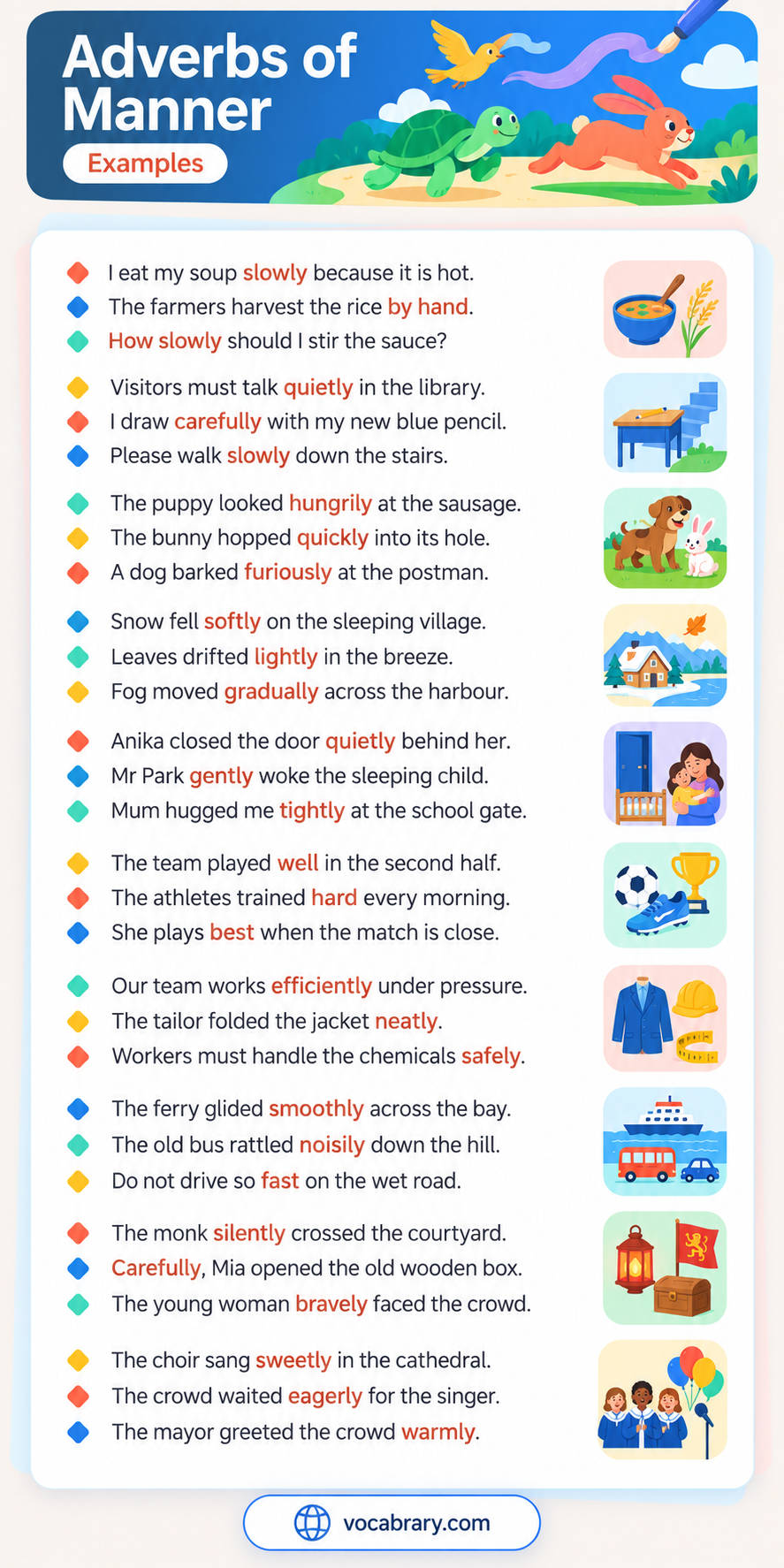
Adverbs of Manner Example Sentences for Everyday Use
Quickly, carefully, loudly, politely, and well are the adverbs of manner that learners study first. Each one answers the question how about an action such as singing, slicing, talking, or answering.
- Nadia sang beautifully at the school concert.
- The chef sliced the onions carefully before frying them.
- Our neighbour talks loudly on the phone every evening.
- Please answer the customer politely, even when she is upset.
- Sven plays the piano well, although he never took lessons.
- The cat crept silently across the kitchen floor.
- Tariq worked hard all summer to pay for his course.
- The train moved slowly through the snowy valley.
- Mrs Okoye drove quickly to the hospital.
- The children waited patiently outside the headteacher’s office.
- She wrapped the gift neatly and added a blue ribbon.
- The old man walked unsteadily across the icy yard.
- Rafael answered the last question confidently.
- The students listened attentively to the guest speaker.
- The farmer spoke angrily about the new tax at the meeting.
- Mariam smiled warmly at the nervous visitors.
- The bridge shook violently during the storm.
- He explained the problem calmly to the whole class.
- Lian cooked the rice perfectly, and everyone asked for more.
- The little girl hugged her grandmother tightly.
Examples of Adverbs of Manner Formed With -ly
Quick becomes quickly, careful becomes carefully, and loud becomes loudly when -ly is added to the adjective. Most adverbs of manner are formed this way, although some adjectives change their spelling first.
| Adjective ending | Spelling rule | Example sentence |
|---|---|---|
| Most adjectives | Add -ly | Quick becomes quickly: Ana ran quickly to the gate. |
| Adjectives ending in -e, but not -le or -ue | Keep the e and add -ly | Polite becomes politely: He spoke politely to the guard. |
| Adjectives ending in -y after a consonant | Change y to i and add -ly | Happy becomes happily: The boys played happily. |
| Adjectives ending in -le | Drop the e and add -y | Gentle becomes gently: She touched the baby gently. |
| Adjectives ending in -ic | Add -ally (the exception is public, which becomes publicly) | Dramatic becomes dramatically: Prices fell dramatically. |
| Adjectives ending in -ue | Drop the e and add -ly | True becomes truly: The witness answered truly. |
| Adjectives ending in -ll | Add -y | Full becomes fully: She explained the plan fully. |
Slowly, Quietly and Politely Example Sentences
Slow, quiet, and polite take -ly without a change in spelling, so slowly, quietly, and politely keep every letter of the adjective.
- The snail moved slowly along the garden wall.
- Zoe closed the door quietly so the baby would not wake.
- He thanked the waiter politely and left a generous tip.
- The students worked seriously during the mock exam.
- Mr Kim spoke softly to the frightened puppy.
- The swimmers dived cleanly into the pool.
- Omar replied rudely, and his mother made him apologise.
- The lifeguard reacted swiftly to the cry for help.
- She carefully folded the letter and put it in her bag.
- The doctor examined the child thoroughly.
Sentences With Happily, Angrily and Lazily
Happy, angry, lazy, and noisy end in -y after a consonant, so they change to happily, angrily, lazily, and noisily. Shy and dry are the exceptions, as in shyly and dryly.
- The twins played happily in the sand all afternoon.
- The customer shouted angrily at the empty counter.
- The cat stretched lazily on the warm windowsill.
- The children ate noisily at the long wooden table.
- Rain fell heavily on the tin roof all night.
- The puppy looked hungrily at the sausage.
- Alberto won the argument easily with two short facts.
- The boy sleepily rubbed his eyes at the window.
- The old clock ticked steadily in the hall.
- Mia was working busily in the garden when the postman called.
Gently, Dramatically and Truly in Sentences
Gentle, dramatic, true, and full change as they become adverbs, producing gently, dramatically, truly, and fully. The endings -le, -ue, and -ll lose a letter, and -ic gains -ally.
- The nurse lifted the patient gently onto the bed.
- Share prices fell dramatically after the announcement.
- Please answer truly, because this form is a legal document.
- The guide explained the safety rules fully before the climb.
- Her dress fitted comfortably, so she wore it all day.
- The old bridge creaked audibly under the weight of the lorry.
- Chen explained the plan enthusiastically to the committee.
- The magician explained the trick simply, and the children understood.
- The cake was sensibly divided into twelve slices.
- The team performed fantastically in the final.
Examples of Irregular Adverbs of Manner Without -ly
Well, fast, hard, and tight do not follow the -ly pattern, because well is the adverb of good and the other three keep the form of the adjective.
Well in a Sentence
The adjective good has no -ly form, so well describes how an action is done, as in she plays well and he cooks well.
- Maya plays the violin well for a self-taught musician.
- Amira speaks three languages well after living abroad.
- The team played well in the second half.
- My grandfather cooks well, and he never uses a recipe.
- Did the interview go well for you this morning?
- You write well, so apply for the editor’s job.
- The visitors behaved well throughout the long tour.
- Hana sleeps well after a long walk.
- The plan worked well despite the heavy rain.
- The students understood the lesson well enough to teach it.
Fast, Hard and Tight Example Sentences
Fast, hard, and tight are both adjectives and adverbs with one spelling. A fast runner uses the adjective, and she runs fast uses the adverb.
- Emeka runs fast, and he wins every school race.
- The cheetah can run fast over short distances.
- Tariq studied hard for the entrance examination.
- It rained hard all night, and the river rose.
- Hold the rope tight, and do not let go.
- Zhen hit the ball hard, and it cleared the garden fence.
- My little brother works hard at everything he tries.
- Do not drive so fast on the wet road.
- The skater turned fast and lost her balance.
Tight and Tightly, Close and Closely in Sentences
Tight and tightly, close and closely, and fair and fairly are pairs of adverbs that both describe how an action is done, and the two forms in a pair are not always interchangeable.
- Dana knotted the scarf tight around her neck.
- Tariq gripped the railing tightly as the boat rocked.
- Mia held the sleepy puppy close to keep it warm.
- The nurse watched the monitor closely throughout the night.
- Everyone in the game must play fair.
- The referee fairly awarded the penalty to the visiting team.
- The clerk wrongly charged us twice for the same ticket.
Sentences About Speed With Quickly and Slowly
Quickly, slowly, rapidly, and fast describe how fast an action is carried out, as in a runner who sprints to the gate or a tortoise that crosses the road.
- The runner sprinted quickly towards the finish line.
- The tortoise crossed the road slowly.
- The river rose rapidly after the storm.
- Customers left the shop hurriedly when the alarm rang.
- The goalkeeper moved swiftly to the left post.
- Time passed slowly during the long lecture.
- Sakura packed her suitcase fast because the taxi was waiting.
- The fire spread rapidly through the dry grass.
- The cashier counted the notes quickly and handed back the change.
- Fog moved gradually across the harbour.
- The bus crawled slowly through the market town.
- Please walk slowly on the wet floor.
Care and Effort Sentences With Carefully and Thoroughly
Carefully, thoroughly, diligently, and carelessly describe the attention that a person gives to a task, such as checking a form or repairing a clock.
- The engineer checked the bolts carefully before the test flight.
- Tomas filled in the form carelessly and missed two boxes.
- The mechanic cleaned the engine thoroughly.
- Ayesha studied diligently for the final exam.
- The watchmaker repaired the clock meticulously.
- He drove cautiously along the icy mountain road.
- The students painted the mural enthusiastically.
- Priya double-checked her answers conscientiously before handing in the paper.
- The workers dug the trench tirelessly until sunset.
- The surgeon operated skilfully for six hours.
- The editor read the manuscript attentively.
- Please handle the glass gently because it is old.
Loudly and Softly in Sound and Voice Sentences
Loudly, quietly, softly, and noisily describe the volume of a voice or an object, as in a teacher who speaks softly or a crowd that cheers loudly.
- The crowd cheered loudly when the home team scored.
- The teacher spoke softly to the shy new pupil.
- The wind howled mournfully around the old farmhouse.
- Visitors must talk quietly in the library.
- The toddler banged his spoon noisily on the tray.
- The choir sang sweetly in the cathedral.
- She whispered nervously into the telephone.
- The engine hummed steadily all night.
- The little boy cried bitterly when his kite broke.
- The singer held the last note clearly for ten seconds.
- A dog barked furiously at the postman.
- The radio played faintly from the next room.
Politely and Rudely in Behaviour Sentences
Politely, rudely, kindly, and bravely describe how a person behaves towards others, whether a waiter thanks a customer or a firefighter enters a burning flat.
- The waiter politely thanked the family for waiting.
- Joseph spoke rudely to the receptionist and then regretted it.
- The firefighter entered the burning flat bravely.
- Mrs Dlamini treated every patient kindly.
- The prince behaved generously towards the poor villagers.
- He answered the judge honestly and without any delay.
- The guests dressed formally for the opening night.
- Our guide treated the group respectfully at every temple.
- The children shared their toys fairly.
- The soldier saluted proudly as the flag went up.
- Sofia refused the generous offer graciously.
- The mayor greeted the crowd warmly.
Happily, Sadly and Nervously in Mood Sentences
Happily, sadly, nervously, and excitedly describe the emotion behind an action, as in a child who waves happily or a student who waits nervously.
- The child waved happily from the train window.
- She waited nervously outside the examination room.
- Grandpa sighed sadly when the old tree fell.
- The puppy wagged its tail excitedly at the door.
- The players looked anxiously at the scoreboard.
- Tomás smiled proudly as his daughter collected the prize.
- The crowd waited eagerly for the singer.
- Dina laughed cheerfully at the joke.
- He stared blankly at the empty page.
- The audience clapped warmly after the final song.
- The twins hugged each other tearfully at the airport.
- Kenji glanced fearfully at the dark corridor.
In a Hurry, With Care and by Hand Example Sentences
Phrases such as in a hurry, with care, and by hand work as an adverb of manner in several words, and they answer the question how in the same way.
- Marta left the house in a hurry and forgot her keys.
- The jeweller cut the stone with great care.
- The farmers harvest the rice by hand.
- The children listened in silence to the old story.
- Hira answered the question in a friendly way.
- The driver raced at full speed to the station.
- The pupils walked in single file along the corridor.
- She cooked the stew step by step, as her mother had taught her.
- The pianist played like a professional at only twelve.
- He broke the window on purpose.
- The old man read the letter out loud.
- The soldiers marched in perfect time.
Manner Adverbs in Different Sentence Positions
Adverbs of manner go after the verb, after the object, before the main verb, between an auxiliary and the main verb, or at the start of a sentence, and the choice changes the emphasis. They do not stand between a verb and its direct object in standard English.
Sentences With the Adverb After the Verb
When the verb has no object, the adverb of manner comes straight after it, as in the baby slept peacefully and the horse galloped wildly.
- The baby slept peacefully through the thunderstorm.
- The horse galloped wildly across the field.
- Rita sings beautifully in the church choir.
- The old bus rattled noisily down the hill.
- Snow fell softly on the sleeping village.
- The athletes trained hard every morning.
- The candidate spoke confidently and won the debate.
- Leaves drifted lightly in the breeze.
- The patient breathed easily after the treatment.
Sentences With the Adverb After the Object
When the verb has an object, the adverb of manner comes after it, as in she closed the door quietly and he speaks Spanish fluently. The adverb stands after the whole verb phrase, never between the verb and its object.
- Anika closed the door quietly behind her.
- Hugo speaks Spanish fluently after two years in Madrid.
- The tailor folded the jacket neatly.
- The mechanic fixed the brakes properly this time.
- Mr Lopez drives his truck dangerously on narrow roads.
- The nurse lifted the box carefully from the shelf.
- Ibrahim kicked the ball powerfully into the net.
- My aunt writes her letters elegantly in blue ink.
- The reporter described the accident accurately.
Carefully Before the Main Verb for Emphasis
Before the main verb, an adverb of manner adds emphasis or gives a literary tone, as in she carefully placed the vase and he quietly left the room.
- She carefully placed the vase on the highest shelf.
- He quietly left the room before the speech ended.
- The detective slowly opened the drawer.
- Ines proudly announced her engagement at dinner.
- The children eagerly opened their presents.
- The young woman bravely faced the crowd.
- Mr Park gently woke the sleeping child.
- The old fisherman patiently waited for the tide.
- The monk silently crossed the courtyard.
Adverbs Between the Auxiliary and the Main Verb
With an auxiliary verb, an adverb of manner goes between the auxiliary and the main verb, as in she has carefully checked and they were quietly reading.
- She has carefully checked every number in the report.
- The children were quietly reading when the lights went out.
- He had bravely refused the bribe.
- The farmers will gladly share the harvest with their neighbours.
- Lucia was anxiously waiting for the results.
- The workers have steadily improved the road all winter.
- You should gently press the button twice.
- They had secretly planned the surprise for months.
- The company has successfully launched its new app.
Slowly at the Start of a Sentence
An opening adverb of manner puts the emphasis on the way of acting, and a comma follows it, as in slowly, the curtain rose and carefully, Mia opened the box.
- Slowly, the curtain rose on the first scene.
- Carefully, Mia opened the old wooden box.
- Angrily, the referee blew his whistle.
- Silently, the soldiers crossed the frozen river.
- Bravely, the girl stepped onto the stage.
- Reluctantly, Mr Hall signed the paper.
- Gracefully, the dancers entered from the left.
- Proudly, Sana held up the trophy.
- Nervously, the boy knocked on the headmaster’s door.
Examples of Adverbs of Manner With Very, Quite and Extremely
In very quickly, quite well, and extremely carefully, an adverb of degree stands before the adverb of manner to show how much. A clerk who works very quickly and a bus that moves too slowly are two cases.
- The clerk works very quickly during the lunch rush.
- Kofi plays the guitar quite well for his age.
- The surgeon worked extremely carefully on the tiny valve.
- The bus moved too slowly for the impatient passengers.
- She spoke so quietly that nobody in the back row heard.
- The team played really badly in the first half.
- He drove rather recklessly along the coast road.
- The exam ended fairly quickly for the confident students.
- Please speak a little more slowly.
- The cake was almost perfectly baked.
Careful and Carefully in Adjective and Adverb Sentences
An adverb of manner describes a verb, while an adjective describes a noun, so quick and quickly look alike but do different jobs in a sentence.
| Feature | Adverbs of manner | Adjectives |
|---|---|---|
| Word described | A verb | A noun or a pronoun |
| Question answered | How is the action done? | What kind of person or thing is it? |
| Typical ending | Most end in -ly | Many end in -ful, -ous, or -y |
| Position | After the verb or the object | Before a noun or after a linking verb |
| Example | The driver stopped suddenly. | The sudden stop surprised us. |
- Aiko is a careful driver, and she drives carefully in the rain.
- A slow train left the station, and it moved slowly uphill.
- Her quiet voice reached us, and she spoke quietly throughout.
- A loud song began, and the crowd cheered loudly.
- He gave a polite answer and replied politely to every question.
- We had a quick lunch, and we ate quickly to catch the bus.
- That is a beautiful song, and Nadia sings it beautifully.
- The happy child ran home and played happily in the garden.
- A gentle breeze moved the curtains, and the nurse worked gently.
- It was a hard exam, and the students worked hard.
Good and Well Contrast Sentences
Good and quick are adjectives that describe a noun, and well and quickly are adverbs that describe a verb. After linking verbs such as feel, look, and taste, an adjective is correct when the word describes the subject.
- Hana is a good cook, and she cooks well.
- The soup tastes good, and Nadia cooks it well.
- Marco is a quick learner who learns quickly.
- You look happy today, and you sang happily this morning.
- He is a bad swimmer and swims badly in cold water.
- Their answer was correct, and they answered correctly.
- The dinner smells delicious, and Mei prepares it skilfully.
- She felt nervous, and she waited nervously by the phone.
- Lucas was angry and shouted angrily at the referee.
- The music sounds wonderful, and the band plays wonderfully.
- It was an easy test, and the class passed it easily.
- The tea tastes sweet, and the children drank it eagerly.
Using Adverbs of Manner in Comparative and Superlative Forms
Adverbs of manner form the comparative with more, or with -er for short adverbs such as fast and hard, and the superlative with most or -est. Well has the irregular forms better and best, and badly has worse and worst.
- Esra drives more carefully than her brother.
- Run faster, or we will miss the train!
- No one in our class works harder than Aiko.
- Kamal sings better than anyone else in the choir.
- Of all the pupils, Sana writes the most neatly.
- The new bus travels more quietly than the old one.
- Tom swims worst of all the boys in the group.
- The second runner finished more slowly than the first.
- Leila speaks most confidently when she prepares her notes.
- She plays best when the match is close.
- The wind blew harder after midnight.
- Please explain it more slowly this time.
Adverbs of Manner in Negative Sentences
A negative sentence places not or never before the verb, and the adverb of manner still follows the verb or the object, as in he did not drive carefully.
- He did not drive carefully on the icy road.
- They do not speak loudly in the library.
- She never answers rudely, even when she is tired.
- Please do not step carelessly on the wet stairs.
- The nurse did not handle the patient roughly.
- I could not sleep peacefully with the noise outside.
- He did not react angrily to the criticism.
- The team did not play well in the first half.
- Nobody spoke harshly at the meeting.
- The students did not answer correctly on the first attempt.
- Don’t speak so fast, because I cannot follow you.
- My neighbour doesn’t play the drums quietly.
Common Adverbs of Manner in How Questions
How opens many questions about manner, and how well, how carefully, and how fast ask about degree and quality. An adverb of manner also stands inside a yes-or-no question.
- How did the pupils behave on the trip?
- How well does your cousin speak French?
- How carefully did the team check the results?
- How fast can a cheetah run?
- Did the soldiers fight bravely during the long siege?
- Who drives more carefully, you or your sister?
- Why does the radio play so loudly at night?
- Did she answer the examiner politely?
- How slowly should I stir the sauce?
- Can you explain the answer clearly?
- How quickly did the ambulance arrive?
- Do the children play quietly when you are working?
Reported Speech and Passive Sentences With Manner Adverbs
In reported speech, the adverb of manner stays the same while the verb changes tense, as in she said he drove dangerously. In a passive sentence, it goes before or after the past participle, as in the glass was carefully wrapped and the glass was wrapped carefully.
- The witness said that the driver had behaved dangerously.
- My mother asked me to speak quietly in the hospital.
- The coach told the players to run faster.
- The manager said that Kofi had worked diligently all year.
- She explained that the machine had worked perfectly until Monday.
- The glass was carefully wrapped in two layers of paper.
- The report was written hastily and contained many errors.
- The wounded soldier was treated kindly by the villagers.
- The door was closed quietly by the last guest.
- The prisoners were treated harshly during the war.
- The cake was beautifully decorated by the youngest baker.
- The new rules were explained clearly to every employee.
Home Sentences With Carefully and Quietly
Cooking carefully, playing quietly, and folding laundry neatly are habits in a house, so these adverbs of manner example sentences show how an adverb of manner describes each one.
- My father cooks the rice carefully and never burns it.
- The children play quietly while the baby sleeps.
- Grandma knits patiently by the window every afternoon.
- The twins argued noisily over the last biscuit.
- Mum folded the laundry neatly into three piles.
- The kettle whistled loudly, and everyone woke up.
- Dad fixed the shelf properly with four long screws.
- Our cat ate her dinner greedily and walked away.
Neatly and Attentively in School Sentences
Writing neatly, listening attentively, and answering confidently are classroom habits, so these adverbs of manner example sentences show how an adverb of manner describes each one.
- The pupils write neatly in their exercise books.
- Ms Adeyemi explains the grammar clearly on the board.
- The class listened attentively to the visiting author.
- Karim answered the question confidently in front of everyone.
- The younger students lined up quietly outside the hall.
- Daniela works hard and rarely misses a lesson.
- The pupils behaved well during the fire drill.
- Mr Tan marked the papers fairly and returned them on Friday.
Work Sentences With Politely and Efficiently
Replying politely, working efficiently, and handling tools safely are working habits, and each one is described by an adverb of manner.
- The receptionist greeted every visitor politely.
- Our team works efficiently under pressure.
- The accountant checked the figures thoroughly before signing.
- Workers must handle the chemicals safely.
- Mr Das presented the results confidently to the board.
- The new employee learned the system quickly.
- Please send the invoice promptly after the meeting.
- The manager spoke frankly about the budget.
Travel Sentences Using Carefully and Patiently
Driving carefully, queuing patiently, and arriving safely are parts of a trip, and each one is described by an adverb of manner.
- The coach driver steered carefully around the sharp bend.
- Passengers queued patiently at the border gate.
- Our flight landed safely despite the strong crosswind.
- The ferry glided smoothly across the bay.
- The tourists haggled cheerfully in the market.
- The guide led the group confidently through the narrow streets.
- The train moved slowly over the old viaduct.
- We packed our bags hurriedly and ran for the bus.
Peacefully and Decisively in News Report Sentences
Marching peacefully, acting decisively, and speaking angrily are the ways of acting that reporters describe, and each one is shown by an adverb of manner.
- Protesters marched peacefully through the capital.
- The government acted decisively after the flood.
- The minister spoke angrily about the delay.
- Firefighters worked tirelessly through the night.
- The rebels withdrew quietly from the village.
- The prime minister firmly rejected the proposal.
- Voters queued patiently at polling stations across the country.
- The council voted unanimously to build a new library.
Fiction Sentences With Bravely and Silently
A knight who fights bravely, a ghost who glides silently, and a miser who counts coins greedily show how writers use an adverb of manner to describe a character.
- The knight fought bravely against three armed men.
- The ghost glided silently through the walls of the castle.
- The miser counted his coins greedily.
- Elizabeth Bennet firmly refused Mr Collins’s proposal.
- The old witch laughed wickedly in the dark forest.
- The pilot listened patiently to the little prince’s story.
- Alice followed the white rabbit curiously down the hole.
- The captain stared grimly at the approaching storm.
Sentences About Sports With Fast and Fairly
Running fast, playing fairly, and defending bravely are ways of acting on a pitch, and each one is described by an adverb of manner.
- The striker ran fast towards the open goal.
- The defender tackled cleanly and won the ball.
- Our captain plays fairly, even when the score is close.
- The gymnast landed perfectly after her last jump.
- The cyclists climbed the hill steadily.
- The goalkeeper dived bravely at the striker’s feet.
- Both teams played aggressively in the first ten minutes.
- The referee spoke calmly to the angry players.
Deeply and Soundly in Health Sentences
Breathing deeply, sleeping soundly, and stretching slowly are ways of caring for the body, and each one is described by an adverb of manner.
- The nurse told the patient to breathe deeply.
- Grandpa slept soundly after the long walk.
- The physiotherapist stretched my leg slowly.
- The doctor spoke gently to the frightened child.
- Chew your food slowly to help your digestion.
- The wound healed quickly after the operation.
- She walked painfully down the corridor after her fall.
- Nadir ate healthily during the whole training camp.
Adverbs of Manner Sentences for Kids
Running happily, eating slowly, and drawing carefully are everyday actions for children, so these adverbs of manner example sentences for kids use quietly, carefully, or slowly.
- The puppy ran happily across the park.
- I draw carefully with my new blue pencil.
- My sister sings loudly in the bath.
- The baby sleeps quietly in her cot.
- Please walk slowly down the stairs.
- Our teacher reads funny stories beautifully.
- I eat my soup slowly because it is hot.
- The bunny hopped quickly into its hole.
- Mum hugged me tightly at the school gate.
- We played nicely together all afternoon.
Short Adverbs of Manner Sentences for Young Learners
Slowly, quietly, happily, and well give beginners short adverbs of manner example sentences of six to eight words, and each one pairs a familiar action with one adverb.
- The turtle walks slowly to the pond.
- Please close the door quietly at night.
- The kids play happily in the garden.
- My brother kicks the ball well.
- The snow falls softly on the roof.
- She paints her pretty picture carefully.
- The cat jumps quickly onto the sofa.
- Dad drives slowly through the village.
Academic Adverbs of Manner Sentences for Students
Essays and exam answers use adverbs of manner such as thoroughly, systematically, and accurately to describe how research is carried out, so these adverbs of manner example sentences suit exam-level writing.
- The researchers examined the samples systematically.
- The author argues convincingly that the policy failed.
- Candidates must answer every question accurately and in full sentences.
- The committee reviewed the evidence thoroughly before voting.
- The graph shows that sales rose sharply in the third quarter.
- The two theories differ significantly in their conclusions.
- The students presented their findings clearly and with confidence.
- The government responded swiftly to the economic crisis.
- The writer describes the war vividly in the opening chapter.
- Participants completed the survey independently in separate rooms.
Using Adverbs of Manner in Short Paragraphs
A busy kitchen, a school concert, a night drive, and a quiet library are the four settings of these short passages, and each passage uses adverbs of manner in several positions.
The chef chopped the onions quickly and fried them gently. He tasted the sauce carefully, and then he added the salt slowly. The waiters carried the plates smoothly across the crowded room. Customers ate happily, and the kitchen closed quietly at midnight.
The children sang loudly on the stage, and the parents clapped warmly. Mina played the flute beautifully, although her hands shook nervously. The teacher smiled proudly from the front row. After the final song, everyone left the hall cheerfully.
Rahul drove carefully along the dark mountain road. The rain fell heavily, and the wipers moved steadily. He spoke softly to keep his sleepy daughter calm. At last the village lights appeared, and he parked gratefully by the church.
The library was silent. Students turned the pages gently and wrote quietly. The librarian walked slowly between the shelves and smiled kindly at the youngest readers. Outside, rain tapped lightly on the windows, and nobody left early.
FAQs
Q1. Which words are the most common adverbs of manner?
The most common adverbs of manner are quickly, slowly, carefully, loudly, quietly, politely, well, hard, and fast. Each one answers the question how about an action. Most end in -ly, but well, hard, and fast do not.
Q2. How do you form an adverb of manner from an adjective?
You form an adverb of manner by adding -ly to the adjective, so quick becomes quickly and careful becomes carefully. Adjectives ending in -y after a consonant change to -ily, as in happy and happily. Adjectives ending in -le lose the e and add -y, as in gentle and gently.
Q3. Where do adverbs of manner go in a sentence?
Adverbs of manner go after the verb when there is no object and after the object when there is one. In she sings beautifully, the adverb follows the verb, and in he closed the door quietly, it follows the object. Before the main verb, the adverb adds emphasis, as in she carefully placed the vase.
Q4. What is the difference between an adverb of manner and an adjective?
An adverb of manner describes a verb, while an adjective describes a noun or a pronoun. A quick reply uses the adjective quick, and she replied quickly uses the adverb quickly. The two forms look alike, but each one answers a different question.
Q5. Is well an adjective or an adverb?
The word well is an adverb when it describes how an action is done, as in she plays the piano well. Well is also an adjective when it means in good health, as in I am well, thank you. The adjective good has no adverb form of its own, so well is the adverb used in its place.
Q6. Do all adverbs of manner end in -ly?
Adverbs of manner do not all end in -ly, because well, fast, and hard keep a different form. Fast and hard are also adjectives with the same spelling, as in a fast car and a hard exam. Phrases such as in a hurry and with care work as adverbs of manner with no -ly at all.
Q7. What is the difference between hard and hardly?
Hard is the adverb that means with great effort, as in he works hard. Hardly means barely or almost not, as in I could hardly hear her. The two words have different meanings, so he works hard and he hardly works describe opposite habits.
Q8. Is it correct to put an adverb of manner before the verb?
An adverb of manner before the main verb is correct and adds emphasis, as in she carefully placed the vase on the shelf. The pattern is common in stories and formal writing. After the verb and its object, the adverb stands at the end, as in he opened the door slowly.
Q9. What are adverbial phrases of manner?
Adverbial phrases of manner are groups of words that answer how in the same way as a single adverb. In a hurry, with great care, by hand, and step by step are examples. They go after the verb or the object, as in she left in a hurry.
Q10. How do you spell adverbs from adjectives ending in -y?
You spell adverbs from adjectives ending in -y by changing the y to i and adding -ly, which gives happily, angrily, and lazily. Shy and dry are the exceptions, and they become shyly and dryly. The same change applies to noisy and noisily.
Q11. What is the difference between fast and quickly?
Fast and quickly both describe a high speed, but fast is also an adjective while quickly is only an adverb. Before a noun, only the adjective form appears, as in a fast train. As adverbs, she runs fast and she runs quickly mean the same.
Q12. What are the comparative and superlative forms of adverbs of manner?
Adverbs of manner form the comparative with more and the superlative with most, as in more carefully and most carefully. Short adverbs such as fast and hard take -er and -est, as in faster and hardest. Well is irregular, with the forms better and best.
Q13. What is the difference between adverbs of manner and adverbs of degree?
Adverbs of manner describe how an action is done, while adverbs of degree describe how much or to what extent. Carefully is an adverb of manner, and very is an adverb of degree. The two types combine in phrases such as very carefully, where very modifies carefully.

Leave a Comment