
An adverb is a part of speech that describes a verb, an adjective or another adverb, as in Nadia sang beautifully. Most adverb sentences examples answer a single question about an action: how it was done, when it started, where it went, how many times, or to what degree.
What Is an Adverb?
An adverb modifies a verb, an adjective, another adverb or a whole sentence, and it answers how, when, where, how many times, or to what degree. An adjective describes a noun instead, so a quick runner uses an adjective while he runs quickly uses an adverb.
Verb + adverb, or adverb + verb
Ravi finished the exam quickly and checked his answers twice.
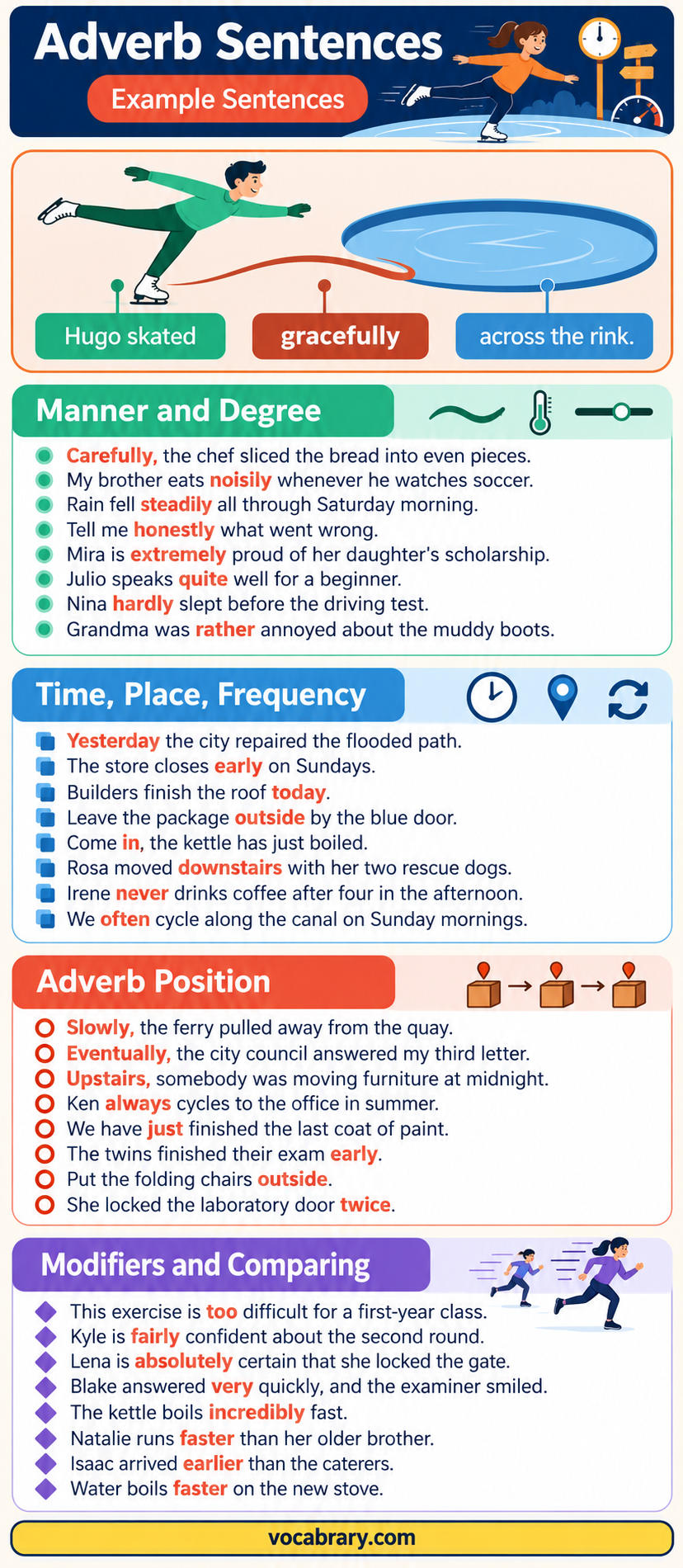
Common Adverb Sentences Examples
Singing beautifully, arriving late, driving carefully and speaking Portuguese fluently are the everyday adverb sentences examples. One bolded word in each line answers how, when, where or how many times the action went.
- Nadia sang beautifully at the school concert.
- The train arrived late, so we missed our connection to Bristol.
- Marcus speaks Portuguese fluently after three years in Lisbon.
- Yesterday the plumber fixed the leaking tap in our kitchen.
- My grandmother walks slowly on the icy pavement.
- Children were playing outside until the rain started.
- Hana never forgets a birthday in her family.
- Diego finished his homework quickly and ran to football practice.
- This soup tastes extremely salty, so nobody asked for a second bowl.
- Please answer every question honestly.
- Karim drove carefully along the narrow mountain road.
- We meet here every Friday afternoon.
- Our professor spoke softly, and the students at the back struggled to hear him.
- Sofia rarely eats dessert during the week.
- A neighbour’s dog barked loudly when the postman opened the gate.
- Did Omar finish the report already?
- Suddenly the lights went out across the whole street.
- The nurse spoke gently to the frightened child.
Six Types of Adverbs With the Questions They Answer
Politely, tomorrow, outside, always, very and therefore each answer a different question about an action. Six adverb types share one grammar job, and the question word beside each type names the answer it gives.
| Type of adverb | Question it answers | Example sentence |
|---|---|---|
| Manner | How? | Priya answered the phone politely. |
| Time | When? | The exam marks arrive tomorrow. |
| Place | Where? | Leave the parcel outside. |
| Frequency | How many times? | Tom always locks the back door. |
| Degree | To what extent? | The film was very long. |
| Reason | Why? | The road was flooded, and therefore the match was cancelled. |
Adverbs of Manner in Example Sentences
Answering a phone politely, slicing bread carefully and dancing gracefully are adverbs of manner, the type that names the way an action was done. Most of them end in -ly and stand next to the verb they describe.
- Priya answered the phone politely even after the fourth complaint from the same caller.
- Carefully, the chef sliced the bread into even pieces.
- Lucia dances gracefully, and her teacher entered her for the regional contest.
- The mechanic examined the engine thoroughly before signing the service form.
- My brother eats noisily whenever he watches football.
- Angrily, Mr Fernandes slammed the office door.
- Sami waited patiently while the nurse prepared the injection.
- Rain fell steadily all through Saturday morning.
- She translated the contract accurately in under two hours.
- The thieves entered the museum silently through a side window.
- Amara sings badly, yet she joins every karaoke night.
- Tell me honestly what went wrong.
- Our tour leader explained the ruins clearly to twelve visitors.
- Joseph writes neatly in his exercise book.
Adverbs of Time in Example Sentences
Yesterday, tomorrow, soon, already and tonight fix the moment of an action. These adverbs of time answer when, and English lets most of them stand at the start or the end of the sentence.
- Yesterday the council repaired the flooded footpath.
- Our marks arrive tomorrow by email.
- Grandpa takes his medicine daily at seven.
- The shop closes early on Sundays.
- Nour has already packed her suitcase for the flight to Amman.
- We will call the dentist soon about the broken filling.
- Then the referee blew the whistle and the crowd rose.
- Elena moved to Toronto recently, and she still misses the sea near her old apartment.
- Have you spoken to the landlord yet?
- Afterwards, we walked to the harbour for ice cream.
- Builders finish the roof today.
- Marta will return the library books later this week.
- Ibrahim arrived first and saved four seats.
- The museum reopens tonight for a candlelit tour.
Adverbs of Place in Example Sentences
Parcels left outside, a cat asleep upstairs and keys that are nowhere in the flat give the plainest adverbs of place. Each bolded word answers where without a preposition in front of it.
- Leave the parcel outside by the blue door.
- Everywhere we looked, tulips filled the fields.
- Our cat sleeps upstairs on my sister’s bed.
- Hasan searched nearby for a chemist that opened on Sunday.
- Come in, the kettle has just boiled.
- My keys are nowhere in this flat.
- Stefan studied abroad for two semesters in Seoul and came home with a new accent.
- The children ran ahead while their parents pushed the pram.
- Push the wardrobe backwards until it touches the wall.
- Rosa moved downstairs with her two rescue dogs.
- Wait there until the doctor calls your name.
- Aunt Fatima walked away without answering my question.
- The engineers work indoors during the winter months.
- Look around before you cross the tram line.
Adverbs of Frequency in Example Sentences
Locking a door every night, cycling on Sunday mornings and washing a van every two weeks produce the standard adverbs of frequency. Each one counts how many times an action repeats.
- Tom always locks the back door before he goes to bed at eleven.
- Ines never drinks coffee after four in the afternoon.
- Sometimes the bus to the harbour runs twenty minutes late.
- My father checks the tyre pressure weekly.
- The choir rehearses twice a week in the village hall.
- Sanjay rarely answers his phone during working hours.
- Usually the market closes at two, but the fish stalls stay open.
- Teachers at our school mark homework daily.
- We often cycle along the canal on Sunday mornings.
- Zara seldom complains, even when the shift runs over.
- Do you visit your grandparents monthly?
- The alarm rings hourly in the hospital corridor.
- Ahmed washes his van fortnightly.
- Occasionally a heron lands on the roof of the boathouse.
Adverbs of Degree in Example Sentences
A film that was very long, a candidate who was completely unprepared and a boy who barely touched his dinner show adverbs of degree. Each bolded word measures how much, and it goes in front of the word it strengthens or weakens.
- The film was very long, and two people left at the interval.
- Mira is extremely proud of her daughter’s scholarship.
- We almost missed the ferry to Corsica.
- Absolutely nothing was left in the fridge on Monday morning.
- Julio speaks quite well for a beginner.
- This coat is too thin for a Warsaw winter.
- Our candidate was completely unprepared for the second interview.
- Nina hardly slept before the driving test.
- Your handwriting has improved enormously since September.
- I am deeply grateful for the loan.
- Grandma was rather annoyed about the muddy boots.
- The lecture hall was totally silent during the announcement.
- Fahad barely touched his dinner.
- Are you really sure about the flight time?
Adverbs of Reason in Example Sentences
A flooded road that cancels a match, missed payments that freeze an account and a lost passport that ends a trip are adverbs of reason at work. Therefore, thus, hence and consequently link a cause to the outcome it produced.
- The road was flooded, and therefore the match was cancelled.
- Ingrid missed two payments; consequently, the bank froze her account.
- Our supplier raised prices, and thus the café printed a new menu.
- Sales fell for six months in a row; accordingly, the board cut the advertising budget by half.
- Rahul lost his passport, and hence he stayed behind.
- Snow blocked the pass; accordingly, the postman turned back.
- Two witnesses withdrew, and the trial was therefore postponed until March.
- The printer had run out of ink, and thus nobody received a timetable.
- Diana speaks three languages; consequently, the embassy offered her a role in Lisbon.
- Heavy rain damaged the crop, and hence the price of onions doubled.
- My alarm failed; hence I missed the first lecture of the term.
- Nobody signed the petition, and the council therefore approved the car park.
Conjunctive Adverbs in Example Sentences
A generous offer turned down, a cancelled train that still ends at a wedding and a bakery with no rye bread show conjunctive adverbs joining two independent clauses. A semicolon comes first and a comma follows the adverb.
- The offer was generous; however, Lina turned it down.
- Tickets sold out in an hour; moreover, the venue added a second night.
- Our train was cancelled; nevertheless, we reached the wedding before the vows.
- Hurry; otherwise we will miss the ferry.
- Ali studied medicine in Cairo; subsequently, he opened a clinic in Alexandria.
- The bakery had no rye bread; instead, we bought two sourdough loaves.
- Meanwhile, the guests waited in the courtyard with cold drinks.
- Petra dislikes long flights; besides, the fares to Auckland had doubled.
- Her first novel sold poorly; nonetheless, the publisher commissioned a second.
- Leeds council promised repairs; furthermore, it agreed to pay the legal costs.
- My uncle collects stamps from the 1950s; likewise, his daughter keeps albums of old coins.
- Negotiations dragged on for months; finally, both sides signed.
- Winter sales were weak; conversely, the summer figures broke a record.
- Indeed, the repair cost more than the washing machine itself.
Interrogative Adverbs in Example Sentences
Trams, hired cars, a shut library and a jamming printer supply the questions that interrogative adverbs open. When, where, why and how ask for a time, a place, a cause or a method.
- When does the last tram leave Piazza Garibaldi?
- Where did you park the hired car?
- Nobody explained why the library shuts on Tuesday mornings.
- How did Amina reach the summit before the guides?
- Tell me when the plumber will send his invoice.
- Ask the porter where the delegates should leave their luggage.
- The interns asked why nobody had warned them about the fire drill.
- How far is the clinic from the bus station?
- Marta wondered how long the interview would last.
- Why does this printer jam every Monday?
- Sara asked how much a monthly travel pass costs for students in Prague.
- I forget when your family moved to Bristol.
- Where did the parade start?
- My father never asked why the engine had failed.
Relative Adverbs in Example Sentences
A village where grandparents met, a summer when a river dried up and the reason why a ferry was delayed are relative adverbs in action. Where, when and why attach a clause to the noun in front of them.
- This is the village where my grandparents met in 1964.
- Sunday is the day when the whole family eats together.
- Nobody explained the reason why the ferry was delayed.
- The office where I trained has closed.
- I remember the summer when the river dried up completely.
- That is the shelf where Mum keeps the passports.
- July is the month when the lavender fields turn purple.
- Rania described the moment when the referee changed his decision and the crowd fell silent.
- A wooden bench marks the place where Ana proposed to Luis.
- Do you know the reason why the alarm rang at midnight?
- Bruges is the city where we spent our honeymoon.
- Autumn is the season when the storms reach the coast.
- Grandad never told us the reason why he sold the farm.
- Nagoya is the town where my mother learned to swim.
Adverbs That Modify Verbs, Adjectives and Other Adverbs
A completely frozen lake, a queue that moved too slowly and a collision nobody was hurt in show the three targets an adverb reaches beyond a plain verb. The same word class describes an adjective, a second adverb, or an entire statement.
Adverbs That Modify Adjectives
Frozen lakes, nervous students and unusually expensive bananas put an adverb in front of an adjective. The adverb measures the adjective, so the reader learns how frozen, how nervous or how expensive.
- The lake was completely frozen by the first week of January this year.
- Hassan felt incredibly nervous before his viva.
- This exercise is too difficult for a first-year class.
- Grandma looked remarkably calm after the accident.
- Your handwriting is surprisingly neat for a doctor.
- Bananas were unusually expensive at the market on Saturday.
- Kofi is fairly confident about the second round.
- We were deeply sorry to hear about your loss.
- The cellar stays perfectly dry even in a storm.
- Lena is absolutely certain that she locked the gate.
- That documentary was utterly boring from the first minute to the last.
- My tea is slightly cold.
- Rome in August is unbearably hot.
- Are you quite ready for the presentation?
Adverbs That Modify Other Adverbs
Answering very quickly, writing extremely neatly and driving far more carefully pair one adverb with another. The first word grades the second, and the verb keeps its own meaning.
- Bilal answered very quickly, and the examiner smiled.
- Queues moved too slowly for passengers with early flights.
- Aisha writes extremely neatly for a six-year-old.
- Our team played rather poorly in the second half.
- The choir sang quite beautifully at the Christmas service.
- Marcus drives far more carefully since the accident on the coast road in March.
- My cousin arrived surprisingly early for a Sunday brunch.
- The kettle boils incredibly fast.
- Nina speaks Japanese almost perfectly after one year in Osaka.
- He explained the rules so clearly that even the youngest player understood.
- Rosa finished much sooner than the other candidates.
- Did the ambulance arrive really quickly?
- A stray dog waited quite patiently outside the butcher’s shop.
- Sami answered less confidently in the second interview.
Sentence Adverbs That Modify a Whole Sentence
Fortunately, unfortunately, apparently and frankly comment on an entire statement rather than on one verb. A comma separates the adverb from the clause it judges.
- Fortunately, nobody was hurt in the collision on the ring road.
- Honestly, I had forgotten the meeting entirely.
- Unfortunately, the visas arrived three days after the flight.
- Clearly, the committee had already made its decision before the first witness spoke at the hearing.
- Luckily, Omar had kept spare keys under the plant pot.
- Apparently, the factory will reopen in spring.
- Sadly, the old cinema on Mill Street closed in June.
- Frankly, the second album disappointed me.
- Surprisingly, the cheapest hotel had the best breakfast.
- Obviously, the referee had not seen the foul.
- The talks dragged on, admittedly, for far too long.
- Curiously, the letter had no stamp and no return address.
Adverb Position at the Start, Middle and End of a Sentence
Quietly at the front, always in the middle and early at the end, one adverb takes three positions without losing its meaning. Frequency adverbs prefer the middle, while manner and time adverbs travel to either edge.
Adverbs at the Start of a Sentence
Quietly closing a reading room, slowly pulling away from a quay and suddenly losing power put the adverb in front of everything else. The opening word sets the mood of the whole clause.
- Quietly, the librarian closed the reading room at eight and switched off the lamps.
- Tomorrow the inspectors visit the bakery on Green Lane.
- Slowly, the ferry pulled away from the quay.
- Never had Rosa seen such a crowd at the station.
- Outside, three cyclists waited for the rain to stop.
- Eventually, the council answered my third letter.
- Rarely does the mayor attend a school assembly.
- Yesterday my neighbour repainted his front gate.
- Suddenly the power failed and the freezer defrosted.
- Upstairs, somebody was moving furniture at midnight.
- Carefully, Yasmin lifted the cake onto the silver tray.
- Soon the almond trees will flower.
- Abroad, my sister pays half as much rent.
- Silently, the two cats crossed the garden wall.
Adverbs in the Middle of a Sentence
Always cycling, already signing a lease and unanimously rejecting a proposal place the adverb just in front of the main verb. Frequency adverbs and short manner adverbs prefer this position.
- Kemal always cycles to the office in summer.
- The tenants have already signed the new lease.
- My sister hardly ever eats bread.
- Pedro is never late for a rehearsal.
- We have just finished the last coat of paint.
- Aisha quietly left the meeting after the vote.
- Members of the panel unanimously rejected the proposal.
- Our landlord rarely answers an email before Friday.
- Dr Okafor carefully removed the splinter from the boy’s thumb with a pair of tweezers.
- The engineers have finally repaired the lift in our building.
- Sana completely forgot her cousin’s wedding anniversary.
- This bus seldom reaches the terminus on time.
- Paulo had almost finished the marathon when his knee gave way.
- My parents still send postcards from every holiday.
Adverbs at the End of a Sentence
Finishing early, landing late and greeting a teacher warmly put the adverb after the verb or its object. Manner, place and time adverbs take the final position most comfortably.
- The twins finished their exam early.
- Pour the batter into the tin slowly.
- Ravi answered the inspector’s questions calmly.
- My flight from Doha landed late.
- Put the folding chairs outside.
- Mrs Alvarez climbed the stairs painfully.
- Our pianist played the final movement flawlessly.
- Send the signed contract back today.
- Farid greeted his old teacher warmly at the school gate on prize day.
- She locked the laboratory door twice.
- Workers repaired the burst pipe overnight.
- Speak loudly, because the hall has no microphone.
- Uncle Bashir drives everywhere.
- The winners will be announced tomorrow.
Adverbs Formed by Adding -ly
Gently, carefully, sincerely and recklessly all start as adjectives and take -ly. A final y becomes i, as in happy and happily, and a final le drops the e, as in gentle and gently.
- Ana closed the lid gently so that the baby slept on.
- The auditor checked every figure carefully.
- Our neighbours argue constantly about the shared driveway.
- Bruno apologised sincerely for the broken window.
- Snow fell heavily across the northern counties.
- Leyla sings softly when she cooks.
- A judge spoke firmly to the two lawyers.
- Ken finished the puzzle easily in eleven minutes.
- Riya answered immediately.
- Tom drove recklessly and lost his licence for a year.
- Nurse Halima bandaged the wound skilfully.
- Ivan described the robbery precisely to two detectives.
- Children waved excitedly at the passing steam train.
- Please chew slowly.
- The choir bowed politely after the final note.
Irregular Adverbs With Well, Fast, Hard and Late
Well, hard, fast and late take no -ly ending at all. Well replaces the adjective good, while hardly and lately are separate words meaning barely and recently.
- Maria plays the cello well for someone who started at thirty.
- Elias trained hard every morning before dawn.
- The courier drove fast along the motorway.
- We arrived late and missed the opening speech.
- Rania speaks Arabic and French equally well.
- Miners in the valley worked hard for very little pay and no pension.
- Type fast, because the test lasts ten minutes.
- A postman came late on Christmas Eve.
- My laptop runs fast since the technician replaced the drive.
- Sami did well in his chemistry practical.
- Study hard and the grades will follow.
- Our train left early, so the platform emptied quickly.
- The dentist saw me late on Friday afternoon.
- Wake me early tomorrow, please.
Adverbs With the Same Form as Adjectives
A fast train that crosses a viaduct fast, a hard worker who studies hard and a late bus that makes you arrive late use one spelling for both jobs. The adjective describes the noun, and the bolded twin describes the verb.
- The train is fast, and it crosses the viaduct fast.
- Bilal is a hard worker who studies hard every evening.
- A late bus made us arrive late at the theatre.
- Early risers in our street leave for work early.
- Keep the ladder straight and climb straight to the top.
- The wall is high, and the swallows fly high over it.
- Seagulls flew low over the harbour before the storm.
- Our daily paper arrives daily at seven.
- Divers went deep into the wreck off the Cornish coast.
- Nobody waited long for a seat on Tuesday.
- My answer was wrong, and I spelled her surname wrong.
- Turn right at the lights and walk right to the end of the lane.
- Marek works late on Thursdays.
- Grip the rope tight and pull hard.
Comparative and Superlative Adverbs in Sentences
Running faster, speaking more clearly, finishing fastest and singing best measure one action against another. Short adverbs add -er and -est, -ly adverbs take more and most, and well and badly become better, best, worse and worst.
Comparative Adverbs in Example Sentences
Nadia running faster than her brother, a printer working more quietly than the old one and a team playing worse away from home compare two performances. Than follows the comparative in most of these lines.
- Nadia runs faster than her older brother.
- Please speak more clearly into the microphone.
- The second candidate answered better than the first.
- Our team played worse in the away match.
- Ibrahim arrived earlier than the caterers.
- This printer works more quietly than the old one.
- Diego finished the crossword sooner than usual.
- Walk more slowly.
- My sister writes more neatly than I do.
- Water boils faster on the new hob.
- Tomas explained the rules more patiently the second time, and the new players finally understood.
- Nobody sang louder than the visiting supporters.
- She studied harder in her final year.
- The children behaved better with their grandmother.
Superlative Adverbs in Example Sentences
Amina finishing fastest, Hugo working hardest and a grandfather remembering the 1970s most vividly rank one action at the top or the bottom. Of plus a group name marks the field being compared.
- Of all the runners, Amina finished fastest.
- Our youngest cousin sings best in the family.
- Hugo works hardest in the week before an exam.
- The captain took the defeat most gracefully of anyone on the pitch.
- Which of the three printers runs most quietly?
- Rosa arrived earliest.
- My grandfather remembers the 1970s most vividly.
- Lena sang worst of the four sopranos on the opening night.
- This lift moves slowest between the fifth and sixth floors.
- Kwame explained the experiment most clearly to the visiting inspectors.
- My father waited longest in the queue outside the embassy.
- The Norwegian skier descended most confidently in the fog and won the bronze medal.
- Sami answered least confidently of the six candidates.
- Of all the cafés on the square, this one closes latest.
Adverb Sentences Examples at Home
Humming cheerfully at the sink, folding sheets neatly and hanging towels outside give the home its own adverbs. Each bolded word describes a chore that repeats in most households every week.
- Dad hums cheerfully while he washes the dishes.
- Close the fridge door properly, or the milk will spoil.
- My mother waters the balcony plants daily.
- Our washing machine finished its cycle already.
- That cat scratches the sofa constantly.
- Hang the wet towels outside on the line.
- Nadia tidies her room thoroughly on Saturdays.
- The neighbours upstairs walk noisily after midnight.
- Grandma folds the sheets neatly and puts them into the linen cupboard.
- Please knock first.
- Ahmed painted the hallway twice before the colour looked right.
- We eat downstairs when the family visits.
- The boiler works perfectly since the engineer came.
- Turn the heating down slightly before bed.
Adverb Sentences Examples at School
Explaining fractions patiently, reading aloud, whispering softly in the library and ringing punctually at half past eight are the school adverbs learners meet first. Classroom instructions rely on them because they say how a task must be done.
- Mr Dawes explains fractions patiently to the whole class until every pupil understands.
- Raise your hand quietly before you answer.
- Yesterday the Year 6 pupils visited the planetarium.
- Nour reads aloud with real confidence now.
- Our history teacher marks essays fairly.
- The bell rings punctually at half past eight.
- Kofi solved the geometry problem correctly on his first attempt.
- Write the date neatly.
- Students in the library whisper softly during exam week.
- Mia never forgets her swimming kit.
- The caretaker locks the gym nightly.
- Practise the scales regularly and the audition will go well.
- Hana answered confidently in front of the visiting inspector.
- Finally the grades were pinned to the noticeboard.
Adverb Sentences Examples at Work
Answering emails promptly, presenting figures confidently and working remotely from Nairobi describe an office week. Manner and frequency adverbs do most of the work in a professional sentence.
- Our manager answers emails promptly, even on a Friday evening.
- The accountant checked the invoices twice.
- Priya presented the quarterly figures confidently to the board.
- Please submit the timesheet today.
- My colleague types remarkably fast.
- Warehouse staff work efficiently during the sales period.
- Tarek negotiated the contract skilfully with the Turkish supplier and saved the company thousands.
- Staff in the call centre answer politely under real pressure.
- Unfortunately, the server crashed during the audit.
- Update the spreadsheet weekly.
- Ana speaks directly to clients who complain.
- The lift in our office breaks down frequently.
- Yusuf works remotely from Nairobi three days a week.
- Sign the delivery note carefully before the driver leaves.
Adverbs in Sports Sentences
A striker who shoots wide, a cyclist grinding uphill and a goalkeeper who dives left fill a match report with adverbs. Commentary needs them because the manner of a movement decides the result.
- A striker shot wide in the final minute.
- Our captain served powerfully throughout the third set.
- Lewis cycled uphill for eleven kilometres.
- The swimmer turned smoothly at every wall.
- Bakary jumped higher than anyone in the district final.
- Defend deep for the last ten minutes.
- Referees whistle immediately after a dangerous tackle.
- Nadia trains twice a day before a championship.
- Tomas dived left and saved the penalty.
- Marathon runners started slowly in the heat of Seville and picked up pace after dusk.
- Pass the ball backwards to the full back.
- Hugo skated gracefully across the rink.
- The boxer moved quickly out of the corner.
- Throw the javelin straight.
Adverbs in Travel Sentences
Ferries that leave hourly, suitcases packed lightly and customs officers who check bags thoroughly supply the travel adverbs. Timetables and warnings both depend on them.
- The ferry to Santorini leaves hourly in August.
- Pack the suitcase lightly for a weekend in Vienna.
- We travelled overland from Istanbul to Tbilisi.
- Hassan boarded first with his infant daughter.
- Trains to the airport run frequently before seven.
- My passport expired recently, so the trip to Buenos Aires was postponed until March.
- Drive slowly on the coastal road after rain.
- A coach arrived punctually at the border crossing.
- Nadine flies abroad four times a year for work.
- Book the tickets early and the fare drops by half.
- Our interpreter spoke clearly to the group of forty.
- The customs officer checked our bags thoroughly.
- Change trains there.
- Yuki has already visited eleven countries.
Adverbs in Daily Routine Sentences
Waking early, showering quickly, napping briefly after the news and locking the door properly mark an ordinary day. Frequency and time adverbs give a routine its rhythm.
- I wake early and drink a glass of water.
- Nadia showers quickly before her shift.
- My father reads the paper slowly over breakfast.
- We leave the house together at ten past eight.
- The bus comes punctually on weekdays.
- Ravi checks his messages constantly during lunch.
- Sana cooks twice a week and freezes the rest.
- Children in our building play outside until dusk in the small courtyard behind the flats.
- Grandpa naps briefly after the news.
- I brush my teeth thoroughly before bed.
- Elena studies Spanish nightly for twenty minutes.
- Lock the door properly when you go out.
- Our neighbours walk their dog regularly at six.
- Tom rarely eats before a morning run.
Adverb Sentences Examples for Kids
Puppies that run fast, kites that fly high and frogs that jump away make the friendliest adverbs for a primary classroom. Every line keeps one bolded adverb and a name a child recognises.
- The puppy runs fast.
- Sara sings loudly in the bath.
- Eat your soup slowly.
- Tom always shares his crayons.
- We played outside all afternoon.
- My baby brother sleeps peacefully.
- A kite flew high over the park.
- Nina drew a rainbow carefully.
- Come here, please.
- Grandma laughed happily at the joke.
- The frog jumped away into the pond.
- Ali waited patiently for his turn on the swing in the playground.
- Close the gate quietly.
- Our dog wags its tail constantly.
Adverb Sentences Examples for Students
Revising regularly, reading a question twice, referencing sources accurately and submitting coursework early are the adverbs that turn up in exam advice. Study sentences use manner and frequency adverbs almost exclusively.
- Revise regularly rather than the night before a paper.
- Read the question twice before you begin writing.
- Maya revised thoroughly and passed with distinction.
- Finally, check your spelling and your dates.
- The examiner spoke slowly so that everyone heard the instructions.
- Answer the essay question directly in the first paragraph.
- Hamza referenced his sources accurately throughout the dissertation.
- Our tutor replies to emails promptly during term.
- Students who plan carefully finish the paper on time and still have ten minutes to check.
- Write legibly, because markers read hundreds of scripts.
- Ines presented her research confidently at the conference in Lyon.
- Rarely does a first draft need no correction.
- Submit the coursework early and avoid the server queue.
- Practise past papers weekly from January.
Short Adverb Sentences for Young Learners
Birds singing sweetly, a bus that stops here and cats that climb high keep the sentence down to three or four words. Beginners copy these lines before they meet longer clauses.
- Birds sing sweetly.
- Run fast!
- She reads quietly.
- The bus stops here.
- Dad drives safely.
- We eat together.
- Cats climb high.
- Stay still.
- Nina waved shyly.
Adverbs and Adjectives in the Same Sentence
A careful driver who parks carefully, a beautiful dancer who moves beautifully and a happy child who plays happily put both word classes side by side. The adjective describes the person, and the bolded adverb describes what that person does.
- A careful driver parks carefully in a narrow street without scratching the paintwork.
- The soup was hot, and Leo ate it greedily.
- Nadia is a beautiful dancer who moves beautifully on stage.
- This printer is quiet, and it runs quietly.
- Sam gave a quick answer and left quickly.
- Our room felt cold, and the children dressed warmly.
- Bilal is a happy child who plays happily with his cousins.
- Her manner is soft, and she speaks softly to patients.
- A heavy lorry braked heavily.
- The path is dangerous, so walk cautiously past the cliff.
- Mira wrote a neat essay and folded it neatly into her file.
- Storms were fierce last week, and the wind blew fiercely all night.
- Yusuf is a slow reader who works through every chapter slowly but finishes the book.
- My old blender is loud, and it hums loudly in the kitchen.
Adverb Sentences Examples in Short Paragraphs
A commuter who wakes early, a grandmother who packs lightly and children who play indoors run several adverbs through one short story. Five or six sentences give manner, time, place and frequency adverbs room to work together.
- Ravi woke early, dressed quickly and left the house before seven. The bus arrived late, so he walked briskly to the station. Fortunately, the train was delayed too. He reached the office exactly on time and greeted his manager cheerfully.
- Every summer my grandmother goes abroad. She packs lightly, books her flights early and always keeps a notebook in her bag. Yesterday she phoned from Lisbon and described the market vividly. Clearly, she has no plan to stop.
- The referee watched the tackle carefully and blew his whistle immediately. Our captain argued loudly; however, the decision did not change. The crowd whistled angrily for a minute. Then the match continued quietly until the final seconds.
- Nadia studies nightly and revises thoroughly before every paper. She reads each question twice, answers confidently and checks her spelling afterwards. Consequently, her marks have risen steadily since September.
- Rain fell heavily all Saturday, so the children played indoors. They built a fort carefully, argued briefly about the roof and then worked together. Meanwhile, their father cooked slowly, and the smell of cinnamon reached every room.
Related
FAQs
An everyday example is "Natalie sang beautifully at the school concert." Another is "Marcus speaks Portuguese fluently after three years in Lisbon."
For young learners, one example is "The puppy runs fast." Another is "We played outside all afternoon."
With manner, one example is "The mechanic examined the engine thoroughly before signing the service form." Another is "The thieves entered the museum silently through a side window."
A time example is "We will call the dentist soon about the broken filling." Another is "Marta will return the library books later this week."
For place, one example is "Our cat sleeps upstairs on my sister’s bed." Another is "Wait there until the doctor calls your name."
In frequency, one example is "Tom always locks the back door before he goes to bed at eleven." Another is "The choir rehearses twice a week in the village hall."
As a degree adverb, one example is "Your handwriting has improved enormously since September." Another is "Frank barely touched his dinner."
A conjunctive example is "The offer was generous; however, Lina turned it down." Another is "Tickets sold out in an hour; moreover, the venue added a second night."
With "more", one example is "Please speak more clearly into the microphone." Another is "The second candidate answered better than the first."
At the start, one example is "Quietly, the librarian closed the reading room at eight and switched off the lamps." Another is "Slowly, the ferry pulled away from the quay."
Related: