
Singular and plural are the grammatical numbers of a noun, a singular noun referring to one person or thing and a plural noun to several, as in a book and two books. The verb agrees with its subject, so the number of the noun decides between is and are, as in the book is and the books are. Even sheep, which has one form for both numbers, is singular or plural only through its verb. Singular and plural example sentences pair each noun with its agreeing verb, beginning with regular plurals.
What Is Grammatical Number?
Grammatical number is the form of a noun, pronoun, or verb that shows whether it refers to one item or to more than one. A countable noun has a singular and a plural form, while an uncountable noun such as advice has only the singular.
Singular subject + is, was, has; plural subject + are, were, have
The child is quiet, but the children are loud.
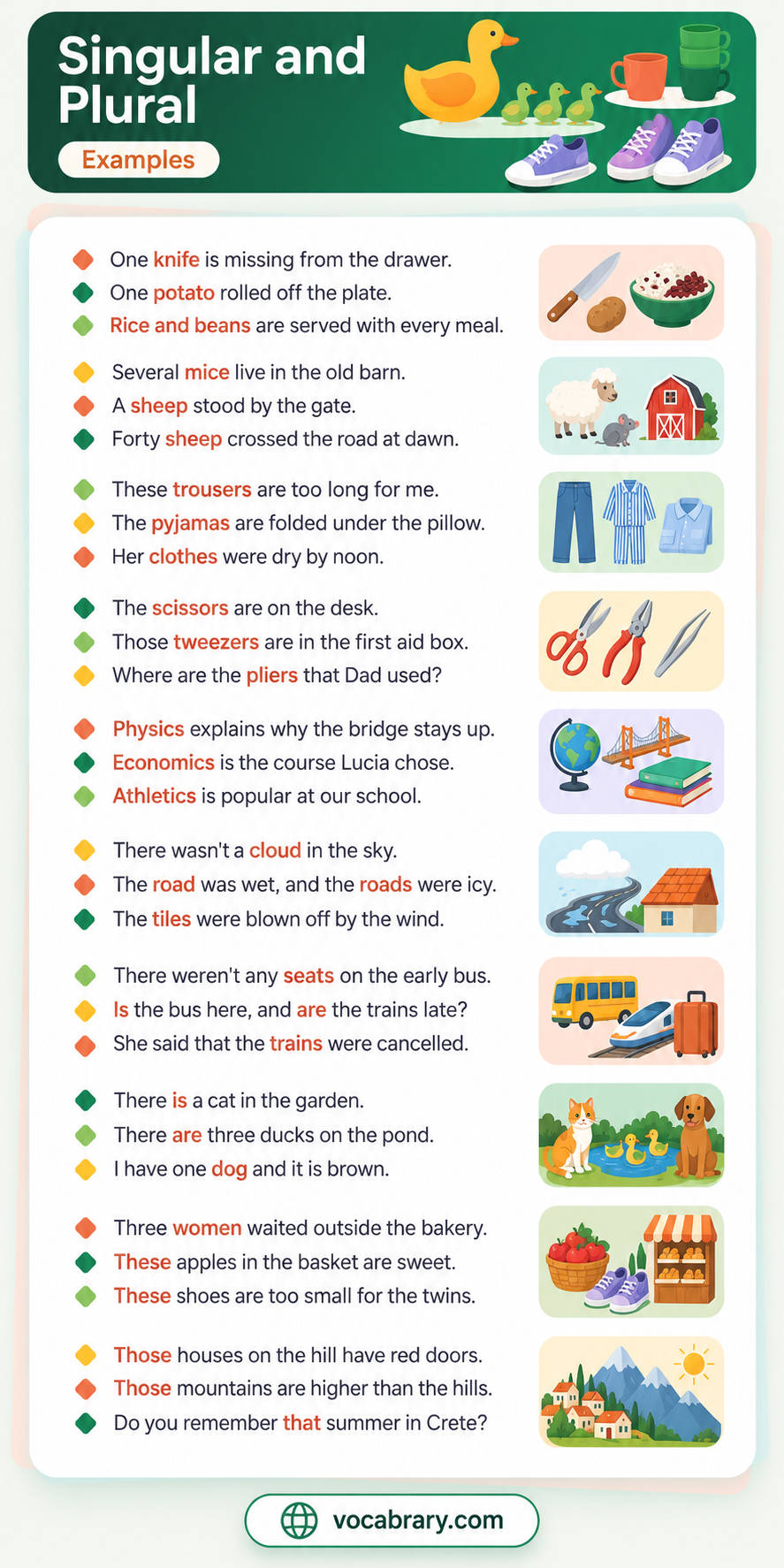
Common Singular and Plural Example Sentences
A cat and cats, a student and students, and a child and children are pairs in which one form names a single item and the other form names several items.
- The cat sleeps on the sofa, but the cats next door hunt at night.
- One student asked a question, and ten students took notes.
- A bus stops here, and two buses pass every hour.
- My sister lives in Cairo, and my sisters visit every summer.
- The child is drawing, and the children are painting.
- A city grows slowly, but some cities grow fast.
- The box is heavy, and the boxes are in the hall.
- One knife is missing from the drawer.
- Three women waited outside the bakery.
- That tooth hurts, and both teeth need a filling.
- The mouse ran under the cupboard.
- Several mice live in the old barn.
- Every day brings a new lesson, and the days pass quickly.
- The teacher is kind, and the teachers are patient with newcomers.
- One potato rolled off the plate.
- My foot is cold, and my feet are wet.
- The library closes at nine, and the libraries in town close earlier.
- A sheep stood by the gate.
- Forty sheep crossed the road at dawn.
- The man is a doctor, and the men are nurses.
- A wolf howled, and the wolves answered.
- This idea is new, and these ideas are better.
- The tourist lost a map, and the tourists asked for another.
- A baby laughed, and the babies in the next room joined in.
Regular Singular and Plural Nouns in Sentences
Books, buses, babies, and keys show the main spelling patterns for regular plurals, and each pattern depends on the last letters of the singular noun.
| Singular ending | Plural rule | Singular | Plural |
|---|---|---|---|
| Most nouns | Add -s | Book | Books |
| Words ending in -s, -x, -z, -ch, -sh | Add -es | Bus | Buses |
| Consonant + y | Change y to -ies | Baby | Babies |
| Vowel + y | Add -s | Key | Keys |
| Some words ending in -f or -fe, such as knife, wolf, and leaf | Change to -ves | Knife | Knives |
| Other words ending in -f or -fe, such as roof, chief, and cliff | Add -s | Roof | Roofs |
Sentences With Nouns That Add -s
Books, cars, and pencils are typical nouns that form the plural with an added -s, the rule that covers most nouns in English.
- I bought one pencil, and the pencils in her bag are new.
- The car stopped, and the cars behind it waited.
- A river crosses the town, and two rivers meet near the coast.
- She keeps one book by the bed and many books in the study.
- The window is open, but the windows upstairs are closed.
- Each flower in the garden has a name tag, and the flowers by the gate are roses.
- One song played twice, and the songs after it were slower.
- The lamp is on the desk, and two lamps stand by the sofa.
- A photograph hangs in the hall, and the photographs in the album are older.
- The clock is slow, but the clocks in the station are exact.
- A nurse greeted us, and three nurses checked the beds.
- Our neighbour has a dog, and our neighbours are friendly.
- The ticket costs ten dollars, and the tickets for children are cheaper.
- That bridge is old, and the bridges upriver are new.
Plural Sentences for Nouns That Add -es
Bus, box, quiz, church, and dish end in -s, -x, -z, -ch, or -sh, and these endings take -es, which adds a syllable (quiz doubles the z first).
- The bus was late, and both buses were full.
- She packed one box, and the boxes on the shelf were empty.
- The teacher gave a quiz on Monday and two quizzes on Friday.
- A church stands on the hill, and the churches in the valley are small.
- One dish broke, and the dishes in the sink were still warm.
- The class begins at nine, and the classes after lunch are shorter.
- That watch is fast, and the other watches are slow.
- She made a wish, and all the wishes on the card were kind.
- A fox crossed the field, and two foxes followed.
- The tax on petrol rose, and the taxes on food stayed the same.
- This brush is soft, but the brushes in the tin are hard.
- A glass fell, and the glasses on the tray stayed safe.
- Each gas in the laboratory has a label, and the gases are stored apart.
- The match was exciting, and the matches last week were dull.
Plural Sentences for Nouns Ending in -y
When a consonant comes before the y, as in baby and city, the y changes to -ies. When a vowel comes before the y, as in monkey and boy, the noun adds only -s, and so do proper names such as Kennedy and Mary.
- A baby cried, and the babies woke up.
- The city is famous, and the cities nearby are quiet.
- One story was funny, and the stories after it were sad.
- The lady waited, and three ladies joined her.
- That country is small, and the countries around it are large.
- The party ended early, and the parties last week lasted all night.
- A boy kicked the ball, and the boys ran after it.
- One key is missing, and the keys on the hook are spare.
- The day was hot, but the days that followed were cool.
- A monkey climbed the fence, and two monkeys watched.
- The journey was long, and the journeys after it were short.
- We met the Kennedys at the airport, and both Marys waved.
- A fly landed on the cake, and the flies followed it.
- The toy is broken, and the toys in the box are new.
Examples of Plurals for Nouns Ending in -f and -fe
Knife, wolf, leaf, and wife change to knives, wolves, leaves, and wives, while roof, chief, belief, and cliff add only -s.
- One knife is blunt, and the knives are sharp.
- The wolf was alone, and the wolves hunted together.
- A leaf fell on my desk, and the leaves covered the yard.
- His wife teaches music, and the wives of the players sat together.
- The loaf is warm, and the loaves on the rack are cooling.
- A thief ran away, and the thieves left a note.
- The shelf is full, and the shelves in the hall are empty.
- One life was saved, and many lives were changed.
- The roof leaks, and the roofs in the village are red.
- A chief spoke first, and the chiefs listened.
- The cliff is steep, and the cliffs along the bay are white.
- That belief is old, and the beliefs of the villagers are different.
- A giraffe ate leaves, and two giraffes drank at the pool.
- The first half of the match was slow, and both halves were dull.
Examples of Nouns Ending in -o With -s and -es
Potatoes, tomatoes, heroes, and echoes take -es, while pianos, photos, zoos, and videos take only -s. Nouns that end in a vowel plus o, such as zoo and radio, always add -s.
- The potato is cooked, and the potatoes on the plate are cold.
- One tomato fell, and the tomatoes in the basket were ripe.
- The hero saved a child, and the heroes of the town were honoured.
- A shout produced an echo, and the echoes lasted for seconds.
- The piano is old, and the pianos in the shop are new.
- She took a photo, and the photos in her phone are all blurred.
- We visited a zoo, and the zoos in Europe have changed.
- The video is short, and the videos online are longer.
- A radio played quietly, and the radios on the shelf were silent.
- The studio is cold, and two studios at the end are warm.
- He played a solo, and the solos that followed were better.
- One kilo of rice is enough, but ten kilos feed the whole street.
- The veto stopped the law, and later vetoes stopped others.
- A kangaroo jumped over the fence, and three kangaroos followed.
Irregular Plural Noun Sentences
Man and men, foot and feet, and tooth and teeth change inside the word, while child and children and ox and oxen take an ending. These irregular plural nouns also include Latin and Greek forms such as cactus and cacti.
- The child is eight, and the children are older.
- A man painted the door, and the men painted the fence.
- That woman is a pilot, and these women are engineers.
- My foot hurts, and my feet are tired after the hike.
- A baby has one tooth, and an adult has thirty-two teeth.
- The mouse is under the sink, and the mice are in the attic.
- A goose crossed the road, and the geese followed.
- The person at the door is a neighbour, and the people inside are guests.
- An ox pulled the cart, and the oxen rested nearby.
- A cactus grows in the pot, and the cacti in the desert are huge.
- The crisis ended quickly, and later crises lasted longer.
- One analysis was wrong, and both analyses were rewritten.
- Each phenomenon is different, and the phenomena in this study were rare.
- A single bacterium is too small to see, but bacteria form colonies.
- The criterion is fairness, and the criteria for the prize are strict.
- A fungus grows on the log, and the fungi in the forest are rare.
Sentences With Singular and Plural Nouns of the Same Form
Sheep, deer, series, and species keep the same form in both numbers, so only the verb or the number word shows whether one or several are meant.
- One sheep is lost, and fifty sheep are safe.
- A deer crossed the road, and three deer followed.
- This series is long, and the series on the other channel are shorter.
- That species is rare, and many species of bird are in danger.
- An aircraft landed, and two aircraft waited on the runway.
- The salmon is fresh, and the salmon in the river are returning.
- A moose stood in the lake, and a herd of moose watched.
- The trout is large, and several trout swim near the bridge.
- A bison grazed alone, and the bison in the park were calm.
- Her offspring is healthy, and the offspring of the lion are playful.
- One fish swims, and many fish are in the tank.
- A means of escape was the window, and other means were blocked.
Plural-Only Nouns Like Scissors and Trousers
Scissors, trousers, jeans, and glasses name objects with two joined parts, and clothes, belongings, and groceries are used only in the plural in these meanings, so all of them take plural verbs. A speaker counts the two-part objects with the phrase a pair of.
- The scissors are on the desk.
- These trousers are too long for me.
- My jeans were wet after the walk.
- Her glasses are broken again, so she needs new ones.
- The pyjamas are folded under the pillow.
- His shorts are still in the wash.
- We watched the birds through binoculars.
- Those tweezers are in the first aid box.
- Where are the pliers that Dad used?
- Her clothes were dry by noon.
- Their belongings were packed in two bags.
- The groceries are on the counter.
- The stairs are steep, and they are slippery.
- Congratulations are in order for the winners.
News and Mathematics as Singular Nouns in Sentences
News, mathematics, physics, and measles end in -s but name one subject, one condition, or one game, so each takes a singular verb.
- The news is on at six.
- Mathematics is taught in the first lesson every morning.
- Physics explains why the bridge stays up.
- Economics is the course Lucia chose.
- Athletics is popular at our school.
- Measles is rare now in this country.
- Diabetes runs in my mother’s side of the family.
- Gymnastics needs strength, balance, and years of practice.
- Linguistics is the study of language.
- The United States is a large country.
- No news is good news, said my grandmother.
- Billiards is played in the back room of the club.
Sentences With Is and Are After Singular and Plural Subjects
Is follows a singular subject, such as a book or a bus, and are follows a plural subject, such as books or buses. In a sentence with there, the verb agrees with the noun that comes after it.
- The book is on the table.
- The books from the library are due on Friday.
- There is a cat in the garden.
- There are three ducks on the pond.
- My brother is a plumber, and my cousins are builders.
- The bus is late, and the trains are cancelled.
- Where is the key, and where are the keys?
- Her hobby is chess, and her hobbies are expensive.
- The flowers are fresh, and the vase is full.
- Is the shop open, and are the restaurants open?
- The window in the bathroom is broken.
- The windows upstairs in the old house are broken.
- A number of students are absent today.
- The number of students is small.
Was and Were Sentences for Past Events
Was follows a singular subject and I, while were follows plural subjects and you. Both forms report the past, as in the road was wet and the roads were wet.
- The road was wet, and the roads were icy.
- I was tired, and my friends were tired too.
- The soup was hot, and the vegetables were fresh.
- Was the exam long, and were the questions hard?
- The guide was late, and the drivers were waiting.
- There was a letter on the mat.
- There were two parcels on the step.
- You were right, and the maps were wrong.
- The dog was loud, and the puppies were quiet.
- My uncle was a pilot, and my aunts were teachers.
- The concert was free, and the seats were empty.
- Her answer was correct, and her answers were quick.
Has and Have in Sentences
Has follows a singular subject, and have follows I, you, we, they, and plural nouns. These two forms also work as helping verbs in the present perfect.
- The girl has a bicycle, and the girls have scooters.
- My teacher has a cold, and my classmates have coughs.
- The house has a garden, and the houses nearby have fences.
- Has the post arrived, and have the parcels been sent?
- The company has ten offices, and its rivals have more.
- He has finished, and they have finished too.
- The museum has opened, and the galleries have closed for repairs.
- A spider has eight legs, and all spiders have silk.
- The farmer has bought a tractor, and the neighbours have borrowed it.
- She has lost her wallet, and we have lost our tickets.
- My parent has a car, and my parents have a van.
- Every student has a locker, and the lockers have numbers.
Present Tense Verb Sentences With Singular and Plural Subjects
Most present tense verbs add -s after a singular subject such as he, she, it, or a singular noun, and they keep the base form after I, you, we, they, and plural nouns.
- The bird sings, and the birds answer.
- My brother cooks, and my parents eat.
- She walks to school, and they walk to the park.
- The river flows south, and the rivers flow to the sea.
- He studies at night, and we study in the morning.
- The machine works, and the machines make a loud noise.
- It rains in April, and the showers last all day.
- The baker opens at six, and the bakers open early.
- A student reads aloud, and the students listen.
- The tap drips, and the taps squeak.
- My sister plays tennis, and my cousins play football.
- The train leaves at noon, and the trains leave hourly.
Singular and Plural Pronoun Sentences
I, he, she, and it are singular pronouns, and we, they, and you in a group are plural. A pronoun agrees in number with the noun it replaces, which is called its antecedent.
- I am a nurse, and we work in the same hospital.
- He plays chess, and they play football.
- The boys packed their bags before leaving the house.
- She brought a cake, and they brought fruit.
- Maria found her keys under the sofa.
- It is raining, and we are indoors.
- The dog wagged its tail when Dad came home.
- Sam, you are early, and boys, you are early too.
- The students lost their books, and the teacher found them.
- Tom told me to wait, and he told us to leave.
- The girl called her mother, and the girls called their fathers.
- Ana saw him, and she saw them.
- The cup is cracked, so it needs replacing.
- The cups are cracked, so they need replacing.
This and These Sentences for Near Items
This refers to one item near the speaker, and these refers to several items near the speaker. This goes with a singular noun, and these goes with a plural noun.
This and These as Determiners
A determiner is a word that stands before a noun, and this and these are determiners that agree with the noun in number.
- This apple on the plate is sweet.
- These apples in the basket are sweet.
- This shoe is too small for me.
- These shoes are too small for the twins.
- I like this song more than the last one.
- We sang these songs at the party.
- This week is busy, and these days are short.
- This child is shy, and these children are loud.
This and These as Pronouns
As pronouns, this and these stand alone and agree with the verb that follows.
- This is my brother, and he lives in Leeds.
- These are my cousins, and they live in Leeds.
- This is the cheapest model in the shop.
- These are the cheapest tickets at the station.
- This is hard to believe, but it is true.
- These are my favourite stories from the old book.
That and Those Sentences for Distant Items
That refers to one item far from the speaker, and those refers to several items far from the speaker. That goes with a singular noun, and those goes with a plural noun.
- That house has a red door.
- Those houses on the hill have red doors.
- Who is that man at the gate?
- Who are those women by the fountain?
- That is my teacher by the school gate.
- Those are my neighbours across the street.
- That mountain is higher than the others.
- Those mountains are higher than the hills.
- Do you remember that summer in Crete?
- Do you remember those evenings on the beach?
- Pass me that book, and put those books on the shelf.
- That was a good idea, but those were better.
Compound Subjects in Singular and Plural Sentences
Tom and Ana, a cook and a baker, and either the pilot or the passengers show how the verb follows the subject. Two subjects joined by and take a plural verb unless they name one unit, as in bread and butter is. Subjects joined by or take the verb that agrees with the nearer one.
- Tom and Ana are friends from primary school.
- The cook and the baker are brothers.
- Either the pilot or the passengers are late.
- Either the passengers or the pilot is late.
- Neither the teacher nor the students were ready.
- Neither the students nor the teacher was ready.
- Rice and beans are served with every meal.
- Bread and butter is the lunch my father always packs.
- Each student brings a lunchbox, and every teacher brings a notebook.
- Everyone is here, and all the guests are seated.
- Somebody was knocking, and two children were crying.
- My friend and colleague, Rosa, is waiting outside.
Negative Sentences With Singular and Plural Nouns
A negative sentence keeps the same agreement: a singular subject takes isn’t, wasn’t, or hasn’t, and a plural subject takes aren’t, weren’t, or haven’t.
- The shop isn’t open, and the banks aren’t open either.
- There wasn’t a cloud in the sky.
- There weren’t any seats on the early bus.
- My brother doesn’t swim, and my sisters don’t swim either.
- The box hasn’t arrived, and the parcels haven’t arrived.
- No child was hurt in the accident.
- No children were injured on the school trip.
- The scissors aren’t in the drawer.
Question Sentences With Singular and Plural Subjects
A question puts is, are, was, were, does, do, has, or have before the subject, and the choice still follows the number of the subject.
- Is the bus here, and are the trains late?
- Does the shop sell stamps, and do the shops sell envelopes?
- Was the film long, and were the seats comfortable?
- Has the letter come, or have the letters come?
- Where is my coat, and where are my gloves?
- How many children are in the class?
- Which book is yours, and which books are hers?
- Which train leaves first, and which trains are direct?
Reported Speech and Passive Voice Sentences With Nouns
In reported speech and in the passive voice, the verb still agrees with the grammatical subject, and the number of that subject determines is or are, was or were.
- She said that the bus was late.
- She said that the trains were cancelled.
- He told us that the children were asleep.
- The window was broken by the storm.
- The tiles were blown off by the wind.
- A letter is sent to every member each year.
- Many letters are sent to members each year.
- The teacher asked whether the essay was finished and whether the essays were marked.
Singular and Plural Sentences for Everyday Situations
Home, school, work, travel, news, fiction, sports, and health each have pairs of singular and plural nouns, such as one sofa and two chairs at home.
Sentences About Furniture and Household Items
A sofa and two chairs, a bed and several pillows, and one fridge and many shelves are the paired nouns of a household.
- The sofa is new, but the chairs are old.
- One bed has four pillows on it.
- The fridge is empty, and the shelves are dusty.
- A plate fell, and the plates in the cupboard rattled.
- The curtain is blue, and the curtains upstairs are red.
- One towel is wet, and the towels on the line are dry.
Classroom Sentences With Pupils and Desks
A classroom has one pupil or many pupils, a desk or rows of desks, and a lesson or long lessons, so each noun occurs in both numbers.
- One pupil is absent, and the other pupils are present.
- The desk is tidy, but the desks at the back are messy.
- A lesson ends at ten, and the lessons after it are shorter.
- The exam is hard, and the exams last year were harder.
- A dictionary is on the shelf, and two dictionaries are on the teacher’s desk.
- The classroom is warm, and the classrooms upstairs are cold.
Office Sentences With Managers and Invoices
A manager and managers, an office and offices, and one invoice and many invoices appear in a workplace, where each noun takes its singular or plural form.
- The manager is away, and the managers are meeting.
- One invoice is late, and the invoices from March are paid.
- The office is quiet, and the offices upstairs are busy.
- A colleague helped me, and my colleagues brought lunch.
- The meeting is at nine, and the meetings this week are short.
- One employee is on leave, and the employees are at a workshop.
Passports and Suitcases in Travel Sentences
On a trip, one passport and two passports, a suitcase and many suitcases, and a flight and several flights change number with the verb.
- Your passport is valid, but their passports have expired.
- The suitcase is heavy, and the suitcases are on the belt.
- One flight was cancelled, and the flights to Rome are delayed.
- A tourist asked directions, and the tourists took photographs.
- The hotel is cheap, and the hotels by the beach are expensive.
- A train leaves at noon, and the trains to the coast leave hourly.
News Sentences With Ministers and Storms
Bulletins use one report or many reports, a minister or ministers, and a storm or storms, so each noun occurs in both numbers.
- The report is accurate, and the reports from the north are not.
- A minister resigned, and the ministers met the press.
- The storm is moving east, and the storms last week caused floods.
- One election was close, and the elections since then were clear.
- The journalist wrote a story, and the journalists waited for more.
- A village was flooded, and the villages upstream were evacuated.
Knights and Dragons in Story Sentences
Stories use a knight and knights, a dragon and dragons, and a chapter and chapters, and each pair shows one item and then several.
- The knight drew his sword, and the knights followed.
- A dragon guarded the cave, and the dragons in the hills slept.
- The first chapter is short, and the later chapters are longer.
- The princess laughed, and the princesses in the tale did too.
- One candle burned, and the candles on the table flickered.
- The hero was brave, and the heroes of the old stories were wise.
Players and Goals in Sports Sentences
A match involves a player and players, a goal and goals, and a runner and runners, and each pair changes with the verb.
- One player was injured, and the players left the pitch.
- The goal was brilliant, and the goals in the second half were better.
- A referee blew the whistle, and the referees shook hands.
- The runner is fast, and the runners behind are tired.
- One fan waved a flag, and the fans sang together.
- The match is on Saturday, and the matches next week are cancelled.
Sentences About Patients and Pills
A clinic has a patient and patients, a pill and pills, and a doctor and doctors, and the verb follows each number.
- The patient is calm, and the patients are waiting.
- One pill is enough, and two pills are too many.
- The doctor is late, and the doctors are in a meeting.
- A bruise formed on her arm, and the bruises faded in a week.
- The ward is clean, and the wards upstairs are full.
- One injection hurt, and the injections later did not.
Singular and Plural Example Sentences for Kids
A dog and dogs, a ball and balls, and a duck and ducks are everyday pairs for children: one item, then many. Singular and plural example sentences for young learners use short subjects and the verbs is and are.
- I have one dog and it is brown.
- We have two dogs and they are brown.
- A ball rolls down the hill.
- Big balls roll down the hill.
- The duck swims in the pond.
- Five ducks swim in the big pond.
- She has one book and he has two books.
- The bird sings in the tree.
- The birds sing in the garden every morning.
- Look at the star, and look at the stars!
- One apple is red, and three apples are green.
- My tooth is loose, and my teeth are clean.
Sentences for Students With Criteria and Analyses
Exam-level answers choose the correct plural and the matching verb, as in the criteria are clear and the analysis is complete. These singular and plural example sentences add Latin and Greek plurals to the usual patterns.
- The criteria for the grant are published online.
- The analysis of the data is complete, but the analyses from last year are missing.
- This phenomenon is rare, but those phenomena have been recorded.
- The hypothesis was tested, and the hypotheses from last year were rejected.
- A report was published, and the reports of earlier years were archived.
- A crisis is a turning point, and crises test every government.
- Economics is a social science, and its theories are debated.
- The bacteria in the sample were counted, and one bacterium was named.
- The sheep in the study were healthy.
Short Paragraphs With Singular and Plural Nouns
Each of four short passages describes one scene, and every verb matches its noun, so singular and plural example sentences read as running text.
The child is eight, and the children at her school are older. She has one bag, and her friends have two bags each. The teacher is kind, and the lessons are short.
My uncle keeps sheep on a hill farm. One sheep is brown, and the other sheep are white. The farmer feeds them every morning, and the dogs guard the gate.
In the market, a woman sells tomatoes, potatoes, and one huge pumpkin. The customers are noisy, and the prices are low. Her scissors are on the stall, and her glasses are in her pocket.
The news is good today. The players are fit, and the match is on Saturday. One fan has bought two tickets, and mathematics is forgotten for the weekend.
Singular Versus Plural Nouns in Example Sentences
Singular nouns such as a bus and a baby differ from plural nouns such as buses and babies in the verb, the demonstrative, the pronoun, and the number word they take.
| Feature | Singular | Plural |
|---|---|---|
| Meaning | One item | More than one item |
| Regular form | Book | Books |
| Verb with be | Is, was | Are, were |
| Verb with have | Has | Have |
| Demonstrative | This, that | These, those |
| Pronoun | He, she, it | They, them |
| Number word | A or an, one | Two, many, several |
| Example | The book is open. | The books are open. |
FAQs
Q1. What are some common examples of singular and plural nouns?
Singular and plural example sentences use pairs such as cat and cats, child and children, box and boxes, baby and babies, and foot and feet. The first form names one item, and the second names more than one. Most pairs follow the -s rule, and a smaller group changes inside the word.
Q2. How do you form the plural of a regular noun?
A regular noun forms its plural by adding -s to the singular, as in book and books. Nouns that end in s, x, z, ch, or sh add -es, as in bus and buses. Nouns that end in a consonant plus y change the y to -ies, as in baby and babies.
Q3. Why do some nouns have the same singular and plural form?
Some nouns have the same singular and plural form because the original word had no separate plural ending. Sheep, deer, fish, series, and species are examples. The verb or the number word shows which meaning is intended, as in one sheep is and ten sheep are.
Q4. Which nouns are always plural?
Nouns for objects with two joined parts are plural in form, and scissors, trousers, jeans, glasses, and pyjamas are the usual examples. They take plural verbs, as in the scissors are sharp. A speaker counts them with the phrase a pair of, as in a pair of scissors.
Q5. Is the word news singular or plural?
The word news is singular, even though it ends in -s. A speaker therefore says the news is good and never the news are good. Mathematics, physics, and economics follow the same pattern.
Q6. When do you use is and when do you use are?
Is follows a singular subject, and are follows a plural subject or two subjects joined by and. A speaker says the book is open and the books are open. In a sentence that begins with there, the verb agrees with the noun after it, as in there are three books.
Q7. What is the difference between this and these?
This goes with a singular noun that is near the speaker, and these goes with a plural noun that is near the speaker. A speaker says this book and these books. That and those make the same contrast for items that are far away.
Q8. Do you say a pair of scissors is or are?
The phrase a pair of scissors takes a singular verb in standard usage, because the subject is the word pair. A speaker says a pair of scissors is on the desk. Without the phrase, the noun scissors is plural, so the scissors are on the desk is correct.
Q9. What is the plural of words that end in -o?
Words that end in -o form the plural with either -es or -s, and no single rule covers every word. Potato, tomato, hero, and echo take -es, while piano, photo, video, and zoo take -s. A dictionary confirms the form for a word that is unfamiliar.
Q10. Are irregular plurals common?
Irregular plurals are few in number but frequent in use, because child, man, woman, foot, tooth, and person are everyday words. Irregular plural nouns change inside the word or take an unusual ending.
Q11. How does a pronoun agree with a singular or plural noun?
A pronoun agrees with its antecedent, the noun it replaces, in number. A singular noun is replaced by he, she, or it, and a plural noun is replaced by they. A speaker says the cup is cracked, so it needs replacing and the cups are cracked, so they need replacing.
Q12. Do uncountable nouns have a plural form?
Uncountable nouns such as advice, furniture, and rice have no plural form, so they take singular verbs. A speaker counts them with unit phrases, as in two pieces of advice. Uncountable nouns take singular verbs, as in the furniture is old.

Leave a Comment