
A noun is a word that denotes a person, place, object or idea, as in teacher, bridge and rain, whereas a pronoun only replaces such a word. Its role depends on position rather than on spelling: rain is the subject in rain stopped play and the object in we dreaded the rain. That is why nouns example sentences move everyday words such as teacher, bridge and kitchen between subject and object position without altering their spelling.
What Is a Noun?
A noun is a word that names a person, an animal, a place, an object, a substance or a quality, and it works as the subject or the object of a verb or as the object of a preposition. A pronoun replaces a noun instead, so Nadia is a noun and she is the pronoun that replaces it.
Determiner + adjective + noun
The tired teacher carried a heavy box of books into the library.
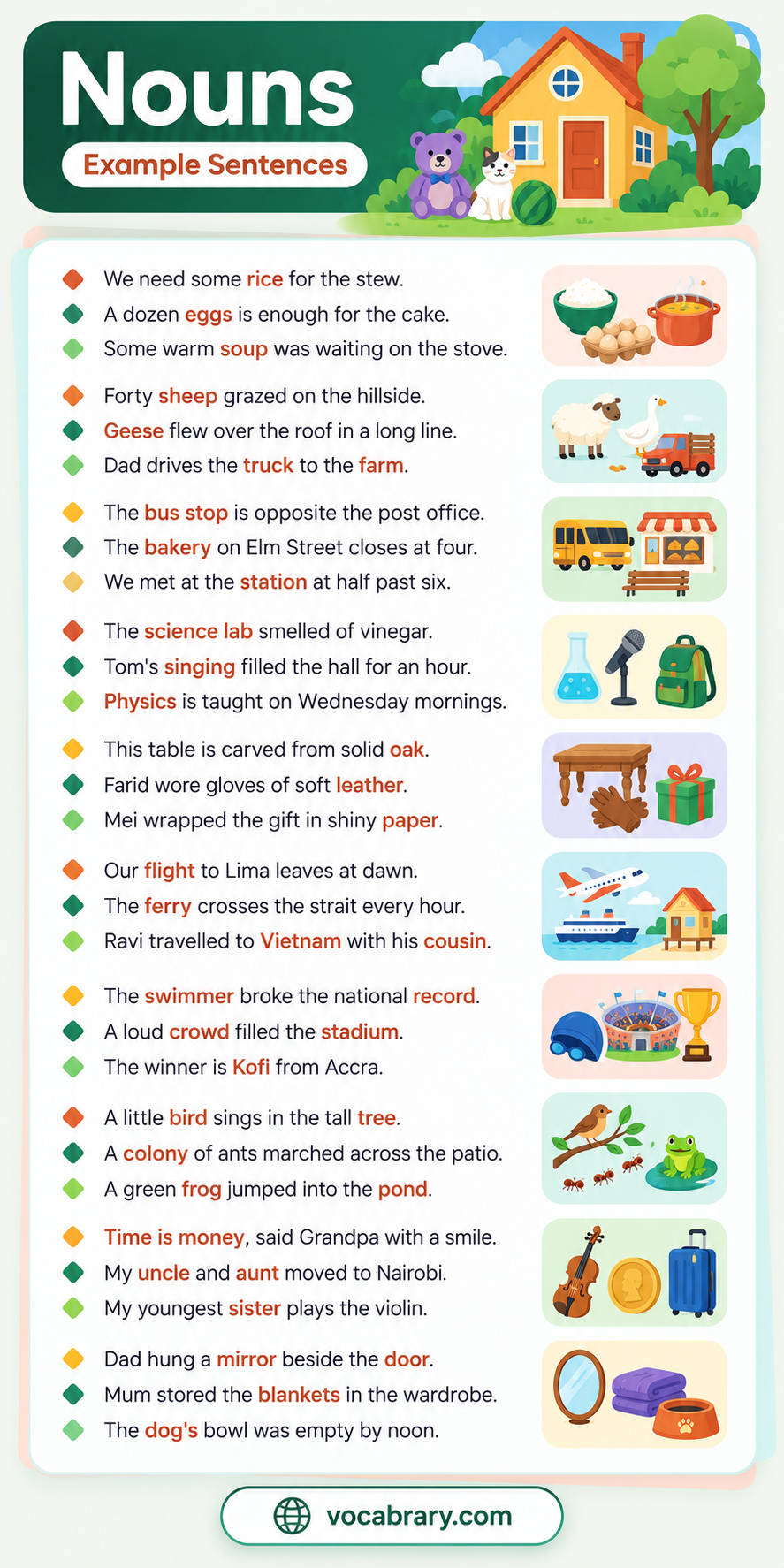
Everyday Nouns Example Sentences
Teachers, rivers, bicycles and kindness are the ordinary nouns in these nouns example sentences, because each word names a person, a place, an object or a quality. A singular countable noun such as bicycle takes a determiner, a word like a, an or the that introduces the noun.
- The teacher handed back the exam papers on Monday morning.
- A river runs through the middle of our town.
- Lucia bought a new bicycle for the ride to Seville.
- Kindness costs nothing, yet it changed his whole week.
- The baby smiled at the camera and waved a tiny hand.
- Farid left his umbrella on the bus again.
- Heavy rain fell on the market all afternoon.
- A small bakery opened beside the station last spring.
- My grandfather keeps a garden full of tomatoes and mint.
- The doctor wrote the prescription in blue ink.
- Songs from the radio filled the kitchen.
- Three children shared one blanket during the storm.
- Nobody found the key to the old cabinet.
- The museum displays a hundred paintings from Peru.
Abstract Noun Sentences for Ideas, Feelings and Qualities
Courage during a flood, honesty at a till and freedom after a prison sentence are abstract nouns, words for qualities and feelings that have no physical form. Many of them end in -ness, -ity, -ment or -tion.
- Her courage during the flood saved three families on Mill Street.
- Honesty at the till earned the young cashier a permanent contract.
- After ten years in prison, Mandla valued freedom above every other gift.
- A sudden happiness filled the room when the results were read aloud.
- Grandfather’s wisdom helped the family through two difficult winters.
- Poverty forced many farmers to leave the valley in the 1990s.
- The coach praised Dina’s determination after the final race.
- Nobody doubted the loyalty of the old gardener.
- The committee admired the creativity of the winning design.
- Boredom made the long train ride feel twice as slow.
- We lost all hope when the bridge closed.
- Karina’s ambition carried her from a rural school to a university in Warsaw.
An abstract noun differs from a concrete noun, because courage has no physical form while bridge is an object that people see and touch.
Sentences With Collective Nouns for Groups
A flock of starlings, a rowing team and a jury in a courtroom are collective nouns, words that are singular in form and name a group as one unit.
- A flock of starlings circled the church tower.
- The rowing team practised at dawn before the regatta.
- The jury listened to the witness in silence.
- A herd of elephants moved toward the waterhole.
- Our class visited the science museum on Thursday.
- The committee postponed its vote until the next meeting.
- A colony of ants marched across the patio.
- Hana joined a choir that performs in three languages.
- The audience whispered during the long opening scene.
- A pack of wolves followed the deer through the snow.
- The crew repaired the sail before the storm arrived.
- Our family celebrates Eid with a long lunch at my aunt’s house.
A collective noun differs from a plain plural noun, because team names a group as one unit while players names several separate individuals.
Proper Noun Example Sentences for Names, Places and Dates
Amina, Lagos, Mount Fuji and Tuesday are proper nouns, names of one specific person, place or date that always begin with a capital letter.
- Amina won the regional chess tournament in Lagos.
- Mount Fuji attracts thousands of climbers each July.
- We celebrate Diwali in late autumn with lamps and sweets.
- Tuesday is the day our class visits the library.
- The Rhine passes through Basel and Cologne on its way to the North Sea.
- My cousin works for Siemens in Munich.
- Dr Patel reads the Guardian every morning on the train.
- Carlos and Mei met at a conference in Singapore.
- The Pacific Ocean covers about a third of the planet’s surface.
- Every April, the town hosts a kite festival on Whitby beach.
- The Louvre welcomes millions of visitors each year.
- Professor Ivanova teaches Russian history at the University of Leeds.
A proper noun differs from a common noun, because Lagos names one specific city while city names any city at all.
Common Noun Sentences for General Names
Teacher, city, mountain and puppy are common nouns, general names for any member of a class, so they take a capital letter only at the start of a sentence.
- The teacher praised every student in the class.
- A city grows quickly when new factories open.
- We climbed a mountain after breakfast.
- The puppy chewed my slipper twice this week.
- Every farmer in the valley sells cheese on Saturday.
- A nurse checked the patient’s temperature at noon.
- The tourist photographed a castle on the hill.
- She keeps a notebook in every coat.
- Two players argued with the referee about a penalty.
- The library closes before the museum.
- A cook needs a sharp knife and a clean board.
- Four sailors rowed to the island at sunrise.
A common noun differs from a proper noun, because teacher names any member of a class while Dr Patel names one particular person.
Countable Noun Sentences With Numbers and Plurals
Three apples, eight chairs and a single ticket are countable nouns, nouns for items that are counted one by one and that take a number, a plural -s or the word many.
- Maya bought three apples and two pears at the market.
- Eight chairs stood around the oval table.
- Please show your ticket at the gate.
- How many tickets did the band sell on Friday?
- A dozen eggs is enough for the cake.
- Few visitors arrived at the museum before noon.
- Ravi carries two bottles of water in his backpack.
- Several cars blocked the narrow lane.
- There are not enough seats for every guest.
- Each window in the old school has its own shutter.
- Both brothers play in the same football club.
- Many birds nest in the reeds beside the lake.
A countable noun differs from an uncountable noun, because apple takes a number and a plural -s while rice takes neither.
Uncountable Nouns in Sentences With Some, Much and Less
Water, advice, furniture and rice are uncountable nouns, nouns for masses that take no plural -s and no number. They combine with some, much and less instead of many and fewer.
- Please drink more water during the match.
- Her advice about the interview was excellent.
- The furniture arrived two days late.
- We need some rice for the stew.
- There is too much traffic on the bridge today.
- Hamid packed little luggage for the weekend.
- Music fills the courtyard every Friday evening.
- Ines has a lot of homework this weekend.
- Warm bread filled the shop with a sweet smell.
- The news from the hospital was encouraging.
- Less sugar makes the cake taste lighter.
- Do you have any information about the 8:15 train?
- Heavy snow closed the mountain road.
An uncountable noun differs from a countable noun, because advice takes much and a singular verb while idea takes many and a plural form.
Possessive Nouns in Sentences With Apostrophes
Nadia’s laptop, the teachers’ meeting and the children’s playground are possessive nouns, nouns that add ‘s or s’ to show who owns or belongs to something.
- Nadia’s laptop was on the kitchen table.
- The teachers’ meeting starts at four in the staff room.
- The children’s playground reopened after the repairs.
- My brother’s bicycle needs a new tyre.
- The dog’s bowl was empty by noon.
- Both girls’ coats were hanging by the door.
- A week’s holiday costs less than I expected.
- Marcus’s sister lives in a small flat in Porto.
- The bird’s nest fell from the branch during the storm.
- All the players’ boots were covered in mud.
- Sofia’s grandmother grows chillies on her balcony.
- The women’s choir rehearses in the church hall.
A possessive noun differs from a plain plural noun, because teachers’ shows ownership while teachers only shows that there is more than one.
Compound Noun Example Sentences Written Closed, Open and Hyphenated
Toothbrush, ice cream, mother-in-law and bus stop are compound nouns, nouns built from two or more words and written as one word, as two words or with hyphens.
- Leo packed his toothbrush and a hairbrush.
- We bought ice cream at the corner shop.
- My mother-in-law arrives from Cairo on Sunday.
- The bus stop is opposite the post office.
- A bookshop on Park Road sells second-hand maps.
- The swimming pool opens at seven.
- Two passers-by helped the cyclist stand up.
- The fire engine reached the street in four minutes.
- Her daughter-in-law teaches maths in Krakow.
- Mina scored in the last minute of the football match.
- A broken traffic light caused a long queue.
- The sunflower turned toward the window all morning.
A compound noun differs from an adjective followed by a noun, because toothbrush is one fixed name while a red brush is a colour word plus a noun.
Material Nouns in Sentences About Metals, Fabrics and Wood
Gold, oak, cotton and steel are material nouns, nouns that name the substance an object is made of. Most of them are uncountable, so they take no a, an or the when they name the substance in general.
- The ring is made of gold and set with a small ruby.
- This table is carved from solid oak.
- Cotton shirts feel cooler in July than wool jumpers.
- The bridge is built from steel and concrete.
- Farid wore gloves of soft leather.
- Pour the hot wax into the mould slowly.
- A window of thick glass protects the exhibit.
- The vase is made of clay from the river bank.
- Mei wrapped the gift in shiny paper.
- Old silk is hard to wash by hand.
- Workers shovelled sand into the sacks.
- The roof is covered with slate from Wales.
- Plastic bags take hundreds of years to break down.
A material noun differs from an ordinary common noun, because gold names the substance itself while ring names one object made from it.
Gender Noun Sentences for Masculine, Feminine and Common Gender
Actor and actress, king and queen, nephew and niece and the word teacher are gender nouns, nouns that refer to male, female, either or neither sex.
- The actor thanked the actress who played his mother.
- The king and the queen greeted the crowd from the balcony.
- Her nephew and niece spent July on the farm.
- A lioness guards the cubs while the males rest.
- The waiter apologised, and the waitress brought fresh coffee.
- My uncle and aunt moved to Nairobi.
- The bull stood apart from the cow and her calf.
- Every teacher in the school received a certificate.
- The host welcomed us, and the hostess showed us the garden.
- A stallion and a mare shared the same field.
- The table is made of oak and stands by the window.
- The widow and the widower attended the memorial together.
A gender noun differs from a neutral common noun, because actress marks a female person while teacher marks no sex at all.
Verbal Noun Sentences With Swimming, Reading and Arrival
Swimming, reading, arrival and refusal are verbal nouns, nouns formed from verbs that name an action itself. A form in -ing that keeps verb features, such as the object in Reading novels is fun, is called a gerund.
- Swimming keeps Rosa fit through the winter.
- His constant complaining annoyed the neighbours.
- The arrival of the ferry was delayed by fog.
- Karim enjoys reading a few pages before bed.
- The council announced the closure of the old library.
- Cooking for ten guests took her the whole afternoon.
- Her refusal to sign the form surprised the manager.
- We heard the loud barking of dogs across the valley.
- Learning a second language demands daily practice.
- The discovery of penicillin saved millions of lives.
- Tom’s singing filled the hall for an hour.
- Writing a letter by hand feels slower, yet calmer.
A verbal noun differs from a finite verb, because swimming names the action itself while swims reports who performs it.
Singular and Plural Noun Pairs in Sentences
One book and three books, a leaf and many leaves, a bus and two buses show how singular and plural nouns change form. Most plurals add -s, and nouns ending in -s, -x, -ch or -sh add -es.
- One book lay on the desk, and three more books stood on the shelf.
- That city is bigger than the other cities in the region.
- A single leaf floated down, then dozens of leaves followed.
- The box on the table is empty, and the boxes in the garage are full.
- A bus left at six, and two buses arrived at seven.
- One wish came true; her other wishes did not.
- The day was long, and the days that followed were longer.
- A key opens one door; these keys open four.
- One baby cried, and then all the babies in the ward cried.
- We took one photo and then forty more photos.
- A potato and two tomatoes went into the soup.
- The fox crossed the road, and two foxes followed.
A regular plural differs from an irregular plural, because books adds -s to book while children changes the word itself.
Sentences With Irregular Plural Nouns Like Children and Women
Children, women, teeth and mice are irregular plural nouns, nouns that form the plural by changing the vowel, changing the ending or keeping the same form, as sheep does.
- Six children sat in a circle on the grass.
- Both women work as pilots for the same airline.
- The dentist checked my teeth and said they look healthy.
- Two mice ran under the fridge.
- Forty sheep grazed on the hillside.
- Geese flew over the roof in a long line.
- My feet hurt after the march through the hills.
- Several men carried the piano up the stairs.
- Researchers published two new analyses of the survey.
- The criteria for the scholarship changed in March.
- Fresh fish were sold at the harbour before sunrise.
- The farmer’s oxen pulled the cart to the village.
- Many people waited outside the stadium.
An irregular plural differs from a regular plural, because men changes a vowel while boys adds the ending -s.
Sentences With Nouns as the Subject
In an active sentence, the subject noun stands before the verb and names who or what performs the action. A pilot guiding a plane, rain flooding a field and a decision surprising a team show this order.
- The pilot guided the plane safely through thick fog.
- Rain flooded the lower field overnight.
- A decision from the board surprised the whole team.
- Maya won the spelling competition twice.
- The bakery on Elm Street closes at four.
- Honesty builds trust between neighbours and friends.
- Students from six countries joined the exchange programme.
- The committee meets every second Tuesday.
- Music plays softly in the waiting room.
- My sister collects stamps from Japan.
- Heavy luggage slowed the passengers at the gate.
- The storm knocked down three trees on our street.
Examples of Nouns as Objects of a Verb
Painting a fence and giving a student a library card show two kinds of object. A direct object receives the action of a transitive verb, and an indirect object names who benefits from it.
Direct Object Noun Sentences
Leila painting a fence, a goalkeeper saving a penalty and a neighbour repairing bicycles show the noun straight after a transitive verb, a verb that needs an object to complete its meaning.
- Leila painted the fence on Sunday.
- The goalkeeper saved the penalty with her left foot.
- Our neighbour repairs bicycles in his garage.
- Mr Okoye teaches chemistry to sixteen-year-olds.
- The baker pulled the loaves from the oven.
- Tourists photographed the cathedral from the bridge.
- Aiko wrote a letter to her old teacher.
- The thief broke the window and ran off.
Indirect Object Noun Sentences
A librarian who gives a student a card and an aunt who reads the twins a tale use an indirect object, the noun that comes between the verb and the direct object.
- The librarian gave the student a new library card.
- Our aunt read the twins a tale about a magic drum.
- Amir sent his mother a postcard from Prague.
- The manager offered the applicant a job.
- We bought our teacher a plant for her desk.
- Dina showed the inspector the damaged roof.
- Mum handed the cashier a twenty-pound note.
- The pilot promised the passengers a smooth landing.
Noun Complement Example Sentences
Maria as a pilot, Tom as a doctor and Hana as club captain show the noun working as a complement, the part that completes the verb. After a linking verb it renames the subject, and after verbs such as elect and appoint it renames the object.
- Maria is a pilot with a Brazilian airline.
- Tom became a doctor after eight years of study.
- My neighbour remains a loyal friend.
- That building was a hospital before the war.
- The students elected Hana captain of the debate club.
- The council appointed Mr Rossi manager of the Milan office.
- The crowd called the firefighter a hero.
- Time is money, said Grandpa with a smile.
- The final result was a draw.
- The winner is Kofi from Accra.
Examples of Nouns After Prepositions
At the station, under the bench and beside a grandmother show a noun as the object of a preposition. The noun completes the phrase that the preposition begins.
- We met at the station at half past six.
- The kitten slept under the bench.
- Ravi travelled to Vietnam with his cousin.
- She poured tea into a cup with a chipped handle.
- The painting hangs above the fireplace.
- After the lecture, we walked along the canal.
- Aisha is afraid of spiders and large moths.
- He left the house without his wallet again.
- The road runs between two vineyards.
- During the storm, the lights flickered twice.
- Pedro sat beside his grandmother on the bench.
- Instead of coffee, Lena ordered mint tea.
Noun Phrase Examples With Determiners and Adjectives
A bright red scarf, those three boys and some warm soup show a noun surrounded by the words that describe or count it. A noun phrase is a noun together with its determiner and other modifiers.
- A bright red scarf hung from the hook.
- Those three boys built a raft from old doors.
- My youngest sister plays the violin.
- Some warm soup was waiting on the stove.
- Every tired runner crossed the line before dark.
- Her grandmother’s embroidered tablecloth covered the whole table.
- Several old photographs lay on the floor.
- Which route did the cyclists take?
- The new headteacher introduced a shorter lunch break.
- Two enormous parcels blocked the doorway.
Subject-Verb Agreement Sentences With Nouns
The dog barks and the dogs bark, the news is encouraging and the scissors are in the drawer: a verb matches the number of its subject noun. Collective, uncountable and plural-only nouns need extra care, because their form and their number do not always agree.
- The dog barks at every stranger, but the dogs next door bark at the postman.
- The news from the capital is encouraging.
- Mathematics was my favourite subject at school.
- The scissors are in the top drawer of the desk.
- The police are searching the harbour for the missing boat.
- My trousers are wet after the long walk.
- Furniture costs more in this shop than online.
- The box of pencils is on the shelf, and the pencils are sharp.
- A pair of gloves was left on the bus.
- Ten kilometres is a long walk with a heavy bag.
- The band is rehearsing, and its members are tired.
- Either the manager or the cashiers are covering the late shift tonight.
- Physics is taught on Wednesday mornings.
- The staff meets every Monday, and each member brings a report.
Negative Sentences With No and Neither Before Nouns
In we have no eggs, not a single student arrived and neither parent attended, the nouns follow no, not a single and neither. The words not and never negate the verb instead.
- We have no eggs left for breakfast.
- Not a single student arrived late.
- Neither parent attended the meeting on Friday.
- The bakery does not open on Sundays.
- Karim has no brother, only two sisters.
- No train leaves the station after midnight.
- Nobody in the street owns a car.
- The museum did not charge an entrance fee.
- She never leaves her keys in the car.
- The doctor has not returned my call.
- We saw no sign of the missing cat.
- Their offer was not acceptable to the union.
- Lucy does not like mushrooms on her pizza.
Question Sentences With Where, Which and How Many
A library, a plumber and a set of chairs appear in questions that begin with where, did and how many. The noun stays in the same role it has in a statement, while the auxiliary verb or question word moves to the front.
- Where is the public library in this town?
- Which platform does the Leeds train use?
- Did the plumber fix the tap?
- How many chairs do we need?
- Whose umbrella is this on the back seat?
- Is your older sister a nurse in Leeds?
- What time does the film start?
- Has the morning mail arrived at the office yet?
- Who left the window open in the kitchen?
- Why did the bridge close so early?
- Do you have any advice for a first-time traveller?
- Will the teacher return the essays tomorrow?
Passive and Reported Sentences With Nouns
A window cracked by a ball and a train reported as late show the noun in two structures. In a passive sentence the noun that receives the action becomes the subject, and in reported speech the noun is part of a clause that follows said or told.
- The window was cracked by a stray cricket ball.
- The report was drafted by two trainees.
- She said that the train was late.
- Tom told us the shop had closed for the day.
- The bridge will be repaired by the city council next year.
- Mia explained that the museum opens at ten.
- The winners were announced by the principal.
- Our neighbour asked whether the parcel had arrived.
- The old church was designed by a Welsh architect.
- The students were told that the exam had moved to Friday.
Sentences About Everyday Objects at Home
A kettle on the stove, a mirror beside the door and a candle on the windowsill are concrete nouns, each naming an object found in the home.
- A kettle whistled on the stove while the toast burned.
- Dad hung a mirror beside the door.
- The laundry dried quickly in the breeze.
- Our neighbour lent us a ladder for the weekend.
- A cushion slipped from the sofa onto the rug.
- Mum stored the blankets in the wardrobe.
- The old fridge hummed all night long.
- Grandma planted tulips along the garden path.
- A candle flickered on the windowsill.
- Rosa swept the crumbs from the table.
- The doorbell rang twice during dinner.
Sentences About the School Day
A bell that ends a lesson, a dictionary on a desk and a choir in the hall belong to the school day. Each is a noun naming a person, a place or an object.
- When the bell rang, the pupils hurried into the hall.
- Mr Hall wrote the homework on the whiteboard.
- Each student received a timetable on the first day.
- The science lab smelled of vinegar.
- Our headmistress announced a trip to the zoo.
- A dictionary lay open beside Priya’s notebook.
- The choir practised in the hall during lunch.
- Two girls shared one textbook during the lesson.
- The exam begins at nine in the gymnasium.
- Hamza borrowed a ruler and a compass from the front desk.
- Ms Adeyemi gathered the essays from every desk before the bell.
Work Sentences With Nouns for People, Documents and Equipment
A manager scheduling a meeting, an accountant sending an invoice and an electrician checking the wiring show the nouns of a working week: people, documents and equipment.
- The manager scheduled a meeting for Thursday at ten.
- Our accountant sent the invoice on Friday.
- A client from Dubai called the office twice.
- The printer jammed during the presentation.
- Staff received a bonus after the best quarter in years.
- The warehouse employs forty workers on the night shift.
- Elena updated the spreadsheet before the deadline.
- The receptionist greeted every visitor by name.
- A new contract was signed on Monday.
- Our department celebrated the launch with cake.
- The electrician checked the wiring in the basement.
Travel Sentences About Flights, Ferries and Hostels
A passport at the border, a ferry across a strait and a hostel near a beach are travel nouns, naming the documents, vehicles and places of a trip.
- The passport control queue stretched around the corner.
- Our flight to Lima leaves at dawn.
- Zoe booked a hotel room facing the old harbour.
- The ferry crosses the strait every hour.
- A kind stranger carried my suitcase up the steps.
- The guide led us through the narrow streets of the old town.
- Tickets for the night train sold out in an hour.
- Our taxi driver knew every shortcut in Istanbul.
- The customs officer stamped the visa.
- We found a small hostel near the beach.
- The map showed three trails through the forest.
News Report Sentences About Officials and Events
A minister resigning, a flood closing a highway and a spokesperson confirming a delay are nouns found in a news report: officials, events and institutions.
- The government unveiled a plan to cut bus fares in rural districts.
- Police arrested two suspects near the bank.
- An earthquake struck the coast at dawn.
- The mayor promised new buses for the northern district.
- Rescue workers pulled a survivor from the rubble.
- The minister resigned after a long inquiry.
- Heavy flooding closed three highways near the coast.
- Voters in the region rejected the proposal by a narrow margin.
- A spokesperson for the airline confirmed the delay.
- Scientists reported a breakthrough in battery technology.
- The newspaper printed an apology on the front page.
Story Sentences With Concrete and Abstract Nouns
A lighthouse against the horizon, silence in a castle and a dragon guarding gold show how stories use concrete and abstract nouns to describe a scene.
- The old lighthouse stood alone against the horizon.
- Silence filled the castle after the queen departed.
- Elizabeth hid her disappointment behind a polite smile.
- A pale moon rose over the sleeping village.
- The sailor told a tale of storms and buried treasure.
- A tremor of hope crossed the face of the young widow.
- In the forest, a fox watched the traveller in silence.
- The detective studied the footprints beneath the window.
- Loneliness followed the old king through every empty hall.
- A letter arrived at dawn, bringing news of the war.
- The dragon guarded a cave of gold.
Match Report Sentences About Players, Results and Equipment
A striker scoring an equaliser, a swimmer breaking a record and a captain lifting a trophy appear as nouns for players, results and equipment in match reports.
- The striker headed in a late equaliser against Lyon.
- The coach changed the formation at half-time.
- The swimmer broke the national record.
- A loud crowd filled the stadium.
- The referee showed the player a yellow card.
- Maria won the match in three sets.
- The captain lifted the trophy above her head.
- A sudden injury ended the sprinter’s season.
- The marathon begins at the old harbour.
- Fans sang the club’s anthem after the victory.
Sentences About Nurses, Symptoms and Treatments
A nurse measuring a temperature, a pharmacist explaining a dose and a surgeon repairing a bone are nouns found in a clinic: people, symptoms and treatments.
- The nurse measured the child’s temperature.
- Regular exercise lowers the risk of heart disease.
- A pharmacist explained the dose carefully.
- Mild fever and a sore throat kept Ali at home.
- The surgeon repaired the broken bone.
- Fresh fruit gives the body vitamins.
- Doctors recommend eight hours of sleep.
- A long walk after dinner improves digestion.
- The clinic offers free vaccines every Tuesday.
- Her headache disappeared after a short nap.
Nouns Example Sentences for Kids
Dogs, birds, cakes and frogs are the nouns that young children name first, and each one is a familiar animal, food or place.
- The brown dog barks at every passing bicycle.
- A little bird sings in the tall tree.
- Mum bakes a big cake for my birthday.
- The sun is hot and the sky is blue.
- Tom has a red ball and a yellow kite.
- My cat sleeps on the warm bed.
- Sara reads a book before bedtime.
- The little fish swims around the bowl.
- A green frog jumped into the pond.
- We eat lunch at the long table.
- The baby laughs when the puppy licks her toes.
- Dad drives the truck to the farm.
- Our teacher has a big smile.
- Rain falls softly on the green grass.
Longer Noun Sentences for Students
Research, erosion, scarcity and compromise are abstract nouns found in exam essays and reading passages. Study-level nouns example sentences combine several nouns in one clause and add possessives and appositives.
- Her research on coastal erosion earned a national award.
- The committee’s decision reflected a growing concern about public safety.
- Despite their disagreement, the two negotiators reached a compromise.
- Economic growth depends on investment in education.
- The novel’s central theme is the cost of ambition.
- Dr Mwangi, a leading specialist in tropical medicine, lectured at the conference.
- The scarcity of fresh water threatens agriculture in several regions.
- Their findings contradicted the hypothesis proposed by earlier scholars.
- The debate over privacy intensified after the leak.
- A shortage of skilled teachers has delayed the reform.
- The mayor, a former engineer, rejected the proposal for a new stadium.
- The jury’s verdict surprised both the prosecution and the defence.
- Early detection improves the prognosis for most patients.
- The ambassador’s departure, announced without explanation, prompted speculation among journalists.
Short Paragraphs With Nouns
A Saturday market, a school playground and a morning train show nouns in connected writing, with several noun types in each text.
Nadia carried a basket to the market early on Saturday. The baker gave her warm bread, and the fishmonger wrapped two sardines in paper. By nine o’clock, her basket was heavy and her purse was light.
The bell rang at noon, and the pupils ran to the playground. Mr Hall counted the children twice because one boy had stayed behind with a book. Patience was all the teacher needed to find him.
The train from Porto reached the station at dawn. A flock of pigeons rose from the platform, and a conductor blew his whistle. Excitement filled the carriage as the passengers gathered their luggage.
Hamza’s grandmother keeps a small garden behind her house. In spring, tulips and mint grow beside a wooden bench. Her neighbours admire the colours, and her grandchildren pick the flowers.
The committee met on Tuesday to discuss the budget. Honesty about the costs convinced the members, and the chairman thanked everyone for the effort.
Noun and Pronoun Sentences Compared
Nadia and she, the keys and them, the teacher and he show a noun and the pronoun that replaces it. A noun names the item, and a pronoun replaces the noun after it has been mentioned.
| Feature | Noun | Pronoun |
|---|---|---|
| Job in the sentence | Names a person, place, object or idea | Replaces a noun that is already known |
| Example | Nadia lost the keys. | She lost them. |
| Determiner in front | Takes a, an, the, my or this | Stands alone, apart from patterns such as we students |
| Plural | Adds -s or changes irregularly, as in child and children | Changes to a different word, as in he and they |
| Capital letter | Proper nouns begin with one, as in Lagos | The pronoun I is always capitalised |
| Meaning | Names the item itself | Depends on an antecedent, the noun it replaces |
FAQs
Q1. What are 10 examples of nouns?
Ten examples of nouns from the nouns example sentences are teacher, river, Lagos, happiness, flock, water, bicycle, Tuesday, children and ice cream. These nouns belong to different types: teacher and bicycle are common, Lagos and Tuesday are proper, happiness is abstract, flock is collective, water is uncountable and children is an irregular plural. Ice cream is a compound noun written as two words.
Q2. How many types of nouns are there?
Nouns fall into many overlapping types, and the nouns example sentences cover thirteen: abstract, collective, proper, common, countable, uncountable, possessive, compound, material, gender, verbal, singular and plural, and irregular plural nouns. The types overlap because one word belongs to several at once, so team is a common, countable and collective noun together. Grammar books add concrete nouns as the opposite of abstract nouns, and the nouns example sentences use both.
Q3. What is the difference between a common noun and a proper noun?
A common noun names a general person, place or object, while a proper noun names one specific person, place or object and begins with a capital letter. City is a common noun, and Nairobi is a proper noun. A common noun takes a capital letter only at the start of a sentence.
Q4. What is the difference between a noun and a pronoun?
A noun and a pronoun differ in what they do: a noun names a person, place, object or idea, and a pronoun replaces a noun that the reader already knows. In Nadia lost the keys, so she called the landlord, Nadia, keys and landlord are nouns, and she is the pronoun. A pronoun depends on an earlier noun called its antecedent.
Q5. How do you identify a noun in a sentence?
You identify a noun by testing whether the word accepts a determiner such as a, an, the or my in front of it, and whether it names a person, place, object or idea. In The old bridge crosses a wide river, bridge and river pass both tests. A second test is the plural, since most nouns accept an -s ending, as in bridges and rivers. Proper nouns such as Lagos and uncountable nouns such as water pass the naming test in the nouns example sentences, but they do not pass every test.
Q6. Which nouns are countable and which are uncountable?
Countable nouns name items that are counted one by one, such as apple, chair and ticket, and uncountable nouns name masses such as water, advice and furniture. Countable nouns take numbers and a plural -s. Uncountable nouns take much and less and are used with a singular verb.
Q7. How do you form the plural of a noun?
Most nouns form the plural by adding -s, as in book and books. Nouns ending in -s, -x, -ch or -sh add -es, a final consonant plus y changes to -ies, and irregular nouns such as child, mouse and foot change their vowels or endings. A few nouns, among them sheep and fish, keep the same form.
Q8. What is a collective noun with an example?
A collective noun is a singular noun that names a group as one unit, and flock, team and jury are common examples. In The team trained twice a day, team names the whole squad as a single group. Some collective nouns belong to one animal only, as in a pride of lions and a school of fish.
Q9. Can one word be both a noun and a verb?
One word is a noun in one sentence and a verb in another when its position and job change, as with walk, answer and plan. In We took a walk, walk is a noun, and in We walk to school, it is a verb. The words around it, such as a determiner or a subject, show which job the word has.
Q10. What jobs does a noun do in a sentence?
A noun does five main jobs in nouns example sentences: subject, direct object, indirect object, complement and object of a preposition. In The teacher gave the students homework in the library, teacher is the subject, students is the indirect object, homework is the direct object and library is the object of in. A noun also works as an appositive, a noun that renames another noun beside it.
Q11. How do you make a noun possessive?
You make a singular noun possessive by adding ‘s, as in the dog’s bowl, and you make a regular plural noun possessive by adding only an apostrophe, as in the dogs’ bowls. An irregular plural that does not end in -s takes ‘s, as in the children’s toys. Names ending in -s take either ‘s or an apostrophe alone, so James’s car and James’ car are both accepted.
Q12. What is the difference between an abstract noun and a concrete noun?
An abstract noun names a quality, feeling or idea with no physical form, while a concrete noun names something the five senses meet. Courage and freedom are abstract, and bridge and rain are concrete. Many abstract nouns end in -ness, -ity, -ment or -tion, as in kindness, honesty, agreement and decision.
Q13. Do nouns always need a capital letter?
Nouns need a capital letter when they are proper nouns or when they start a sentence. Paris, Friday and Dr Okoye begin with capitals, but city, day and doctor do not. Book and film titles follow a separate style rule that capitalises their main words, so the nouns example sentences capitalise only proper nouns and the first word of each sentence.
Related
- Abstract Noun Example Sentences
- Collective Noun Example Sentences
- Proper Noun Example Sentences
- Common Noun Example Sentences
- Countable Noun Example Sentences
- Uncountable Noun Example Sentences
- Possessive Noun Example Sentences
- Compound Noun Example Sentences
- Material Noun Example Sentences
- Gender Noun Example Sentences
- Verbal Noun Example Sentences
- Singular and Plural Example Sentences
- Irregular Plural Noun Example Sentences
- Parts of Speech Example Sentences
- Pronouns Example Sentences
- Verbs Example Sentences
- Adjectives Example Sentences
- Adverb Sentences Examples
- Prepositions Example Sentences
- Determiners Example Sentences

Leave a Comment