
A proper noun is a noun that identifies one particular person, place, or organisation and is written with a capital letter, as in Nairobi. Referring to one particular person or place and not a class, it retains its capital letter in any position: Lisbon is capitalised mid-sentence, city only at the start. Proper noun example sentences apply that capital letter to individual people, cities, and days, from Maria and Brazil to the Nile and Monday.
What Is a Proper Noun?
A proper noun is the specific name of one person, place, organisation, day, or title, and it takes a capital letter in standard writing. A common noun such as city names any member of a class, while Lisbon names one particular city.
Capital letter + specific name (with the or without the)
My cousin Ines moved from Lisbon to Toronto in September.
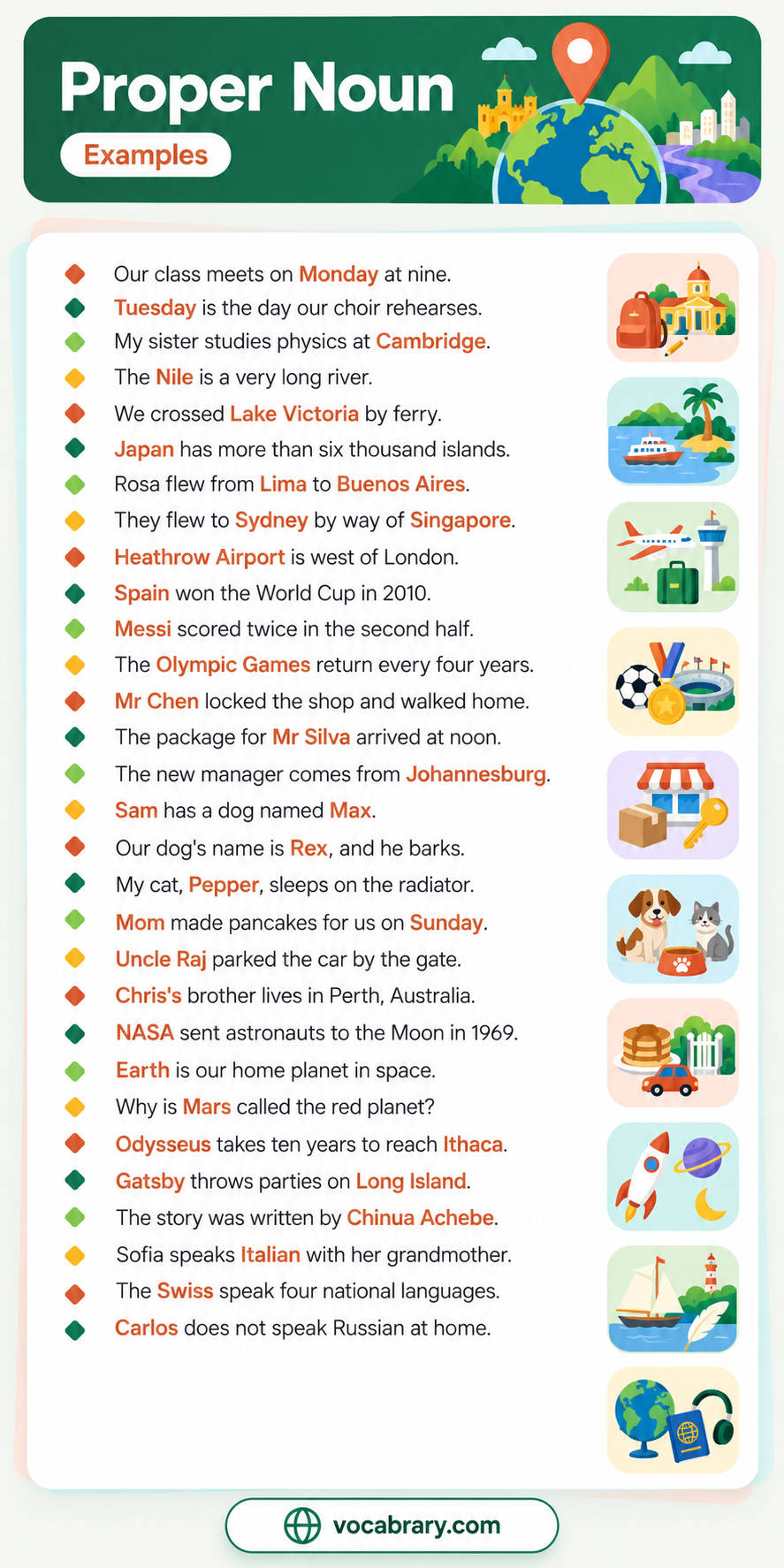
Common Proper Noun Example Sentences
Maria, Brazil, the Nile, and Monday are the proper nouns that learners meet first, and each one names one particular person, country, river, or day.
- Maria teaches biology at a school in Valencia.
- Brazil shares a border with ten other countries.
- The Nile flows north through Egypt and into the Mediterranean Sea.
- Our class meets on Monday at nine.
- My uncle drives a Honda to work.
- Kilimanjaro is the highest mountain in Africa.
- We celebrate Diwali with lamps and sweets every autumn.
- Sofia speaks Italian with her grandmother.
- The Louvre is one of the largest museums in Paris.
- Google was founded in a garage in California.
- Nelson Mandela became president of South Africa in 1994.
- In March the days in London begin to grow longer.
- Mount Fuji is visible from Tokyo on a clear winter morning.
- Ahmed carried the flag for Egypt at the opening ceremony.
- The Pacific Ocean is the largest ocean on Earth.
- Lagos is the largest city in Nigeria.
- Christmas is celebrated on December 25 in many countries.
- My neighbour works for UNICEF in the capital.
- Ottawa is the capital of Canada, not Toronto.
- The Eiffel Tower was finished in 1889.
Sentences With Names of People
Aisha, Carlos, Marie Curie, and Ada Lovelace are names of people, and a proper noun for a person includes a first name, a surname, or both.
- Aisha painted the mural on the school wall.
- Carlos and his sister walk to school together.
- Marie Curie won two Nobel Prizes, one in physics and one in chemistry.
- Kofi found a wallet on the bus and returned it.
- Ada Lovelace wrote notes on an early mechanical computer in the 1840s.
- Hiro repairs bicycles in a small shop in Osaka.
- Ingrid Larsen captains the swimming team at our school.
- Mahatma Gandhi led a peaceful march to the sea in 1930.
- Please give this form to Mr Patel at the front desk.
- Frida Kahlo painted many self-portraits in Mexico City.
- Tomas forgot his umbrella again this morning.
- Wangari Maathai organised women to plant millions of trees in Kenya.
- Both Leila and Omar joined the chess club in September.
- Serena Williams won her first Grand Slam title in 1999.
- My grandmother, Yuki, still grows tomatoes at ninety.
City and Country Names in Sentences
Cairo, Seoul, Peru, and Australia are names of cities and countries, and each name takes a capital letter wherever it is written in a sentence.
- Cairo is the capital of Egypt.
- We landed in Seoul after a twelve-hour flight.
- Peru is home to the mountain city of Cusco.
- Canberra, not Sydney, is the capital of Australia.
- My cousin studies architecture in Istanbul.
- Kenya borders Tanzania, Uganda, Ethiopia, Somalia, and South Sudan.
- The fast train from Madrid to Barcelona takes under three hours.
- Japan has more than six thousand islands.
- Tourists crowd the old streets of Prague every summer.
- Mexico City is built on a high plateau.
- After the conference in Nairobi, Dana flew home to Chicago.
- Argentina and Chile share a long border along the Andes.
- The ferry from Dover reaches Calais in about ninety minutes.
- Mumbai is the home of a large film industry.
Mountain, River and Lake Example Sentences
The Amazon, Mount Everest, Lake Victoria, and the Pacific Ocean are natural features with proper names. Each name keeps its capital letters when a common word such as lake is part of it.
- The Amazon carries more water than any other river on Earth.
- Mount Everest stands on the border between Nepal and China.
- Fishermen cast their nets on Lake Victoria before sunrise.
- The Danube flows through ten countries on its way to the Black Sea.
- The Alps stretch across eight countries in central Europe.
- Whales migrate across the Pacific Ocean every year.
- The Rocky Mountains stretch from Canada to New Mexico.
- We walked along the Thames from Westminster to Tower Bridge.
- Kilimanjaro rises above the plains of northern Tanzania.
- The Andes run along the western edge of South America.
- Barges move grain along the Mississippi to New Orleans.
- Lake Titicaca is shared by Peru and Bolivia.
- Millions of pilgrims bathe in the Ganges each year.
- The Himalayas formed when two continental plates collided.
Organisation and Company Names in Sentences
The United Nations, NASA, Oxford University, and the Red Cross are organisations with proper names, and a name of several words capitalises each main word.
- The United Nations was founded in 1945.
- NASA sent astronauts to the Moon in 1969.
- The Red Cross opened a shelter for flood victims.
- Oxford University welcomes students from many countries.
- My sister works at Microsoft in Dublin.
- The World Health Organization has its headquarters in Geneva.
- Amnesty International published a report on prison conditions.
- Samsung introduced a folding phone in 2019.
- The European Union has twenty-seven member states.
- Harvard is the oldest university in the United States.
- IKEA sells flat-pack furniture in dozens of countries.
- The local Rotary Club raised money for a new library.
- UNICEF delivers vaccines to remote villages.
- Lego began as a Danish toy company.
Day, Month and Holiday Example Sentences
Saturday, April, Diwali, and Thanksgiving are names of days, months, and holidays, and each one begins with a capital letter wherever it is written.
- The market opens early on Saturday.
- Tuesday is the day our choir rehearses.
- Rain fell across the valley throughout April.
- Her birthday falls in November, close to Thanksgiving.
- Families light lamps for Diwali in October or November.
- Many Americans eat turkey on Thanksgiving Day.
- Ramadan lasts for a lunar month of fasting from dawn to sunset.
- We hung paper lanterns for the Lunar New Year parade.
- Halloween falls on October 31 each year.
- Children in Thailand splash water during Songkran in April.
- Easter is celebrated in spring in the Northern Hemisphere.
- Neighbours exchange sweets and visits during Eid.
- Hanukkah lasts eight days and nights.
- Independence Day fireworks lit the sky over Boston on July 4.
Language and Nationality Sentences With Capital Letters
English, Swahili, Brazilian, and Ghanaian are names of languages and nationalities, and each begins with a capital letter, unlike school subjects such as biology and music. Proper adjectives such as Italian are formed from these names, and proper adjective example sentences cover them.
- Students in Nairobi study English and Swahili from the first year.
- Daniel is a Brazilian, and his wife is a Pole.
- Laila speaks Arabic at home and French at school.
- Korean has its own alphabet, designed in the fifteenth century.
- Many Danes cycle to work in every season.
- Hindi and English are both official languages in India.
- She translated the poem from Spanish into English.
- My roommate speaks Japanese and teaches it on weekends.
- I am learning Portuguese before my trip to Lisbon.
- The Swiss speak four national languages.
- Both of my grandparents were Ghanaians.
- Her mother tongue is Tagalog, and she teaches it.
- Mandarin has more native speakers than any other language.
Brand and Product Name Sentences
Nike, Toyota, Google, and Coca-Cola are brand names, and a brand is a proper noun even when the product it names, such as a shoe or a car, is a common noun.
- Tomas bought a pair of Nike running shoes.
- My father has driven a Toyota for twenty years.
- Google answered my question before I finished typing.
- She opened a cold Coca-Cola at the picnic.
- The children built a castle from Lego.
- The football team wore Adidas shirts for the final.
- Priya recorded the lecture with her iPhone.
- A Samsung television hung on the wall of the waiting room.
- We ordered a desk from IKEA and built it in an hour.
- Nokia made some of the first popular mobile phones.
- Netflix added three new comedies this week.
Examples of Titles of Works
Hamlet, The Odyssey, Mona Lisa, and The Lion King are titles of works, and each title is a proper noun whose main words begin with capital letters.
- We read Hamlet in the final term.
- The Odyssey tells the story of a hero’s long voyage home.
- Millions of tourists queue to see the Mona Lisa in Paris.
- The class watched The Lion King on the last day of term.
- Chinua Achebe wrote Things Fall Apart in 1958.
- Pride and Prejudice opens with a famous sentence about marriage.
- My brother reads The Jungle Book aloud to his daughter.
- She wrote an essay on One Hundred Years of Solitude.
- Spirited Away won an Academy Award for animated film.
- Our choir sang Yesterday at the school concert.
- Matilda is Roald Dahl’s story about a girl who loves books.
Capital Letter Sentences for Proper Nouns and Exceptions
Names of people, places, days, months, languages, and organisations take capital letters, while seasons, directions, and general titles stay in lower case unless they form part of a name.
Capital and Lower Case Sentences Compared
Aisha and Friday take capitals, while spring and north do not, since names take capitals and the common words for seasons and directions do not.
| Category | Capital letter | Example |
|---|---|---|
| Names of people | Yes | Aisha met Professor Khan. |
| Days and months | Yes | The festival ends on Friday in October. |
| Seasons | No | We plant tomatoes every spring. |
| Directions | No | Drive north for ten minutes. |
| Regions | Yes | He grew up in the South. |
| Titles before names | Yes | President Mandela spoke first. |
| Titles without names | No in most styles | The president spoke first. |
| Languages | Yes | She studies Korean. |
| School subjects | No | She studies biology. |
Lower Case Sentences With Seasons and Directions
Spring, autumn, north, and east are common nouns, so they begin with a lower-case letter unless a name such as Spring Festival includes them.
- Leaves fall in autumn across the whole of New England.
- Rosa plants tomatoes every spring in the back garden.
- Turn east at the traffic light and walk to Kings Bridge.
- A cold wind blew from the north over Lake Michigan all morning.
- The summer holidays begin in July.
- Birds fly south from Canada before the first frost.
- Heavy rain is forecast for northern Ghana this week.
- The sun rises in the east above the Sahara.
- The Spring Festival in China marks the Lunar New Year.
- Winter in Oslo brings snow and very short days.
Regions and Titles Before Names in Sentences
The South, the Midwest, President Lincoln, and Professor Khan take capitals because they are names, while a title alone or a direction word does not.
- Rain is forecast for the South on Friday, while the Midwest stays dry.
- She grew up in the Middle East and studied in Scotland.
- Tourists love the beaches of Southeast Asia.
- President Lincoln delivered a famous speech at Gettysburg.
- Kiran, the president of our club, welcomed the new members.
- Queen Victoria ruled for more than sixty-three years.
- Professor Khan graded the essays over the weekend.
- Our professor, Dr Alvarez, gave us an extra week.
- Captain Rivera greeted the passengers at the gate.
- Please ask your mother to send the form to Ms Evans.
- I told Mom that the train was late.
- Uncle Raj parked the car by the gate.
Proper Noun Sentences With the and Without the
A proper noun takes the when it names a river, an ocean, a mountain range, a desert, a plural place, or an institution, band, or newspaper. It takes no the when it names a single city, lake, or mountain.
Sentences With the Nile and the Alps
The Nile, the Alps, the Atlantic, and the Netherlands each take the, because they name a river, a mountain range, an ocean, and a plural country.
- Farmers along the Nile grow cotton and wheat.
- Skiers fill the resorts of the Alps in January.
- Cargo ships cross the Atlantic carrying cars and grain.
- The Netherlands is famous for its tulip fields and canals.
- Our cousins emigrated to the United States in 1998.
- Hikers camped beside the Rhine for two nights.
- The Sahara stretches from the Atlantic coast to the Red Sea.
- The Philippines is made up of more than seven thousand islands.
- Rain finally reached the Andes after a dry spring.
- The tour of the Louvre takes about two hours.
- The Beatles formed in Liverpool in 1960.
- Mina read the Guardian on the train.
- We flew over the Bahamas on the way to Miami.
- The Hague hosts several international courts.
Sentences With Paris, Kenya and Lake Victoria
Paris, Kenya, Lake Victoria, and Mount Fuji take no the, because each names one city, one country, one lake, or one mountain.
- We spent three days in Paris last summer.
- Kenya is known for its long-distance runners.
- Lake Victoria borders three different countries.
- Mount Fuji is a popular climb in July and August.
- Rosa flew from Lima to Buenos Aires.
- Oxford Street is crowded on Saturday afternoons.
- Africa has fifty-four countries recognised by the United Nations.
- Google opened an office near our school.
- Everest attracts climbers from around the world every spring.
- Central Park is a green space in New York City.
- My sister studies physics at Cambridge.
- Thursday is the day of the weekly market.
Possessive Proper Noun Examples
Maria’s, Ghana’s, the Smiths’, and Dickens’s show how a proper noun takes an apostrophe to show ownership. Writers differ on names ending in s, so Dickens’s and Dickens’ both appear in print, and possessive noun example sentences cover the wider pattern.
- Maria’s bicycle is leaning against the garden wall.
- Ghana’s capital city, Accra, lies on the coast.
- The Smiths’ house is the one with the blue door.
- Dickens’s novels were first printed in weekly parts.
- Microsoft’s headquarters are in Redmond, Washington.
- I borrowed Ahmed’s notes before the exam.
- Brazil’s coastline stretches for thousands of kilometres.
- Sara and Omar’s wedding was held in a garden in Amman.
- Tom’s and Priya’s presentations were the shortest in the class.
- The Khans’ garden is full of roses in June.
- Mozart’s music fills the concert hall tonight.
- Chris’s brother lives in Perth, Australia.
- Tokyo’s subway carries millions of passengers every day.
- The Nile’s delta spreads out into the Mediterranean Sea.
Subject Position Sentences With a Proper Noun
A proper noun in subject position names who or what the sentence is about, as with Amara in Amara plays and Canada in Canada shares.
- Amara plays the violin in the school orchestra.
- Canada shares the longest land border in the world with the United States.
- Mr Chen locked the shop and walked home.
- Venus is hotter than Mercury, though farther from the sun.
- Toyota manufactures hybrid cars in several countries.
- Lagos is noisy, colourful, and full of music.
- Priya and Daniel painted the fence on Sunday.
- Spain won the World Cup in 2010.
- Mount Etna erupts regularly and lights the night sky.
- Ramadan begins about ten days earlier each year.
- The Amazon receives heavy rain for most of the year.
- Ms Rivera teaches the youngest class in the school.
Object and Complement Sentences With Names
A proper noun follows a verb as its object, as in visited Lima, or follows be as a complement, a word that renames the subject, as in Tokyo is the capital.
- We visited Lima during our trip to Peru.
- The teacher praised Hana for her careful work.
- Mia invited Carlos and Aisha to the picnic.
- The capital of Japan is Tokyo.
- The new mayor is Fatima Okoye.
- She named her new puppy Biscuit.
- The children call their teacher Miss Lin.
- Astronomers named the comet Hale-Bopp after its two discoverers.
- The winner of the marathon was Grace Wanjiru.
- We crossed Lake Victoria by ferry.
- My favourite city in the world is Istanbul.
- Our dog’s name is Rex, and he barks.
Examples of Names After From and Between
From, for, between, next to, and by introduce a proper noun in phrases such as from Beijing and between Brazil and Germany, and the name is the object of the preposition.
- Mei received a letter from Beijing last week.
- The package for Mr Silva arrived at noon.
- We walked along the river toward Oxford.
- Nothing compares with Thanksgiving at my aunt’s house.
- The match between Brazil and Germany ended in a draw.
- Sofia sat next to Hassan during the lecture.
- A bridge over the Danube joins the two halves of the city.
- The story was written by Chinua Achebe.
- They flew to Sydney by way of Singapore.
- The festival begins on Friday and ends on Sunday.
Negative Sentences With Proper Nouns
Not, never, no, and neither make a statement about Carlos, Jamaica, or Sweden negative, and the proper noun keeps its capital letter.
- Carlos does not speak Russian at home.
- Jamaica is not part of Europe.
- We did not visit Rome on this trip.
- Ms Chen never arrives late to class.
- Mount Kenya is not visible from Nairobi on cloudy days.
- The shop is not open on Sunday.
- Neither Anna nor Peter has finished the report.
- Sweden has no desert, though it has many lakes.
- Ravi did not eat lunch at McDonald’s that day.
- Nobody in our class has read Hamlet yet.
- Diwali is not celebrated on the same day in every country.
Question Sentences With Where, Which and Who
Where, which, who, and when open questions about Kilimanjaro, Vienna, and Ramadan, and the proper noun keeps its capital letter inside the question.
- Where exactly is Kilimanjaro located in Africa?
- Did Mina call you yesterday evening?
- Which river flows through Vienna and Budapest?
- Is Thursday the day of the school trip?
- Who wrote the novel Things Fall Apart?
- Has Doctor Okoye arrived at the clinic?
- How far is Madrid from Lisbon?
- When does Ramadan begin this year?
- Does Samsung make tablets as well as phones?
- Are Ahmed and Lina coming to the party?
- What time does the train for Edinburgh leave?
- Why is Mars called the red planet?
Reported Speech and Passive Sentences With Names
In reported speech, a proper noun such as Peru or Shakespeare keeps its capital letter, and in a passive sentence, a name such as Wangari Maathai keeps it too.
- Ines said that Peru was her favourite country.
- The teacher told us that Shakespeare wrote Hamlet.
- Our guide explained that Kilimanjaro is a dormant volcano.
- Paris was chosen as the host city for the conference.
- The Nobel Peace Prize was awarded to Wangari Maathai in 2004.
- He asked whether Lina had finished her homework.
- She announced that Diwali would begin on Thursday.
- The novel was translated from Russian into English.
- The mayor said that Lagos needed more buses.
- The film was directed by Hayao Miyazaki.
- Mr Patel was told that his flight to Delhi had been cancelled.
- It was reported that Nike would open a new store in Seoul.
Home and School Sentences With Relatives and Teachers
Grandma, Aunt Sunita, Greenfield Primary, and Ms Lopez are names from family life and school life, where proper nouns name relatives, pupils, teachers, and buildings.
- Grandma baked fresh bread for Easter.
- My brother Kofi keeps his football boots under the bed.
- We eat dinner with Aunt Sunita every Friday.
- Our school, Greenfield Primary, won the reading contest.
- In September, the new term at Westbrook Academy begins.
- Ms Lopez hands out the maths books at the start of class.
- The class from Room 12 painted a map of Africa.
- Pupils study French on Tuesday and Thursday.
- My cat, Pepper, sleeps on the radiator.
- Sports day at Hillcrest School ended with a relay race.
Office and Travel Sentences With Companies and Landmarks
Atlas Logistics, Heathrow Airport, the Taj Mahal, and Marrakech are names from offices and journeys, where proper nouns name employers, airports, landmarks, and cities.
- Rosa manages the accounts at Atlas Logistics.
- Our meeting with Siemens is on Wednesday morning.
- The new manager comes from Johannesburg.
- Flights to Bangkok leave from Terminal 2 at dawn.
- We stayed at the Hotel Miramar near the harbour.
- Heathrow Airport is west of London.
- Tourists photographed the Taj Mahal at sunrise.
- Our guide in Marrakech spoke Arabic, French, and English.
- Ticket sales for Carnival in Rio de Janeiro begin in autumn.
- The conference in Singapore starts on Monday.
- An engineer from Samsung presented the new design.
- Pablo booked a train from Berlin to Prague.
News and Sports Sentences With Teams and Athletes
Brazil, Serena Williams, the Premier League, and the BBC appear in headlines and match reports, where proper nouns name teams, athletes, competitions, and broadcasters.
- Brazil won the football World Cup in 1994 and again in 2002.
- Serena Williams retired from professional tennis in 2022.
- The Olympic Games return every four years.
- Messi scored twice in the second half.
- Negotiators from Norway and Iceland met in Oslo.
- The Tour de France ends on the Champs-Élysées in Paris.
- Parliament debated the new budget on Wednesday.
- Officials in Jakarta announced new flood defences.
- Kenya dominated the long-distance races at the championships.
- The Premier League season starts in August.
- Reporters from the BBC interviewed the survivors.
- Simone Biles won four gold medals at the 2016 Olympics in Rio de Janeiro.
Fiction Sentences With Characters and Places
Hamlet, Elizabeth Bennet, Odysseus, and Alice are characters whose names are proper nouns, and the places they visit, such as Ithaca and Wonderland, are proper nouns too.
- Hamlet meets the ghost of his father on the castle wall.
- Elizabeth Bennet refuses the first proposal from Mr Darcy.
- Odysseus takes ten years to reach Ithaca.
- Alice follows a white rabbit down a hole into Wonderland.
- Sherlock Holmes notices the mud on the visitor’s boots.
- Mowgli grows up among wolves in the jungle.
- Gatsby throws parties on Long Island.
- In Matilda, Miss Honey teaches the youngest pupils.
- Dorothy and Toto are carried off to Oz by a tornado.
- Scheherazade tells stories to the king for a thousand and one nights.
Science and Health Sentences With Planets and Hospitals
Marie Curie, Mars, Jupiter, and Saint Mary’s Hospital are names from laboratories and clinics, where proper nouns name scientists, planets, hospitals, and universities.
- Marie Curie studied radioactivity in Paris.
- Mars has two small moons, Phobos and Deimos.
- The World Health Organization published new guidance on handwashing.
- Doctor Patel works at Saint Mary’s Hospital in Leeds.
- Alexander Fleming discovered penicillin in 1928.
- Jupiter is the largest planet in the solar system.
- Researchers at Johns Hopkins University study infectious diseases.
- Earth takes about 365 days to circle the sun.
- The patient was transferred to Saint Mary’s Hospital after midnight.
Proper Noun Example Sentences for Kids
Lily, Canada, Monday, and Christmas are the names that children write first, and short sentences about a name, a country, or a day fit a first lesson.
- My name is Lily, and I am eight.
- I live in Canada with my family.
- Monday is the first school day of the week.
- Sam has a dog named Max.
- Christmas comes in December every year.
- Our teacher is Mr Brown, and he likes jokes.
- The Nile is a very long river.
- We ate lunch at Burger Barn on Saturday.
- Mom made pancakes for us on Sunday.
- My best friend is Ravi, and he lives next door.
- Earth is our home planet in space.
- We saw a lion at Safari Park on Friday.
Proper Noun Example Sentences for Students
Nelson Mandela, the Industrial Revolution, World War II, and the University of Cape Town are names that appear in essays and exam answers, where proper nouns also name historical events and periods.
- Nelson Mandela spent twenty-seven years in prison before he became president of South Africa.
- The Amazon basin contains the largest rainforest in the world.
- The Industrial Revolution began in Britain in the eighteenth century.
- World War II ended in 1945, and the United Nations was founded soon after.
- Researchers at the University of Cape Town published their findings in March.
- The Renaissance started in Italy and spread across Europe.
- Students from Nigeria, Poland, and Vietnam presented at the conference in Geneva.
- The treaty was signed in Versailles in June 1919.
- The Constitution of India came into force on 26 January 1950.
- Orwell argues that careless language weakens political thought.
- The Berlin Wall fell in November 1989.
- Charles Darwin published On the Origin of Species in 1859.
Proper Nouns in Short Paragraphs
A trip from Nairobi to Cairo, a Portuguese class, a safari in the Maasai Mara, a festival in Leicester, and a football final in Qatar use several proper nouns in a row. Connected writing shows how proper nouns work together.
Aisha flew from Nairobi to Cairo on Friday. In Cairo she met her cousin Karim, and they walked along the Nile at sunset. On Sunday they visited the Egyptian Museum.
Mr Santos teaches Portuguese at Riverside High School. Every October, his class cooks food from Brazil and listens to music from Lisbon. Thursday is the day of the final quiz.
Visitors fly from Nairobi to the Maasai Mara each August to watch the wildebeest cross the Mara River. Their guide, Joseph, speaks English, Swahili, and Maa.
Diwali arrived early in Leicester this year. Priya and her cousins hung lamps along Belgrave Road, and their grandmother, Nani, cooked sweets for the whole street.
Argentina played France in the final on Sunday in Qatar. Fans from Buenos Aires and Paris filled the stadium, and the referee, Szymon Marciniak, blew the whistle at six o’clock.
Common Noun and Proper Noun Sentences Compared
A city, a river, a month, and a company are common nouns, and Lisbon, the Nile, March, and Toyota are the proper nouns that name one particular case of each. Related types are covered in common noun example sentences and abstract noun example sentences.
| Common noun | Proper noun | Sentence |
|---|---|---|
| City | Lisbon | The city of Lisbon has seven hills. |
| Country | Kenya | The country called Kenya lies on the equator. |
| River | The Nile | A river such as the Nile crosses several countries. |
| Month | March | The month of March brings warmer weather. |
| Day | Friday | Our trip is on Friday, not on a school day. |
| Company | Toyota | A company such as Toyota employs thousands of workers. |
| Language | Swahili | The language called Swahili is spoken across East Africa. |
| Teacher | Ms Rivera | Our teacher, Ms Rivera, reads aloud each morning. |
FAQs
Q1. What are some common examples of proper nouns?
Common examples of proper nouns are names of people such as Maria, places such as Nairobi and the Nile, and organisations such as the United Nations. Days, months, holidays, languages, brands, and titles of works join the same group. Each name takes a capital letter wherever it is written in a sentence.
Q2. How do you identify a proper noun in a sentence?
You identify a proper noun by asking whether the word names one particular person, place, or object instead of a whole class. In We visited the museum in Lisbon, the word museum names any museum, while Lisbon names one city. A capital letter in the middle of a sentence is a second signal, although the first word of every sentence also has one.
Q3. What is the difference between a proper noun and a common noun?
A proper noun names one particular person, place, or object, while a common noun names any member of a class. The word city is common, and the word Lisbon is proper. A proper noun begins with a capital letter in standard writing, and a common noun begins with one only at the start of a sentence or in a title.
Q4. Do proper nouns always start with a capital letter?
Proper nouns start with a capital letter in standard written English, with a small number of brand styles as the exception. Names such as iPhone and eBay keep a lower-case first letter because the owners chose that spelling. Long names also keep small words such as of and the in lower case, as in the Bank of England.
Q5. Are the days of the week and months proper nouns?
The days of the week and the months of the year are proper nouns, so Monday, Friday, March, and October all take capital letters. Each name identifies one particular day or month in the calendar. The same rule covers holidays such as Diwali, Eid, and Thanksgiving.
Q6. Are seasons and directions proper nouns?
Seasons and directions are common nouns, so spring, summer, autumn, winter, north, and south stay in lower case. A season or a direction takes a capital letter only when it is part of a name, as in the Spring Festival or North Korea. Regions such as the South and the Midwest also take capitals, because they name particular parts of a country.
Q7. When do proper nouns take the?
Proper nouns take the when they name rivers, oceans, mountain ranges, deserts, plural places, and many organisations, as in the Nile, the Pacific, the Alps, and the United Nations. Single cities, most countries, lakes, and single mountains take no the, as in Paris, Kenya, and Mount Fuji. Names such as the Netherlands and the Philippines follow the plural pattern.
Q8. How do you make a proper noun possessive?
You make a singular proper noun possessive by adding an apostrophe and s, as in Maria’s bike and Ghana’s capital. A plural family name takes an apostrophe after the s, as in the Smiths’ house. Names that end in s take either ‘s or a bare apostrophe, so Dickens’s and Dickens’ both appear in print.
Q9. Are titles such as president and doctor proper nouns?
Titles such as president and doctor are capitalised when they stand directly before a name, as in President Mandela and Doctor Patel. After the name, or without a name, most style manuals keep the title in lower case, as in the president spoke. A family word used as a name, such as Mom, also takes a capital letter.
Q10. Are languages and nationalities proper nouns?
Languages and nationalities are proper nouns, so English, Swahili, Brazilian, and Polish all begin with a capital letter. School subjects such as biology and music are common nouns and stay in lower case. Proper adjectives such as Italian and Egyptian also take capitals, as the proper adjective example sentences show.
Q11. Can a proper noun be plural?
A proper noun takes a plural form when it names more than one person or place with the same name, as in the Smiths and the Kennedys. Some proper nouns are plural from the start, such as the Alps, the Himalayas, and the Philippines. Plural family names add -s or -es without an apostrophe.
Q12. Are brand names proper nouns?
Brand names are proper nouns, because each one names a particular company or product line, as with Nike, Toyota, and Google. The product itself stays a common noun, so you write a Toyota for the brand and a car for the item. A brand name keeps its own capital pattern, such as iPhone or eBay.
Q13. What are some proper noun example sentences for kids?
Proper noun example sentences for kids use short names that children already know, such as My name is Lily, I live in Canada, and Monday is a school day. Each sentence pairs a name with a short verb phrase. A child finds the name in each sentence by looking for the capital letter.

Leave a Comment