
A proper adjective is an adjective type derived from a proper noun that names a specific national, cultural, or personal origin, as in the Japanese garden attracted visitors all summer. Proper adjective example sentences with Italian, Shakespearean, and Himalayan show the form at work in food, travel, school, and literature.
What Is a Proper Adjective?
A proper adjective is a modifier formed from a proper noun, and it always begins with a capital letter. A common adjective such as "tall" or "red" describes a general quality, while a proper adjective such as "Victorian" traces the modifier to a specific name.
Proper noun + suffix (-an, -ian, -ese, -ish, -ic, -ist, -esque) = Proper adjective
The chef prepared a Brazilian stew with black beans and smoked pork.
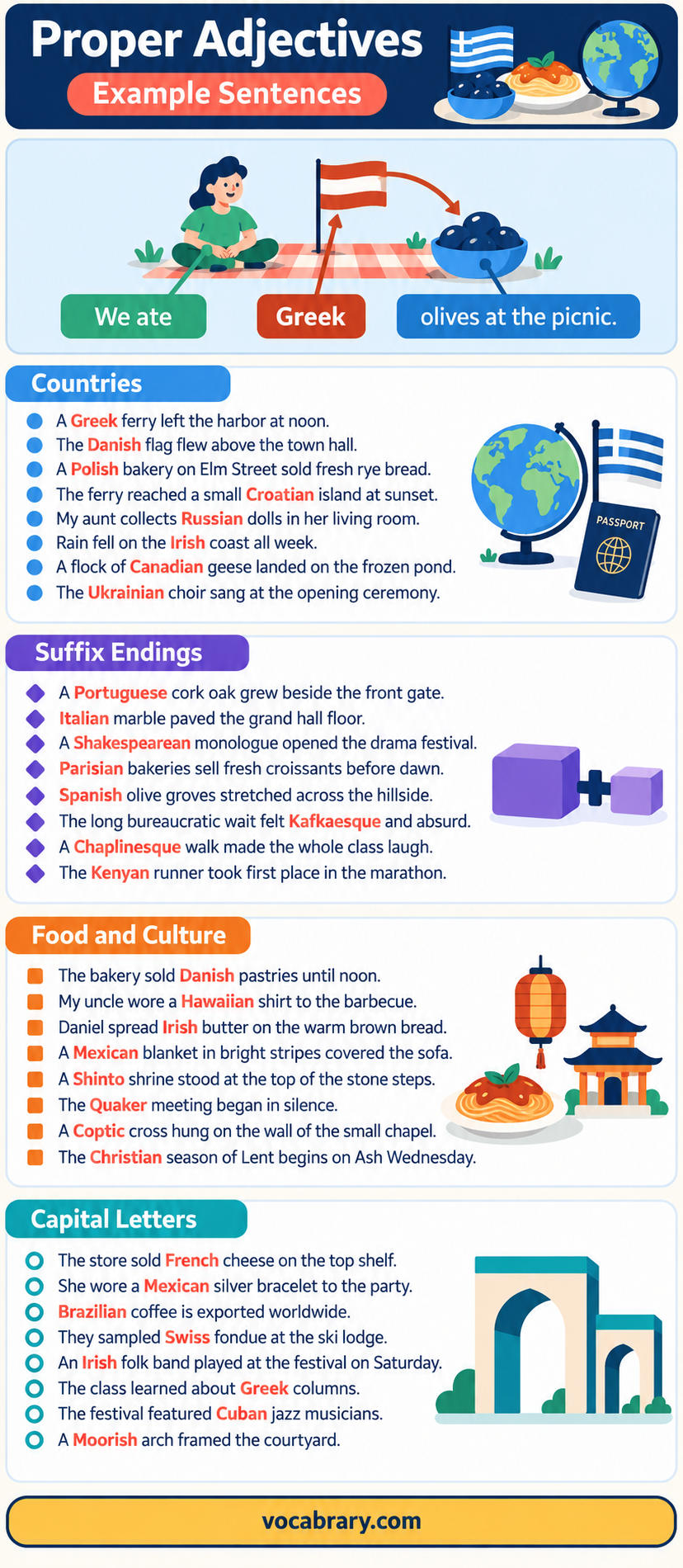
Common Proper Adjective Example Sentences
Japanese tea, Italian pasta, Shakespearean drama, and Californian wine are the starting mix. The proper adjective in each sentence keeps its capital letter because it traces back to a proper noun.
- The Japanese cherry blossom festival drew thousands of visitors to the park last spring.
- A plate of Italian pasta with fresh basil and olive oil arrived within minutes of ordering.
- Her favorite French perfume filled the room the moment she opened the bottle.
- German steel reinforced the bridge along the highway outside town.
- Several Chinese lanterns hung from the trees during the autumn celebration.
- At the new restaurant, the Mexican tacos earned five stars on opening night.
- Our neighbors served a Thai curry with coconut milk and fresh vegetables.
- An American flag was raised over the courthouse steps before the Fourth of July parade started in the morning.
- Yesterday the music teacher introduced a Brazilian drumming rhythm to the class.
- Australian surfers competed on the north shore during the winter championship.
- A row of Indian spices lined the top shelf of the kitchen cupboard.
- One Swiss watchmaker repaired my grandfather’s pocket watch in a single afternoon.
- Spanish guitar music drifted through the open windows of the cafe on the corner.
- Two Korean exchange students joined our chemistry lab this semester.
- For their anniversary, the couple booked a weeklong tour of three Greek islands across the Aegean Sea.
- An Egyptian cotton bedsheet replaced the old linen one in the guest room.
Proper Noun to Proper Adjective Conversion
A proper noun turns into a proper adjective through a suffix such as -an, -ese, -ish, -ean, -ic, -ist, or -esque. Each suffix produces a different ending, but the capital letter always stays.
| Proper noun | Suffix | Proper adjective | Example sentence |
|---|---|---|---|
| Japan | -ese | Japanese | A Japanese maple tree grew beside the front gate. |
| Italy | -an | Italian | Italian marble paved the grand hall floor. |
| Shakespeare | -ean | Shakespearean | A Shakespearean monologue opened the drama festival. |
| Paris | -ian | Parisian | Parisian bakeries sell fresh croissants before dawn. |
| China | -ese | Chinese | Chinese silk was the most prized fabric on the old trade route. |
| Spain | -ish | Spanish | Spanish olive groves stretched across the hillside. |
| Darwin | -ian | Darwinian | The biology professor explained Darwinian natural selection to the first-year class. |
| Kafka | -esque | Kafkaesque | The long bureaucratic wait felt Kafkaesque and absurd. |
| Marx | -ist | Marxist | A Marxist reading of the novel changed the class discussion. |
| Victoria | -n | Victorian | A row of Victorian townhouses lined the cobblestone street. |
Proper Adjectives From Country Names
Japanese sushi, Italian gelato, French wine, German cars, and Korean dramas are phrases most people recognize at once. The proper adjective tells the reader which nation the noun comes from.
- The Japanese bullet train ran from Tokyo to Osaka in under three hours.
- An Italian leather bag caught her eye at the market near the Ponte Vecchio.
- French pastries filled the glass counter at the bakery on Rue de Rivoli.
- German lager outsold all other beers at the Oktoberfest tent last October.
- His Chinese calligraphy instructor corrected the brushstroke before the ink dried.
- A Mexican mariachi band played three songs outside the town hall at sunset.
- Brazilian coffee beans arrived at the roastery in fifty-kilogram sacks and were roasted within two days of delivery.
- The school hosted an Indian dance workshop during the multicultural week.
- Korean skincare products sold out at the new drugstore within a week of opening.
- A Thai boxing match drew a large crowd to the outdoor stadium on Friday.
- Several Nigerian novelists won international prizes in the past decade.
- Turkish carpets lay across the floor of the antique shop on the high street.
- Canadian maple syrup sweetened the pancakes at the Sunday brunch.
- Australian wool sweaters were the warmest ones on the shelf at the winter sale.
- Over the weekend, the family tried a Vietnamese pho recipe from a cooking magazine.
- Ethiopian runners dominated the long-distance races at the championship.
- Swedish meatballs and gravy were the top-selling dish at the furniture store cafe.
- Peruvian quinoa replaced rice in the lunch bowls at the health food counter.
Proper Adjectives From Person Names
Shakespearean tragedy, Marxist theory, Freudian slips, Darwinian fitness, and Orwellian surveillance are five established person-derived proper adjectives. The proper noun of the thinker, author, or leader gives its name to the adjective.
- The drama club rehearsed a Shakespearean comedy for three weeks before performing it on the last night of the school year.
- A Marxist critique of income inequality ran in the economics journal last month.
- Her Freudian slip revealed what she had been thinking about all morning.
- Darwinian evolution became the central theme of the biology semester.
- Surveillance cameras on every corner gave the city an Orwellian atmosphere.
- Without hesitation, the professor dismissed the argument as a Machiavellian trick designed to mislead the committee.
- Dickensian poverty filled the chapters of the nineteenth-century novel assigned to the class.
- A Platonic friendship between the two characters drove the plot of the film.
- Students practiced a Socratic dialogue in pairs during the philosophy seminar.
- Strict discipline earned the coach a Napoleonic reputation among the swimmers.
- A Byronic hero brooded at the center of the romantic poem.
- Keynesian spending policies shaped the government’s response to the recession.
- Fans praised the director for creating a Hitchcockian sense of dread in the opening scene.
- Drawing on Palladian symmetry, the architect designed the new library wing with tall columns and a balanced facade.
- Einsteinian relativity changed the way physicists thought about the universe.
- That Wagnerian opera ran for four hours without an intermission.
Proper Adjectives From Place Names
Parisian fashion, Himalayan salt, Californian vineyards, Venetian glass, and Saharan sand dunes name places that lend their adjectives to recipes, travel writing, and daily speech.
- Parisian boutiques displayed the new spring collection weeks before any other city.
- A bag of Himalayan pink salt sat on the kitchen counter next to the pepper grinder.
- Californian avocados arrived at the market stall early on Wednesday morning.
- Inside the museum, a Venetian glass chandelier from the seventeenth century hung in the main gallery.
- One Saharan sandstorm delayed all flights out of the airport for six hours and left the runway under a layer of fine red dust.
- Texan brisket smoked for twelve hours over mesquite wood.
- The inn on the hill served Alaskan salmon with dill sauce and roasted potatoes.
- Caribbean coral reefs drew marine biologists to the research station last summer.
- A Siberian wind brought the coldest temperatures the village had recorded in a decade.
- Two Appalachian folk songs opened the concert at the mountain lodge.
- Mediterranean olive oil was the base of every dressing at the salad bar.
- The expedition crossed the Antarctic ice sheet over a period of forty-seven days.
- His Bostonian accent gave away his hometown the moment he introduced himself.
- Alpine wildflowers bloomed beyond the tree line along the trail in late June.
- Scandinavian furniture filled the showroom with birch desks and linen chairs.
- Florentine leather goods drew tourists to the narrow shops along the Arno.
Proper Adjectives for Religion and Culture
Christian hymns, Buddhist monks, Islamic architecture, and Hindu festivals are proper adjectives that trace back to the name of a faith or its founder. The capital letter signals a specific tradition, not a general trait.
- A Christian choir performed at the cathedral on Sunday mornings during Advent.
- Buddhist monks walked barefoot through the village at dawn to collect alms.
- The Islamic geometric pattern on the tile wall fascinated the architecture students.
- Hindu temples in Varanasi attracted pilgrims from across the subcontinent.
- During Hanukkah, a Jewish menorah glowed in the window of the community center, and the candles burned until the wax ran out.
- Lutheran congregations in Scandinavia date back to the sixteenth century.
- At the top of the hill, the Catholic school required uniforms for all students from kindergarten onward.
- Confucian principles of respect and duty shaped the family’s daily routines.
- Sikh volunteers served free meals at the community kitchen on weekends.
- Protestant reformers challenged church practices across northern Europe in the 1500s.
- A Taoist garden with a stone path and a koi pond bordered the meditation hall.
- In Athens, the Orthodox Easter celebration lasted three full days.
- Methodist churches in the village held a joint service on Christmas morning.
- Anglican hymns opened the school assembly at half past eight.
Proper Adjectives in Everyday Life
Italian espresso at a morning cafe, Swiss chocolate in a lunchbox, and Scottish tartan on a winter scarf are proper adjectives that turn up before breakfast is over. Food, fashion, music, and sports send these words into daily conversation.
- The barista brewed a double shot of Italian espresso for the first customer of the day.
- A bar of Swiss chocolate melted in his pocket during the afternoon bus ride.
- Scottish tartan scarves sold out at the department store before Christmas.
- She downloaded a Bollywood soundtrack, and the entire car sang along to the music during the three-hour road trip to the coast.
- Swedish saunas were installed in the basement locker room during the renovation.
- An Argentinian tango class met in the dance studio on Tuesday evenings.
- Dutch tulips lined both sides of the garden path behind the farmhouse.
- All morning, a Viennese waltz played on a loop in the dentist’s waiting room.
- Jamaican jerk chicken was the best-selling dish at the food truck rally.
- A Persian rug warmed the hardwood floor beneath the dining chairs.
- Colombian coffee filters sat beside the kettle in the break room.
- Japanese sushi rolls filled the platter at the Friday office lunch.
- At the mall, the sports shop sold American basketball jerseys beside the running shoes.
- Moroccan mint tea was the welcome drink at the hotel reception.
- His Cuban cigar filled the balcony with a rich, smoky aroma.
Proper Adjective Example Sentences in Literature and History
Homeric epics, Arthurian legends, Elizabethan theater, and Byzantine politics give a name and a period to each historical or literary reference. The proper adjective ties the sentence to a real person, era, or text.
- Homeric similes comparing warriors to storms filled Book Five of the Iliad.
- The English department offered a full semester on Arthurian legends and their later retellings.
- Elizabethan actors performed on an open-air stage at the Globe Theatre in London.
- Scholars described the Byzantine court as a web of alliances and betrayals.
- Augustan poets in eighteenth-century England modeled their verses on ancient Roman writers.
- A Gothic cathedral with flying buttresses towered over the old market square.
- After 1918, the fall of the Ottoman Empire redrew the borders of the Middle East and created several new nation-states across the region.
- Renaissance painters in Florence studied human anatomy to improve their portraits.
- Jacobean drama grew darker and more violent than the plays of the earlier Elizabethan period.
- Viking longships crossed the North Atlantic and reached the coast of Newfoundland around the year 1000.
- In the autumn term, the class read a Chaucerian tale from The Canterbury Tales in Middle English.
- Napoleonic wars lasted over a decade and reshaped the political map of Europe.
- Spartan discipline in the ancient army became a model for military training.
- Edwardian manners and dress codes shaped the first decade of the twentieth century.
Proper Adjective Example Sentences for Kids
A seven-year-old eating Italian pizza, coloring an American flag, and reading a Greek myth already uses proper adjectives without knowing the grammar word. The capital letter and the named origin are the only new lessons.
- My mom made Italian pizza with extra cheese for dinner.
- We colored an American flag with red, white, and blue crayons.
- The teacher read a Greek myth about a boy who flew too close to the sun.
- French bread from the bakery was still warm when we got home.
- My best friend brought Japanese candy to share at lunchtime.
- Next to the lions, the African elephant was the largest animal at the zoo.
- We watched a British cartoon about a pig and her little brother.
- Chinese New Year decorations hung in the school hallway for a whole week.
- Dad ordered Mexican tacos with extra salsa.
- Our class wrote letters to Canadian pen pals across the border.
- A big Australian kangaroo hopped around the enclosure at the wildlife center.
- On Monday, the librarian showed us a picture of an Egyptian pyramid in a history book.
Proper Adjective Example Sentences for Students
A thesis on Marxist theory, a report on Elizabethan drama, and an exam question on Darwinian adaptation give proper adjectives an academic setting. The capital letter and the named source are the grammar targets for revision.
- The professor assigned a research paper on Marxist economics, and the deadline fell on the last Friday of the semester.
- A report on Elizabethan theater counted for thirty percent of the final grade.
- On the biology exam, students defined Darwinian natural selection in two paragraphs.
- Shakespearean sonnets followed a strict rhyme scheme of three quatrains and a couplet.
- In geography, students compared Amazonian deforestation rates over the past fifty years.
- An Aristotelian framework guided the ethics discussion during the seminar.
- Newtonian mechanics was the first chapter in the physics syllabus this year.
- One history essay traced the Napoleonic Code’s influence on modern law.
- A Socratic questioning method led the tutorial on logic and reasoning.
- Euclidean geometry problems opened the math test.
- The architecture module explored Palladian design through floor plans and sketches.
- Freudian psychology was the focus of Chapter Three in the textbook.
- Before the lecture, students reviewed Kantian ethics in the assigned reading.
Proper Adjectives and Common Adjectives in the Same Sentence
A tall Victorian clock, a spicy Mexican salsa, and a cold Siberian wind put a common adjective (italicized) and a proper adjective (bolded) side by side in one sentence. More adjective sentences work through the same pairing.
- The old Victorian house on Elm Street needed a new roof, fresh paint, and a repaired front porch.
- A thick Norwegian sweater kept him warm during the snowstorm.
- Spicy Mexican salsa burned her tongue at the summer picnic.
- Down the narrow Venetian canal, the orange sunset reflected on the water.
- Fresh Italian mozzarella tasted better than the packaged version.
- A loud Brazilian drum circle opened the annual street festival.
- One tiny Japanese garden had a stone lantern beside the pond.
- Warm Mediterranean air dried the wet towels on the clothesline.
- That rare Shakespearean folio lay in a locked glass cabinet at the museum.
- The icy Siberian wind rattled the loose shutters all night.
Sentences Rewritten With the Correct Proper Adjective
Forgetting the capital letter, writing "Japan food" instead of "Japanese food," and dropping the suffix altogether are the errors a learner needs to catch.
- The store sold French cheese on the top shelf ✅, wrong as The store sold french cheese on the top shelf ❌.
- He studied Aristotelian logic at the university ✅, wrong as He studied Aristotle logic at the university ❌.
- She wore a Mexican silver bracelet to the party ✅, wrong as She wore a Mexico silver bracelet to the party ❌.
- That recipe called for Italian oregano ✅, wrong as That recipe called for italian oregano ❌.
- A Shakespearean tragedy was assigned for homework ✅, wrong as A shakespeare tragedy was assigned for homework ❌.
- Brazilian coffee is exported worldwide ✅, wrong as Brazil coffee is exported worldwide ❌.
- The Buddhist temple was open to visitors ✅, wrong as The buddhist temple was open to visitors ❌.
- They sampled Swiss fondue at the ski lodge ✅, wrong as They sampled swiss fondue at the ski lodge ❌.
- Chinese porcelain decorated the mantelpiece ✅, wrong as China porcelain decorated the mantelpiece ❌.
- A Victorian lamp lit the reading corner ✅, wrong as A victorian lamp lit the reading corner ❌.
Related
- Parts of Speech Example Sentences
- Compound Adjective Example Sentences
- Predicate Adjective Example Sentences
FAQs
An everyday example is "A plate of Italian pasta with fresh basil and olive oil arrived within minutes of ordering." Another is "Oliver wore a Swiss watch to the interview."
With countries, one example is "German steel reinforced the bridge along the highway outside town." Another is "Canadian maple syrup sweetened the pancakes at the Sunday brunch."
From a surname, one example is "Surveillance cameras on every corner gave the city an Orwellian atmosphere." Another is "Students practiced a Socratic dialogue in pairs during the philosophy seminar."
For a place, one example is "Californian avocados arrived at the market stall early on Wednesday morning." Another is "Alpine wildflowers bloomed beyond the tree line along the trail in late June."
In religion, one example is "Buddhist monks walked barefoot through the village at dawn to collect alms." Another is "Sikh volunteers served free meals at the community kitchen on weekends."
At the table, one example is "The barista brewed a double shot of Italian espresso for the first customer of the day." Another is "A Persian rug warmed the hardwood floor beneath the dining chairs."
In history, one example is "Viking longships crossed the North Atlantic and reached the coast of Newfoundland around the year 1000." Another is "Elizabethan actors performed on an open-air stage at the Globe Theatre in London."
At the office, one example is "Our company imports Italian leather for its handbags." Another is "Henry flew to Chicago to meet an American investor."
For children, one example is "My mom made Italian pizza with extra cheese for dinner." Another is "We colored an American flag with red, white, and blue crayons."
In class, one example is "Newtonian mechanics was the first chapter in the physics syllabus this year." Another is "Euclidean geometry problems opened the math test."
Related:

Leave a Comment