
An interrogative adjective is an adjective placed before a noun to form a question about that noun, as in which train leaves first. Interrogative adjective example sentences with which, what, and whose pair the adjective with singular and plural nouns in direct questions, indirect questions, and everyday conversation.
What Is an Interrogative Adjective?
An interrogative adjective modifies a noun by turning a statement into a question about identity, ownership, or type. An interrogative pronoun (who, whom, which, what) replaces the noun entirely, while an interrogative adjective keeps the noun and asks about it.
which / what / whose + noun
Which jacket do you want to wear to the dinner tonight?
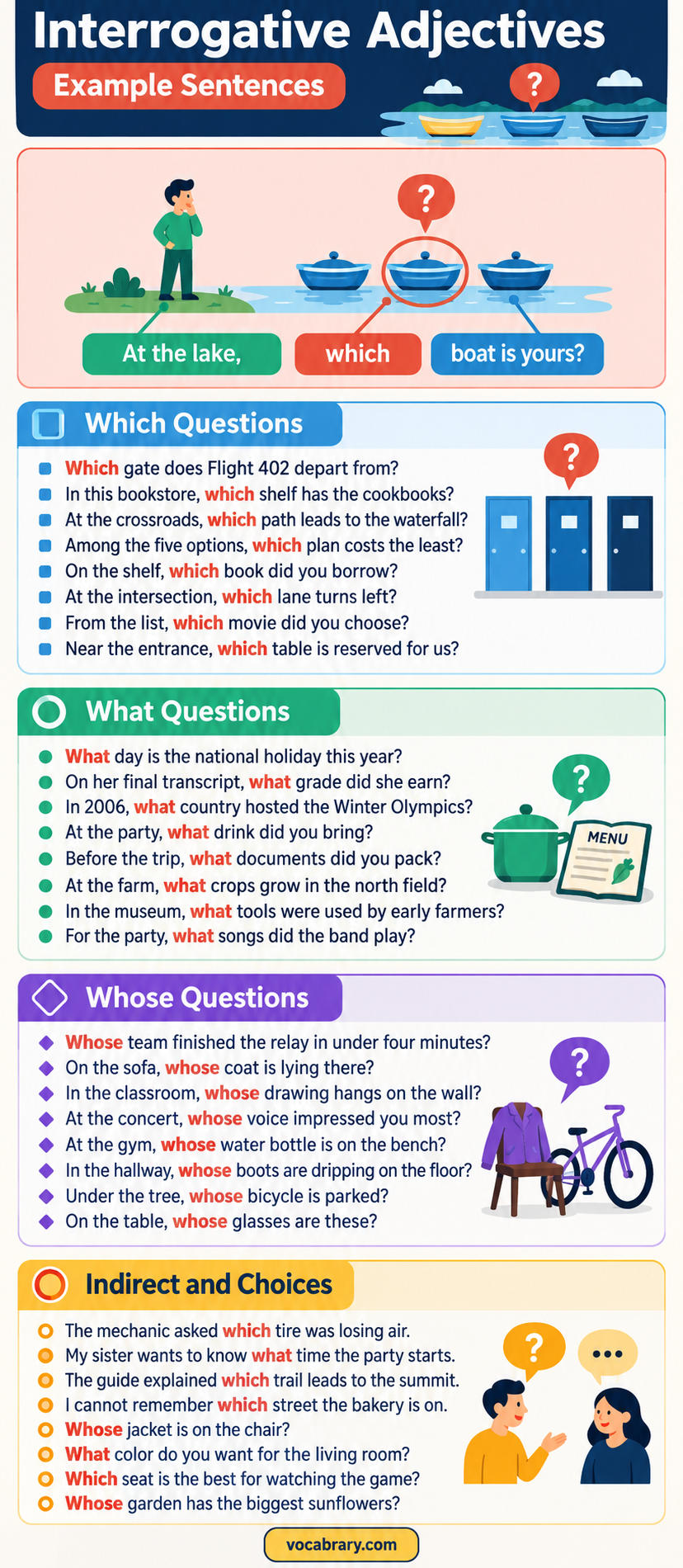
Common Interrogative Adjective Example Sentences
Buses to the station, library closing times, and an umbrella left on a bench are the opening mix, and which, what, and whose land directly before the noun in every line.
- Which bus goes to the central train station?
- What time does the library close on Saturdays?
- Whose umbrella was left on the bench outside the cafe?
- Which road did you take to avoid the morning traffic?
- At the bakery counter, what flavour did the customer order?
- On this contract, whose signature did the notary verify?
- Which hotel is closest to the airport?
- After the quarterly board meeting, what decision did the directors reach about the proposed expansion?
- Near the park entrance, whose bicycle was chained to the railing?
- Tell me which chapter the professor assigned for Monday.
- What language does your neighbour speak at home?
- Every afternoon, whose dog keeps barking at the mail carrier?
- For the encore, which song did the band play?
- On the form that the embassy sent last week, what date did you write as your official start day?
- Whose turn is it to lock up the office tonight?
- In the second row, which seat is still available?
- What address should the courier deliver the parcel to?
Interrogative Adjectives With Singular and Plural Nouns
A dress for a party, colours for bedroom walls, and a coat on a door show that which, what, and whose keep the same spelling whether the noun is singular or plural.
| Interrogative adjective | Use | Example sentence |
|---|---|---|
| Which | Choosing from a known set (singular noun) | Which dress fits the theme of the party? |
| Which | Choosing from a known set (plural noun) | Which colours did you pick for the bedroom walls? |
| What | Open-ended question (singular noun) | What book are you reading this month? |
| What | Open-ended question (plural noun) | What courses does the school offer in the first year? |
| Whose | Asking about ownership (singular noun) | Whose coat is hanging on the back of the door? |
| Whose | Asking about ownership (plural noun) | Whose shoes are blocking the hallway? |
| Which | Narrowing between two (singular noun) | Which laptop runs faster with several programmes open? |
| What | Asking for a category (singular noun) | What instrument does your daughter play in the orchestra? |
Sentences With "Which"
Choosing one restaurant over another, picking a seat in a theatre, and selecting a hiking trail from a posted map are the decisions "which" narrows down. The adjective signals that a known set of choices exists.
- Which gate does Flight 402 depart from?
- Among the three finalists, which design impressed the judges?
- In this bookshop, which shelf has the cookbooks?
- At the crossroads, which path leads to the waterfall?
- From the hiring panel, which candidate was invited back for a second interview?
- For dessert, which cake do you recommend at this bakery?
- On the fifth floor, which room has the conference setup?
- Which lane was assigned to the fastest swimmer on race day?
- Which airport is closer to downtown, the east one or the west one?
- After the storm, which roads were still open to traffic?
- In our neighbourhood, which dentist accepts new patients?
- During the sale, which jacket was marked down the most?
- Between the express and the local, which train arrives first?
- At the museum, which painting drew the largest crowd last weekend?
- The waiter asked which menu the birthday group wanted, the regular or the set dinner.
- Before Friday, which homework problems are due?
Sentences With "What"
Asking the time of a flight, the name of a street, and the price of a ticket leave the answer wide open. "What" asks without limiting the response to a fixed set.
- What time does the first train leave on weekday mornings?
- For the front door of the new house, what colour did they paint it?
- At the ticket counter, what price is a balcony ticket for Saturday’s show?
- Now that he has grown, what size shoes does your son wear?
- What day is the national holiday this year?
- In the survey, what reason did most employees give for leaving?
- On the running track, what brand of shoes does the marathon coach prefer?
- At the corner, what instrument did the street musician play?
- On her final transcript, what grade did she earn?
- At the hotel front desk, what room did they assign to our group?
- For sourdough bread, what temperature does the oven need?
- What name did the parents give their newborn daughter?
- Last winter, what country hosted the Winter Olympics?
- From the dinner menu, what dish comes with a side salad?
- On New Year’s Eve, what movie did your family watch?
- After the building inspection last Thursday, what repairs did the landlord promise to finish before the cold weather?
Sentences With "Whose"
A misplaced suitcase at the airport, an unsigned painting in a gallery, and a parked car with no permit are ownership puzzles. "Whose" asks who owns the noun.
- Whose suitcase was left at the baggage claim after the flight landed?
- During the night, whose footsteps echoed through the hallway?
- At the county baking contest, whose recipe won first place?
- In row B of the parking lot, whose car has a flat tyre?
- Between classes, whose phone keeps ringing in the corridor?
- At the charity auction, whose painting sold for the highest price?
- On the desk in the main office, whose folder has the quarterly budget numbers that the accountant requested?
- From the history department, whose essay received a perfect score?
- Whose children were running through the hotel corridor this morning?
- After the fire drill, whose badge was found on the stairwell floor?
- Yesterday, whose idea was it to move the meeting to Thursday?
- On this note taped to the fridge, whose handwriting is it?
- At the lost-and-found, whose glasses match this description?
- Down at the harbour, whose boat was moored at the far end?
- Whose team finished the relay in under four minutes?
- In the second drawer, whose passport was mixed in with the old letters?
Interrogative Adjectives in Indirect Questions
Asking a travel agent about departure times, wondering about a colleague’s lunch order, and trying to recall a street name place the interrogative adjective inside a statement. The sentence reports or wonders about the question rather than asking it outright.
- The passenger asked which platform the northbound train departs from.
- Nobody remembered whose phone had been left on the conference desk.
- Sara wanted to know what time the pharmacy opens on Sundays.
- At noon, a manager checked which applicants submitted their forms before the deadline.
- I forgot whose turn it is to pick up the children from school.
- After the paper jam, a technician asked what model of printer the office uses.
- Our teacher explained which chapters the final exam would draw from.
- We discussed whose proposal the committee should review first.
- On the sidewalk, a tourist wondered what currency the island nation accepts.
- She asked which entrance to the museum is accessible by wheelchair.
- Before labelling the samples, a nurse checked whose blood test still needed a tag.
- He wanted to know what ingredients the chef used in the sauce.
- Passengers asked which gate the airline had moved the departure to.
- I never found out whose footprints were in the garden after the rain.
- When the courier arrived at the lobby, the receptionist asked what floor the delivery should go to.
Sentences With Both "What" and "Which"
A sport paired with a team, a cuisine paired with a restaurant, and a symptom paired with a medicine show how "what" opens the field and "which" narrows it to a named set.
- What sport do you play, and which team are you on?
- At dinner, what type of cuisine do you enjoy, and which restaurant do you visit most?
- She asked what size she needed and which brand fit her best.
- In your studies, what field interests you, and which programme at the university teaches it?
- He wondered what colour to paint the garden fence and which shade on the chart at the hardware store looked closest to grey.
- On the weekends, what hobby do you enjoy, and which club in the city offers lessons?
- The doctor asked what symptoms she had and which medicines she had already tried.
- For a new job, what skill do employers value, and which certification proves it?
- After lunch, what dessert do you prefer, and which bakery makes the best one?
- The librarian asked what field the student was researching and which database had the strongest sources.
Interrogative Adjective Example Sentences for Kids
Picking a crayon for a drawing, finding out who lost a lunchbox, and choosing a seat on the school bus are questions a seven-year-old already asks.
- Which crayon do you want for the sky in your drawing?
- At the zoo, what animal did you see today?
- On the classroom floor, whose lunchbox is sitting there?
- Which game do you want to play at recess?
- What flavour of ice cream is your favourite when you visit the shop after school?
- After school, whose dog followed us home from the park?
- During story time, which book did the teacher read?
- Outside the window, what colour is the bird on the branch?
- Under the desk, whose pencil rolled there?
- On the school bus, which seat do you like best?
- What name did you give your new goldfish?
- By the hooks, whose backpack is hanging on the wrong one?
- Before bedtime, which story do you want to hear tonight?
Interrogative Adjective Example Sentences for Students
Choosing an elective, confirming a deadline, and identifying a formula on a revision sheet are questions that turn exam preparation into grammar practice.
- Which elective did you enrol in this semester?
- On the physics worksheet, what formula solves the third problem?
- In the Friday lecture on academic writing, whose thesis statement did the professor read aloud as a model for the class?
- For the final paper, which citation style does the department require?
- What percentage of the grade does the midterm exam represent?
- After the experiment, whose lab report had the most accurate data?
- Before the entrance test, which chapters does the revision booklet summarise?
- On the vocabulary quiz, what score did you earn?
- During the seminar, whose presentation ran over the ten-minute limit?
- Between March and April, which scholarship deadline falls first?
- What evidence did the debating team use to support the opening argument?
- From Monday’s lecture, whose notes are available for photocopying?
- At the library, what database did the professor recommend for the research assignment?
Interrogative Adjectives in Everyday Life
Coffee sizes at a cafe, a barking dog next door, and a parcel at the wrong address are daily questions that call for which, what, or whose before the noun.
- What time does the supermarket close on public holidays?
- In this store, which aisle has the household products?
- On our street, whose parcel was delivered to the wrong address?
- What brand of toothpaste does your dentist recommend?
- For this television, which remote controls the volume?
- Downstairs, whose laundry is still in the washing machine?
- What size pizza did you order for the family dinner?
- Near the station, which pharmacy stays open until midnight?
- Every Friday night, whose music is playing through the wall?
- For your morning coffee, what milk do you add?
- On Tuesday, which bin goes out, the recycling or the general waste?
- Whose children left their scooters on the pavement again?
- At the hardware store near the roundabout, what brand of paint did they suggest for the bathroom ceiling?
- Which neighbour agreed to water the garden while we are away?
- This morning, whose cat was sleeping on the bonnet of my car?
- Before the party, what snacks did you buy at the corner shop?
Interrogative Adjectives and Interrogative Pronouns in the Same Sentence
"Which restaurant" beside "which did you call" and "whose coat" beside "whose was lost" show the adjective and the pronoun in a single sentence. More interrogative pronoun sentences separate the two roles.
- Which restaurant did you call, and which did the group vote for?
- She asked what time the store opens, but what mattered more was the parking.
- Whose coat is on the hook, and whose was left in the car?
- At the contest, which design won, and which was the runner-up?
- What reason did he give, and what convinced the manager to agree?
- In the end-of-term class, whose essay scored highest on the marking rubric, and whose did the teacher return for revision?
- They debated which colour to paint the hall, and which looked better under lamplight.
- From the menu, what drink did the waiter suggest, and what did you order instead?
- At the theatre, whose ticket was in the front row, and whose had a balcony seat?
- Between the two options, which route takes less fuel, and which gets you there faster?
Sentences Rewritten With the Correct Interrogative Adjective
Writing "who’s" for "whose," picking "what" when two named choices call for "which," and reversing the pair for open-ended questions are the most frequent mix-ups among learners.
- Whose jacket is on the chair? ✅, wrong as Who’s jacket is on the chair? ❌
- Which of the two dresses do you prefer? ✅, wrong as What of the two dresses do you prefer? ❌
- After the game, whose turn comes next? ✅, wrong as Who’s turn comes next? ❌
- Between the red and the blue, which team won the semifinal? ✅, wrong as What team won the semifinal, the red or the blue? ❌
- What time does the bus arrive? ✅, wrong as Which time does the bus arrive? ❌ (when the schedule is unknown)
- At the restaurant, whose bag was left behind? ✅, wrong as Who’s bag was left behind at the restaurant? ❌
- From the seating chart, which seat did you reserve, A3 or B7? ✅, wrong as What seat did you reserve, A3 or B7? ❌
- What colour do you want for the living room? ✅, wrong as Which colour do you want for the living room? ❌ (when no swatches are offered)
- On the counter, whose keys are there? ✅, wrong as Who’s keys are on the counter? ❌
- For the morning commute, which train leaves first, the 8:10 or the 8:25? ✅, wrong as What train leaves first, the 8:10 or the 8:25? ❌
Related
- Parts of Speech Example Sentences
- Demonstrative Adjective Example Sentences
- Compound Adjective Example Sentences
FAQs
An interrogative adjective and an interrogative pronoun differ in their relationship to the noun in the sentence. The adjective always goes before a noun and modifies it ("which door"), while the pronoun replaces the noun and works on its own ("which did you choose"). Which, what, and whose shift between both roles depending on whether a noun follows them, and more adjective sentences show the full range of words that modify nouns.
Three words are interrogative adjectives in English: which, what, and whose. All three go directly before a noun to turn a statement into a question, and no other English word takes that same role. Some grammar references add "whichever" and "whatever," yet most classify those as relative adjectives rather than interrogative ones.
No, "whose" is an interrogative adjective only when it comes before a noun and asks about ownership, as in "whose bag is this." When "whose" replaces a noun instead of modifying one, it becomes an interrogative pronoun, as in "whose is this." The word also works as a relative adjective in statements such as "the author whose novel won the prize."
No, "who" is not an interrogative adjective because it replaces a noun rather than modifying one that follows it. In "who called last night," the word "who" is a pronoun that takes the place of the caller’s name, while "whose phone rang last night" is an adjective modifying "phone." English limits the interrogative adjective set to which, what, and whose.
Many modern grammar references classify which, what, and whose as determiners rather than adjectives, and both labels describe the same role in a sentence. Traditional grammar calls them adjectives because they modify nouns, while modern linguistics calls them determiners because they narrow down the noun phrase. The two labels describe one role, so either term is correct in a classroom or on an exam.
An interrogative adjective goes directly before the noun it modifies, with nothing between them. In "which door leads outside," the adjective "which" is next to "door," and moving it anywhere else ("door which leads outside") turns it into a relative adjective or creates a grammatical error. This fixed position makes the three interrogative adjectives among the easiest to identify in a sentence.
"What" asks an open-ended question with no fixed set of answers in mind, while "which" narrows the question to a known or limited group. In "what language do you speak," the asker has no idea of the answer, but in "which language do you study, French or German," the choices are named. The difference depends on whether the speaker knows the possible answers in advance.
Yes, which, what, and whose all take the same position before a noun in indirect questions, where the question is embedded inside a reported statement. In "she asked which bus goes downtown," the adjective "which" modifies "bus" inside a reported question. Indirect questions with interrogative adjectives do not end with a question mark, because the main clause is a statement.
Ten interrogative adjective example sentences cover all three words in one pass. Which train leaves at noon? What colour is the front door? Whose coat was left in the hallway? Which movie did the critics praise? What grade did she earn? Whose idea started the fundraiser? Which floor has the meeting room? What brand does the coach prefer? Whose car blocked the driveway? Which chapter does the test draw from?
A demonstrative adjective (this, that, these, those) singles out a specific noun, while an interrogative adjective (which, what, whose) asks a question about a noun. In "this jacket is warm," the speaker identifies a particular jacket, but in "which jacket is warm," the speaker does not know and is asking. Both types go directly before a noun, yet one declares and the other inquires.
A sentence with an interrogative adjective is one where which, what, or whose comes directly before a noun and asks a question about it, such as "which bus goes downtown." If the same word replaces the noun instead of modifying it, as in "which goes downtown," it is an interrogative pronoun rather than an adjective. The quickest test is to check whether a noun follows which, what, or whose.
The most frequent error is confusing "whose" (possessive) with "who’s" (the contraction of "who is"), as in writing "who’s jacket" instead of "whose jacket." A second error is using "what" when a known pair of choices calls for "which," such as saying "what dress" instead of "which dress, the red or the blue." Practising these two distinctions fixes most interrogative adjective mistakes on grammar exams.
No, "why" is not an interrogative adjective because it does not come before a noun or modify one. In "why did you leave," the word "why" asks about the reason for the whole action, functioning as an interrogative adverb rather than an adjective. English limits the interrogative adjective set to which, what, and whose, all of which modify a noun directly.

Leave a Comment