
An intensive pronoun is a pronoun that ends in -self or -selves and repeats its antecedent for emphasis alone, as in The president herself signed the letter. Intensive pronoun example sentences put all eight of these pronouns to work, from myself stressing a first-person speaker to themselves reinforcing a plural antecedent.
What Is an Intensive Pronoun?
An intensive pronoun is a -self or -selves word that echoes a noun or pronoun in the same sentence purely to add emphasis, not to receive the action of the verb. A reflexive pronoun looks identical but works as the object of the verb or preposition, so I myself baked the bread uses an intensive pronoun while I hurt myself uses a reflexive one.
Antecedent + intensive pronoun (same person or thing)
The children themselves planned the entire fundraiser.
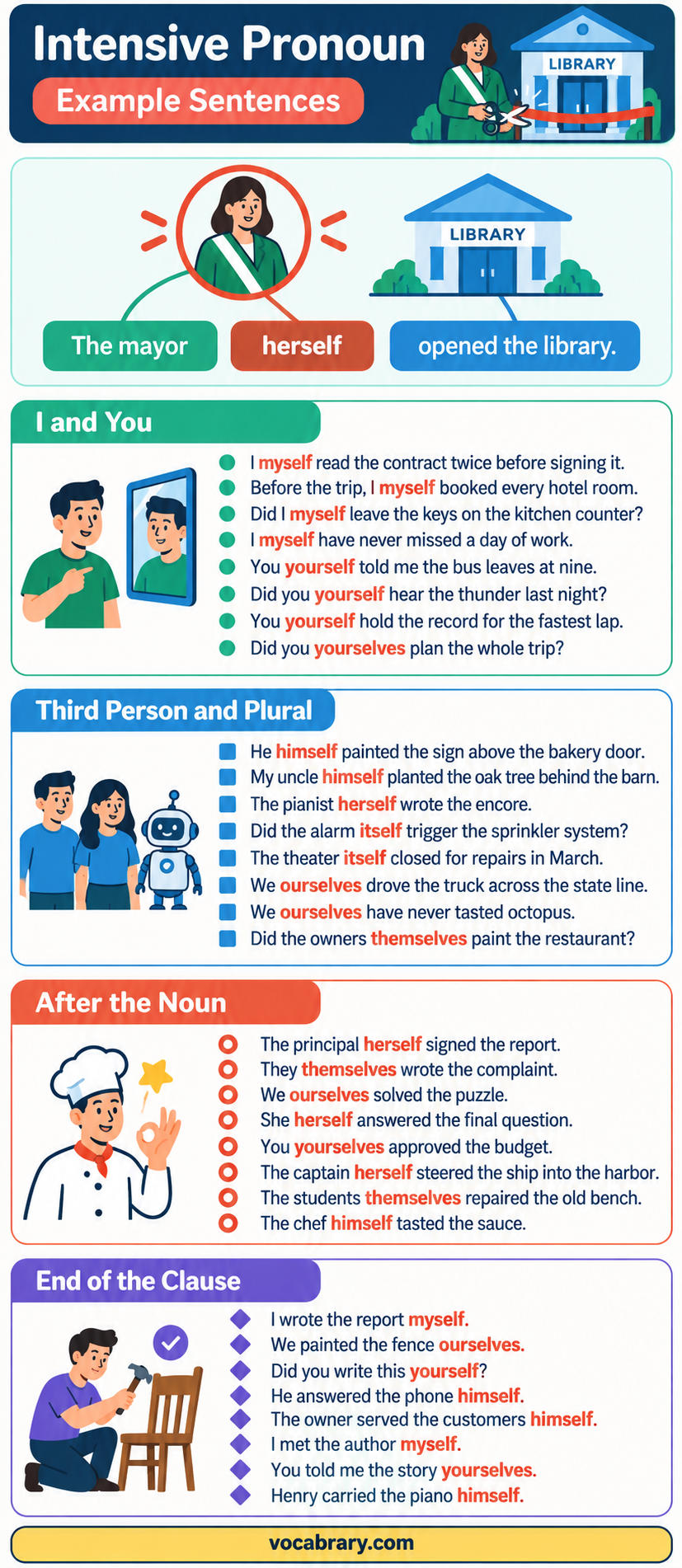
Common Intensive Pronoun Example Sentences
A mayor handing out diplomas, a grandmother threading her own needle, and a headteacher sweeping a flooded corridor all gain emphasis from the intensive pronoun placed right next to the antecedent.
- The mayor himself handed every diploma to the graduates on stage.
- My grandmother herself threaded the needle without her reading glasses.
- I myself repaired the fence after the storm knocked two panels down.
- Both twins themselves decorated the hall for the wedding reception.
- You yourself admitted that the recipe needed more salt and less cumin.
- Our old cat itself pushed the garden gate open and wandered into the road.
- Dr Mensah herself stitched the wound in the emergency ward.
- We ourselves painted every wall in the flat over a single weekend.
- Mr Tanaka himself drove the delivery van when no other driver arrived on time.
- Nobody at the charity trusted the rumour until the director herself confirmed it in a press briefing the next morning.
- Priya herself sewed the curtains from fabric she bought at the weekend market.
- She herself built the bookcase from reclaimed oak.
- You yourselves signed the lease without asking a single question about the deposit.
- That river itself carved the valley over thousands of years.
- Our headteacher himself swept the corridor after the pipe burst and flooded the ground floor.
- Volunteers themselves drove through the night to deliver blankets to the shelter.
- The ambassador himself apologised on live television for the scheduling error.
- Did you yourself write that letter, or did someone else draft it?
Intensive Pronouns by Person and Number
Eight intensive pronouns from myself through themselves exist in English, and each one matches its antecedent in person and number, as when I takes myself and they takes themselves.
| Person and number | Intensive pronoun | Example sentence |
|---|---|---|
| First person singular | Myself | I myself signed the lease. |
| Second person singular | Yourself | You yourself chose the paint colour. |
| Third person singular (masculine) | Himself | He himself installed the new shelf. |
| Third person singular (feminine) | Herself | She herself planted the roses along the path. |
| Third person singular (neuter) | Itself | The machine itself detected the fault. |
| First person plural | Ourselves | We ourselves drafted the proposal. |
| Second person plural | Yourselves | You yourselves approved the final budget. |
| Third person plural | Themselves | They themselves repaired the leaking roof. |
Myself as an Intensive Pronoun
Cooks, tile-layers, and speech-writers reach for myself when the emphasis falls on who did the deed in person.
- I myself cooked the entire Thanksgiving dinner without a single recipe.
- Nobody asked me to, but I myself painted the fence before the tenants arrived.
- I myself tiled the bathroom floor over the bank holiday weekend.
- After the meeting, I myself drafted the memo and sent it to every member of the team.
- Did I myself not warn you about the leak under the kitchen sink?
- Every receipt in that folder I myself signed on the day of purchase.
- Before dawn, I myself mixed the cement for the garden wall.
- At the fundraiser, I myself counted every coin in the donation jar.
- Without a single helper, I myself assembled the bunk beds on Saturday morning.
- From my second-floor window, I myself witnessed the entire accident and gave a statement to the police within the hour.
- On three separate days during that winter, I myself drove the school bus when the regular driver was ill at home.
- For the farewell dinner, I myself wrote and rehearsed the entire speech.
Yourself and Yourselves as Intensive Pronouns
In kitchens, draughty offices, and parents’ evenings, yourself and yourselves stress that you are the person performing the deed.
- You yourself said the kitchen needed a new coat of paint.
- Did you yourself taste the soup before serving it to the guests?
- You yourselves voted for the new policy at the last board meeting.
- Before the interview, you yourself admitted your application was incomplete.
- Have you yourself walked the entire coastal path in a single day?
- At the parents’ evening last autumn, you yourselves praised the new science curriculum in front of the governing board and three local reporters.
- Not once did you yourself complain about the cold in the draughty office.
- During the blackout, you yourself found the fuse panel in total darkness.
- After the match, you yourselves admitted that the referee’s decision was correct.
- Without any instruction, you yourself fitted the new lock on the garden shed.
- Last summer you yourselves built the deck from a pile of loose timber.
- Nobody told you to, yet you yourselves cleared the footpath of fallen branches and broken glass.
Himself and Herself as Intensive Pronouns
In emergency wards, on school sports fields, and at graduation ceremonies, himself and herself echo the doer to stress who performed the deed in person.
- Dr Mensah herself reviewed every chart in the oncology ward before the morning round.
- Captain Alvarez himself landed the plane during a severe thunderstorm over the Atlantic.
- She herself planted two hundred tulip bulbs along the garden path.
- He himself sanded every floorboard in the hallway by hand.
- Mrs Okoro herself rang every parent on the school contact list.
- Nobody else volunteered, so the coach himself refereed the final match.
- The carpenter herself carved the banister from a single slab of walnut.
- After the ceremony, the principal herself shook hands with every graduate and posed for photographs with each family in the courtyard.
- My father himself wired the entire ground floor of the old cottage.
- He himself wrote the cover letter and posted it before the Friday deadline.
- Did Katya herself bake all three hundred biscuits for the charity fair?
- Professor Nakamura himself answered the student’s email within the hour.
Itself as an Intensive Pronoun
Machines, rivers, arguments, and old buildings are non-human or abstract antecedents that take itself to stress their own part in the action.
- The machine itself detected the fault before any technician noticed it.
- Our car itself locked the doors once it reached thirty miles per hour.
- That old building itself survived two earthquakes and a flood.
- Every recipe itself warned against adding too much chilli to the broth.
- Nature itself reclaimed the abandoned railway within a single decade.
- Did the alarm itself trigger the sprinkler system?
- His argument itself contradicted every claim he had made in the original proposal he submitted to the board three months earlier.
- After the spring floods, the river itself changed course and carved a new channel through the farmland.
- A single investigation itself cost the company over fifty thousand euros.
- Company software itself corrected the formatting error without any manual input from the design team.
Ourselves and Themselves as Intensive Pronouns
On playgrounds, beside cracked foundations, and in committee rooms, ourselves and themselves stress that the group performed the deed without outside help.
- We ourselves raised the money for the new playground equipment.
- The villagers themselves rebuilt the stone bridge after the flood destroyed it.
- They themselves admitted the software had a serious flaw in the login system.
- Citizens themselves petitioned the council for a safer pedestrian crossing.
- Our neighbours themselves cleared the shared alley of rubbish every Saturday.
- Did the players themselves choose the new team captain?
- We ourselves installed the solar panels on the roof last September.
- The builders themselves spotted the crack in the foundation before any inspector arrived.
- Not a single parent complained, because the children themselves apologised for the broken classroom window and offered to pay for a replacement from their pocket money.
- After the meeting, committee members themselves drafted the new bylaws.
- Fans themselves funded the documentary about the local football club.
- My sisters themselves planned the surprise party and kept the secret for three weeks.
Intensive and Reflexive Pronouns in the Same Sentence
An intensive and a reflexive -self word look identical. Planting a garden with emphasis and then getting hurt on a bicycle pedal put the same pronoun into two different grammatical roles inside one sentence.
- I myself planted the entire garden, and over the summer I taught myself to prune roses.
- She herself locked the front door, but she accidentally cut herself on the sharp latch.
- He himself repaired the bicycle and later hurt himself on a loose pedal.
- The cat itself knocked the vase off the shelf and then groomed itself on the rug.
- We ourselves built the patio, and afterwards we treated ourselves to a restaurant dinner.
- You yourself admitted the error, yet you never forgave yourself for it.
- They themselves planned the party and reminded themselves to buy balloons before the shop closed.
- The manager herself approved the overtime and later rewarded herself with a day off.
- He himself wrote the melody, and he taught himself to play it on guitar.
- You yourselves chose the paint, and you gave yourselves the whole weekend to apply it.
- The mayor himself opened the festival, and he poured himself the first glass of cider.
- We ourselves reported the leak, and we blamed ourselves for not noticing it sooner.
Intensive Pronouns in Everyday Life
Washing dishes after a dinner party, mowing a neighbour’s lawn, and clearing an entire driveway of snow earn the same emphatic pronoun right after the doer.
- I myself washed every dish after the dinner party ended.
- She herself chose the wallpaper for the living room.
- My neighbour himself mowed both lawns without being asked.
- You yourself left the tap running in the bathroom all night.
- The dog itself fetched the newspaper from the front step every morning.
- We ourselves packed the car for the camping trip at five in the morning.
- Grandma herself knitted the scarf in under a week.
- Nobody told him to, yet my uncle himself cleared the entire driveway of snow before sunrise.
- Our landlord himself replaced the broken window the same afternoon.
- Did you yourself remember to lock the shed before the rain started?
- Both parents themselves drove to the airport at three in the morning to collect the exchange student.
- He himself ironed every shirt on Sunday evening.
- The plumber herself diagnosed the leak and fixed it in twenty minutes flat.
- After dinner, the children themselves loaded the dishwasher without a single complaint.
Intensive Pronouns at School and in Exams
Students memorising irregular verbs, librarians unpacking textbook boxes, and tutors admitting an assignment was too long all use the intensive pronoun to stress who did the work.
- The teacher herself graded every test paper over the weekend.
- Students themselves collected the science equipment from the storage room.
- I myself memorised forty irregular verbs before the final exam.
- Our professor himself rewrote the syllabus during the summer break.
- Did Amira herself present the research findings to the whole school?
- Nobody else helped, so the librarian herself unpacked all thirty boxes of new textbooks and shelved every one.
- We ourselves wrote the script for the class play.
- You yourself chose the essay question on the very first day of the term.
- The headmaster himself announced the exam timetable in morning assembly.
- Both lab partners themselves cleaned the beakers after the chemistry experiment.
- He himself scored full marks on the maths paper without a calculator.
- My tutor herself admitted that the reading assignment was twice as long as it needed to be.
Intensive Pronouns at Work
On construction sites, in boardrooms, and behind kitchen counters, the intensive pronoun stresses who took charge of the task at hand.
- The CEO herself addressed the shareholders at the annual meeting.
- Our foreman himself welded the cracked beam on the construction site.
- I myself drafted the quarterly report before the Friday deadline.
- Nurses themselves sterilised the instruments when the technician was absent.
- You yourself submitted the proposal three days ahead of schedule.
- A qualified electrician himself traced the fault to a loose wire behind the main panel.
- We ourselves trained the new interns during their first week on the job.
- Nobody else on the shift was available, so the manager himself unloaded the delivery lorry by hand.
- Did the architect herself approve the final blueprint before construction began?
- My supervisor himself stayed past midnight to finish the inventory count.
- They themselves negotiated the contract without a lawyer present.
- The chef herself peeled every potato for the banquet and refused to delegate a single kitchen task to her assistants.
Intensive Pronouns in Literature and Speeches
Odysseus stringing his own bow, Brutus joining a conspiracy, and Frederick Douglass learning to read despite enslavement are deeds retold with the intensive pronoun next to the historical or fictional figure.
- Odysseus himself strung the great bow in Homer’s Odyssey, a feat no suitor had managed.
- Brutus himself joined the conspiracy against Caesar in Shakespeare’s Julius Caesar and struck one of the fatal blows on March 15, 44 BC.
- Frederick Douglass himself learned to read as an enslaved child, as he recounted in his 1845 autobiography.
- Elizabeth Bennet herself confronted Lady Catherine de Bourgh in Jane Austen’s Pride and Prejudice about the rumoured engagement to Mr Darcy.
- Rosa Parks herself refused to surrender her bus seat in Montgomery, Alabama, on December 1, 1955.
- Winston Churchill himself delivered the "We shall fight on the beaches" speech to the House of Commons on June 4, 1940.
- Marie Curie herself isolated radium in her Paris laboratory and earned a second Nobel Prize in Chemistry in 1911.
- In Charles Dickens’s Great Expectations, Pip himself narrated his rise from the Kent marshes to the streets of London.
- Abraham Lincoln himself signed the Emancipation Proclamation on January 1, 1863.
- Amelia Earhart herself flew solo across the Atlantic Ocean and landed in Northern Ireland on May 21, 1932.
Intensive Pronoun Example Sentences for Kids
Seven-year-olds feeding hamsters, drawing posters, and growing pumpkins at the autumn fair use the same intensive pronouns that adults use, in shorter sentences.
- Sami himself fed the class hamster before the bell rang.
- Lucy herself drew the poster for the school talent show.
- We ourselves cleaned up after the picnic in the park.
- Dad himself made the birthday cake with three layers of chocolate frosting and a row of strawberries on top.
- The puppy itself found its way home from the park.
- Mum herself fixed the broken zip on my school bag.
- Did you yourself build that tower out of wooden blocks?
- Grandad himself grew the biggest pumpkin at the autumn fair.
- I myself learned to ride a bicycle without training wheels.
- She herself painted the birdhouse bright yellow.
- Our class itself decided the name for the new goldfish.
- Two friends themselves wrote a song for the end-of-year assembly.
Sentences Rewritten With the Correct Intensive Pronoun
Herself signed the report, myself finished the project, and themselves wrote the complaint are three wrong versions, and each one needs its antecedent back before the intensive pronoun for the sentence to work.
- The principal herself signed the report ✅, wrong as Herself signed the report ❌.
- I myself finished the project on time ✅, wrong as Myself finished the project on time ❌.
- They themselves wrote the complaint ✅, wrong as Themselves wrote the complaint ❌.
- You yourself chose the departure date ✅, wrong as Yourself chose the departure date ❌.
- He himself cooked the dinner ✅, wrong as Himself cooked the dinner ❌.
- We ourselves solved the puzzle ✅, wrong as Ourselves solved the puzzle ❌.
- The engine itself overheated during the trial run ✅, wrong as Itself overheated during the trial run ❌.
- She herself answered the final question ✅, wrong as Herself answered the final question ❌.
- The neighbours themselves called the fire brigade ✅, wrong as Themselves called the fire brigade ❌.
- My brother himself mended the broken chair ✅, wrong as Himself mended the broken chair ❌.
- You yourselves approved the budget ✅, wrong as Yourselves approved the budget ❌.
- The artist herself framed the painting ✅, wrong as Herself framed the painting ❌.
Related
- Parts of Speech Example Sentences
- Reciprocal Pronoun Example Sentences
- Distributive Pronoun Example Sentences
FAQs
An everyday example is "The senator herself answered every question from the audience." Another is "I myself have never been to Venice."
With "myself", one example is "I myself built the treehouse in the backyard last summer." Another is "When the printer broke, I myself repaired it with a paper clip."
One example is "The mayor himself cut the ribbon at the new library." Another is "The pianist herself wrote the encore."
With "itself", one example is "The castle itself dates from the thirteenth century." Another is "The bridge itself survived the earthquake without a crack."
A group example is "The actors themselves built the set for the school play." Another is "We ourselves carried the groceries up five flights of stairs."
At the end of a clause, one example is "The chef prepared the meal himself." Another is "We painted the fence ourselves."
A school example is "The principal herself read the names at the graduation." Another is "Students themselves chose the topic for the science fair."
At work, one example is "The pilot herself inspected the aircraft before takeoff." Another is "We ourselves negotiated the lease for the new office."
A historical example is "Abraham Lincoln himself signed the Emancipation Proclamation on January 1, 1863." Another is "Charles Darwin himself published On the Origin of Species in 1859."
For kids, one example is "Dad himself pushed me on the swing." Another is "Our puppy itself dug the hole under the fence."
Related: